Volcanic Repeating Arms · Volume 9
Legacy — New Haven Arms, the Henry Rifle and the Winchester 1866
How a failed pistol's action carried a .44 rimfire into the Civil War, what Henry's 1860 patent says it improved, Nelson King's loading gate, the company that took Oliver Winchester's name, and the other line of descent through Smith & Wesson
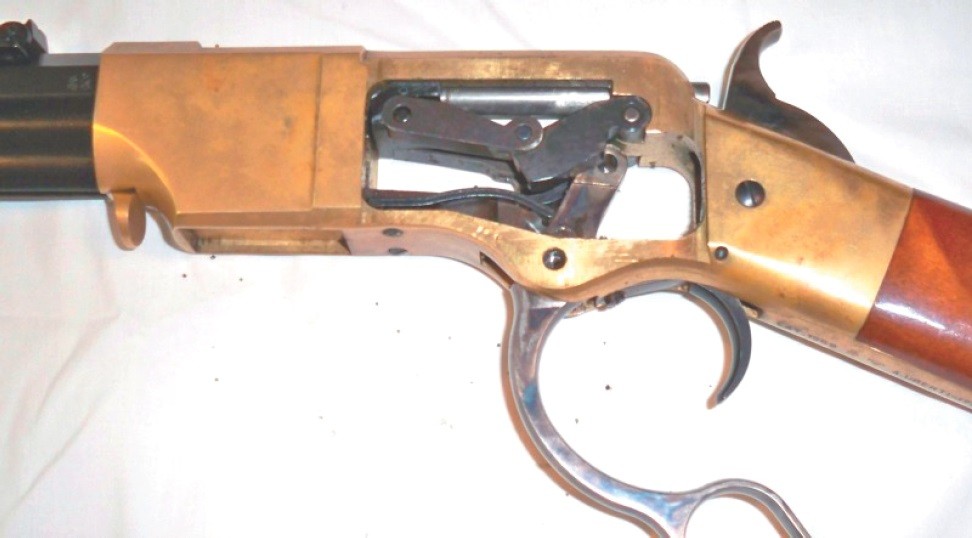
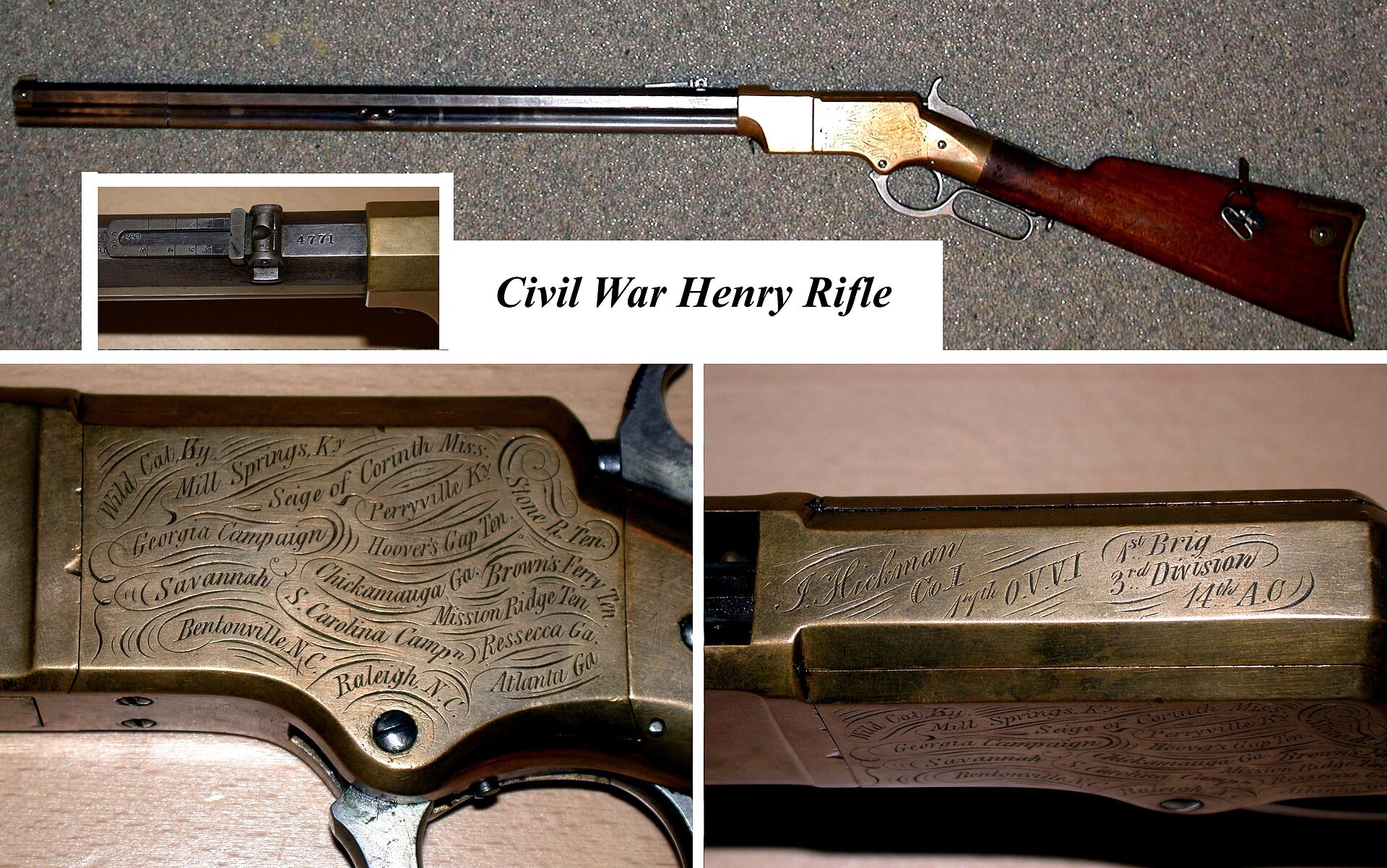
The Volcanic failed as a product and succeeded as a design. Within ten years of the Volcanic Repeating Arms Company’s suspension, its action, with a new cartridge, had been carried into the Civil War as the Henry rifle and refined into the first gun to carry Oliver Winchester’s name. Its patents’ first owners, Horace Smith and Daniel Wesson, had meanwhile built a revolver company on the metallic cartridge their own 1854 patent had drawn. This volume follows both lines, and stays close to the patents, because the patents state plainly what each step changed.
The hub has no dedicated dive on the Henry rifle or the Winchester 1866. This volume therefore gives enough of each to show the lineage, and no more.
9.1 Two lines of descent
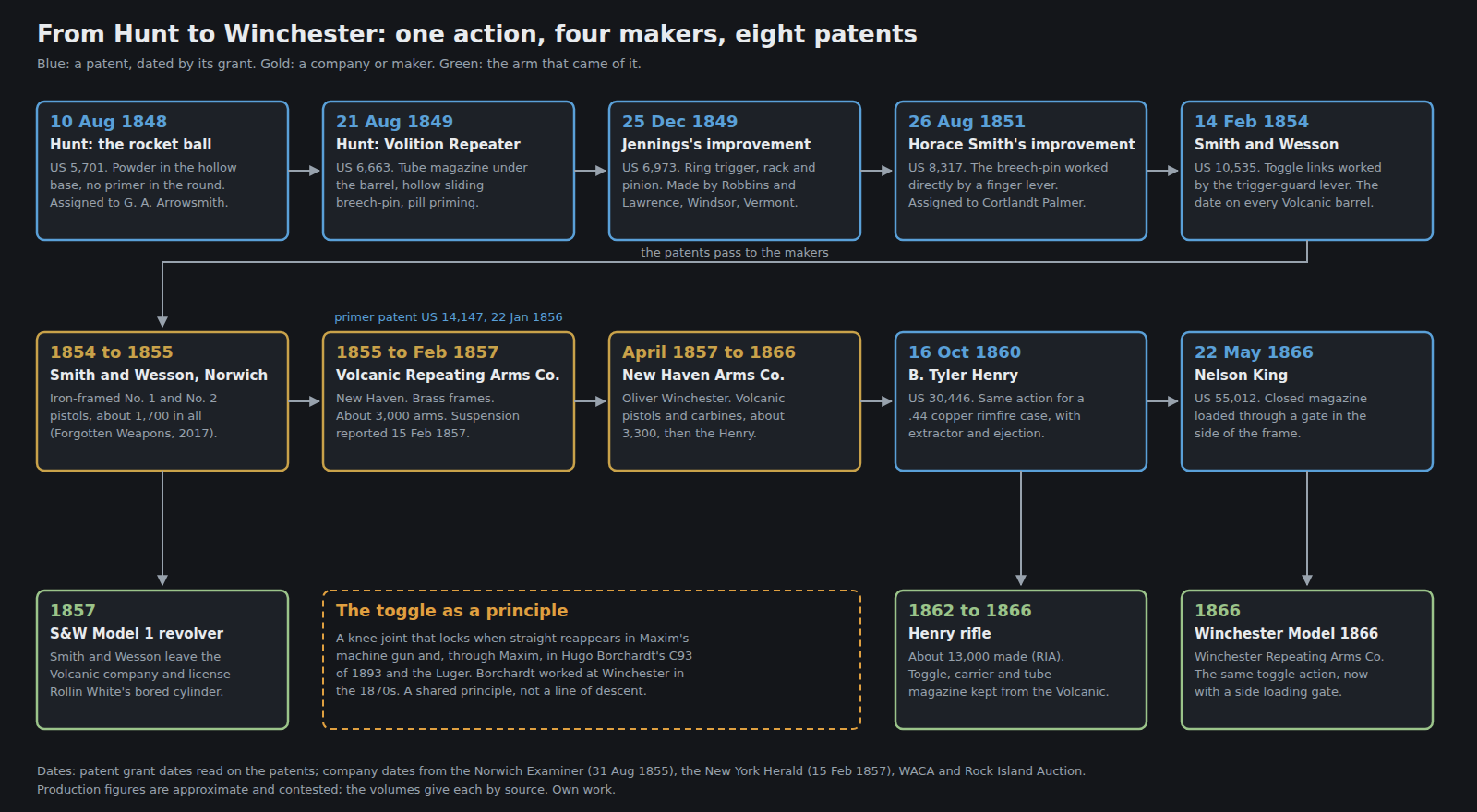
The Daisy dive puts it in a sentence: the company that made the Volcanic “became, by two separate lines of descent, Winchester and Smith & Wesson”.1 The record supports the sentence with one refinement. Winchester descends from the Volcanic company directly, through its assets, its patents and its superintendent. Smith & Wesson descends from the men who designed the Volcanic, who left before it failed and built something else.
9.2 New Haven Arms after the Volcanic
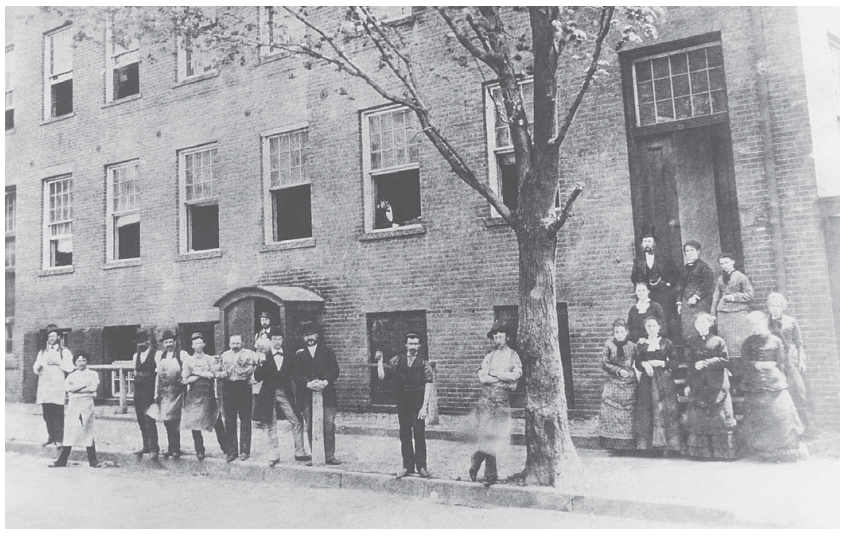
Oliver Winchester reorganised the bankrupt Volcanic company’s assets as the New Haven Arms Company in April 1857 (Volume 2). Sawyer, writing in 1920, describes what followed: “The president and principal owner was the Oliver F. Winchester, who, from being a stock-holder in the preceding companies, then first publicly appeared as a manufacturer of arms. During the first few years of the life of the new company, Mr. Henry gave much of his time to experiments for the improvement of the arms, the ammunition of which had become obsolete.”2
The company kept making and selling Volcanic pistols and carbines, under the Volcanic name, at least until 1859 (Volume 2). Forgotten Weapons gives its output as “another 3300 guns, both large and small frame by 1861”; an anonymous compilation on proofhouse.com says about 3,200 in 1857–58, many of them unsold “for almost 100 years” until sold to employees for as little as a dollar.34 Rock Island’s blog says the pistols outsold the carbines and rifles.5 Then, Sawyer: “In 1860 the New Haven Arms Company abandoned the manufacture of rifles and pistols using loaded bullets and bent their efforts upon the production of rifles only — Henry rifles, which used rim fire copper cartridges.”2
9.3 B. Tyler Henry’s cartridge
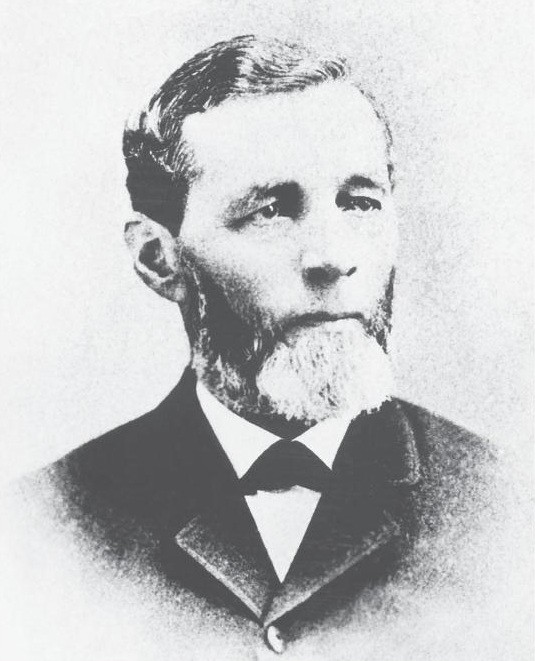
Benjamin Tyler Henry had followed the design from Windsor to Norwich to New Haven (Volumes 1 and 2). Rock Island’s essay says Henry “began experimenting with the .22 caliber rimfire cartridge of Wesson, making it larger”, and that by the end of 1858 he had a .44 rimfire “capable of a 1,200 fps muzzle velocity”.6 The source of the idea was close at hand. Smith and Wesson had drawn a Flobert-type copper cartridge in their 1854 patent and, after leaving, had built the .22 Short for their 1857 revolver (Volume 2; the hub’s .22 Rimfire dive, Vol 2).
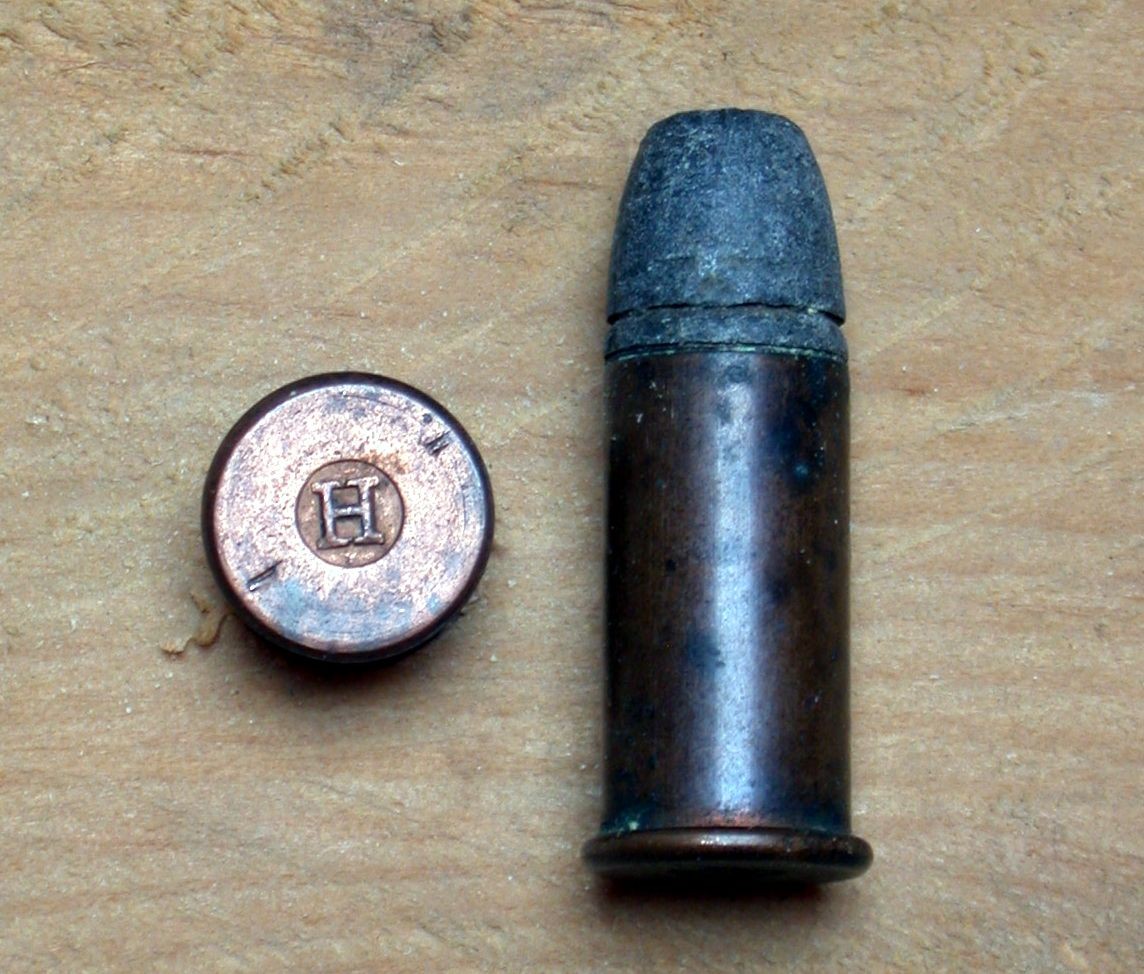
Sawyer describes the result: “The ammunition being a novelty, the company manufactured that too and adopted for a trademark the letter “H” (for Henry) stamped upon the heads of the shells. The Winchester Company still uses that symbol on rim fire ammunition.” He gives the cartridge as holding “25 grains of powder and a conical bullet of about half ounce weight — 216 grains”; Rock Island’s essay gives 28 grains and 200.26 The two descriptions differ and are given separately.
9.4 The Henry patent of 1860
US Patent 30,446, granted on 16 October 1860 to “B. Tyler Henry, of New Haven, Connecticut, assignor to Oliver F. Winchester”, for an “Improvement in Magazine Fire-Arms”, begins by saying exactly what it improves:7
“My invention relates to improvements in a repeating breech-loading gun designed and arranged for the exclusive use of a hollow loaded ball with a primer inserted in the base. My improvements are designed to remove the objections heretofore existing in this class of fire-arms by a change in the construction of the moving parts and the addition of new features, adapting the arm to the use of a solid ball inclosed in a metal cartridge, thus greatly increasing the power and certainty of fire of the arm.”
The “class of fire-arms” for “a hollow loaded ball with a primer inserted in the base” is the Volcanic, and Henry’s patent is assigned to the man who owned the Volcanic’s patents. The drawing is of “a sporting-rifle, twenty-four-inch barrel, carrying fifteen charges”.7
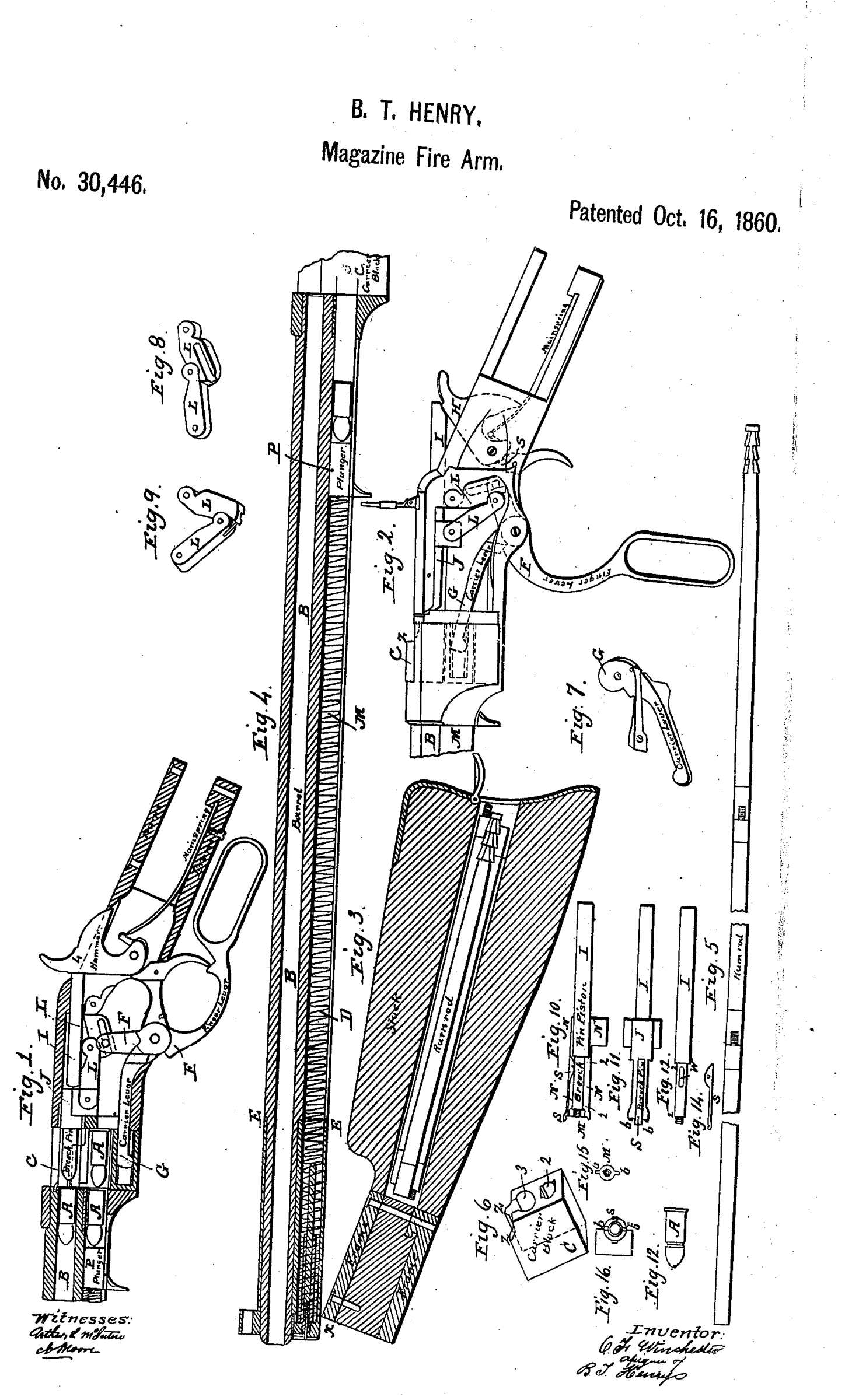
Henry’s three claims are each a consequence of the case. The first: a hollow breech-pin with a piston working through it, “the giving of said piston additional end motion for the purpose of exploding the fulminate”, so that the hammer’s blow is carried through the breech-pin to two “fillets” that strike the cartridge’s rim. The second: a spring catch on the breech-pin, which “takes a firm hold of the flange of the cartridge when pressing it into the barrel, and which cannot be detached without withdrawing the charge or metal case”, the extractor. The third: a carrier block whose top is “curved out on the top near the rear end … so as to strike the cartridge forward of the center, and thus raising the forward end, while the rear end is held down by the spring-catch, tripping it over, freeing it from the spring, and ejecting it with considerable force”, the ejector.7
9.5 What carried over, part by part
Read side by side, the 1854 and 1860 patents describe the same machine.
Table 1 — What carried over, part by part
| Part | Volcanic, US 10,535 (1854) | Henry, US 30,446 (1860) |
|---|---|---|
| Magazine | ”a long tube, C … Underneath the barrel”; front section L turning on a collar to load8 | ”a tube under the barrel … with a spiral spring … This tube is made in two parts. The short part … is made to turn on the barrel”7 |
| Loading | Follower pin pushed to the front, spring held in L, L turned aside8 | ”sliding the plunger … toward the muzzle … the cap is to be turned upon the barrel so as to open the end of the magazine … The ammunition is to be dropped in”7 |
| Lever | The trigger guard G, pivoted on pin a8 | The finger-lever F7 |
| Lock | Toggles: “When the toggles are brought into a straight line … the piston-slide H … serves as a breech”8 | Links L “in a parallel line with the breech-pin J, and held firmly in their place by the finger-lever F, forming a strong brace”7 |
| Carrier | Carrier D raised and lowered by the lever8 | Carrier block C raised by the carrier lever G7 |
| Cocking | Hammer set to full cock by the slide’s back pressure (claim 1)8 | The breech-pin is used “to press back the hammer and cock the gun”7 |
| Firing | Hammer strikes the rear of the slide; “firing by concussion”8 | Hammer strikes a piston through the hollow breech-pin, which strikes the rim through two fillets (claim 1)7 |
| Extraction and ejection | For the patent’s cased round: dovetail recess and carrier projections (claim 2); none needed for the production ball8 | Spring catch and an ejecting carrier top (claims 2 and 3)7 |
| Ammunition | Cased Flobert type in the drawing; the self-primed ball in production89 | .44 copper rimfire7 |
The last three rows are what changed. Everything above them is the Volcanic.
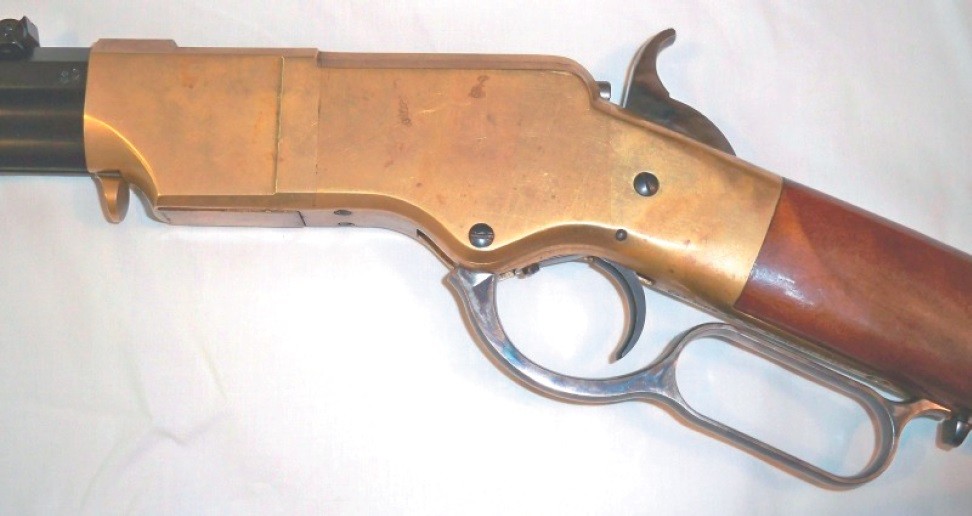
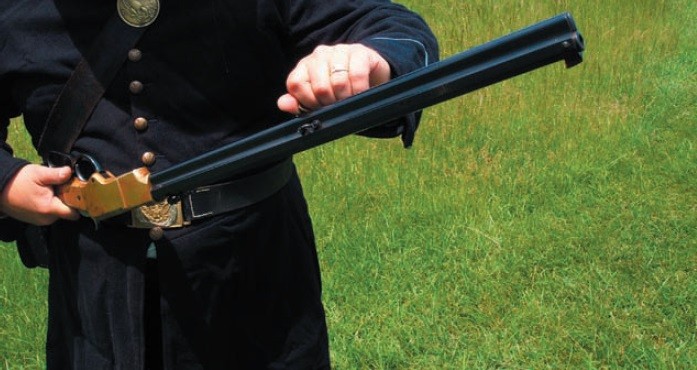
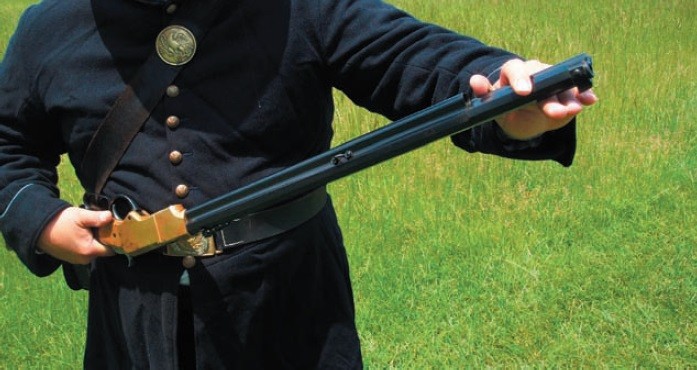
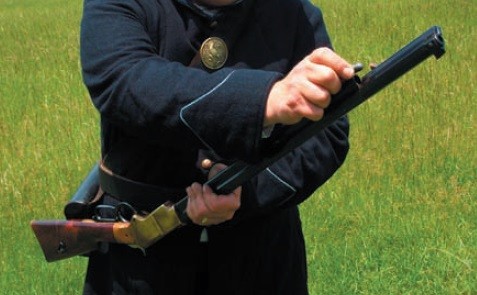
The magazine routine of the Volcanic survived into the Henry unchanged, and the National Park Service photographed it for living-history interpreters at Stones River National Battlefield. Its captions are period drill: “Quitting the piece with the left hand, the plunger is seized between thumb and forefinger, and is thrust to the top of the magazine.”10
9.6 The Henry rifle
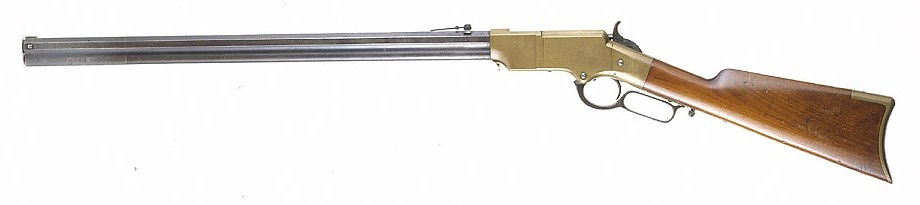
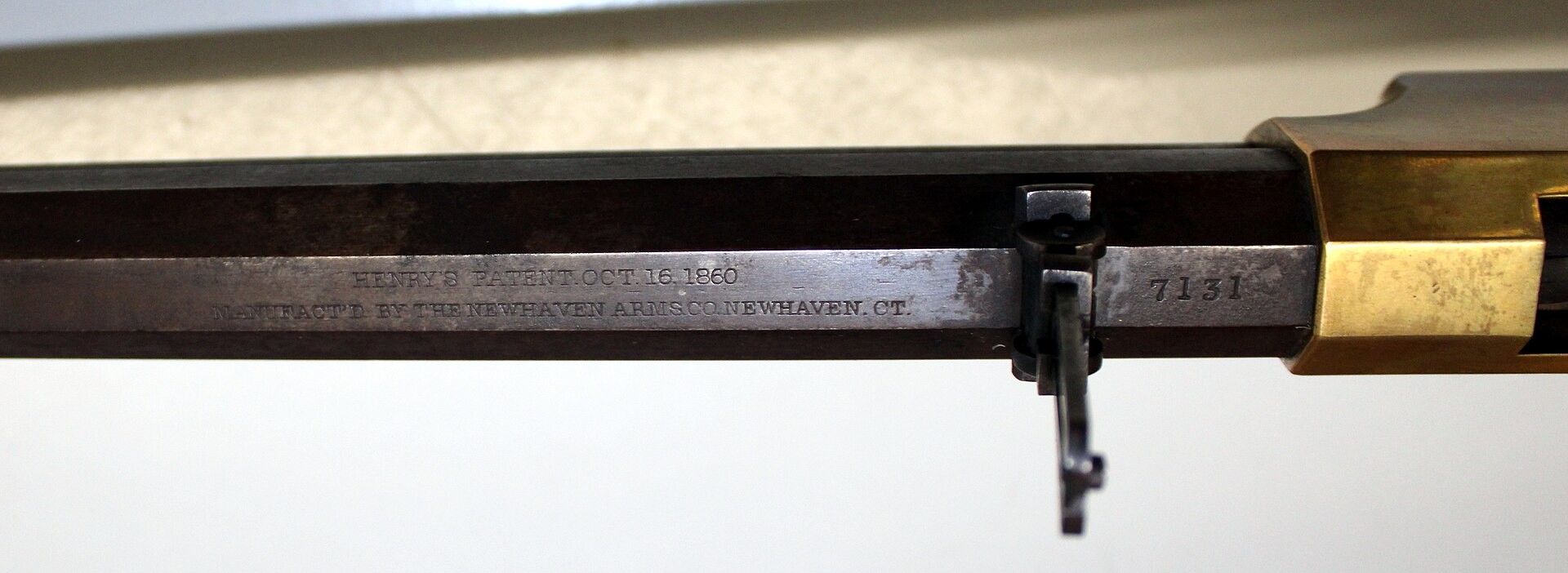
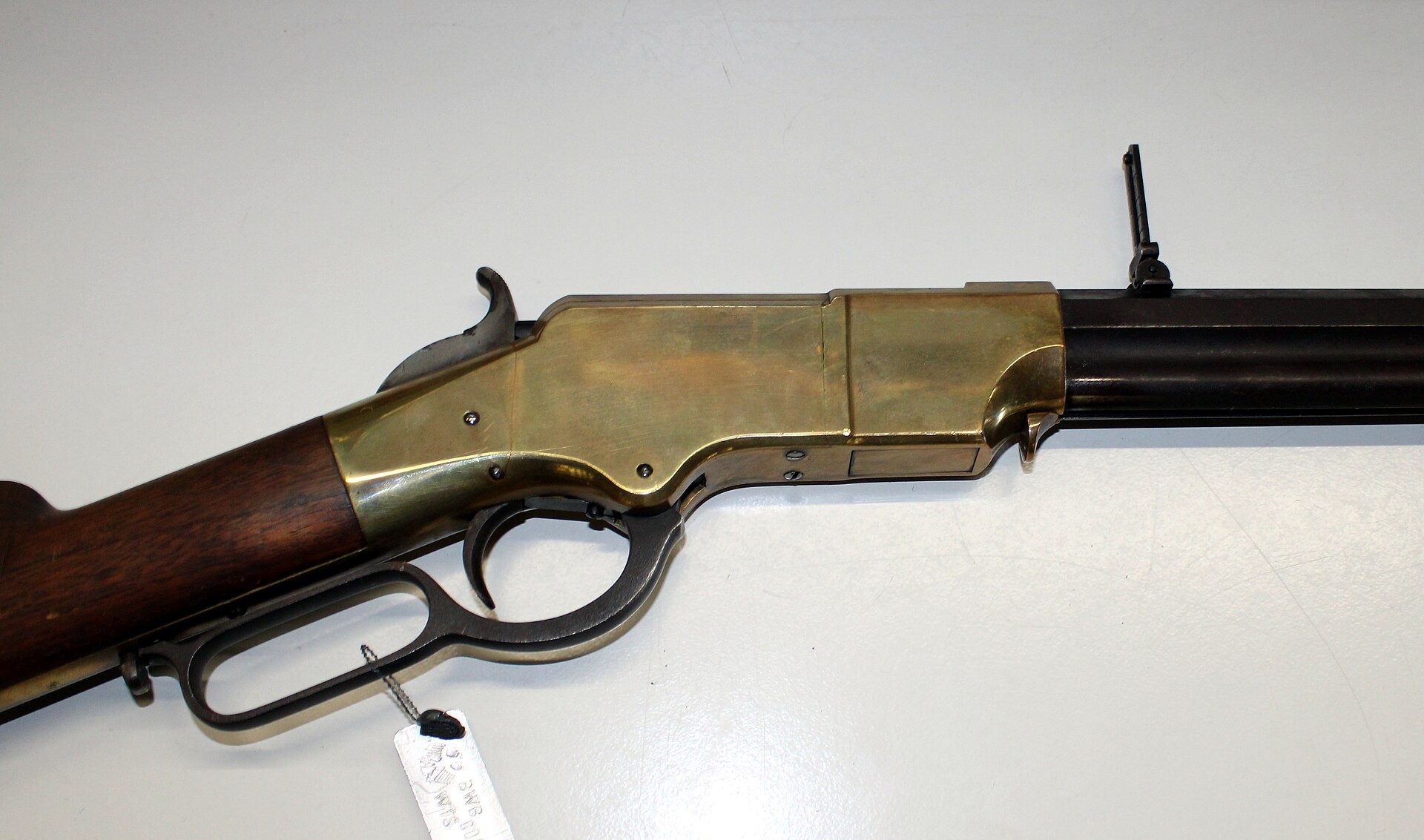
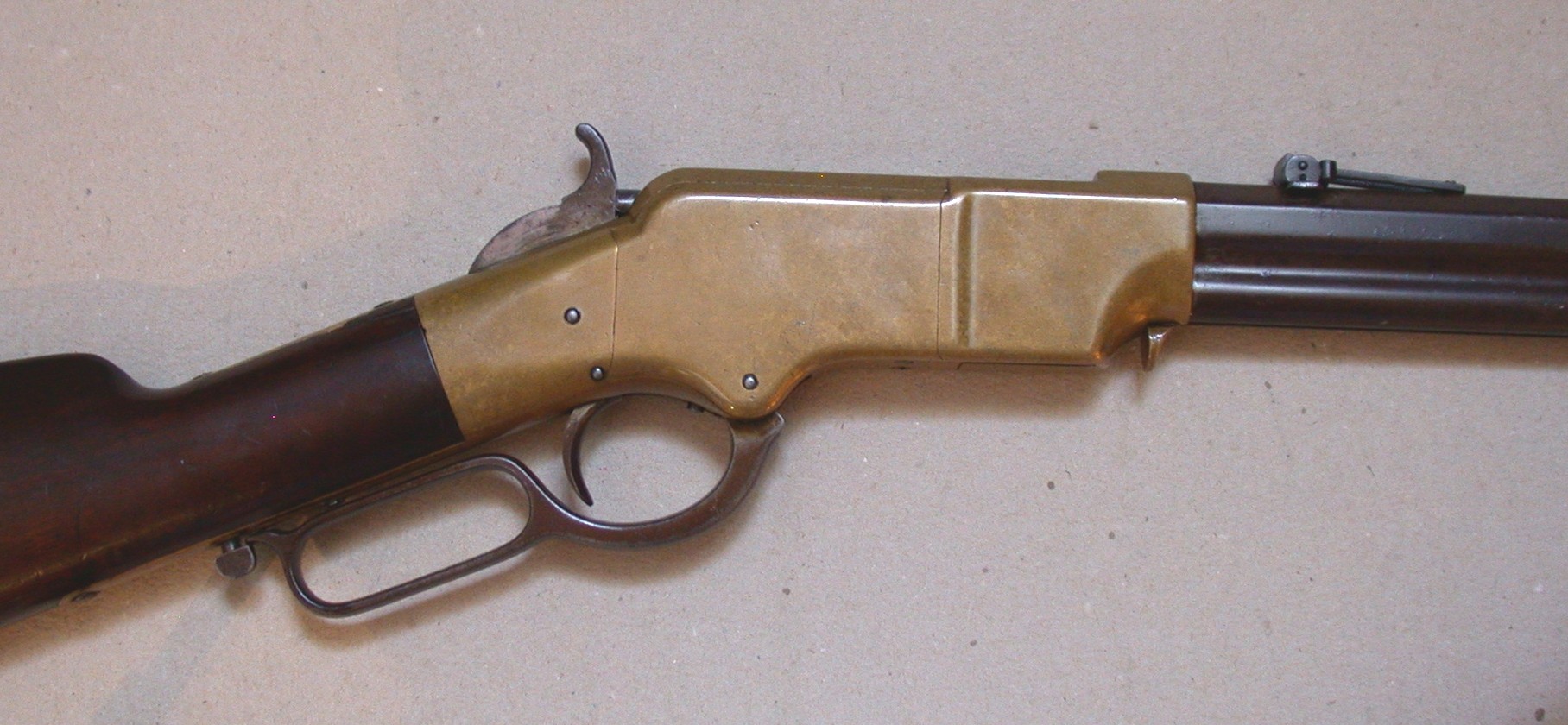
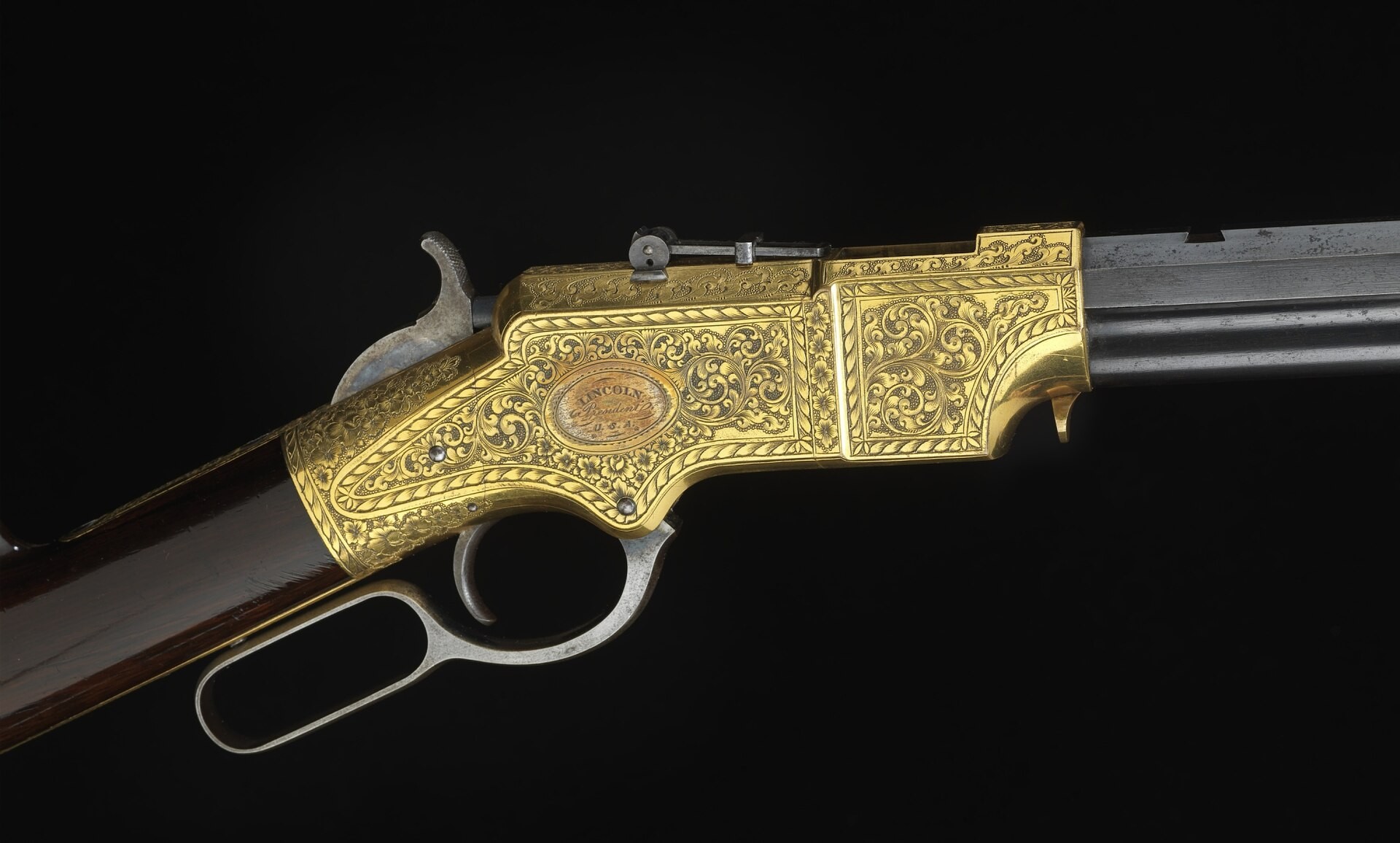
Rock Island’s essay says “the first regular production Henry rifles were made in 1862” and gives the total made as “about 13,000”.6 Sawyer describes the production rifle: “the weight was about 10 pounds, the barrel was 24” long, the calibre was .44”, with six grooves and a gain twist; he says it was “considerably in use during the Civil War — a sporting rifle privately purchased to the extent of about 10,000 by entire companies and regiments of state troops in federal service”, and that the government would not buy it.2 Those are a 1920 author’s statements, given as his.
9.7 Henry’s departure and Nelson King’s gate
Rock Island’s account says Henry left in 1864 and that Nelson King was hired as foreman; and that in 1865, while Winchester was in Europe, Henry petitioned the Connecticut legislature to rename the New Haven Arms Company the “Henry Repeating Rifle Company”.6 The account is a secondary one and the petition was not seen.
King’s contribution is on the record. US Patent 55,012, granted on 22 May 1866 to “Nelson King, of Bridgeport … assignor to O. F. Winchester, of New Haven”, recites the arms it improves: those patented by Horace Smith and Daniel B. Wesson in February 1854 and by B. T. Henry in October 1860.11 It names the problem in the slotted magazine those patents shared: “the open slot upon the under side of the tube would admit more or less dirt”, and the purpose of the change, that “the cartridges may be placed in the magazine with greater facility”. Its single claim: “Forming an opening through the frame relatively to the carrier-block and magazine, and in combination therewith, so that the magazine may be charged through the carrier-block from one side of the arm”.11 The magazine becomes a closed tube; the cartridges go in through a gate in the right side of the frame; and the shooter can, the patent says, charge it with his right hand only.
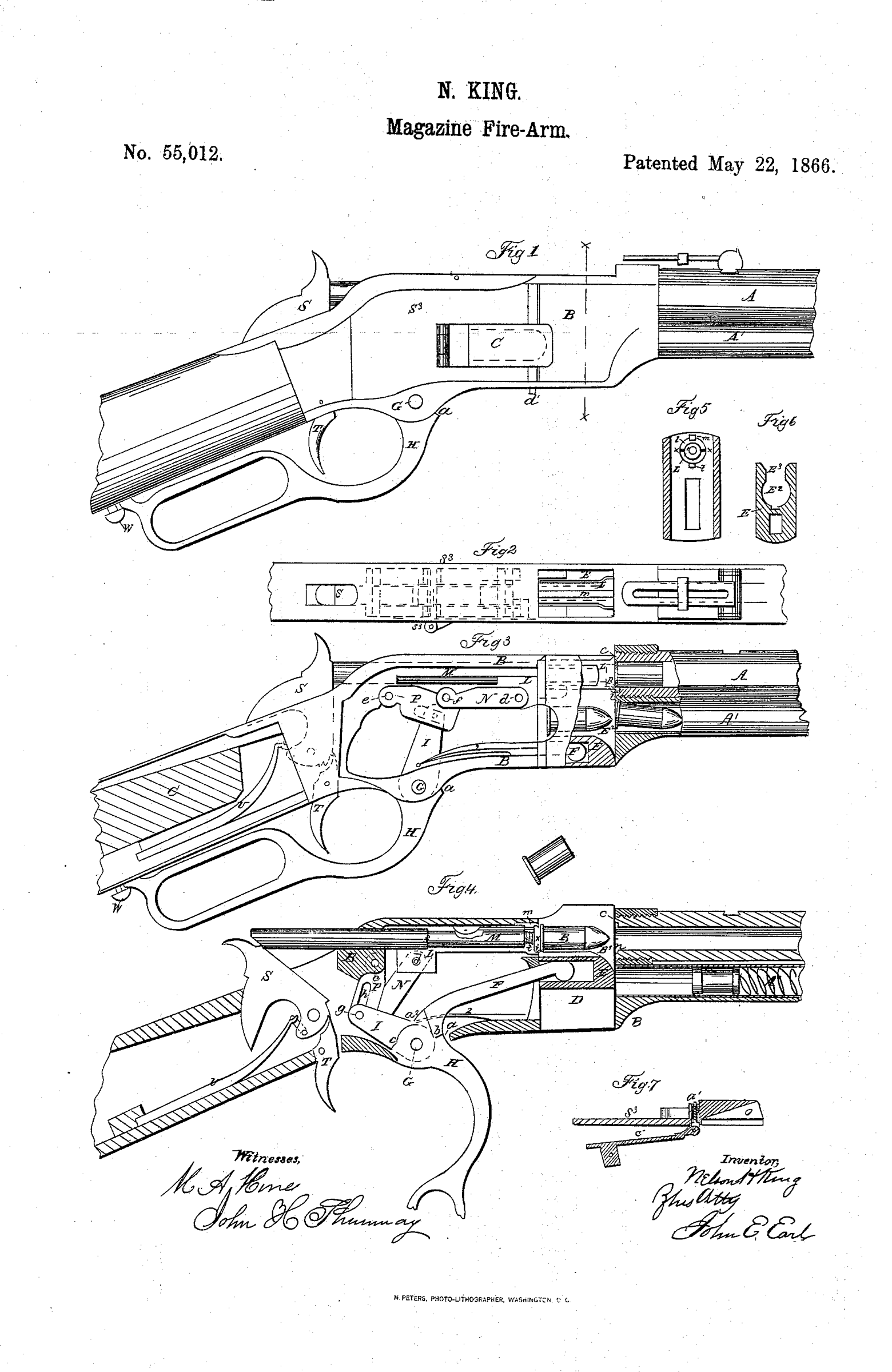
That ends the last feature of Hunt’s 1849 gun to survive unchanged, the magazine filled by swinging its front out of line. The toggle and the carrier stayed.
9.8 The Winchester Repeating Arms Company and the Model 1866
The date the Winchester Repeating Arms Company was formed is given two ways. The Winchester Arms Collectors Association says Winchester “reorganized New Haven Arms yet again as the Winchester Repeating Arms Company on July 1, 1866.”12 Rock Island’s essay says Winchester shut the New Haven Arms Company on 7 July 1866, that stock sales began on 30 December 1866, and that the company was “officially incorporated on February 20, 1867, with the final transfer of assets from New Haven Arms to WRA taking place on March 30”.6 The two are compatible if the earlier date is the business reorganisation and the later the corporate charter, but the Connecticut charter was not seen and neither date is printed here as fact.
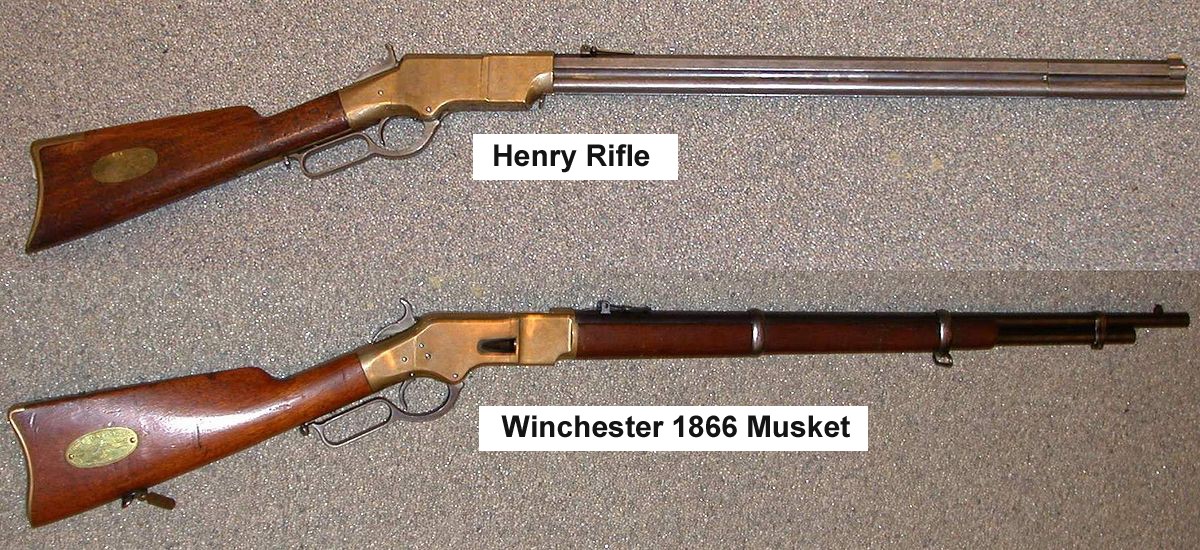
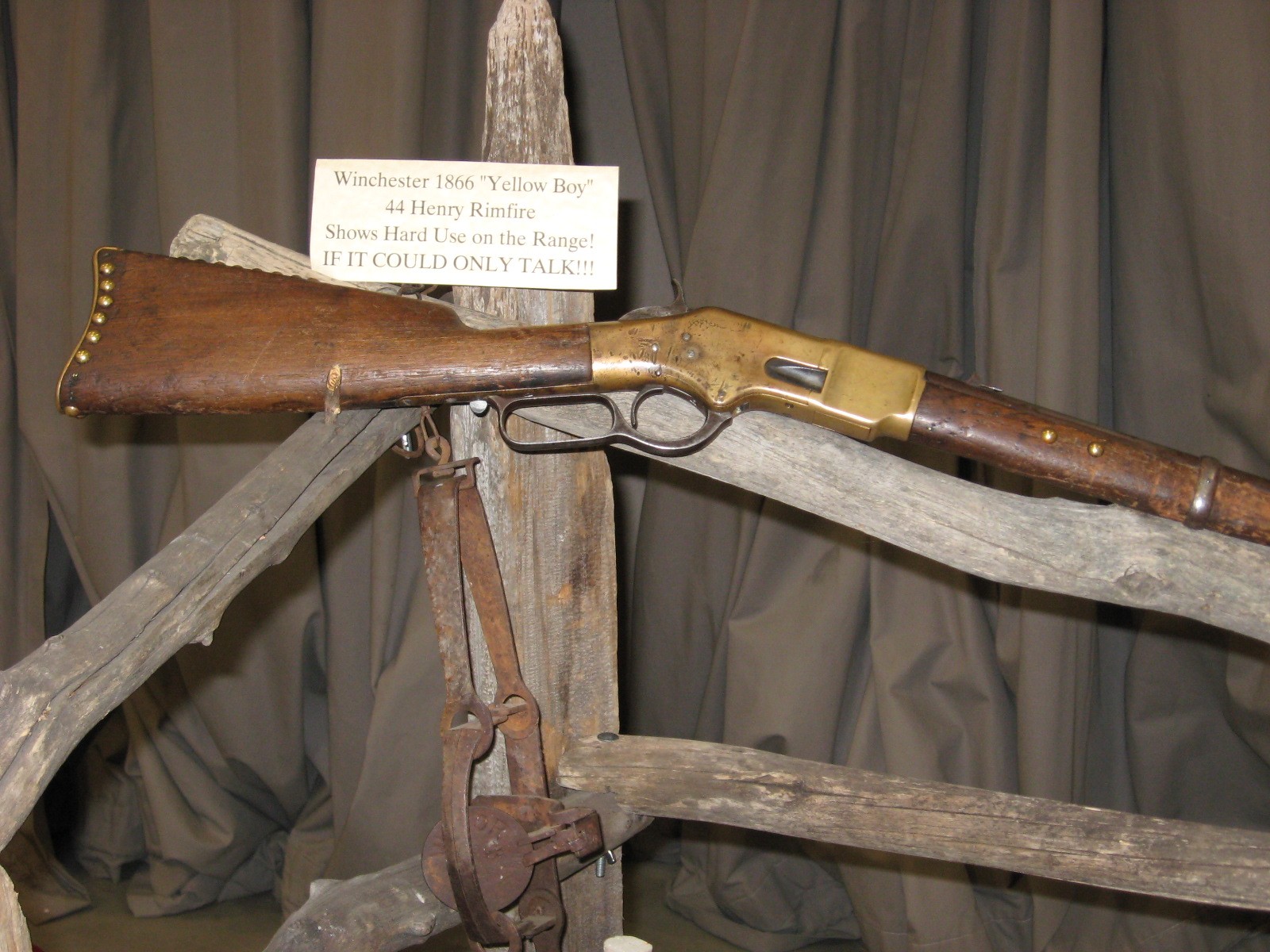
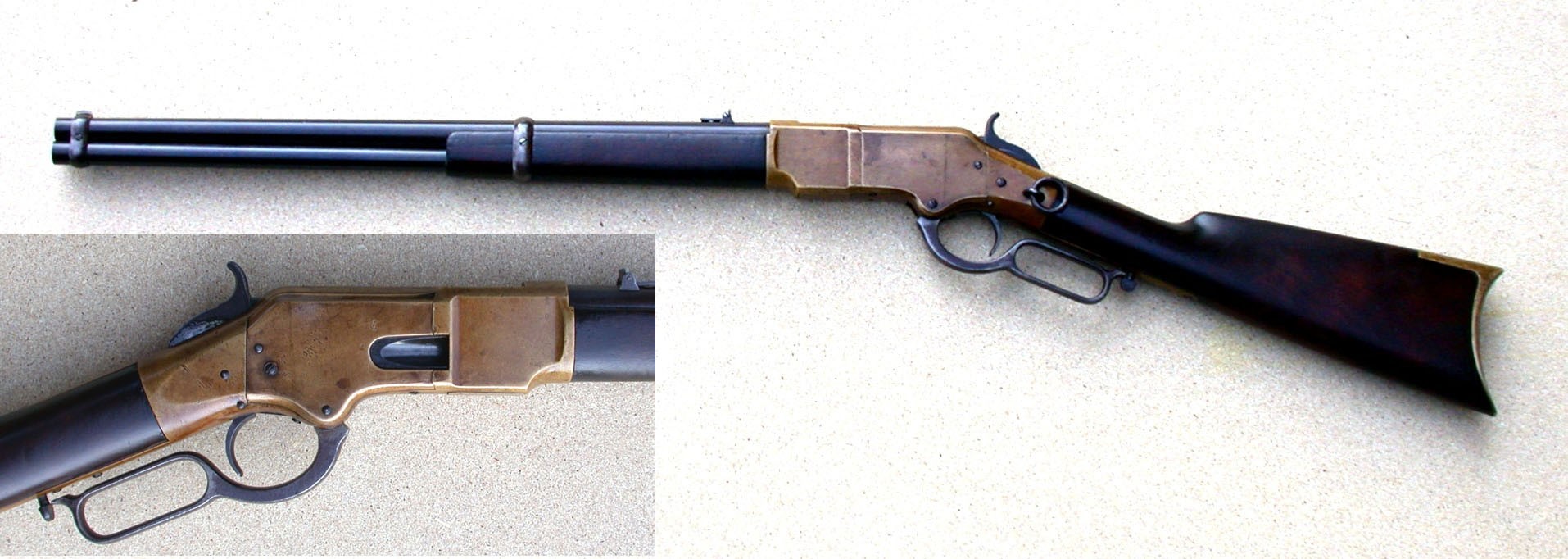
The Model 1866 is the Henry with King’s gate, a wooden forearm and a few other changes. Rock Island’s essay records that on its barrels “the words ‘King’s Patent’ were placed on barrels immediately next to the ‘Henry’s Patent’ markings, and would be later replaced around serial number 23,000 with Henry’s contribution removed, leaving the sole marking of ‘King’s Improvement – Patented.’”6 Production is given as “more than 170,000 … when its run was completed in 1898” by Rock Island and as 170,100 by the proofhouse.com compilation.64
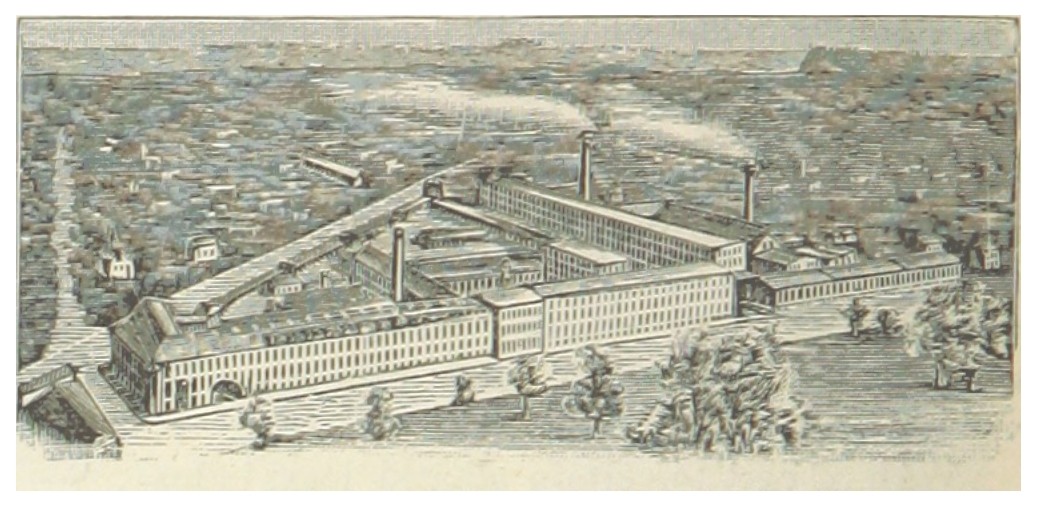
9.9 The other line: Smith & Wesson
Horace Smith and Daniel Wesson left the Volcanic company within months of its formation, licensed Rollin White’s bored-through cylinder in November 1856, and began making the Model No. 1 revolver in .22 rimfire in 1857 (Volume 2).13 The line from the Volcanic to that revolver is not the action, which they abandoned, but the cartridge. Their own 1854 patent had drawn a copper-cased Flobert-type round and an extractor to pull it out; the Volcanic never used it; the Model 1 was built around it.
There is a symmetry in the story worth stating plainly. The two partners patented a lever action for a metallic cartridge and then sold a lever action that fired a loaded ball. Their successors at New Haven made the lever action work by going back to the metallic cartridge, and the two partners made their fortune by taking the metallic cartridge to a different action.
9.10 The toggle after Winchester
How long the toggle lasted in Winchester’s lever guns after the Model 1866 was not checked against a primary source for this dive. It is commonly said to have continued in the Model 1873 and to have been replaced by John Browning’s designs of the later 1880s, and it is given here only as that. Elsewhere, John Eckert’s ASAC Bulletin article on the Luger traces the toggle as a principle from the Volcanic to Maxim and, through Maxim, to Hugo Borchardt, who “was hired by Winchester in 1873” and designed the C93 “incorporating the breech locking toggle principle of the Maxim” (Volume 5).14 The hub’s Borchardt C-93 dive takes up that line. It is a shared principle, a knee joint that locks when straight, put to a different use, not a line of descent.
9.11 What the Volcanic left
The Volcanic gave its descendants four things and took one thing to its grave.
It gave them the tube magazine under the barrel, which every Henry and lever-action Winchester used and which most lever guns still use. It gave them the carrier, the block that lifts a round from the magazine to the bore. It gave them the toggle lock worked by the lever, carried unchanged in principle into the Henry and the Model 1866. And it gave them the lever that is also the trigger guard, Horace Smith’s 1851 idea, which is still the shape of a lever-action rifle.
What it took with it was the loaded ball. Walter Hunt’s idea of putting the powder inside the bullet was what the whole line had been built to fire, from the Volition Repeater of 1849 to the last Volcanic carbine. The Henry patent’s first paragraph is its obituary: the improvements were designed to remove the objections to the hollow loaded ball “by … adapting the arm to the use of a solid ball inclosed in a metal cartridge, thus greatly increasing the power and certainty of fire of the arm.”7 The hub’s Daisy dive, Vol 15 follows the caseless idea forward from there, through a hundred and ten years of silence to the Daisy V/L and the G11, and reaches the same conclusion about the brass case that New Haven reached in 1860.
References
Footnotes
-
The hub’s Daisy dive, Vol 15, “Caseless Ammunition, Volcanic to G11”, /pellet-and-bb/rifles/daisy/vol-15/ . ↩
-
Charles Winthrop Sawyer, Our Rifles, Boston, 1920, pp. 276–279. https://archive.org/details/firearmsinameric00sawyrich , accessed 2026-10-18. Public domain. ↩ ↩2 ↩3 ↩4
-
Ian McCollum, “The Volcanic: Smith & Wesson’s First Pistol”, Forgotten Weapons, 18 August 2017, https://www.forgottenweapons.com/the-volcanic-smith-wessons-first-pistol/ , accessed 2026-10-18. ↩
-
“Winchester Dates”, proofhouse.com, https://proofhouse.com/win/winchester.htm , accessed 2026-10-18. Anonymous compilation. ↩ ↩2
-
Rock Island Auction Company, “Lever Action Pistol”, RIAC blog, https://www.rockislandauction.com/riac-blog/lever-action-pistol , read 2026-10-18. ↩
-
Rock Island Auction Company, “The Evolution of the Winchester Rifle”, RIAC blog, https://www.rockislandauction.com/riac-blog/the-evolution-of-the-winchester-rifle/ , read through the shared fetch engine 2026-10-18. Source of the 1858 cartridge, 1862 production, 13,000 total, 1864 departure, 1865 petition, the 1866–67 company dates, the King’s Patent markings and the 170,000 production figure; an auction-house essay without inline citations. ↩ ↩2 ↩3 ↩4 ↩5 ↩6 ↩7
-
B. Tyler Henry, assignor to Oliver F. Winchester, US Patent 30,446, “Improvement in Magazine Fire-Arms”, 16 October 1860. https://patents.google.com/patent/US30446A/en , OCR text and drawing, accessed 2026-10-18. ↩ ↩2 ↩3 ↩4 ↩5 ↩6 ↩7 ↩8 ↩9 ↩10 ↩11 ↩12 ↩13
-
Horace Smith and Daniel B. Wesson, US Patent 10,535, “Improvement in Fire-Arms”, 14 February 1854. https://patents.google.com/patent/US10535A/en , accessed 2026-10-18. ↩ ↩2 ↩3 ↩4 ↩5 ↩6 ↩7 ↩8 ↩9
-
Horace Smith and Daniel B. Wesson, assignors to the Volcanic Repeating Arms Company, US Patent 14,147, 22 January 1856. https://patents.google.com/patent/US14147A/en , accessed 2026-10-18. ↩
-
Stones River National Battlefield, National Park Service, 19th Century Repeaters manual (2018), photographs and captions as hosted on Wikimedia Commons (“Henry rifle operation 01 thrusting the plunger.jpg” and following), public domain, accessed 2026-10-18. ↩
-
Nelson King, assignor to O. F. Winchester, US Patent 55,012, “Improvement in Magazine Fire-Arms”, 22 May 1866. https://patents.google.com/patent/US55012A/en , accessed 2026-10-18. ↩ ↩2
-
Winchester Arms Collectors Association, “History”, https://winchestercollector.org/history/ , accessed 2026-10-18. ↩
-
Lee A. Silva, “Sam Colt’s Big Business Blunder Was a Boon for Gunmakers”, HistoryNet, 20 June 2017, https://historynet.com/sam-colts-big-business-blunder-boon-gunmakers/ , accessed 2026-10-18. ↩
-
John Eckert, “A Luger Short Story”, American Society of Arms Collectors Bulletin 111 (2015), pp. 56–74, https://americansocietyofarmscollectors.org/wp-content/uploads/2022/04/2015-B111-Luger-Short-Story.pdf , accessed 2026-10-18. ↩
Comments (0)