Volcanic Repeating Arms · Volume 8
Building One — A Machinist's Path to an Antique-Pattern Repeater
Three build paths and what each makes in law, the data that exists and the data that has to be measured, frame, barrel, magazine, toggle and lockwork in a shop with CNC mills, printers and a laser, the ammunition problem stated honestly, and why a copy should never carry an original's legend
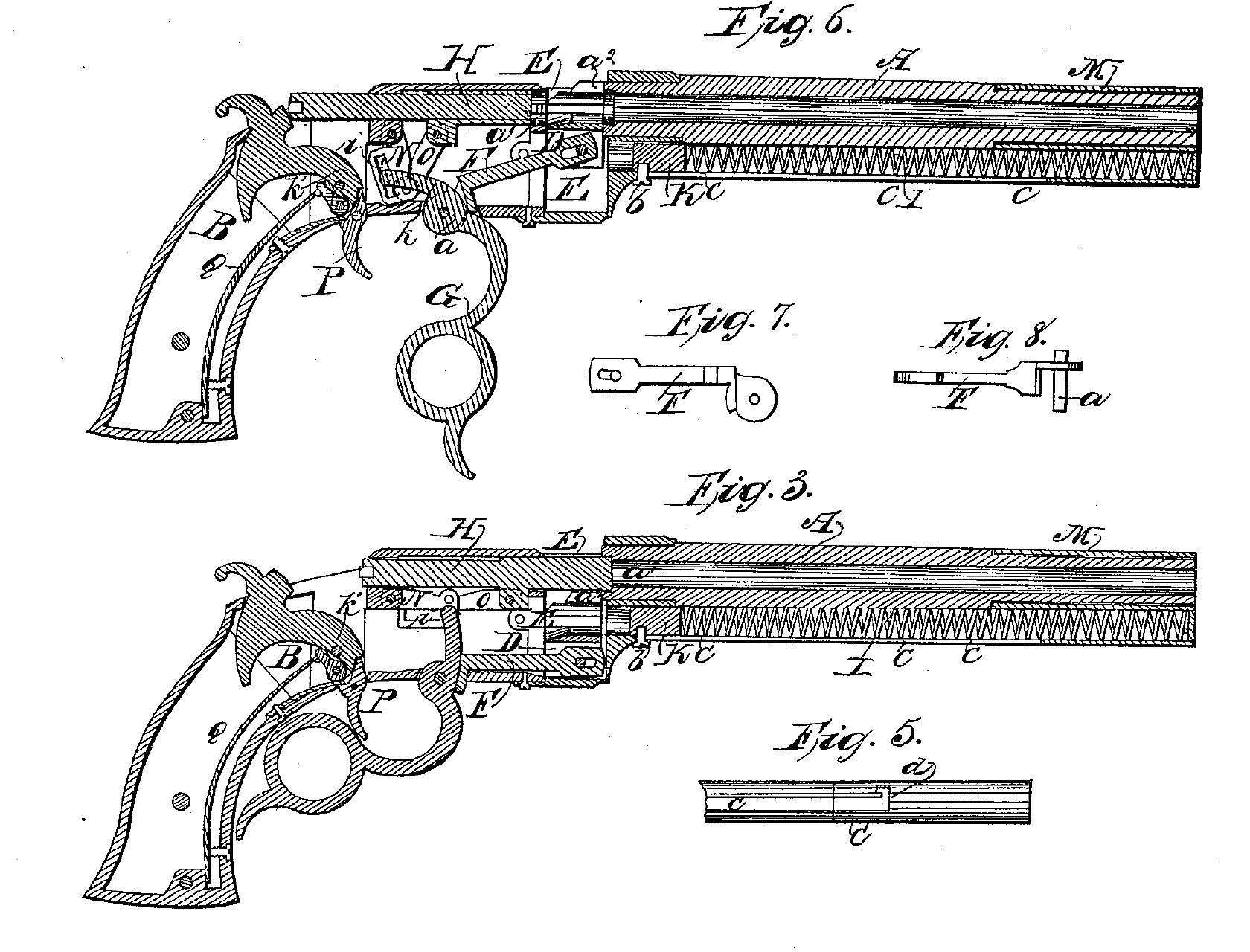
No complete set of drawings for a Volcanic has been published, no maker sells a kit, and no one makes its ammunition. A reproduction therefore has to be designed as well as made. This volume is written for a shop with multiple CNC mills, 3D printers, a 100 W laser and a full gunsmithing bench, at the level of someone who does not need bluing or reaming explained. It sets out the choices, the data that exists, the data that does not, and the order of work. It does not invent dimensions: where none is published, it says so and says how to get one. It does not give a recipe for priming compound.
8.1 Choose the build before the first cut
The legal analysis in Volume 7 makes the first decision for the builder, because what the gun fires decides what it is in law.
Table 1 — Choose the build before the first cut
| Path | Fires | What it is, federally and in Michigan | Difficulty |
|---|---|---|---|
| A. Cartridge Volcanic | A modern cartridge: .22 LR, .380 ACP, or a straight-walled pistol round | An ordinary firearm, made for personal use without a licence; a pistol in Michigan is subject to the pistol rules if not antique | Moderate. The ammunition is solved; the work is in extraction, ejection and safety |
| B. Faithful replica | A self-primed caseless ball, period pattern | Possibly an antique under the replica clause; unresolved; needs an ATF classification before it can be relied on | Hardest. The ammunition must be designed and made, and its legal status depends on how |
| C. Display replica | Nothing: no bore, no chamber, no firing mechanism capable of being restored | Not a firearm if it is not designed to, and cannot readily be converted to, expel a projectile by an explosive (18 U.S.C. § 921(a)(3)) | Easiest, and the safest place to prove the toggle geometry |
Path A is more faithful to the patent than it sounds. US 10,535 was drawn for a cased cartridge and claims a recess in the slide to grip and extract the case (Volume 2).1 A Volcanic-pattern pistol firing a cased round, with the patent’s extractor, is the gun Smith and Wesson patented. It is also, in effect, what Uberti has announced in .380 ACP (Volume 7), and what Pietro Venditti built in the 1870s when he added extractors to his metallic-cartridge copies.23
Path C should be built first whichever of the others is the goal. A non-firing model in printed plastic and then in brass proves the toggle, carrier and magazine timing without a bore anywhere in the shop. The definition in § 921(a)(3), a weapon “which will or is designed to or may readily be converted to expel a projectile by the action of an explosive”, is the line to stay on the right side of while it is a model.4
8.2 What exists to build from
The patents. US 10,535 (1854) is the mechanism: the parts with their letters, the cycle, the slot arrangement of the magazine, the carrier lever.1 US 14,147 (1856) is the period primer.5 US 30,446 (1860) is the same mechanism adapted to a rimfire case, with an extractor and an ejecting carrier.6 US 55,012 (1866) replaces the slotted magazine with a closed one loaded through the frame.7 Patent drawings of the period are not to scale and carry no dimensions.
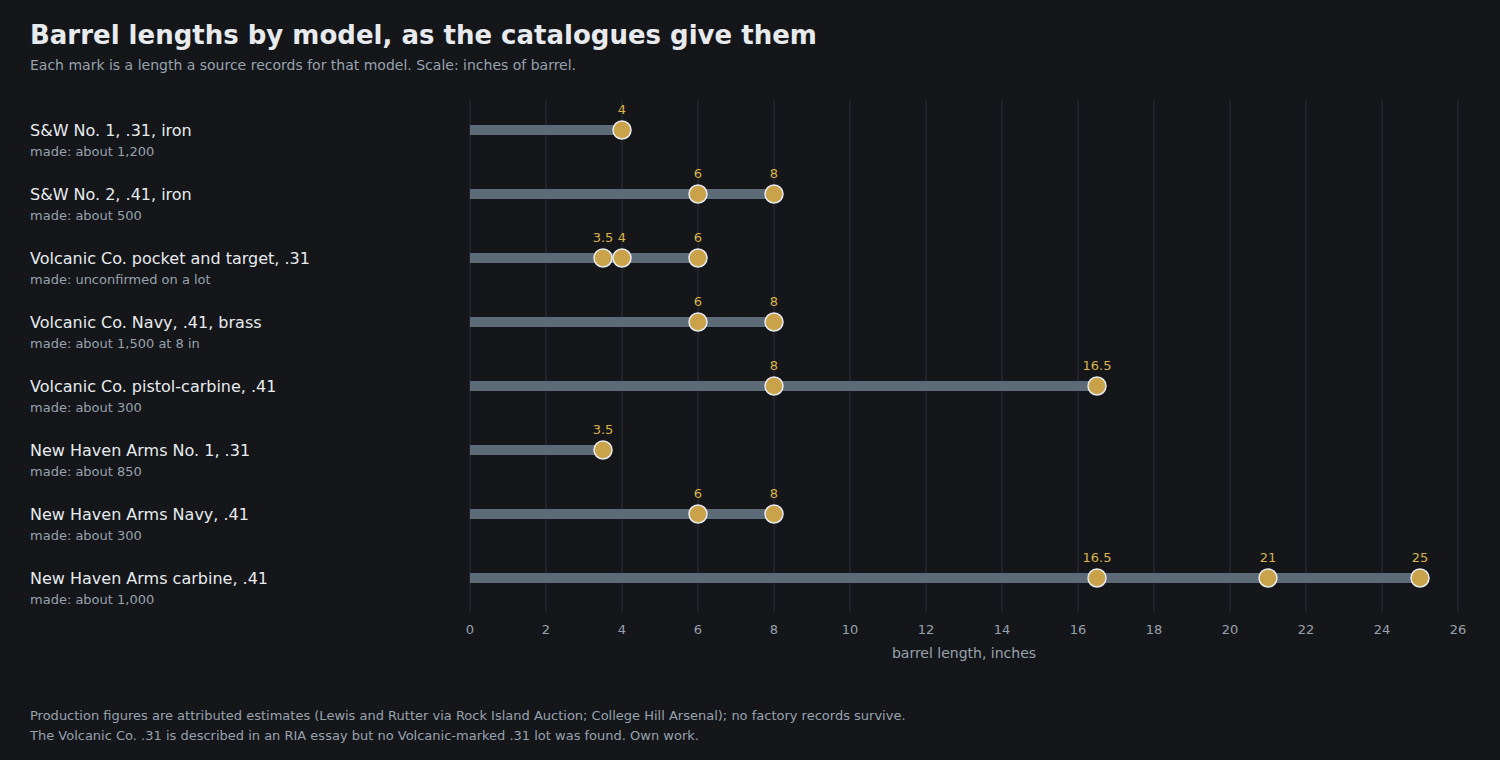
Catalogue measurements. Barrel lengths and magazine capacities are recorded model by model (Volume 4).
Rifling. The only published rifling data for these arms is in Douglas Scott’s 2019 study for the National Park Service, made from bore casts that were 3D-scanned and measured. Its Appendix II gives, in inches:8
Table 2 — What exists to build from
| Gun | Twist direction | Lands and grooves | Land width | Groove width |
|---|---|---|---|---|
| Smith & Wesson No. 1, “iron frame Volcanic, ca 1854-1855 pistol”, .31 | Left | 5 | 0.120–0.121 | 0.065–0.068 |
| Volcanic lever action No. 1 pistol, .31 | Right | 6 | 0.072–0.075 | 0.083–0.091 |
| Volcanic carbine, .41 | Right | 6 | 0.122–0.125 | 0.082–0.091 |
| Henry rifle, .44, for comparison | Right | 6 | 0.095–0.105 | 0.114–0.121 |
“For this project twist rate was not considered”, Scott writes, so the rate is not in the data.8 Neither are bore and groove diameters. A rough check is possible: six lands and six grooves of the widths given for the .41 carbine add up to a circumference of about 1.22 to 1.30 inches, which is a diameter of roughly 0.39 to 0.41 inch, consistent with a nominal .41. That is arithmetic on Scott’s figures, not a measured diameter, and a groove diameter for a barrel should never be taken from it. These are one gun of each type.
Ammunition. Ed Lewis gives the No. 2 ball at 100 grains with 6.5 grains of black powder, the construction of the ball, and its faults (Volume 3).9 No measured section or full dimensions of either ball were found.
Photographs. The photographs used in this dive (Volume 4), the patent sheets, and for the closely related Henry the National Park Service’s photographs of a field-stripped rifle and its parts.10
8.3 What has to be measured
Everything else. The list below is what a builder needs and could not find published:
- Bore and groove diameters, twist rate and groove depth, for whichever calibre is reproduced.
- Frame: overall dimensions, wall thicknesses, side-plate outline and thickness, screw positions and threads, the carrier chamber, the slide’s guideway.
- Toggle: link lengths, pivot positions on the frame and the slide, and the position and shape of slot i and arm k.
- Lever: pivot position, the arm k geometry, the ring and the carrier-lever contact faces.
- Hammer, mainspring, trigger and sear geometry.
- Magazine tube: outside and inside diameters, wall thickness, the length and width of slot c, the cross-slot d, the collar M, the follower and the spring.
- The chamber, if reproducing the ball, and the ball itself: diameter, length, base cavity, primer seat.
- The frame alloy, by analysis (an XRF reading on an original would answer it non-destructively).
The way to get them is to measure an original. Museums and collectors grant access to researchers more often than one might expect, and the NPS study shows the method for the bore: casts made, scanned and measured, which leaves no mark.8 Measurements off a gun should be recorded with the serial and the date, the way the hub records unit data, because the guns vary between makers and within a maker. Photographs of a disassembled original, if the owner permits disassembly by someone qualified (Volume 6), give the internal geometry that the patent drawings only suggest.
8.4 Laying out the mechanism
Start in CAD with the patent’s Fig. 3 and Fig. 6, scaled to a known length (the barrel), and treat everything in them as proportion, not dimension. Then design to the measurements as they come in.
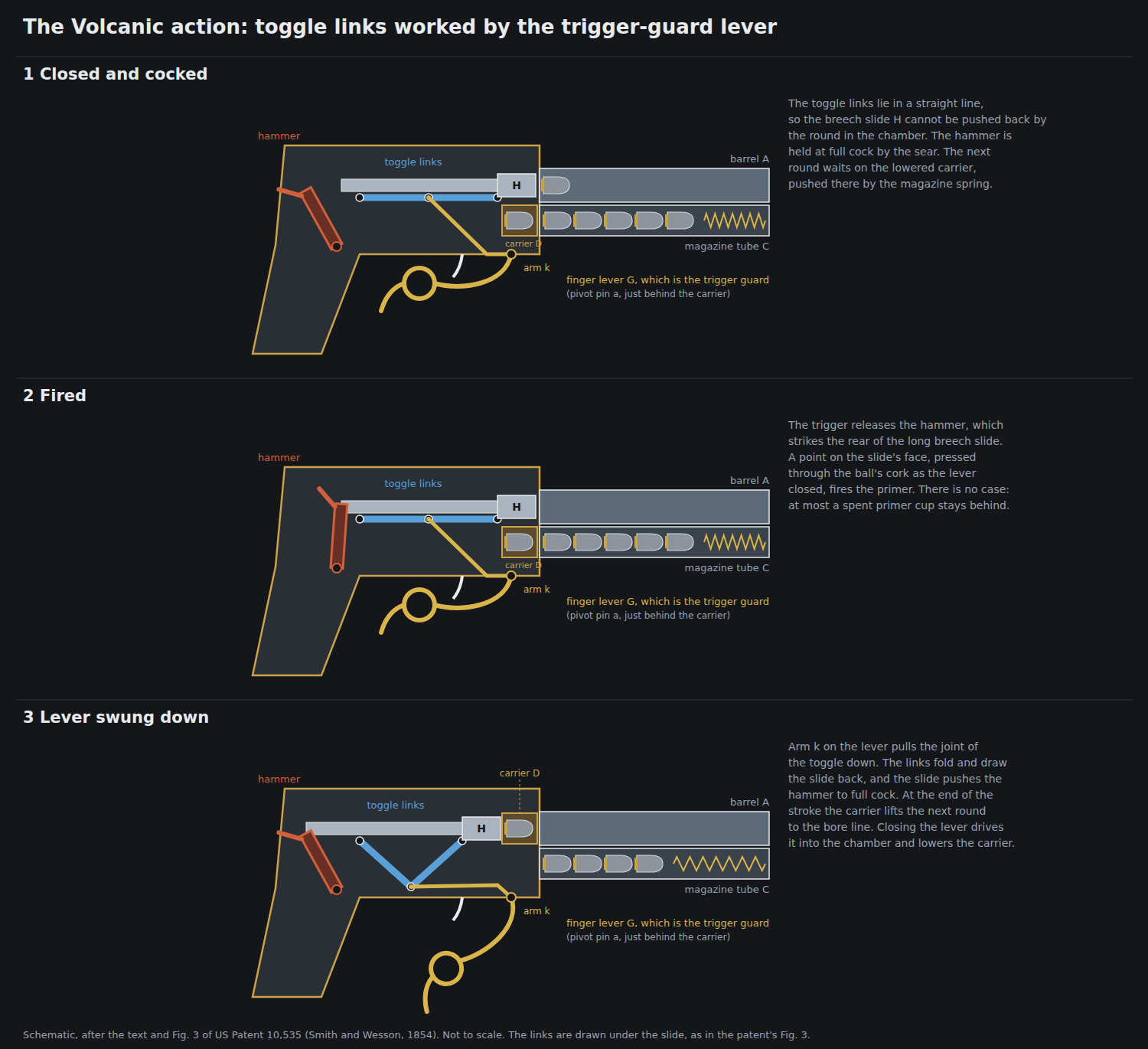
The toggle is the part to get right first. In the closed position the two links must lie straight, or very slightly past straight in the direction that pushes the knee into its stop, with the slide against the breech face. In the open position the slide must have travelled back far enough to clear the full length of the round on the carrier, plus clearance, and to have pushed the hammer past full cock. The patent gives the relationship, not the numbers: arm k on the lever carries studs in slot i on the back toggle, and the lever’s lower arm raises the carrier lever while its upper arm depresses it.1 That makes the lever a cam: the angles at which the carrier begins to rise, reaches the bore line, begins to fall and is fully down must be timed against the slide’s position, so that the carrier is never rising while the slide is in its path and the slide never closes before the round is aligned.
Lay out the timing as a plot of slide position and carrier position against lever angle, check it in CAD motion, and then print it. A printed model at full size in PETG or a similar tough filament, with steel pins at the pivots, shows within an afternoon whether the carrier fouls the slide, whether the lever reaches its stop with the links straight, and how the hammer is picked up. Printed parts are not strong enough for a firing gun and should never be mistaken for it; they are layout tools.
The Henry is a useful second reference for the layout, because its toggle and carrier are the same arrangement at larger size and its parts are photographed in the NPS manual.
8.5 The frame and side plates
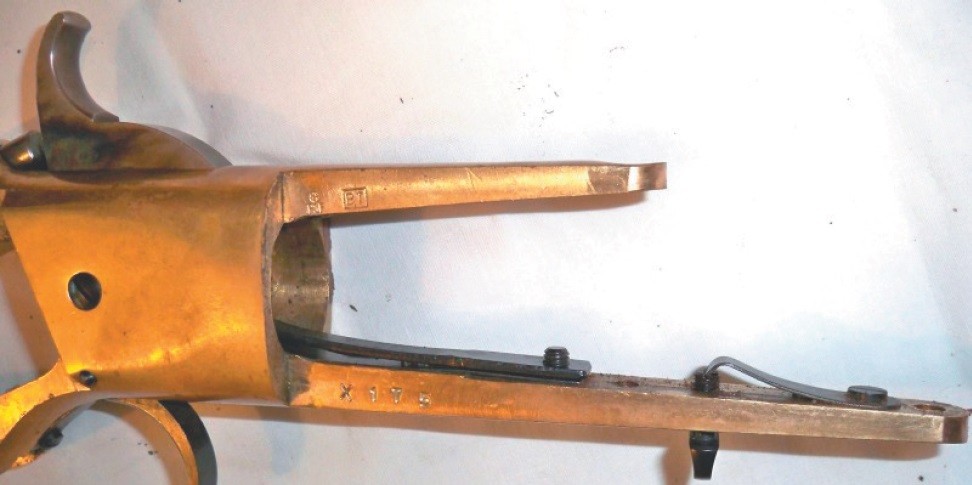
The original Smith & Wesson frames were iron; the New Haven frames were brass or bronze, catalogued as “gunmetal”, and no analysis of the alloy was found (Volume 4). For Path C any machinable brass will do. For a firing build the frame is the receiver and holds the toggle’s frame pivot, so its alloy and section have to be chosen for the load the cartridge puts on it.
That load is a design calculation the builder has to make for the chosen cartridge; no source gives it for this design. Two pieces of evidence bound it. Uberti has announced a brass-framed Volcanic in .380 ACP for production, which suggests that a brass frame can be engineered for that cartridge.2 And the Henry and the Winchester 1866, which carried the same toggle in brass frames, fired the .44 rimfire (Volume 9). A builder choosing a cartridge stronger than those, or a frame thinner than the originals, is outside what any existing gun demonstrates.
On a multi-axis CNC mill the frame is a solid block machined from both sides, with the carrier chamber, the slide guideway and the toggle and lockwork cavities cut from the sides that the side plates will cover. The side plates are cut from plate and fitted to the frame so the joints disappear; the market’s attention to “perfect side-plate joints” on originals is a good standard for a copy (Volume 6). The New Haven No. 1 used one screw for the lever and side plates and the Smith & Wesson two;11 screw positions should come from a measured gun. Holes in brass for pivots that carry load should be bushed in steel where the stress analysis calls for it.
The laser has three uses here: cutting templates and gauges for checking the frame profile; cutting thin shim stock for spacers and spring templates; and marking (§ 10). It is not a way to cut the frame itself.
8.6 The barrel and the magazine
The barrels were octagonal: part round and part octagon on Smith & Wesson guns, full octagon on the New Haven guns, with the magazine tube under the barrel; dealers and auction houses describe it as an “octagon barrel with integral magazine”.1112 A modern barrel is made from a rifled blank of suitable barrel steel turned and milled to octagon on the CNC mill, with the magazine tube joined under it. How the original tube was joined (brazed, soldered or integral) is not described in any source found, and should be read from an original.
Rifling for Path A follows the cartridge chosen, not the Volcanic. For Path B, the measured land and groove counts and directions above are a starting point; twist rate has to come from measurement or from a judgement about stabilising the ball reproduced.
The magazine is where the original’s design is most fully known and most likely to cause trouble. The 1854 patent’s arrangement is: a tube with a long slot c along it; a follower K with a pin b running in the slot; a spring I ahead of the follower; a front section L, carrying the spring, that turns on a collar M round the barrel; and a short slot d in L, turned at right angles at its end, to hold the spring compressed while L is turned aside.1 Henry’s 1860 patent keeps it: “This tube is made in two parts. The short part … is made to turn on the barrel, so as to leave the end of the tube … open to drop in the ammunition.”6 The slotted tube admits dirt, as King’s 1866 patent complained.7
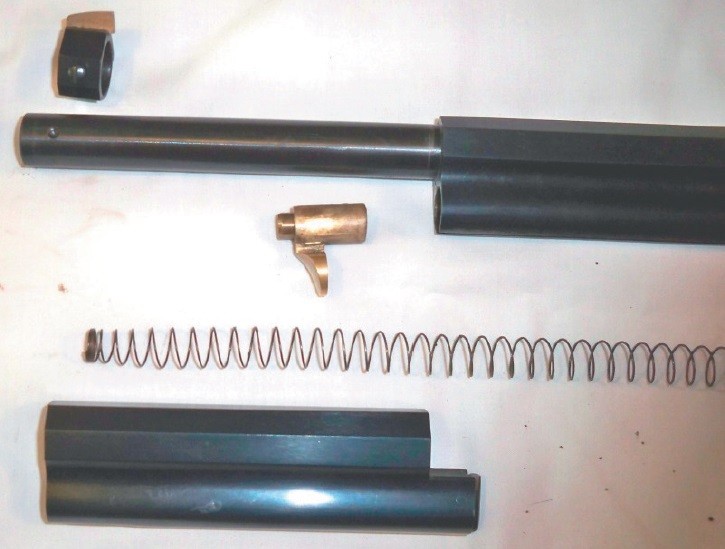
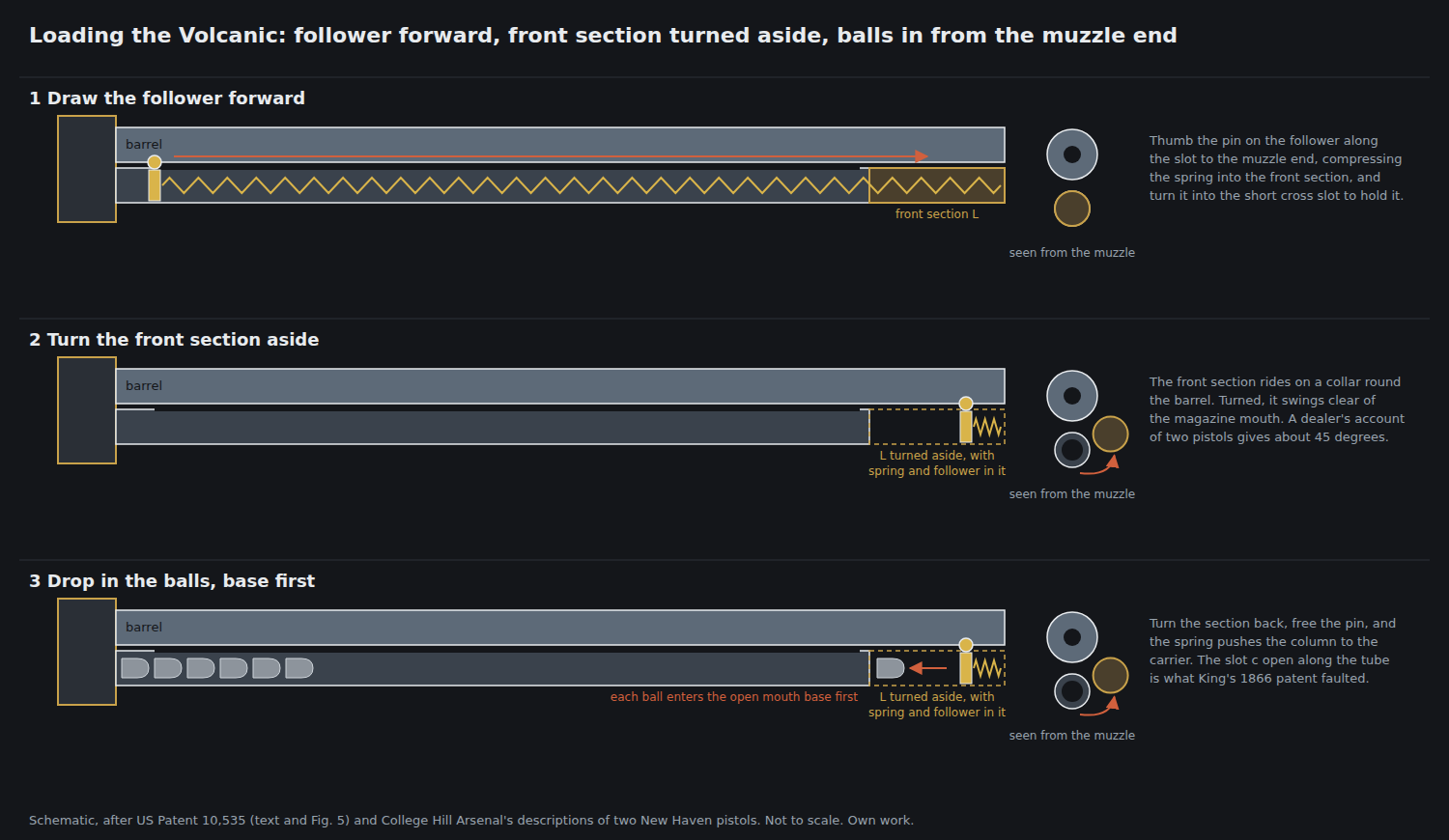
For a firing build the magazine needs one change from the original if the ammunition is the self-primed ball: the column must not be able to fire itself. Lewis records chain fire in the tube from pressure on the thin priming (Volume 3).9 A modern cartridge build avoids it with round-nosed bullets bearing on rimfire rims or centrefire primers in the ordinary way, as every tube-magazine lever gun does; a ball build has to solve it in the ammunition (§ 9).
8.7 The toggle, slide and carrier
These are the high-stress steel parts and are made as such. The links, their pins and the slide in a suitable alloy steel, hardened and tempered; the carrier, which only lifts, can be made of the frame material or steel. The pins are the weak point of any toggle, and in the Volcanic they carry the full breech load through two links in compression; they should be sized by calculation for the chosen cartridge, made from drill rod or a proper pin steel, and fitted closely.
For Path A the slide needs what the patent drew and the production guns did not: a firing pin (a separate pin is better than the original’s arrangement of striking the whole slide, § 8), an extractor and an ejector. Two period answers are available. The 1854 patent’s dovetail recess in the slide face, which grips the case head as the slide closes and draws the case back, with projections on the rising carrier to throw it clear.1 And Henry’s 1860 arrangement: a spring catch on the breech-pin that grips the flange, and a carrier “curved out on the top near the rear end … so as to strike the cartridge forward of the center, and thus raising the forward end, while the rear end is held down by the spring-catch, tripping it over, freeing it from the spring, and ejecting it”.6 Henry’s is proven over thousands of rifles and is the better choice for a cartridge build.
Headspace and chamber are set to the cartridge with its reamer and gauges in the usual way.
For Path B the slide face carries the point that pierces the ball’s cork on closing and through which the hammer’s blow fires the primer.513 The patent’s own warning applies: the cork was there to cushion the fulminate from blows, and a ball pressed hard against the point by a straightening toggle can fire before the trigger is touched (Volume 3).9
8.8 Lockwork and the safety a modern build needs
The original lockwork is simple: a hammer behind the slide, a mainspring Q, a trigger P with its sear, and the hammer cocked by the slide’s backward travel.1 The springs are made from spring steel and tempered; the hammer and sear surfaces are hardened and stoned in the ordinary way.
The original has no safety of any kind, and its firing system makes that worse than it sounds. In the Volcanic the hammer strikes the rear of the slide, whose face is already against the primer;113 a blow to a lowered hammer on a loaded chamber is transmitted straight to the primer. That is the condition every modern single-action safety system exists to prevent. All4shooters reports that Uberti’s US-market Volcanic will need “an automatic safety system, such as a transfer bar”.2 For any firing build in this shop the same standard applies: a separate inertial firing pin that cannot reach the primer unless the trigger is pulled (a transfer bar or a firing-pin block), so that the gun can be carried with the hammer down on a loaded chamber without the risk the original carried. It is a departure from the original that a copy should make.
The second departure is a positive lever latch. The original’s toggle is held straight by the lever and nothing else (Volume 5). For a cartridge build, the lever should be held closed against its stop by a latch or detent, and the gun should not be able to fire unless the lever is fully closed; a trigger block worked by the lever is the usual way.
8.9 The ammunition problem
For Path A there is no problem: buy factory ammunition in the chosen calibre.
For Path B the ammunition is the project, and this volume does not provide a recipe for it. No published modern method for making a self-primed caseless ball was found (Volume 7). The period primer, by its patent, was a copper or brass cup holding a cork, a pellet of fulminating powder and a cross-shaped iron or steel disc, seated on the powder in the ball’s base.5 Making a primary explosive such as fulminate is dangerous work outside a licensed facility and is not described here.
That leaves a builder of Path B with a choice that is partly technical and partly legal:
- Seat a commercial primer in a hollow-base ball. Technically feasible in principle; no source documents a working design. Legally, Volume 7 explains why a standard commercial primer moves the round toward “conventional centerfire fixed ammunition” and puts the antique status that is Path B’s whole point at risk.
- Abandon Path B for Path A. A Volcanic-pattern gun firing a cased round is the gun the 1854 patent describes.
- Build Path C and treat the ammunition as a display object: a dummy ball with no powder and no primer, which is what the one modern forum builder found actually did.14
Whatever round is chosen, the faults Lewis lists are the specification it must meet: no chain fire in a tube magazine; no firing as the breech closes; consistent seating depth so the point always reaches the primer; a gas seal at the breech; and a way to clear a misfire.9 The brass case meets all five. That is the conclusion the whole history reaches, and the Daisy dive’s Vol 15 reaches it for caseless ammunition generally.
8.10 Finishing, and how to mark a copy
The originals’ finishes are recorded in Volume 4: browned barrels and blued iron frames on Smith & Wesson guns; blued barrels and natural, silver-plated or gold-plated brass frames on the New Haven guns; case-hardened hammers and triggers; walnut or rosewood grips; open-scroll engraving on many. Rust bluing or browning, case colouring and silver or gold plating are all within a gunsmithing shop’s reach or that of a specialist plater.
A copy should not carry an original maker’s legend. Rock Island sold in 2010 a modern copy of a Smith & Wesson pistol roll-marked “SMITH & WESSON/NORWICH CT./PATENT/CAST STEEL” and called it “extremely difficult to distinguish from an original example” (Volume 6).15 A copy marked with a period legend becomes, the moment it leaves its maker’s hands, a fake; and in a market where originals fetch tens of thousands of dollars it will be sold as one. The laser makes clean, permanent markings easy: the builder’s name, the year, and the word REPRODUCTION, on the frame where an owner will see it. Engraving in the period style on the frame is a matter of taste; a period legend on the barrel is a matter of honesty.
8.11 Testing
There is no proof house for privately made firearms in the United States. For Path A the cartridge’s industry pressure is the design load, and the builder’s calculations should carry a safety factor over it. First firings are made remotely, with the gun in a fixture and fired by a lanyard, starting with single rounds loaded by hand rather than from the magazine, and the toggle pins, frame and slide inspected after each stage for any set, cracking or peening. Only then is the magazine filled, one round at a time to begin with.
For Path B the same applies with more force, because the ammunition is untested as well as the gun, and because the failure modes Lewis records include the magazine firing itself.9 A tube magazine full of primed balls should not be fired from the hand until the ammunition has been shown, in a fixture, not to chain-fire.
8.12 A build sequence
- Decide the path and, for Path B, request an ATF classification before building a firing gun (Volume 7).
- Gather the data: patents, catalogue measurements, the NPS rifling table, photographs. Arrange to measure an original.
- Lay out the mechanism in CAD from the patent figures scaled to a measured barrel; plot slide, carrier and hammer against lever angle.
- Print a full-size model; correct the timing; repeat until the lever closes with the links straight, the carrier never fouls the slide, and the hammer is picked up cleanly.
- Make Path C in brass and steel with no bore: a working display model that proves the frame, toggle, carrier and magazine in metal.
- For a firing build, redesign the slide, firing pin, extractor and lockwork for the cartridge and the safety standard in § 8; do the stress calculations for the frame pivots and the toggle pins.
- Make the barrel and magazine; chamber and headspace to the cartridge.
- Assemble, time, and function-test with dummy rounds.
- Test-fire remotely, inspect, and only then fire from the hand.
- Finish, and mark it as what it is.
References
Footnotes
-
Horace Smith and Daniel B. Wesson, US Patent 10,535, “Improvement in Fire-Arms”, 14 February 1854. https://patents.google.com/patent/US10535A/en , accessed 2026-10-18. ↩ ↩2 ↩3 ↩4 ↩5 ↩6 ↩7
-
Matthias S. Recktenwald, “Uberti presents the prototypes of the Volcanic replica”, all4shooters, 23 August 2026, https://www.all4shooters.com/en/shooting/culture/uberti-presents-the-prototypes-of-the-volcanic-replica/ , accessed 2026-10-18. ↩ ↩2 ↩3
-
Ian McCollum, “Pietro Venditti Copies the Volcanic Repeating Pistol”, Forgotten Weapons, 25 March 2020, https://www.forgottenweapons.com/pietro-venditti-copies-the-volcanic-repeating-pistol/ , accessed 2026-10-18. ↩
-
18 U.S.C. § 921(a)(3), Legal Information Institute, https://www.law.cornell.edu/uscode/text/18/921 , accessed 2026-10-18. ↩
-
Horace Smith and Daniel B. Wesson, assignors to the Volcanic Repeating Arms Company, US Patent 14,147, 22 January 1856. https://patents.google.com/patent/US14147A/en , accessed 2026-10-18. ↩ ↩2 ↩3
-
B. Tyler Henry, US Patent 30,446, 16 October 1860. https://patents.google.com/patent/US30446A/en , accessed 2026-10-18. ↩ ↩2 ↩3
-
Nelson King, US Patent 55,012, 22 May 1866. https://patents.google.com/patent/US55012A/en , accessed 2026-10-18. ↩ ↩2
-
Douglas D. Scott, “Historic Rifling Data Characteristics: Using Forensic Techniques to Further Archeological Inquiry into Firearms Use”, National Park Service, National Center for Preservation Technology and Training, September 2019, Appendix II, https://www.nps.gov/subjects/ncptt/upload/2019-01.pdf , accessed 2026-10-18. ↩ ↩2 ↩3
-
Ed Lewis, “Volcanic Self-Contained Ammunition (A Cartridge Hound Special)”, Collector’s Firearms blog, 12 June 2025, https://collectorsfirearms.com/2025/06/12/volcanic-self-contained-ammunition-a-cartridge-hound-special/ , accessed 2026-10-18. ↩ ↩2 ↩3 ↩4 ↩5
-
Stones River National Battlefield, National Park Service, 19th Century Repeaters manual (2018), photographs as hosted on Wikimedia Commons, public domain, accessed 2026-10-18. ↩
-
Rock Island Auction Company lot descriptions, read 2026-10-18 and logged in 02-inputs/research-models-market.md, Appendix A; lot 4095/6 for the single screw on the New Haven No. 1. ↩ ↩2
-
International Military Antiques, listing for a New Haven Arms Volcanic Navy, https://www.ima-usa.com/products/original-u-s-civl-war-1857-new-haven-arms-co-volcanic-navy-8-inch-barrel-belt-pistol-41-lever-action-serial-no-2442-as-seen-on-history-channel-pawn-stars , accessed 2026-10-18. ↩
-
Springfield Weekly Republican, 23 February 1856, p. 1, Library of Congress, Chronicling America, https://www.loc.gov/resource/sn83020847/1856-02-23/ed-1/?sp=1 , accessed 2026-10-18. ↩ ↩2
-
CAS City forum, “Need ammo for your Volcanic?”, posts of 6 April 2021, https://www.cascity.com/forumhall/index.php?topic=64458.0 , accessed 2026-10-18. ↩
-
Rock Island Auction Company, lot 1014/2229, 27 February 2010, https://www.rockislandauction.com/detail/1014/2229/unknown-centerfire-pistol-41 , read 2026-10-18. ↩
Comments (0)