Volcanic Repeating Arms · Volume 5
How It Works — Toggle Links, a Carrier, and a Magazine Loaded from the Muzzle
The 1854 patent part by part: a trigger guard that is also the lever, a knee joint that locks when straight, a breech slide the hammer strikes from behind, a carrier that lifts each ball to the bore, and a front section that swings aside for loading
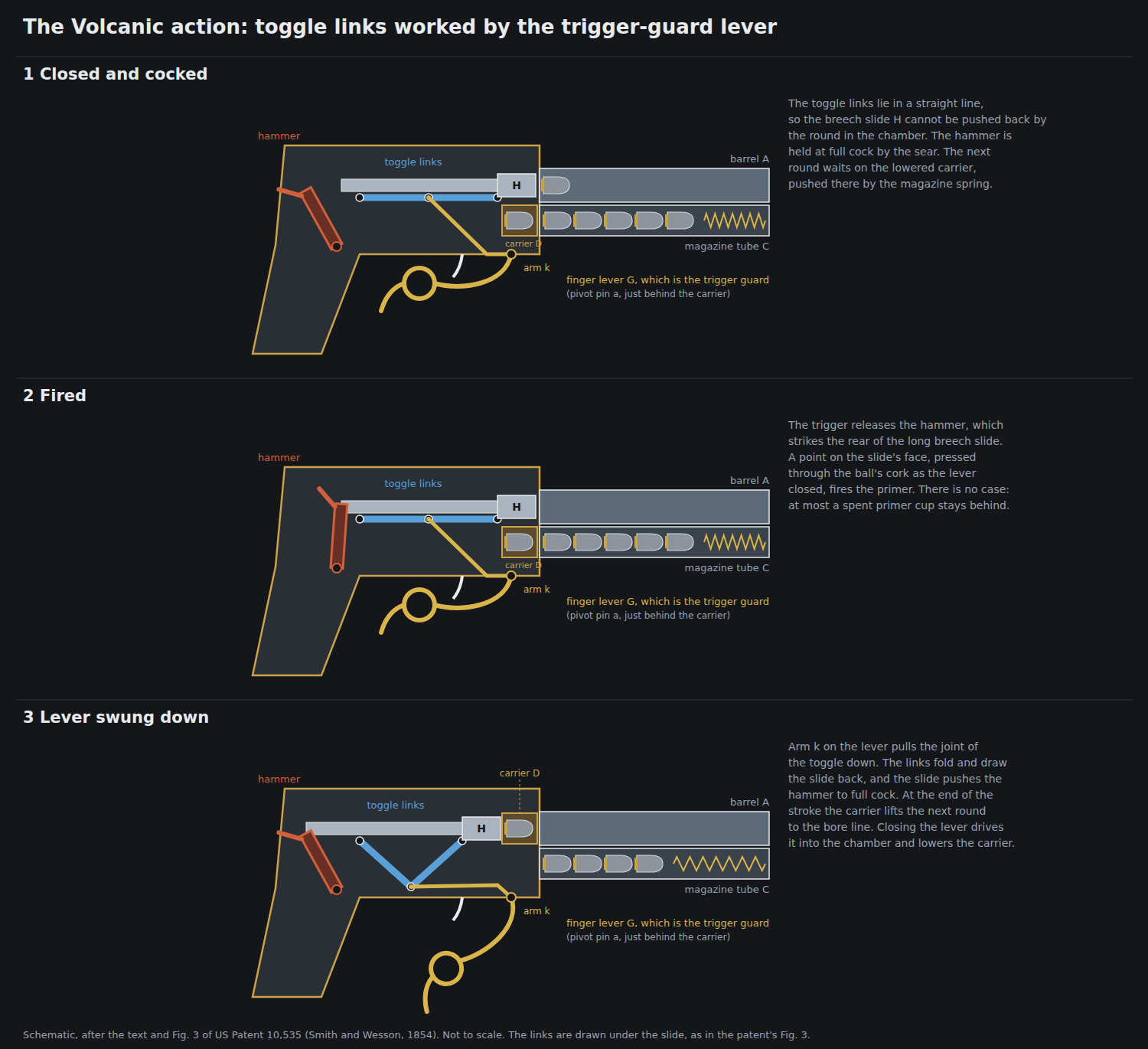
The Volcanic is one of the few nineteenth-century firearms whose mechanism can be read almost entirely from its patent. US Patent 10,535, granted to Horace Smith and Daniel B. Wesson on 14 February 1854, describes the pistol part by part with reference letters and explains how the lever works every one of them. This volume reads it that way, sets beside it the one detailed period description of the arm in use, from a Springfield newspaper of February 1856, and notes where the production guns, which fired a caseless ball rather than the patent’s copper cartridge, must have differed.
No maker’s or armourer’s instructions for the Volcanic were found. Volume 6 explains what that means for taking one apart.
5.1 What the mechanism has to do
Any lever-action repeater feeding from a tube under the barrel has to do six things with one stroke of the lever: unlock the breech, draw the breech-block back, cock the hammer, lift a round from the level of the magazine to the level of the bore, push it into the chamber, and lock the breech again. A cartridge gun has to extract and eject a case as well. The Volcanic had no case to deal with, which is why it could get by without an extractor and why its successor, the Henry, needed one (§ 10).
What makes the Volcanic interesting is how few parts do all six jobs. The trigger guard is the lever. The lever drives the toggle and the carrier together. The breech slide, driven back by the toggle, cocks the hammer by pushing it. Nothing is separately sprung except the hammer, the trigger and the magazine.
5.2 The parts, by the patent’s letters
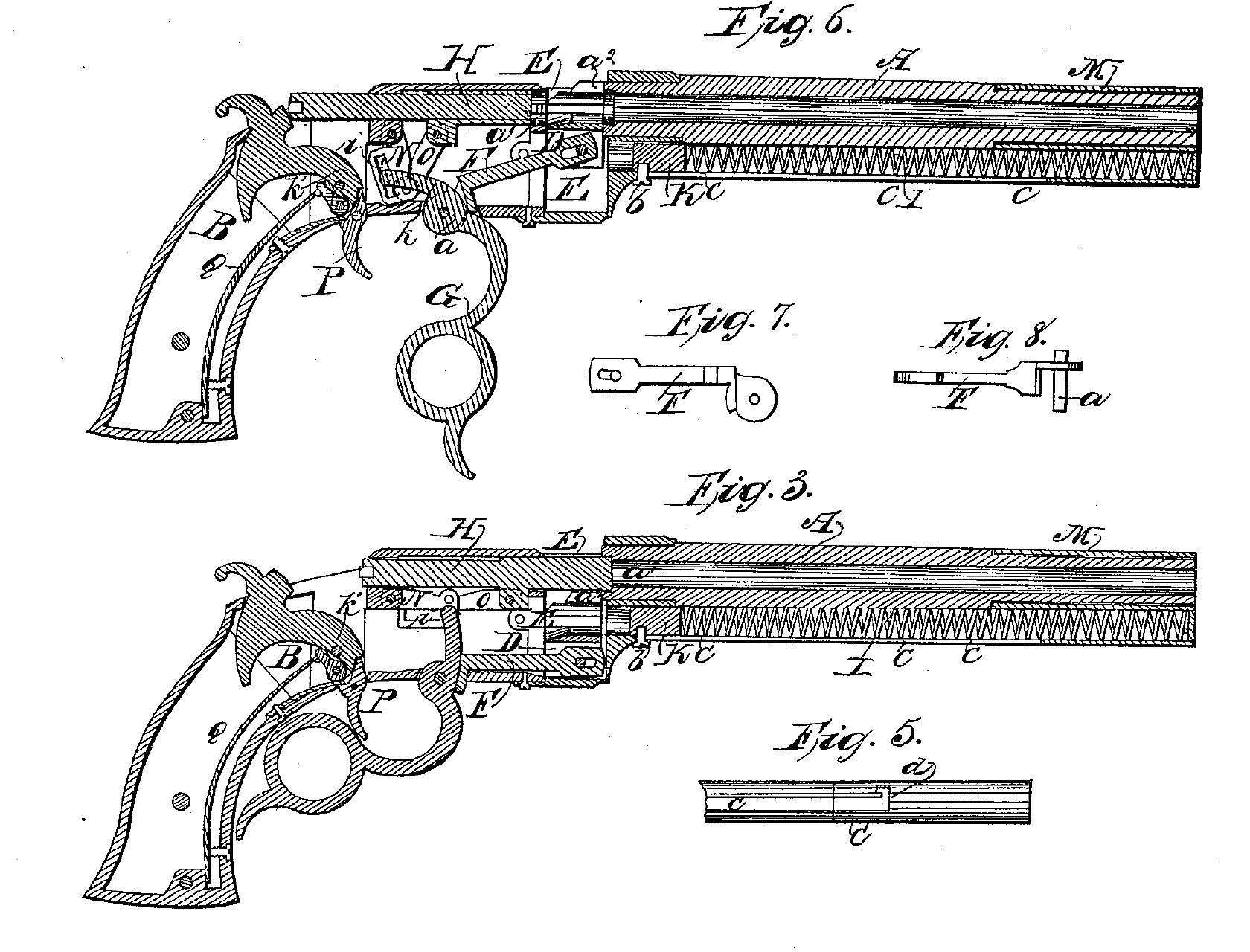
The patent lists the parts in its own words. The table gives each with its letter and the patent’s description.1
Table 1 — The parts, by the patent's letters
| Letter | Part | The patent’s words |
|---|---|---|
| A | Barrel | ”the barrel of the piece” |
| B | Frame and grip | ”the stock or lock-case” |
| C | Magazine | ”a long tube, C, that serves as a magazine for carrying the cartridges”, “Underneath the barrel” |
| D | Carrier | ”a carrier or slide-block, D, whose office is to receive a cartridge from the magazine and transfer it or raise it up into line with the barrel” |
| E | Carrier chamber | the carrier “is caused to slide up and down within a chamber, E” |
| F | Carrier lever | ”a lever, F, that plays or turns on a fulcrum, a, with the trigger-guard G” |
| G | Trigger guard and operating lever | ”the trigger-guard G, which is also a lever, and made to turn on the same pin a” |
| H | Breech slide | ”A piston-slide, H, is also employed to force the cartridge out of the carrier … and into the barrel”; when closed it “serves as a breech to the barrel” |
| I | Magazine spring | ”a helical spring, I, that bears against a cylindric slider, K” |
| K | Follower | the “cylindric slider” with a screw-pin b |
| b | Follower pin | ”a screw-pin, b, projects and extends into and through a long slot, c” |
| c, d | Slots | the long slot c in the magazine, opening into “another and short slot, d, that is cut through a spring chamber or tube, L” |
| L | Front section (spring chamber) | applied to the barrel “by means of a clasping-tube, M, as to be capable of being turned laterally entirely out of line with the magazine” |
| M | Clasping tube | the collar on the barrel that L turns on |
| (toggles) | Toggle links | joining “the piston-slide H and the lock or stock frame” |
| k | Arm on the lever | ”an arm, k, projecting upward from the trigger-guard, and provided with one or more studs to enter and slide in a slot, i, formed through or affixed to the back toggle” |
| i | Slot | in the back toggle, taking the studs of arm k |
| P | Trigger | ”The trigger is shown at P” |
| Q | Mainspring | ”and the mainspring at Q” |
The patent does not give the hammer a letter in the passage that describes it; it calls it “The cock or percussion-hammer”, “arranged in rear of the piston and breech-slide H”.1
5.3 The toggle: a knee that locks when straight
The lock is the toggle. Two links are pinned end to end: the back one to the frame, the front one to the breech slide. When they lie in a straight line along the bore, the slide is held forward and cannot be pushed back, because a push along the line of two straight links tries to compress them end-on and they will not shorten. The patent puts it in one sentence: “When the toggles are brought into a straight line with each other, the piston-slide H is moved hard up against the rear end of the cartridge, and serves as a breech to the barrel.”1 To open the breech the joint between the links has to be moved off the line, and then the links fold and the slide can come back.
John Eckert’s description of the same principle in the Borchardt and Luger, in the American Society of Arms Collectors’ Bulletin, gives the image: “Like the human knee, it will remain locked until pivot II is raised above the axis between pivots I and III.”2 In the Volcanic the knee bends downward, and the thing that moves it is the lever.
The lever does not merely release the knee; it holds it. Arm k, rising from the trigger guard, carries studs that run in slot i in the back toggle.1 Swinging the lever down pulls the knee down; swinging it up pushes the knee back into line. B. Tyler Henry’s 1860 patent, which kept the arrangement, describes the closed position exactly: the links “in a parallel line with the breech-pin J, and held firmly in their place by the finger-lever F, forming a strong brace to resist the backward pressure or force of the explosion”.3 That is the important limitation of the Volcanic-Henry toggle. It is held straight by the lever, not driven over centre and locked against a stop. If the lever is free to move, the breech can begin to open. No source consulted records the Volcanic’s breech opening under fire; with a ball of the power described in Volume 3, the load on the links was small.
5.4 The cycle, step by step
The patent states the whole cycle in one sentence: “Thus the trigger-guard, when so moved, is made to simultaneously cause the hammer to be cocked, the piston-slide to be forced back, and the carrier to be elevated.”1 The period description in the Springfield Weekly Republican of 23 February 1856 tells it from the user’s side: “By a forward movement of a suitable lever just front of the trigger, the breech-pin is drawn directly backward, and a ball is carried up and placed in line with the bore. Next, by drawing the same lever back to its original position, the breech pin is forced to its place, driving the ball into the barrel”.4 Put together, in order:
Lever down and forward (opening).
- The trigger guard G turns on its pin a. Arm k on the guard pulls the joint of the toggle links down through the studs in slot i.1
- The links fold and draw the breech slide H back out of the chamber.
- The rear of the slide pushes the hammer back until the sear catches it at full cock. This is the patent’s first claim: the hammer “may be moved and set to full-cock by the pressure or back action of the slide induced by the action of the trigger-guard lever”.1
- The lower arm of the trigger guard raises the carrier lever F, and the carrier D, holding the ball that the magazine spring pushed into it, rises in its chamber E to bring the ball into line with the bore. The patent: “The carrier-lever is elevated by the lower arm of the trigger-guard lever”.1
Lever up and back (closing).
- Arm k pushes the joint of the links up; the links straighten and drive the slide forward.
- The slide pushes the ball out of the carrier and into the chamber.1
- The upper arm of the trigger guard depresses the carrier lever, and the carrier drops back to the level of the magazine, where the spring pushes the next ball into it: the carrier lever is “depressed by the upper arm thereof”.1
- With the links straight, the slide is locked against the chamber. The hammer stays at full cock; the arm is ready to fire.
The 1856 article adds a detail the patent lacks. As the slide closes, the ball is pressed home and the slide’s point punctures the ball’s base, “puncturing by a point on its end, quite through both the metallic covering and the cork, and pressing fairly upon the percussion portion of the enclosed cartridge.”4 The ball is primed for firing by the closing of the breech.
5.5 Firing by concussion
Pulling the trigger releases the hammer. In the patent, the hammer “is made to strike directly against the rear end of the slide H, and to inflame the priming by the concussion produced by its percussion or blow on such end.”1 The 1856 article says the same of the production gun: “on pulling the trigger the hammer strikes fair upon the hinder end of the breech pin”.4
The breech slide therefore acts as its own firing pin. The hammer does not reach the primer; it hits the back of a long slide whose front is already pressed against the primer, and the blow is transmitted through it. The patent calls this “firing by concussion instead of percussion” and explicitly does not claim it as new.1 The 1856 primer patent describes the same arrangement from the ammunition’s side: “a blunt projecting piece is pressed through the cork until it bears on the fulminating-powder and disk. A smart blow from a hammer will then ignite the percussion”.5
Two consequences follow. The slide face sits in contact with the primer under the force of the closed toggle, which is why an oversized ball could fire as the breech closed: Ed Lewis lists exactly that among the Volcanic’s faults.6 And the part that touches the fulminate is the slide’s point, which is what Lewis means when he says fulminate corroded the firing pin and required its replacement.6 Auction catalogues of Volcanic pistols mention a replaced or “new firing pin” only in period conversions to metallic cartridges, so how the point was made and fitted on an unaltered gun could not be established from the sources consulted.7
5.6 The carrier
The carrier is a block sliding vertically in its chamber at the back of the barrel and the front of the frame. It receives a ball from the magazine at its lower position and lifts it to the bore. In the patent it also had a second job: as it rose, “projections … on the carrier are forced in contact with it (the cartridge) by and during the next upward movement of the carrier, and expel it from the piece or fire-arm”.1 That is the ejection of a spent copper case that the slide had withdrawn with its dovetail recess. A production Volcanic had no case to throw out.
Rock Island’s catalogues of Volcanic Repeating Arms Navy pistols describe the bolt with a “single hook extractor”, and one New Haven Navy with “Hick’s ‘double nipple’ extractor”.7 Neither catalogue says what the hook was for on a caseless gun. The 1856 primer patent says the cork “serves as a means for withdrawing the primer from the arm after it has been discharged”, and Lewis records that “the priming disc sometimes failed to extract”, which disabled the arm.56 An extractor that drew a stuck primer cup or an unfired ball out of the chamber would make sense of both, but no source says that is what the hook did, and it is given here only as a possibility.
5.7 The magazine and how it is loaded
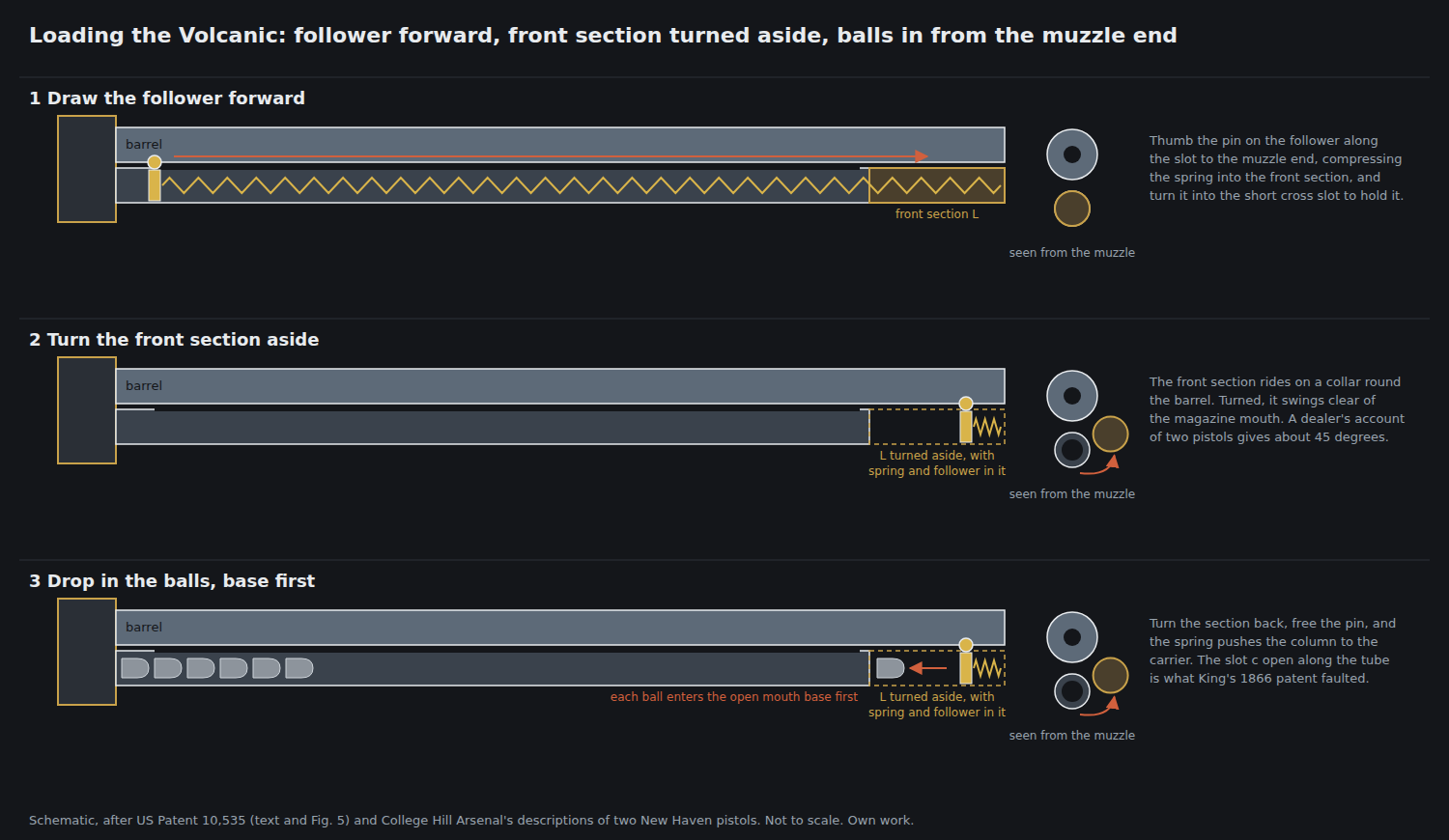
The magazine is a tube under the barrel, open along its length by slot c, in which the follower’s pin b runs.1 The spring sits ahead of the follower and pushes the column of balls rearward toward the carrier. The front section of the tube, the spring chamber L, carries the spring and turns on a collar M round the barrel.
To load, the patent describes the sequence in terms of its slots. Short slot d, in the front section, “is turned at its upper end a short distance at right angles to its main part. Thence it is turned down a short distance parallel to such main part … for the purpose of confining the spring within the chamber in a contracted state. By applying the finger to the head of the screw b and pushing the slider K toward the spring I, we can crowd the spring entirely into the chamber L, and so as to carry the screw b to the upper part of the slot d. When this is the case, if we press the screw laterally into the bent part of the groove, the spring may be preserved in place in the chamber while such chamber is turned out of line with the magazine”.1 The front section can then be turned “laterally entirely out of line with the magazine, so as to permit the latter to be supplied with cartridges whenever necessary”.1
College Hill Arsenal’s description of a New Haven No. 1 pistol tells it practically: “To load the pistol, the follower was pulled towards the muzzle, until it had passed a split in the magazine tube. The front 1” section of the tube could then be rotated about 45-degrees to the right … After inserting the cartridges, the front portion of the magazine was rotated back to the closed position and the follower was released.”8 The same dealer’s description of an eight-inch Volcanic-marked Navy gives the rotating section as “2 ¼-inch”.8 The 45-degree figure is the dealer’s; a search summary of another source gives about 90 degrees, and that source could not be opened. The Winchester Arms Collectors Association says simply that the arms were “loaded from the muzzle end by pivoting the loading sleeve”.9
This is Walter Hunt’s arrangement of 1849. Hunt’s patent describes separating the ball tube from the spring case, throwing it outward, filling it “with cartridges from cases prepared for the purpose containing, say, twelve”, and returning it to line.10 Forgotten Weapons describes the Volcanic’s equivalent of those cases: a period loader for the .31 made of “six pewter tubes soldered together” with a sliding lid, holding thirty balls, used by “simply pouring the contents of a tube directly into the magazine of the pistol”.11
Nelson King’s 1866 patent names the weakness of the slotted tube in its first paragraph: “the open slot upon the under side of the tube would admit more or less dirt”.12 Volume 9 follows King’s fix, a closed tube loaded through a gate in the frame.
5.8 What the production guns changed
The patent was drawn for a copper-cased cartridge; the guns fired a caseless ball. Three features of the patent therefore had no work to do, or a different one, in production:
Table 2 — The patent was drawn for a copper-cased cartridge; the guns fired a caseless ball. Three features of the patent therefore had no work to do, or a different one, in production
| Patent feature | Patent’s purpose | In production |
|---|---|---|
| Dovetail recess in the slide face (claim 2) | Grip and withdraw the spent copper case1 | No case to withdraw. Catalogues describe a hook extractor on the bolt of Volcanic company Navies; its purpose is not stated7 |
| Projections on the carrier | Throw the withdrawn case out as the carrier rises1 | No case to throw out |
| Hammer striking the slide | Fire the case’s priming by concussion1 | Kept: the slide’s point pierces the ball’s cork and the hammer blow fires the primer45 |
The changes visible on the guns themselves between makers are covered in Volume 4: iron to brass frames, part-octagon to full-octagon barrels, the lever spur dropped, one screw for the lever and side plates on the New Haven No. 1 instead of two.7 The National Park Service’s bore casts record one more. In Douglas Scott’s 2019 rifling study, a Smith & Wesson iron-framed No. 1 has five lands and grooves with a left-hand twist, and a Volcanic-marked No. 1 has six with a right-hand twist.13 That is one gun of each, and Scott did not record twist rate, but it is a measured difference and the only published rifling data for these arms. Volume 8 uses the figures.
5.9 Where the mechanism fails
The faults recorded in the sources are partly the mechanism’s and partly the ammunition’s, and they interact. From Lewis’s list and the catalogues:67
- Chain fire in the magazine. Each ball’s nose rests on the primer of the one ahead. Lewis records accidental discharge in the magazine from pressure on the thin priming.
- Firing as the breech closes. An oversized ball, pressed home by the straightening toggle against the slide’s point, could fire before the trigger was pulled.
- Failure to fire. An undersized ball could be pushed too far forward to be reached by the point.
- Thimbling. The front of the ball could leave while its rear stayed in the chamber.
- A primer left in the chamber, disabling the arm until it was cleared.
- A corroded firing point, needing replacement.
- Faults recorded on guns that survive. Rock Island’s condition reports note a “Magazine follower jammed”, a lever that “does not stay up”, a hammer that does not lock properly when the lever is run, an elevator that “needs some work”, a hairline crack in a frame at the breech, and many period replacement followers.7
The period instruction for a misfire, printed on a No. 2 cartridge box, is the only maker’s instruction found for any part of the mechanism: “If, by accident, a ball should miss fire, it must be carefully pushed back with the rod, leaving the carrier down.”14 With the carrier down, the chamber is open to the front of the frame, and a rod from the muzzle can push a dud ball back out.
5.10 The same action in the Henry
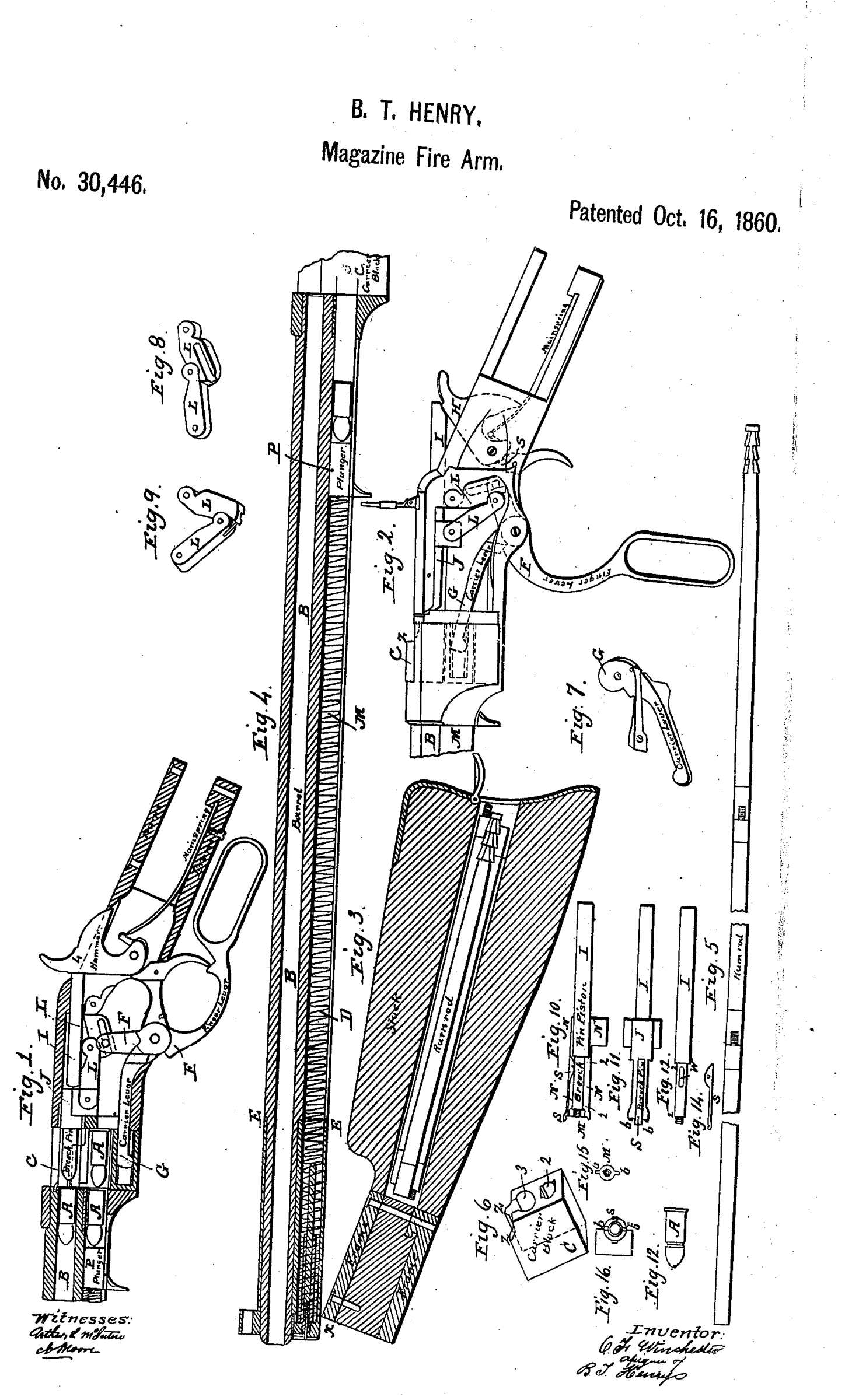
Henry’s 1860 patent describes itself as an improvement of exactly this mechanism: “My invention relates to improvements in a repeating breech-loading gun designed and arranged for the exclusive use of a hollow loaded ball with a primer inserted in the base. My improvements are designed to remove the objections heretofore existing in this class of fire-arms by a change in the construction of the moving parts and the addition of new features, adapting the arm to the use of a solid ball inclosed in a metal cartridge, thus greatly increasing the power and certainty of fire of the arm.”3
The patent keeps the tube magazine with a turning front section (“The short part … is made to turn on the barrel, so as to leave the end of the tube … open to drop in the ammunition”), the carrier block, the toggle links worked by the finger lever, and the hammer cocked by the breech-pin.3 It adds three things the Volcanic did not need: a piston through the hollow breech-pin, given “additional end motion for the purpose of exploding the fulminate” in the cartridge’s rim through two “fillets”; a spring catch on the breech-pin that grips the cartridge’s flange to extract it; and a carrier top “curved out on the top near the rear end … so as to strike the cartridge forward of the center, and thus raising the forward end, while the rear end is held down by the spring-catch, tripping it over, freeing it from the spring, and ejecting it with considerable force.”3 Every one of the additions exists because the Henry fired a case.
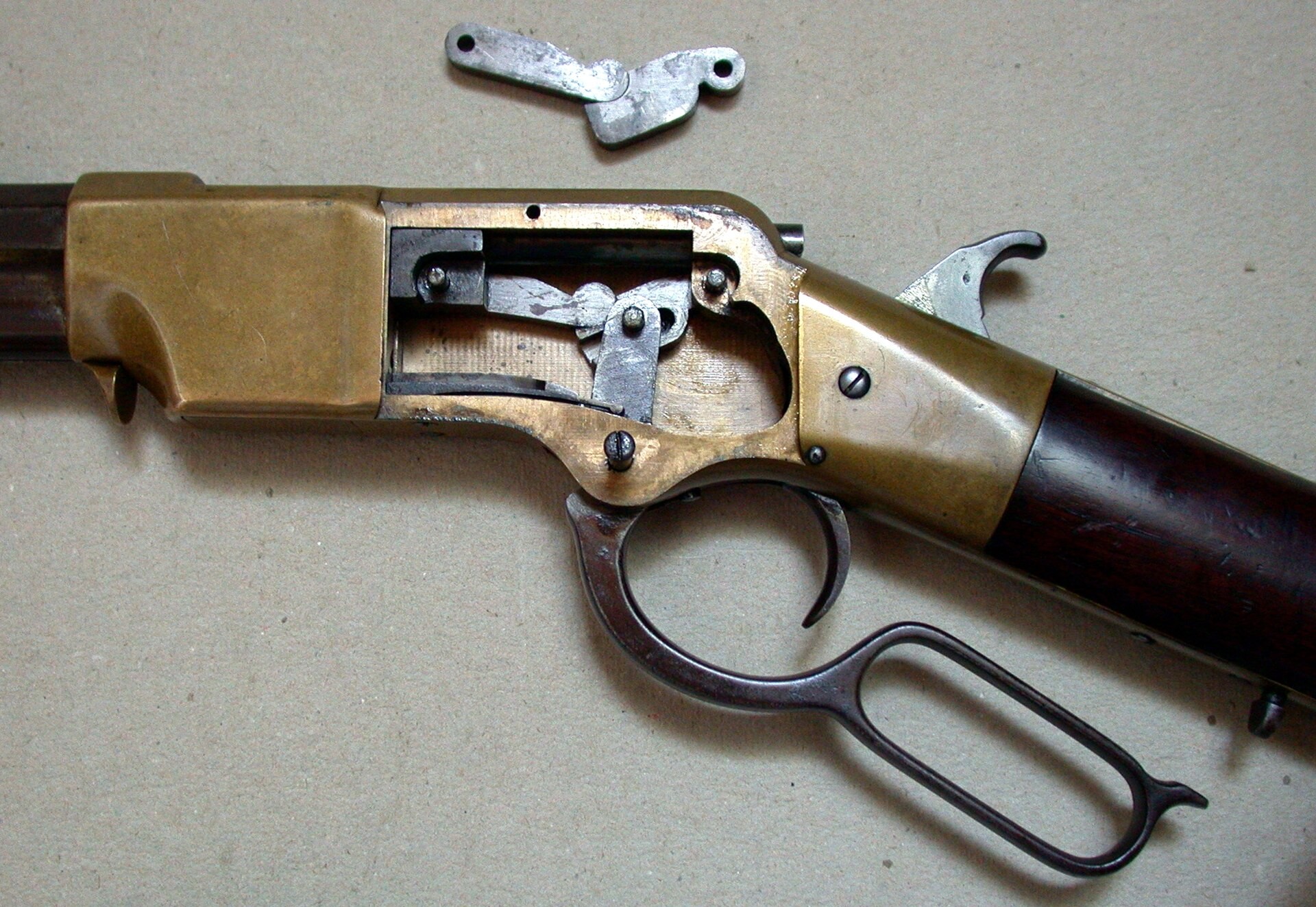
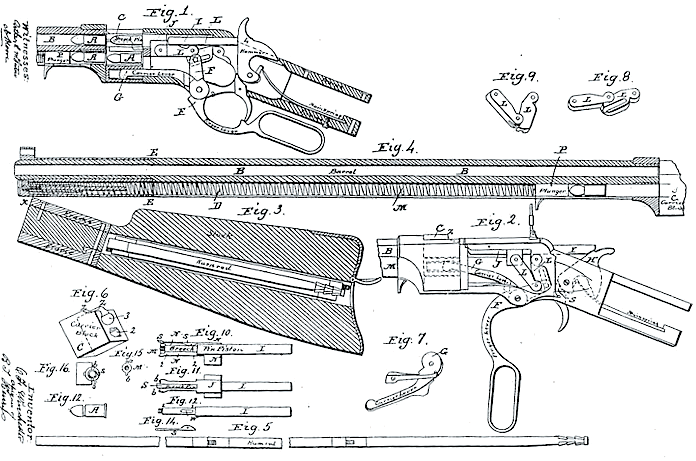
Volume 9 follows the Henry and its successor in full.
5.11 The toggle elsewhere
The toggle as a principle reappeared in arms that owe the Volcanic nothing directly. Eckert, in his ASAC Bulletin article on the Luger, writes: “One of the mechanisms that intrigued American designers especially was the toggle lock. The original Volcanic pistol was locked with a toggle mechanism, John M. Browning experimented with it, but the most successful to use the idea to facilitate a recoil operated firearm was Hiram Maxim.”2 He records that Hugo Borchardt “was hired by Winchester in 1873” and designed the C93 “incorporating the breech locking toggle principle of the Maxim”.2 The hub’s Borchardt C-93 dive takes that line up.
The difference is worth stating. In the Volcanic the toggle is worked by hand through the lever and held straight by it. In the Maxim and the Borchardt the toggle is driven open by recoil and closes under a spring; it is the same geometry doing a different job. The Volcanic’s claim on the principle is priority of use in a repeater, not descent.
References
Footnotes
-
Horace Smith and Daniel B. Wesson, US Patent 10,535, “Improvement in Fire-Arms”, 14 February 1854. Google Patents, https://patents.google.com/patent/US10535A/en , OCR text and patent PDF, accessed 2026-10-18. All quotations on the parts, the cycle and the claims. ↩ ↩2 ↩3 ↩4 ↩5 ↩6 ↩7 ↩8 ↩9 ↩10 ↩11 ↩12 ↩13 ↩14 ↩15 ↩16 ↩17 ↩18 ↩19
-
John Eckert, “A Luger Short Story”, American Society of Arms Collectors Bulletin 111 (2015), pp. 56–74, https://americansocietyofarmscollectors.org/wp-content/uploads/2022/04/2015-B111-Luger-Short-Story.pdf , accessed 2026-10-18. ↩ ↩2 ↩3
-
B. Tyler Henry, assignor to Oliver F. Winchester, US Patent 30,446, “Improvement in Magazine Fire-Arms”, 16 October 1860. https://patents.google.com/patent/US30446A/en , accessed 2026-10-18. ↩ ↩2 ↩3 ↩4
-
Springfield Weekly Republican (Springfield, Mass.), 23 February 1856, p. 1, Library of Congress, Chronicling America, https://www.loc.gov/resource/sn83020847/1856-02-23/ed-1/?sp=1 , accessed 2026-10-18. ↩ ↩2 ↩3 ↩4
-
Horace Smith and Daniel B. Wesson, assignors to the Volcanic Repeating Arms Company, US Patent 14,147, “Improved Primers for Cartridges of Fire-Arms”, 22 January 1856. https://patents.google.com/patent/US14147A/en , accessed 2026-10-18. ↩ ↩2 ↩3
-
Ed Lewis, “Volcanic Self-Contained Ammunition (A Cartridge Hound Special)”, Collector’s Firearms blog, 12 June 2025, https://collectorsfirearms.com/2025/06/12/volcanic-self-contained-ammunition-a-cartridge-hound-special/ , accessed 2026-10-18. ↩ ↩2 ↩3 ↩4
-
Rock Island Auction Company lot descriptions, 2009–2025, read 2026-10-18 and logged in 02-inputs/research-models-market.md, Appendix A: hook extractors on lots 87/1026, 84/35, 81/12 and 88/23; the “double nipple” extractor on lot 84/8; the period cartridge conversion with new firing pin on lot 82/2; condition faults on lots 4095/3007, 4094/6, 1047/4172, 87/82 and 88/23. ↩ ↩2 ↩3 ↩4 ↩5 ↩6
-
College Hill Arsenal, catalogue descriptions: New Haven Arms No. 1 pocket pistol, https://collegehillarsenal.com/new-haven-arms-no-1-volcanic-pocket-pistol ; Volcanic-marked Navy pistol, https://collegehillarsenal.com/Fine-Volcanic-Marked-Volcanic-Navy-Pistol ; accessed 2026-10-18. ↩ ↩2
-
Winchester Arms Collectors Association, “Volcanic Rifles & Pistols”, https://winchestercollector.org/?p=367 , accessed 2026-10-18. ↩
-
Walter Hunt, US Patent 6,663, 21 August 1849. https://patents.google.com/patent/US6663A/en , accessed 2026-10-18. ↩
-
Ian McCollum, “Loading Tool for a .31 Caliber Volcanic Repeater”, Forgotten Weapons, 30 November 2020, https://www.forgottenweapons.com/loading-tool-for-a-31-caliber-volcanic-repeater/ , accessed 2026-10-18. ↩
-
Nelson King, assignor to O. F. Winchester, US Patent 55,012, “Improvement in Magazine Fire-Arms”, 22 May 1866. https://patents.google.com/patent/US55012A/en , accessed 2026-10-18. ↩
-
Douglas D. Scott, “Historic Rifling Data Characteristics: Using Forensic Techniques to Further Archeological Inquiry into Firearms Use”, National Park Service, National Center for Preservation Technology and Training, September 2019, Appendix II, https://www.nps.gov/subjects/ncptt/upload/2019-01.pdf , accessed 2026-10-18. ↩
-
Joe Engesser, “The Volcanic Pistol: The First Smith & Wesson Handgun”, Rock Island Auction Company, 20 October 2022, https://rockislandauction.com/riac-blog/the-volcanic-pistol , read 2026-10-18, quoting a No. 2 cartridge box. ↩
Comments (0)