Volcanic Repeating Arms · Volume 6
Collecting, Condition, Fakes, Care and Taking One Apart
Fifty-odd auction results dated and sourced, what moves the price, a correctly marked modern copy that sold for $7,000, mismatched stocks, museum conservation guidance for brass and iron, and why no disassembly sequence is printed here
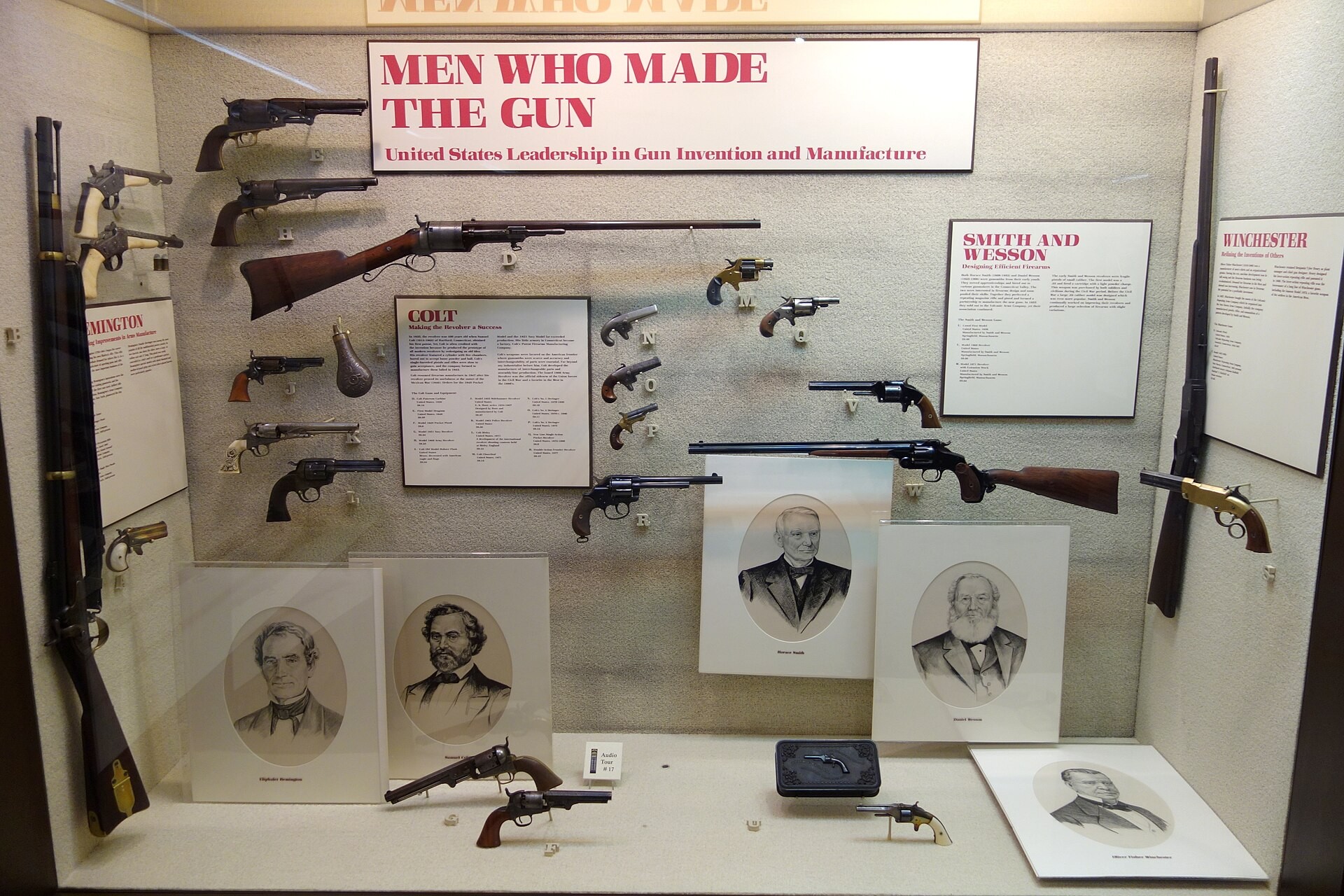
A Volcanic is an expensive antique that does not survive in great numbers and cannot be fired in its original form with any ammunition that exists. Collectors buy it as a document of the line that runs from Hunt to Winchester and Smith & Wesson. This volume sets out what the market has paid, what it pays more and less for, the reworks and copies that are documented, how museums say an antique of brass and iron should be handled and kept, and why a disassembly sequence is not given.
6.1 The market in one paragraph
From the auction record read for this dive, an ordinary, honest Volcanic company Navy pistol has hammered at Rock Island Auction for roughly $5,500 to $10,000 when it has problems (pitting, replating, mechanical faults) and $22,500 to $40,000 when it is excellent or engraved and cased. Smith & Wesson No. 1 pistols have mostly hammered between $6,500 and $9,000, with fine and documented examples at $17,000 to $30,000. New Haven Arms carbines have hammered at $17,000 to $30,000. The very top of the market is set by documented, cased and engraved pieces and by the long arms Smith & Wesson made in tiny numbers: a Smith & Wesson lever rifle, one of three known, sold for $488,750 with premium in June 2020.12 Those are observations from one house’s results, not a price index.
6.2 How the prices below were read
Rock Island Auction’s lot pages refuse automated reading by the usual tools; they were read through the hub’s shared fetcher, as its log directs.3 Each page carries a “hammer price”, which is the price before the buyer’s premium. That was checked: a New Haven Arms No. 2 Navy hammered at $37,500 in December 2024, and Rock Island’s own blog reports it as selling for $44,063, which is $37,500 plus 17.5 per cent.12 The premium in force at earlier sales was not checked, so the Rock Island figures below are hammer prices and a buyer paid more. James D. Julia’s and Greg Martin’s figures include their premium. Four Rock Island lots show no hammer price at all, which normally means unsold or passed; they are omitted.
Every lot is logged with its URL in this dive’s research notes. Serial numbers are given where the catalogue printed them.
6.3 Auction results by model
Volcanic Repeating Arms Company No. 2 Navy pistol, 8 in, .41.
Table 1 — Volcanic Repeating Arms Company No. 2 Navy pistol, 8 in, .41.
| Date | House, lot | Serial | Description | Price |
|---|---|---|---|---|
| 2006, spring | Julia 336 | 385 | Very fine; casting flaws; spliced period grip repair | $11,500 (with premium)4 |
| 2011-05-20 | RIA 1020 | 1752 | Period silver replate; pitting; magazine collar screw missing | $7,5001 |
| 2013, Oct. | Julia 1080 | 728 | ”Extremely fine plus”; about 99 per cent original brown barrel | $43,125 (with premium)4 |
| 2013-09-15 | RIA 3101 | 1732 | Extremely fine; ex-Winchester Gun Museum; follower a period replacement | $35,0001 |
| 2015-02-20 | RIA 5002 | — | Re-nickeled, “over 90% bright” | $8,0001 |
| 2016-12 | RIA 69/3000 | 1732 | The same pistol, resold | $35,0001 |
| 2020-06-05 | RIA 20 | 1094 | Engraved, silver-plated, ivory grips, factory case, box of New Haven Arms No. 2 cartridges | $35,0001 |
| 2020-12-04 | RIA 12 | — | Excellent, unengraved | $22,5001 |
| 2021-05-14 | RIA 2 | 1198 | Fine; period alteration to a brass cartridge | $12,0001 |
| 2021-05-14 | RIA 12 | 1441 | Excellent | $40,0001 |
| 2021-09-10 | RIA 83/7 | — | Very fine | $14,0001 |
| 2021-12-03 | RIA 35 | — | Very fine | $16,0001 |
| 2022-02-16 | RIA 1039/20 | — | Address “faintly visible” | $6,0001 |
| 2022-05-13 | RIA 85/22 | — | Exceptionally fine; bolt period-modified | $22,5001 |
| 2022-12-10 | RIA 1026 | 1689 | Excellent; gold-plated frame; 95 per cent barrel blue | $30,0001 |
| 2023-05-19 | RIA 88/23 | — | Very good; hairline crack in frame at breech | $10,0001 |
| 2024-05-17 | RIA 16 | — | Excellent; “no disassembly marks” | $27,5001 |
| 2024-05-17 | RIA 4091/1009 | — | Engraved, silver-plated; barrel blue a 19th-century retailer’s; grips re-varnished | $13,0001 |
| 2024-10-04 | RIA 1047/4172 | — | Fine; lever does not lock the hammer properly | $8,5001 |
| 2025-02-21 | RIA 1048/7 | — | Engraved; period silver replate; extensive pitting | $5,5001 |
| 2025-08-15 | RIA 4095/3012 | — | Excellent; “nine-shot” | $25,0001 |
| 2025-12-05 | RIA 4096/1016 | not printed | Description word for word that of serial 1732 | $22,5001 |
The last row is instructive. Serial 1732, an ex-Winchester Gun Museum pistol deaccessioned by the Cody museum, hammered at $35,000 in 2013 and again in 2016. A December 2025 lot carries an identical description and condition report, down to “three very small dents in the top of the right side plate”, without printing the serial, and hammered at $22,500. If it is the same pistol, which the identical text makes very likely but the catalogue does not confirm, it fell by about a third in hammer price over twelve years.1 One lot proves nothing about the market, and Rock Island’s blog reports a Navy selling for $12,925 with premium in February 2025 alongside one that hammered at $5,500 in the same sale.2
Smith & Wesson, Norwich.
Table 2 — Smith & Wesson, Norwich.
| Date | House, lot | Serial | Model and description | Price |
|---|---|---|---|---|
| 2002, fall | Julia 274 | 1 | No. 2, 8 in; numbers “might be redone”; “possibly refinished” | $14,375 (with premium)4 |
| 2015-04-24 | RIA 64/355 | 153 G | No. 1; fine; 35 per cent brown | $17,0001 |
| 2015-12-04 | RIA 1005 | 136 | No. 1, engraved; good; R. L. Wilson letter | $6,5001 |
| 2017-09-08 | RIA 71/17 | E 61 | No. 1 Type II; exceptionally fine; pictured in Lewis and Rutter | $30,0001 |
| 2020-12-04 | RIA 81/1 | — | No. 1 Type II, engraved; very good | $9,0001 |
| 2020-12-04 | RIA 81/28 | 52 | No. 2, 6 in; very good plus | $14,0001 |
| 2021-05-14 | RIA 1227 | 19 | No. 1 Type I; fine, all original | $19,0001 |
| 2022-12-09 | RIA 87/82 | 8 | No. 2 Type 1, deluxe engraved; elevator “needs some work” | $18,0001 |
| 2025-08-15 | RIA 4095/3043 | E15 | No. 1, engraved; very good | $8,5001 |
| 2025-08-15 | RIA 4095/15 | 53 | No. 1, engraved, ivory; “re-enhanced barrel markings and engraving” | $6,5001 |
Rock Island’s essay adds two sales with premium: a cased pair of engraved No. 1s at $80,500 and a Smith & Wesson pistol-carbine with detachable stock at $86,250, both in September 2020.2
New Haven Arms Company.
Table 3 — New Haven Arms Company.
| Date | House, lot | Serial | Model and description | Price |
|---|---|---|---|---|
| c. late 2004 | Greg Martin | — | Cased pair of ivory-gripped No. 1s, ex-King Farouk, “the only known cased pair” | $123,750 (with premium; reported as a record)5 |
| 2009-04-25 | RIA 3408 | 454 | No. 1; “Fine as period refinished” | $5,5001 |
| 2016-02-25 | RIA 1026/1 | — | Carbine, 21 in | $17,0001 |
| 2016-04-29 | RIA 67/1013 | 1981 | No. 2 Navy, 6 in, deluxe engraved, silver-plated | $45,0001 |
| 2019-09-06 | RIA 77/33 | — | Carbine, 16.5 in, factory engraved, silver-plated; all original | $30,0001 |
| 2020-06-05 | RIA 79/19 | — | Carbine, 16.5 in; plain brass “was polished” | $19,0001 |
| 2020-09-11 | RIA 80/17 | — | No. 2 Navy on a Volcanic company barrel | $27,5001 |
| 2020-12-04 | RIA 81/23 | 34 | Carbine, engraved, early; lower buttplate screw replaced | $27,5001 |
| 2021-09-10 | RIA 83/5 | — | No. 2 Navy, cased | $15,0001 |
| 2021-12-03 | RIA 84/8 | — | No. 2 Navy, early 1857, legend on left flat | $19,0001 |
| 2023-08-25 | RIA 89/1019 | 22 | Carbine, plain polished brass; some pitting | $17,0001 |
| 2023-12-08 | RIA 4090/7 | 68 | Carbine, 21 in, engraved; follower “crudely made period replacement” | $22,5001 |
| 2024-12-06 | RIA 4093/1009 | — | No. 2 Navy, 6 in, factory engraved | $37,500 ($44,063 with premium)12 |
| 2025-05-02 | RIA 4094/6 | 2017 | No. 1, engraved, silver-plated; lever does not stay up | $8,0001 |
| 2025-08-15 | RIA 4095/6 | 5 | No. 1, early, marked only “PATENT”; exceptionally fine | $15,0001 |
| 2025-08-15 | RIA 4095/3007 | 13 | Carbine, 16.5 in, plain; follower jammed | $20,0001 |
American Rifleman valued a New Haven No. 1 at $12,500 to $16,500 in Fine to Excellent condition in 2016.6
Pistol-carbines (Volcanic company, with attachable stock).
Table 4 — Pistol-carbines (Volcanic company, with attachable stock).
| Date | RIA lot | Serial | Description | Hammer |
|---|---|---|---|---|
| 2020-06-05 | 79/18 | 402 (stock 49) | New Haven-marked, factory cased, on Volcanic components | $30,0001 |
| 2020-09-11 | 80/1011 | 62 (stock 61) | With period telescope; four-line legend; period rimfire conversion | $37,5001 |
| 2020-10-08 | 1035/18 | — | Barrel shortened to 15.5 in; replacement stock that does not fit | $13,0001 |
| 2021-06-10 | 1037/42 | — | With stock; George Madis letter “original and correct” | $16,0001 |
| 2021-09-10 | 83/3010 | 478 | Stock only | $8,0001 |
| 2022-08-26 | 86/3024 | — | With stock; frame replated silver | $14,0001 |
Jennings and Smith-Jennings rifles, the precursors: a Jennings breech-loading single shot hammered at $9,500 in June 2020; Second Model Smith-Jennings repeaters at $16,000 (2023, documented, pictured in Lewis and Rutter) and $5,000 (2024, some pitting).1 A Smith-Jennings pistol, described in Lewis and Rutter as the only one known, sold for $23,000 with premium in June 2020.7
Ammunition. A Volcanic Repeating Arms Company 200-count No. 2 tin with its balls sold for $43,125 with premium in September 2020.2
No Volcanic lot was found at Morphy, Bonhams, Christie’s or Hindman in this research. The record is overwhelmingly one house’s, which is a limitation.
6.4 What moves the price
The catalogue language shows what the trade rewards and penalises. Rewarded: original finish expressed as a percentage (“95% barrel blue”, “85% plum brown”); “untouched patina”; “all original”; “perfect side-plate joints” and “no disassembly marks”; factory engraving; plating that is original rather than later; a factory case; documentation, whether a letter from George Madis or R. L. Wilson, a Cody museum letter for ex-Winchester Gun Museum pieces, or a page in Lewis and Rutter where the gun is pictured.1 Penalised: replating and re-nickeling, refinishing, re-varnished grips, polished brass, pitting, “re-enhanced” markings, replaced followers, screws and sights, mechanical faults, and frame cracks.1
Two points are specific to the Volcanic. First, disassembly marks on side-plate screws and joints are a recognised loss of value, because the side plates are how the action is reached and a careless screwdriver leaves evidence. Second, the follower is a known weak part: several catalogues describe followers as period replacements, one as “crudely made”, one as jammed.1
6.5 Reworks, restorations and fakes
A correctly marked modern copy exists and has been sold. Rock Island’s lot 1014/2229, sold on 27 February 2010, was catalogued as “an expertly made recreation of a Smith & Wesson Volcanic style lever-action pistol”, roll-marked “SMITH & WESSON/NORWICH CT./PATENT/CAST STEEL”, with an engraved iron frame and rosewood grips, and described as “extremely difficult to distinguish from an original example”. It hammered at $7,000.1 The legend it carries is the same as that recorded on an original S&W No. 2 (Volume 4). This is the clearest documented risk in the Volcanic market: a copy good enough that an auction house said it was hard to tell from an original, with correct markings.
Serials that may have been redone. James D. Julia, cataloguing an S&W large-frame pistol numbered 1 in 2002, wrote that its numbers were “slightly larger then those found on other Smith & Wesson Volcanics and might be redone”, that “The screws and marking show slight signs that the gun was possibly refinished”, and recommended “comparison with a known completely original specimen”.4
Restoration. Rock Island’s 2009 catalogue of S&W No. 2 serial 2: “Very good as restored”, cleaned, with an “applied plum-brown patina” and “reoiled replacement grips”.1
Re-enhanced markings. An S&W No. 1 sold in 2025 had “re-enhanced barrel markings and engraving”.1
Refinishing and replating, in many lots: “period replated silver”, “re-nickeled”, “period refinished”, “replated silver” on a pistol-carbine, a blue “touched up” over two inches at the breech, and a brass receiver that “was polished”.1 Note “period”: a replating done in the nineteenth century is still a replating, but the trade grades it less harshly than a modern one.
Composite pistol-carbines. A barrel “shortened to 15 1/2 inches”; a “replacement walnut attachable stock (doesn’t fit correctly)”; stocks that “are often mismatched”; and gun and stock numbers that differ even on sets accepted as original.1 A pistol-carbine with its stock is two objects to authenticate.
Not documented. No source was found for modern fakes carrying Volcanic company or New Haven Arms legends, for carbines made up from pistols, or for a collector-association warning bulletin. That is a statement about what was found, not a reassurance; the S&W copy shows that the skill exists.
6.6 Period alterations that are not fakes
Some Volcanics were altered in the nineteenth century to fire metallic cartridges, after the ball had failed. Rock Island has catalogued a Volcanic company Navy “period altered to a brass cartridge” with a new firing pin, a screw-fastened top extractor and a milled receiver and chamber; and a pistol-carbine with a “period rimfire conversion”, a fixed firing pin and two extractors.1 Pietro Venditti, in southern Italy in the 1870s, made copies of the Volcanic, some of which fired metallic cartridges with added extractors (Volume 7).8 And most Jennings repeaters were converted to single shots in their working lives (Volume 1). These alterations are part of the guns’ histories, they lower the price against an unaltered example, and they should be described for what they are rather than reversed.
6.7 Authentication: what the trade relies on
From the catalogues, the evidence a buyer can ask for:
- The barrel legend, read against Volume 4’s transcriptions, including the side flats on an S&W No. 1. A legend that is crisp where the surrounding finish is worn is a reason to look at it under magnification; “re-enhanced” is a catalogue word for a reason.
- Matching numbers inside the grips, on the frame, on the lever, inside the side plates and on internal parts (Volume 4 gives the locations by maker). Matching numbers are evidence of an original assembly. They are not proof, because numbers can be added; a mismatched part is not proof of fraud either, because followers and screws were replaced in period.
- Construction details by maker: iron or brass frame, part or full octagon barrel, one screw or two for the lever and side plates, the lever spur.
- Provenance: an expert letter, a museum deaccession, a published photograph.
- Comparison with a known original, which is Julia’s advice and remains the best.
6.8 Handling an antique that may be loaded
The National Park Service’s Conserve O Gram 10/1, Caring for Historic Longarms, written for museum staff and stated to apply to handguns too, opens with the rule: “Always handle firearms as though they are loaded.”9 For breech-loaders it says: “Carefully open the action (bolt, slide, or lever)”, “Shine a light down the barrel and/or use a small mirror”, and “If a cartridge will not easily eject from the breech, leave the action open and immediately consult a conservator or gun specialist who is familiar with antique firearms.” It adds: “Never fire an antique weapon” and “Caution: gunpowder, regardless of age, is dangerous.”9
A Volcanic needs two additions to that, both following from Volumes 3 and 5. First, a ball in the chamber will not “eject”: there is no case and no extractor for it, and the period instruction was to push a misfired ball back out with a rod from the muzzle, “leaving the carrier down”.2 Second, a breech check does not show the magazine. A Volcanic may hold balls in its tube with the chamber empty, and the balls are primed. The follower’s position in its slot shows whether the tube is empty: on a loaded gun the follower sits forward of the breech end, held back by the column (an inference from the patent’s arrangement, not a stated instruction). Lewis records that pressure on the primers could set balls off in the tube.10 An unknown Volcanic should be treated as possibly loaded in its magazine, and a gun found loaded should go to a specialist rather than be unloaded by working the action. NPS also advises storing “guns and ammunition separately”.9
6.9 Taking one apart: why no sequence is printed
No maker’s instructions, armourer’s manual or published collector’s procedure describing how a Volcanic comes apart was found in this research. The sources checked and found silent on it include the 1854 patent, Forgotten Weapons’ Volcanic articles of 2014 and 2017 (their videos were not transcribed), American Rifleman’s articles of 2016 and 2026, Rock Island’s essays and catalogues, and the NPS Conserve O Gram, which says explicitly that it “will not tell you how to dismantle and conserve guns. These techniques require specialist knowledge … If firearms in your collection need to be dismantled and cleaned, contact a conservator with experience in firearms for advice.”9 A broadside of about 1855, issued by the company’s New York agent J. W. Post, is described by a dealer as carrying “detailed operating instructions beneath the illustration”; its text has not been transcribed anywhere found, and a legible image was not obtained.11 It is the best lead for a period instruction.
This dive does not reconstruct a sequence from the patent drawings or from inference. A plausible-sounding procedure for a gun worth tens of thousands of dollars, with soft brass side plates and a market that marks down every screwdriver scratch, would do more harm than none.
What the sources do establish is what a correct procedure has to account for:
- The side plates come off. Julia records serial numbers “inside each side-plate, and on internal parts”; Rock Island prizes “perfect side-plate joints” and “no disassembly marks”.41 Access to the action is through the side plates, held by screws: two on an S&W, one shared with the lever on a New Haven No. 1.1
- The internals are numbered. Serials appear on the links, the bottom of the bolt, the carrier and the lever on some guns.14 Parts should go back where they came from.
- The magazine has its own system. Follower, spring, front section and collar (Volume 5), with a catch spring that catalogues call a “T-bar spring” or “magazine catch”.1 The spring is under compression whenever the follower is not fully forward.
- The frame is brass on most guns. Brass screw holes strip and brass edges dent. Screwdrivers must be fitted to the slots; catalogues treat marks on the screw heads as damage.
- Some guns have been altered. A period conversion may not come apart the way an unaltered gun does.
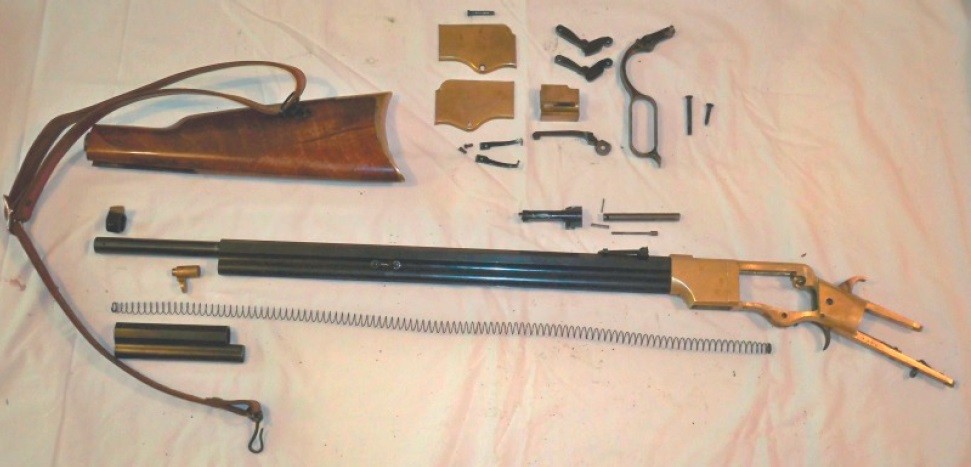
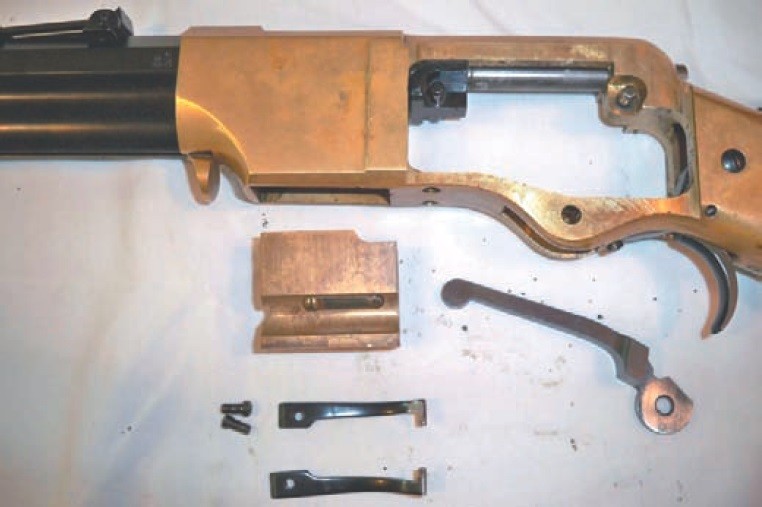
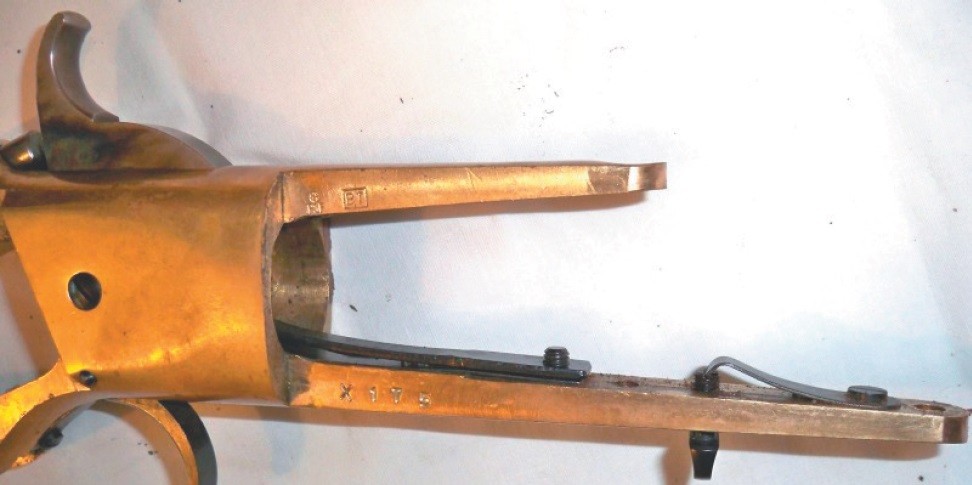
The related arm whose disassembly is documented is the Henry rifle. The National Park Service’s 19th Century Repeaters manual, prepared at Stones River National Battlefield for living-history use, photographs a Henry field-stripped and its action and magazine parts.12 Those photographs are reproduced below as a guide to how the descendant of the mechanism is laid out. They are a Henry, not a Volcanic, and the parts differ in size, number and detail.
6.10 Conservation and care
The museum guidance is short and specific. From the NPS Conserve O Gram 10/1:9
- Handle with cotton or plastic gloves; carry one arm at a time with both hands; pad the surfaces it rests on with closed-cell polyethylene foam.
- Clean dust “using a soft bristle brush and an adjustable powered vacuum with a small nozzle. Vacuum through a piece of cheesecloth or a fine screen”. Remove dried dirt “by using wooden toothpicks, or … sharp wooden or bone styluses … Do not use metal picks or tools”.
- Wood: “a light application of mineral spirits”, then “a coat of Renaissance wax or other high quality hard wax”.
- Metal: “Apply a small amount of lightweight, non-drying oil (lubricating or gun oil) on moving parts with a cotton swab. Remove excess oil.” “Wipe fresh fingerprints from metal using non-drying oil and a soft, clean cloth.”
- Keep a record: “Record the condition of each firearm before and after each maintenance treatment.”
- Environment: constant relative humidity, set with a conservator; temperature for comfort, 64 to 68 °F; no sunlight; ultraviolet filters; no leather slings or holsters stored with the gun, because “The leather can react with the metal”.
For the brass frames, the Canadian Conservation Institute’s notes apply. CCI Notes 9/3 says “Polishing … is an abrasive operation that removes tarnish and some surface metal” and “Repeated polishing results in loss of surface detail”; “If uncertainty exists on this point, it is safest to clean without polishing”, and “For objects in storage, always limit treatment to cleaning.” It warns that polishes made for automotive or stainless steel “often contain very hard particles”, and recommends a wax of “equal volumes of Shellsol or Varsol with a bleached micro-crystalline paste wax” containing “no synthetic components, such as polyethylene”.13 CCI Notes 9/13 describes dezincification, “a process in which zinc is lost and copper is left behind”, seen as “a change in colour, from the yellow typically found in brass to the salmon pink of pure copper metal”, caused by chlorides, acids and alkalis, including ammonia in some polishes; it recommends keeping brass clean, handling it with gloves, and avoiding commercial polishes where possible.14
Two cautions specific to the Volcanic follow. Many frames carry traces of original silver or gold plating (Volume 4); polishing removes plating along with tarnish, and the market prices original plating highly. And the Volcanic frame alloy is called “gunmetal” in the catalogues but has not been analysed in any source found, so whether it is a brass in the sense CCI 9/13 means, with enough zinc to dezincify, is not established.
The iron parts (Smith & Wesson frames, barrels, hammers, levers) take the NPS guidance for metal: a light non-drying oil, fingerprints wiped off, stable humidity. Original browning and bluing are thin and are lost to abrasive cleaning as surely as plating.
6.11 Repair
There is no parts supply. No maker has produced Volcanic parts since the 1860s, and Uberti’s announced reproduction (Volume 7) is a redesigned gun in .380 ACP, not a source of original-pattern parts. Repair of an antique Volcanic is therefore a matter of making a part or of leaving the fault alone, and the market’s view is plain from the catalogues: a period replacement is acceptable, a crude one is noted, and a modern one is a deduction.1
The faults recorded on surviving guns, from the same catalogues, are a lever that does not stay up, a hammer that does not lock when the lever is run, an elevator (carrier) that needs work, a jammed follower, a missing magazine-collar screw, stripped or replaced screws, cracked grips and a frame cracked at the breech.1 None of these should be repaired in a way that cannot be undone, and none should be repaired with the intention of firing the gun. The conservator’s principle, reversible and recorded, is the right one for an object whose value lies in its originality, and a frame crack at the breech is a reason never to load the gun at all.
6.12 Buying one
Most Volcanics change hands at auction, and a few through specialist dealers. A buyer should ask for: the barrel legend photographed in raking light, side flats included; the serial numbers under the grips and on the lever, photographed; the condition of the side-plate screws; whether the magazine follower, spring and front section work; and any letter or provenance. Rock Island’s condition reports are detailed and say plainly when a part is replaced, a finish is not original or a mechanism does not work, and that candour is the standard to ask of any seller.
The legal position of an original, made before 1899, is set out in Volume 7: under federal law and Michigan’s it is an antique and not a “firearm” for most purposes, and it can be bought and shipped without a dealer. That is not true of a modern copy.
References
Footnotes
-
Rock Island Auction Company lot descriptions and hammer prices, 2009–2025, read through the shared fetch engine on 2026-10-18 and logged with sale date, lot, serial, description, hammer price and URL in this dive’s research notes, 02-inputs/research-models-market.md, Appendix A. Hammer prices exclude the buyer’s premium. ↩ ↩2 ↩3 ↩4 ↩5 ↩6 ↩7 ↩8 ↩9 ↩10 ↩11 ↩12 ↩13 ↩14 ↩15 ↩16 ↩17 ↩18 ↩19 ↩20 ↩21 ↩22 ↩23 ↩24 ↩25 ↩26 ↩27 ↩28 ↩29 ↩30 ↩31 ↩32 ↩33 ↩34 ↩35 ↩36 ↩37 ↩38 ↩39 ↩40 ↩41 ↩42 ↩43 ↩44 ↩45 ↩46 ↩47 ↩48 ↩49 ↩50 ↩51 ↩52 ↩53 ↩54 ↩55 ↩56 ↩57 ↩58 ↩59 ↩60 ↩61 ↩62 ↩63 ↩64 ↩65 ↩66 ↩67 ↩68 ↩69
-
Rock Island Auction Company blog: Joe Engesser, “The Volcanic Pistol: The First Smith & Wesson Handgun”, 20 October 2022, https://rockislandauction.com/riac-blog/the-volcanic-pistol ; and “Lever Action Pistol”, https://www.rockislandauction.com/riac-blog/lever-action-pistol ; read 2026-10-18. Captioned sale prices include premium. ↩ ↩2 ↩3 ↩4 ↩5 ↩6 ↩7
-
Photo Helper, FETCH_LOG.md (the hub’s fetch log), entries of 2026-09-19 and 2026-09-20 on reading Rock Island Auction lot pages. ↩
-
James D. Julia, lot descriptions with prices realised including premium, accessed 2026-10-18: lot 274, Fall 2002, https://jamesdjulia.com/item/274-122/ ; lot 336, Spring 2006, https://jamesdjulia.com/item/lot-336-rare-volcanic-navy-pistol-57491/ ; lot 1080, Fall 2013, https://jamesdjulia.com/item/lot-1080-rare-volcanic-arms-navy-size-lever-action-pistol-49410/ . ↩ ↩2 ↩3 ↩4 ↩5 ↩6
-
“Bids Overflow for Volcanic Pistols in San Francisco”, Antiques and the Arts Weekly, 4 January 2005, https://antiquesandthearts.com/bids-overflow-for-volcanic-pistols-in-san-francisco/ , accessed 2026-10-18. ↩
-
“I Have This Old Gun: New Haven ‘Volcanic’ No. 1 Pocket Pistol”, American Rifleman, 16 September 2016, https://americanrifleman.org/content/i-have-this-old-gun-new-haven-volcanic-no-1-pocket-pistol , accessed 2026-10-18. ↩
-
Rock Island Auction Company, “Lever Action Pistol”, RIAC blog, read 2026-10-18, citing Lewis and Rutter, Volcanic Firearms. ↩
-
Ian McCollum, “Pietro Venditti Copies the Volcanic Repeating Pistol”, Forgotten Weapons, 25 March 2020, https://www.forgottenweapons.com/pietro-venditti-copies-the-volcanic-repeating-pistol/ , accessed 2026-10-18. ↩
-
Allan L. Montgomery, “Caring for Historic Longarms: Storage and Handling Requirements”, Conserve O Gram 10/1, National Park Service, May 1999, https://www.nps.gov/subjects/museums/upload/10-01_508.pdf , accessed 2026-10-18. ↩ ↩2 ↩3 ↩4 ↩5
-
Ed Lewis, “Volcanic Self-Contained Ammunition (A Cartridge Hound Special)”, Collector’s Firearms blog, 12 June 2025, https://collectorsfirearms.com/2025/06/12/volcanic-self-contained-ammunition-a-cartridge-hound-special/ , accessed 2026-10-18. ↩
-
Union Drummer Boy, dealer listing, “Rare Broadside Advertising the Volcanic Repeating Fire-Arms”, J. W. Post, sole agent, c. 1855, inventory FIR 190, https://uniondb.com/product/rare-broadside-advertising-the-volcanic-repeating-fire-arms/ , accessed 2026-10-18. ↩
-
Stones River National Battlefield, National Park Service, 19th Century Repeaters manual (2018), photographs and drawings as hosted on Wikimedia Commons (“Henry rifle field stripped.jpg”, “Henry rifle action disassembled.jpg”, “Henry rifle frame.jpg”), public domain, accessed 2026-10-18. ↩
-
Bob Barclay and Charles Hett, “The Cleaning, Polishing and Protective Waxing of Brass and Copper”, CCI Notes 9/3, Canadian Conservation Institute (1983, revised 1988 and 2007), https://www.canada.ca/en/conservation-institute/services/conservation-preservation-publications/canadian-conservation-institute-notes/care—brass-copper.html , accessed 2026-10-18. ↩
-
Lyndsie Selwyn, “Preventing and Treating the Dezincification of Brass”, CCI Notes 9/13, Canadian Conservation Institute, 2019, https://www.canada.ca/en/conservation-institute/services/conservation-preservation-publications/canadian-conservation-institute-notes/dezincification-brass.html , accessed 2026-10-18. ↩
Comments (0)