Volcanic Repeating Arms · Volume 7
Firing One Today, Reproductions, and the Law
Why an original should not be fired, the absence of any commercial Volcanic ammunition, Uberti's 2026 prototype in .380 ACP, a half-scale copy that fires BBs on percussion caps, Italian copies of the 1870s, and what federal and Michigan law make of an original and of a newly made copy
This volume answers three practical questions: can an original be fired, does anyone make a reproduction or the ammunition for one, and what does the law say about an original and about a new one. The last question decides whether the build path in Volume 8 produces an antique or an ordinary firearm, so it is treated at length. Nothing here is legal advice. The statutes are quoted so that a reader can take them to someone qualified rather than take this page’s word for them.
7.1 Two questions that are easy to confuse
An original Volcanic, made between 1854 and about 1860, is an antique firearm under federal law because of when it was made. That status is settled and simple (§ 6).
A newly made Volcanic-pattern repeater is not an antique because of when it was made, since it was made now. Whether it is an antique at all depends on whether it falls within the replica clause of the federal definition, and that turns on whether its ammunition is “rimfire or conventional centerfire fixed ammunition”. For a gun firing a self-primed caseless ball, that is a genuinely open question (§ 7). For a gun firing .22 LR or .380 ACP, as every modern reproduction found does, it is not open at all: those are firearms.
7.2 Firing an original
It should not be done, and the museum position is unequivocal. The National Park Service’s Conserve O Gram on historic longarms says: “Never fire an antique weapon.”1 An instructor’s article for NRA Women adds the general warning that “Antique firearms in a firearms training course can create a potential hazard”, and that modern smokeless loads in arms made for black powder “could cause a catastrophic failure of equipment”.2 That article is one instructor’s advice, not NRA policy, and no NRA or collector-association written policy on firing originals was found.
For a Volcanic the reasons are specific, and they come from Volumes 3 to 6:
- The ammunition is the hazard. Lewis records chain fire in the magazine from pressure on the thin priming, balls firing as the breech closed, balls left half in the chamber, and spent primers jamming the action.3 A surviving period ball is at least 165 years old and its fulminate’s condition is unknowable from outside; Lewis records that iron anvil discs slowly deactivated the primer, which means some balls are inert and some are not.3
- The gun is old brass. The frames are an unanalysed “gunmetal” alloy, and at least one catalogued Navy has “a hairline crack in frame at breech”.4 The lock is a toggle held straight by the lever (Volume 5), on a gun whose lever, catalogue reports note, sometimes “does not stay up”.4
- The market prices it on originality. A part damaged in firing cannot be bought (Volume 6).
There is a record of originals being fired in recent years, and it is thin. A dealer’s listing for a New Haven Arms Navy, serial 2442, says it was “featured and test fired on an episode of History Channel’s Pawn Stars in October 2023”; the ammunition is not stated and the episode was not checked.5 On the Single Action Shooting Society’s forum in May 2021 one member recalled a video of a member “firing one with original type ammo some years back”, and another said fired originals “made more of a hissing sound”.6 A Cowboy Action forum thread of 2020–21 reports that a television series, American Guns, made a small batch of replica rocket balls and fired them in an original .41 Navy; the poster could not find the episode, another member said many episodes were “faked”, and this research found no trace of it either.7 A YouTube video titled “Volcanic ‘Rocket Ball’ Fire Test”, by the channel Boom Depot, exists; its title and channel were confirmed, but its description, the gun used and whether the balls were original or reproduction could not be read, and it is listed here as unverified.8 Ian McCollum’s Forgotten Weapons articles on the Volcanic handle originals and an original box of ammunition but do not describe live firing.9
None of that is evidence that firing an original is safe. It is evidence that it has occasionally been done.
7.3 Is there any ammunition?
No commercial Volcanic or rocket-ball ammunition exists, and none has been made commercially since about 1860. Searches of collector forums, cowboy-action forums, cartridge-collector forums and the trade press found no maker and no product.10 All4shooters, reporting Uberti’s 2026 prototype, says Uberti ruled out rocket-ball ammunition for its reproduction.11 The one forum member who asked, in 2021, whether anyone had made a modern rocket ball got the American Guns rumour in reply, and himself built a non-firing dummy round.7
No published method for loading rocket-ball-style projectiles with modern components was found. That absence matters for Volume 8, which treats the ammunition as the hardest problem in building a reproduction and sets out the choices rather than a recipe. It matters for the law too, because whether a newly made gun is an antique depends on what it fires (§ 7).
Original period balls do exist and are collected; a full tin sold for $43,125 in 2020 (Volume 3). They are collectors’ objects and, for the reasons above, not ammunition.
7.4 Reproductions: what exists
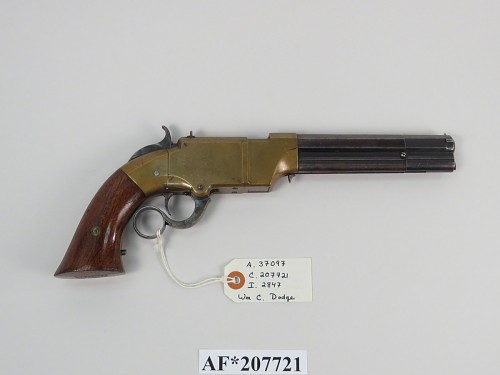
Uberti’s prototype, 2026. All4shooters reported in August 2026 that Uberti’s president, Giacomo Merlino, showed a prototype lever-action pistol “from the Volcanic family” at trade shows in March 2026, including EOS in Parma. The display gun was deactivated with a dummy barrel. “Based on the current development status, Uberti is expected to chamber the new Volcanic in .380 ACP.” The prototype had “an unfinished eight-inch barrel”; “A six-inch version is also planned”; the eight-inch magazine is to hold seven rounds and the six-inch five. “The Uberti Volcanic has a brass frame.” It loads by an external follower button in a slot along the magazine tube, pushed forward until spring and follower lock under the muzzle, after which “The magazine-tube end cap can then be released and rotated sideways”, which is the original’s system. It “should enter series production in 2027”, and US-market pistols will need “an automatic safety system, such as a transfer bar”. No price was given.11 GUNSweek (29 March 2026) and Armi e Tiro (25 April 2026) report the same: a prototype for production in 2027, in .380 ACP, with six- and eight-inch barrels; Armi e Tiro says the reproductions “riproducono con fedeltà il progetto Volcanic”, reproduce the Volcanic design faithfully.12 A Smith & Wesson Forum member who saw it wrote that “the receiver had to be stretched and redesigned quite a bit so it doesn’t look much like an original”.13 No product page or press release from Uberti was found. As of October 2026 it is an announced prototype, not a product.
If it reaches the market in .380 ACP, it will be an ordinary modern firearm under federal law, sold through dealers, because .380 ACP is conventional centerfire ammunition in current manufacture (§ 7). It would also be the first commercial Volcanic reproduction of any kind found in this research.
Burke Gallery Guns, half scale. The Firearm Blog described in July 2017 a 1:2 scale functional copy of the Volcanic pistol: “Their pistol fires 4.5mm steel BBs powered by #10 black powder percussion caps”, “all parts (except the springs) of these miniature replicas are CNC machined rather than being cast”, at about 350 to 450 feet per second, with “an MSRP of $599.95”.14 Whether it is still offered was not checked. Miniatures firing caps occupy their own legal space and are not covered here.
Small builds, unverified. A SASS forum member recalled in 2021 that “Don Barker from Cody, Wy was building Volcanic pistols in 22lr. He built about 40 total”, with a named gunsmith fitting parts around 2000.6 Another described a scratch-built Volcanic rifle, “Charlie’s .40 cal Volcanic”, made “to fire brass cased ammo” on modified .40 S&W brass, and a third linked a home-gunsmithing scratch-build thread of twenty-eight pages.6 None of the underlying threads could be opened, and this research found no other trace of the Barker pistols. They are reported as forum recollections.
Modern copies sold at auction. Rock Island catalogued in 2010 “an expertly made recreation of a Smith & Wesson Volcanic style lever-action pistol”, correctly roll-marked, which hammered at $7,000 (Volume 6).4 A Collector’s Firearms listing for a quarter-scale working miniature of a Volcanic Navy appeared in search results but could not be opened.
Period copies. Pietro Venditti, in southern Italy in the mid-to-late 1870s, made copies of the Volcanic, according to Forgotten Weapons. He held patents of 1872 for a two-barrelled rocket-ball pistol, of 1875 for a Volcanic-type arm with a 26-round capacity, and of 1877 for a cartridge, and built a few hundred guns of two types: one with two auxiliary refill tubes, and one closer to the Volcanic but firing metallic cartridges, with extractors added to the bolt.15
Not found. No Volcanic from Denix, Pedersoli, Cimarron, Taylor’s, Navy Arms, Dixie Gun Works or Armi San Marco was found by search. That rests on searches, not on checking each catalogue item by item. Smith & Wesson’s modern “Model 1854” is a side-gate lever rifle in magnum calibres named for the patent year; it is not a Volcanic reproduction.10
7.5 The nearest thing on the market
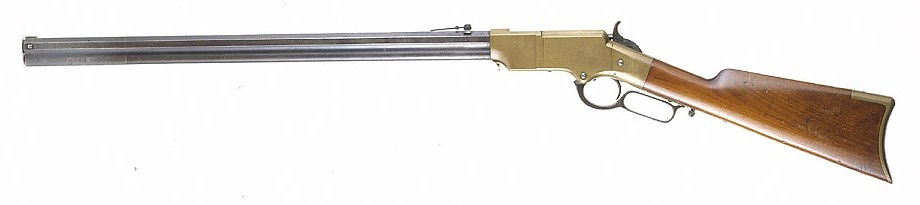
The commercially available guns closest to the Volcanic are reproductions of its direct descendants, the Henry rifle and the Winchester Model 1866, both toggle-link lever actions with brass frames. Prices from the makers’ own pages on 18 October 2026:
Table 1 — The commercially available guns closest to the Volcanic are reproductions of its direct descendants, the Henry rifle and the Winchester Model 1866, both toggle-link lever actions with brass frames. Prices from the makers' own pages on 18 October 2026
| Gun | Maker | Calibre and barrel | Listed price | Source |
|---|---|---|---|---|
| 1860 Henry Rifle, brass frame | Uberti | .44-40, 24.5 in | $1,679 | uberti-usa.com16 |
| 1860 Henry Rifle, brass frame | Uberti | .45 Colt, 24.5 in | $1,579 | uberti-usa.com16 |
| 1860 Henry Rifle, steel frame | Uberti | .45 Colt, 24.5 in | $1,679 | uberti-usa.com16 |
| The Original Henry Rifle, H011 and H011C | Henry Repeating Arms | .44-40 or .45 Colt, 24.5 in | $3,015 | henryusa.com17 |
| 1866 Yellowboy Short Rifle | Uberti | .45 Colt, 20 in | $1,549 | uberti-usa.com16 |
| 1866 Yellowboy Sporting Rifle | Uberti | .45 Colt, 24.25 in | $1,349 | uberti-usa.com16 |
Uberti notes that “Specifications and prices are subject to change without notice.” Henry Repeating Arms describes its Original Henry with a “specially-formulated hardened brass receiver” and a “one-piece octagonal barrel and magazine”.17 All of these are modern firearms in current calibres, sold through dealers. The hub’s Henry SPD Hush dive covers a modern Henry Repeating Arms lever gun.
7.6 The law: an original
The federal definition is in 18 U.S.C. § 921(a)(16):18
“The term “antique firearm” means— (A) any firearm (including any firearm with a matchlock, flintlock, percussion cap, or similar type of ignition system) manufactured in or before 1898; or (B) any replica of any firearm described in subparagraph (A) if such replica— (i) is not designed or redesigned for using rimfire or conventional centerfire fixed ammunition, or (ii) uses rimfire or conventional centerfire fixed ammunition which is no longer manufactured in the United States and which is not readily available in the ordinary channels of commercial trade; or (C) any muzzle loading rifle, muzzle loading shotgun, or muzzle loading pistol, which is designed to use black powder, or a black powder substitute, and which cannot use fixed ammunition. …”
And § 921(a)(3), defining “firearm”, ends: “Such term does not include an antique firearm.”18
Every original Volcanic, Smith & Wesson and New Haven Arms arm was made between 1854 and about 1860, so every one falls within subparagraph (A) by date alone. ATF’s question-and-answer page puts the result plainly: “Do antique firearms come within the purview of the GCA? No.”19 An original can be bought, sold and shipped across state lines without a dealer as far as the Gun Control Act is concerned. The National Firearms Act’s own definition, in 26 U.S.C. § 5845(g), also covers any firearm “manufactured in or before 1898” that is not designed for conventional fixed ammunition, so an original pistol-carbine with its stock is outside the NFA too.20
The hub’s Protector Palm Pistol dive, Vol 8 walks through the same definition for another self-contained-cartridge oddity of the nineteenth century, including its interaction with the NFA, and the DL-44 dive, Vol 10 applies it to pre-1899 Mauser C96s.
7.7 The law: a newly made copy
A Volcanic made now fails subparagraph (A), which turns only on the date of manufacture. Subparagraph (C) is for muzzle-loaders and does not fit a breech-loading repeater. That leaves (B), the replica clause, and it has two elements.
Is it a “replica of any firearm described in subparagraph (A)”? The Volcanic is a pre-1899 design, so a faithful copy is a replica of one. The word “replica” is not defined in the statute or in ATF’s regulation at 27 CFR 478.11, which repeats the statutory definition and adds no definition of either “replica” or “fixed ammunition”.21 A loosely inspired design with modern features weakens this element. Uberti’s prototype, said to have a stretched and redesigned receiver, illustrates the question even before its calibre is considered.
Is it “not designed or redesigned for using rimfire or conventional centerfire fixed ammunition”? For a copy in .22 LR, .380 ACP or any other modern cartridge, plainly not: it is designed for exactly that, and clause (ii) does not help because those cartridges are in current manufacture. Such a copy is an ordinary firearm.
For a copy built to fire a self-primed caseless ball like the original, the question is open, and it has two parts.
Is a Volcanic ball “fixed ammunition”? The only federal regulatory definition found is in ATF’s National Firearms Act regulations, not its Gun Control Act regulations: “Fixed ammunition. That self-contained unit consisting of the case, primer, propellant charge, and projectile or projectiles.”22 A Volcanic ball has no case separate from its projectile; the bullet is the container. That supports an argument that it is not fixed ammunition. Against it: the 1856 primer has its own copper or brass “case” in the patent’s own word; ATF may read “fixed ammunition” functionally, as any self-contained round; and the period sources called these rounds “ball cartridges” and “a complete cartridge, cased water tight in metal”.23 The argument is arguable, not settled.
If it is fixed ammunition, is it “conventional centerfire”? The ball is struck at the centre of its base. The statute’s word is “conventional”, and a self-primed hollow ball with an iron disc and a cork is not what anyone means by conventional. The risk is in the primer a modern builder would use. ATF’s Industry Circular 98-2 of 1997, concerning in-line muzzle-loaders ignited by shotshell primers, took the position that “Primers are not an antique ignition system”, and Congress overrode that only for muzzle-loaders, by adding subparagraph (C) in 1998.24 A builder who seats a standard commercial small pistol primer in the base of a hollow ball has moved the round a long way toward “conventional centerfire” in ATF’s eyes. A period-pattern primer of the 1856 kind is further from it, and making one raises the practical and safety problems Volume 8 discusses.
Is the ammunition “no longer manufactured in the United States and … not readily available”? If the round is fixed ammunition at all, clause (ii) asks whether it is in commercial manufacture, and Volcanic ammunition has not been since about 1860 (§ 3). But clause (ii) applies only to “rimfire or conventional centerfire” ammunition, so it helps only if the first argument fails and the second succeeds. And a builder making his own balls does not make them “readily available in the ordinary channels of commercial trade”; a maker who began selling them commercially might.
No ATF ruling or letter on a Volcanic replica, on rocket-ball ammunition, or on any self-primed caseless round’s effect on antique status was found.25 The only authoritative answer is a voluntary classification request, with a sample, to ATF’s Firearms and Ammunition Technology Division. Anyone intending to build a Volcanic-pattern arm and treat it as an antique should get one first. The hub’s Daisy dive covers a caseless rifle of 1968, the V/L, which was sold as an ordinary firearm; it was not a replica of a pre-1899 design, so the antique question never arose for it.
7.8 The NFA trap in the pistol-carbine

The original pistol-carbine was a pistol with an eight- or sixteen-inch barrel and an attachable shoulder stock (Volume 4). An original is an antique and outside the NFA. A newly made copy that is not an antique is an ordinary firearm, and if it has a shoulder stock and a barrel under sixteen inches it is a short-barreled rifle under the National Firearms Act. The NFA’s antique definition, § 5845(g), uses almost the same words as the Gun Control Act’s: a firearm “not designed or redesigned for using rim fire or conventional center fire ignition with fixed ammunition and manufactured in or before 1898 (including any matchlock, flintlock, percussion cap, or similar type of ignition system or replica thereof, whether actually manufactured before or after the year 1898)”.20 The same open questions apply. ATF’s guide to NFA definitions frames the antique test around the ignition system and the availability of the ammunition: it treats an original antique rifle with a short barrel as subject to the NFA “because it employs a conventional ignition system and uses fixed ammunition that is readily available”.26
Two consequences for a builder. A stocked copy of the eight-inch pistol, if it is not an antique, must be registered as a short-barreled rifle before it is made. Public Law 119-21 took the making tax on short-barreled rifles to $0 but left registration in place, as the hub’s Suppressor Law dive, Vol 3 explains. And the original carbines’ barrels were catalogued at 16.25 to 16.5 inches, close enough to the sixteen-inch line that a copy should be measured by ATF’s method before it is assumed to be a rifle.4
7.9 Making one for yourself, federally
If a new Volcanic-pattern arm is an antique, it is not a “firearm” under the Gun Control Act, and the Act’s rules on manufacture, marking and transfer do not touch it.19
If it is not an antique, it is an ordinary firearm, and federal law allows an individual to make one for his own use without a licence. ATF’s question-and-answer page: “No, a license is not required to make a firearm solely for personal use. However, a license is required to manufacture firearms for sale or distribution.”27 The 2022 rule on frames and receivers, 27 CFR 478.12, defines the receiver of a long gun as “the part … that provides housing or a structure for the primary component designed to block or seal the breech prior to initiation of the firing sequence (i.e., bolt, breechblock, or equivalent)”, and the frame of a handgun as the part housing the sear or its equivalent.28 For a Volcanic-pattern arm that is the brass frame. The Supreme Court upheld the rule against a facial challenge in Bondi v. VanDerStok in March 2025; its later treatment by ATF was not checked.28 A privately made firearm that passes into a licensed dealer’s inventory must then be marked under the privately-made-firearm rules.21
7.10 Michigan
Michigan exempts antique firearms from its licensing law, and defines them in the National Firearms Act’s words rather than the Gun Control Act’s.
MCL 28.422(1) provides that, except as otherwise provided, a person shall not “(a) Purchase, carry, possess, or transport a pistol in this state without first having obtained a license for the pistol”, nor “(b) Purchase a firearm that is not a pistol in this state without first having obtained a license for the firearm”.29 MCL 28.432(1)(h) provides that section 2 (that is, § 28.422) “does not apply to … (h) Purchasing, owning, carrying, possessing, using, or transporting an antique firearm. As used in this subdivision, “antique firearm” means that term as defined in section 231a of the Michigan penal code”.29
MCL 750.231a(2) defines it:29
“As used in this section, “antique firearm” means either of the following: (i) A firearm not designed or redesigned for using rimfire or conventional center fire ignition with fixed ammunition and manufactured in or before 1898, including a matchlock, flintlock, percussion cap, or similar type of ignition system or replica of such a firearm, whether actually manufactured before or after 1898. (ii) A firearm using fixed ammunition manufactured in or before 1898, for which ammunition is no longer manufactured in the United States and is not readily available in the ordinary channels of commercial trade.”
That is the § 5845(g) wording. There is no separate replica subparagraph and no muzzle-loader clause, and the replica language hangs off a firearm “not designed or redesigned for using rimfire or conventional center fire ignition with fixed ammunition”. The “conventional center fire” question in § 7 is therefore the same question in Michigan.
The general definitions in MCL 750.222 and MCL 28.421 define “firearm” and “pistol” (a firearm “26 inches or less in length”) and contain no antique-firearm definition or exclusion.29 Every Volcanic pistol, including the sixteen-inch pistol-carbine without its stock, is a “pistol” by that length test, which matters only if it is not an antique.
The practical result:
- An original is an antique under § 750.231a(2)(i), by date and ignition, and is outside the licensing requirement of § 28.422.
- A newly made copy in a modern cartridge is an ordinary firearm; a pistol needs the licence and the record-keeping the hub’s Remington XP-100 dive, Vol 5 describes for Michigan pistols.
- A newly made copy firing a period-pattern self-primed ball may or may not be an antique, on the same open questions as federally.
- Whether Michigan requires any record for a pistol that its owner made rather than bought, if it is not an antique, was not resolved. The licence covers purchasing, carrying, possessing and transporting; the sales-record duties attach to sales. No Michigan State Police statement on self-made pistols was found, and the question should be put to the State Police or a Michigan firearms lawyer.
Section 750.231a(1) also contains an exception to the pistol-carrying offence for a person carrying an antique firearm completely unloaded in a closed case in the trunk of a vehicle; its full wording should be read on the legislature’s site before it is relied on.29
7.11 What to do before building
- Decide what the reproduction will fire. A modern cartridge settles the law: it is a firearm, federally and in Michigan.
- If the aim is an antique, design it as a faithful replica of a specific pre-1899 model, firing a self-primed ball with no conventional primer, and expect to defend both points.
- Before making it, ask ATF’s Firearms and Ammunition Technology Division for a classification, with drawings and a sample of the ammunition.
- Do not fit a shoulder stock to a pistol with a barrel under sixteen inches unless it is classified as an antique or registered first.
- In Michigan, get advice on the pistol question if the arm will not be an antique.
Volume 8 sets out the build itself.
References
Footnotes
-
Allan L. Montgomery, “Caring for Historic Longarms: Storage and Handling Requirements”, Conserve O Gram 10/1, National Park Service, May 1999, https://www.nps.gov/subjects/museums/upload/10-01_508.pdf , accessed 2026-10-18. ↩
-
Heidi Lyn Rao, “Firearm Trainers: 4 Dangerous Pitfalls to Avoid”, NRA Women, 10 August 2022, https://www.nrawomen.com/content/firearm-trainers-4-dangerous-pitfalls-to-avoid , accessed 2026-10-18. ↩
-
Ed Lewis, “Volcanic Self-Contained Ammunition (A Cartridge Hound Special)”, Collector’s Firearms blog, 12 June 2025, https://collectorsfirearms.com/2025/06/12/volcanic-self-contained-ammunition-a-cartridge-hound-special/ , accessed 2026-10-18. ↩ ↩2
-
Rock Island Auction Company lot descriptions, read 2026-10-18 and logged in 02-inputs/research-models-market.md, Appendix A: lot 88/23 (frame crack), 4094/6 (lever), 1014/2229 (the 2010 copy), carbine lots 4095 sale p. 63 and 80/1011 (barrel lengths). ↩ ↩2 ↩3 ↩4
-
International Military Antiques, listing for a New Haven Arms Volcanic Navy, serial 2442, https://www.ima-usa.com/products/original-u-s-civl-war-1857-new-haven-arms-co-volcanic-navy-8-inch-barrel-belt-pistol-41-lever-action-serial-no-2442-as-seen-on-history-channel-pawn-stars , accessed 2026-10-18. Dealer listing. ↩
-
SASS Wire forum, “Volcanic” thread, May 2021, https://forums.sassnet.com/index.php?%2Ftopic%2F316730-volcanic%2F= , posts of 4, 5, 7 and 11 May 2021, accessed 2026-10-18. Forum recollections. ↩ ↩2 ↩3
-
CAS City forum, “Need ammo for your Volcanic?”, 1860 Henry board, started 25 August 2020, https://www.cascity.com/forumhall/index.php?topic=64458.0 , posts of 6 April 2021, accessed 2026-10-18. ↩ ↩2
-
Boom Depot, “Volcanic ‘Rocket Ball’ Fire Test”, YouTube, https://www.youtube.com/watch?v=sX_xyXNbb0o ; title and channel confirmed 2026-10-18; content not confirmed. ↩
-
Ian McCollum, Forgotten Weapons: “Volcanic Repeating Pistol (Video)”, 5 May 2014; “The Volcanic: Smith & Wesson’s First Pistol”, 18 August 2017; “Original Volcanic ‘Rocket Ball’ Cartridges”, 24 August 2020; https://www.forgottenweapons.com , accessed 2026-10-18. ↩
-
Searches recorded in 02-inputs/research-ammo-mech-repro.md, sections 4.1 and 5.2, 2026-10-18: International Ammunition Association forum, CAS City, SASS Wire, all4shooters, and the ranges of the makers named. Absence found by search, not by item-by-item catalogue checks. ↩ ↩2
-
Matthias S. Recktenwald, “Uberti presents the prototypes of the Volcanic replica”, all4shooters, 23 August 2026, https://www.all4shooters.com/en/shooting/culture/uberti-presents-the-prototypes-of-the-volcanic-replica/ , accessed 2026-10-18. ↩ ↩2
-
“Uberti prototype Volcanic pistol”, GUNSweek, 29 March 2026, https://gunsweek.com/en/pistols/news/uberti-prototype-volcanic-pistol ; Ruggero Pettinelli, “Uberti riporta in vita la Volcanic”, Armi e Tiro, 25 April 2026, https://www.armietiro.it/uberti-riporta-in-vita-la-volcanic ; accessed 2026-10-18. ↩
-
Smith & Wesson Forum, “Uberti Volcanic”, posts of 10 and 13 April 2026, https://smith-wessonforum.com/threads/uberti-volcanic.793418/ , accessed 2026-10-18. ↩
-
Hrachya H, “1:2 Scale Functional Copy of Volcanic Pistol”, The Firearm Blog, 24 July 2017, https://www.thefirearmblog.com/blog/2017/07/24/12-scale-functional-copy-volcanic-pistol , accessed 2026-10-18. ↩
-
Ian McCollum, “Pietro Venditti Copies the Volcanic Repeating Pistol”, Forgotten Weapons, 25 March 2020, https://www.forgottenweapons.com/pietro-venditti-copies-the-volcanic-repeating-pistol/ , accessed 2026-10-18. ↩
-
Uberti USA, “1860 Henry Rifle”, https://www.uberti-usa.com/1860-henry-rifle , and “1866 Yellowboy Rifle”, https://www.uberti-usa.com/1866-yellowboy-rifle , prices read 2026-10-18. ↩ ↩2 ↩3 ↩4 ↩5
-
Henry Repeating Arms, “The Original Henry Rifle”, https://www.henryusa.com/rifles/the-original-henry-rifle/ , price read 2026-10-18. ↩ ↩2
-
18 U.S.C. § 921(a)(3), (a)(16), Legal Information Institute, https://www.law.cornell.edu/uscode/text/18/921 , accessed 2026-10-18. ↩ ↩2
-
ATF, “Do antique firearms come within the purview of the GCA?”, question and answer page, https://www.atf.gov/firearms/qa/do-antique-firearms-come-within-purview-gca , read from the Wayback Machine capture of 5 September 2015 (atf.gov refuses automated reading), accessed 2026-10-18. ↩ ↩2
-
26 U.S.C. § 5845(g), Legal Information Institute, https://www.law.cornell.edu/uscode/text/26/5845 , accessed 2026-10-18. ↩ ↩2
-
27 CFR 478.11, Legal Information Institute, https://www.law.cornell.edu/cfr/text/27/478.11 , accessed 2026-10-18. Checked for definitions of “replica” and “fixed ammunition”; neither is present. ↩ ↩2
-
27 CFR 479.11, Legal Information Institute, https://www.law.cornell.edu/cfr/text/27/479.11 , accessed 2026-10-18. ↩
-
US Patent 14,147 (22 January 1856), https://patents.google.com/patent/US14147A/en ; Daily National Intelligencer, 17 February 1855, and Springfield Weekly Republican, 23 February 1856, Library of Congress, Chronicling America; accessed 2026-10-18. ↩
-
ATF Industry Circular 98-2, 6 November 1997, TTB archive, https://www.ttb.gov/public-information/industry-circulars/archives/1998/98-02 ; and ATF Firearms Technology Branch, “Firearms Update — Antique Firearms”, 18 November 2004, read from a Wayback Machine capture of 5 December 2004; accessed 2026-10-18. Public Law 105-277 added subparagraph (C), effective 21 October 1998. ↩
-
Searches for an ATF ruling, letter or classification on Volcanic replicas, rocket-ball ammunition or caseless self-primed ammunition and antique status, recorded in 02-inputs/research-history-law.md, section 6.7, 2026-10-18. None found. ↩
-
ATF, “National Firearms Act definitions: antique firearm”, guide page read from the Wayback Machine capture of 15 September 2015, accessed 2026-10-18. ↩
-
ATF, “Does an individual need a license to make a firearm for personal use?”, question and answer page, https://www.atf.gov/firearms/qa/does-individual-need-license-make-firearm-personal-use , read from Wayback Machine captures of 3 March 2016 and 7 October 2025, accessed 2026-10-18. ↩
-
27 CFR 478.12, Legal Information Institute, https://www.law.cornell.edu/cfr/text/27/478.12 , accessed 2026-10-18; Bondi v. VanDerStok, No. 23-852, decided 26 March 2025 (judgment not opened; decision as reported). ↩ ↩2
-
Michigan Compiled Laws, Michigan Legislature, accessed 2026-10-18: MCL 28.421, https://www.legislature.mi.gov/Laws/MCL?objectName=mcl-28-421 ; MCL 28.422, https://www.legislature.mi.gov/Laws/MCL?objectName=mcl-28-422 ; MCL 28.432, https://www.legislature.mi.gov/Laws/MCL?objectName=mcl-28-432 ; MCL 750.222, https://www.legislature.mi.gov/Laws/MCL?objectName=mcl-750-222 ; MCL 750.231a, https://www.legislature.mi.gov/Laws/MCL?objectName=mcl-750-231a . ↩ ↩2 ↩3 ↩4 ↩5
Comments (0)