Volcanic Repeating Arms · Volume 4
Models, Markings, Serials and Identification
Iron against brass, part-octagon against full octagon, three makers' barrel legends, two serial systems, the pistol-carbine and its mismatched stocks, and a table for telling a Smith & Wesson from a Volcanic from a New Haven

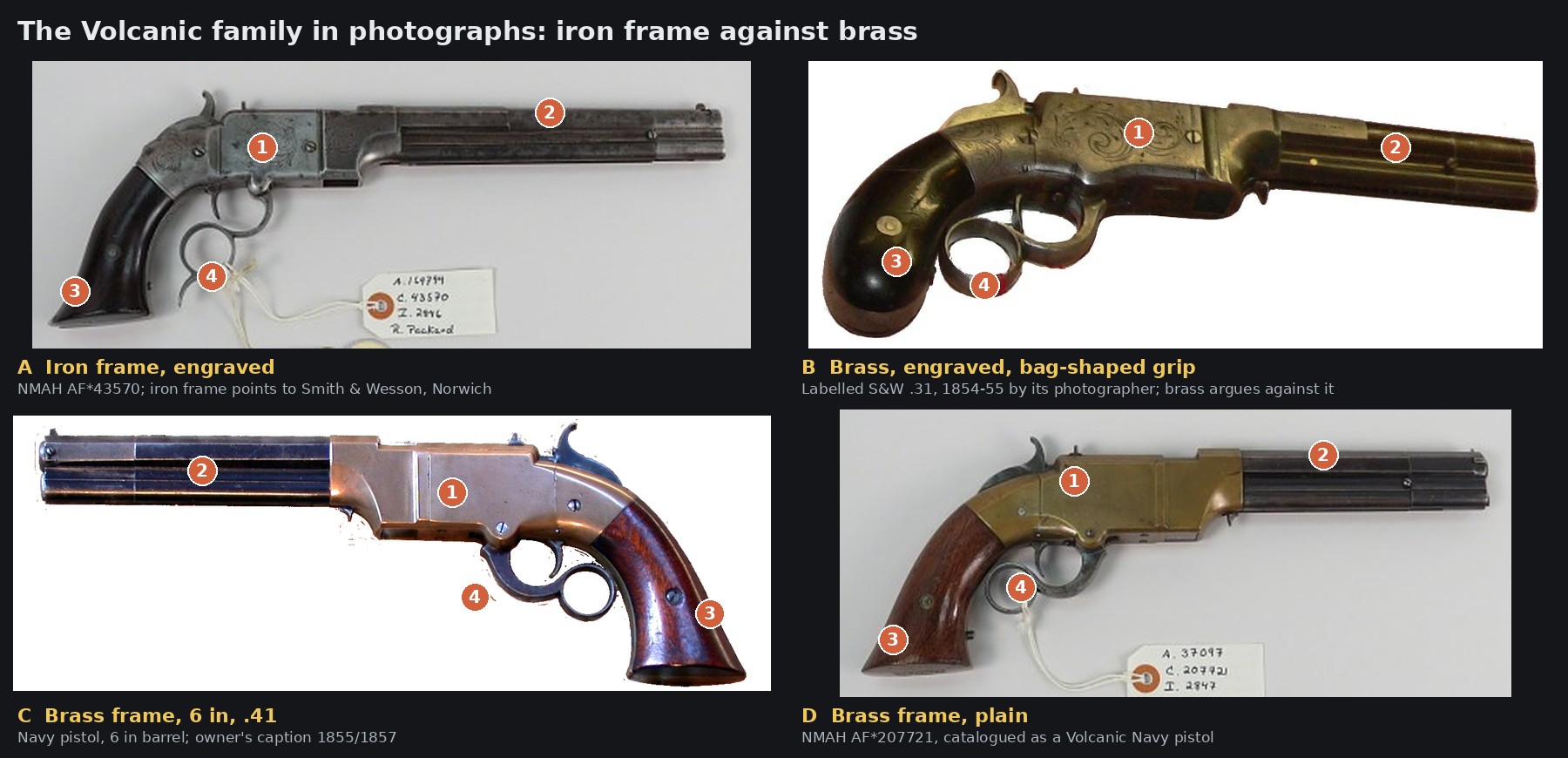
There are only about eight thousand Volcanic-family arms in the estimates, made by three companies over about six years, and the variations between them are small enough that auction catalogues still get them wrong. The useful fact for a reader trying to identify one is that the three makers left different fingerprints: Smith & Wesson used iron, the two New Haven companies used brass; Smith & Wesson stamped its name and Norwich, the Volcanic Repeating Arms Company stamped its full name, and the New Haven Arms Company stamped neither. Most of what follows elaborates those three facts.
Almost everything here is built from auction catalogue descriptions, because that is where the guns are described in detail. Rock Island Auction’s lot pages from 2009 to 2025, read for this dive and logged with lot numbers in the research notes, carry quoted barrel legends, serial locations and condition reports for more than fifty guns.1 Their production figures largely trace to Edmund Lewis and Stephen Rutter’s Volcanic Firearms (2011), which was not consulted directly; where a catalogue gives a page reference to it, the reference is carried.2
4.1 The three makers and what they made
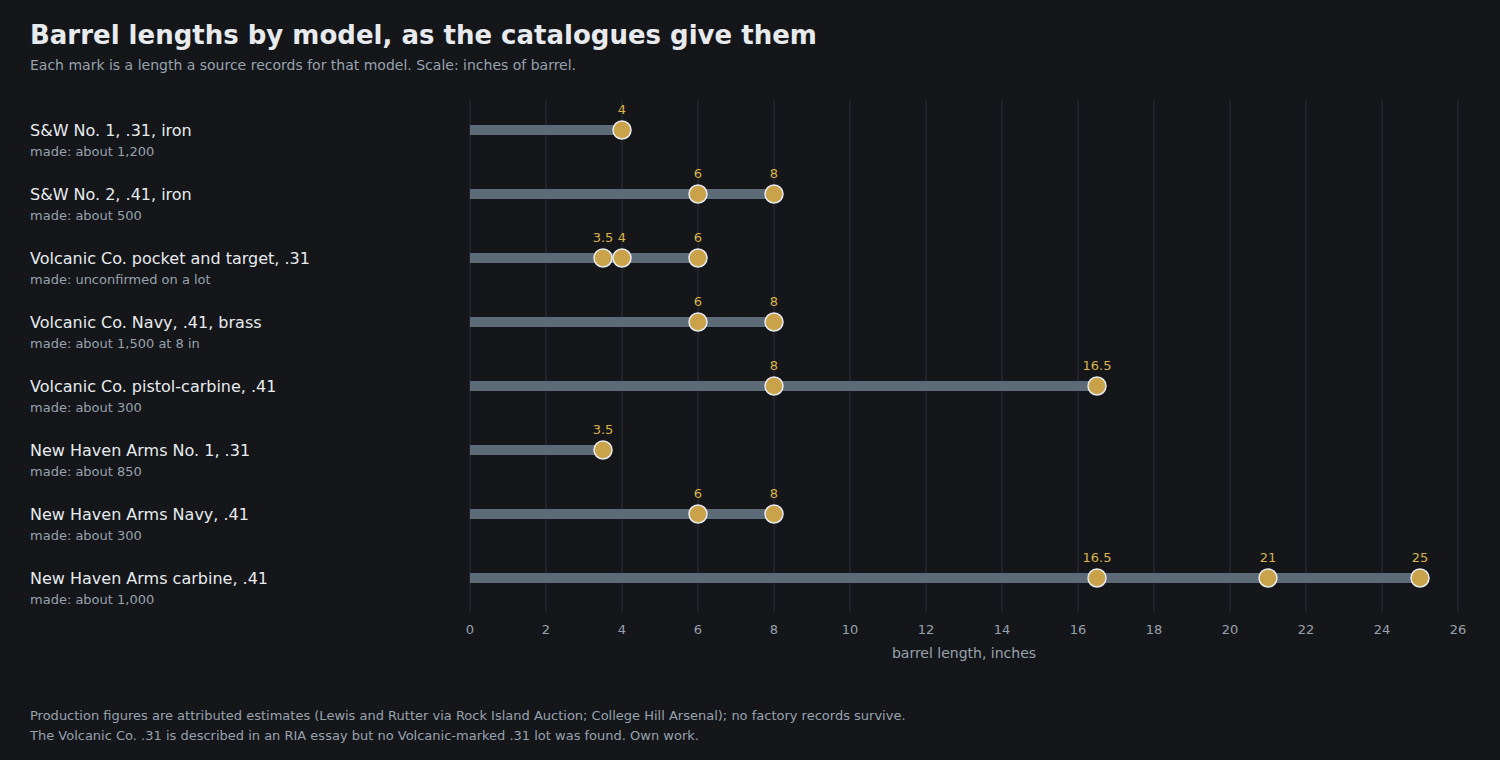
Table 1 — The three makers and what they made
| Maker | Years | Model | Calibre | Barrel | Magazine | Frame |
|---|---|---|---|---|---|---|
| Smith & Wesson, Norwich | 1854–55 | No. 1 (small frame) | .31 | 4 in, part round, part octagon | 6 | Iron |
| Smith & Wesson, Norwich | 1854–55 | No. 2 (large frame) | .41 | 6 or 8 in, part round, part octagon | 10 (6 in) | Iron |
| Volcanic Repeating Arms Co. | 1855–57 | Pocket and target pistols | .31 | 3.5 to 4 in pocket; 6 in target | 6 pocket; 10 target | Brass |
| Volcanic Repeating Arms Co. | 1855–57 | No. 2 Navy pistol | .41 | 8 in (6 in also made), full octagon | 10 (one lot says 9) | Brass |
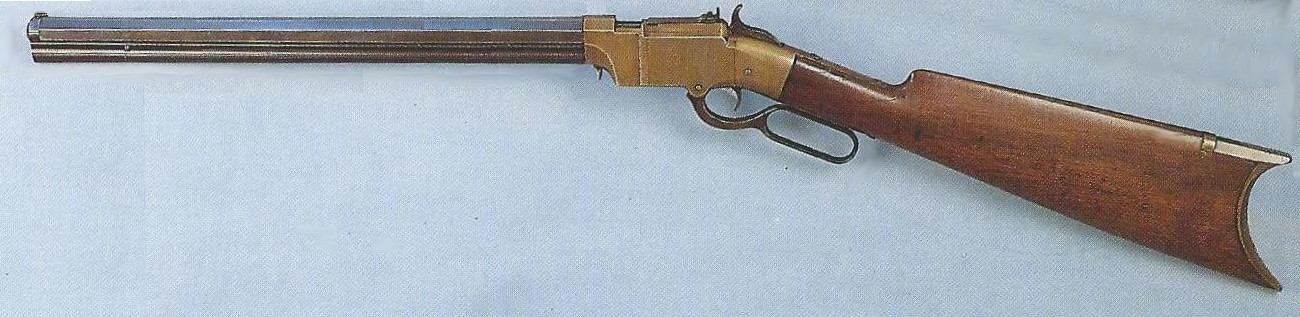
| Volcanic Repeating Arms Co. | 1855–57 | Pistol-carbine with attachable stock | .41 | 8 in and 16 to 16.5 in | 18 to 20 (16.5 in) | Brass |
| Volcanic Repeating Arms Co. | 1855–57 | Carbine | .41 | 16.5 in | — | Brass |
| New Haven Arms Co. | 1857–60 | No. 1 pocket pistol | .31 | 3.5 in full octagon (advertised as 4 in) | 6 | Brass |
| New Haven Arms Co. | 1857–60 | No. 2 Navy pistol | .41 | 6 or 8 in | 10 | Brass |
| New Haven Arms Co. | 1857–60 | Carbine | .41 | 16.5, 21 or 25 in | 20 (16.5 in) | Brass |
Sources for every row are in the sections below. Two rows need a warning. The Volcanic company’s .31 pocket and target pistols are described in Rock Island’s 2022 essay (“a pocket model with a 3.5 to 4-inch barrel length and a target model with a 6-inch barrel length, both chambered for a .31 caliber Volcanic round”), but no Volcanic-marked .31 was found on any lot page read, and Forgotten Weapons says the company’s pistols were “all .41 caliber Navy types”.34 And the Volcanic company’s carbines are described in captions and one lot with an attachable stock; their barrel lengths, apart from the 16.5 inch, could not be separated from the New Haven Arms guns.1
Capacities other than the ones in the table vary between sources. The Winchester Arms Collectors Association gives .31 pistols “4 or 6 inch barrels holding 6 or 10 rounds respectively”, .41 pistols “6” or 8” barrel carrying 8 or 10 rounds”, and carbines “16” holding 20 rounds, 20” holding 25 rounds and 24” holding 30 rounds”.5 Rock Island’s essay gives carbines “between 18 and 30 rounds depending on barrel length”.3 The Association’s 20 and 24 inch carbine barrels do not match the 21 and 25 inch lengths every Rock Island carbine lot gives, and the lot descriptions, written with the gun on the bench, are preferred here.
4.2 Smith & Wesson, Norwich: the iron-framed pistols
The No. 1 is a .31 pocket pistol with a four-inch barrel. Rock Island’s catalogue of a Type I example (serial 19) describes “a ‘four-inch’ part-round/part-octagon barrel” and a six-shot integral magazine, an iron frame blued, the barrel browned, the hammer case-hardened, with a flat muzzle, a flat magazine lock spring, a single-screw retaining spring and a finger-spur lever.1 Type II pistols have a crowned muzzle, a rounded T-bar spring, a narrow muzzle collar and a “clam-shell” follower; the spur lever is rare on them.1 The grips are rosewood and “bag-shaped”, and open-scroll engraving is described as standard.1
Production: about 1,200 in total, of which, per Lewis and Rutter page 31 as quoted in two 2025 Rock Island lots, about 700 were made and assembled by Smith & Wesson in 1854–55 and about 500 assembled by the Volcanic Repeating Arms Company from Smith & Wesson parts between 1855 and 1857.12 That explains why one Rock Island lot says 700 and another says 1,200.
The No. 2 is the large-frame .41, with part-round, part-octagon barrels of six and eight inches and a ten-shot magazine at six inches.1 Early No. 2s have what Rock Island calls a “hump” frame, placed by one catalogue “behind the hammer” and by another “behind the trigger”.1 The figure most often given is about 500 made, or “fewer than 500”.1
Smith & Wesson also made a few long arms and a pistol-carbine with a detachable stock; Rock Island’s essay records the sale of a Smith & Wesson lever rifle described as one of three known ($488,750, June 2020) and a factory-engraved Smith & Wesson pistol-carbine with stock ($86,250, September 2020).3 Those are the house’s captions; the lot pages were not read.
4.3 Volcanic Repeating Arms Company: brass and the Navy pistol
The Volcanic company changed the frame metal. Sawyer, writing in 1920: “The Volcanic Repeating Arms Company substituted bronze for iron, as much as possible, in their arms, and specialized on hand instead of shoulder arms.”6 Rock Island’s catalogues call the frame metal “gunmetal”, described in the 2022 essay as “a bronze/brass alloy”.3 Its actual composition was not found analysed in any source consulted. American Rifleman attributes the change from iron to brass to Winchester’s period; the lot descriptions of brass-framed guns marked with the Volcanic company’s own name contradict that.71
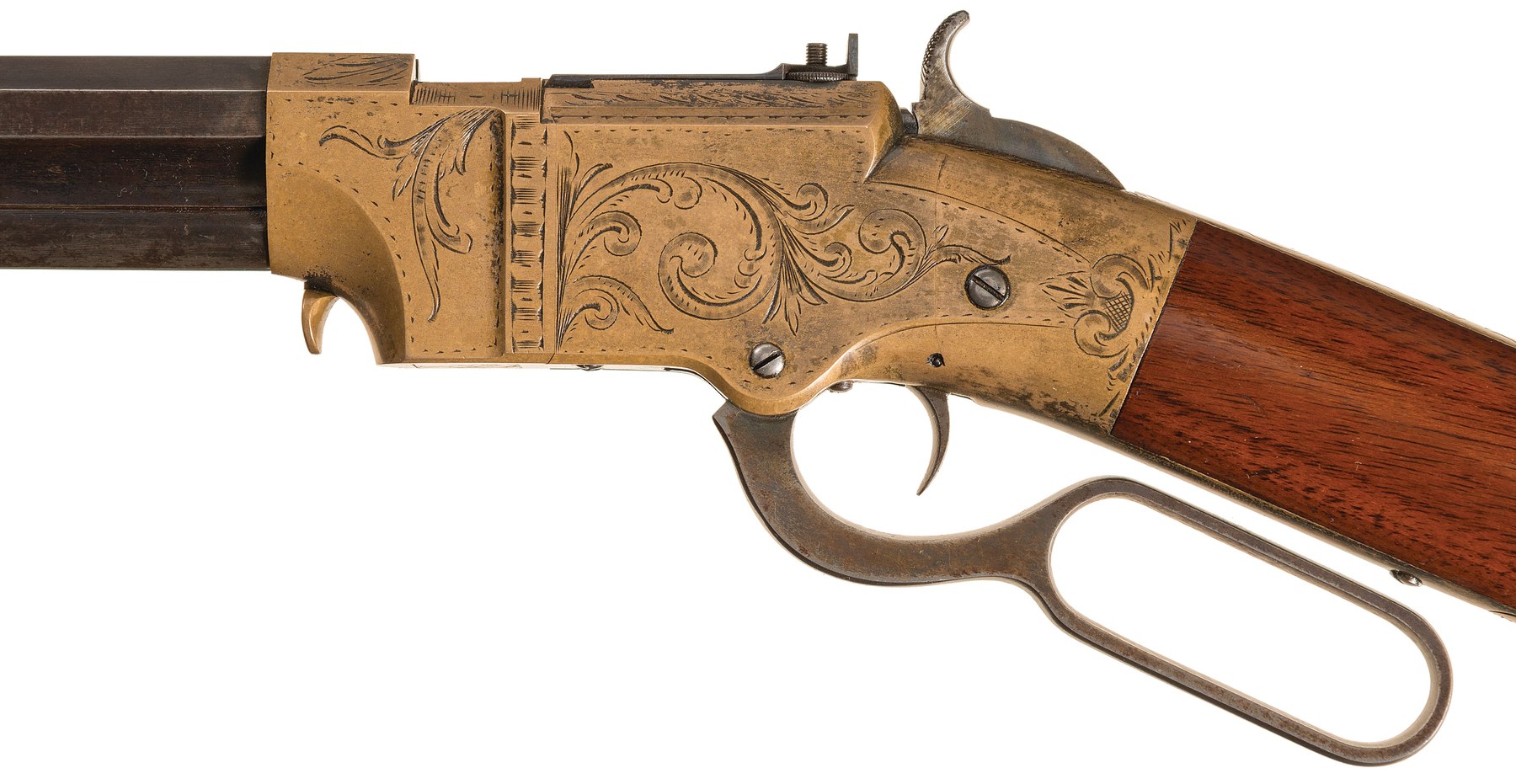
The company’s main product was the No. 2 Navy pistol: .41, eight-inch full octagon barrel, ten-shot magazine. Rock Island repeats on many lots that “an estimated 1500 Lever Action Navy Pistols with 8-inch barrels” were made between 1855 and 1857, and its essay says “between July 1855 and April 1857”; one 2015 lot says 1,200 instead.13 Six-inch Navies were also made.3 Rock Island’s catalogues distinguish a “Type I” barrel with a full rib.1 Finishes recorded on the lots: blued barrel; natural, silver-plated or gold-plated brass frame; case-hardened hammer and trigger; fire-blued bolt, elevator and sight.1 One Navy lot notes that its lever “correctly, lacks a finger spur”.1 One catalogue observes that “The receiver lacks the factory engraving found on most Volcanic Repeating Arms pistols”, though plain-framed Navies are common in the record.1
The capacity is ten on most lots. One Rock Island lot of 2025 describes a “nine-shot” magazine, and a newspaper account of 1856 has Colonel Hay firing an eight-inch pistol “which discharges nine balls in rapid succession”.18 One 2021 lot says twenty, almost certainly a catalogue error.1
4.4 The pistol-carbine
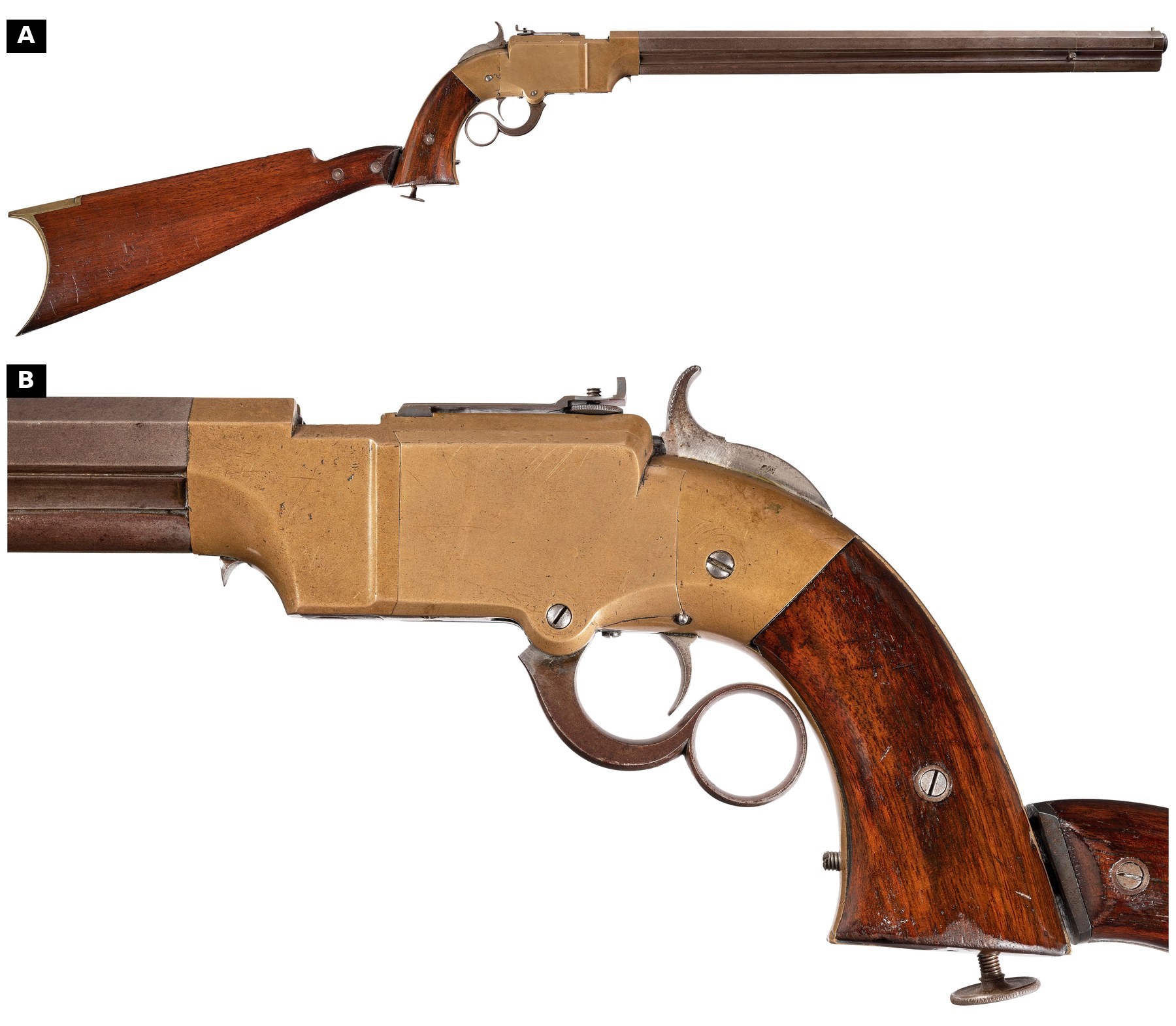
The Volcanic company made a pistol that could take a shoulder stock. Rock Island’s lot descriptions say that “The Volcanic Arms Company manufactured approximately 300 pistol carbines with 16 and 8-inch barrels and attachable stocks c. 1855-1857”, and that “They were originally advertised as ‘Detached Breech Rifle Carbines.’”1 A 16.5-inch example is described with an eighteen-shot magazine.1
The stock fitting is described on two lots. One: “The back strap has a holes for the attachable stock lug and alignment pin and a thumb-screw on the butt to tighten the stock”, the stock having “a steel yoke and lug”. The other: a “single hole to accept a detachable shoulder stock lug and a small alignment pin. The pistol butt has an inverted, knurled, round head, adjusting screw.”1
The New Haven Arms Company “did not manufacture pistol carbines as a regular production item”; Rock Island says that “An unknown but very small number of unfinished Volcanic Repeating Arms Company pistol-carbines were finished and sold by the New Haven Arms Company following the reorganization”, and catalogued one such gun, factory cased, with a re-marked Volcanic legend.1
The collecting caution is specific. Stock numbers often differ from gun numbers even on sets accepted as matched (gun 402 with stock 49; gun 62 with stock 61), and a 2021 catalogue of a stock sold alone warns that “when the stock is encountered with the shoulder fired arm, the stocks are often mismatched”.1 One pistol-carbine had its barrel “shortened to 15 1/2 inches” and carried a “replacement walnut attachable stock (doesn’t fit correctly)”.1 Volume 6 returns to this. Volume 7 explains why a stocked pistol with a barrel under sixteen inches matters legally if it is a modern copy rather than an antique.
4.5 New Haven Arms Company: the No. 1, the Navy and the carbines
The No. 1 pocket pistol is a .31 with a 3.5-inch full octagon barrel. A Rock Island catalogue points out the discrepancy: “Although New Haven advertised No. 1 pocket pistols with a 4 inch barrel, the barrels actually measured 3 1/2 inches on production examples. No. 1 pistols manufactured by Smith & Wesson c. 1854-1855 had a 4 inch barrel but these barrels were part octagon. The barrel on this pistol is full octagon.”1 The same catalogue says the standard New Haven No. 1 has “a full octagon barrel, a flat bottom grip, a finger loop lever without spur, a single screw securing the lever and side plates rather than two as on the Smith & Wesson specimens”.1 A dealer who measured one, College Hill Arsenal, gives “about 3 11/16” from the breech face to the muzzle.9 About 850 were made: 1857 to 1862 according to Lewis and Rutter page 73 as quoted by Rock Island and according to American Rifleman, 1857 to 1860 according to another Rock Island lot.110 The price new was $12.00 plain and $13.50 engraved.1
The No. 2 Navy was made in six- and eight-inch lengths with a ten-shot magazine.1 Early New Haven Navies were built on Volcanic company barrels with the legend over-stamped (below). Rock Island gives “an estimated total of 300 No. 2 Navy pistols” on one lot and “1 of only an estimated 300 … with a .41 caliber, six inch barrel” on another; the two lots disagree on what the 300 counts.1
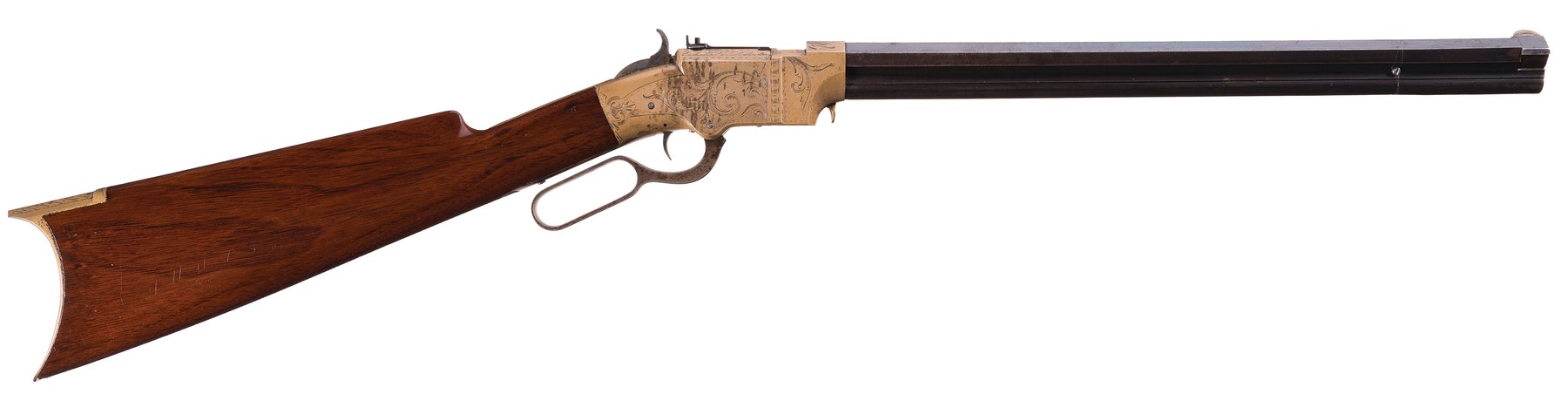
The carbines are .41 with barrels of 16.5, 21 and 25 inches, the 16.5-inch carbine holding twenty.1 Rock Island’s catalogues give “approximately 1,000 carbines for all three barrel lengths … between 1857 and 1860”, and its essay “fewer than 1,000”.13 A Rock Island lot citing Lewis and Rutter page 79 says fewer than 100 had 21-inch barrels.11 Carbine frames are usually factory engraved; Rock Island calls plain frames “rare”.1 The barrel has what the catalogues call a “Type II half-rib”.1 And, citing Lewis and Rutter page 83, the carbines “were numbered in the same sequence as the pistols and pistol carbines”.1
4.6 Barrel legends
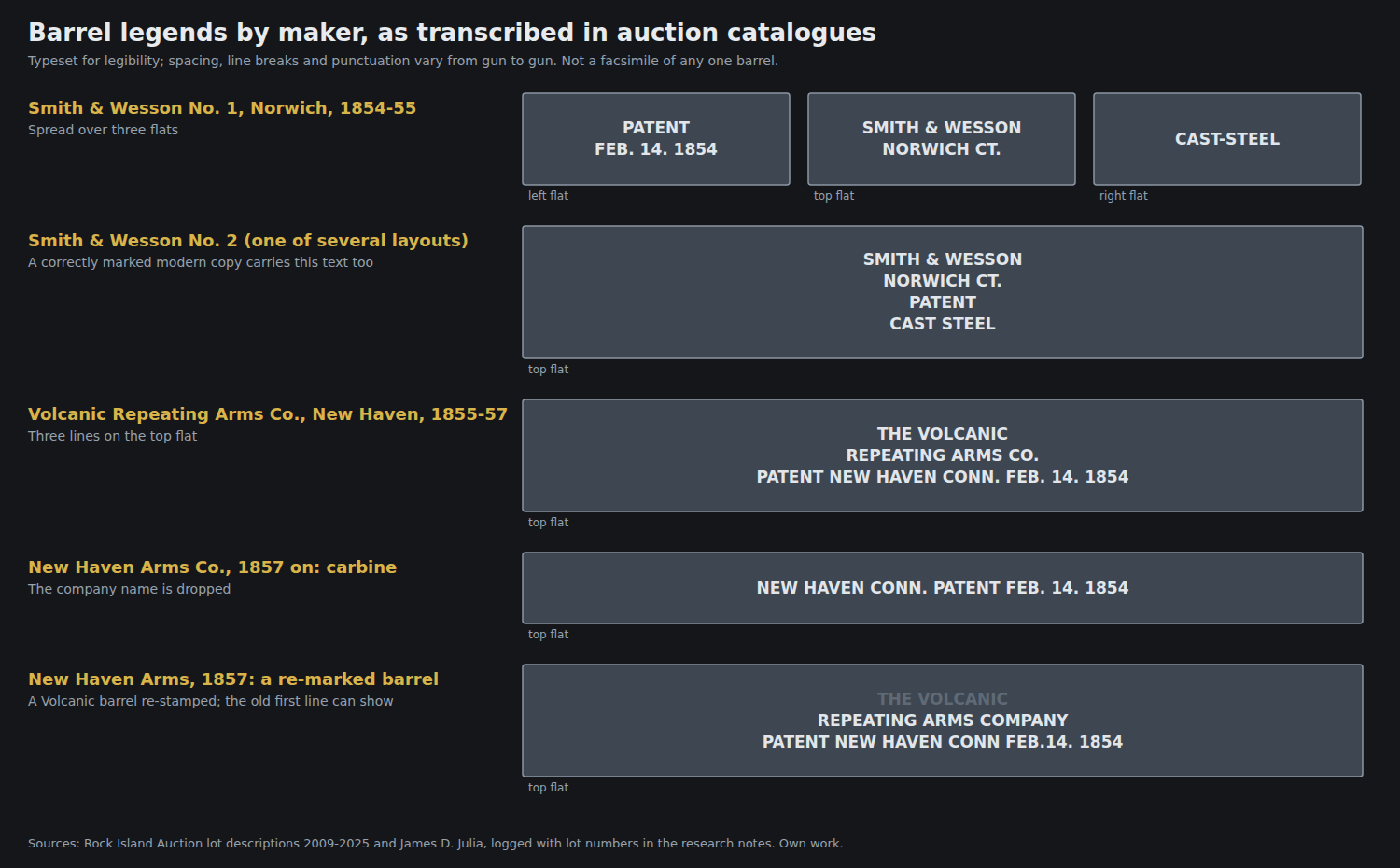
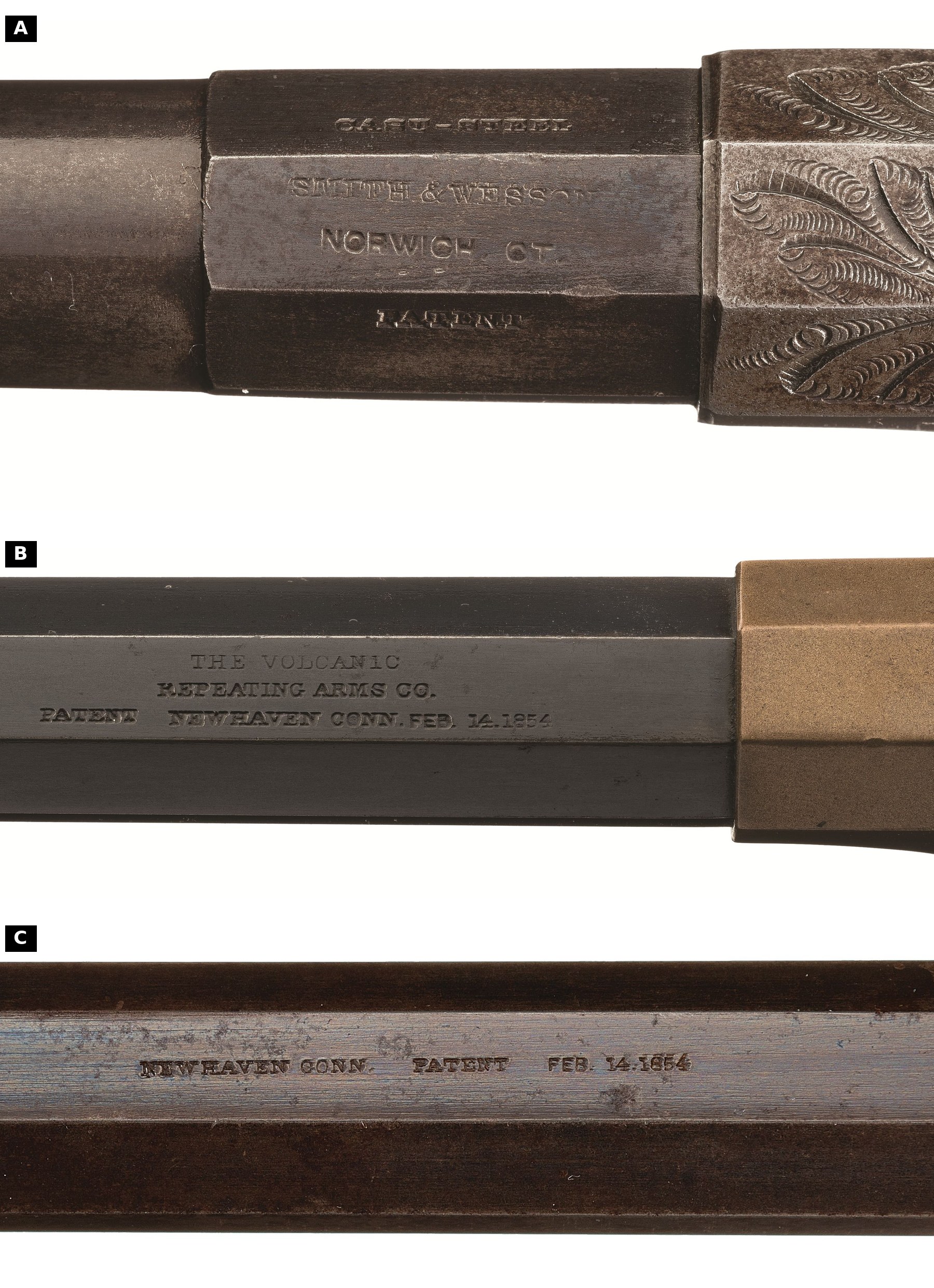
The legends are the surest identifier and the most often faked feature (Volume 6). Quoted from catalogue transcriptions, with at least two examples behind each:
Smith & Wesson No. 1. The legend is spread over three flats: on top, “SMITH & WESSON/NORWICH CT.” in two lines; on the right flat, “CAST-STEEL”; on the left flat, “PATENT/FEB. 14. 1854” in two lines.1 Two catalogues describe the right-flat stamp differently, one as “stamped upside down” and one as “reading up from the magazine”, which may be the same feature described from two viewpoints.1 The early Type I serial 19 has only “PATENT” on the left flat.1
Smith & Wesson No. 2. Several layouts are recorded: “PATENT SMITH &WESSON/NORWICH CT. CAST-STEEL” on top (serial 52); “CAST-STEEL/PATENT/NORWICH, CT./1854” on top of the breech, called “uncommon” (serial 8); “SMITH & WESSON/NORWICH CT./PATENT/CAST STEEL” on top (serial 2); and “SMITH&WESSON / NORWICH.CT. / PATENT / CAST-STEEL” on James D. Julia’s serial 1.112 The third of these is exactly the legend on a modern copy Rock Island sold in 2010.1
Volcanic Repeating Arms Company. Three lines on the top flat: “THE VOLCANIC/REPEATING ARMS CO./PATENT NEW HAVEN CONN. FEB. 14. 1854”, with small variations in spacing between transcriptions.1 One catalogue observes on serial 1094 that “The third line is deeper than the other two and was stamped separately”.1 A pistol-carbine carries a four-line variant: “THE VOLCANIC/REPEATING ARMS CO./NEW HAVEN CONN./PATENT FEB. 14. 1854”.1 The Henry Ford museum catalogues a pistol (serial 1480) as “THE VULCANIC / REPEATING ARMS CO.”, almost certainly a typing error.13 Legends on the side flats rather than the top are “extremely rare”.1
American Rifleman’s 2016 article says the Volcanic name “was never stamped on the guns”. That is true of New Haven Arms guns and false of the Volcanic company’s, every one of which in the record carries “THE VOLCANIC” on its top flat.101
New Haven Arms Company. The company’s name is dropped. Carbines: “NEW HAVEN CONN. PATENT FEB. 14. 1854” in one line. No. 1 pistols: “NEW HAVEN CONN./PATENT FEB. 14. 1854” in two lines. No. 2 Navies: “PATENT FEB.14. 1854/NEW HAVEN CONN.” and variants.1 One Rock Island lot says the change was made “following Oliver Winchester’s takeover … to eliminate the reference to Volcanic Repeating Arms Co.”; another dates it to April 1857.111 The earliest New Haven No. 1 recorded, serial 5, has no maker’s mark, only “PATENT”.1
Transitional barrels. Early New Haven guns used Volcanic company barrels re-marked. Catalogued examples read “REPEATING ARMS COMPANY/PATENT NEW HAVEN CONN FEB.14. 1854” with “Traces of the earlier ‘THE VOLCANIC’ markings … visible above”, or carry the new legend on the left flat over barely visible Volcanic lines.1 A barrel showing two legends is not necessarily tampered with; it may be exactly this.
4.7 Serial numbers and where to find them
Smith & Wesson. Rock Island’s catalogue of serial 19 says “The first 100 pistols … were serial numbered 1-100; subsequent pistols were numbered in 100 gun lots with ‘A-F’ following the serial number.”1 Observed numbers fit that loosely: “B 67”, “E 61”, “E15”. One, “153 G”, fits it neither in the letter nor in the three-digit number, and that catalogue says “Relatively little information is known about exact numbers of production”.1 The number appears on the left side of the frame under the grips and inside the grips, and on some guns also on the hammer, the rear sight, the links, the bottom of the bolt, the carrier, the lever and inside the side plates.112
Volcanic Repeating Arms Company. Plain numbers, in the record from the low hundreds to the 1700s for Navies. The number is on the right side of the lever, on the butt beneath the grip (right on some guns, left on others), inside both grips, and on Julia’s serial 385 “inside each side-plate, and on internal parts”.112 An inspector’s letter (catalogues record “1”, “L”, “Y”, “X” and “K”) appears on the left of the lever.1 A carbine serial 2986 is described by Rock Island as at “the very end of the standard production range … late 1855 to early 1856”.11
New Haven Arms Company. Pistols carry the number on the left side of the frame under the grip and inside the grips; Navies also on the right of the lever.1 Carbines carry it on the left side of the lower tang under the stock, on the stock under the buttplate, inside the buttplate heel and on the shanks of the tang and buttplate screws.1 Some carbines carry low assembly numbers (“13”, “22”, “34”, “68”) rather than serials in a long sequence.1
Serial numbers recorded here are from published third-party catalogues. Volume 6 sets out why a matching set of numbers is the single most useful check on originality, and why it is not proof.
4.8 Finishes, engraving and grips
Finishes, from the catalogues:
Table 2 — Finishes, from the catalogues
| Part | Smith & Wesson | Volcanic Repeating Arms | New Haven Arms |
|---|---|---|---|
| Barrel | Browned1 | Blued; Julia’s serial 728 described as “brown”112 | Blued1 |
| Frame | Iron, blued, factory engraved1 | Brass natural, silver-plated or gold-plated; plain or engraved1 | Brass natural or silver-plated; carbines usually engraved1 |
| Hammer and trigger | Case-hardened1 | Case-hardened1 | — |
| Grips | Rosewood; bag-shaped on the No. 1, flared on the No. 21 | Walnut, flared or flat-bottomed, varnished1 | Walnut, flat-based1 |
Rock Island and Julia disagree on the Volcanic company’s barrel finish; Julia’s serial 728 is described with about 99 per cent original brown finish, and Rock Island’s Navies as blued.121 One Rock Island catalogue says a blued Navy barrel “appears to have been done on special order by a 19th Century retailer”.1 Both finishes may be original on different guns. Engraving was a factory option on all three makers’ guns, and a New Haven No. 1 cost $1.50 more engraved.1 A cased pair of engraved Smith & Wesson No. 1s, engraved according to Rock Island’s caption by Wurfflein, sold for $80,500 in September 2020.3
4.9 The comparison plates
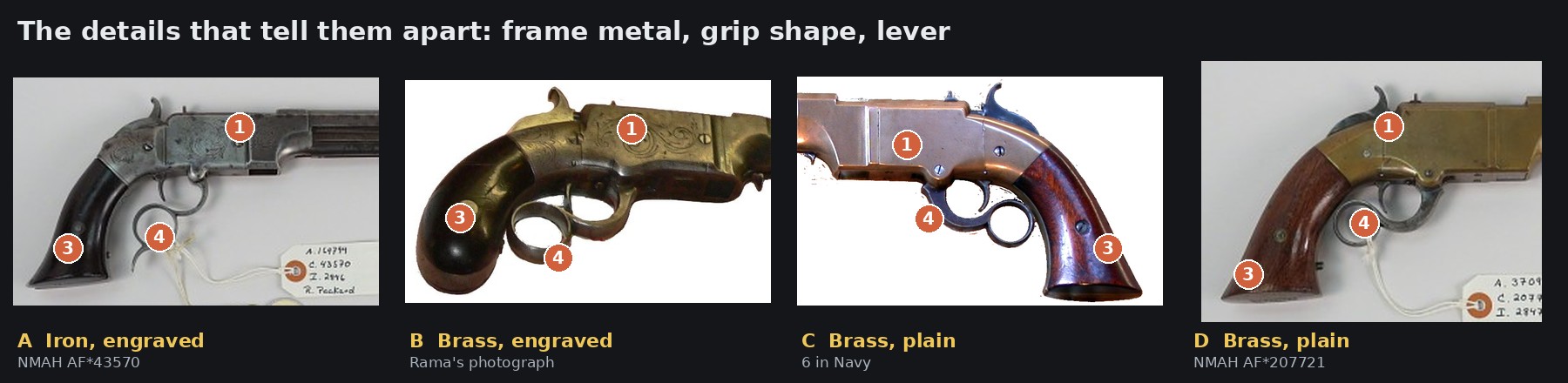
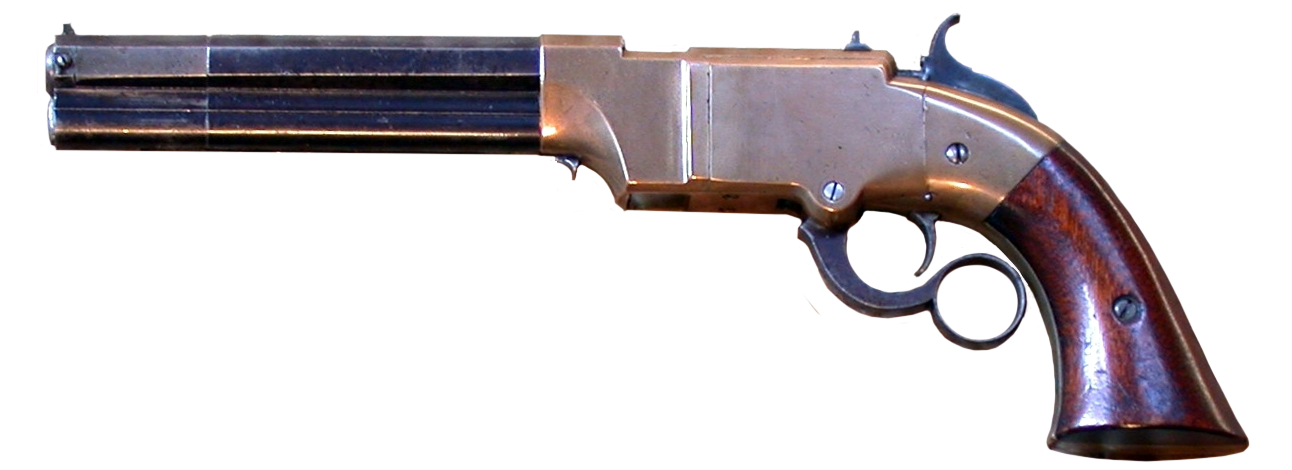
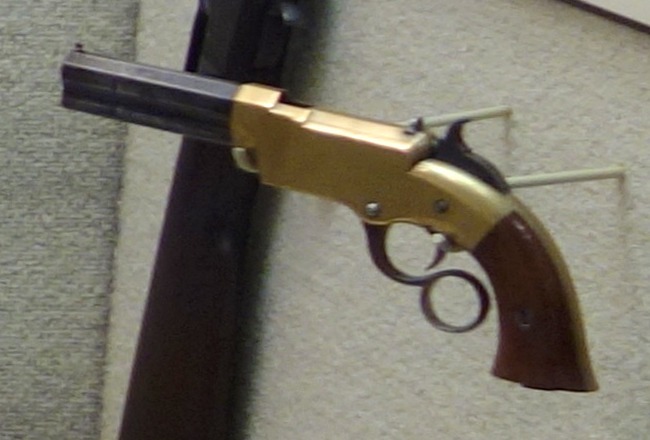
The two plates use the same four photographs, which were every photograph of a complete Volcanic pistol on Commons that this dive could verify. Each is shown as photographed. Some sources show the left side and some the right; none has been mirrored, because a mirrored photograph reverses its markings.
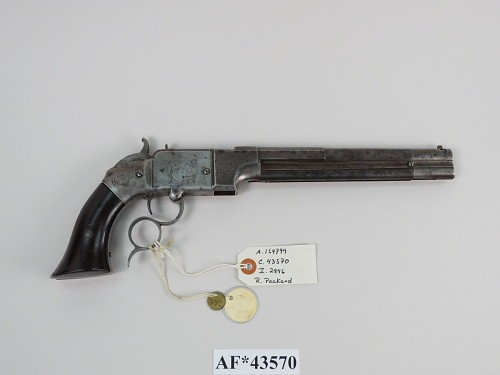
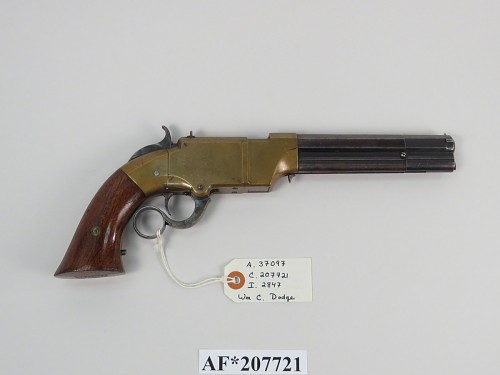
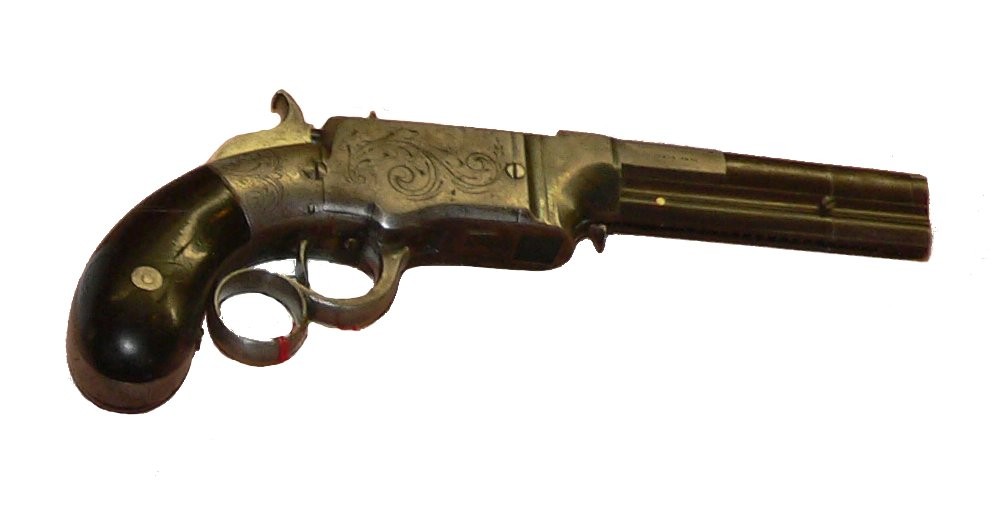
Panel A, the National Museum of American History’s AF*43570, shows the iron frame and the engraving of a Smith & Wesson. Panel B is the instructive one. Its photographer labelled it a Smith and Wesson .31 of 1854–55, and the bag-shaped grip agrees with the descriptions of the S&W No. 1. But its frame is plainly brass, and the catalogues agree that Smith & Wesson’s frames were iron. The pistol may be one of the roughly 500 No. 1s that Lewis and Rutter say the Volcanic company assembled from Smith & Wesson parts, or the label may be wrong; the barrel legend would decide it, and it is not legible in the photograph. Panels C and D are brass Navy pistols of one of the two New Haven makers.
4.10 Tell them apart
Table 3 — Tell them apart
| Feature | Smith & Wesson, Norwich | Volcanic Repeating Arms Co. | New Haven Arms Co. | Where to look |
|---|---|---|---|---|
| Frame metal | Iron, blued (one lot says steel)1 | Brass (“gunmetal”)13 | Brass1 | Frame and side plates |
| Barrel profile | Part round, part octagon1 | Full octagon; Navy “Type I” full rib1 | Full octagon; carbines “Type II” half rib1 | Barrel |
| Barrel legend | Name and NORWICH CT.; on the No. 1 spread over three flats with CAST-STEEL1 | THE VOLCANIC / REPEATING ARMS CO. / PATENT NEW HAVEN CONN. FEB. 14. 18541 | No company name: NEW HAVEN CONN. PATENT FEB. 14. 1854; some re-marked Volcanic barrels1 | Top flat, then side flats |
| Lever | Early No. 1: finger spur; later: no spur1 | Ring, Navy without spur1 | Ring without spur (No. 1)1 | Under the frame |
| Screws for lever and side plates | Two1 | Not recorded | One (No. 1)1 | Sides of the frame; single source |
| Grips | Rosewood; bag-shaped (No. 1)1 | Walnut, flared or flat-bottomed1 | Walnut, flat-based1 | Grip |
| Serial | 1 to 100, then lots with letter suffixes1 | Plain numbers; inspector’s letter on the lever1 | Plain numbers; carbines in the pistol sequence12 | Under the grips; right side of the lever |
| Calibres and barrels | No. 1 .31, 4 in; No. 2 .41, 6 or 8 in1 | Navy .41, 8 in (6 in also); .31 described but unconfirmed; pistol-carbine 16.5 in13 | No. 1 .31, 3.5 in; Navy .41, 6 or 8 in; carbine 16.5, 21 or 25 in1 | Measure the barrel |
The row on screws rests on a single catalogue and should be checked against a second gun before it is relied on.
4.11 An identification sequence
- Look at the frame. Iron points to Smith & Wesson. Brass rules out a Norwich-made Smith & Wesson, but not an S&W-marked gun assembled in New Haven.
- Read the top flat of the barrel. “SMITH & WESSON / NORWICH” is Smith & Wesson. “THE VOLCANIC / REPEATING ARMS CO.” is the Volcanic company. A New Haven address with no company name is the New Haven Arms Company. Two legends, one fainter, may be a transitional re-marked barrel.
- Check the barrel profile against the legend. A Smith & Wesson barrel should be part round and part octagon; a New Haven No. 1 full octagon. A mismatch is a reason to look harder.
- Measure the barrel and count the magazine. Compare with the table above.
- Remove the grips, if the owner allows it, and compare serial numbers. Frame, grips and lever should agree; on a carbine, the tang and the buttplate. Volume 6 explains what a mismatch can and cannot mean.
- On a pistol-carbine, authenticate the stock separately. Stocks were often mismatched in the period.
4.12 What cannot be settled from a photograph
Several questions in this volume cannot be answered from the evidence available to it, and are left open rather than guessed.
- The Volcanic company’s .31 pistols. Described in one essay, unconfirmed on any lot page read, contradicted by Forgotten Weapons.34
- The composition of “gunmetal”. No analysis was found. It matters for conservation (Volume 6) and for anyone choosing an alloy for a reproduction (Volume 8).
- Serial dating. No published serial-to-date table exists for any of the three makers, and the Winchester Arms Collectors Association says there are no factory records.5 Catalogue statements such as “late 1855 to early 1856” for a serial are estimates.
- Production totals. Every figure in this volume is an estimate, nearly all traceable to Lewis and Rutter. They are given by source and not averaged.
References
Footnotes
-
Rock Island Auction Company lot descriptions, 2009–2025, read through the shared fetch engine on 2026-10-18 (the site refuses ordinary automated reading). Every lot cited is logged with its sale date, lot number, serial as printed, barrel, finish, condition, hammer price and URL in this dive’s research notes, 02-inputs/research-models-market.md, Appendix A (entries A1 to A57). The quotations above are from the catalogue text of those lots. ↩ ↩2 ↩3 ↩4 ↩5 ↩6 ↩7 ↩8 ↩9 ↩10 ↩11 ↩12 ↩13 ↩14 ↩15 ↩16 ↩17 ↩18 ↩19 ↩20 ↩21 ↩22 ↩23 ↩24 ↩25 ↩26 ↩27 ↩28 ↩29 ↩30 ↩31 ↩32 ↩33 ↩34 ↩35 ↩36 ↩37 ↩38 ↩39 ↩40 ↩41 ↩42 ↩43 ↩44 ↩45 ↩46 ↩47 ↩48 ↩49 ↩50 ↩51 ↩52 ↩53 ↩54 ↩55 ↩56 ↩57 ↩58 ↩59 ↩60 ↩61 ↩62 ↩63 ↩64 ↩65 ↩66 ↩67 ↩68 ↩69 ↩70 ↩71 ↩72 ↩73 ↩74 ↩75 ↩76 ↩77 ↩78 ↩79 ↩80 ↩81 ↩82 ↩83 ↩84 ↩85 ↩86 ↩87 ↩88 ↩89 ↩90 ↩91 ↩92 ↩93
-
Edmund E. Lewis and Stephen W. Rutter, Volcanic Firearms: Predecessor to the Winchester Rifle (Andrew Mowbray, 2011). Not consulted directly; cited through the page references (pp. 31, 73, 79, 83) that Rock Island’s catalogues give. ↩ ↩2 ↩3
-
Joe Engesser, “The Volcanic Pistol: The First Smith & Wesson Handgun”, Rock Island Auction Company, 20 October 2022, https://rockislandauction.com/riac-blog/the-volcanic-pistol , read 2026-10-18. ↩ ↩2 ↩3 ↩4 ↩5 ↩6 ↩7 ↩8 ↩9 ↩10 ↩11
-
Ian McCollum, “The Volcanic: Smith & Wesson’s First Pistol”, Forgotten Weapons, 18 August 2017, https://www.forgottenweapons.com/the-volcanic-smith-wessons-first-pistol/ , accessed 2026-10-18. ↩ ↩2
-
Winchester Arms Collectors Association, “Volcanic Rifles & Pistols”, https://winchestercollector.org/?p=367 , accessed 2026-10-18. ↩ ↩2
-
Charles Winthrop Sawyer, Our Rifles, Boston, 1920, pp. 64 and 277 and Plate 9. https://archive.org/details/firearmsinameric00sawyrich , accessed 2026-10-18. Public domain. ↩
-
Rick Hacker, “America’s Lever Revolution”, American Rifleman, 6 July 2026, https://www.americanrifleman.org/content/america-s-lever-revolution/ , accessed 2026-10-18. ↩
-
Democrat and Sentinel (Ebensburg, Pa.), 24 December 1856, p. 1, Library of Congress, Chronicling America, https://www.loc.gov/resource/sn86071378/1856-12-24/ed-1/?sp=1 , accessed 2026-10-18. ↩
-
College Hill Arsenal, catalogue descriptions of a New Haven Arms No. 1 pocket pistol, https://collegehillarsenal.com/new-haven-arms-no-1-volcanic-pocket-pistol , and a Volcanic-marked Navy pistol, https://collegehillarsenal.com/Fine-Volcanic-Marked-Volcanic-Navy-Pistol , accessed 2026-10-18. Dealer descriptions. ↩
-
“I Have This Old Gun: New Haven ‘Volcanic’ No. 1 Pocket Pistol”, American Rifleman, 16 September 2016, https://americanrifleman.org/content/i-have-this-old-gun-new-haven-volcanic-no-1-pocket-pistol , accessed 2026-10-18. ↩ ↩2
-
Rock Island Auction Company, lot 4091/1027 (citing Lewis and Rutter p. 79 for the 21-inch carbines, and dating the shortened legend to April 1857), and the 4095 sale catalogue, p. 63 (carbine serial 2986), read 2026-10-18; logged in 02-inputs/research-history-law.md. ↩ ↩2 ↩3
-
James D. Julia, lot descriptions: Smith & Wesson large frame serial 1, Fall 2002, lot 274, https://jamesdjulia.com/item/274-122/ ; Volcanic Navy serial 385, Spring 2006, lot 336, https://jamesdjulia.com/item/lot-336-rare-volcanic-navy-pistol-57491/ ; Volcanic Navy serial 728, Fall 2013, lot 1080, https://jamesdjulia.com/item/lot-1080-rare-volcanic-arms-navy-size-lever-action-pistol-49410/ ; accessed 2026-10-18. ↩ ↩2 ↩3 ↩4 ↩5
-
The Henry Ford, object 00.3.1655, “Volcanic Repeating Arms Pistol, circa 1856”, https://www.thehenryford.org/collections/explore/artifact/5738 , accessed 2026-10-18. ↩
Comments (0)