Volcanic Repeating Arms · Volume 1
Hunt, Jennings and Robbins & Lawrence — the Repeater Before the Volcanic, 1847–1852
A New York inventor's loaded ball and Volition Repeater, the model-maker who simplified it, the Vermont armory that tried to build five thousand, and the machinist who replaced its rack and pinion with a finger lever
The Volcanic is usually introduced as the ancestor of the Winchester, which it is. It is less often introduced as the end of something: the third serious attempt in seven years to build a repeating arm around one New York inventor’s idea, that a bullet could carry its own powder. The first two attempts were Walter Hunt’s own gun and Lewis Jennings’s simplification of it, built in Windsor, Vermont, by the most capable private armory in the United States. They failed. The Volcanic came out of the wreckage, and so did nearly every name connected with it, because the men who built the Jennings rifle in Vermont were Horace Smith, Daniel Wesson and Benjamin Tyler Henry.
This volume follows the idea from 1847, the year Hunt’s English patent was granted, to 1852, when the Vermont work ended and Smith and Wesson went to Norwich. Volume 2 takes the story through the Volcanic Repeating Arms Company to Oliver Winchester. The ammunition, which is the whole reason the guns existed, has its own treatment in Volume 3; the hub’s Daisy dive, Vol 15 sets the Rocket Ball in the longer line of caseless cartridges from Hunt to the G11, and that survey is not repeated here.
1.1 Why the story starts in 1847
Hunt’s American repeating-gun patent was granted on 21 August 1849, but its own specification records that the gun was “patented in England, December 10, 1847”.1 The ball it fired was patented in the United States on 10 August 1848.2 So the design existed, and was being protected abroad, two years before the American grant. That matters for dating the idea: every account that starts the Volcanic story in 1848 starts it with the ammunition, not the gun.
The period is the last decade of the muzzle-loader. Percussion ignition was the standard; the self-contained metallic cartridge did not yet exist in American service. The hub’s History of Muzzleloaders dive, Vol 14 describes the end of that era and the cartridge that ended it. Hunt’s problem was the one every repeating-arm designer of the 1840s faced: a magazine needs rounds that can be stored, fed and fired without a man pouring powder. A paper cartridge cannot be pushed along a spring-loaded tube; a loose ball and a loose charge cannot be fed at all. Hunt’s answer was to put the powder inside the bullet.
1.2 Walter Hunt and the loaded ball
Walter Hunt of New York was a prolific inventor, credited with a long list of devices outside firearms, and Rock Island Auction’s account of him observes that he “had an unfortunate habit of not patenting his inventions”.3 That reputation is real; the stories usually told with it, about debts and the sale of other patents for small sums, could not be confirmed from any source consulted for this volume and are not repeated here.
His firearms patents are on the record and say exactly what he claimed. US Patent 5,701, dated 10 August 1848, is headed on its drawing sheet simply “Cartridge” and in its text “Loaded Ball”. Hunt describes “a new and useful Improvement in the Construction of a Metallic Cartridge, made entire with the ball, for fire-arms, which I term a rocket-ball”.2 The ball has a cavity in its rear, packed with powder; the cavity is closed by a cap “A”, which “in form resembles the Chinese gong, with a central perforation, F, in its discous head, which is the point of ignition from the priming.” Over the hole, on the inside of the cap, sits “a thin water-proof tissue or seal … through which the fire from the priming may penetrate, and which will at the same time secure the powder in the cartridge from escape or accidental injury.” Ball and cap were to be “formed in molds by pressure”, then pressed a second time to fix the cap and make the cartridges uniform in size.2
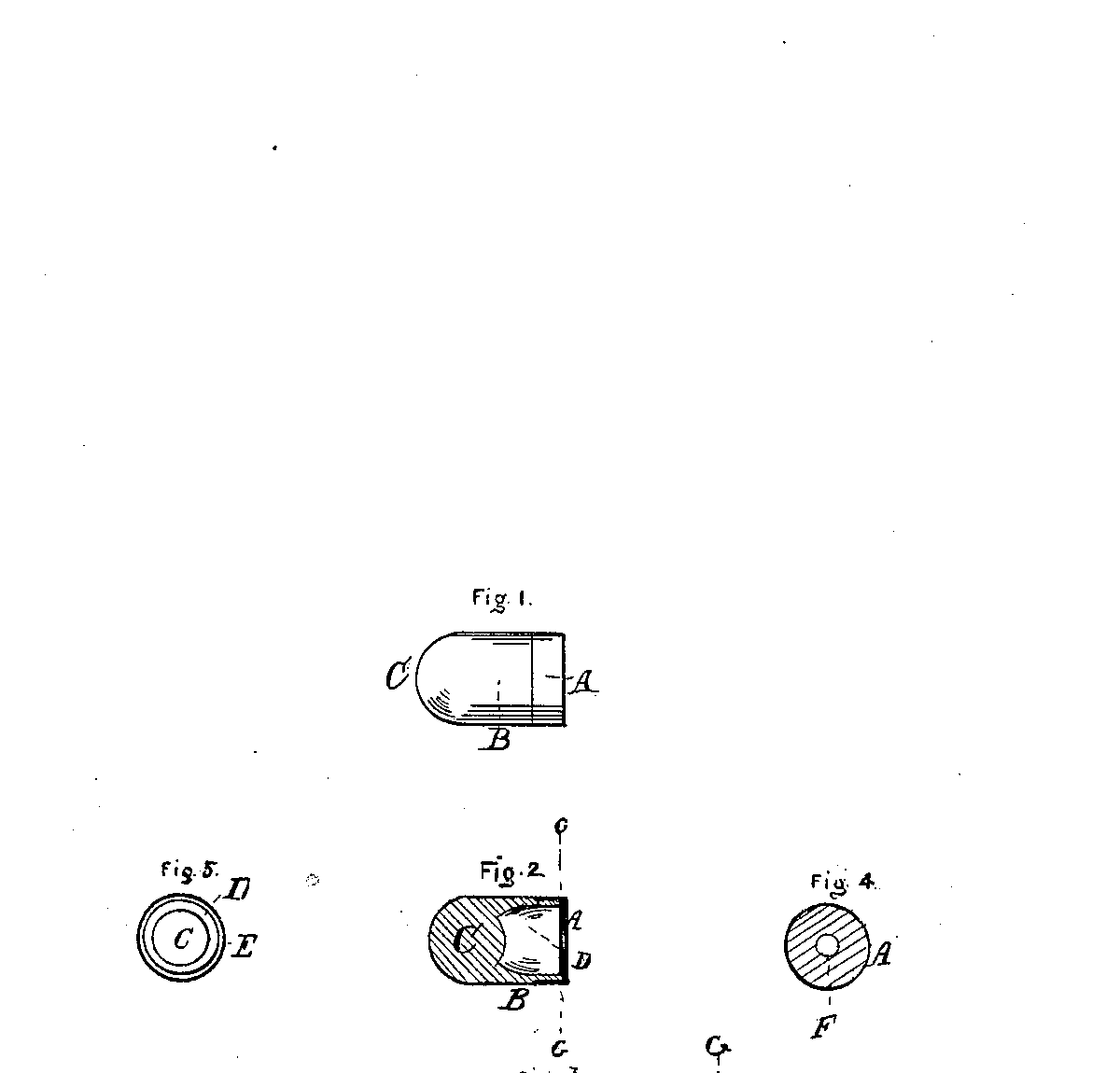
Two details in the patent explain a great deal of what followed.
First, the 1848 ball carried no priming. The fire came “from the priming”, meaning a primer in the gun, and passed through the hole in the cap. That is why Hunt’s gun, and Jennings’s after it, carried a separate magazine of priming pills. The self-primed ball that the Volcanic fired was a later development, patented in 1854 and 1856 by Smith and Wesson, and Volume 3 traces it.
Second, Hunt intended the cap to seal the breech. On firing, he wrote, “the cap A is left in the breech, with its head or disk pressed firmly against the breech-plug, and its rim or flange forced outward against the inner periphery of the caliber of the barrel, forming an air-tight stopper, which effectually prevents all backward escape of the powder”. In a gun with a sliding breech-pin, he added, the cap would be “carried out forward of each succeeding ball, operating as an effectual wiper to the barrel at each discharge”.2 The gas seal that a brass case would later provide was here to be done by a disposable cap that stayed behind and was pushed out by the next shot. It is an ingenious idea and it explains the claim, repeated in the Daisy dive, that the case’s sealing job is the hardest one to replace.
Hunt’s own ball was large. Ed Lewis, co-author with Stephen Rutter of the standard book on Volcanic arms, gives the Hunt ball for the Jennings rifle as .54 calibre nominal, measured at .553 to .560 inch, weighing 330 to 336 grains, with no primer, “ignited by a gravity-fed priming pill from the gun’s magazine”.4 Collectors on the International Ammunition Association forum record Hunt balls with and without a patent date stamped on them, in at least three lengths.5
1.3 The Volition Repeater
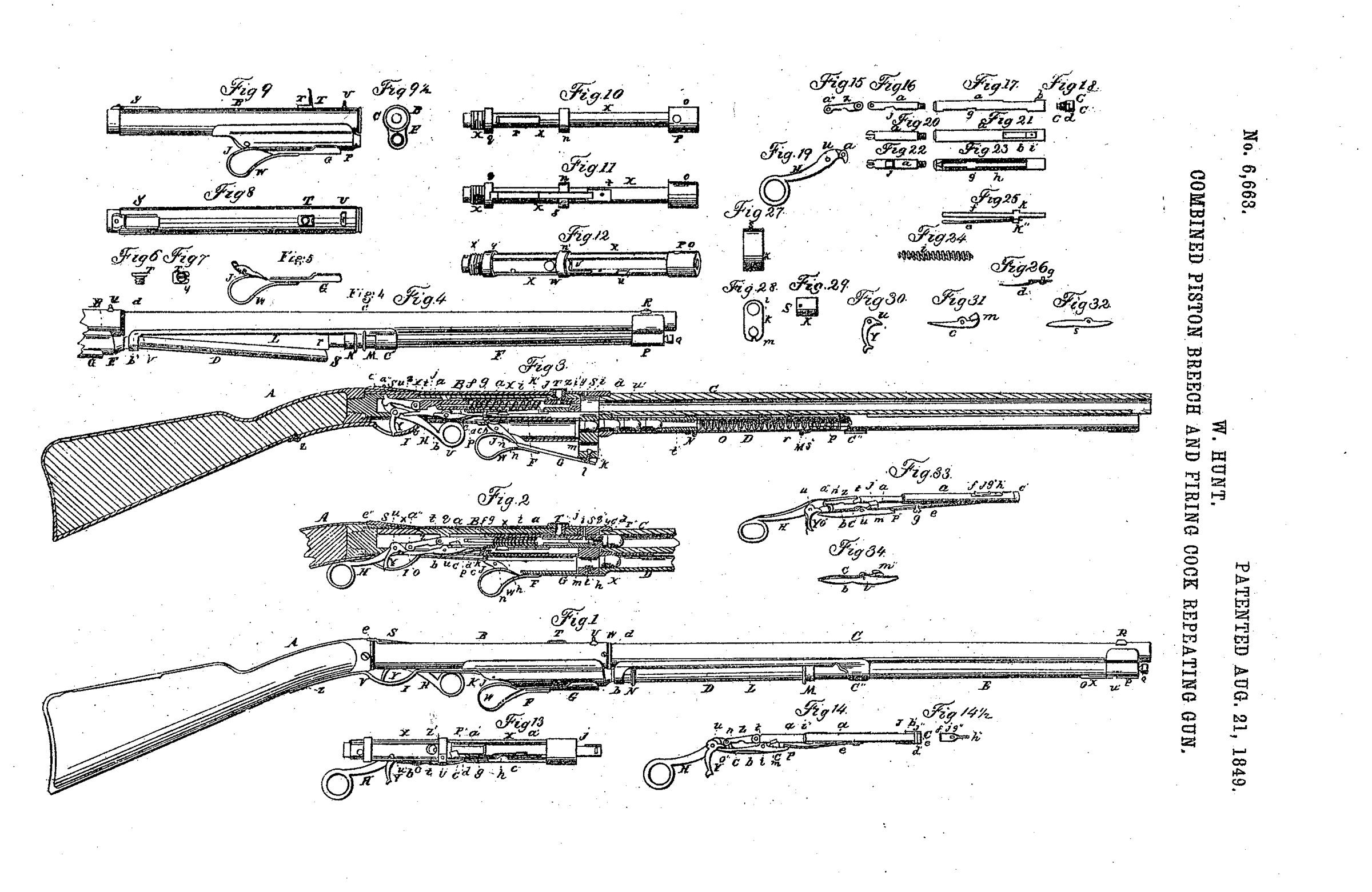
US Patent 6,663, granted 21 August 1849, is headed “Combined Piston Breech and Firing-Cock Repeating Gun”. On its face it is issued to “Geo. A. Arrowsmith, of New York, N. Y., assignee of Walter Hunt”, and Hunt’s text names the arm “The Volition Repeater”.1
Hunt’s first claim describes the heart of it: “The construction of a hollow sliding or piston breech-pin, which is operated by a lever in loading and securing the charge in the breech of the gun, which breech-pin, in addition to the above characteristic, contains or has attached to it the mainspring, firing cock or punch, and firing-chamber of the priming.”1 In plain terms, the bolt carried its own striker and its own little chamber for a priming pill. The second claim covers carrying the priming from “the fixed magazine” into that chamber by the movement of the breech-pin itself. Under the barrel ran the ball tube. A charging trigger drove the breech-pin forward and locked it; a separate firing trigger released the punch.
The patent’s description of loading is worth quoting because it shows that the Volcanic’s way of filling its magazine is Hunt’s. The ball tube “is then separated from the spring-case … and thrown outward by the spring … ready for filling with cartridges from cases prepared for the purpose containing, say, twelve, more or less.” Hunt considered twelve balls “of sufficient length for convenience or utility”.1 Separate the front of the tube, swing it out of line, drop in the balls, swing it back: that is the loading routine of every Volcanic pistol and carbine (Volume 5), seven years before the first of them was made.
Rock Island Auction describes the Volition Repeater as a gun that was probably never finished as a production design, and offers an explanation that cuts against the usual one. “It is popularly, yet incorrectly, accepted that Hunt’s rifle failed for several reasons (potential cost of manufacture, primitive manufacturing equipment, too complicated)”, the essay says; “The Volition Repeater design was likely never finalized, improved upon, nor produced because Jennings was already developing and redesigning a simpler rifle.”3 That is an auction house’s interpretation, not a documented finding, and an earlier version of the same essay put it more strongly than the current one.3 What is documented is that both patents were assigned to the same backer at grant and that the next patent on the gun was Jennings’s, four months later.
1.4 George Arrowsmith, Lewis Jennings and the 1849 improvement
George A. Arrowsmith of New York appears on the face of both Hunt patents and of the next one. US Patent 6,973, dated Christmas Day 1849, is issued to “Geo. A. Arrowsmith, assignee of Lewis Jennings, of New York”, for an “Improvement in Breech-Loading Fire-Arms”.6 Rock Island Auction describes Jennings as an inventor and model-maker who made working models of Hunt’s gun under Arrowsmith.3
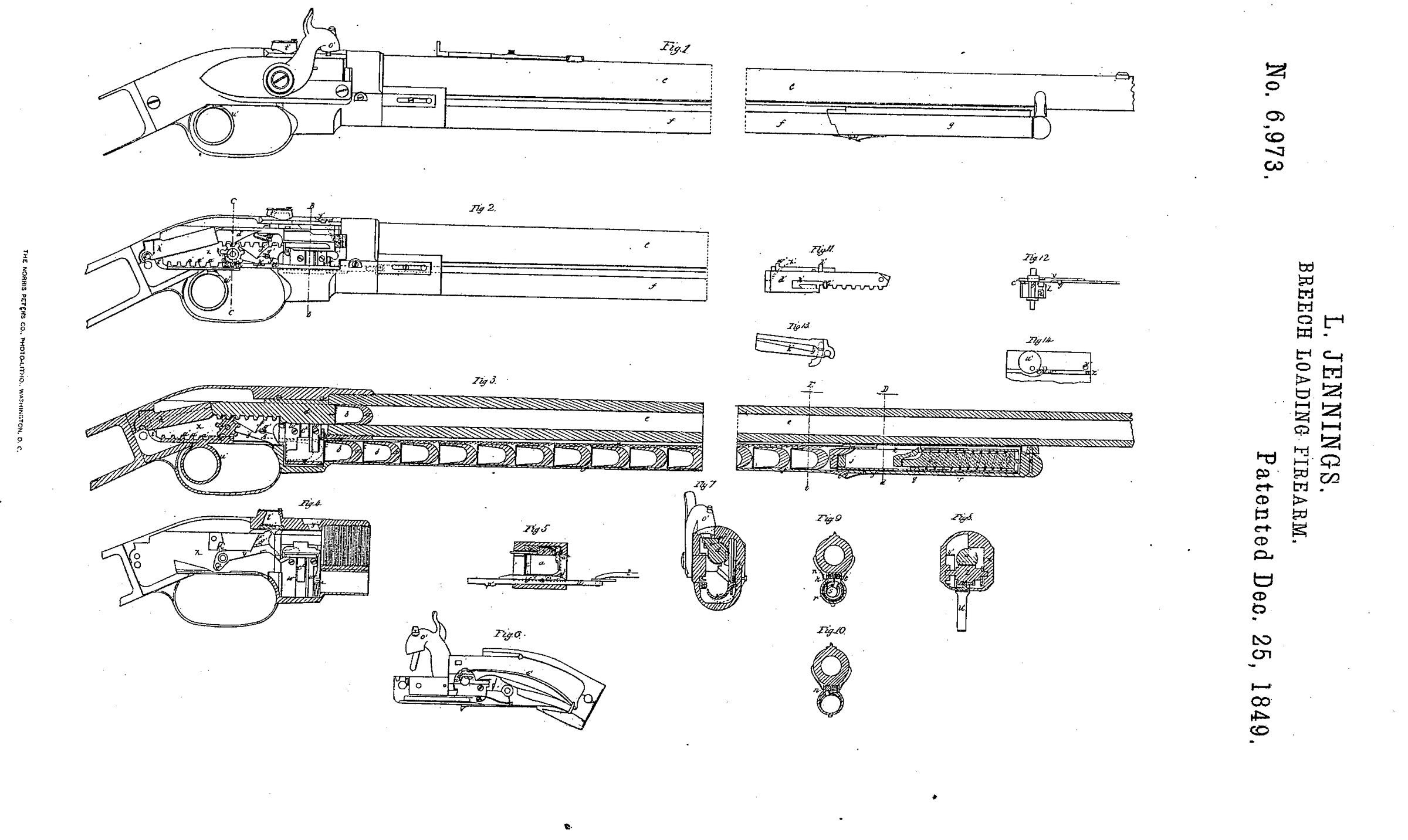
Jennings kept Hunt’s tube magazine, his sliding breech-pin and his separate priming. He changed how the shooter drove them. The patent’s claims name the parts: a “charger” (the follower) made “in two parts, connected by a spring” so as to absorb differences in ball length; a carrier that lifts one ball into line with the bore; a sliding breech-pin that pushes it home; a jointed “abutting lever” that swings up behind the breech-pin to take the recoil; a stop that holds the column in the magazine; a spring catch; and all of it combined “with the sliding trigger-bar”.6 The priming was a reservoir of percussion pills in the top of the breech, with a rotating plate that dropped one pill into the touch-hole each time the breech-pin moved.6
That last point corrects a source this volume otherwise relies on. Charles Winthrop Sawyer, writing in 1920, says the Jennings rifle was “fired by a Maynard Tape primer held in a priming magazine on the top of the frame”.7 Jennings’s own patent describes pills of percussion powder in a reservoir and a turning plate that feeds them one at a time.6 Rock Island’s catalogue descriptions of surviving Jennings and Smith-Jennings rifles likewise speak of an “automatic pill primer” and “pellet” primers.8 The patent and the guns agree; Sawyer’s tape primer is not supported.
The mechanism was driven by a ring trigger that slid forward and back. Sawyer gives its travel as “about 3 inches”.7 That figure is his and could not be checked against a measured specimen.
1.5 Cortlandt Palmer and Robbins & Lawrence
The money for production came from a New York hardware merchant. Rock Island Auction’s account says Arrowsmith “could not fund both inventors so for $10,000 … he sold the patent rights” to “Courtlandt C. Palmer, former railroad president and leading hardware merchant in New York City”.3 The date of that sale is not given. The spelling of the name varies: the 1851 Smith patent prints “Cortlandt Palmer, of New York, N.Y.”, Horace Smith’s 1893 obituary has “Cortland”, and most modern writing uses “Courtlandt”.910 This dive uses the patent’s spelling.
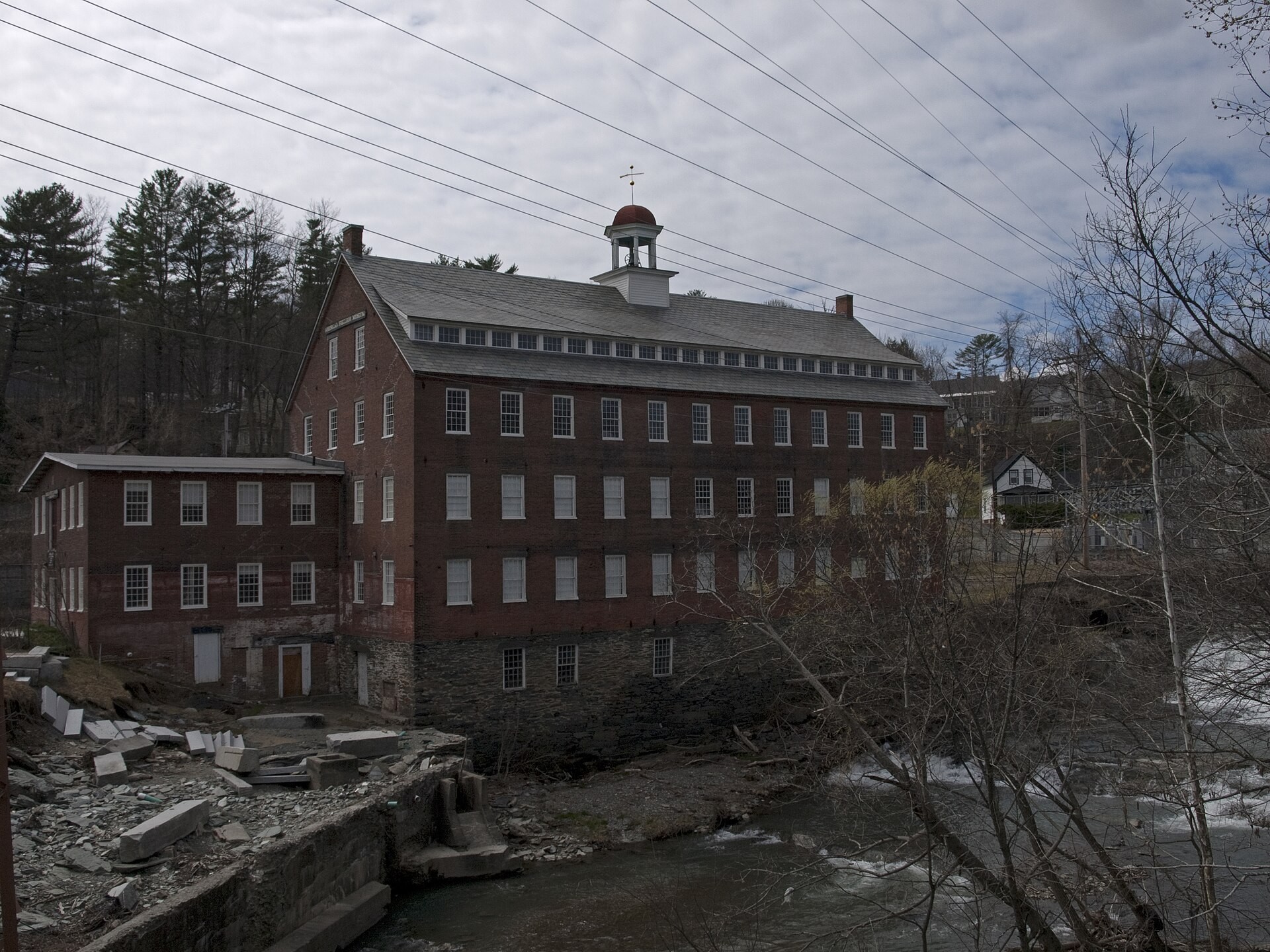
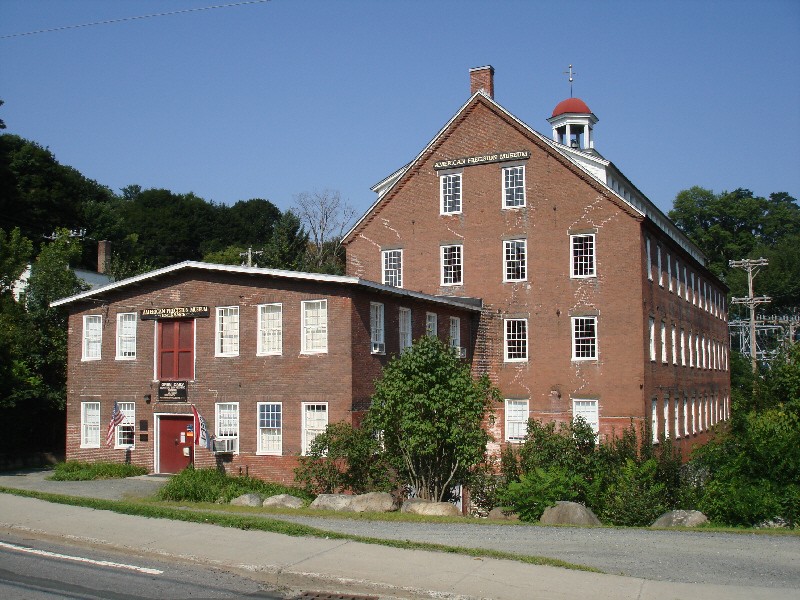
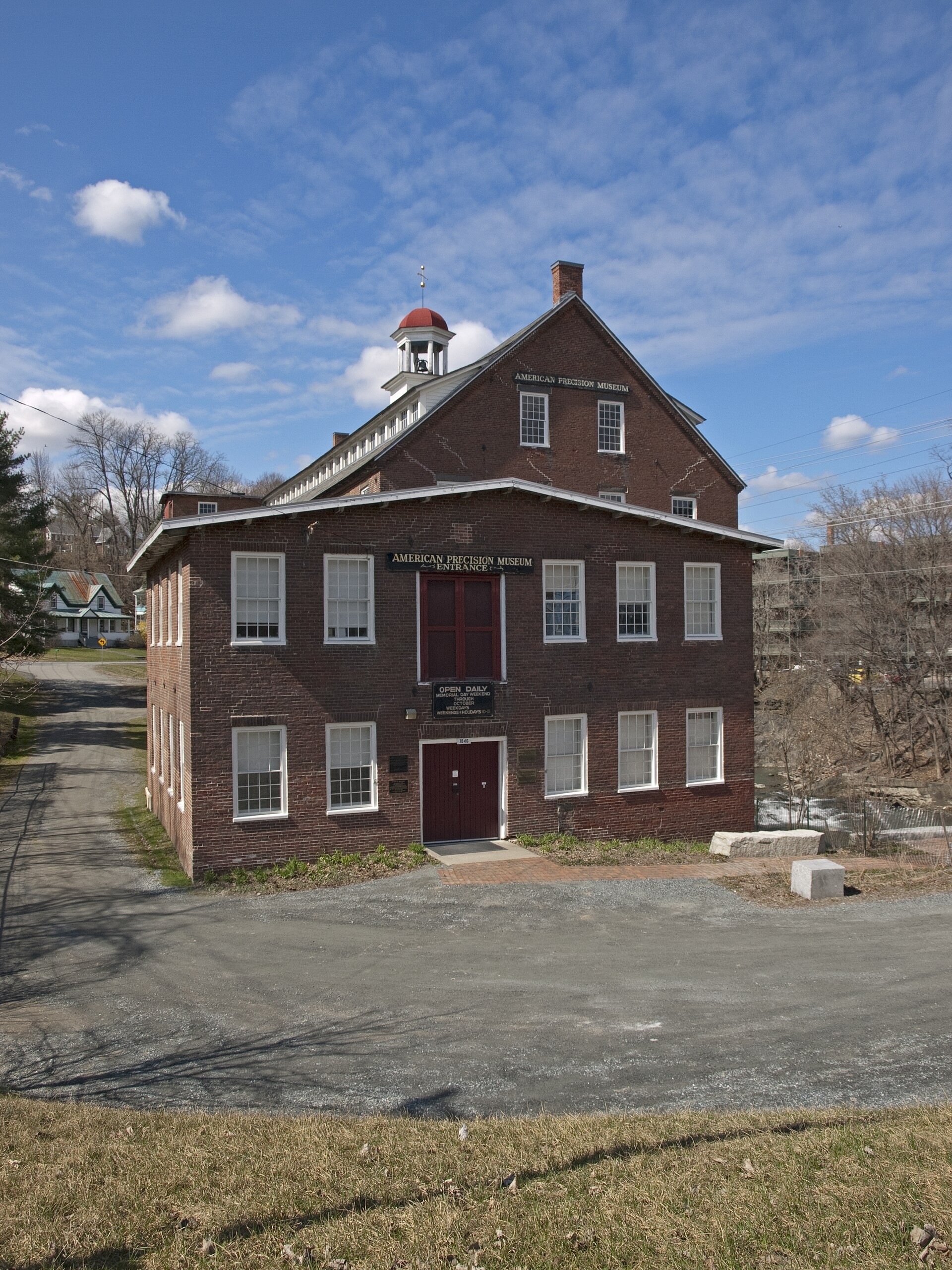
Palmer contracted the work to Robbins & Lawrence of Windsor, Vermont, which Rock Island calls “then the largest non-government arms manufacturer in the United States”.3 The armory building survives. It was built in 1846 and now houses the American Precision Museum.11
The number of rifles ordered and the number made are not the same, and the sources disagree on both:
Table 1 — The number of rifles ordered and the number made are not the same, and the sources disagree on both
| Figure | What it counts | Source |
|---|---|---|
| 5,000 | Jennings rifles Palmer financed, an order “never filled in its entirety” | Rock Island Auction essay3 |
| fewer than 1,000 | ”Jennings rifles produced in all its varieties” | Rock Island Auction essay3 |
| fewer than 1,000 | repeaters, single-shot breech-loaders and muzzle-loaders together, “1848–1851” | Rock Island Auction lot description, citing Lewis and Rutter8 |
| 1,000 | ”Jennings and Smith Jennings rifles … between 1849 and 1852”, per the Windsor historian Guy Hubbard, 1924 | proofhouse.com compilation, anonymous12 |
| fewer than a thousand | ”Hunt-Jennings rifles” | American Rifleman, 202613 |
The figures are compatible in order of magnitude and incompatible in detail, and none rests on a surviving production ledger that any source cites directly.
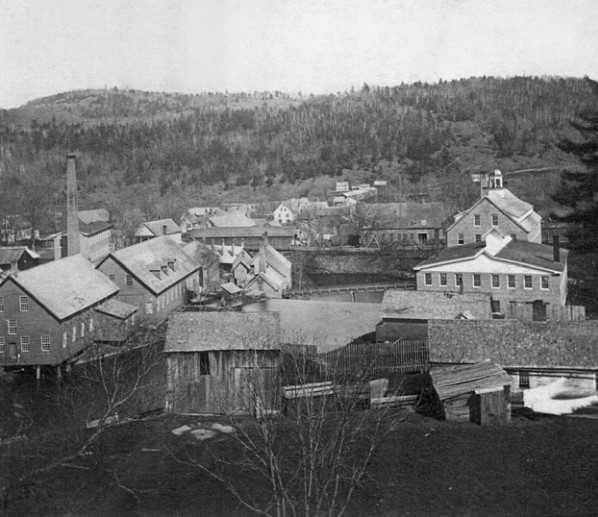
Robbins & Lawrence were known for interchangeable manufacture, and the company’s machine-tool work is the subject of the American Precision Museum. That reputation sits awkwardly beside the Jennings rifle’s record. A first-rate shop built a rifle that did not work well, and the lesson is that the fault lay in the design and the ammunition, not in the making.
1.6 Why the Jennings rifle failed
The most specific evidence comes from Richard S. Lawrence himself, as Rock Island Auction quotes him: “The result in firing the gun was that the ball leaded the barrel, by building on, to such an extent that in firing twenty shots from a 50-100 calibre bore there would be a hole in the barrel less than 25-100.”3 Read as Lawrence’s notation, a half-inch bore was choked to under a quarter of an inch by lead after twenty shots. The original of that recollection was not located; it is cited here as Rock Island quotes it.
The same account records the rifle called “too complicated” by the Ordnance Department and “underpowered due to the limited powder in the ‘rocket ball’”.3 The underpowered complaint is the one that followed the whole family, and Volume 3 shows how unsettled the numbers behind it are. The leading complaint is more specific to the Hunt ball: a large, soft, unpatched ball driven by a small charge through a rifled bore.
What happened to the rifles is documented in the guns that survive. Rock Island’s description of a Second Model Smith-Jennings repeater states that “The majority of these Smith-Jennings repeating rifles were converted to single shot with a ramrod in place of the magazine tube.”8 A Jennings breech-loading single shot sold by the same house “loads from the breech using a folding door, has an automatic pill primer operated by the ring trigger which connects to a rack and pinion mechanism, and has a long ramrod/cleaning rod tube in place of the magazine tube”.8 Wikipedia’s Rocket Ball article, citing a 2021 article by Danny Michael in Armax, adds that many were converted to muzzle-loading percussion arms, with the bolt removed and a breech block and nipple fitted.14 That article sits behind a paywall and only its abstract was seen.
The practical consequence for a collector is set out in Volume 6. The short version: an unconverted Jennings repeater is the rarity, and a single-shot Jennings may be either a factory breech-loader or a converted repeater.
1.7 Horace Smith’s finger lever, 1851
Horace Smith of Norwich, Connecticut, received US Patent 8,317 on 26 August 1851, assigned to Cortlandt Palmer, for an “Improvement in Breech-Loading Fire-Arms”. The specification says plainly what it improves: “the fire-arms secured by Letters Patent granted to Lewis Jennings on the 25th day of December, 1849”.9
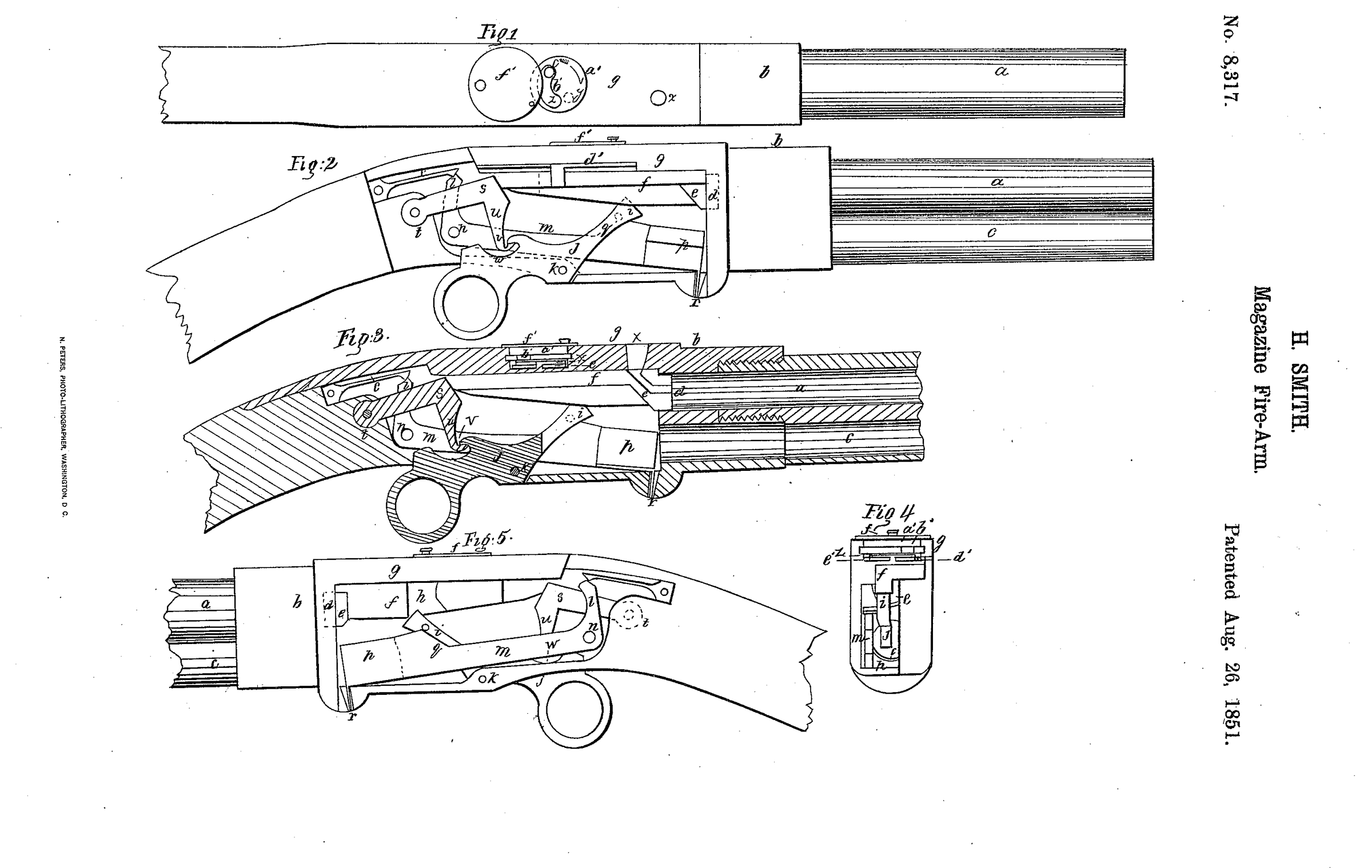
Smith’s first claim is “operating the breech-pin directly by the finger-lever”, in combination with the abutting lever that braces it.9 The text describes it: “A recess … is formed in the left-hand side of the said carrier to receive the end of an arm … of a finger-lever … that turns on a fulcrum-pin …, the lower arm of the said lever being formed with a loop for the finger, by which it is to be operated.”9 His second claim covers “elevating the charge-lifter by the breech-pin carrier coming in contact with an arm of the lifter, and depressing it by the finger-lever”.9 The patent also describes, without claiming it, a rack on the breech-pin carrier turning a priming plate at the bottom of “a magazine of pills of percussive powder”.9
Rock Island’s account summarises the change as removing “the rack and pinion action from the Jennings models and replacing it with an action that pivoted at the front”.3 Its blog on lever-action pistols puts it differently, as “a pivoting trigger rather than a trigger moving forward and backward in a straight line”, and records that a Smith-Jennings pill-lock repeating pistol, “described as the only known today” in Lewis and Rutter, sold at Rock Island in June 2020 for $23,000.15 A reader comment on Forgotten Weapons, reported only in a search summary, credits the idea to Smith’s employee B. Tyler Henry; that could not be confirmed and is not adopted.
The finger lever is the piece of this story that lasted. Smith’s patent does not yet have the toggle links that lock the Volcanic’s breech; those arrive in the 1854 patent he shared with Wesson. But the shape of the operation, a loop under the frame swung forward and back to work the breech and the carrier together, is here in 1851.

Sawyer’s text for the plate makes a claim this dive confirms from the patent: Smith and Wesson’s 1854 patent showed the mechanism “using a metallic centre-fire cartridge. The latter was not produced commercially, and the Smith & Wesson and Volcanic rifles used self propelled bullets such as the Jennings rifle used.”7 Volume 3 reads the 1854 patent’s cartridge in full. Sawyer’s summary is right in substance; the patent drawing is a copper-cased cartridge of the kind used in French “saloon” pistols.
1.8 Three men in one Vermont shop
Rock Island Auction places three of the men who would define the next decade at Robbins & Lawrence at the same time. Benjamin Tyler Henry was “shop foreman … in charge of making improvements to the mechanism”; “Horace Smith had been stationed at the Robbins & Laurence plant by Courtlandt Palmer himself to supervise the manufacturing of the Jennings rifles”; and Daniel Wesson “was employed by Leonard Pistol Works but was inspecting parts and finished pistols of the Leonard percussion pepperbox pistols that were contracted to Robbins & Lawrence”.3 Sawyer, in 1920, puts Henry at Windsor “about 1850 … to oversee the work upon the Jennings magazine gun”.7
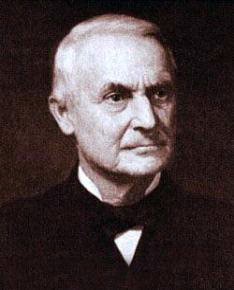
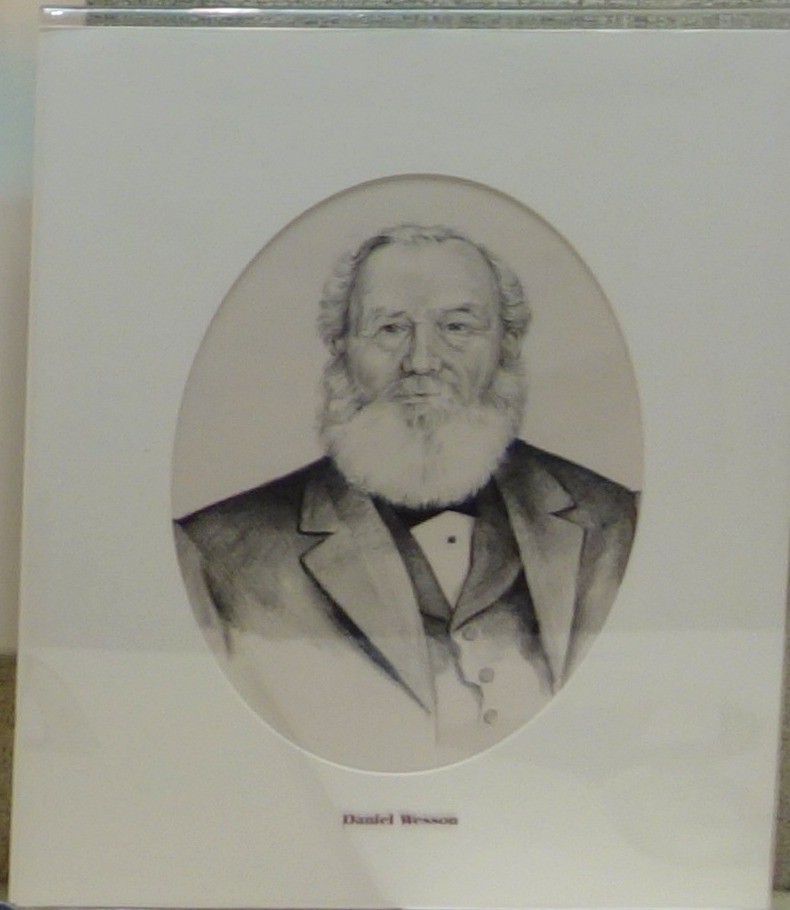
These are secondary accounts and they differ on titles, but they agree on the essential fact: the people who designed and built the Volcanic learned the problem by building the Jennings rifle. Smith brought the finger lever. Wesson, by the account of his 1906 obituary, formed his partnership with Smith in Norwich in 1852; Smith’s 1893 obituary says 1853, with “the necessary money being furnished by Cortland Palmer of New York”.10 Henry, by Sawyer’s account and Rock Island’s, went with them as a superintendent.37 Volume 2 picks up the Norwich partnership.
1.9 Telling the Jennings rifles apart
A reader looking at a Jennings-family rifle needs to know which of four things it is. The table is built only from sourced descriptions of surviving guns and from the patents.
Table 2 — Telling the Jennings rifles apart
| Feature | Jennings repeater | Jennings single shot | Smith-Jennings repeater | Where to look |
|---|---|---|---|---|
| Operating control | Ring trigger sliding fore and aft, rack and pinion (US 6,973)6 | Ring trigger with rack and pinion working the pill primer8 | Pivoting finger lever with a loop (US 8,317)915 | Under the frame |
| Magazine | Tube under the barrel6 | Ramrod or cleaning-rod tube in its place; loads through a folding breech door8 | Tube under the barrel; most converted to single shot with a ramrod in its place8 | Under the barrel |
| Priming | Pill reservoir and rotating plate in the top of the breech6 | ”Automatic pill primer"8 | "Automatic pellet primer on top of frame”8 | Top of the frame |
| Frame | — | — | Second Model: the “pregnant frame”, with a bulge at the bottom8 | Frame profile |
| Markings | ”Robbins & Lawrence and Dixon agent markings in two blocks” on the left of the receiver8 | Same | ”PATENT 1849/C.P. DIXON AGENT/NEW YORK” on the left8 | Left side of the receiver |
| Numbers | Under 1,000 of all Jennings types together8 | Included in that figure | About 400 Second Models, 1851–528 | — |
The “C. P. Dixon” of the markings is the New York agent whom Sawyer names as the rifle’s distributor.7
1.10 What 1852 handed on
By 1852 the idea of the magazine rifle firing a loaded ball had been tried twice and had not worked commercially. What it had produced was a set of parts and a set of people. The parts were the tube magazine with a separable front for loading (Hunt, 1849), the carrier that lifts a round from the magazine to the bore (Jennings, 1849), and the finger lever that drives breech-pin and carrier together (Smith, 1851). The people were Smith, Wesson and Henry, and the patents were owned by Palmer, who would carry them into the next venture.
What was still missing was a breech that locked, a ball that primed itself, and a way to make the arm cheaply enough to sell. The Norwich partnership of 1852–55 supplied the first two. Nobody, in the end, supplied the third.
References
Footnotes
-
Walter Hunt, US Patent 6,663, “Combined Piston Breech and Firing-Cock Repeating Gun”, 21 August 1849, issued to Geo. A. Arrowsmith as assignee; text records “patented in England, December 10, 1847”. https://patents.google.com/patent/US6663A/en , accessed 2026-10-18. Source of the “Volition Repeater” name, the two claims quoted, and the twelve-ball loading passage. ↩ ↩2 ↩3 ↩4
-
Walter Hunt, US Patent 5,701, “Loaded Ball” (drawing sheet: “Cartridge”), 10 August 1848, assignor to Geo. A. Arrowsmith. Google Patents, https://patents.google.com/patent/US5701A/en , OCR text and drawing sheet, accessed 2026-10-18. Quotations are from the specification and claim. ↩ ↩2 ↩3 ↩4
-
Rock Island Auction Company, “The Evolution of the Winchester Rifle”, RIAC blog, https://www.rockislandauction.com/riac-blog/the-evolution-of-the-winchester-rifle/ , read through the shared fetch engine 2026-10-18; earlier version by Joel R. Kolander, “Lever Action Progression: ‘That Damned Yankee Rifle…’”, 31 May 2013. An auction-house essay that cites no primary documents inline; treated as a good secondary source. The 2013 version says the popular failure reasons “have no merit”; the current version says they “have some merit but are far from the whole story”. ↩ ↩2 ↩3 ↩4 ↩5 ↩6 ↩7 ↩8 ↩9 ↩10 ↩11 ↩12 ↩13
-
Ed Lewis, “Volcanic Self-Contained Ammunition (A Cartridge Hound Special)”, Collector’s Firearms blog, 12 June 2025, https://collectorsfirearms.com/2025/06/12/volcanic-self-contained-ammunition-a-cartridge-hound-special/ , accessed 2026-10-18. Lewis is co-author of Volcanic Firearms (below). ↩
-
International Ammunition Association forum, “Hunt’s Rocket Ball”, https://forum.cartridgecollectors.org/t/hunts-rocket-ball/15031 (posts of 7 September 2014 and 3 October 2018), and “Volcanic and Hunt rocket ball type cartridges”, https://forum.cartridgecollectors.org/t/volcanic-and-hunt-rocket-ball-type-cartridges/55188 (June 2023), accessed 2026-10-18. Collector observations. ↩
-
Lewis Jennings, US Patent 6,973, “Improvement in Breech-Loading Fire-Arms”, 25 December 1849, issued to Geo. A. Arrowsmith as assignee. https://patents.google.com/patent/US6973A/en , accessed 2026-10-18. Claims quoted for the two-part charger, the carrier, the abutting lever and the sliding trigger-bar; specification for the pill reservoir and rotating plate. ↩ ↩2 ↩3 ↩4 ↩5 ↩6 ↩7
-
Charles Winthrop Sawyer, Our Rifles (Firearms in American History, vol. 3), Boston, 1920, pp. 64 and 276–278 and Plate 9. Internet Archive, https://archive.org/details/firearmsinameric00sawyrich , accessed 2026-10-18. Public domain. ↩ ↩2 ↩3 ↩4 ↩5 ↩6
-
Rock Island Auction Company lot descriptions, read 2026-10-18: Jennings breech-loading single shot, 5 June 2020, lot 79/12, https://www.rockislandauction.com/detail/79/12/engraved-robbins-lawrence-jennings-breech-loading-rifle ; Second Model Smith-Jennings repeater, 25–27 August 2023, lot 89/3076 (cites Lewis and Rutter p. 17), https://www.rockislandauction.com/detail/89/3076/second-model-smithjennings-repeating-rifle-with-auto-primer ; Second Model Smith-Jennings repeater, 23–24 August 2024, lot 4092/1004, https://www.rockislandauction.com/detail/4092/1004/robbins-lawrence-second-model-smithjennings-repeating-rifle . ↩ ↩2 ↩3 ↩4 ↩5 ↩6 ↩7 ↩8 ↩9 ↩10 ↩11 ↩12 ↩13 ↩14
-
Horace Smith, US Patent 8,317, “Improvement in Breech-Loading Fire-Arms” (drawing sheet: “Magazine Fire-Arm”), 26 August 1851, issued to Cortlandt Palmer as assignee. https://patents.google.com/patent/US8317A/en , accessed 2026-10-18. ↩ ↩2 ↩3 ↩4 ↩5 ↩6 ↩7
-
Obituaries of Daniel B. Wesson (Norwich Morning Bulletin, 6 August 1906) and Horace Smith (Norwich Morning Bulletin, 17 January 1893), as quoted by Iconic Norwich, https://iconicnorwich.org/?p=54753 , accessed 2026-10-18. ↩ ↩2
-
Wikimedia Commons file description, “The armory complex in Windsor around the time of the Civil War, of Lamson, Goodnow & Yale”, citing the Vermont Historical Society, Vermont History 79 (“Guns for Billy Yank”), https://vermonthistory.org/journal/79/VHS7902GunsForBillyYank.pdf , accessed 2026-10-18. Source of the 1846 construction date and the building’s present use. ↩
-
“Winchester Dates”, proofhouse.com, https://proofhouse.com/win/winchester.htm , accessed 2026-10-18. Anonymous compilation; cited only for the Hubbard figure it reports. ↩
-
Rick Hacker, “America’s Lever Revolution”, American Rifleman, 6 July 2026, https://www.americanrifleman.org/content/america-s-lever-revolution/ , accessed 2026-10-18. ↩
-
“Rocket Ball”, English Wikipedia, accessed 2026-10-18, citing Danny Michael, Armax VII(2), 2021, doi:10.52357/armax20674 (abstract only seen). Cited only for the muzzle-loading conversions. ↩
-
Rock Island Auction Company, “Lever Action Pistol”, RIAC blog, https://www.rockislandauction.com/riac-blog/lever-action-pistol , read 2026-10-18. ↩ ↩2
Comments (0)