Volcanic Repeating Arms · Volume 3
The Rocket Ball and the Volcanic Ball — What It Was, Who Patented It, and Why It Failed
Hunt's primerless ball of 1848, two cased cartridges Smith and Wesson patented and never made, the copper-cup primer of 1856 that the guns actually fired, a hundred grains on six and a half of powder, and the seven ways it let its shooters down
The guns in this dive exist because of their ammunition, and they died of it. A tube magazine needs a self-contained round; in 1848 none existed in America, and Walter Hunt’s answer was to put the powder inside the bullet. Twelve years later B. Tyler Henry put it inside a copper case instead, and the loaded ball was finished.
3.1 What this volume adds to the caseless story
The hub’s Daisy dive, Vol 15 owns the long view:1 the line of caseless rounds from the rocket ball through the Daisy V/L and the H&K G11 to the Voere VEC-91, and the four jobs a brass case does that every caseless design has to replace (sealing the breech, carrying away heat, protecting the propellant, and making a misfire clearable). That argument applies here exactly and is not repeated. This volume stays with what is specific to the Volcanic: the patents read in full, the construction of the ball as collectors and the period press describe it, the published figures for its power with each attributed, and the specific ways it failed.
One correction to the common account belongs at the start. The rocket ball is usually described as a single thing, Hunt’s 1848 invention, made in .31 and .41 calibres. It was not one thing. Hunt’s ball was large, about .54, and carried no priming; the .31 and .41 balls with a primer in the base were Smith and Wesson’s, patented in their final form in 1856 and assigned to the Volcanic company. Treating them as the same round is how the 1854 patent came to be credited with ammunition it never describes.
3.2 Three different rounds called the rocket ball
Table 1 — Three different rounds called the rocket ball
| Round | Date | Priming | Calibre | Source |
|---|---|---|---|---|
| Hunt’s “rocket-ball” | US 5,701, 10 Aug 1848 | None in the round; fire from the gun’s pill primer through a hole in the base cap | .54 nominal, .553–.560 in measured; 330–336 gr | Patent;2 Lewis3 |
| The cased cartridges of the 1854 patents | US 10,535 (14 Feb 1854) and US 11,496 (8 Aug 1854) | Priming in a projecting copper base (10,535); priming behind a perforated disc in a copper case (11,496) | Not stated | Patents45 |
| The Volcanic ball | Made from 1854–55; primer patented US 14,147, 22 Jan 1856 | Self-primed: a copper or brass cup holding cork, fulminate and an iron or steel disc, seated over the powder in the ball’s base | No. 1 .31; No. 2 .41; some later .36 | Patent;6 Lewis3 |
3.3 Hunt’s ball, 1848
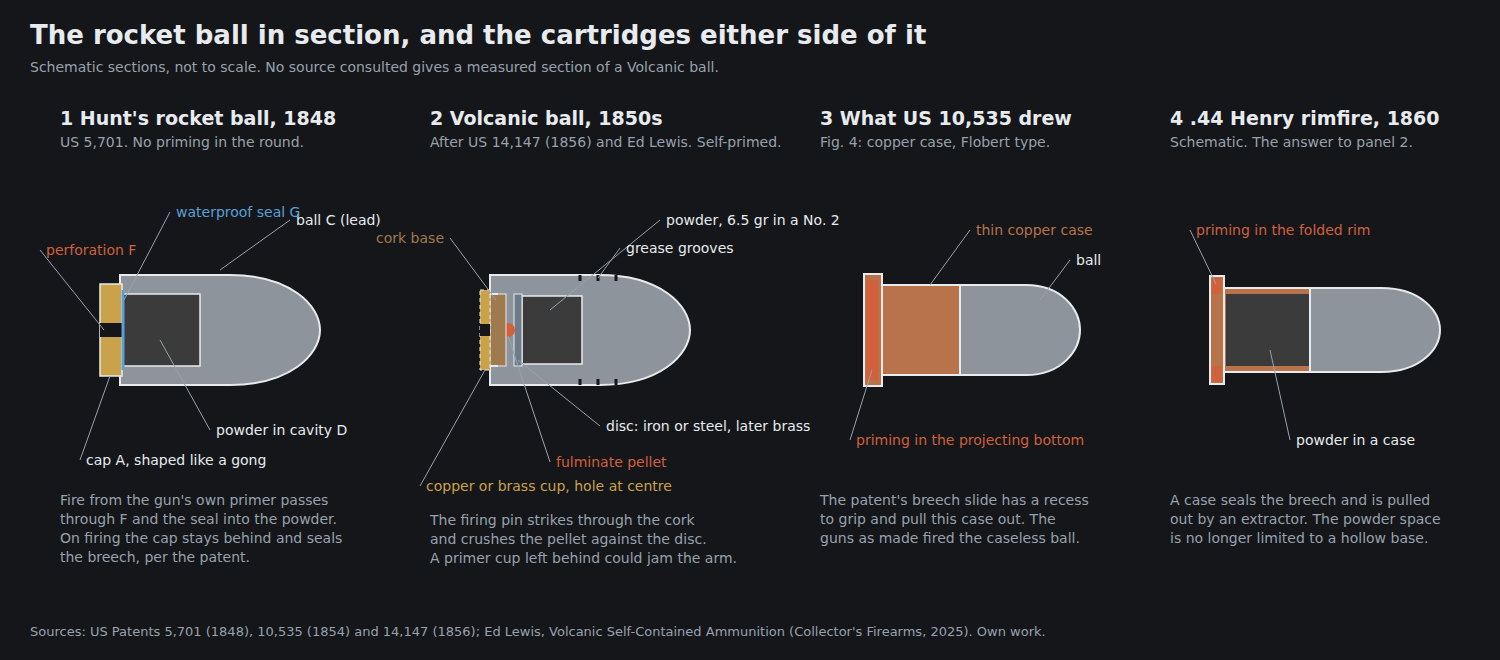
Volume 1 quotes Hunt’s patent at length. The essentials for the ammunition are these. The ball had a rear cavity “to contain the charge of powder for propelling said ball”, closed by a cap “A” that “in form resembles the Chinese gong, with a central perforation, F, in its discous head, which is the point of ignition from the priming”, sealed on the inside by “a thin water-proof tissue”.2 Ball and cap were pressed in moulds, and pressed again to fix the cap and size the round.2
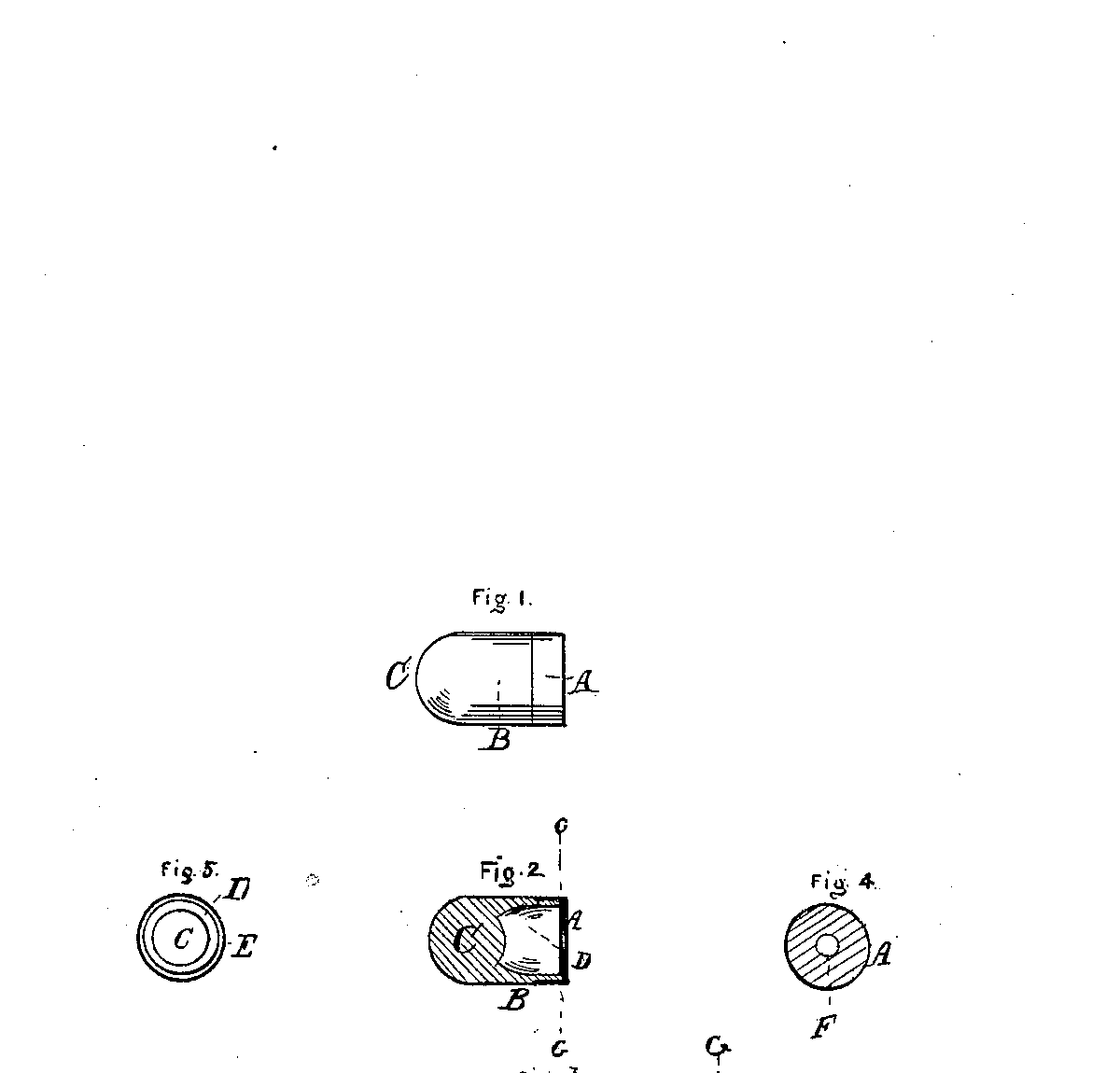
Hunt meant the cap to stay in the breech and act as a gas seal, its rim “forced outward against the inner periphery of the caliber of the barrel, forming an air-tight stopper”.2 In a gun with a sliding breech-pin it would be pushed out ahead of the next ball as “an effectual wiper to the barrel”.2 Whether it worked is not recorded anywhere this volume could find. Richard Lawrence’s recollection of the Jennings rifle, quoted in Volume 1, is that the ball leaded the bore badly enough to choke a half-inch barrel to under a quarter of an inch in twenty shots.7
Ed Lewis gives the Hunt ball’s size from surviving examples: .54 nominal, .553 to .560 inch measured, 330 to 336 grains, charge unknown, no primer, “ignited by a gravity-fed priming pill from the gun’s magazine”.3 Collectors record Hunt balls with the patent date stamped on them and without, in at least three overall lengths, and one forum contributor notes “They would have different weights based on size but I’m not aware of any consistency.”8
3.4 The two cartridges Smith and Wesson patented in 1854
The patent stamped on every Volcanic barrel, US 10,535 of 14 February 1854, illustrates its pistol with a cartridge that is not a rocket ball. Fig. 4 and the text describe “the same as is used in that species of pistols usually termed the ‘Saloon pistol,’ it being, as we believe, a French invention. This cartridge has its case of thin copper, and with a projecting bottom that contains the percussion-powder, the ball being inserted in the other end or top of the case.”4 The breech slide’s face carries a dovetail recess to grip and withdraw “the refuse metal or cartridge” after firing, and the carrier, rising, throws it out.4 That is a case extractor and ejector for a Flobert-type round, and the patent claims it. Volume 5 explains why the production guns had no use for it.
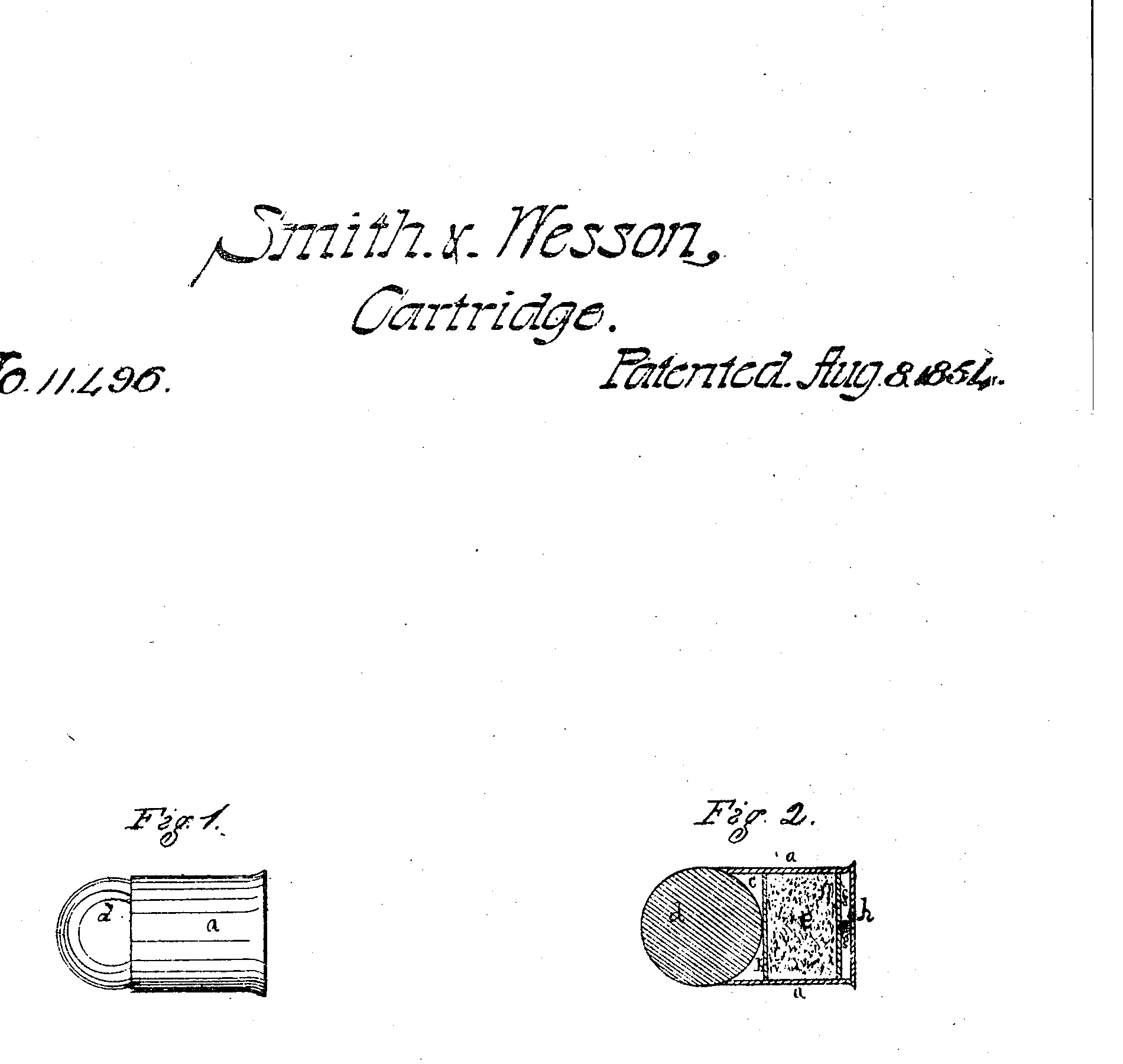
The second patent, US 11,496 of 8 August 1854, signed on 10 May 1853, is also for a cased round. “In Fig. 2, a represents the cylindrical case of the cartridge, which may be made of thin plate-copper or any other suitable material. It is formed with a partition, b, across it and near to the ball”, the space between the partition and the ball being “filled with tallow or other equivalent”. Behind the partition is the powder; “A metallic perforated disk or plate, f, is placed on the powder”, and behind that disc “the percussion-pellet or priming g is placed, it being made to rest against the disk”. The closed end of the case was to be “very thin and yielding, or of some substance easily punctured by a blunt point or needle”.5 The claims are for the tallow inside the cartridge and for the disc resting on the powder with the priming behind it, so that the firing blow falls “in the line of the axis of the cartridge”.5
Neither 1854 cartridge was produced commercially, as far as any source records. Sawyer wrote in 1920 that the cartridge shown in the 1854 patent “was not produced commercially, and the Smith & Wesson and Volcanic rifles used self propelled bullets”.9 A collector’s site, revivaler.com, calls the 11,496 round S&W’s “base-fire” cartridge and says it was “too expensive to produce because of its complexity”; that is a secondary assessment and its source is not given.10 What carries forward from 11,496 into the production ammunition is the arrangement of a disc on the powder with the priming behind it, struck on the axis by a point.
3.5 The primer of 1856 and the ball the guns fired
US Patent 14,147, dated 22 January 1856, is issued to “Horace Smith, of Norwich, and Daniel B. Wesson, of New Haven, Conn., assignors to the Volcanic Repeating Arms Company”, for “Improved Primers for Cartridges of Fire-Arms”.6 It is the patent for the ammunition the guns used.
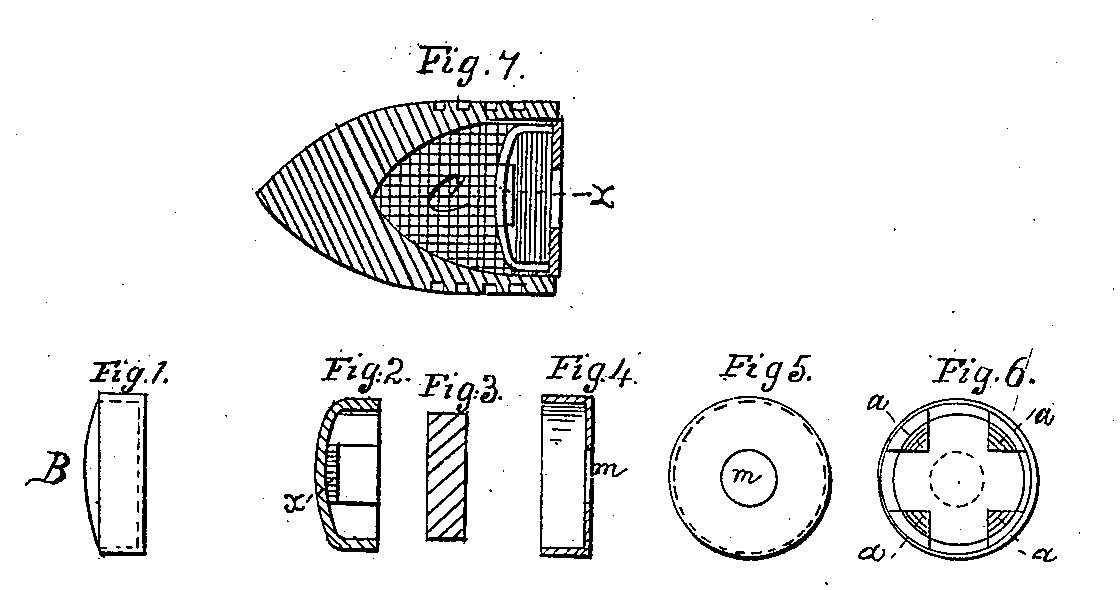
The specification describes a primer “composed of four materials, combined: First, copper or brass; second, iron or steel; third, cork or its equivalent; and, fourth, fulminating-powder.” The disc is “made in the form of a cross, with the arms bent upward sufficiently to allow them to bear firmly on the copper case which covers it”, with “an indentation, concave on the inside and in the center, forming a proper cavity for the fulminating-powder”. The cork “is placed in the disk upon the fulminating-powder, serving to secure it in its position, and affording for it an elastic protection from any blow the primer may receive on its exterior surface. It also serves as a means for withdrawing the primer from the arm after it has been discharged.” The cup is a cylinder “with one end closed, except a small circular hole … through the center”.6
The primer “is more particularly designed for a loaded ball, made solid, except a cavity … which contains the powder and primer, both pressed into it by power, the primer closing the rear end water-tight and resting firmly on the powder.” In operation, “The ball being placed in the arm, a blunt projecting piece is pressed through the cork until it bears on the fulminating-powder and disk. A smart blow from a hammer will then ignite the percussion, and by forcing the fire through the openings … will explode the powder in the ball.”6
The patent is explicit about what it is not claiming: “We do not claim the steel disk; nor placing the percussion-powder on it in the rear of the powder; nor the method of exploding the same, as a patent has already been granted to us for that”.6 That earlier patent is 11,496. What 14,147 claims is the combination of cup, disc, cork and fulminate.
A newspaper report of February 1856 describes the same ball from the outside. “The peculiarity of these arms consists more in the ball than in the gun itself. It is a complete cartridge, cased water tight in metal. The ball is in the cylindro-conical or Minie form, with a deep cavity in the backside in which is inserted both the powder and the percussion cap. A coating of cork intervenes between the cap and the thin metal which forms the outer covering”. On closing the lever, the breech-pin drives the ball into the barrel, “at the same time puncturing by a point on its end, quite through both the metallic covering and the cork, and pressing fairly upon the percussion portion of the enclosed cartridge. … on pulling the trigger the hammer strikes fair upon the hinder end of the breech pin”.11
Ed Lewis’s description of surviving balls adds what the patent leaves out and records how the round changed. “As originally made, the bullet was first charged with black powder, then an iron anvil disc was placed”, followed by a fulminate priming pill and a cork base; the rear of the lead was pressed inward against the cork, and on some balls a perforated metal cap covered it.3 The balls were then grooved, greased, swaged and varnished. Fine-grooved balls with five or six grooves are thought to be earlier and usually have iron anvils; coarse-grooved balls with three or four grooves usually have brass ones. Lewis gives the reason for the change, and calls the dating conjecture: iron reacts with fulminate over time and makes the primer inactive.3 Copper caps “proved unsatisfactory” and are very rare.3
Lewis’s account and the patent differ on one point that matters for anyone reproducing the round. The patent’s primer is a self-contained unit with its own metal cup; Lewis describes balls whose closure is cork held by the lead rim, with a cap only on some. Both kinds evidently existed. A dealer’s description of a No. 2 ball made after December 1855 says the Volcanic cartridges “used a steel disc under the cork wafer with the fulminate located in the middle”, and that “Later, a copper cap was added, with the last version using a brass cap.”12 The evidence is consistent with a sequence (cork closure first, metal cup later) but no source dates the stages firmly.
3.6 Sizes, weights and charges
Table 2 — Sizes, weights and charges
| Ball | Bullet | Charge | Source |
|---|---|---|---|
| No. 2, .41 | 100 gr | 6.5 gr black powder | Lewis; Lewis and Rutter as quoted by Rock Island31314 |
| .41 | 106 gr | not stated | Forgotten Weapons, 201415 |
| No. 1, .31 (New Haven No. 1 pistol) | 53 gr | ”less than 6 grs.” | American Rifleman, 201616 |
| ”.38 caliber” ball dissected at Winchester | 100 gr | 6.5 gr, with a small fulminate pellet and glass in the base | Charles T. Haven’s history of Winchester, as cited by Lewis3 |
| Hunt ball (Jennings rifle) | 330–336 gr | unknown | Lewis3 |
Lewis records that some later balls are .36 calibre, “for which no gun is known”.3 The “.38” of the Winchester dissection is as Lewis reports it; it may be a description of a .41 ball, and the Haven book itself was not seen. Glass ground into fulminate was a known way of making a priming mixture more sensitive to a blow; neither source says that is why it was there, and this volume does not assert it.
A Rock Island lot description gives a No. 2 tin of balls as “.41 caliber and .67 inches long” with “seven grooves and brass bases”; that page refused automated reading and the figure comes from a search summary, so it is not relied on. A collector’s blog photograph caption gives auctioned No. 1 balls as about half an inch long with brass primer rims.17 No source consulted gives a measured section or a full set of dimensions for either size.
3.7 Who made it, how it was sold, what it cost
Lewis names Crittenden & Tibbals of South Coventry, Connecticut, as the likely first maker of the .31 and .41 balls, adding that “no records confirm their ties to the gun companies”. He dates the Volcanic Repeating Arms Company’s own ammunition department to 1 May 1856; before that, ammunition came from Norwich and South Coventry. Black japanned tins were probably Volcanic’s own; cardboard boxes were probably made by the Kingsbury Box Company; boxes held 200, sometimes with sawdust packing. Grey unlacquered tins of 200 No. 1 balls labelled Smith & Wesson he attributes to Crittenden & Tibbals.3 Forgotten Weapons also names Crittenden & Tibbals, which it says later became part of UMC; that lineage is Forgotten Weapons’ claim.18
Prices are recorded four ways and do not agree:
Table 3 — Prices are recorded four ways and do not agree
| Price | Source |
|---|---|
| ”prepared at a profit for $1 per hundred” | Springfield Weekly Republican, 23 February 185611 |
| 200 rounds .31 for $2.00; 200 rounds .41 for $2.40 | Rock Island Auction essay, 202213 |
| $10 per thousand (.31) and $12 per thousand (.41), in tins of 200 | Forgotten Weapons, 202018 |
| Round tins at $10 and $12 per thousand, “no one has seen one of these round tins” | Lewis, quoting another author3 |
The 1856 newspaper figure is the maker’s own claim, printed in a promotional article. The other three are consistent with one another at about a penny a ball.
Two artefacts of the ammunition trade are worth knowing. Forgotten Weapons describes a period loader for the .31 pistol: “six pewter tubes soldered together” with a sliding lid, holding thirty balls, used by “simply pouring the contents of a tube directly into the magazine of the pistol”.19 And the tins themselves are now collectors’ objects: Rock Island sold a Volcanic Repeating Arms Company 200-count No. 2 tin with ammunition for $43,125 in September 2020, by the house’s own account, the same price it reports for a pistol-carbine with stock and telescope.13
3.8 Ballistics and accuracy as published
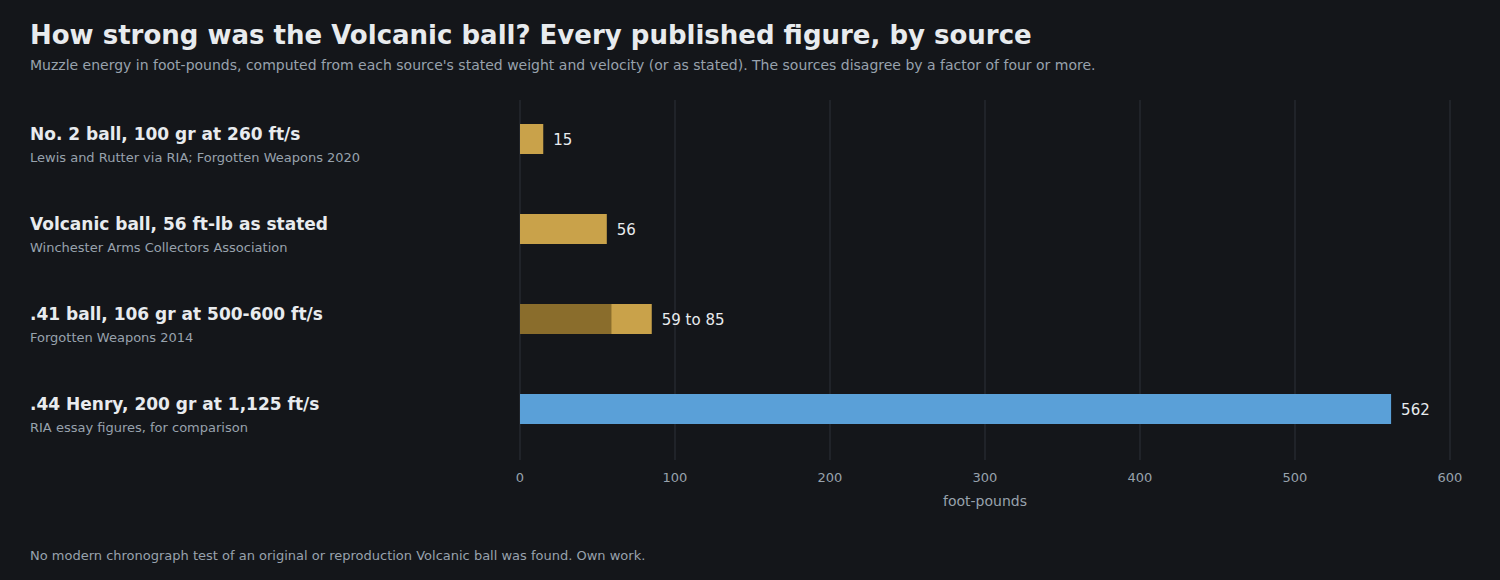
The figures conflict, and the conflict cannot be resolved from anything published. Lewis and Rutter, quoted by Rock Island, give the No. 2 ball at 100 grains on 6.5 grains of black powder at 260 feet per second.13 Lewis repeats it in 2025.3 Ian McCollum of Forgotten Weapons gave the same 260 figure in 2020.18 American Rifleman’s 2026 article repeats it too, and is not independent.20 That works out to about 15 foot-pounds.
McCollum’s own 2014 page gives the .41 as “a 106gr bullet at about 500-600 fps”, or 59 to 85 foot-pounds.15 The Winchester Arms Collectors Association says the ammunition “was grossly underpowered as muzzle energy was an unimpressive 56 foot pounds”, without a calibre or a source.21 Fifty-six foot-pounds at 100 grains implies about 500 feet per second, which fits McCollum’s 2014 number and not the 260. Rock Island’s essay, without a source, puts “Smith & Wesson cartridges” at about 500 feet per second against the Henry’s 1,200.13
So the published record contains two velocities for the same round, roughly 260 and roughly 500 feet per second, and the same author has given both. No source describes a chronograph test of an original or reproduction ball. The two figures are given here separately and are not averaged. The hub’s own instrumented test of a caseless round, Tom Gaylord’s 2021 chronograph session with 1969 Daisy V/L ammunition reported in the Daisy dive, shows what such a test would look like; nothing comparable exists for the Volcanic.
The period claims are promotional and are recorded as claims. The February 1855 paragraph said the pistol “will put it through a three-inch plank at a distance of ninety rods”; one reprint reads “ninety yards”.11 The February 1856 article said the penetration “appears about equal to those of the Minie rifle, or all that need be desired”.11 The account of Colonel Hay at Hythe in 1856 has nine balls in an eight-inch ring at 100 yards, seven at 200 and five at 300 from an eight-inch pistol.11 Rock Island calls that report “an exaggeration at best”.13 A pistol firing a 100-grain ball at even 500 feet per second would drop several feet over 300 yards; the claim is not credible as reported, and the damaged newspaper text adds uncertainty to its numbers.
No published accuracy test of an original Volcanic under modern conditions was found.
3.9 Why it failed: the seven faults
Lewis lists the faults of the Volcanic ball, and his list is the most complete in print.3 Each is attributed to him unless another source is named.
- Power. The powder space was whatever the hollow base could hold. Every source agrees on this, whatever velocity it gives.
- Accidental discharge in the magazine. Pressure on the thin priming could set balls off in the tube. The Winchester Arms Collectors Association describes the same failure as “multiple charges going off at the same time”.21 A tube magazine puts each ball’s nose against the base of the one ahead, and the base is where the fulminate was; the patent’s cork, “affording for it an elastic protection from any blow”, was there to prevent exactly this.6
- Sealing. The ball had no effective shoulder, so gas leaked at the breech. The Collectors Association also records “gas leakage from around the breech”.21
- Fit. An oversized ball could fire under the pressure of the closing bolt; an undersized one could be pushed too far forward and fail to fire.
- “Thimbling”. Friction could make the front of the ball leave while its rear stayed in the chamber.
- The primer left behind. The priming disc sometimes failed to come out and disabled the arm. The 1856 patent anticipated withdrawing the spent primer by its cork;6 the production guns had no extractor (Volume 5).
- Corrosion. The fulminate corroded the firing pin, which then had to be replaced. Separately, an iron anvil disc slowly deactivated the primer, which is why the anvils changed to brass.
The cartridge box itself told the owner what to do with a misfire. Rock Island quotes the instruction printed on a No. 2 box: “If, by accident, a ball should miss fire, it must be carefully pushed back with the rod, leaving the carrier down.”13 That is the fourth job of the brass case, set out in the Daisy dive, done by hand with a cleaning rod.
The common claim that fouling or the corrosiveness of fulminate generally killed the design could not be traced to a source beyond Lewis’s specific points, and is not repeated.
3.10 Was it hopelessly weak?
Modern writing calls the round “exceedingly underpowered even for its day” (Forgotten Weapons) and “anemic”, and the Daisy dive calls Hunt’s concept “hopelessly underpowered from the day it was drawn”.181 On the 260 feet per second figure the No. 2 ball carried about 15 foot-pounds, and that verdict follows.
The period evidence does not all point the same way. The gun was sold, advertised and bought for several years by people who could shoot it. A British musketry officer fired it at Hythe at the British government’s order. In September 1858 the New-York Daily Tribune reported a police detachment at the Staten Island quarantine disturbances who “have fired at targets with the volcanic repeating rifles, which they use with great skill and precision”, and judged the force “equal to three times their number armed with the ordinary muskets”.11 That is newspaper praise, not a test, but it is not the description of a toy.
The fair statement is narrower than either side’s. On the best-sourced figure the ball was weak; on another published figure it was about as strong as a small pocket cartridge of the time; nobody has measured it; and the arm’s commercial failure is fully explained by the faults listed above without deciding the velocity question.
3.11 What replaced it
By 1858 or so, according to Rock Island’s account, B. Tyler Henry at the New Haven Arms Company had a .44 rimfire cartridge “capable of a 1,200 fps muzzle velocity”.13 Sawyer, in 1920, gives the Henry cartridge as 25 grains of powder and “a conical bullet of about half ounce weight — 216 grains”; Rock Island’s essay gives 28 grains and 200.913 The two descriptions differ, and the hub has no .44 Henry dive to reconcile them.
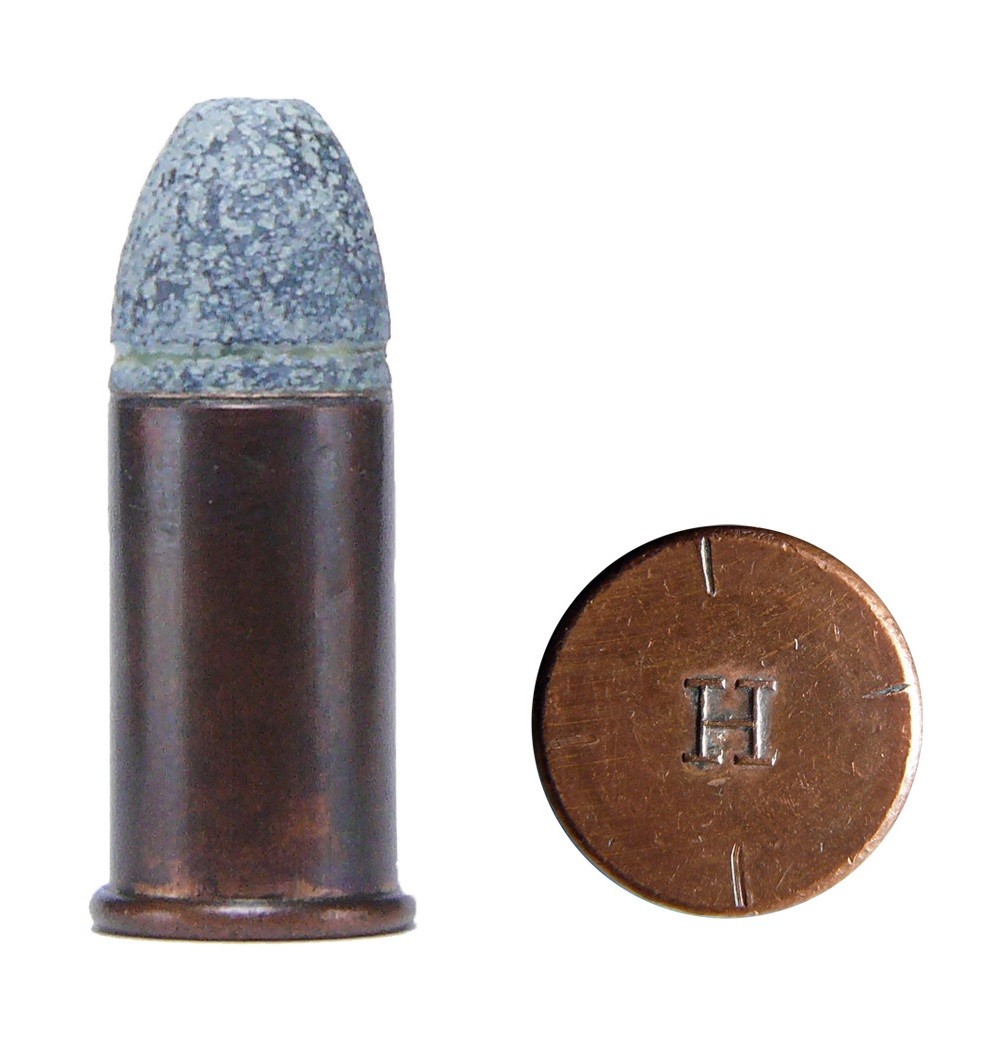
The Henry round was the Flobert principle that Smith and Wesson had drawn in their 1854 patent, scaled up: a copper case with the priming in a folded rim. It sealed the breech, it was extracted and thrown clear after every shot, its powder space was a case rather than a hollow, and a misfire came out with the lever. Volume 9 follows it into the Henry rifle. The Volcanic action survived the change almost untouched. The ammunition did not survive at all.
References
Footnotes
-
The hub’s Daisy dive, Vol 15, “Caseless Ammunition, Volcanic to G11”, /pellet-and-bb/rifles/daisy/vol-15/ . ↩ ↩2
-
Walter Hunt, US Patent 5,701, “Loaded Ball”, 10 August 1848. https://patents.google.com/patent/US5701A/en , accessed 2026-10-18. ↩ ↩2 ↩3 ↩4 ↩5
-
Ed Lewis, “Volcanic Self-Contained Ammunition (A Cartridge Hound Special)”, Collector’s Firearms blog, 12 June 2025, https://collectorsfirearms.com/2025/06/12/volcanic-self-contained-ammunition-a-cartridge-hound-special/ , accessed 2026-10-18. Lewis is co-author of the book at note 5. Source of the assembly order, the groove and anvil sequence, the iron-fulminate reaction, the sizes and weights, the makers and packaging, the Haven dissection and the seven faults. ↩ ↩2 ↩3 ↩4 ↩5 ↩6 ↩7 ↩8 ↩9 ↩10 ↩11 ↩12 ↩13 ↩14
-
Horace Smith and Daniel B. Wesson, US Patent 10,535, “Improvement in Fire-Arms”, 14 February 1854. https://patents.google.com/patent/US10535A/en , accessed 2026-10-18. ↩ ↩2 ↩3
-
Horace Smith and Daniel B. Wesson, US Patent 11,496, “Improvement in Cartridges”, 8 August 1854 (signed 10 May 1853). https://patents.google.com/patent/US11496A/en , accessed 2026-10-18. ↩ ↩2 ↩3
-
Horace Smith and Daniel B. Wesson, assignors to the Volcanic Repeating Arms Company, US Patent 14,147, “Improved Primers for Cartridges of Fire-Arms”, 22 January 1856. https://patents.google.com/patent/US14147A/en , accessed 2026-10-18. All quotations on the primer’s construction, operation and claim. ↩ ↩2 ↩3 ↩4 ↩5 ↩6 ↩7
-
Rock Island Auction Company, “The Evolution of the Winchester Rifle”, RIAC blog, https://www.rockislandauction.com/riac-blog/the-evolution-of-the-winchester-rifle/ , read 2026-10-18, quoting Richard S. Lawrence. ↩
-
International Ammunition Association forum, “Volcanic and Hunt rocket ball type cartridges”, https://forum.cartridgecollectors.org/t/volcanic-and-hunt-rocket-ball-type-cartridges/55188 (posts of 11–12 June 2023), and “Hunt’s Rocket Ball”, https://forum.cartridgecollectors.org/t/hunts-rocket-ball/15031 , accessed 2026-10-18. ↩
-
Charles Winthrop Sawyer, Our Rifles, Boston, 1920, pp. 64 and 278. https://archive.org/details/firearmsinameric00sawyrich , accessed 2026-10-18. Public domain. ↩ ↩2
-
“Smith & Wesson and New Haven Arms Lever Action Pistols”, revivaler.com, https://revivaler.com/smith-wesson-and-new-haven-arms-lever-action-pistols/ , accessed 2026-10-18. Collector’s site; cited only for its characterisation of the 11,496 round. ↩
-
Newspapers via the Library of Congress, Chronicling America, accessed 2026-10-18: Daily National Intelligencer, 17 February 1855, p. 3; Ellsworth American, 23 February 1855; Springfield Weekly Republican, 23 February 1856, p. 1, https://www.loc.gov/resource/sn83020847/1856-02-23/ed-1/?sp=1 ; Democrat and Sentinel (Ebensburg), 24 December 1856, p. 1; New-York Daily Tribune, 9 September 1858, p. 6, https://www.loc.gov/resource/sn83030213/1858-09-09/ed-1/?sp=6 . ↩ ↩2 ↩3 ↩4 ↩5 ↩6
-
The Horse Soldier, dealer listing for a No. 2 Volcanic cartridge, https://www.horsesoldier.com/products/firearms/cartridges-and-gun-tools/45712 , accessed 2026-10-18. Dealer description. ↩
-
Joe Engesser, “The Volcanic Pistol: The First Smith & Wesson Handgun”, Rock Island Auction Company, 20 October 2022, https://rockislandauction.com/riac-blog/the-volcanic-pistol , read through the shared fetch engine 2026-10-18. Quotes Lewis and Rutter for the 6.5 gr, 100 gr, 260 ft/s figures; source of the box instruction, the ammunition prices, the Hay assessment and the cartridge-tin sale. ↩ ↩2 ↩3 ↩4 ↩5 ↩6 ↩7 ↩8 ↩9
-
Edmund E. Lewis and Stephen W. Rutter, Volcanic Firearms: Predecessor to the Winchester Rifle (Andrew Mowbray, 2011). Not consulted directly. ↩
-
Ian McCollum, “Volcanic Repeating Pistol (Video)”, Forgotten Weapons, 5 May 2014, https://www.forgottenweapons.com/volcanic-repeating-pistol-video/ , accessed 2026-10-18. ↩ ↩2
-
“I Have This Old Gun: New Haven ‘Volcanic’ No. 1 Pocket Pistol”, American Rifleman, 16 September 2016, https://americanrifleman.org/content/i-have-this-old-gun-new-haven-volcanic-no-1-pocket-pistol , accessed 2026-10-18. ↩
-
Scott Mayer, “Cartridges Before There Were Cartridges”, John1911.com, 7 May 2017, https://john1911.com/cartridges-before-there-were-cartridges/ , accessed 2026-10-18. Secondary blog without citations. ↩
-
Ian McCollum, “Original Volcanic ‘Rocket Ball’ Cartridges”, Forgotten Weapons, 24 August 2020, https://www.forgottenweapons.com/original-volcanic-rocket-ball-cartridges/ , accessed 2026-10-18. ↩ ↩2 ↩3 ↩4
-
Ian McCollum, “Loading Tool for a .31 Caliber Volcanic Repeater”, Forgotten Weapons, 30 November 2020, https://www.forgottenweapons.com/loading-tool-for-a-31-caliber-volcanic-repeater/ , accessed 2026-10-18. ↩
-
Rick Hacker, “America’s Lever Revolution”, American Rifleman, 6 July 2026, https://www.americanrifleman.org/content/america-s-lever-revolution/ , accessed 2026-10-18. ↩
-
Winchester Arms Collectors Association, “Volcanic Rifles & Pistols”, https://winchestercollector.org/?p=367 , accessed 2026-10-18. No author or sources given. ↩ ↩2 ↩3
Comments (0)