Volcanic Repeating Arms · Volume 2
Smith & Wesson, the Volcanic Repeating Arms Company and Oliver Winchester, 1852–1857
A Norwich workshop on Central Wharf, a patent that drew the wrong cartridge, a name in print before the company existed, an $80,000 sale, a shirt-maker on the board, and a suspension notice in February 1857
The Volcanic’s company history is short, crowded and badly retold. In five years a two-man workshop in Norwich, Connecticut, patented a lever action, sold it to a New Haven corporation for a large sum, watched that corporation fail, and saw its assets bought by a shirt manufacturer who reorganised them as the New Haven Arms Company. The usual telling compresses it into a sentence and gets three things wrong: where the name came from, when the works moved, and what the famous 1854 patent covers.
This volume uses the period record where it exists: the patents, read in full, and contemporary newspapers found through the Library of Congress’s Chronicling America collection. Where the only source is a later auction essay or collector’s website, it says so. Production figures are given by source and never averaged, because almost every one of them traces to a single book, Lewis and Rutter’s Volcanic Firearms (2011),1 and to estimates rather than ledgers; the Winchester Arms Collectors Association states that “There are no factory records available for this model.”2
2.1 The Norwich partnership
Horace Smith and Daniel Baird Wesson went into business together in Norwich, Connecticut, with Cortlandt Palmer’s money. When they did depends on which obituary is read. Wesson’s, in the Norwich Morning Bulletin of 6 August 1906, says that in Norwich “in 1852 he became associated with the late Horace Smith, formed a partnership and established a factory here”. Smith’s, in the same paper on 17 January 1893, says “Smith and Wesson formed their first partnership in 1853, when they went to Norwich and established a factory … the necessary money being furnished by Cortland Palmer of New York.”3 Wikipedia gives 1854 for the formal partnership with Palmer. Rock Island Auction’s essay says the venture “lasted only 17 months”, which, counted back from the Volcanic company’s formation in mid-1855, lands near the patent date of February 1854.4 These are not necessarily in conflict. Shop work in 1852 or 1853 and a formal three-way partnership in 1854 would explain all of them; but no contemporary partnership document was found, and the dates are given as the sources give them.
Rock Island’s account of the money says the partners “asked Mr. Courtlandt Palmer for around $10,000 for tooling of the new inventions. He agreed and re-assigned the Hunt, Jennings, and Smith patents to the new partnership known as Smith & Wesson.”4 It also names B. Tyler Henry as “likely” a shop superintendent.4 The works were on Central Wharf in Norwich; the Norwich Examiner says so in 1855.5
2.2 The patent of 14 February 1854
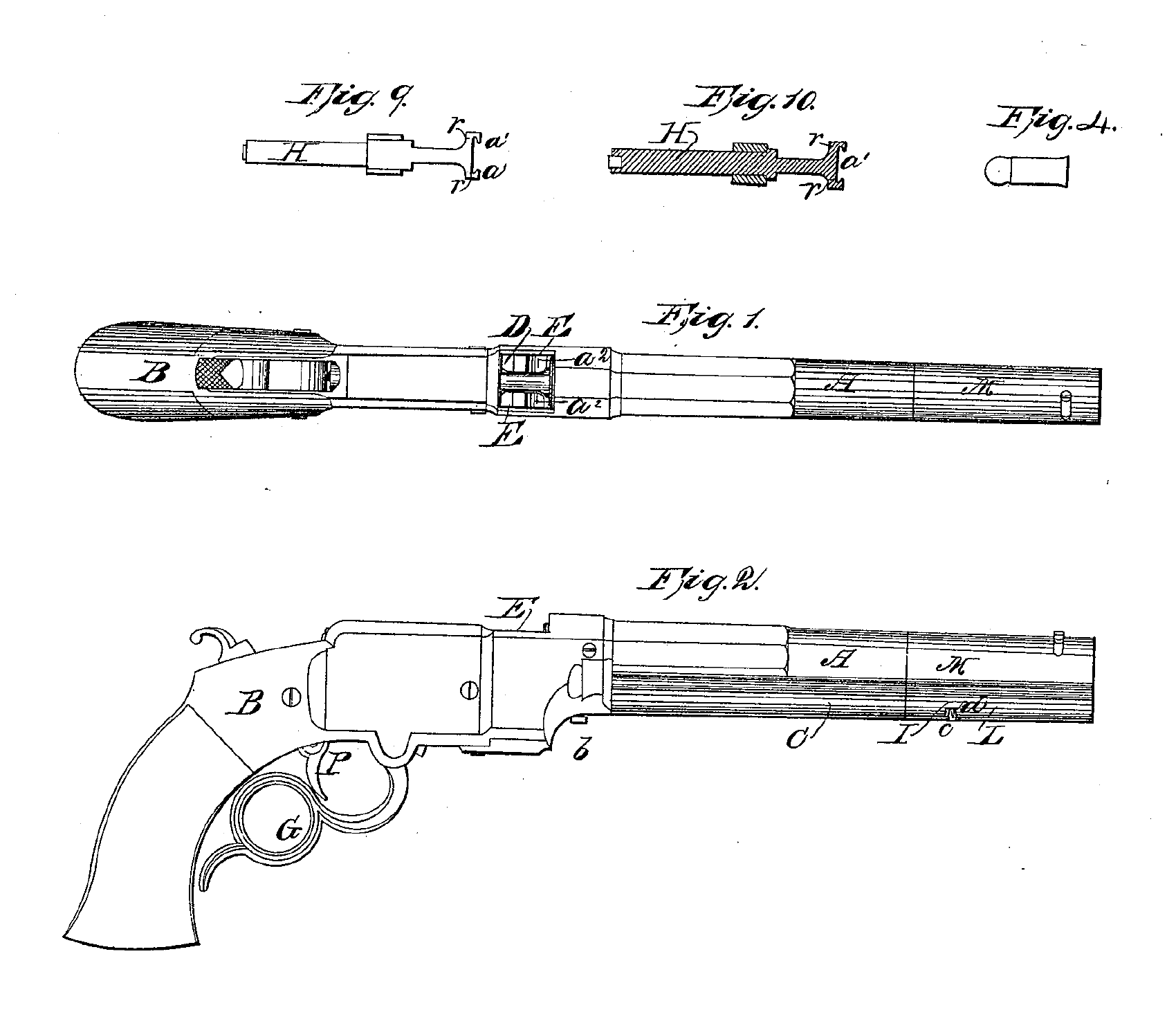
US Patent 10,535, “Improvement in Fire-Arms”, was granted to Horace Smith and Daniel B. Wesson of Norwich on 14 February 1854. The signatures are dated 24 May 1853, so the design was complete nine months before the grant.6 Its date is the one roll-stamped on every Volcanic Repeating Arms and New Haven Arms barrel (Volume 4), and it is the most misdescribed document in the story.
The patent describes a pistol with a magazine tube under the barrel; a carrier that lifts a cartridge into line with the bore; a “piston-slide” that pushes it into the chamber and “serves as a breech to the barrel”; two toggles joining that slide to the frame, so that “When the toggles are brought into a straight line with each other, the piston-slide H is moved hard up against the rear end of the cartridge”; and a trigger guard that is also the operating lever, so that “the trigger-guard, when so moved, is made to simultaneously cause the hammer to be cocked, the piston-slide to be forced back, and the carrier to be elevated.”6 Volume 5 works through the mechanism part by part.
What the patent does not describe is the Volcanic’s ammunition. Its Fig. 4 shows a small cased round, and the text explains it: “Fig. 4 is a side view of the kind of cartridge to be used therein, it being the same as is used in that species of pistols usually termed the ‘Saloon pistol,’ it being, as we believe, a French invention. This cartridge has its case of thin copper, and with a projecting bottom that contains the percussion-powder, the ball being inserted in the other end or top of the case.”6 That is a Flobert-type parlour cartridge, the ancestor of the .22 rimfire; the hub’s .22 Rimfire dive, Vol 2 dates Flobert’s BB Cap to 1845. The patent’s second claim is for a dovetail recess in the face of the breech slide “for the purpose of enabling the slide to seize the metal of the cartridge … so that the refuse metal or cartridge may be withdrawn from the barrel by the piston-slide when next retracted, and discharged by the upward movement of the carrier.”6 An extractor, in other words, for a spent case.
The guns as made fired a caseless, self-primed ball with nothing to extract. So the 1854 date certifies the mechanism, not the ammunition. Sawyer said as much in 1920: the 1854 patent showed the mechanism “using a metallic centre-fire cartridge. The latter was not produced commercially”.7 The first claim, which the guns did use, is the arrangement by which “the hammer may be moved and set to full-cock by the pressure or back action of the slide induced by the action of the trigger-guard lever”.6 Notably, the patent explicitly does not claim the carrier, the slide used as a breech, or “the firing by concussion”.6
A second Smith and Wesson patent of the same year, US 11,496 of 8 August 1854, is also for a cased cartridge: a copper case with a tallow chamber behind the ball and the priming behind a perforated disc.8 Volume 3 reads it, and the January 1856 patent that finally covered the self-primed ball, in detail.
2.3 The pistols made at Norwich
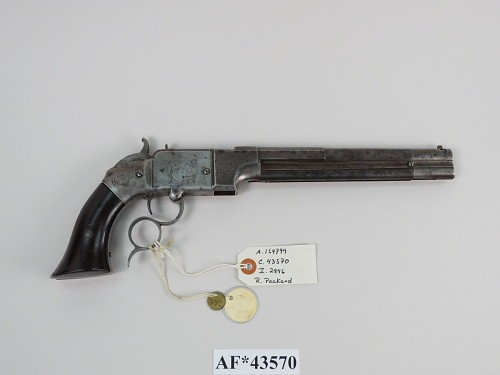
Smith and Wesson built two pistols at Norwich: a small-frame .31 with a four-inch barrel, the No. 1, and a large-frame .41 with six- or eight-inch barrels, the No. 2. Both had iron frames, which distinguishes them at a glance from every later Volcanic.910 Volume 4 has the full taxonomy, the barrel markings and the serial system. The production figures, every one of them an estimate, are these:
Table 1 — Smith and Wesson built two pistols at Norwich: a small-frame .31 with a four-inch barrel, the No. 1, and a large-frame .41 with six- or eight-inch barrels, the No. 2. Both had iron frames, which distinguishes them at a glance from every later Volcanic.[^7][^8] Volume 4 has the full taxonomy, the barrel markings and the serial system. The production figures, every one of them an estimate, are these
| Model | Figure | Source |
|---|---|---|
| All Smith & Wesson lever pistols | about 1,700 | Forgotten Weapons, 2017; Rock Island Auction essay and lot 87/82104 |
| No. 1 (.31) | about 1,200, of which about 700 assembled by Smith & Wesson in 1854–55 and about 500 assembled by the Volcanic Repeating Arms Company from Smith & Wesson parts | Rock Island Auction lots 4095/3043 and 4095/15, citing Lewis and Rutter p. 319 |
| No. 2 (.41) | about 500, or fewer than 500 | Rock Island Auction lots 87/82, 81/28, 47/31889 |
| All Smith & Wesson lever arms, 1853–55 | about 1,600, of which 600 transferred to the Volcanic company for assembly, “according to remaining Winchester records” | proofhouse.com, anonymous11 |
The 700-and-1,200 split matters. It means a gun marked Smith & Wesson may have been assembled in New Haven after the sale, which is consistent with the documented transfer of parts and with the overlap of iron-framed guns into the first Volcanic company period.
Smith and Wesson also made a few long arms. Rock Island Auction sold, in June 2020, an engraved Smith & Wesson lever-action rifle described as “One of only three Smith & Wesson lever action repeating rifles known to exist”, and in September 2020 a Smith & Wesson pistol-carbine with a detachable stock.4 Those are auction captions; the lot pages were not read.
2.4 The name came before the company
The commonly repeated story is that “Volcanic” was not an official name, and that it was attached to the gun after a magazine review compared its rapid fire to a volcanic eruption. Rock Island Auction’s essay puts it that way.4 The period newspapers do not support it.
On 17 February 1855 the Daily National Intelligencer of Washington printed this:
“Volcanic Repeating Pistol.—We have seen and fired a pistol, recently invented and patented, which bids fair to excel every thing in that line that has yet been offered to the public attention. … The volcanic pistol carries a Minie or conical ball, in a rifle barrel, and will put it through a three-inch plank at a distance of ninety rods. The receiving tube will hold ten ball cartridges, which may be deposited in two seconds of time. The pistol may be discharged thirty times in fifty seconds. … There is no priming, no caps, and therefore no danger to the eyes from any ignition near the breach.”12
The paragraph was reprinted in Maine within a week and was still circulating in California in June and Louisiana in August.12 On 10 March 1855 the Springfield Weekly Republican reported that “At Norwich, they make volcanic repeating pistols”.12
So the name was in national print in February 1855, attached to pistols being made in Norwich by Smith and Wesson, about five months before the Volcanic Repeating Arms Company was formed. The paragraph uses it as the gun’s name; it does not compare the gun to an eruption. No Scientific American review coining the name was located; the Chronicling America search found nothing earlier than February 1855, which, because newspaper digitisation is incomplete, means “nothing found”, not “nothing existed”. Who chose the name is unknown. That it was the product’s name before it was the company’s is documented.
2.5 The sale to New Haven, 1855
The Norwich Examiner of 31 August 1855 explained why Norwich had lost the business:
“NORWICH. Smith & Weston [sic].—This firm have left our city and removed their works to New Haven, under the following circumstances, as we are informed. Last year they secured a patent for their invention of the Volcanic Repeating Pistol. As this invention became known, their business increased until the tenement they occupied on Central Wharf was too strait for them, and it became necessary to seek enlargement. They made applications in this city for funds to enable them to extend their operations, but without success. In the meantime New Haven came to their relief. A company formed in that city bought the patent and paid Smith & Weston $80,000 for it, and took them as partners into the concern. This company has gone forward to erect buildings that will accommodate 200 workmen, and the manufacture is already in successful operation.”5
The machine-read text of that page garbles the sum; read from the page image it is $80,000. The paper says “as we are informed”, so the figure is local report rather than a published accounting, and it does not say whether it was paid in cash or in stock. The Springfield Weekly Republican of 22 September 1855 confirms the move: “the removal of Smith & Wesson, manufacturers of the volcanic repeating pistol, from that city to New Haven, because, wanting material aid, they found better inducements in the latter place.”12
That fixes the move in 1855. The Winchester Arms Collectors Association and Wikipedia give 1856, and the Association’s page says the company “began producing rifles and pistols in early 1856”.2 The contemporary newspapers put manufacture in New Haven “already in successful operation” by the end of August 1855. The likeliest reconciliation is that the later date belongs to the new factory buildings rather than to the move itself, but that is an inference.
2.6 The Volcanic Repeating Arms Company
The company that bought the patent was the Volcanic Repeating Arms Company of New Haven. Its exact date of incorporation was not found in a primary source. Dealer and encyclopedia accounts give July 1855; Rock Island’s essay says Oliver Winchester joined “its Board of Directors as a Vice President in June 1855”, which would put the company in existence by June.4 A Connecticut charter or a New Haven newspaper of mid-1855 would settle it.
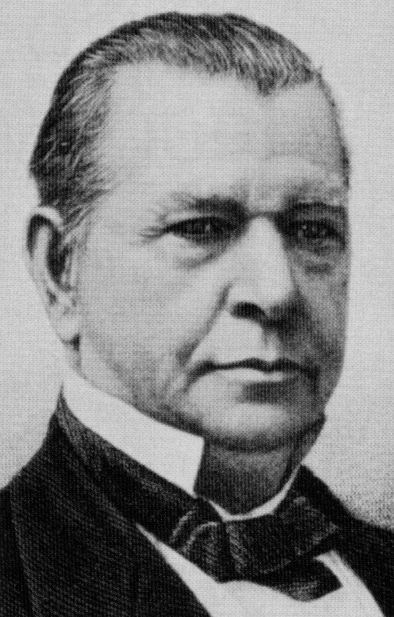
Oliver Fisher Winchester, born 30 November 1810, was a New Haven shirt manufacturer in partnership with John M. Davies.24 How large his stake was is disputed. The Winchester Arms Collectors Association calls him the company’s “largest stockholder”.2 Rock Island’s essay is more specific and more modest: “There were 29 stockholders in all, one of which was a local men’s shirt manufacturer … This shirt maker purchased 80 shares and went by the name of Oliver F. Winchester”, and “After becoming a minority stakeholder (1.33%) at Volcanic Arms, he also joined its Board of Directors as a Vice President in June 1855.”4 Neither cites a document. They may both be true at different dates, since a minority holder could become the largest creditor; but as written they conflict, and this volume does not choose between them.
The company’s scale is recorded in the press. The Norwich paper spoke of buildings for 200 workmen in August 1855; in February 1856 the Springfield Weekly Republican reported that “The manufacture of the ‘volcanic repeating fire-arm’ has been commenced at New Haven on an extensive scale” and that “About 70 men are now employed at the manufactory.”12 The same article gives the clearest period description of the ammunition, quoted in Volume 3, and adds that “The balls are prepared at a profit for $1 per hundred”, that “The rifles hold thirty and the smallest pistols seven balls each”, and that “Both the balls and the arm are the joint invention of Horace Smith and Daniel B. Wesson of New Haven, and were patented in 1854.”12 That last sentence is loose: the ball’s primer was patented in 1856.
The company’s frames were brass, a change from Norwich iron that Sawyer put plainly in 1920: “The Volcanic Repeating Arms Company substituted bronze for iron, as much as possible, in their arms, and specialized on hand instead of shoulder arms.”7 Auction catalogues call the frame metal “gunmetal”.9 American Rifleman places the change from iron to brass later, under Winchester.13 The catalogued guns are the stronger evidence: Volcanic Repeating Arms pistols and carbines are described with brass frames lot after lot.9
2.7 The primer patent of January 1856
On 22 January 1856 the Washington Evening Star printed the week’s patents. Among them: “Horace Smith, of Norwich, Conn., and Daniel B. Wesson, of New Haven, Conn., assignors to The Volcanic Repeating Arms Company, of New Haven, Conn — For improved primes [primers] for cartridges of fire arms.”12 This is US Patent 14,147, and it is the patent for the self-primed Volcanic ball. Its claim is “The combination of a copper or brass case, an iron or steel disk, with cork or its equivalent, and fulminating-powder”, designed “for a loaded ball, made solid, except a cavity … which contains the powder and primer”.14
Three things follow. The ammunition the guns fired was patented in 1856, not 1854. It was patented by Smith and Wesson as assignors to the company, which means the company owned it from the start. And Wesson’s address is given as New Haven, so he had moved with the works. Volume 3 reads the patent in full.
2.8 Selling the Volcanic
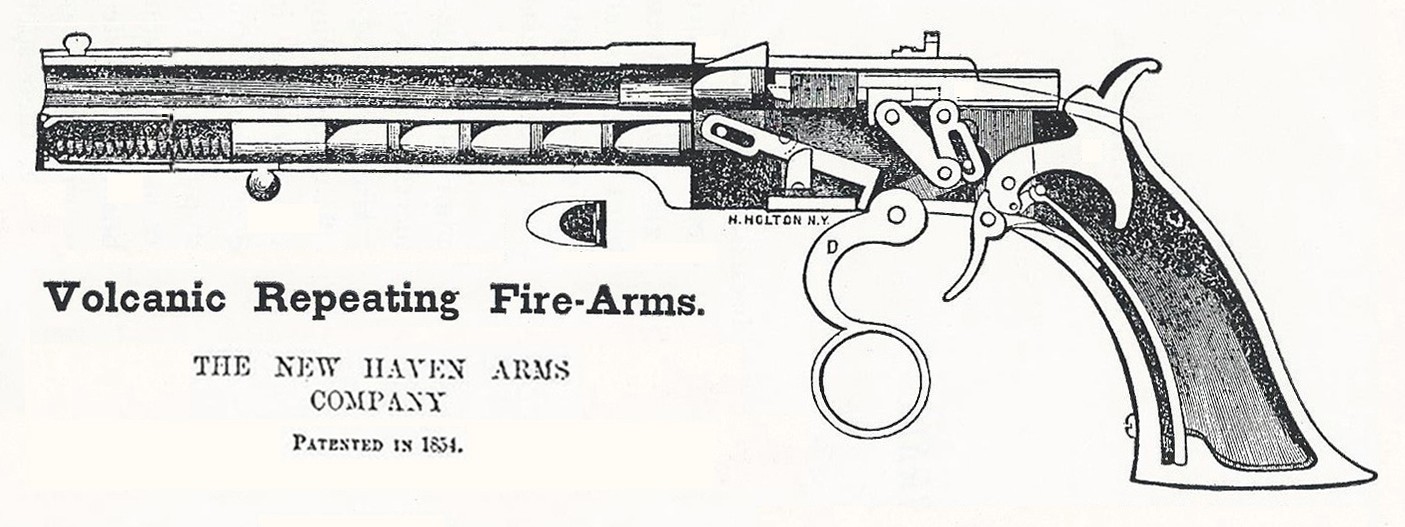
The company sold through agents in New York. The New-York Daily Tribune of 13 March 1856 carried this advertisement: “The Volcanic Repeating Fire-Arms, which fire 30 shots per minute—Ammunition waterproof—can be seen at the Company’s Depot, No. 23 John-st. New-York. J. W. POST, Sole Agent.”12 By November the agency was at 229 Broadway, and the copy had a testimonial: “VOLCANIC REPEATING Pistol and CARBINE, like those recently fired by Col. Hay, at Hythe, England, by order of the British Government”.12
Colonel Hay’s trial at the British Army’s School of Musketry at Hythe was reported in American papers that December. The Ebensburg Democrat and Sentinel of 24 December 1856 says Hay fired an eight-inch Navy pistol “which discharges nine balls in rapid succession”, putting nine balls inside an eight-inch ring at 100 yards, seven of nine at 200, and five of nine at 300.12 The machine-read text is damaged on several of the numbers; Rock Island’s essay, quoting Scientific American of 29 November 1856 for the same trial, calls the account “an exaggeration at best”.4 Volume 3 sets it beside the published ballistics. What it establishes is that the arm was offered to, and tested by, a British musketry officer, and that the company advertised the fact.
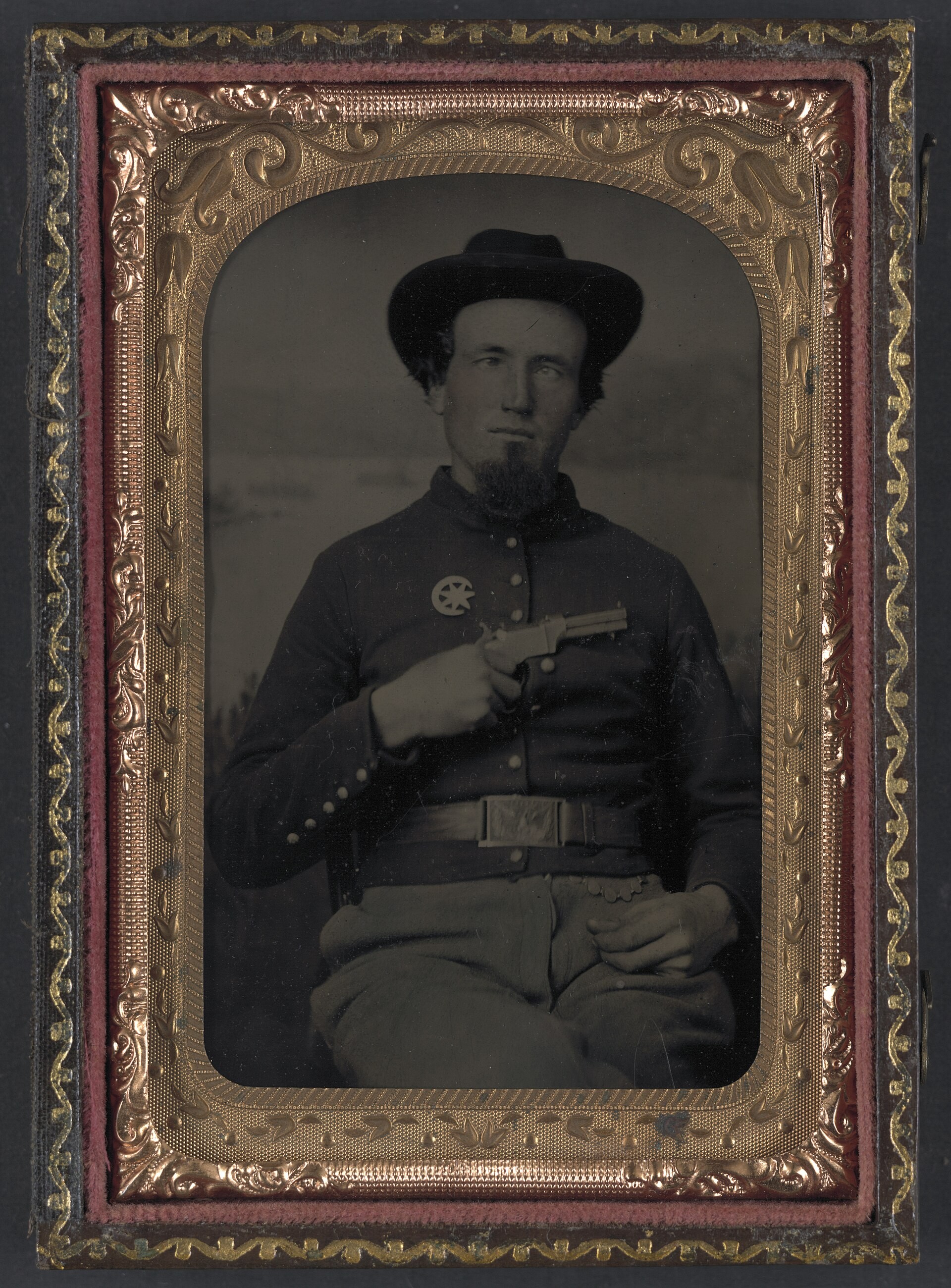
2.9 Smith and Wesson leave
Rock Island’s essay says that within about eight months of the company’s formation “the three men, Wesson, Smith, and Palmer, had fully abandoned the company”.4 Wikipedia’s account has Wesson staying as plant manager for roughly that period. The reason given in every account is the revolver. On 3 April 1855 Rollin White of Hartford patented a revolving cylinder with chambers bored “right through the rear of the said cylinder”, which is to say a cylinder that could be loaded from behind with a metallic cartridge.15
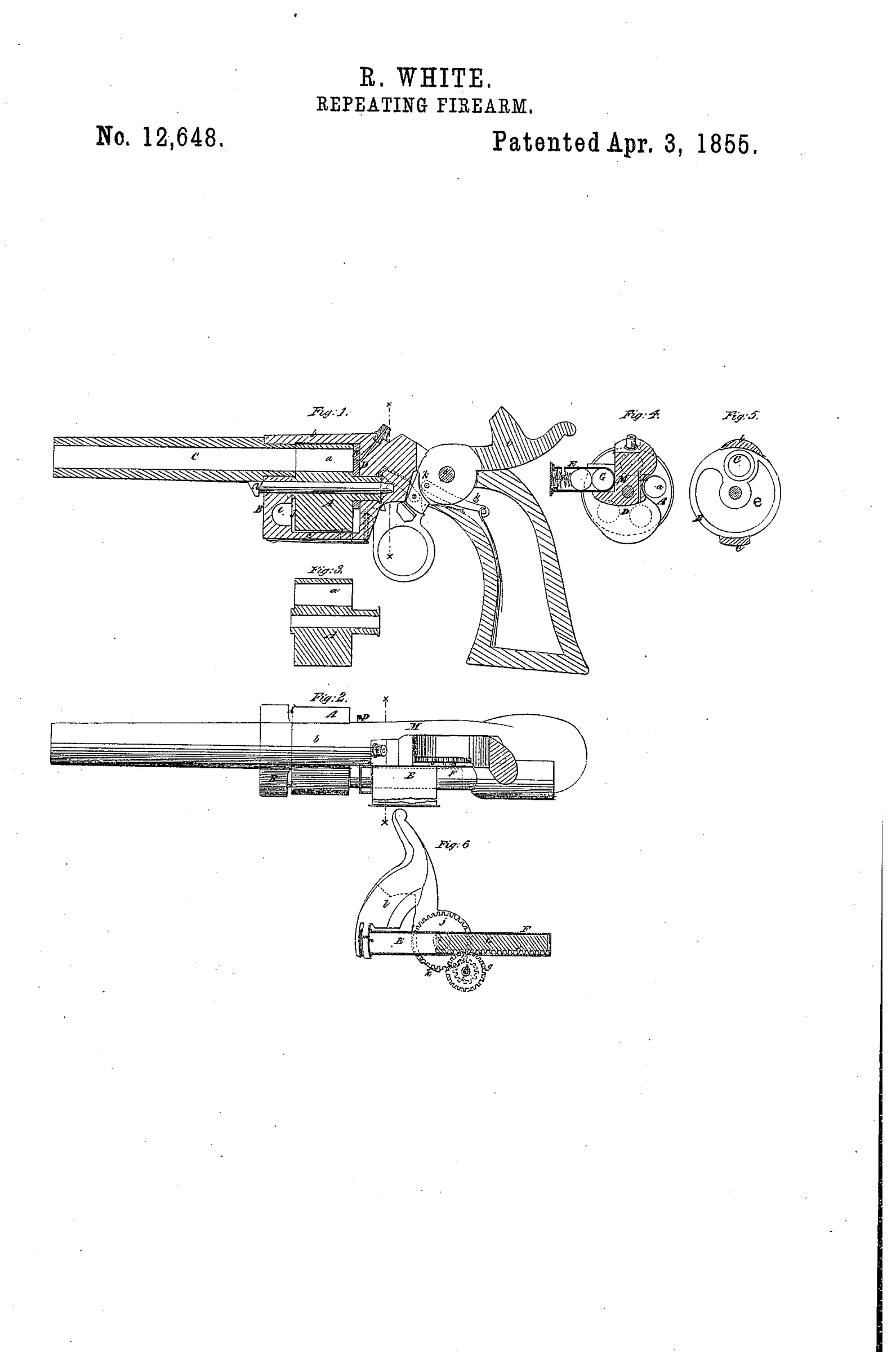
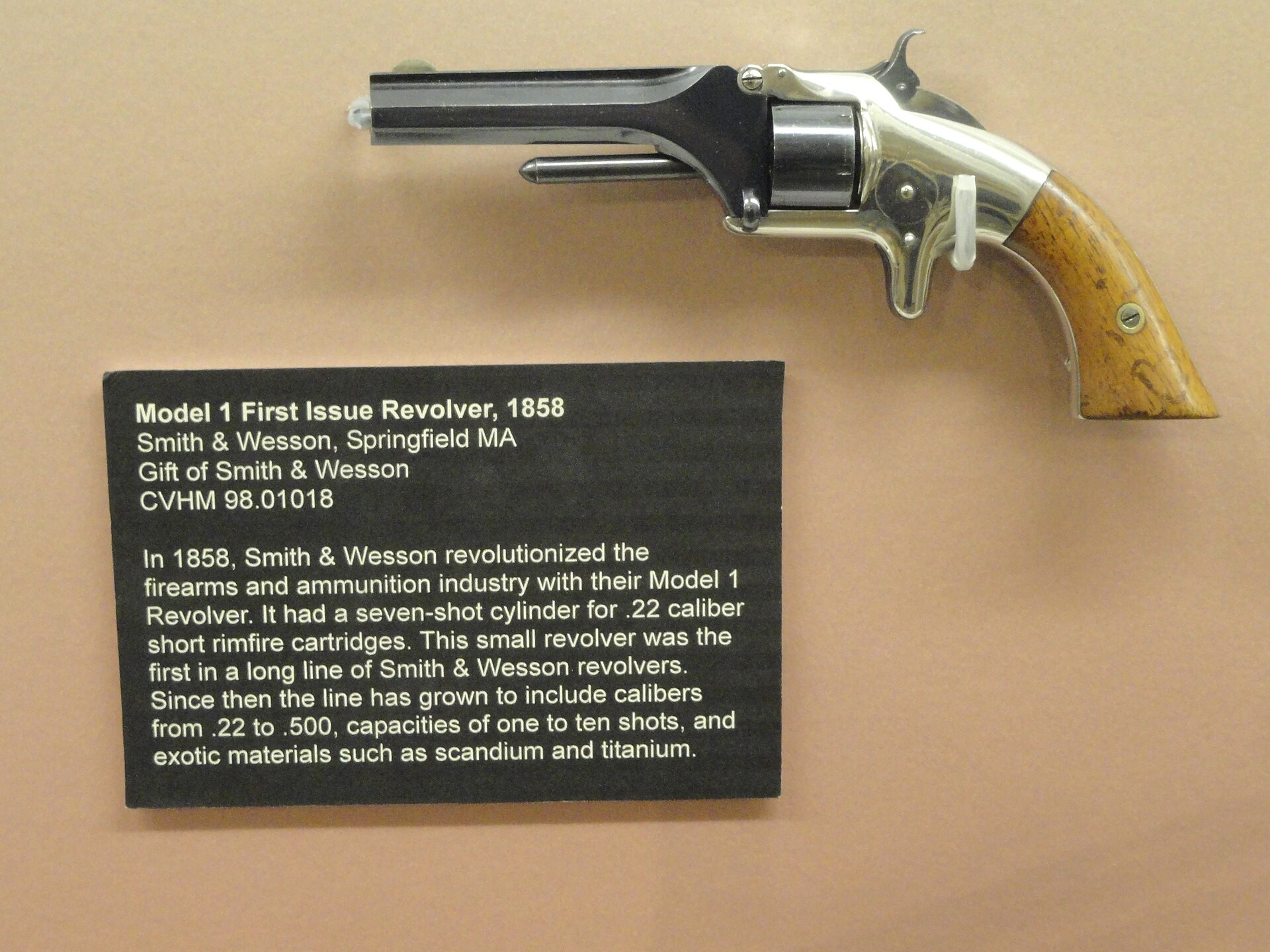
Lee A. Silva’s account in HistoryNet dates the agreement between Smith and Wesson and White to 17 November 1856, giving them exclusive rights to bored-through-cylinder revolvers until the patent expired in 1869, and dates the start of production of the Smith & Wesson Model No. 1, a .22 rimfire revolver, to 1857 in Springfield, Massachusetts.16 The cartridge it fired is the .22 Short, the round the hub’s .22 Rimfire dive, Vol 2 describes as opening the American metallic-cartridge era. It is the descendant of the Flobert-type cartridge drawn in Smith and Wesson’s own 1854 patent.
2.10 Suspension and Oliver Winchester
The company did not last two years. On 15 February 1857 the New York Herald listed it among the week’s commercial failures: “Volcanic Repeating Arms Company, New Haven, Conn., suspended, supposed to be only temporary.”12 It was not temporary.
The secondary accounts differ on the date. The Winchester Arms Collectors Association says the company “by the end of that year [1856] became insolvent”; Wikipedia, uncited, says Winchester “forced the insolvency” in late 1856; Rock Island’s essay says “Volcanic’s insolvency took place in February 1857”, and one of its lot descriptions says “The Volcanic Repeating Arms Co. existed for only 19 months”, which from mid-1855 also lands in February 1857.249 The Herald notice supports February 1857 for the public failure. Financial trouble in late 1856 and a suspension in February 1857 are compatible.
What happened next is given by Rock Island: the courts “awarded all assets of the Volcanic Repeating Arms Co. to Oliver Winchester in 1857”, including the patent assignments of Hunt, Jennings, Smith and Wesson; “Other stockholders received nothing”; and Winchester sold the assets other than the patents to a new company, licensing it to make the arms.4 Rock Island’s 2022 essay on the Volcanic pistol gives the price as “$40,242.51”.4 American Rifleman’s 2026 account says instead that “in 1856, Smith & Wesson declared the Volcanic Repeating Arms Company insolvent, with fewer than 3,400 total guns sold”.13 That conflicts with the other accounts on who acted, and with Forgotten Weapons on the numbers; it is recorded and not adopted.
2.11 The New Haven Arms Company
Winchester reorganised the business as the New Haven Arms Company in April 1857, according to the Winchester Arms Collectors Association.2 A Rock Island lot description says the shortened barrel legend that omits the Volcanic company’s name was “introduced in April 1857 after Oliver Winchester took control”.9 The period record shows the new company still using the old name: the North Carolina State Fair’s list of exhibits, printed in October 1857, includes “Volcanic repeating fire arms, New Haven Arms Company. These arms at once attest their superiority by their simple and durable structure.”12 A New Orleans dealer was advertising “THE VOLCANIC REPEATING RIFLE AND PISTOL” in April 1859.12
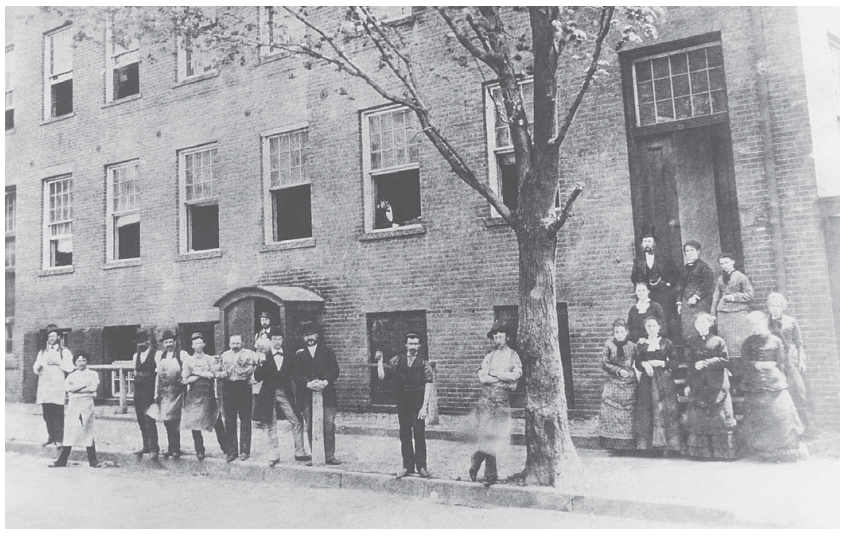
B. Tyler Henry was the plant superintendent.47 Sawyer, in 1920, describes the next three years: “During the first few years of the life of the new company, Mr. Henry gave much of his time to experiments for the improvement of the arms, the ammunition of which had become obsolete. In 1860 the New Haven Arms Company abandoned the manufacture of rifles and pistols using loaded bullets”.7 The arms it made in the meantime are described in Volume 4. The production estimates:
Table 2 — B. Tyler Henry was the plant superintendent.[^2][^5] Sawyer, in 1920, describes the next three years: "During the first few years of the life of the new company, Mr. Henry gave much of his time to experiments for the improvement of the arms, the ammunition of which had become obsolete. In 1860 the New Haven Arms Company abandoned the manufacture of rifles and pistols using loaded bullets".[^5] The arms it made in the meantime are described in Volume 4. The production estimates
| Maker | Figure | Source |
|---|---|---|
| Volcanic Repeating Arms Co., 1855–57 | ”another 3000 pistols, all .41 caliber Navy types” | Forgotten Weapons, 201710 |
| Volcanic Repeating Arms Co., 1855–57 | ”about 3,000 guns” | proofhouse.com11 |
| Volcanic Repeating Arms Co., Navy 8 in | about 1,500 between July 1855 and April 1857 | Rock Island Auction, many lots and essay94 |
| New Haven Arms Co. | ”another 3300 guns, both large and small frame by 1861” | Forgotten Weapons, 201710 |
| New Haven Arms Co., 1857–58 | ”about 3,200”, many unsold “for almost 100 years” | proofhouse.com11 |
| All three makers | ”fewer than 8,000” | Rock Island Auction essay4 |
Forgotten Weapons’ three figures add to 8,000, consistent with Rock Island’s ceiling. American Rifleman’s 3,400 is not consistent with either.
Volume 9 follows the New Haven Arms Company to the Henry rifle and the Winchester Repeating Arms Company.
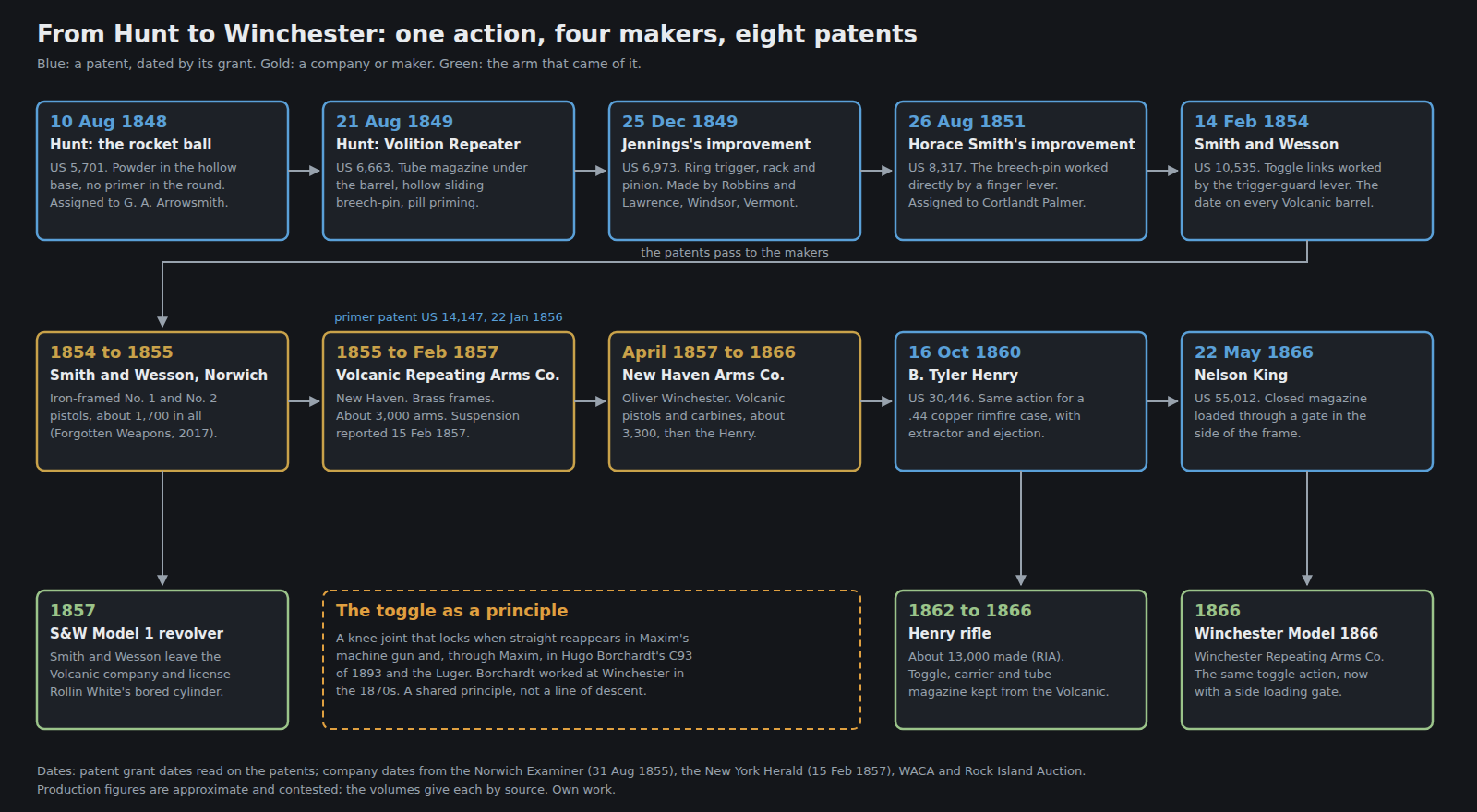
2.12 The dates, set against each other
Table 3 — The dates, set against each other
| Event | Date | Evidence |
|---|---|---|
| Smith and Wesson partnership begins | 1852, or 1853, or 1854 | Obituaries of Wesson (1906) and Smith (1893); Wikipedia3 |
| Toggle-action patent signed | 24 May 1853 | US 10,5356 |
| Toggle-action patent granted | 14 February 1854 | US 10,5356 |
| Cased-cartridge patent granted | 8 August 1854 | US 11,4968 |
| ”Volcanic Repeating Pistol” in print, made at Norwich | 17 February and 10 March 1855 | Daily National Intelligencer; Springfield Weekly Republican12 |
| Rollin White’s bored-through cylinder | 3 April 1855 | US 12,64815 |
| Winchester on the board as vice president | June 1855 | Rock Island essay4 |
| Volcanic Repeating Arms Co. formed | mid-1855 (July per secondary accounts) | No charter found |
| Works moved to New Haven; $80,000 sale reported | by 31 August 1855 | Norwich Examiner5 |
| Primer patent assigned to the company | 22 January 1856 | US 14,147; Evening Star1412 |
| About 70 men employed | February 1856 | Springfield Weekly Republican12 |
| Colonel Hay’s trial at Hythe reported | November–December 1856 | New-York Daily Tribune; Democrat and Sentinel12 |
| Smith and Wesson license Rollin White | 17 November 1856 | HistoryNet (Silva)16 |
| Company “suspended” | 15 February 1857 | New York Herald12 |
| New Haven Arms Co. formed | April 1857 | Winchester Arms Collectors Association2 |
| New Haven Arms exhibits “Volcanic repeating fire arms” | October 1857 | Weekly North Carolina Standard12 |
References
Footnotes
-
Edmund E. Lewis and Stephen W. Rutter, Volcanic Firearms: Predecessor to the Winchester Rifle (Andrew Mowbray, 2011). Not consulted directly; cited through the page references auction catalogues give. ↩
-
Winchester Arms Collectors Association, “History”, https://winchestercollector.org/history/ , and “Volcanic Rifles & Pistols”, https://winchestercollector.org/?p=367 , accessed 2026-10-18. ↩ ↩2 ↩3 ↩4 ↩5 ↩6 ↩7
-
Obituaries of Daniel B. Wesson (Norwich Morning Bulletin, 6 August 1906) and Horace Smith (Norwich Morning Bulletin, 17 January 1893), as quoted by Iconic Norwich, https://iconicnorwich.org/?p=54753 , accessed 2026-10-18. ↩ ↩2
-
Rock Island Auction Company essays, read through the shared fetch engine 2026-10-18: “The Evolution of the Winchester Rifle”, https://www.rockislandauction.com/riac-blog/the-evolution-of-the-winchester-rifle/ ; and Joe Engesser, “The Volcanic Pistol: The First Smith & Wesson Handgun”, 20 October 2022, https://rockislandauction.com/riac-blog/the-volcanic-pistol (bibliography: Lewis and Rutter; Jinks and Krein; McDowell; Ezell). Source of the 17-month and 8-month figures, Palmer’s $10,000, Winchester’s 80 shares and vice-presidency, the court award, the $40,242.51 purchase price, and the captions of the Smith & Wesson rifle and pistol-carbine sales. Good secondary sources; none of these figures is footnoted to a document in the essays. ↩ ↩2 ↩3 ↩4 ↩5 ↩6 ↩7 ↩8 ↩9 ↩10 ↩11 ↩12 ↩13 ↩14 ↩15 ↩16 ↩17 ↩18
-
The Examiner (Norwich, Conn.), 31 August 1855, p. 2, https://www.loc.gov/resource/sn84027771/1855-08-31/ed-1/?sp=2 . The sum was read from the page image because the machine-read text garbles it. ↩ ↩2 ↩3
-
Horace Smith and Daniel B. Wesson, US Patent 10,535, “Improvement in Fire-Arms”, 14 February 1854 (signed 24 May 1853). https://patents.google.com/patent/US10535A/en and the patent PDF, accessed 2026-10-18. ↩ ↩2 ↩3 ↩4 ↩5 ↩6 ↩7 ↩8
-
Charles Winthrop Sawyer, Our Rifles, Boston, 1920, pp. 64 and 276–278. https://archive.org/details/firearmsinameric00sawyrich , accessed 2026-10-18. Public domain. ↩ ↩2 ↩3 ↩4
-
Horace Smith and Daniel B. Wesson, US Patent 11,496, “Improvement in Cartridges”, 8 August 1854 (signed 10 May 1853). https://patents.google.com/patent/US11496A/en , accessed 2026-10-18. ↩ ↩2
-
Rock Island Auction Company lot descriptions, 2009–2025, read through the shared fetch engine 2026-10-18 and logged with sale, lot, serial and URL in this dive’s research notes (02-inputs/research-models-market.md, Appendix A). Cited here: lots 87/82, 81/28 and 47/3188 (S&W No. 2 production); 4095/3043 and 4095/15 (the 700 and 500 split, citing Lewis and Rutter p. 31); 4093 flipbook lot 12 (19 months); 4091/1027 (April 1857 legend change); and the brass-frame descriptions of Volcanic Repeating Arms Navy pistols and carbines throughout. ↩ ↩2 ↩3 ↩4 ↩5 ↩6 ↩7 ↩8
-
Ian McCollum, “The Volcanic: Smith & Wesson’s First Pistol”, Forgotten Weapons, 18 August 2017, https://www.forgottenweapons.com/the-volcanic-smith-wessons-first-pistol/ , accessed 2026-10-18. ↩ ↩2 ↩3 ↩4
-
“Winchester Dates”, proofhouse.com, https://proofhouse.com/win/winchester.htm , accessed 2026-10-18. Anonymous compilation citing “remaining Winchester records”. ↩ ↩2 ↩3
-
Newspapers via the Library of Congress, Chronicling America, accessed 2026-10-18: Daily National Intelligencer (Washington), 17 February 1855, p. 3, https://www.loc.gov/resource/sn83026172/1855-02-17/ed-1/?sp=3 ; Ellsworth American, 23 February 1855; Springfield Weekly Republican, 10 March 1855, p. 3, https://www.loc.gov/resource/sn83020847/1855-03-10/ed-1/?sp=3 ; Shasta Courier, 16 June 1855; Southern Sentinel (Plaquemine), 4 August 1855; Springfield Weekly Republican, 22 September 1855, p. 3; Evening Star (Washington), 22 January 1856, p. 2, https://www.loc.gov/resource/sn83045462/1856-01-22/ed-1/?sp=2 ; Springfield Weekly Republican, 23 February 1856, p. 1, https://www.loc.gov/resource/sn83020847/1856-02-23/ed-1/?sp=1 ; New-York Daily Tribune, 13 March 1856, p. 1, and 17 November 1856, p. 4; Democrat and Sentinel (Ebensburg), 24 December 1856, p. 1, https://www.loc.gov/resource/sn86071378/1856-12-24/ed-1/?sp=1 ; New York Herald, 15 February 1857, p. 5, https://www.loc.gov/resource/sn83030313/1857-02-15/ed-1/?sp=5 ; Weekly North Carolina Standard, 28 October 1857, p. 1; New Orleans Daily Crescent, 18 April 1859, p. 4. Quotations are from the machine-read page text checked for sense; damaged readings are noted where they matter. ↩ ↩2 ↩3 ↩4 ↩5 ↩6 ↩7 ↩8 ↩9 ↩10 ↩11 ↩12 ↩13 ↩14 ↩15 ↩16 ↩17 ↩18 ↩19
-
Rick Hacker, “America’s Lever Revolution”, American Rifleman, 6 July 2026, https://www.americanrifleman.org/content/america-s-lever-revolution/ ; and “I Have This Old Gun: New Haven ‘Volcanic’ No. 1 Pocket Pistol”, American Rifleman, 16 September 2016, https://americanrifleman.org/content/i-have-this-old-gun-new-haven-volcanic-no-1-pocket-pistol ; both accessed 2026-10-18. ↩ ↩2
-
Horace Smith and Daniel B. Wesson, assignors to the Volcanic Repeating Arms Company, US Patent 14,147, “Improved Primers for Cartridges of Fire-Arms”, 22 January 1856. https://patents.google.com/patent/US14147A/en , accessed 2026-10-18. ↩ ↩2
-
Rollin White, US Patent 12,648, “Improvement in Repeating Fire-Arms”, 3 April 1855. https://patents.google.com/patent/US12648A/en , accessed 2026-10-18. ↩ ↩2
-
Lee A. Silva, “Sam Colt’s Big Business Blunder Was a Boon for Gunmakers”, HistoryNet, 20 June 2017, https://historynet.com/sam-colts-big-business-blunder-boon-gunmakers/ , accessed 2026-10-18. ↩ ↩2
Comments (0)