SA80 (L85 Family) · Volume 9
Owning, Buying and Building One in the US
Why no service SA80 is in American civilian hands, the semi-automatic SA80s that do exist, the AR-based lookalikes and airsoft replicas, federal and Michigan law, section 922(r), and two semi-automatic builds worked through against a real home lab: an AKB-23 lookalike and a shop-made SA80-pattern body, with three ways to join it
9.1 What this volume covers
The SA80 is the one major NATO service rifle that an American could not buy in any form until 2026. This volume sets out why, what has changed, and what the law allows a builder in Michigan to do. It covers ownership routes, the market as it stood in October 2026 with every price dated and taken from the seller’s own page, the federal and Michigan rules linked to the hub’s existing treatments, and two semi-automatic builds worked through against a specific home lab: an AR-based lookalike assembled on Aly & Kaufman’s AKB-23, and a shop-made SA80-pattern body around a purchased barrel and bolt, with rivets, an added spot or TIG welder, and outside welding each set out for joining that body. It contains no select-fire content: the service rifle’s automatic mechanism is not described, and nothing here is a route to one.
9.2 No service SA80 is for sale
No transferable SA80 machine gun was found in the United States. Searches of auction-house records for an L85 or SA80 found none.1 The reasons are structural. The L85A1 entered British service in 1985 and was never sold commercially in the United States in automatic form; on 19 May 1986 18 U.S.C. § 922(o) froze the civilian transfer of machine guns made after that date. A post-1986 dealer sample is possible in principle, but none was located. The finding is “none found”, not “none exist”. The § 922(o) freeze and what “transferable” means are covered in the hub’s MP 40 dive, Volume 6 and FN P90 dive, Volume 4.
There is no surplus stream either. The Ministry of Defence’s stated policy, quoted in a 2015 freedom-of-information reply, is that “all weapons are disposed of by being destroyed”.2 By 2026 a written answer said only that “a disposal plan is under consideration” for the L85 as Project GRAYBURN replaces it (Volume 3).3 The STEN and Sterling kit markets that the hub’s other British dives rely on were built on governments selling surplus; for the SA80 there has been none.
US Marines have fired SA80s on joint exercises (photographs in Volumes 2 and 3). Those were British rifles on British training, not civilian items.
9.3 Deactivated rifles do not travel
British-deactivated SA80s exist, and some are reported to have been offered to Americans.4 They cannot be imported. Under 18 U.S.C. § 925(d)(2), the Attorney General shall authorise the import of a firearm that is “unserviceable” as a curio or museum piece “other than a machinegun”; a deactivated L85 is a machine gun’s receiver, and the curio route excludes it. The sporting-purposes route of § 925(d)(3) excludes surplus military firearms.5 The federal regulation defines an “unserviceable firearm” as one “incapable of discharging a shot by means of an explosive and incapable of being readily restored to a firing condition”, and defines “machine gun” to include “the frame or receiver of any such weapon”.6 The hub’s MP 40 dive, Volume 6 and STEN dive, Volume 11 already state that UK and EU deactivation standards do not change a weapon’s US status; the SA80 is no exception.
9.4 Semi-automatic SA80s before 2026: rumour and one record
Three stories circulate.
- The “Super Ensign”. The one documented semi-automatic SA80 of the 1980s. Jonathan Ferguson describes a “self-loading only ‘Super Ensign’ L85A1 variant … designed as a semi-automatic stablemate for the manually-operated Ensign (L98A1), reworked from the L85A1 as per typical civilian-legal designs sold around the world, in order to prevent ready conversion to automatic fire.” Only a few seem to have been made and no advertisements are known, but “persistent unconfirmed rumours exist of a few examples in the hands of UK shooters prior to the 1988 ban, and even of examples in the US”.7
- A 1980s import. Forum posts relayed by search engines describe Golden State Arms of California importing British “SA80 sporters” in the late 1980s, variously “approximately 200” or “five” sales samples, at about $5,000. No import record, auction listing or maker document was found, and the claim that British Aerospace made rifles in 1985 is anachronistic, since it bought Royal Ordnance in 1987 (Volume 2). No number is printed here.
- 1990s kit builds by a California shop are a single forum claim, also unverified.
What can be said is that American Rifleman, in July 2026, described a civilian-legal L85 in the United States as having “remained elusive” until Murdoch & Co.’s rifle.8
9.5 The Prexis kit that did not ship
In February 2010 The Firearm Blog reported that a company called Prexis planned “a US made kit version” of the SA80 containing “all the parts needed to build the rifle”, with one catch: “The lower receiver which will require bending into shape.” An update gave a pre-order price of $1,800 and a list price of $2,400.9 No evidence that it shipped was found; the blog’s tag page for Prexis holds only that post. It matters here as the only commercial proposal for a flat-blank SA80 receiver folded by the buyer — exactly the approach the build section below has to consider.
9.6 Murdoch & Co.’s EM85
In January 2026 a company called Murdoch & Co. launched the first US-made semi-automatic SA80s at the SHOT Show. Its pages, read on 18 October 2026, describe the line.10
Table 1 — Murdoch & Co.'s EM85
| Model (maker’s name) | What the maker says | Price on the maker’s page, 2026-10-18 |
|---|---|---|
| EM-85 (Collector) | “This opportunity is reserved for 100 rifles”; “uses real MOD parts”, including “original Enfield factory parts such as the magazine-well”; “Precision Nitride Barrel”; “Correct Markings and MOD style serial”. Caliber 5.56, barrel 20.0 in, overall length 30.9 in, 9.5 lb with magazine and irons, twist 1/7 | Not shown |
| EM85A3 | ”With no original parts like the EM85A1 and A2 the A3 is not limited edition”; “Authentic 1/1 Stamped body”; “Full Picatinny Rail and removable Modern Mlok A3 Handguard”; “Adjustable gas system”; FDE and OD Cerakote; lead time 6–9 months; 40 per cent down | $6,500.00 |
| Variants | Period configurations from a 1985 A1 with iron sights to a 2016 A3, and an “M22A2 / EM85C with SUSAT and Vertical Grip”; LSW, Cadet GP and .22 “currently completing” | Not shown |
The company’s about page names its founder as Evan Murdoch, gives the motto “British Heritage made in the USA”, and credits a relationship with Jonathan Ferguson, Keeper of Firearms and Artillery at the Royal Armouries — the author of the ARES series this dive relies on — as “a keystone to the EM85s authenticity and accuracy”.10
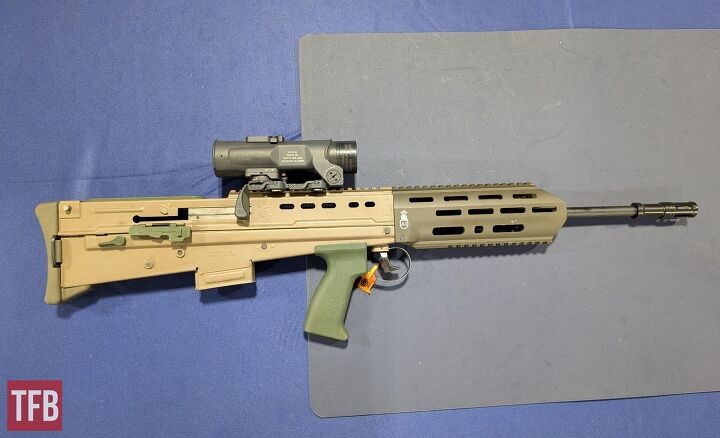
The trade press adds detail and earlier prices. The Firearm Blog (25 January 2026): the company designed and fabricated “the stamped receiver”, reverse-engineered from original components and checked against rifles at the Royal Armouries; the Collector Series uses “authentic, issued L85A1 handguards”, “original magazine-wells” and some internals such as mainsprings; the production A3 uses no original parts; the launch prices were $12,000 for the Collector Series ($8,500 down, 100 planned), $4,500 MSRP for the EM85A3, and $2,500 for an “EMA3 Carbine Upper”; and the article mentions “the use of some AR-15 components in the action”, without saying which.11 GUNSweek (21 January 2026) says the rifles are made “starting from scratch”, not from parts kits, with A1 parts “chiefly furniture saved from scrapped rifles” and the A2 rail from “original supplier Daniel Defense”.12 American Rifleman (22 July 2026) says the aim was “not to replicate the L85, but to re-engineer and remanufacture it in semi-auto form”.8
Discrepancies and gaps, stated rather than resolved:
- Price. The EM85A3 launched at a $4,500 MSRP (TFB, January) and American Rifleman still printed $4,500 in July; the maker’s page showed $6,500 on 18 October 2026.
- Barrel length. The maker’s page says 20.0 in; GUNSweek says 20.4 in, which is the British service figure of 518 mm. The maker’s figure is used here for the EM85.
- Overall length. 30.9 in on the maker’s page, which equals the L85A2’s 785 mm.
- The carbine. No barrel length, overall length or NFA status for the “EMA3 Carbine Upper” or “EM85C” was published. An L22-length barrel would make it a short-barrelled rifle (below).
- Location, licence and markings. None of the pages read gives a city, state or licence number, or a statement about § 922(r). Its markings page says “Every Murdoch and Co. features a Serial Number” and shows “Examples Coming Soon”. Federal law requires a licensed maker’s name, city and state on the receiver (27 CFR 478.92); what an EM85 carries could not be confirmed.
- Section 922(r). Imported British parts in the Collector Series — handguards (a “forearm”) certainly, perhaps others — count toward the ceiling. Compliance is the maker’s obligation at assembly; the count was not published.
A forum post of January 2026, not the maker, said the company “would probably offer parts kits if someone were to ask” and was offering deactivated rifles to Americans; neither is on the maker’s pages.4
9.7 AR-based lookalikes
A rifle that looks like an SA80 but works like an AR is simpler and cheaper. The documented one is Aly & Kaufman’s AKB-23, a “dedicated bufferless bullpup lower kit” that pairs with piston AR-type uppers and was shown at SHOT 2025 on a Brownells BRN-180, with a billet aluminium receiver, a mil-spec single-stage trigger and STANAG magazines.13 The maker’s page on 18 October 2026 listed:14
Table 2 — AR-based lookalikes
| Item | Price |
|---|---|
| AKB-23 (FM-15) “L85” | $749.99 |
| AKB-23 (BRN180) “L85” | $879.99 |
| AKB-23 L85-style assembled rifle | $1,920.00 |
| AKB-23 LSW-style assembled rifle (interest list) | $2,400.00 |
| Brownells BRN-180 Gen 2.5 18.5” upper, .223 Wylde (resold) | $849.99 |
| L85-style carrying-handle iron sight set | $150.00 ($160.00 micro mount) |
| “L85” flash hider, 1/2×28 | $42.99 |
| Extended buttpad | $68.00 |
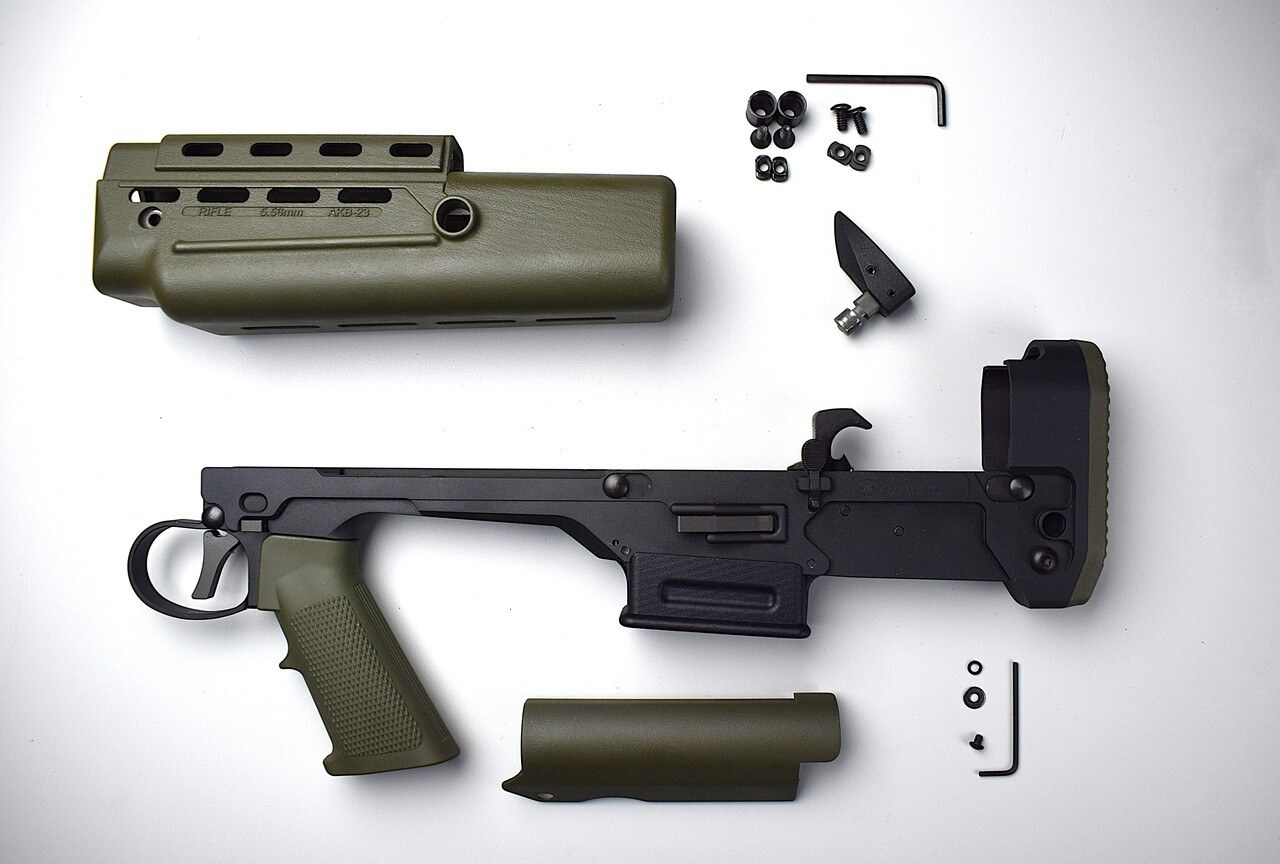
An LSW version with a 24-inch barrel was shown in February 2026 without a production date.15 The “(FM-15)” listing is a second version of the lower for Foxtrot Mike’s FM-15 upper, not a different kind of product.16 The maker sells the AKB-23 as a “Complete ‘Ready to go’ AKB-23 lower receiver” that “Must ship to FFL”, which settles the question left open on 18 October: the AKB-23 is the rifle’s receiver, not a chassis around one (route 2, below). Its mechanism is the BRN-180’s (an AR-180B pattern), not the SA80’s, so Volumes 5 and 6 do not apply to it. A second chassis, SRU Precision’s SARB-15 for the BRN-180, is described in press summaries as an unserialised accessory; it was not confirmed on the maker’s page.
9.8 Airsoft replicas
Airsoft makers have built L85s for years, and they are the most accessible way to handle the layout. A Hong Kong retailer’s L85 category page, read on 18 October 2026, listed, all as out of stock that day: ARES L85A2 electric guns ($389.99) and AFV carbines ($414.99); G&G L85A1 and L85A2 “ETU EBB” electric guns ($419.99 and $439.99) and an L85 carbine ($419.99); ICS’s L85A2 ($442.99); ARES L85A3 electric guns ($406.99, Deluxe $616.99); and WE’s L85A2 gas-blowback rifle ($408.99), described for its “realistic depiction of the L85’s operation”.17 A US retailer’s pages could not be read (they sit behind a bot challenge) and their prices are not printed.
Gas-blowback physics and performance are covered in the hub’s Airsoft gas dive; electric-gun internals and buying in the G&G CM16 Raider dive. Imitation firearms sold in the United States carry the federal blaze-orange marking, set out in the E-11 dive, Volume 10.
9.9 Surplus parts and accessories
Genuine British parts reach the US in small numbers. Aly & Kaufman listed a “British MOD Surplus” H&K steel 30-round magazine at $95.00 and a surplus L85 sling at $20.00 on 18 October 2026.14 Murdoch’s Collector rifles use original handguards and magazine wells.11 No US dealer of SA80 internal parts, bolts, carriers, barrels or trigger housings was found, and no price for a SUSAT. Volume 8 lists the fittings.
9.10 Which part is the firearm
On the service rifle, the body — the pressed upper with the barrel extension welded in — houses the bolt and carries the serial; the trigger mechanism housing holds the fire control and the magazine. The federal regulation’s general definition of a rifle’s receiver as the part that houses the component which locks the breech is quoted and discussed in the hub’s Steyr AUG dive, Volume 6 §6.2, together with Bondi v. VanDerStok (2025), which upheld the rule. Applied to the SA80 layout, the body is the receiver. The trigger mechanism housing, which does not house the bolt, should not be — but no ATF classification of any SA80-pattern part was found, and a builder whose design moves the bolt’s housing into a different part should ask (below). The regulation names specific receivers for some designs; no SA80 entry was found.
9.11 Section 922(r) on an SA80-pattern rifle
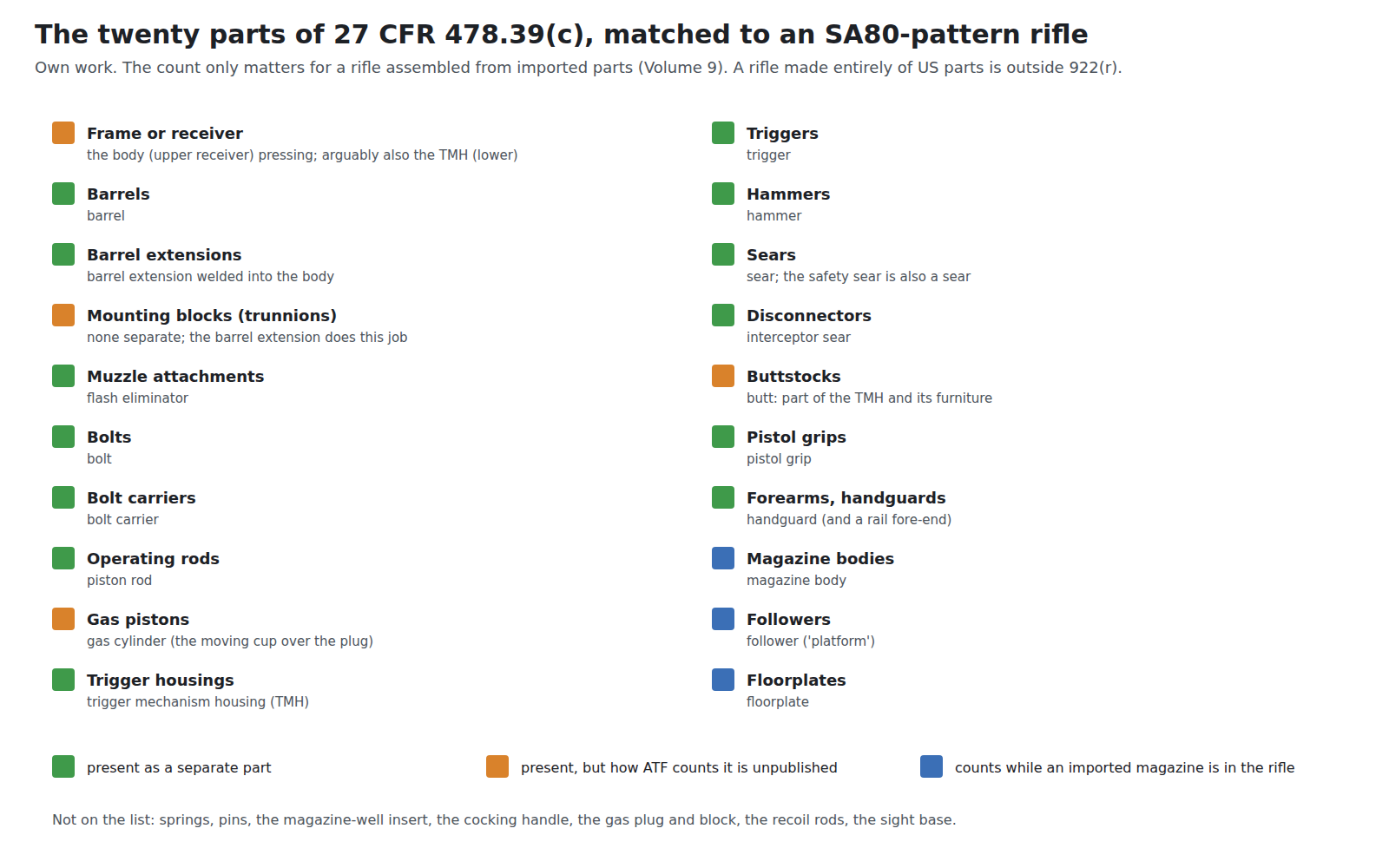
18 U.S.C. § 922(r) and its regulation, 27 CFR 478.39, forbid assembling a semi-automatic rifle that could not itself be imported using more than ten of the twenty imported parts listed in 478.39(c). The hub’s canonical treatment, including why the rule is a ceiling on imported parts rather than a quota of US parts, and how a magazine adds three parts the moment it is inserted, is in the Steyr AUG dive, Volume 6 §6.7–6.8 and the AK-47 dive, Volume 17. An SA80-pattern rifle, with its pistol grip, flash suppressor and bayonet lug, has the features ATF has treated since 1989 as failing the sporting-purposes test, so the rule applies to one assembled from imported parts.
For a rifle made entirely of US parts, § 922(r) does not arise. It only bites when imported parts are used, and on an SA80-pattern rifle in 2026 the likely imported parts are few and specific: surplus British magazines (three listed parts: body, follower, floorplate), original handguards (a “forearm”), and, on rifles like Murdoch’s Collector, perhaps original magazine wells (not a listed part) and other furniture.
Three SA80-specific points the AUG treatment does not cover:
- The barrel extension is welded into the receiver. It is a listed part (“barrel extensions”) inside another listed part (the receiver). A US-made body with a US-made extension welded in removes both from the imported count; an imported body would bring both in.
- The gas piston is the moving cylinder, not a rod (Volume 5). Whether ATF would count the cylinder, the rod or both as “gas pistons” and “operating rods” was not found; counting both is the conservative choice.
- The butt is part of the trigger mechanism housing. As on the AUG, an imported one-piece housing-and-butt may count as two listed parts.
Hub conflict noted for the record: the STEN dive, Volume 6 numbers the selector, extractor and magazine release among the twenty listed parts. None of the three is in 27 CFR 478.39(c); the list above is the regulation’s.
9.12 Length, the NFA and Michigan’s 26 inches
A bullpup’s short overall length makes two lines matter at once.
Table 3 — Length, the NFA and Michigan's 26 inches
| Configuration | Barrel | Overall | Federal status | Michigan “pistol” line (26 in) |
|---|---|---|---|---|
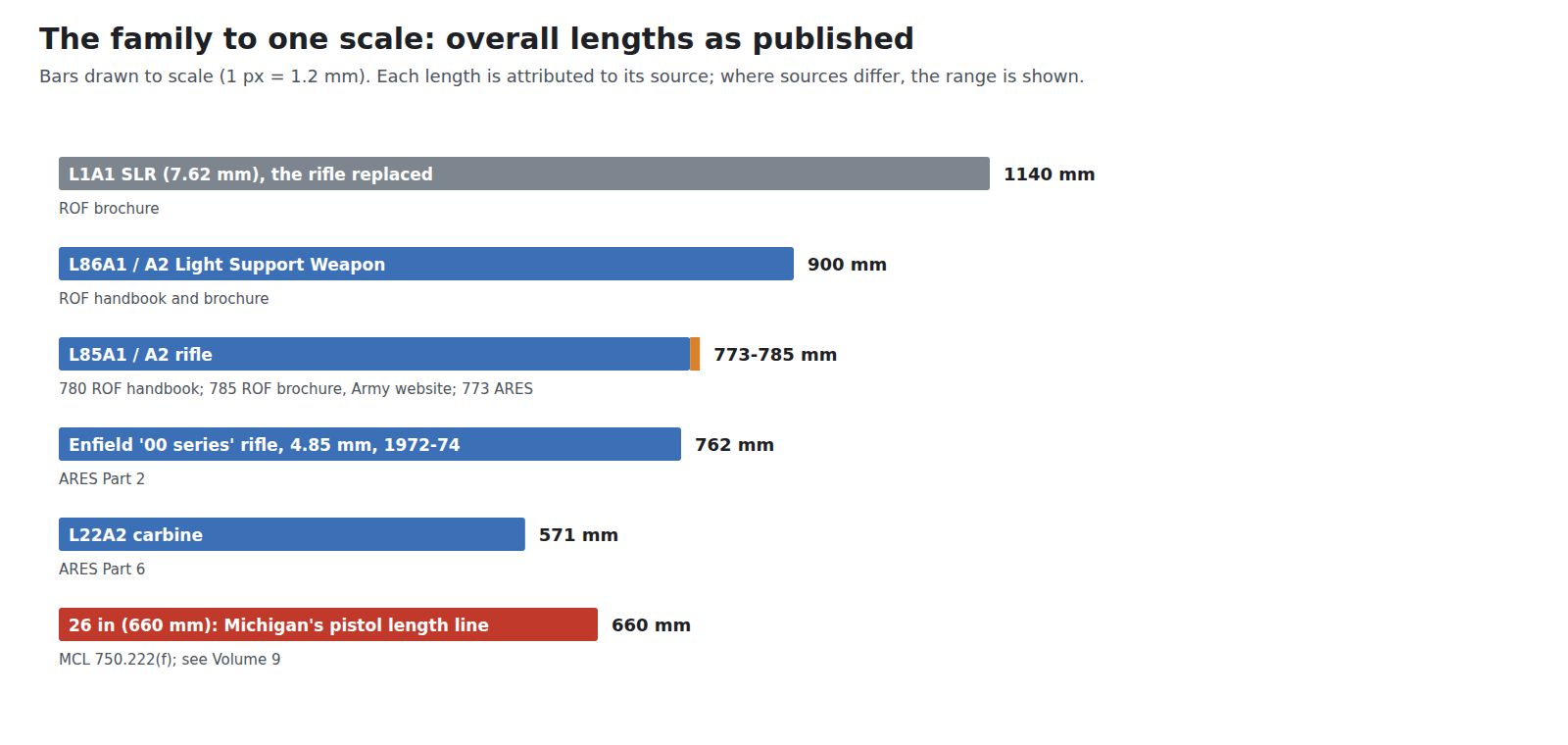
| L85A2 pattern | 518 mm (20.4 in) | 785 mm (30.9 in) | Rifle | Clear by about 4.9 in |
| Murdoch EM85 (maker’s figures) | 20.0 in | 30.9 in | Rifle | Clear |
| L22A2 pattern | 285 mm (11.2 in) without suppressor | 571 mm (22.5 in) | Short-barrelled rifle | Under 26 in |
Sources: Army website, ARES Part 6, Murdoch & Co.181910 A barrel under 16 inches makes a short-barrelled rifle under the National Firearms Act. Public Law 119-21 reduced the making and transfer tax on short-barrelled rifles to $0 from 1 January 2026 but did not remove registration, and did not touch machine guns; the hub’s MP 40 dive, Volume 6 sets this out. Michigan defines a “pistol” as a firearm “26 inches or less in length” (MCL 750.222(f)), and an L22-pattern carbine, even lawfully registered, would fall inside it. The AUG dive’s §6.9 treats the same trap for the AUG, and the hub’s AR Pistol .300 BLK dive, Volume 4 covers Michigan’s short-barrelled rifle statute and the pistol-brace history after Mock v. Garland.
9.13 The Michigan position
The hub’s Michigan coverage is linked rather than restated: rifle transport and storage in the AR-15 5.56 dive, Volume 7 §7.7; the machine-gun statute, MCL 750.224, in the MP 40 dive, Volume 6 §6.6; and the licence to purchase a non-pistol firearm under MCL 28.422 as amended by 2023 PA 19, with no state serialisation of privately made firearms found and no assault-weapons statute, in the Steyr AUG dive, Volume 6 §6.10. That search of the Michigan statutes was made in September 2026 and was not repeated for this dive, so later legislation is unchecked. For an SA80-pattern rifle the points that bite are the purchase licence for a receiver bought rather than made, the 26-inch line above, and MCL 750.230’s prohibition on altering a firearm’s marks of identity.
9.14 Building one: three routes
A Michigan resident who wants an SA80 has three legal routes in 2026, in rising order of shop work.
- Buy an EM85. The only US-made semi-automatic SA80 with a stamped body and the SA80’s own layout. Ownership is an ordinary rifle purchase under MCL 28.422.
- Build an AR-based lookalike. An AKB-23 lower and a BRN-180 upper make an SA80-shaped rifle with an AR-180B mechanism and AR-15 parts support. Most of the work is assembly and dressing.
- Make an SA80-pattern rifle. A pressed-steel SA80-pattern body as the receiver, made in the shop, carrying a purchased BRN-180-pattern barrel, barrel extension and bolt carrier group. It is semi-automatic from the first drawing.
Routes 2 and 3 are both worked through below, and the body of route 3 is given three joining routes. Neither is recommended over the other; Comparing the routes sets them side by side so the reader can decide. Both are scoped against a particular home lab, as catalogued in October 2026: a Shapeoko 3 XXL CNC router, a Nomad 3 CNC mill, a 7×16 mini lathe and a manual mini mill with DRO, several 3D printers, a 60 W CO2 laser with a 100 W tube on hand, a press brake and a 30-ton press (no load gauge), a 240 V circuit, a stick (SMAW) welder, a powder-coat oven (not a heat-treat furnace), and a full gunsmithing toolset not itemised. It has no TIG set and no resistance spot welder. Where a build needs a capability that list does not include, this volume says so rather than assuming it.
9.15 Route 2: building the AKB-23 lookalike
Route 2 is the short one. Everything that fires the rifle is bought finished; the shop’s work is assembly, fitting the SA80-pattern furniture, and the dressing that makes it read as an L85. Every price below is from the seller’s own page as displayed on 19 October 2026, and almost every item was out of stock that day.16
9.15.1 What is bought
Table 4 — What is bought
| Item (seller’s name) | What the seller says | Price, 2026-10-19 |
|---|---|---|
| AKB-23 (BRN180) “L85”, SKU AKB-23-brn-L85 | ”Complete ‘Ready to go’ AKB-23 lower receiver. Cheek piece/hardware, and rounded triggerguard.” Fits BRN-180 uppers Gen 1 to 2.5; “Gen 1 uppers will require slight trimming to the handguard/rail retainer”. Furniture OD green or black | $879.99 |
| — option: L85 style handguard | ”requires 7 Mlok slot rail (standard on 16” & 18” BRN180)” | +$90.00 |
| — option: L85 style charging handle | ”L85A2 style scoop charging handle” | +$40.00 |
| — option: extended buttpad | ”for 16” uppers. ‘required for non-NFA 26” OAL‘“ | no charge shown |
| Brownells BRN-180 Gen 2.5 18.5” upper, .223 Wylde, SKU BRN180-18.5 (resold by A&K) | Complete upper; out of stock, “more on order eta Nov 2026” | $849.99 |
| AKB-23 L85 style grip | ”L85 inspired grip and filler section for that blocky look”; “final design subject to change” | $75.00 |
| Carry handle iron sight set (L85) | “L85 inspired carry handle iron sight set”; a Micro or ACRO red-dot version is $160.00 | $150.00 |
| KAK Industry “L85” flash hider, 1/2×28 | ”L85 clone flash hider”; “able to accept a British issue L3A1 SA80 bayonet. Pre-drilled for pin and weld”; 3.124 in long, 3.4 oz | $42.99 |
| Magazines | Magpul TMAG 30-round, $27.00; “British MOD Surplus” H&K steel 30-round SA80 magazine, “AK & BA date codes (2009 & 2010)”, $95.00 | $27.00–$95.00 each |
| Or: AKB-23 L85 style assembled rifle, SKU AKB-23-brn-rifle | ”Complete fully assembled AKB-23 rifle with 18.5 Brownells BRN180 upper receiver”; L85-style handguard, triggerguard and charging handle, one STANAG magazine, standard BRN-180 muzzle brake. “We will open up for more rifle orders around Nov” | $1,920.00 |
Brownells’ own pages for the BRN-180 refused automated reading on 19 October 2026, so the upper’s price here is the reseller’s, and its twist, weight and country of manufacture are not confirmed from Brownells. A Foxtrot Mike FM-15 version of the lower is listed at $749.99, and an assembled FM-15 rifle with a 20-inch barrel shows “Price TBD”.16
9.15.2 The lower is the receiver
The AKB-23 is “machined from aircraft grade aluminum billet coated with MIL-A 8625 Type III hardcoat anodizing or Cerakote over anodizing”, with a “Milspec single stage trigger”, a “Crossbolt safety”, a “Nylon polymer magwell”, swappable trigger guards and an A2 pistol grip, and it is sold “Complete ‘Ready to go’”. Every listing for it says “Must ship to FFL”, and the maker asks for the buyer’s dealer’s licence at checkout; the BRN-180 upper ships without that line.16 A part that must go through a dealer is being treated by its maker as the firearm, just as the fire-control half of an AR-15 is. No ATF classification of the AKB-23 itself was found, and the general definitions are discussed in Which part is the firearm. In practice: the AKB-23 is bought through a dealer, with the federal background check and Michigan’s purchase rules (MCL 28.422 as amended; The Michigan position, above) applying to it; the upper, the furniture and the parts are ordinary mail-order items. Where the maker’s serial and marking sit on the lower was not read: the user manual is hosted on a file-sharing service that could not be opened, and it is the document to read before buying.
9.15.3 Assembly
The maker’s own instructional series names the steps: “upper lower assembly”, “handguard installation”, “cheekpiece installation”, “buttpad replacement”, “endcap replacement” and “more in-depth disassembly”.20 The videos were not watched for this volume and the manual could not be opened, so no sequence below goes beyond what the pages establish:
- Match the upper to the lower. Select the BRN-180 generation when ordering; a Gen 1 upper needs “slight trimming to the handguard/rail retainer”, and the maker asks to be contacted after purchase. “AR grips with extra tang may not fit.”
- Mate the upper. The lower is “bufferless” with “removable endcaps”: the BRN-180’s own recoil system lives in its upper, so there is no buffer tube to fit and nothing in the lower to time to the carrier.
- Fit the furniture. Cheek piece (supplied with its hardware), the L85-style handguard over the BRN-180’s 7-slot M-LOK rail, the L85-style charging handle, and the buttpad that suits the barrel length. Into the handguard’s polymer M-LOK slots, screws go in without thread-locker: the maker warns that Loctite “can easily strip the polymer slots”.
- Function-check before live fire, with the upper on: safety on and off, trigger reset, hammer follow, with an empty chamber. Experienced-builder practice for any AR-type rifle; nothing about it is specific to the AKB-23.
9.15.4 The trigger and its bar
The AKB-23 arrives with its fire control installed: a “Milspec single stage trigger” and a crossbolt safety. In any bullpup the trigger sits well forward of the hammer and is joined to it by a linkage; the AKB-23’s linkage design is not published, so nothing here describes it, and no change to it is suggested. One buyer reported a “surprisingly crisp 4.5 lb” pull, and another wrote that the rifle is “definitely NOT ambidextrous”. Those are buyers’ reports, not the maker’s specification. As delivered it is a semi-automatic rifle, and the point of buying a “ready to go” lower is that its fire control was assembled and checked by its maker.
9.15.5 Making it read as an SA80
What the maker sells already gets most of the way: L85-style handguard, scoop charging handle, grip, carrying-handle sights and a flash hider that takes an issue bayonet. What the lab adds:
- Furniture not sold. The SA80 butt, cheek piece and pistol grip are polymer and carry little load. Pieces the maker does not offer, or in a period colour it does not sell (the A1’s black, the A3’s Flat Dark Earth; Volume 4), can be printed in a tough engineering polymer or routed. Any printed part that carries load or locks into the receiver should be tested before it is trusted; furniture is a different matter from the receiver itself, and the printed-receiver question of § 922(p) does not arise when the receiver is the maker’s aluminium lower (Steyr AUG dive, Volume 11 §11.11).
- The sight line. The carrying-handle irons give the L85A1 profile; the Micro and ACRO versions put a red dot in the same silhouette. A SUSAT reproduction on a Picatinny base is the A1’s other look (Volume 8); no US price for a genuine SUSAT was found.
- Cocking handle. The A2’s comma-shaped scoop is the maker’s option. An A1’s small round knob (Volume 4) would have to be made, and on a BRN-180 carrier it is a cosmetic part that must not change the handle’s engagement.
- Finish. The aluminium is anodised or Cerakoted by the maker. The service bodies were phosphated and painted; a matt black or FDE coating, applied in the lab’s powder-coat oven to non-receiver parts or as a Cerakote job, completes the look. Do not powder-coat a hardened or spring-tempered part.
9.15.6 What it can never look like, and why
Some of the SA80 is in the AKB-23’s shape and some is not, because the mechanism inside is a BRN-180’s:
- The body. The SA80’s upper is a pressed-steel box with its sight dovetail on top (Volume 5). The AKB-23 upper is the BRN-180’s own receiver with a continuous Picatinny rail; the lines of a pressing, its spot welds and the dovetail cannot be had without replacing the upper.
- The barrel. A BRN-180 barrel of 18.5 in against the service rifle’s 518 mm (20.4 in), with the BRN-180’s gas block where the SA80 has its plug and moving cylinder (Volume 5).
- The controls. The AKB-23’s “Crossbolt safety” is its maker’s part, not the SA80’s safety catch with its S and F positions (Volume 5), and there is no change lever (correctly: this is a semi-automatic rifle).
- The magazine release and bolt release are the AKB-23’s and the BRN-180’s, not the SA80’s.
- Weight and balance. Billet aluminium and a BRN-180 upper do not weigh what a steel body does; one buyer gave 9.2 lb empty with a 1.25–4× scope, which is neither confirmed nor comparable with the service figure (Volume 4).
9.15.7 Section 922(r)
Section 922(r) counts imported listed parts and only bites when more than ten are used (above). The only plainly imported part on the route-2 parts list is the surplus British magazine, which counts as three listed parts while it is in the rifle. The country of manufacture of the AKB-23 and of the BRN-180 upper is not stated on the pages read, so this volume does not assert that the route-2 rifle is all US-made; a builder who adds imported furniture or a second imported magazine should ask the makers and count. On the parts as listed, the count stays far below eleven.
9.15.8 Length against the 26-inch lines
The maker’s figures: “BRN180 18.5” meets 26” OAL with no buttpad extension”; a 16-inch upper needs the extended buttpad, or a “permanently attached muzzle device that adds 2” past muzzle”, to meet it.16 Those are statements about the federal line: under 26 U.S.C. § 5845(a)(4) a weapon made from a rifle is an NFA firearm if it “has an overall length of less than 26 inches”. Michigan’s “pistol” is a firearm “26 inches or less in length” (MCL 750.222(f)), so a rifle measuring exactly 26.0 in passes the federal line and is still a Michigan pistol. The maker publishes no measured overall length for either configuration. Measure the finished rifle, with the stock and muzzle device as fitted, and keep a clear margin over 26 inches. How large that margin is with either barrel was not published, and with a 16-inch barrel the maker’s own wording implies it depends on the extension.
9.15.9 Cost
Kit path: lower with handguard and charging handle $1,009.99, upper $849.99, grip $75.00, L85 irons $150.00, flash hider $42.99, three magazines (one surplus at $95.00, two Magpul at $27.00) $149.00: $2,276.97 before the dealer’s transfer fee and tax. The assembled rifle is $1,920.00 with one magazine; dressing it with the same grip, irons and flash hider brings it to $2,187.99. The kit’s equivalent of the assembled rifle (lower, handguard, charging handle and upper) is $1,859.98 without a magazine, so building from the kit saves almost nothing; what it buys is the choice of colour, buttpad and upper generation, and the build itself.16
9.16 Route 3: the shop-made hybrid
Route 3 runs from here to Proving the build: the design choice, the body and its three joining routes, the barrel group, the fire control, the gas and return parts, the furniture, and the checks before first fire.
9.16.1 The design choice that decides everything
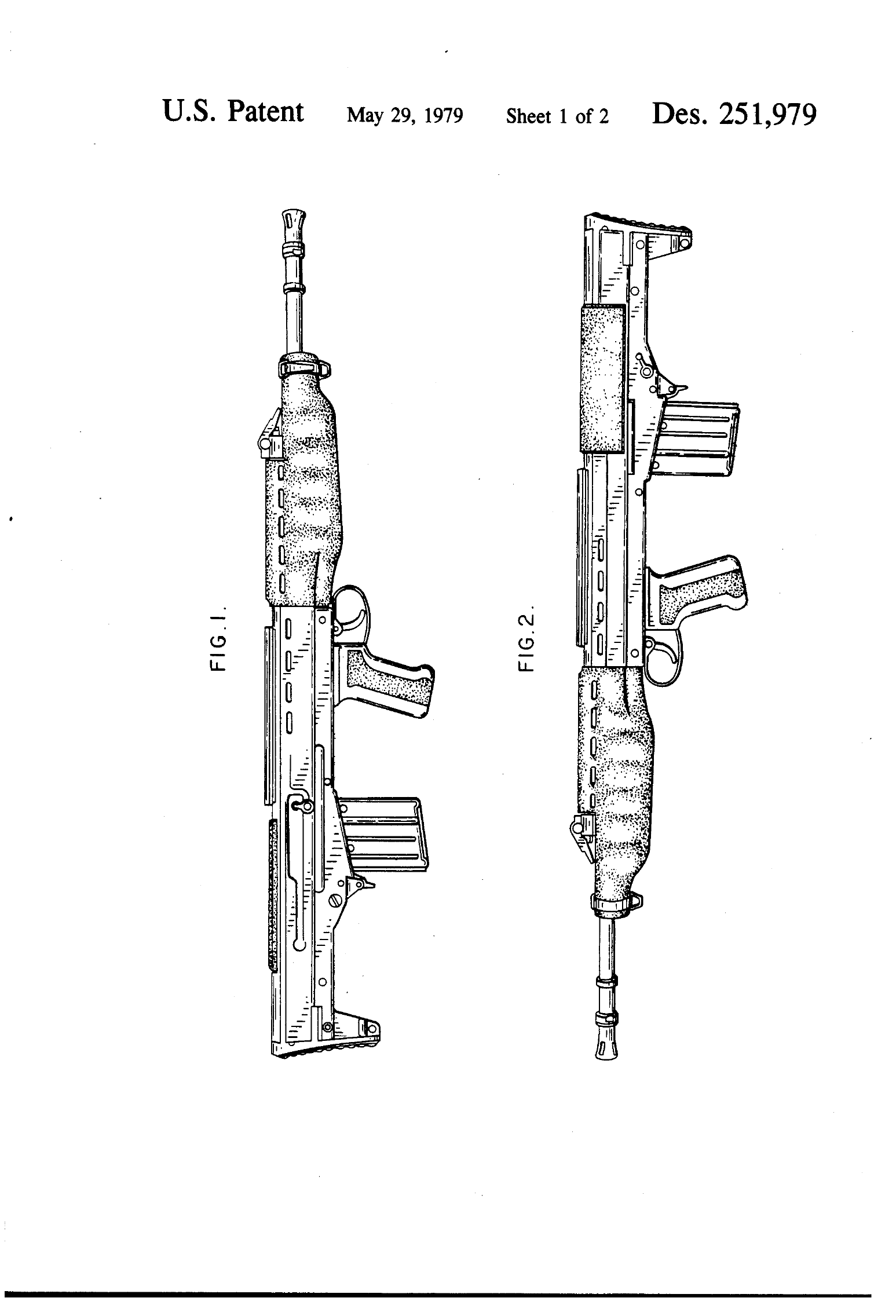
No dimensioned drawing of any SA80 part has been published. The Royal Ordnance documents give no dimension; the ARES series gives none below overall length; Murdoch reverse-engineered its body from originals and checked it against Royal Armouries rifles, and publishes nothing.11 The only public drawing of the rifle’s external form is Hance’s 1979 design patent, which protects appearance and carries no dimensions (Volume 1). A faithful SA80 bolt, carrier, barrel extension and trigger mechanism therefore cannot be made from the sources; they would have to be measured from a real part, and none is available in the United States outside Murdoch’s shop.
The workable design is a hybrid: an SA80-pattern pressed body and trigger housing, made in the shop to the external form, housing a US-made, commercially supported AR-180B-pattern barrel, barrel extension and bolt carrier group — the BRN-180’s, the family the AKB-23 already uses. That is the same choice Murdoch’s own press describes (“some AR-15 components in the action”) and the same lineage the SA80 came from (Volume 5).11 It keeps every locking surface in a part made by a barrel maker, and it keeps the rifle US-made throughout, so § 922(r) does not arise.
9.17 The body: what a pressed and welded receiver asks of a shop
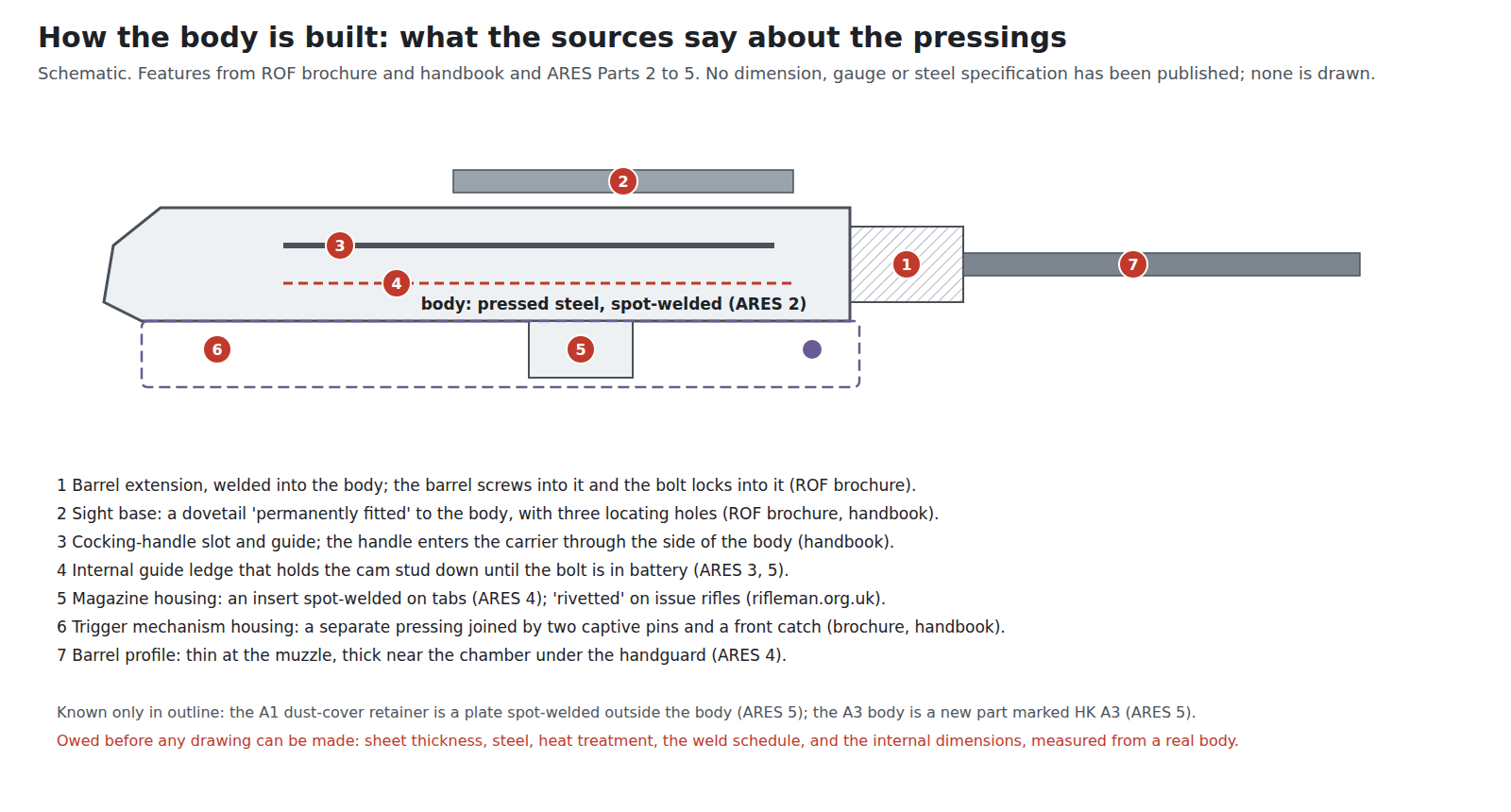
What the sources say about the service body (Volume 5): pressed steel, spot-welded, with the barrel extension welded in, a permanently fitted sight dovetail, a cocking-handle slot and guide, an internal guide ledge, a magazine-housing insert spot-welded or riveted to the trigger housing, and the trigger housing joined by two captive pins and a front catch.212223 Sheet thickness, steel, heat treatment and weld schedule are not published.
Making that in a home shop is a sheet-metal job, and the lab above is a machining lab. Honestly mapped:
- Blanks. A flat blank for each side or for a folded U, with slots, vents and pin holes, is a CNC-router or CNC-mill job on a sheet the machine can hold. A CO2 laser at 60 or 100 W is not a steel-cutting tool at any plausible receiver gauge; in this build it cuts templates, forming-die patterns and gaskets, and marks finished parts.
- Forming. The SA80 body is folded and formed. The lab has a press brake and a 30-ton press without a load gauge. Prexis’s 2010 kit shows the industry’s answer for a kit: a flat lower “which will require bending into shape”.9 Bends that run the length of the body go on the brake. A folding fixture machined on the router and used in the press handles the short, closed forms the brake cannot reach.
- Joining. The service body is spot-welded. The lab’s welder is a stick (SMAW) set, with no TIG and no resistance spot welder. Stick welding is a poor match for thin formed sheet, which burns through and distorts easily, so it is not a substitute here. Three routes remain: rivets, an added resistance spot welder or TIG set, or welding out of house. Each is worked through in Joining the body: three routes.
- Heat treatment. Whether the service body is hardened is not published. If the body carries no locking load — and in the hybrid design it does not, because the bolt locks into the purchased barrel extension — a mild-steel or 4130 body in the normalised condition is a reasonable engineering choice, but that is a design judgement for the builder, not a sourced figure. That choice also suits the lab, whose oven is a powder-coat oven and not a heat-treat furnace: any part that does need hardening and tempering goes to a heat-treat shop.
- The barrel extension interface. In the service rifle the extension is welded into the body. In the hybrid it is the BRN-180’s, clamped or retained in a machined block that is itself welded or riveted into the body by whichever joining route is chosen. That block takes the barrel’s hoop and torque loads and is the one part that should be machined from bar and fitted to the purchased extension.
9.18 Joining the body: three routes
The service body is spot-welded, and its magazine well is described as spot-welded on its tabs by one source and “rivetted into the body” on issue rifles by another (Volume 5).2224 The lab cannot spot-weld or TIG-weld today. The three ways round that are set out below at the same depth, with a decision table at the end; none is recommended over the others.
Three things are common to all of them.
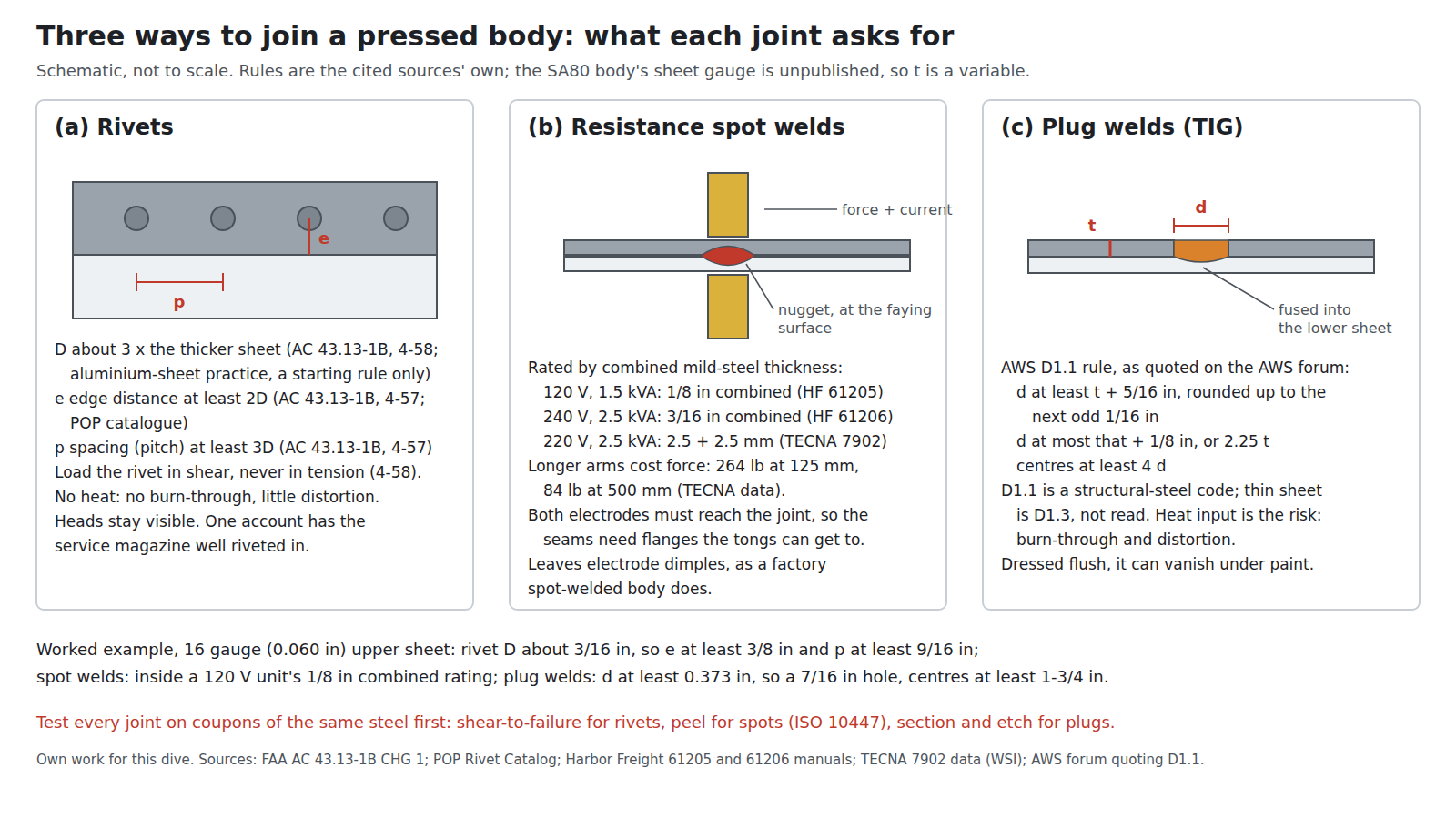
- The gauge is the builder’s choice. No sheet thickness for the SA80 body has been published, so every joint below is sized from the thickness t the builder picks. The worked examples use 16 gauge (0.060 in) as an illustration, not as the service figure.
- The fixture decides the rifle. Whatever joins the sheets also freezes their geometry. The carrier guides, the barrel-extension block and the sight dovetail have to be located from one datum, the bore axis, by a fixture machined on the router or the mill, with the sheets clamped to it. The spot-welder maker’s instruction applies to every process: “Ensure there are no gaps between the workpieces as this will weaken the weld”, and use separate clamps rather than the tool itself to pull parts together.25 After joining, the carrier must run the full stroke without binding (Proving the build) before anything else is fitted.
- Coupons come first. Every joint is made first on test pieces of the same steel, the same gauge and the same surface preparation, and broken. The receiver is never the first joint of its kind.
9.18.1 (a) Rivets
Equipment. Nothing the lab lacks. Holes are drilled on the mill or through a drill plate cut on the router; solid rivets are set in the press with rivet sets turned on the lathe; blind rivets need only a hand or air riveting tool. The cost is the rivets and the time.
Which rivet. Two kinds suit a steel body.
- Solid steel rivets, upset in the press. They need access to both sides of the joint, which in a closed box means planning the order of assembly so that each seam is riveted while it is still open. Countersunk heads set flush and dressed come closest to an unbroken pressing.
- Steel blind rivets, set from one side. Emhart’s POP catalogue lists steel-body, steel-mandrel open-end rivets at a rated shear of 295 lb and tensile of 425 lb for 1/8 in, 410 and 570 lb for 5/32 in, and 590 and 815 lb for 3/16 in, each with its own hole size (1/8 in: 0.129–0.133 in).26 The FAA’s guidance is that “the locking characteristics of a blind rivet are not as good as a driven rivet”, so blind rivets are used where a driven one cannot be, and that friction-lock types “are very sensitive to vibrations”.27 A rifle body is a vibrating structure; where blind rivets are used, mechanical-lock types are the better choice.
Joint design. The published rules come from aircraft and fastener practice and are applied here as starting points, not as an SA80 specification. FAA Advisory Circular 43.13-1B: for single-row rivets, “the edge distance should not be less than 2 times the diameter of the rivet and spacing should not be less than 3 times the diameter of the rivet”; the general rule for rivet diameter (in aluminium sheet) is “approximately three times the thickness of the thicker sheet”; and “Do not use rivets where they would be placed in tension”.27 POP’s guidance agrees on edge distance (“not less than twice the rivet diameter”) and adds that “Too large a hole will reduce the shear and tensile strengths” and that rivet and sheet should have “the same physical and mechanical properties”.26 For 16-gauge sheet that gives a 3/16 in rivet, edge distance at least 3/8 in and spacing at least 9/16 in. Those flanges have to be designed into the pressing from the start; tear-out of a short edge is what the edge-distance rule guards against.
Fixture and distortion. Riveting adds no heat, so there is no burn-through and no weld distortion. Distortion comes instead from hammering and from holes that do not line up. Drill each seam through both sheets together while they are clamped in the fixture, hold the drilled holes with temporary fasteners, and squeeze rather than hammer, working from the middle of a seam outwards.
Testing the joint. Make lap-shear coupons, a single rivet and a short row, in the chosen sheet and rivet, and pull them to failure. The rivet should shear; if the sheet tears out to the edge or the hole elongates first, the edge distance or the sheet is too small. Measuring the load needs a gauge or load cell; the lab’s 30-ton press has no gauge, so a load reading needs an added gauge or load cell. Without one, the failure mode is still the useful result.
How it looks. Rivet heads show unless they are countersunk and dressed. Flush, dressed countersunk heads under phosphate and paint come close to a pressing; domed heads read as a Kalashnikov, not an SA80. A riveted magazine well matches one account of the issue rifle.24
Cost and time. The lowest cash cost of the three. The time goes into designing flanges, laying out and drilling holes, and making the coupons; no figure is estimated.
Failure modes. Loose or “working” rivets under recoil and vibration; tear-out at a short edge distance; cracks starting at holes drilled too near a bend; blind-rivet mandrels that loosen; and corrosion between unlike metals.
9.18.2 (b) Adding a spot welder or a TIG set
9.18.2.1 A resistance spot welder
Equipment. Rated sheet thickness is given by the makers as combined mild-steel thickness, so a two-sheet joint’s per-sheet limit is half of it.
Table 5 — A resistance spot welder
| Unit (seller) | Supply | Rating | Rated mild steel | Per sheet | Timer | Price, 2026-10-19 |
|---|---|---|---|---|---|---|
| Chicago Electric 120V Spot Welder, item 61205 (Harbor Freight) | 120 V, 13.5 A | 1.5 kVA at 50% duty | ”up to a combined thickness of 1/8” sheet steel” | 1/16 in (about 16 ga) | None: weld time is set by “the skill of the operator” | $159.99 |
| Chicago Electric 240V Spot Welder, item 61206 (Harbor Freight) | 240 V, 16 A | 2.5 kVA at 50% duty | ”up to a combined thickness of 3/16” sheet steel” | 3/32 in (about 13 ga) | None | $159.99 |
| TECNA 7902 (WSI, US distributor) | 220 V on a 20 A fuse (440 V on request) | 2.5 kVA at 50% duty | ”0.10 x 0.10 in. (2.5 x 2.5 mm)“ | 0.098 in | Electronic, 2 to 65 cycles | Not published (quote) |
Sources: Harbor Freight product pages and owner’s manuals; WSI’s TECNA 7902 pages.252829 Harbor Freight’s 61206 web page gives its galvanised capacity as “2 pieces of 20 gauge” while its manual gives 16 gauge; the mild-steel figures agree. Miller’s portable spot welder could not be priced (its manual link was dead and a reseller says the line is discontinued).
Can a 120 V unit do it? It depends on a gauge nobody has published. On the makers’ ratings, two sheets of 16 gauge (0.0598 in each) fall inside a 120 V, 1.5 kVA unit’s 1/8 in; 14 gauge (0.075 in) and 13 gauge need the 240 V class; past about 0.10 in a sheet, a hand-portable unit is out of its range. Two cautions narrow those numbers in practice. Reach costs force: TECNA’s electrode force falls from 264 lb on its 125 mm arms to 84 lb on its 500 mm arms, and a weld inside a U-shaped body needs reach.29 The budget units have no timer: the operator times each weld by hand, so the same weld twice depends on the operator, while the TECNA’s SCR timer counts cycles. The lab has a 240 V circuit, so the 240 V class is open to it.
Joint design. Spot welds need lap flanges that both electrodes can reach, which on a closed body means flanges outside the box or seams welded before the box is closed. No published spacing or edge-distance table for spot welds was read for this volume (the industry tables are in AWS and RWMA documents not consulted). Set the minimum spacing from coupons instead: weld a row at decreasing pitch and peel them; when the nuggets shrink, current is shunting through the previous weld.
Fixture and distortion. Heat input is small and local, so distortion is the least of the three welded routes. The fixture holds the sheets tight and clear of the tongs; the welder’s own maker warns against using the tongs as a clamp.25
Testing the joint. The peel test: weld two strips, peel them apart, and look. A good weld tears a “button” out of one sheet; a weld that separates flat at the faying surface is too cold, too short or too lightly clamped. ISO 10447 sets out peel and chisel testing of resistance spot welds in sheets from 0.5 to 3.0 mm.30 Set a minimum button size from the first good coupons and hold every later coupon to it.
How it looks. The same process as the factory: small electrode dimples on both faces, as on the spot-welded service body (Volume 5). The most faithful of the three.
Cost and time. $159.99 for a 120 V or 240 V budget unit, plus electrode tips and a tip dresser. Each weld takes seconds; the time goes into the fixture and coupons.
Failure modes. Cold welds that hold until loaded and then fail flat; burn-through and expulsion (“Weld time too long” in the maker’s own troubleshooting table); mushroomed tips; shunting through a neighbouring weld; and gaps between sheets.25
9.18.2.2 A TIG set
Equipment. A TIG set is the more versatile purchase and the more expensive one. Welders Supply listed Miller’s Diversion 180 (907627) at $2,928.00 on 19 October 2026: 115 or 230 V input through an interchangeable plug, 125 A at 35% duty on 115 V and 180 A at 10% duty on 230 V, AC and DC.31 AC matters only for aluminium; a DC-only TIG machine is enough for a steel body. A budget AC/DC unit’s price could not be confirmed on its seller’s product page and is not printed. Add an argon cylinder and regulator, tungsten and filler (not priced).
Joint design: plug welds. The service body’s spot welds are most nearly copied by plug welds: a hole in the outer sheet, filled and fused into the sheet behind. AWS D1.1’s rule, as quoted on the American Welding Society’s own forum, is that “The minimum diameter of the hole for the plug shall be no less than the thickness of the part containing it plus 5/16(8mm)”, “preferably rounded to the next greater odd 1/16” of an inch; that the maximum equals the minimum plus 1/8 in (3 mm) or 2-1/4 times the thickness of the member, whichever is greater; and that “The minimum center to center spacing for plug welds shall be 4 times the diameter of the hole”.32 For 16-gauge sheet that is a 7/16 in hole on centres of at least 1-3/4 in. D1.1 is a structural-steel code; sheet steel is the subject of AWS D1.3, which was not read, and on a small receiver D1.1’s rule allows few welds, which is a reason to prove the joint’s strength on coupons rather than assume it. Seam welds with a copper backing bar, the STEN’s method, are an alternative where a seam rather than a lap is wanted; the STEN dive, Volume 7 §7.3.3 sets out that procedure and is not repeated here.
Fixture and distortion. The largest risk of the three. Each plug puts heat into thin sheet next to the carrier guides. Clamp the sheets tight over copper or aluminium chill bars, weld plugs in an order that alternates sides and ends rather than running along a seam, let each cool, and check carrier travel between groups of welds. The HK PSG1 dive, Volume 9 quotes a builder’s warning that adding filler before the heavier part is hot burns through the thin receiver wall.
Testing the joint. Section a coupon through the middle of a plug, polish the cut face and etch it: fusion into the lower sheet shows as a continuous etched weld running into it; a line at the bottom of the hole is lack of fusion. A pry or peel test of a second coupon shows whether the plug tears out of the sheet or lets go at the root.
How it looks. Dressed flush and refinished, a plug weld can disappear; it does not give the service rifle’s dimples. A weld that was poorly prepared shows through any finish, as the STEN dive, Volume 9 §9.6 notes.
Cost and time. About $2,928 for the Miller package before gas, plus the time it takes to become good at thin-sheet TIG. The set then also serves the barrel-extension block, the fixtures and the next sheet-metal receiver.
Failure modes. Burn-through; lack of fusion at the root; distortion of the guides; cracking at the edge of a plug; porosity from dirty sheet.
9.18.3 (c) Welding out of house
What to hand the shop. The body clamped in the builder’s own fixture, so the shop is welding to the builder’s geometry; a drawing marking every joint by type, size, position and order; coupon pieces of the same steel and gauge; and the test each coupon must pass (peel for spots, a section for plugs).
What to ask. Which process and machine (a spot welder with a timer, or TIG); whether the shop will weld and break coupons first, the same day, and hand them back; whether it will follow the builder’s weld order; and whether it will check carrier travel, or let the builder check it, before the body leaves.
The licensing question. ATF’s published position is in ATF Ruling 2015-1. It answers whether “Federal Firearms Licensees (FFL), or unlicensed machine shops, may engage in the business of completing, or assisting in the completion of, the manufacture of firearm frames or receivers for unlicensed individuals”, and holds that “Any person … engaged in the business of performing machining, molding, casting, forging, printing (additive manufacturing) or other manufacturing process to create a firearm frame or receiver … must be licensed as a manufacturer”, must mark the firearm and must keep manufacturer’s records. A licensed gunsmith who performs such work “‘distributes’ a firearm to the customer upon return”. A business cannot avoid the rule by letting the customer run its machines: it “may not avoid the manufacturing license, marking, and recordkeeping requirements … by allowing persons to perform manufacturing processes … using machinery, tools, or equipment under its dominion and control”.33
What that establishes, and what it does not:
- Established: a shop that, as a business, performs the process that creates a receiver for an unlicensed person needs a manufacturer’s licence, whether it holds a gunsmith’s licence or none; renting time on its machines does not change that.
- Not established: the ruling does not mention welding by name, and no ATF statement applying it to welding a sheet-metal receiver was found. Whether welding performed on parts before the joint that makes them a receiver is caught was not found either. Whether the ruling has been modified since the 2022 frame-or-receiver rule was not checked.
- What follows in practice: an unlicensed welding shop has reason to decline the joint that makes the body a receiver, and many will decline any firearm work. A licensed manufacturer can do it, but then the body is that licensee’s manufacture, marked by it, and comes back to the builder as a transfer from a licensee, with the paperwork that implies. A body that is already a receiver when it leaves the builder is a firearm in transit and in the shop’s hands; a licensee who takes in a privately made firearm must mark it (27 CFR 478.92(a)(2), set out in the Borchardt C-93 dive, Volume 9).
How it looks, cost and time. Whatever the shop’s process gives. Shop rates and lead times are quotes and are not printed. The builder’s own time goes into the fixture, the drawing and the coupons, which are the same as for routes (a) and (b).
Failure modes. No shop willing to take it; a shop that skips the coupons; and distortion discovered only after the body comes back.
9.18.4 The stick welder’s place
The lab’s stick welder is not a tool for the body’s sheet, but it is not idle: weld tables, fixture frames, holding brackets and any thick section, including the mounting of the machined barrel-extension block where both parts are heavy enough. Thin-sheet work is what it cannot do.
9.18.5 Choosing a joining route
Table 6 — Choosing a joining route
| (a) Rivets | (b1) Spot welder | (b2) TIG set | (c) Out of house | |
|---|---|---|---|---|
| Added equipment, 2026-10-19 | None (rivets, sets turned in-house) | $159.99, 120 V or 240 V budget unit; industrial units by quote | $2,928.00 (Miller Diversion 180), plus gas | None |
| Supply | n/a | 120 V to about 16 ga per sheet; 240 V to about 13 ga | 115 or 230 V | n/a |
| Fidelity to the service body | Heads visible; one account has the service magazine well riveted | Highest: the factory’s own process and dimples | Plugs can vanish under paint; no dimples | As the shop’s process |
| Heat and distortion | None | Low | Highest | As the shop’s process |
| Repeatability | Good, if holes are jigged | Poor without a timer; good with one | Skill-dependent | The shop’s |
| Coupon test | Lap shear to failure | Peel (ISO 10447) | Section and etch; pry | Specified by the builder |
| Licensing questions | None beyond making a firearm | None beyond making a firearm | None beyond making a firearm | ATF Rul. 2015-1: a shop that creates the receiver needs a manufacturer’s licence |
| Main failure mode | Tear-out; loosening | Cold welds | Burn-through; distortion | No shop will do it |
| What the reader gives up | The welded look | Flanges must be reachable; a 240 V circuit for heavier sheet | Money and practice time | Control, and the body’s status as the builder’s own manufacture if a licensee welds it |
9.19 The barrel, barrel extension and bolt
Buy them. The lab’s lathe is a 7×16, nominally 16 inches between centres, which cannot hold a 20-inch barrel between centres for profiling or chambering. A BRN-180-pattern barrel comes chambered, headspaced to its own extension, and with the bolt it is meant to run with. The builder’s job is to locate it in the body so that the bolt carrier runs true in the body’s guides and the sight line on the body’s dovetail is parallel to the bore. A 20-inch or 18.5-inch barrel keeps the rifle clear of both the federal 16-inch and Michigan’s 26-inch lines (above).
No separate price for a BRN-180 barrel, extension and carrier set was found. The plainest source of a matched set is a complete BRN-180 upper ($849.99 from Aly & Kaufman on 19 October 2026, out of stock), whose barrel, extension and bolt carrier group are used and whose aluminium receiver is not.16 That is a sourcing inference, not a maker’s offer; a builder who finds the set sold separately should check that the bolt and extension are a headspaced pair.
9.20 Fire control: semi-automatic by design
The service SA80’s trigger mechanism housing is select-fire, and its parts are neither available nor wanted. The fire control for this build is a commercial semi-automatic AR-pattern group in a bullpup housing driven by a trigger bar — the general arrangement of the AKB-23, which pairs a mil-spec single-stage trigger with a bullpup lower but does not publish its linkage — or a purpose-made semi-automatic group following the principle Ferguson describes for the Super Ensign: a rifle “reworked … in order to prevent ready conversion to automatic fire”.7 The hub’s other build volumes describe the general practice; on this build the points are:
- no automatic sear, no provision for one, and no surface in the housing that could carry one;
- no change lever; the L98A2 cadet rifle is the service precedent for an SA80 with the change lever simply omitted (Volume 4);7
- the trigger bar’s length and stiffness set the pull weight and creep. A long, flexible bar is the bullpup’s characteristic trigger complaint, and the bar is a part worth making stiff.
Nothing in this volume, and nothing in the hub, describes the SA80’s automatic function beyond the maker’s one sentence (Volume 5).
9.21 Gas parts, recoil rods and the rest
The hybrid uses the purchased upper’s own gas and return system. A builder who wanted the SA80’s plug, moving cylinder and piston rod (Volume 5) would be making them without dimensions, and they are the parts the maker told users to clean and gauge every 200 rounds. There is no reason to copy them for function. The three-rod return assembly is likewise the SA80’s own answer to its own carrier; the BRN-180’s system fits the BRN-180’s carrier.
The cocking handle is the visible SA80 feature most worth reproducing: a comma-shaped handle on the right, through a slot in the body. In the hybrid it drives the purchased carrier through an adapter, and the right-side ejection the SA80 shares with the AR-180B is unchanged. Like the service rifle, the result can be fired only from the right shoulder.
9.22 Furniture, sights and finish
This is where the lab is strongest.
- Furniture. Butt, cheek pieces, pistol grip and handguard are polymer on the service rifle. Printed in a tough engineering polymer, or routed, they carry little load. If a printed part is anything more than furniture, the hub’s treatment of 18 U.S.C. § 922(p) for printed nylon receivers in the Steyr AUG dive, Volume 11 §11.11 applies; with a steel body it does not arise.
- Sights. The service rifle has no fixed sights. A dovetail base on the body, as the original’s, carries an SA80-pattern carrying handle (Aly & Kaufman sells one) or a Picatinny adaptor for a modern optic (Volume 8).14
- Finish. The service bodies were phosphated and painted; the A3 is Flat Dark Earth. Murdoch offers Cerakote.10 The laser can mark the builder’s own name, city and serial (below).
9.23 Proving the build
The hub’s other build volumes set out headspace checks, first-fire procedure and function testing at experienced-gunsmith depth. Three checks are specific to this build:
- Carrier travel. The carrier must run the full stroke on the body’s guides without binding at any point, with the cocking handle fitted, before a barrel goes in.
- Fire control under the bar. Function-check the trigger, safety and disconnect with the trigger bar installed and the housing closed, including a drop-and-bump check. The XL80’s second-pattern trigger was made heavier “to prevent inadvertent firing when dropped on the muzzle”; the long bar is the reason.22
- Ejection clearance. The case ejects beside the face. Confirm on the first rounds, from the right shoulder, that cases clear the body and the shooter, and do not fire it from the left.
Marking. A privately made firearm for personal use, not for sale, may be made by an unlicensed person under federal law; the marking and serialisation rules for privately made firearms, and the 2025 VanDerStok decision, are treated in the STEN dive, Volume 10 and the Steyr AUG dive, Volume 6. Marking the body with the maker’s name, city and state and a unique serial is the conservative course whatever the minimum.
9.24 Comparing the routes
Table 7 — Comparing the routes
| Route 1: buy an EM85 | Route 2: AKB-23 lookalike | Route 3: shop-made hybrid | |
|---|---|---|---|
| Cash cost | $6,500.00 for the EM85A3 on the maker’s page, 18 Oct 2026; 40% down | $1,920.00 assembled, or $2,276.97 as a dressed kit with three magazines (19 Oct 2026); plus dealer’s fee | A BRN-180-pattern barrel, extension and carrier (a donor upper is $849.99), a semi-automatic fire-control group, sheet and bar stock (not priced), and $0 to $2,928 of joining equipment |
| Shop time | None; maker’s lead time 6–9 months | Hours: assembly and dressing | By far the most: fixtures, forming dies, coupons, the body, the housing; not estimated |
| Tools beyond the lab | None | None | None for rivets; a spot welder or TIG set for welds; or an outside shop |
| Fidelity to the SA80 | Highest: stamped body and the SA80’s layout; Collector Series has original parts | SA80-shaped furniture on a BRN-180 upper; no pressed body, no dovetail | SA80-pattern pressed body and outline; joints from rivets (visible) to spot welds (factory look) |
| Mechanism | Maker’s semi-automatic SA80 action, with “some AR-15 components” | AR-180B (BRN-180); bufferless bullpup lower | AR-180B (BRN-180) barrel, extension and carrier in an SA80-pattern body |
| Parts support | The maker only | BRN-180 and AR-15 parts; the lower’s maker | Barrel group: BRN-180; body and housing: the builder |
| Legal status | An ordinary rifle purchase; a serialised rifle from a licensed maker | The lower ships through a dealer; the rest is mail order; watch the 26-inch lines | A privately made firearm; if an outside shop does the receiver-making weld, ATF Rul. 2015-1 applies to the shop |
| What the reader gives up | Money and waiting; the maker’s markings and 922(r) count are unpublished | The SA80’s body, sight dovetail and controls | Time, and every part made without an original to measure |
Sources: the sections above. The EM85 price is the maker’s from 18 October 2026 and was not re-read on 19 October.
9.25 Questions only ATF, a lawyer or a maker can answer
- Is the body (the part housing the bolt) the receiver of an SA80-pattern rifle for 27 CFR 478.12, or could ATF view the trigger mechanism housing as one? No classification was found.
- In a § 922(r) count, is the SA80’s moving gas cylinder a “gas piston”, is the piston rod an “operating rod”, or both? Is a one-piece butt-and-trigger-housing one listed part or two?
- What does the Murdoch EM85 carry as its maker’s marking, city and state, and what is its § 922(r) count with original parts?
- What are the barrel length, overall length and NFA status of Murdoch’s carbine upper?
- For Aly & Kaufman: where is the AKB-23’s serial and maker’s marking, what are the measured overall lengths of the 16-inch and 18.5-inch builds, where are the lower and its furniture made, and what does the trigger linkage look like? (The lower ships through a dealer, which settles that it is the receiver.)
- For ATF or a lawyer: does ATF Rul. 2015-1 reach a welding shop that joins a sheet-metal body for a private maker, and does it reach welding done on parts before the joint that makes them a receiver? Has the ruling been modified since the 2022 frame-or-receiver rule?
9.26 What could not be established
- Any record of a 1980s semi-automatic SA80 import; the numbers on forums are not printed.
- Whether Prexis’s kit shipped.
- Any dimension of any SA80 part: sheet gauge, steel, heat treatment, weld schedule, bolt-lug count, locking geometry.
- Murdoch’s location, licence, markings and § 922(r) position.
- A US price for a SUSAT; a US source of SA80 internal parts.
- US airsoft prices (bot-walled).
- Brownells’ own price and specification for the BRN-180 upper (its pages refused automated reading on 19 October 2026); the reseller’s price is used.
- The AKB-23 user manual (hosted on a file-sharing service that could not be opened), its serial location, its linkage, its country of manufacture, and the measured overall length of any AKB-23 build.
- A published spacing and edge-distance table for resistance spot welds in mild steel (AWS and RWMA tables were not read), and the text of AWS D1.3 for plug welds in sheet; D1.1’s rule is given as quoted by the AWS forum.
- A budget TIG set’s price on its seller’s own product page; a current price for any industrial portable spot welder (TECNA’s is by quote).
9.27 Corrections this volume makes
- A US-made semi-automatic SA80 exists: Murdoch & Co.’s EM85, launched January 2026; its A3 was $6,500 on the maker’s page on 18 October 2026, up from a $4,500 launch MSRP.
- A semi-automatic L85A1, the “Super Ensign”, was designed in the 1980s; US examples are a rumour, not a record.
- Deactivated British SA80s cannot be imported under the curio route, which excludes machine guns.
- A § 922(r) count is not needed for an all-US build; it applies only where imported parts are used. The STEN dive’s list of listed parts includes three that are not on the regulation’s list.
- An L22-length SA80-pattern carbine is both an NFA short-barrelled rifle and a Michigan “pistol” by overall length.
- No dimensioned drawing of any SA80 part is public; a faithful scratch-built SA80 mechanism cannot be made from the sources, which is why the scoped build uses a purchased AR-180B-pattern barrel, extension and bolt.
- The AKB-23 is the receiver, not a chassis. Its maker sells it as a “Complete ‘Ready to go’ AKB-23 lower receiver” that “Must ship to FFL” (19 October 2026), which settles the question this volume left open on 18 October.
- Building the AKB-23 from the kit saves nothing over the assembled rifle: the kit’s equivalent costs $1,859.98 without a magazine against $1,920.00 assembled with one (seller’s pages, 19 October 2026).
- A 120 V spot welder is rated for about 16-gauge sheet per sheet, not more: Harbor Freight’s 120 V unit is rated for 1/8 in combined mild steel and its 240 V unit for 3/16 in; neither has a weld timer.
- An outside shop that welds a receiver for a private maker meets ATF Rul. 2015-1, which requires a manufacturer’s licence of any business performing “other manufacturing process to create a firearm frame or receiver” for unlicensed persons. The ruling does not name welding; what it settles and what it does not are set out above.
References
Footnotes
-
Auction-house searches for a transferable L85 or SA80, 18 October 2026; none found. Recorded in this dive’s
02-inputs/research-market-law-build.md. ↩ -
Gaz Corfield, “Mystery of the L98A1 Cadet GP rifle’s fate”, UK Shooting News, 7 March 2016, quoting an MoD freedom-of-information reply of April 2015, https://ukshootingnews.wordpress.com/2016/03/07/mystery-of-the-l98a1-cadet-gp-rifles-fate/, consulted 2026-10-18. ↩
-
UK Parliament, written answer 112713, answered 26 February 2026. questions-statements.parliament.uk, consulted 2026-10-18. ↩
-
CanadianGunNutz forum, “New US made semi auto L85 manufactured by Murdoch and Co”, post by user JasonGTA, 29 January 2026, https://www.canadiangunnutz.com/forum/threads/new-us-made-semi-auto-l85-manufactured-by-murdoch-and-co.2561287/, consulted 2026-10-18. A forum post, not the maker; reported as such. ↩ ↩2
-
18 U.S.C. § 925(d), Legal Information Institute, https://www.law.cornell.edu/uscode/text/18/925, consulted 2026-10-18. ↩
-
27 CFR 479.11, definitions of “unserviceable firearm” and “machine gun”. eCFR, consulted 2026-10-18. ↩
-
Jonathan Ferguson, “British Enfield SA80 Part 7: L98A1 Cadet GP Rifle”, The Hoplite, 27 May 2017. Wayback capture of 6 June 2017, https://web.archive.org/web/20170606131613/http://armamentresearch.com/british-enfield-sa80-part-7-l98a1/, consulted 2026-10-18. ↩ ↩2 ↩3
-
Jeremiah Knupp, “The Murdoch & Co. EM85: An SA80 For America”, American Rifleman, 22 July 2026, https://www.americanrifleman.org/content/the-murdoch-co-em85-an-sa80-for-america/, consulted 2026-10-18. ↩ ↩2
-
Steve Johnson, “Build your own Enfield SA80 soon”, The Firearm Blog, 8 February 2010, updated 9 January 2013, https://www.thefirearmblog.com/blog/2010/02/08/build-your-own-enfield-sa80-soon, consulted 2026-10-18. ↩ ↩2
-
Murdoch & Co. pages “Home”, “EM-85”, “EM85A3”, “EM85 Variants”, “About”, “Markings and Serials” and “Gun Making”, https://murdochandco.com/, consulted 2026-10-18. ↩ ↩2 ↩3 ↩4
-
Matthew Moss, “[SHOT 2026] Murdoch & Co. launch American-made SA80s”, The Firearm Blog, 25 January 2026, https://www.thefirearmblog.com/blog/shot-2026-murdoch-co-launch-american-made-sa80s-44825827, consulted 2026-10-18. ↩ ↩2 ↩3 ↩4
-
“Murdoch & Co. EM85 rifles: a real civilian SA-80”, GUNSweek, 21 January 2026, https://gunsweek.com/en/rifles/news/murdoch-co-em85-rifles-real-civilian-sa-80, consulted 2026-10-18. ↩
-
Matthew Moss, “[SHOT 2025] The SA80 at Home – the AKB-23”, The Firearm Blog, 21 January 2025; James Reeves, The Firearm Blog, 28 January 2025. Consulted 2026-10-18. ↩
-
Aly & Kaufman LLC, home page product listings, https://aandk.llc/, read through the shared fetch engine, consulted 2026-10-18. ↩ ↩2 ↩3
-
Matthew Moss, The Firearm Blog, 12 February 2026, on the AKB-23 LSW. Consulted 2026-10-18. ↩
-
Aly & Kaufman LLC (Broken Bow, Nebraska), product pages read through the shared fetch engine on 2026-10-19: “AKB-23 (BRN180) ‘L85’” https://aandk.llc/akb-23-brn180-l85/ ; “AKB-23 (FM-15) ‘L85’” https://aandk.llc/akb-23-fm-15-l85/ ; “AKB-23 L85 style assembled rifle” https://aandk.llc/akb-23-l85-style-assembled-rifle/ ; “AKB-23 (FM-15) L85 style assembled rifle” https://aandk.llc/akb-23-fm-15-l85-style-assembled-rifle/ ; “BRN-180 Gen 2.5 18.5” upper receiver 223 WYLDE” https://aandk.llc/brn-180-gen-2-5-18-5-upper-receiver-223-wylde/ ; “AKB-23 L85 style grip” https://aandk.llc/akb-23-l85-style-grip/ ; “Carry handle iron sight set (L85)” https://aandk.llc/l85-carry-handle-iron-sight-set-1913/ ; “Carry handle iron sight set (Micro mount)” https://aandk.llc/carry-handle-iron-sight-set-micro-mount/ ; “‘L85’ Flash Hider 1/2x28” (KAK Industry) https://aandk.llc/l85-flash-hider-1-2x28/ ; “Magpul TMAG 30rd Magazine” https://aandk.llc/magpul-tmag-30rd-magazine/ ; “HK Steel 30rd Magazine” https://aandk.llc/hk-steel-30rd-magazine/ . Customer reviews on those pages are quoted as buyers’ reports only. Brownells’ own BRN-180 pages returned HTTP 403 the same day. ↩ ↩2 ↩3 ↩4 ↩5 ↩6 ↩7
-
RedWolf Airsoft (Hong Kong), L85 category page, consulted 2026-10-18. All items listed as out of stock that day. ↩
-
British Army, “Small arms and support weapons”, army.mod.uk. Wayback capture of 28 September 2024, http://web.archive.org/web/20240928000237/https://www.army.mod.uk/equipment/small-arms-and-support-weapons/, consulted 2026-10-18. ↩
-
Jonathan Ferguson, “British Enfield SA80 Part 6: Carbines”, The Hoplite, 24 May 2017. Wayback capture of 18 January 2026, http://web.archive.org/web/20260118060548/http://armamentresearch.com/british-enfield-sa80-part-6-carbines/, consulted 2026-10-18. ↩
-
Aly & Kaufman LLC, “AKB-23” instructional playlist, YouTube, six videos published 22 February 2025 (“AKB-23 Upper lower assembly”, “Handguard installation”, “Cheekpiece installation”, “Buttpad replacement”, “Endcap replacement”, “more in-depth disassembly”), titles read 2026-10-19; the videos were not watched. The user manual linked from the product page is on a file-sharing host that could not be opened. ↩
-
Royal Ordnance, The Enfield Weapon System (sales brochure, c. 1985), “Construction”. Via the UK Historic Arms Resource Centre, https://www.rifleman.org.uk/Images/PDF-files/Enfield_Weapons_System/index.html, consulted 2026-10-18. ↩
-
Jonathan Ferguson, “British Enfield SA80 Part 4: XL80 Series”, The Hoplite (Armament Research Services), 17 May 2017. Wayback capture of 17 January 2026, http://web.archive.org/web/20260117090848/http://armamentresearch.com/british-enfield-sa80-part-4-xl80-series/, consulted 2026-10-18. ↩ ↩2 ↩3
-
Jonathan Ferguson, “British Enfield SA80 Part 5: SA80 A1 vs A2”, The Hoplite, 20 May 2017. Wayback capture of 28 May 2017, http://web.archive.org/web/20170528111515/http://armamentresearch.com:80/british-enfield-sa80-part-5-sa80-a1vsa2/, consulted 2026-10-18. ↩
-
“Enfield Cadet Rifles L98A1 and L98A2”, UK Historic Arms Resource Centre, https://www.rifleman.org.uk/Enfield_Cadet_Rifles_L98A1_and_L98A2.html, consulted 2026-10-19: final issue rifles have “an integral magazine-well rivetted into the body and protruding underneath”. ↩ ↩2
-
Harbor Freight Tools, “120V Spot Welder”, Chicago Electric item 61205 (also 45689), https://www.harborfreight.com/120v-spot-welder-61205.html, and its owner’s manual, https://manuals.harborfreight.com/manuals/61000-61999/61205-193175498069.pdf, both consulted 2026-10-19: $159.99; 120 V, 13.5 A; 1.5 kVA at 50% duty; “Mild Steel: up to a combined thickness of 1/8” sheet steel”. ↩ ↩2 ↩3 ↩4
-
Emhart Teknologies (Stanley Engineered Fastening), POP Rivet Catalog, “Design Guidelines” pp. 10–11 and steel open-end rivet tables pp. 19–20, https://www.stanleyengineeredfastening.com/-/media/Web/SEF/Resources/Docs/POP/POP-Rivet-Catalog.pdf, consulted 2026-10-19. The catalogue notes that POP rivets “are not certified for structural aerospace applications”. ↩ ↩2
-
Federal Aviation Administration, Advisory Circular AC 43.13-1B with Change 1, Acceptable Methods, Techniques, and Practices: Aircraft Inspection and Repair, 27 September 2001, paragraphs 4-57 and 4-58, https://www.faa.gov/documentLibrary/media/Advisory_Circular/AC_43.13-1B_w-chg1.pdf, consulted 2026-10-19. Aircraft aluminium practice, used here as a starting rule for steel sheet. ↩ ↩2
-
Harbor Freight Tools, “240V Spot Welder”, Chicago Electric item 61206 (also 45690), https://www.harborfreight.com/240v-spot-welder-61206.html, and its owner’s manual, https://manuals.harborfreight.com/manuals/61000-61999/61206-193175500083.pdf, both consulted 2026-10-19: $159.99; 240 V, 16 A; 2.5 kVA at 50% duty; “Mild Steel: up to a combined thickness of 3/16” sheet steel”. ↩
-
Weld Systems Integrators (WSI), “TECNA 7902 Portable Spot Weld Gun”, https://wsiweld.com/depot/tecna-7902/ and https://wsiweld.com/product/tecna-te7902/, consulted 2026-10-19. Price by quotation. ↩ ↩2
-
BS EN ISO 10447:2015, Resistance welding. Testing of welds. Peel and chisel testing of resistance spot and projection welds, scope as given on the BSI Knowledge product page, consulted 2026-10-19 (the 2015 edition is withdrawn and replaced by ISO 10447:2022). The procedure itself was not read. ↩
-
Welders Supply, “Miller Diversion 180 TIG welder 907627”, https://weldersupply.com/P/371/MillerDiversion180ACDCTi, consulted 2026-10-19: $2,928.00 with free shipping; output ratings as quoted. ↩
-
American Welding Society forum, reply by “QCCWI”, 26 October 2005, quoting AWS D1.1 on plug welds, https://app.aws.org/forum/topic_show.pl?pid=37437, consulted 2026-10-19. The code itself was not read. ↩
-
Bureau of Alcohol, Tobacco, Firearms and Explosives, ATF Ruling 2015-1, “Manufacturing and Gunsmithing”, 2 January 2015 (clarifying ATF Rul. 2010-10). atf.gov refuses automated reading; read from the Internet Archive’s copy of https://www.atf.gov/firearms/docs/ruling/2015-1-manufacturing-and-gunsmithing/download (capture of 5 October 2016), consulted 2026-10-19. ↩
Comments (0)