SA80 (L85 Family) · Volume 3
The H&K Rebuild: A2, L22 and A3
What Heckler & Koch changed part by part, what it cost by four official counts, Afghanistan 2002, the L22 carbine, the A3 mid-life improvement, and Project GRAYBURN
3.1 What this volume covers
Volume 2 ended in May 2000 with the government considering “modifications to the system proposed by the design authority Heckler and Koch”. This volume covers what was done: the A2 rebuild of about 200,000 weapons, mostly at H&K’s factory in Oberndorf; the trials that cleared it and the Afghan deployment that seemed to contradict them; the carbine and cadet rifle that came out of the same programme; the A3 that followed from 2018; and the replacement programme that is meant to retire the whole family from 2030.
The part-by-part list of changes comes from Jonathan Ferguson’s ARES article of 2017, which he based on Steve Raw’s The Last Enfield and an article by Anthony Williams, and on handling A1 and A2 rifles side by side at the Royal Armouries.1 Costs and fleet numbers come from Hansard, written answers and Ministry of Defence freedom-of-information replies, which are given separately where they disagree.
3.2 The decision, 2000
The programme was announced piecemeal. Ministers spoke of a decision “very soon” in May 2000; by 26 October Lewis Moonie, Under-Secretary for Defence, said that “most will be carried out in the factory in Germany” and that “at least 20,000 weapons” would be “fully modified and … back in service by the end of next year”.2 On 12 February 2001 Moonie told the Commons that the government had taken “decisive action to rectify two long-standing equipment problems by commencing a modification programme for the SA80 rifle and by launching a new competition for the Bowman radio requirement”.3
Ferguson dates the technical milestones: H&K engaged in 1995; “In 2001, the SA80 A2 build standard was finalised and troop trials began that year. General issue followed in 2002.”1
3.3 What Heckler & Koch changed
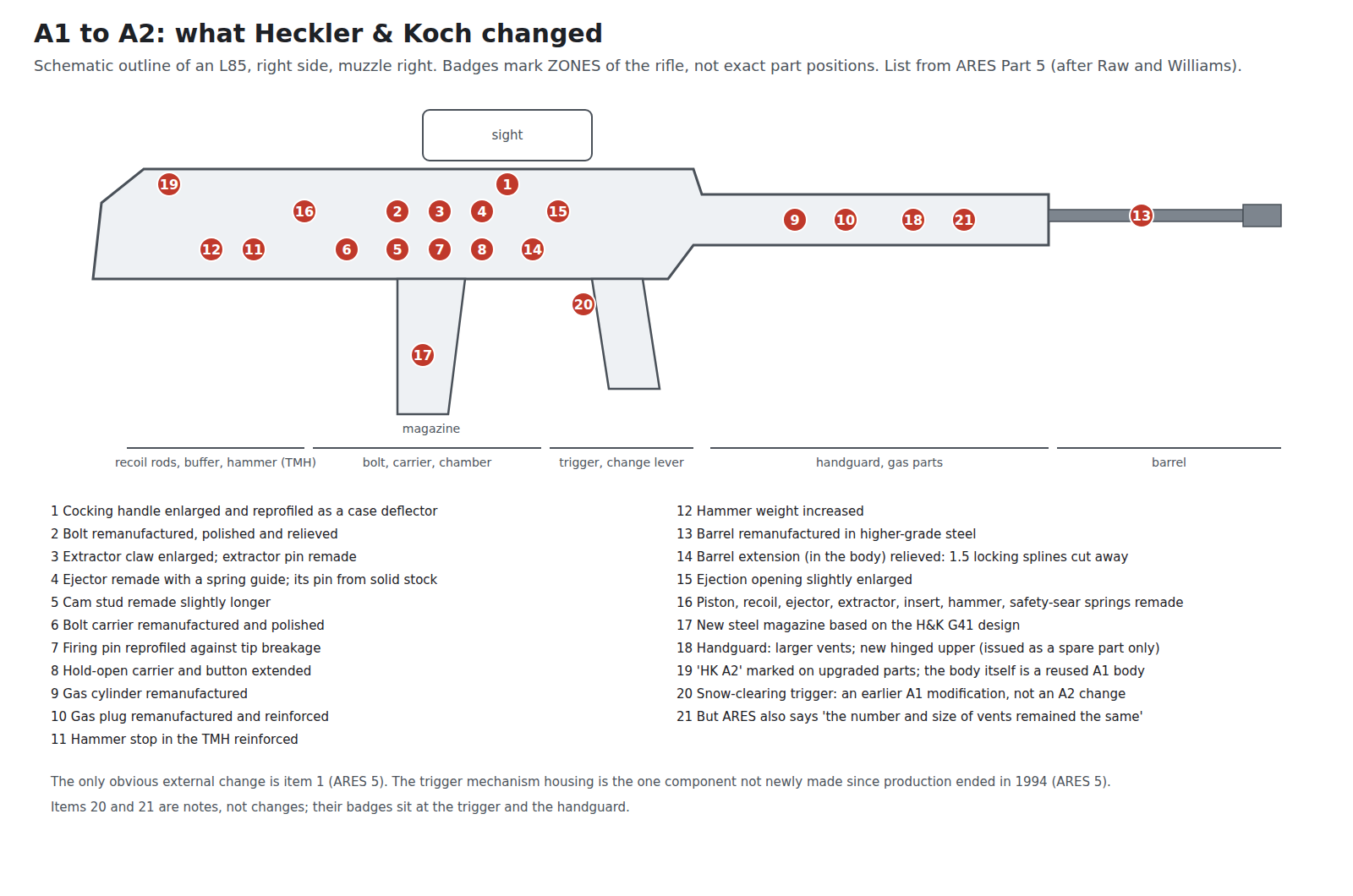
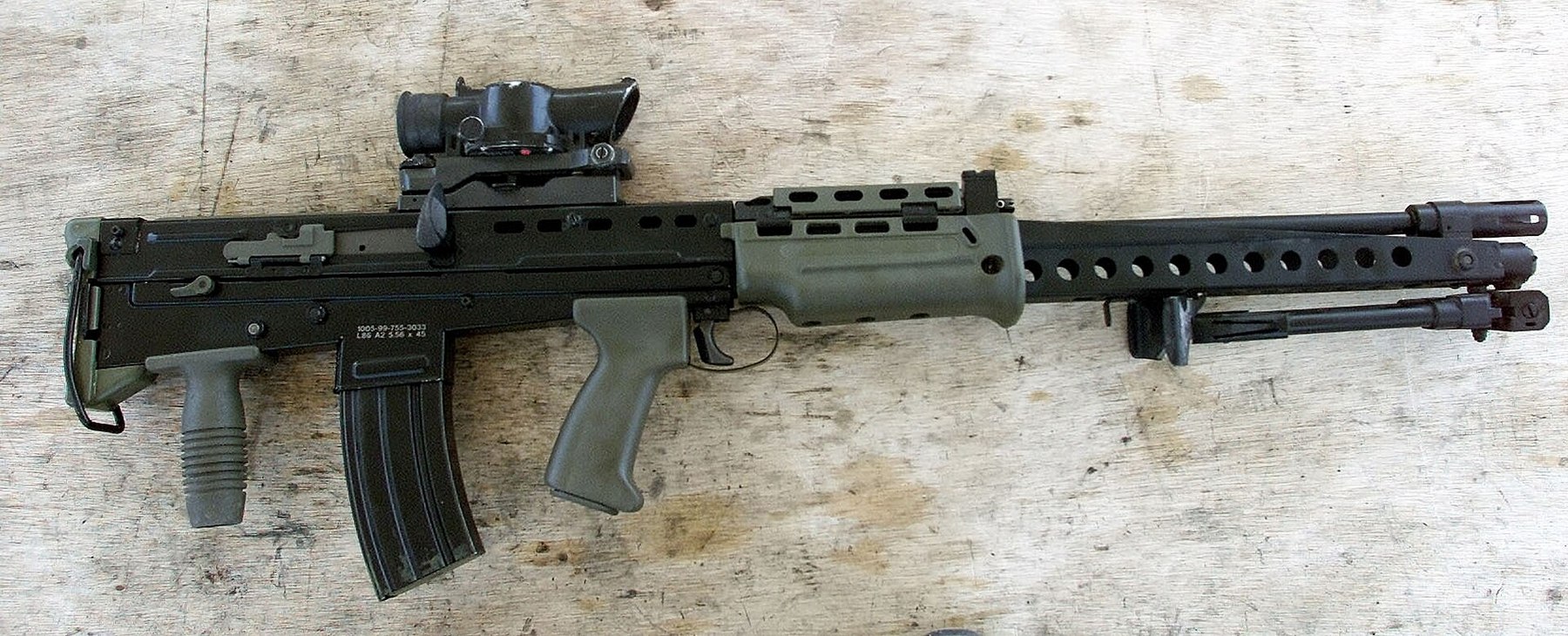
“The only obvious external change was the composite plastic and metal comma-shaped cocking handle/case deflector … Inside, the story was very different; almost every major component was replaced. Nonetheless, no features were extensively redesigned. The changes made were subtle and involved improved materials, precise manufacturing methods, and superior quality control.”1 Ferguson’s list, grouped here by assembly:
Table 1 — "The only obvious external change was the composite plastic and metal comma-shaped cocking handle/case deflector ... Inside, the story was very different; almost every major component was replaced. Nonetheless, no features were extensively redesigned. The changes made were subtle and involved improved materials, precise manufacturing methods, and superior quality control."[^ares5] Ferguson's list, grouped here by assembly
| Assembly | Change (ARES Part 5) |
|---|---|
| Cocking handle | Enlarged and reprofiled to serve as a case deflector |
| Bolt | Remanufactured, polished and relieved to reduce friction |
| Extractor | Claw enlarged; extractor pin remanufactured |
| Ejector | Remanufactured to include a spring guide; retaining pin remanufactured from solid stock |
| Cam stud | Remanufactured to slightly greater length |
| Hold-open device | Carrier and button extended for more positive engagement |
| Bolt carrier | Remanufactured and polished |
| Firing pin | Remanufactured and reprofiled to prevent tip breakage |
| Gas cylinder | Remanufactured |
| Gas plug | Remanufactured and reinforced to prevent damage |
| Trigger mechanism housing | Hammer stop reinforced; hammer weight increased |
| Barrel | Remanufactured in higher-grade steel |
| Barrel extension | (Part of the body, not the barrel) relieved, “1.5 locking splines cut away” to ease extraction |
| Ejection opening | Slightly enlarged |
| Springs | Piston, recoil, ejector, extractor, extractor insert, hammer and safety-sear springs all remanufactured |
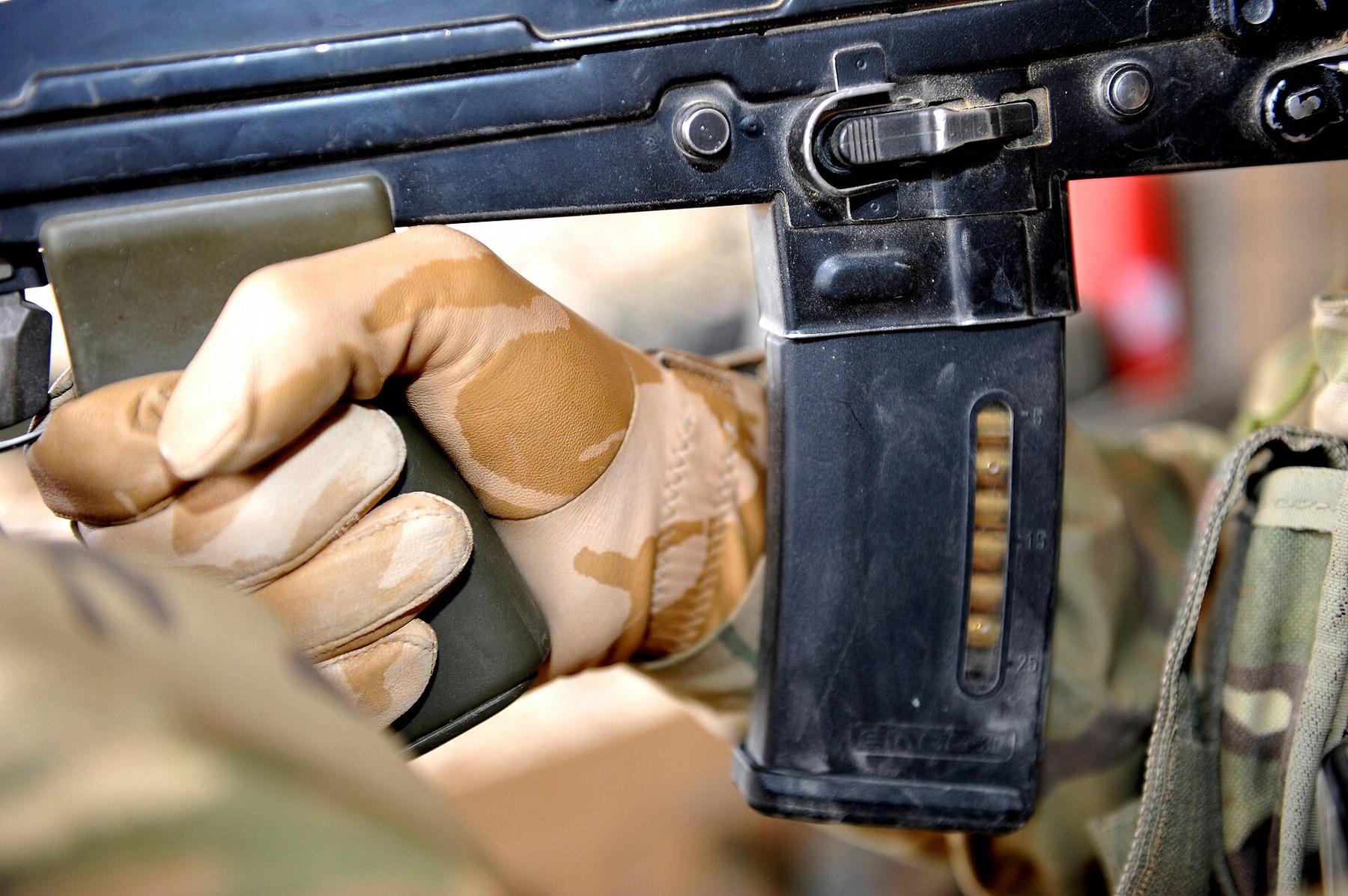
| Magazine | New steel magazine “based upon H&K G41 design” |
| Handguard | Redesigned “with larger vents, and a new upper with large plastic hinges in lieu of the plastic-covered sheet metal upper”; introduced as a spare part only, A1 handguards being kept “with their old markings machined away” |
| Markings | ”HK A2” on all upgraded components, “most obviously on the rear upper of the body” |
A peer put a near-identical list to the government in July 2002 — “a new breech block, breech bolt, cartridge extractor, cartridge ejector, recoil springs, extractor spring, firing pin, cocking handle, magazine, gas plug and cylinder, and the light support weapon has been given a new barrel and hammer” — so the substance of the list was public while the rifles were still being converted.4
The body is the exception that proves the rule. It “is marked ‘HK A2’ but, unlike other parts marked in this way, is otherwise unmodified (and is in fact a re-used component taken from A1 series weapons)”. Ferguson suggests the marking really applies to the relieved barrel extension, which is welded into the body.1 The receiver that Enfield and Nottingham pressed and welded in the 1980s is therefore still the receiver of every A2.
3.4 What was not changed
Ferguson is equally specific about what H&K left alone: “despite complaints about the number of vents in the receiver and handguard and the large, open ejection port, these supposed ‘problem’ features were not addressed in the A2. The number and size of vents remained the same, and the ejection opening was actually slightly enlarged.”1
That sentence sits uneasily with the same article’s list, which says the handguard was “redesigned with larger vents”. The two statements can be reconciled if “vents” in the later sentence means the body’s, or the A1 handguards kept in service, but the article does not say so. Both are given here as written; the difference matters to anyone identifying a handguard (Volume 4).
The layout, the gas system, the bolt and its locking, the trigger mechanism and the right-hand-only ejection all survived. So did the left-hand problem: an A2 still cannot be fired from the left shoulder.
3.5 The Kuwait trials, 2001
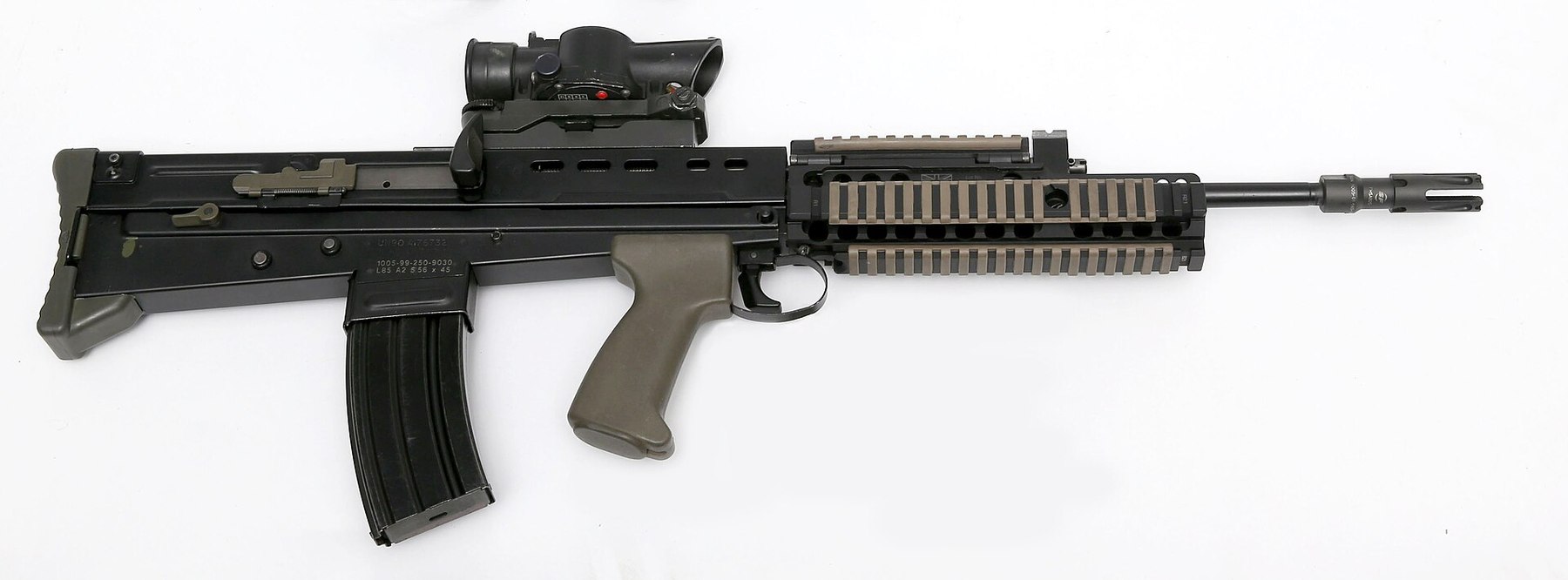
Before general issue the rebuilt rifles were tested in heat and sand. Lord Bach told the Lords in July 2002 that “extensive trials were undertaken … those trials demonstrated that the SA80-A2 was a very reliable weapon system. The testing included trials in Kuwait in very high temperatures with strong winds and blowing sand.”4 MOD photographs dated May 2001 show the modified rifle and LSW on that trial; the LSW is fitted with the new magazine.
3.6 Afghanistan, 2002
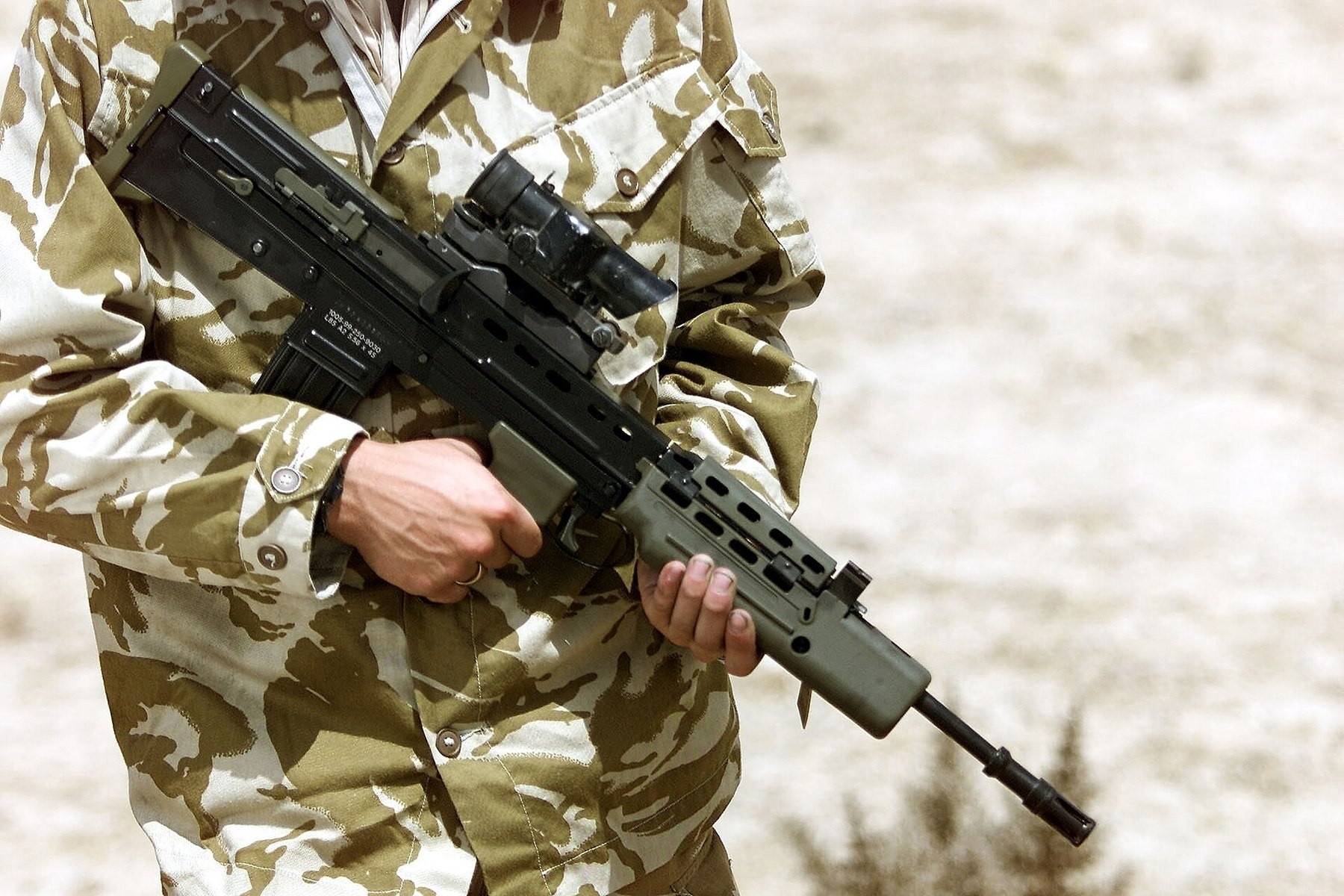
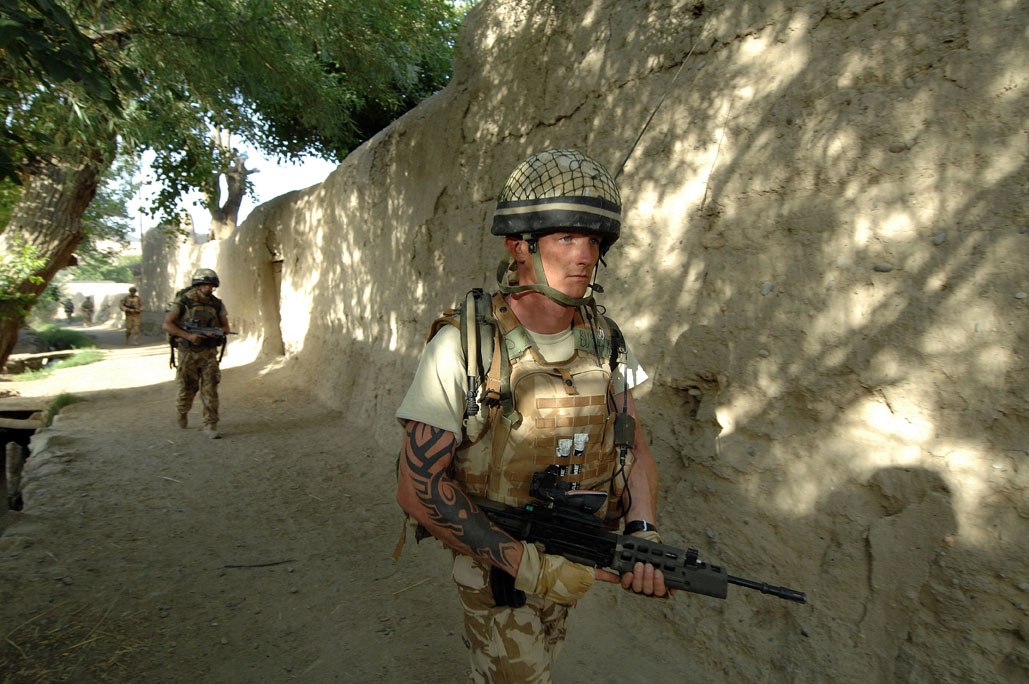
The A2 went to Afghanistan with the International Security Assistance Force and then with the Royal Marines. In January 2002 Lord Bach called it “among the best assault rifles in the world”.5 By July the government was answering questions about failures.
- 10 July 2002, Lords. Bach: “the SA80-A2 is operating in a very difficult environment in Afghanistan with both dusty conditions and extremes of temperatures. We have had reports from Afghanistan of equipment failure.”4
- 15 July 2002, Commons. Bernard Jenkin asked whether “the exercise in Afghanistan involving a platoon of 30, firing 90 rounds each, resulted in 20 out of the 30 rifles jamming”. Hoon did not confirm the figure; he said there had been “a significant improvement” from the upgrade, but that on a visit he had found “concerns among the Royal Marines … about the reliability of the rifle”, and that a team “from the manufacturers and from the Ministry of Defence was there, specifically to put the rifle through still more exacting tests”.6
- 17 July 2002, Commons. Adam Ingram: “the SA80 A2 is a more capable and much more reliable weapon than its predecessor. The question is whether it is good enough.” Moonie: “The modifications were tested in Kuwait, which has very similar—if not identical—conditions of heat and dust as those in Afghanistan. The rifle performed admirably under those conditions, which is why we have such difficulty in coming to terms with the fact that it failed to work in Afghanistan.”7
The “20 out of 30” figure is the questioner’s and was never confirmed. What resolved the episode is not in the parliamentary record. Ferguson’s assessment, written fifteen years later: “it appears to have been down to a cleaning issue that has, one way or another, been addressed and has not since reappeared.”1
3.7 What it cost
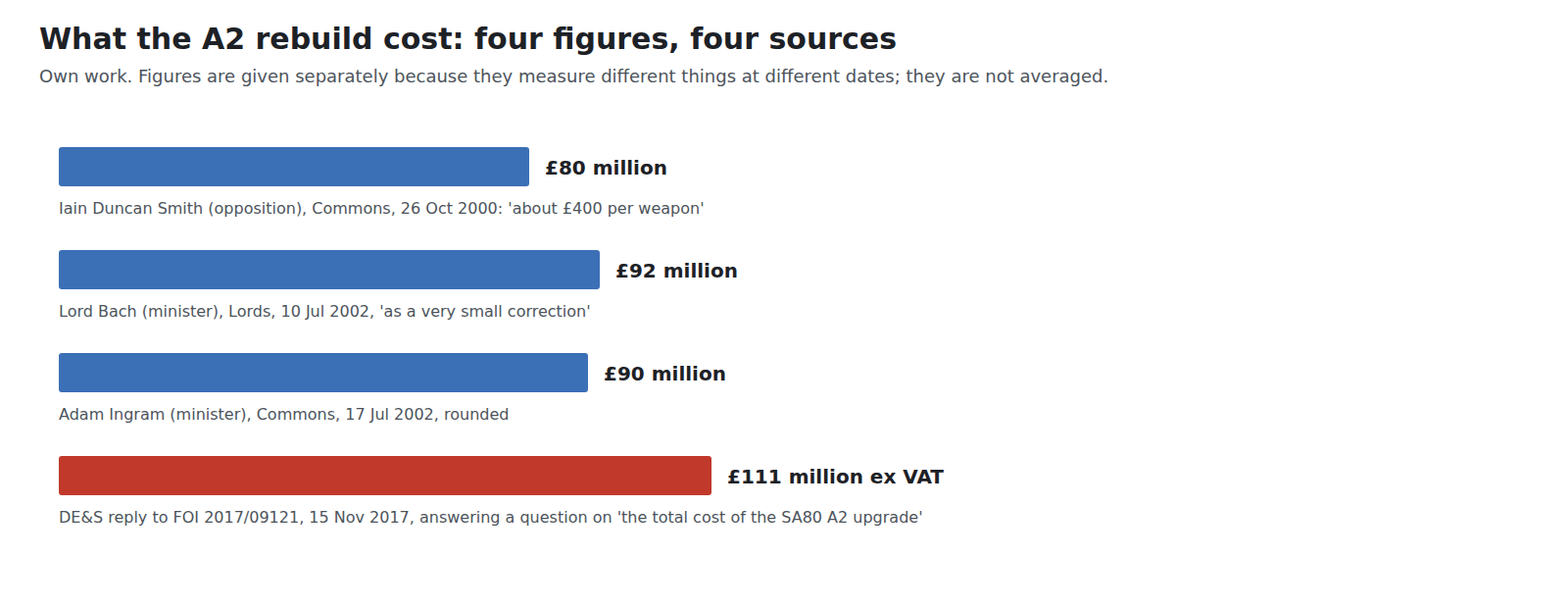
Four official or parliamentary figures exist, from different speakers and dates. They measure different things and are not averaged.
Table 2 — What it cost
| Figure | Who and when | What it is |
|---|---|---|
| £80 million, “about £400 per weapon” | Iain Duncan Smith, opposition, Commons, 26 Oct 20002 | Opposition estimate before the work began |
| £92 million | Lord Bach, minister, Lords, 10 Jul 2002, “as a very small correction”4 | Ministerial figure mid-programme |
| £90 million | Adam Ingram, minister, Commons, 17 Jul 20027 | The same, rounded |
| £111 million ex VAT | DE&S reply to FOI 2017/09121, 15 Nov 20178 | ”The total cost of the SA80 A2 upgrade” by H&K |
Bach set the rebuild against the alternative: “The cost of replacing the SA80 would be in the region of £500 million. That would be the cost of buying a new system, including spares, additional infrastructure, rifle racks, blank firing adapters, and so on. We have no intention of doing that.”4 The £400-per-weapon estimate implies about 200,000 weapons; that is arithmetic on an opposition figure, not an official count.
A separate MoD reply of August 2017 priced a single SA80 A2 at “Basic fit – approximately £1,000” and “Equipped to fight (does not include night sight) – approximately £4,000”, excluding VAT, at the most recent purchase.9
3.8 The reliability figure nobody can source
Popular accounts give the A2’s reliability as a mean of about 25,200 rounds between stoppages for the rifle and about 13,000 for the LSW. The figure appears on forums, in encyclopaedias and in hobby sites, sometimes in text that reads like an official brief. No MoD document, written answer or Hansard statement containing it was found. The closest official statement is Ingram’s in July 2002 that “the mean time in relation to failure of that rifle … unquestionably showed a big improvement”, with no number.7 The figure is therefore given here only to say it is unsourced. The sourced figures are the XL70’s 95 rounds between stoppages and the 2,500-round failure target (Volume 2).
3.9 The A2 at war, 2003 to 2014
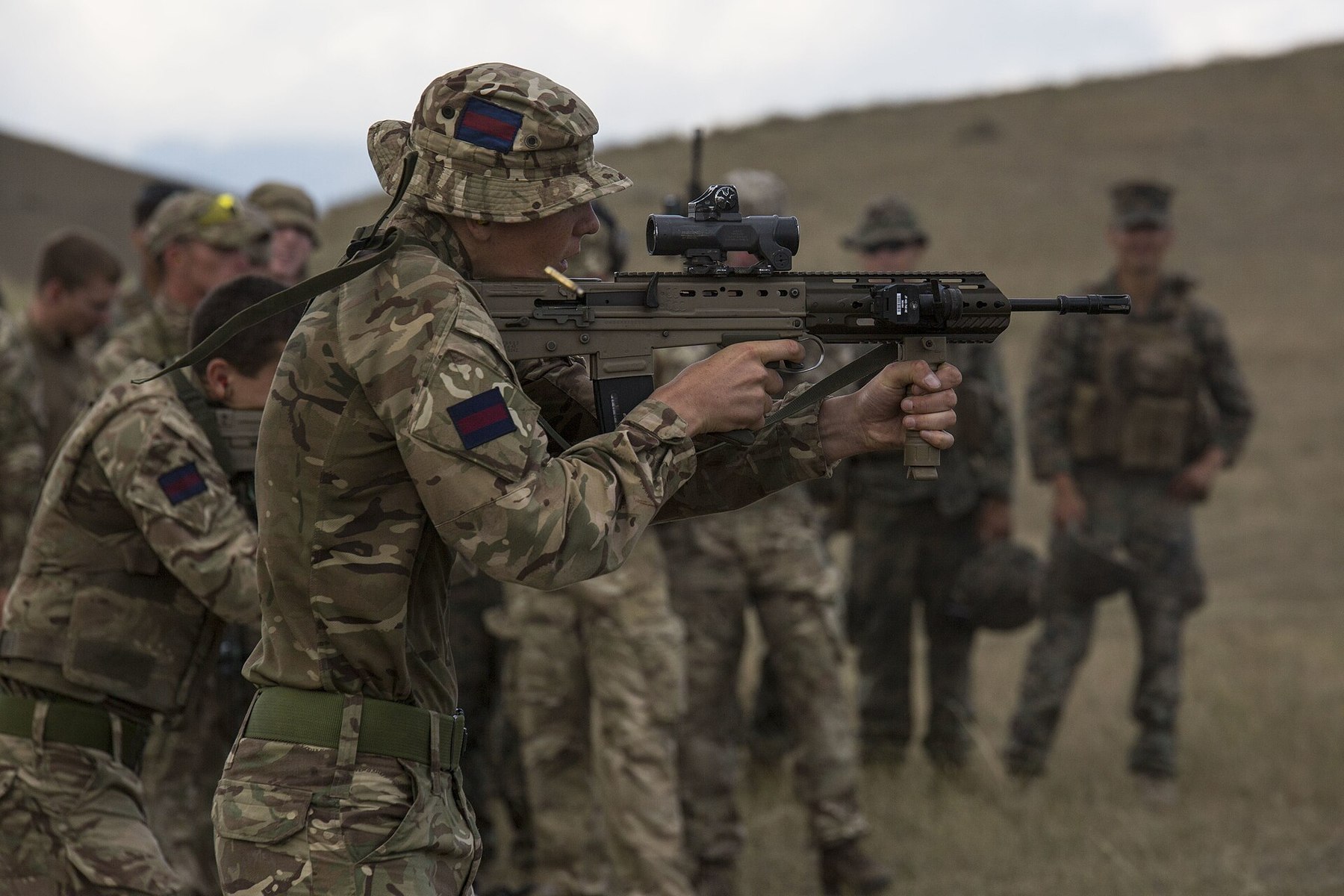
From 2003 to 2014 the A2 served in Iraq and Afghanistan, and its configuration changed through Urgent Operational Requirements (UORs) and the Future Integrated Soldier Technology programme without a change of designation. Ferguson lists the main additions: the 4× ACOG and the Elcan Specter OS4x “Lightweight Day Sight” (LDS) with their Picatinny adaptors; laser light modules Marks 2 and 3; the Daniel Defense railed fore-end with a Grip Pod vertical grip and bipod; Magpul E-Mag polymer magazines; and a SureFire flash suppressor, since withdrawn because it “appears to be incompatible with the issue Blank Firing Adaptor”.1 The sights and accessories are Volume 8. The 2008 configuration, he notes, is “representative of a front-line weapon c.2008”, and rifles in that state migrated to reserve armouries later.
His summary of the A2’s service: “after 15 years of combat use in Iraq and Afghanistan, the L85A2 rifle is still going strong. Complaints are few … the only real complaint to be made is that the weapon remains excessively heavy.”1
3.10 The L22 carbine
Carbine SA80s were tried long before one was issued. Ferguson records three: a 1984 conversion of an XL64E5 with a 242 mm (9.5 in) barrel; a 1989 Royal Ordnance run marked “CA 00X” with a 310 mm (12.2 in) barrel including flash suppressor and the LSW’s rear grip used as a foregrip, advertised but, by an unconfirmed account in Raw, sold to a Middle Eastern customer and destroyed in a warehouse fire; and a Nottingham version with a 390 mm (15.4 in) barrel and the LSW handguard.10
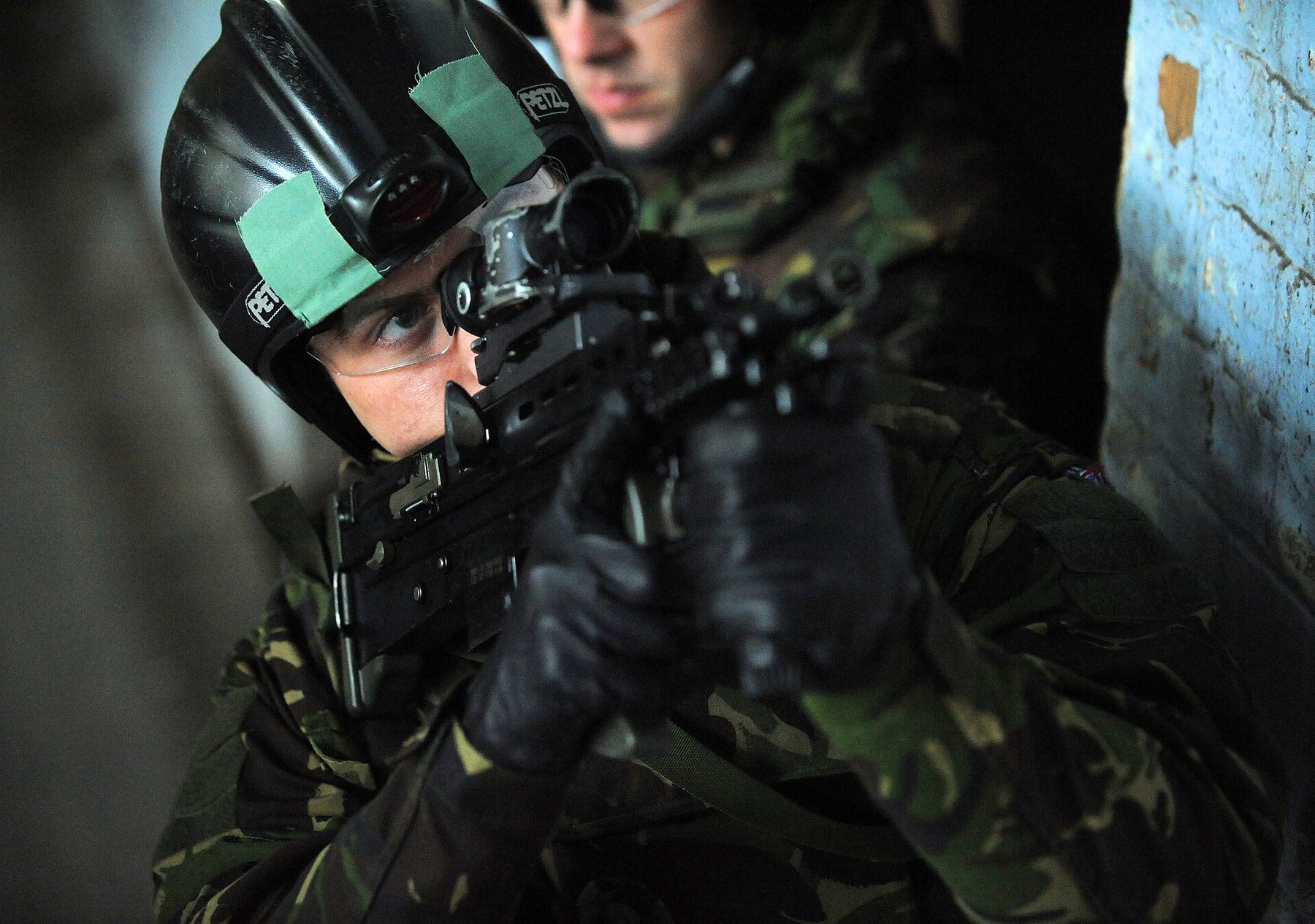
The issued carbine came from H&K in 2003 and entered service in early 2004.110 Its changes, per Ferguson:10
- a gas plug with a narrower bore “to compensate for the increased gas pressure of the shorter gas system”, lengthened to give “approximately 2.5 mm extra travel”, with twin lugs for removal from the front of the gas block; the “excessive” and “off” positions were deleted and the operating rod shortened;
- “a vented aluminium heat-shield/rail accessory system, with Picatinny rails at the 6 o’clock and 3 o’clock positions”, and an H&K vertical foregrip as standard;
- no iron sights;
- a 20-round magazine available.
The carbines “are assembled from surplus L85A1 parts plus newly manufactured H&K components”; they are not converted LSWs. The designation is muddled — “L22A1” and “L22A2” both appear in print — but “all of the actual weapons are marked ‘L22 A2 5.56 x 45’”. The nickname is “SA80K” or “Stubby K”. Muzzle velocity falls from about 930 m/s to about 780 m/s, and the effective range for rapid fire is given as 200 m. It was issued to armoured-vehicle crews of the Royal Armoured Corps, Apache crews of the Army Air Corps (who carried it in a seat holster) and naval boarding parties.10 The L22A2 is 571 mm long overall, with a barrel of 327 mm including suppressor (285 mm without), and weighs 3.52 kg with SUSAT.10
3.11 The L98A2 cadet rifle
The cadet forces had their own SA80 from the late 1980s: the L98A1, a manually operated rifle with the gas parts removed and a large external cocking lever (Volume 4). With the A2 programme it was replaced. Ferguson: “a new Cadet rifle was produced from A2 upgraded parts with a new semi-automatic only trigger mechanism (the change lever is still omitted) … From 2009, the L98A1 was phased out of use in favour of the L98A2”, which is “distinguishable from the L85A2 only by its lack of change lever (selector switch) and the markings”.11 The L98A2 is the one member of the family built as a semi-automatic-only rifle, and it bears on Volume 9.
3.12 Exports
“The A1 family saw few export sales, and most of these comprised part of overseas military assistance packages. Only Bolivia and Jamaica appear to have made direct purchases. Despite the success of SA80 A2 series, there have been no further export sales.” Ferguson gives the reasons: a tarnished reputation, better-established bullpups, H&K’s preference for selling its own designs such as the HK416, and the clincher — “no full production line exists to manufacture complete weapons for sale even if there were a market”.1 No official list of recipient countries was found; a user map circulating on Commons is derived from wiki sources and is not used here.
3.13 The A3: the Mid Life Improvement
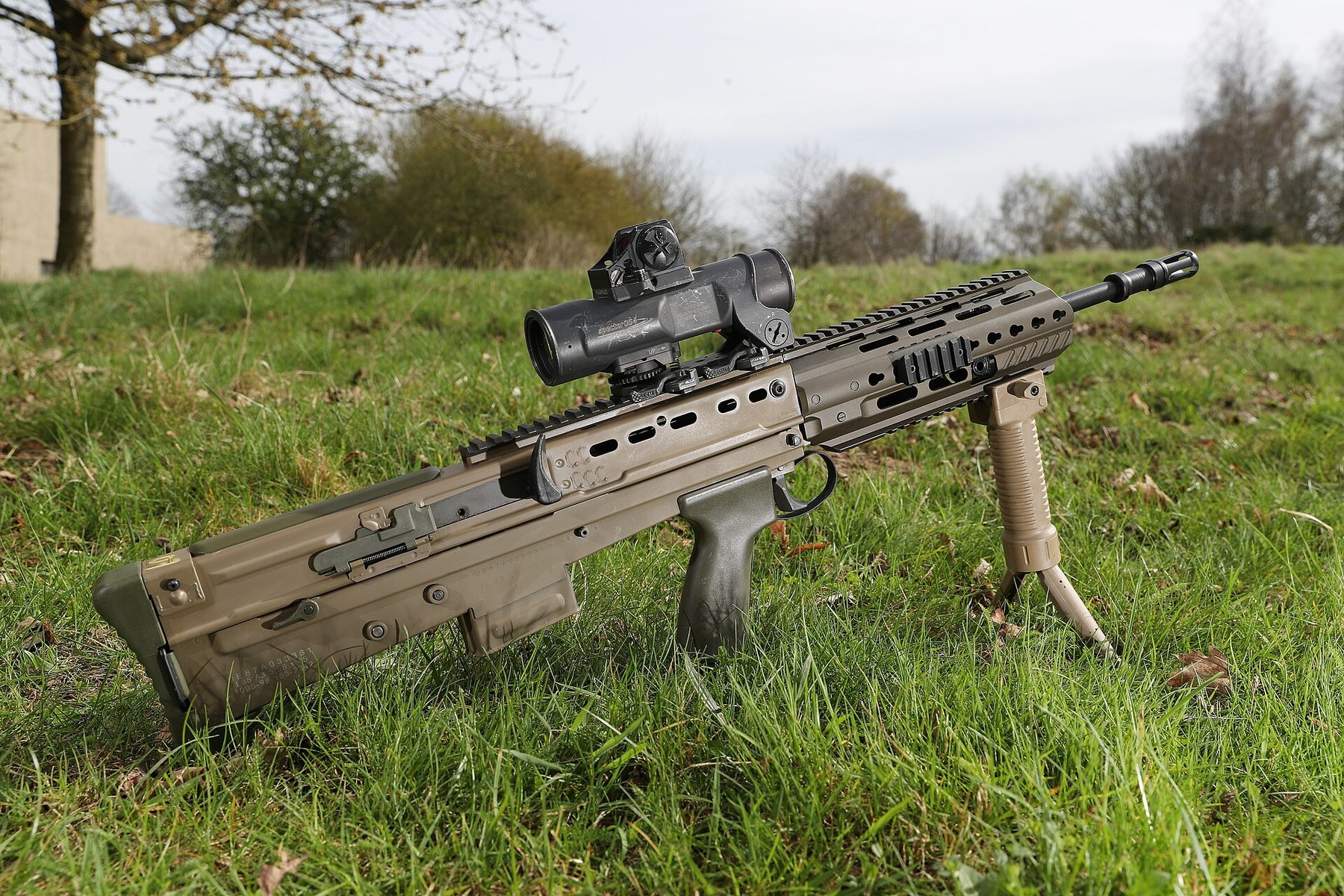
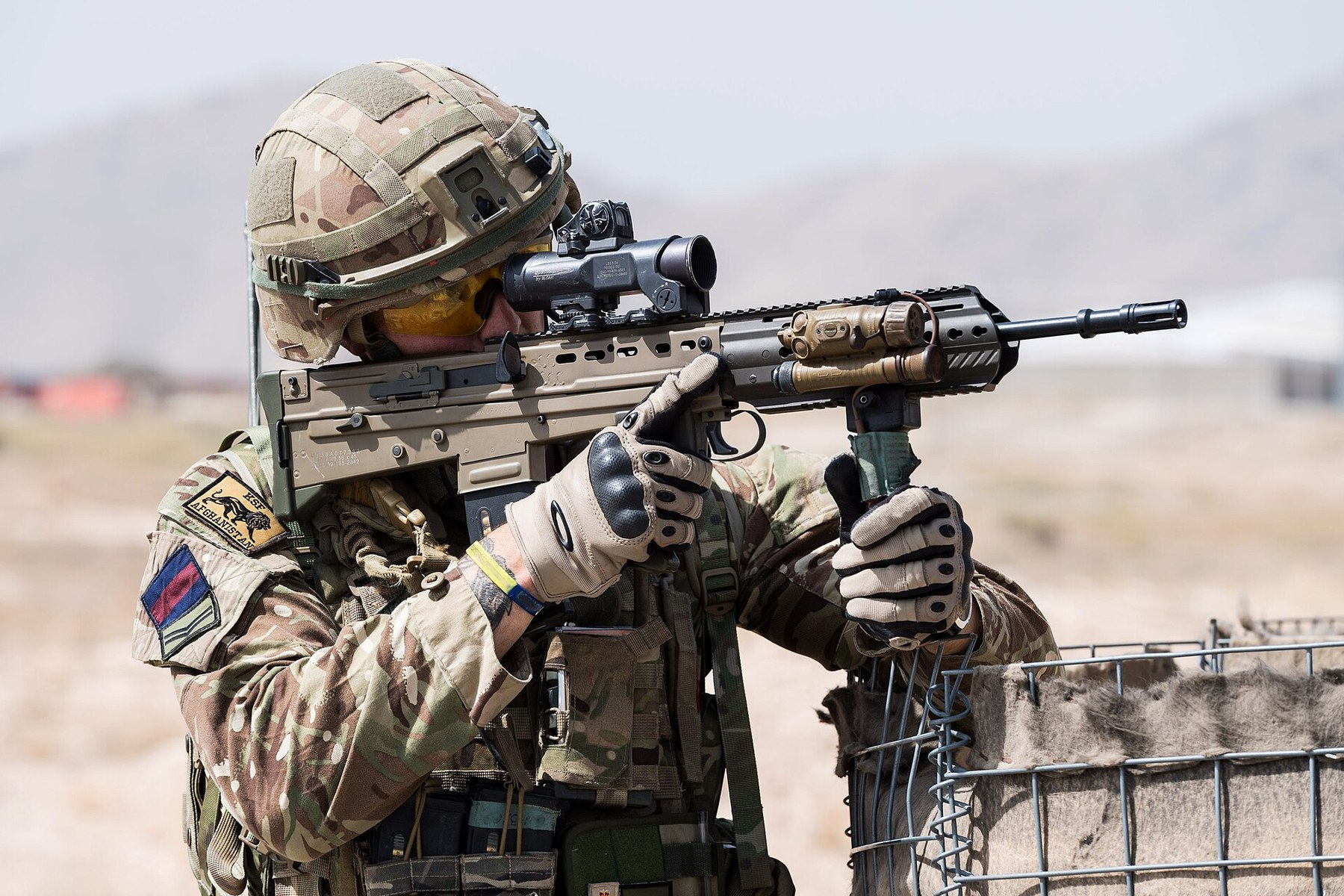
The next standard was prefigured by the “SA80 Equipped to Fight Improvement Programme” (SA80 EFI), shown in prototype by about 2016: “a new H&K-designed negative-space accessory fore-end with continuous Picatinny/NATO rail extension, a cut-away gas block (to accommodate the new rail system), and a modified change lever (selector switch) to prevent over-rotation”, in desert colour with the LDS sight and a new body marked “HK A3”. A tender for “an initial 5,000 units to this specification” called it “SA80 A3”.1 Ferguson notes that A3-marked bodies were already being fitted to rifles that stayed L85A2 by designation.
The government announced the programme on 11 April 2018. The MoD and DE&S release called it the Mid Life Improvement (MLI), to keep the rifle “in service until 2025 and beyond”, with an “initial investment” of £5.4 million, work by Heckler & Koch sustaining “around 20 highly skilled jobs at the Nottingham Small Arms Factory”, and 5,000 weapons in the first tranche, whose fielding “began in February”. The release named four changes: a more durable coating in Flat Dark Earth; a rifle 100 g lighter than the A2; a “more streamlined fore grip”; and a bracket for new low-light sights that clip on or in front of the day sight.12 It does not mention the rail or the gas block, which come from Ferguson and from photographs.
The figures for the first tranche differ by source. The 2018 release says £5.4 million; a DE&S freedom-of-information reply of November 2017 said “the expected cost of the initial 5,000 weapons is £4.4m (ex VAT)”.128 The difference may be VAT or scope; neither document explains it. Written answers record 364 A3s delivered by 3 January 2018, held by the Small Arms School Corps and the Infantry Trials and Development Unit; 5,000 A2s “currently” being upgraded in July 2018; and that “The SA80 A3 was first produced in 2017”.131415 Trade press reported a later contract with NSAF Ltd, H&K’s British subsidiary at Nottingham, for a larger tranche; the primary contract notice was not read and no figure from it is printed here.
3.14 How many: the fleet in official answers
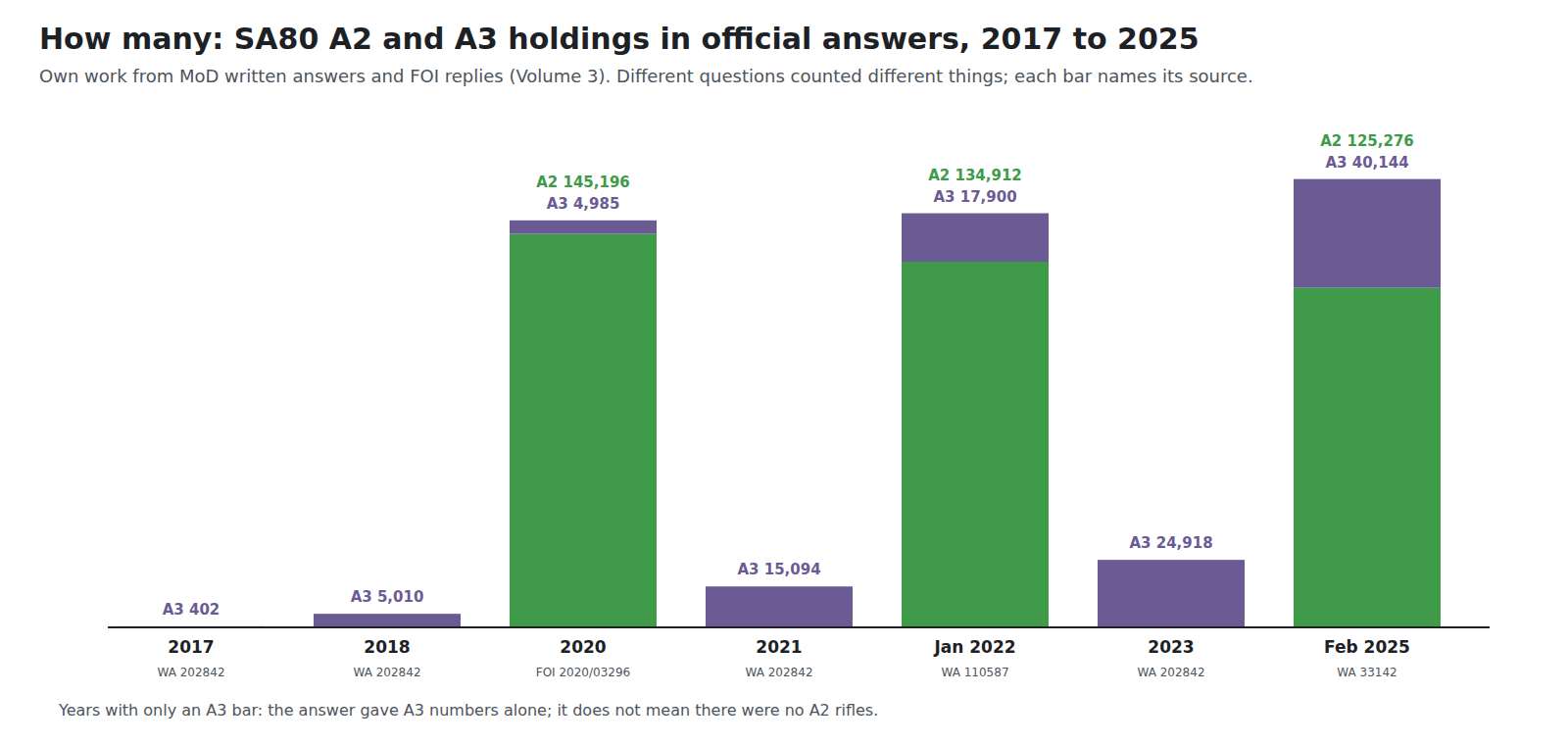
No total of SA80s ever made was found (Volume 2). Holdings are better documented, but each answer counted something slightly different.
Table 3 — How many: the fleet in official answers
| Date | A2 | A3 | Source |
|---|---|---|---|
| 3 Jan 2018 | — | 364 delivered | WA 12072813 |
| 5 May 2020 | 145,196 “in service” | 5,000 “purchased in 2018/2019” | FOI 2020/0329616 |
| 28 Jan 2022 | 134,912 | 17,900 | WA 11058717 |
| 2017–2023, by year | — | 402; 5,010; 5,010; 4,985; 15,094; 17,908; 24,918 | WA 202842 (Current Assets Register)15 |
| 25 Feb 2025 | 125,276 | 40,144 | WA 3314218 |
The 2020 reply added that “Over 10,000 further SA80 A2 are due to be upgraded under the new contract”.16 Between 2022 and 2025 the A3 holding rose by about 22,000 while the A2 holding fell by about 9,600; the answers do not explain the difference, which may include disposals, conversions from stock and changes in what was counted.
3.15 Project GRAYBURN and the end of the SA80
The replacement programme is called Project GRAYBURN. Its history in written answers shows a date slipping:
- 6 December 2023. The out-of-service date is 2030; GRAYBURN is “working towards submission of the Strategic Outline Business Case”; “A new common basic weapon with up to four variants is expected to be delivered from Financial Year 2026-27.”19
- 16 January 2025. “The L85 rifle (‘SA80’) will be replaced over the coming decade through Project GRAYBURN. The project has entered the concept phase.”20
- 28 April 2025. “The British Army’s projected Out of Service Date for the L85A3 (SA80A3) variant of the L85 rifle family is currently 2030.”21
- 27 November 2025. An assessment phase in 2026; “The project aims to replace the SA80 family of rifles through the 2030s”; “intermediate calibres including the 6.8 x 51mm are part of this work.”22
- 2026. Answers through September 2026 describe the project as still in its concept phase with no fixed schedule, refer to UK–US cooperation “in support of the British Army’s Project GRAYBURN, which will replace the L85 rifle”, and say that “a disposal plan is under consideration” for the L85.23
The December 2023 expectation of delivery from 2026–27 and the 2026 position of a project still in concept are both official; they are given with their dates.
Some units have already left the SA80. A written answer of March 2025 records that “An order of 1,620 L403A1 rifles was made by Defence Equipment and Support, all of which were received by 10 March 2025”; the Royal Marines also hold the Sig Sauer MCX as the L143A2.2425 Trade reporting identifies the L403A1 as Knight’s Armament’s KS-1; no MoD page naming the maker was found, and one written answer pairs “KS-1” with the L143A2 instead, so the attribution is left to the trade press.
What happens to the rifles afterwards matters to Volume 9. The MoD’s stated policy, quoted to a cadet-rifle researcher in 2015, is that “all weapons are disposed of by being destroyed”.26
3.16 Corrections this volume makes
- The A2 body is a reused A1 body, marked “HK A2” but otherwise unmodified (Ferguson). The receiver was not remade; most of what it carries was.
- The A2 programme’s final cost was £111 million excluding VAT (DE&S, 2017), not the £80 million, £90 million or £92 million quoted in 2000–02; those are earlier or partial figures and are given separately.
- The “25,200 rounds between stoppages” A2 figure has no official source that could be found.
- The snow-clearing trigger is not an A2 feature; it was an A1 modification.
- ARES contradicts itself on the A2 handguard’s vents: “larger vents” in its list, “the number and size of vents remained the same” in its text.
- The L22 carbine was built from surplus L85A1 parts plus new H&K parts, not from LSWs, and every example is marked “L22 A2” whatever the literature calls it.
- GRAYBURN’s dates have slipped in the official record: delivery “from Financial Year 2026-27” (December 2023) against a project still in concept in 2026.
References
Footnotes
-
Jonathan Ferguson, “British Enfield SA80 Part 5: SA80 A1 vs A2”, The Hoplite (Armament Research Services), 20 May 2017. Wayback capture of 28 May 2017, http://web.archive.org/web/20170528111515/http://armamentresearch.com:80/british-enfield-sa80-part-5-sa80-a1vsa2/, consulted 2026-10-18. Ferguson cites Steve Raw, The Last Enfield (Collector Grade, 2003), and an article by Anthony Williams. ↩ ↩2 ↩3 ↩4 ↩5 ↩6 ↩7 ↩8 ↩9 ↩10 ↩11
-
House of Commons, “Defence Procurement”, 26 October 2000: Iain Duncan Smith, Lewis Moonie. https://hansard.parliament.uk/Commons/2000-10-26/debates/90a600bb-c8c1-494c-a100-04e5a15e6620/, consulted 2026-10-18. ↩ ↩2
-
House of Commons, 12 February 2001, Lewis Moonie. https://hansard.parliament.uk/Commons/2001-02-12/debates/7cc26dc8-d932-4700-a564-92dd98838e1f/, consulted 2026-10-18. ↩
-
House of Lords, oral question “SA80-A2 Rifle”, 10 July 2002: Lord Redesdale, Lord Bach. https://hansard.parliament.uk/Lords/2002-07-10/debates/055379da-b1c5-4186-8d5a-be17cce63893/, consulted 2026-10-18. ↩ ↩2 ↩3 ↩4 ↩5
-
House of Lords, “Army”, 16 January 2002, Lord Bach. https://hansard.parliament.uk/Lords/2002-01-16/debates/75d50ca8-9e81-49e9-9a9c-3a3861efecec/, consulted 2026-10-18. ↩
-
House of Commons, 15 July 2002: Bernard Jenkin, Geoff Hoon. https://hansard.parliament.uk/Commons/2002-07-15/debates/fdf86ff2-1ace-46d3-9d4b-d37b4c3efae6/, consulted 2026-10-18. ↩
-
House of Commons, “Defence Procurement”, 17 July 2002: Adam Ingram, Lewis Moonie. https://hansard.parliament.uk/Commons/2002-07-17/debates/9acf43c4-951c-452e-809d-cb25c8efd205/ and https://hansard.parliament.uk/Commons/2002-07-17/debates/b5061c70-432b-4f03-b857-9b6c6b1524d3/, consulted 2026-10-18. ↩ ↩2 ↩3
-
Defence Equipment and Support, reply to FOI 2017/09121, 15 November 2017 (SA80 A2 upgrade cost; A3 initial tranche). Open Government Licence. Copy in this dive’s
02-inputs/sources/. ↩ ↩2 -
Ministry of Defence, reply to FOI 2017/07603, 17 August 2017 (SA80 A2 unit cost). Open Government Licence. Copy in this dive’s
02-inputs/sources/. ↩ -
Jonathan Ferguson, “British Enfield SA80 Part 6: Carbines”, The Hoplite, 24 May 2017. Wayback capture of 18 January 2026, http://web.archive.org/web/20260118060548/http://armamentresearch.com/british-enfield-sa80-part-6-carbines/, consulted 2026-10-18. ↩ ↩2 ↩3 ↩4 ↩5
-
Jonathan Ferguson, “British Enfield SA80 Part 7: L98A1 Cadet GP Rifle”, The Hoplite, 27 May 2017. Wayback capture of 6 June 2017, https://web.archive.org/web/20170606131613/http://armamentresearch.com/british-enfield-sa80-part-7-l98a1/, consulted 2026-10-18. ↩
-
Ministry of Defence and Defence Equipment and Support, “British Army’s rifle set for multi-million-pound upgrade”, press release, 11 April 2018. https://www.gov.uk/government/news/british-armys-rifle-set-for-multi-million-pound-upgrade, consulted 2026-10-18. ↩ ↩2
-
UK Parliament, written answer 120728, answered 8 January 2018. questions-statements.parliament.uk, consulted 2026-10-18. ↩ ↩2
-
UK Parliament, written answer 160131, Guto Bebb, answered 10 July 2018. questions-statements.parliament.uk, consulted 2026-10-18. ↩
-
UK Parliament, written answer 202842, James Cartlidge, answered 24 October 2023 (A3 holdings on the Current Assets Register, 2017–2023). questions-statements.parliament.uk, consulted 2026-10-18. ↩ ↩2
-
Ministry of Defence, reply to FOI 2020/03296, 5 May 2020 (L85 fleet). Open Government Licence. Copy in this dive’s
02-inputs/sources/. ↩ ↩2 -
UK Parliament, written answer 110587, answered 28 January 2022. questions-statements.parliament.uk, consulted 2026-10-18. ↩
-
UK Parliament, written answer 33142, answered 4 March 2025. questions-statements.parliament.uk, consulted 2026-10-18. ↩
-
UK Parliament, written answer 4336, James Cartlidge, answered 6 December 2023. questions-statements.parliament.uk, consulted 2026-10-18. ↩
-
UK Parliament, written answer 23095, answered 16 January 2025. questions-statements.parliament.uk, consulted 2026-10-18. ↩
-
UK Parliament, written answer 45196, Maria Eagle, answered 28 April 2025. questions-statements.parliament.uk, consulted 2026-10-18. ↩
-
UK Parliament, written answer 93233, Luke Pollard, answered 27 November 2025. questions-statements.parliament.uk, consulted 2026-10-18. ↩
-
UK Parliament, written answers 112713 (26 February 2026), 125983 (20 April 2026), 18788 (20 July 2026), 23077 and 23451 (8 September 2026). questions-statements.parliament.uk, consulted 2026-10-18. ↩
-
UK Parliament, written answer 36868, answered 18 March 2025 (L403A1). questions-statements.parliament.uk, consulted 2026-10-18. ↩
-
UK Parliament, written answers 42787 (8 April 2025) and 42676 (7 April 2025) (Royal Marines rifles). questions-statements.parliament.uk, consulted 2026-10-18. ↩
-
Gaz Corfield, “Mystery of the L98A1 Cadet GP rifle’s fate”, UK Shooting News, 7 March 2016, quoting an MoD freedom-of-information reply of April 2015. https://ukshootingnews.wordpress.com/2016/03/07/mystery-of-the-l98a1-cadet-gp-rifles-fate/, consulted 2026-10-18. ↩
Comments (0)