SA80 (L85 Family) · Volume 4
The Family and How to Tell Them Apart
L85A1, A2 and A3 rifles, the L86 Light Support Weapon, the L22 carbine, the L98 cadet rifles and the drill rifle, with comparison plates, a tell-them-apart table and the markings
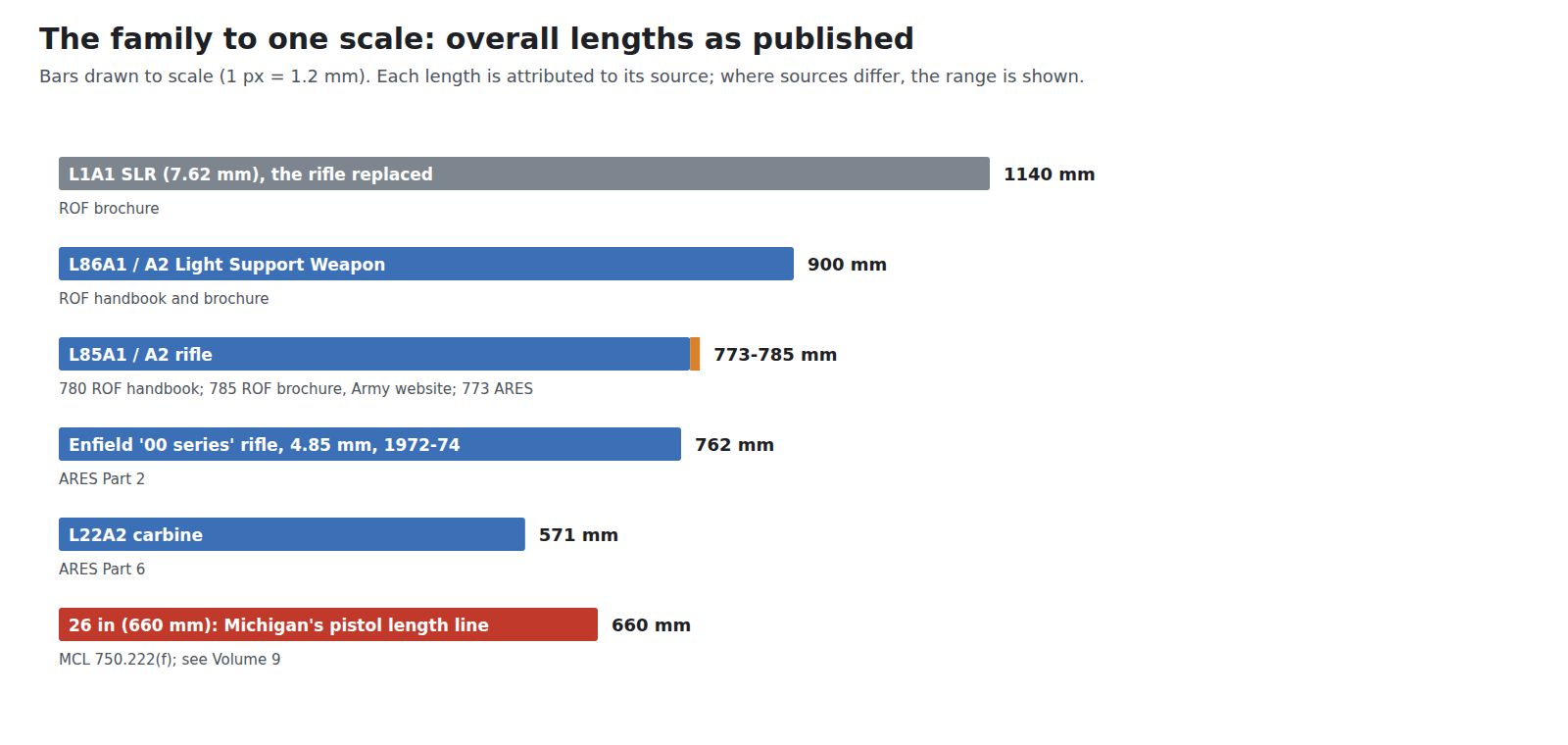
4.1 What this volume covers
Every SA80 looks like every other SA80 at a glance: a short, angular, black or tan bullpup with a magazine behind the pistol grip and an optic on top. The family is in fact eight or nine distinct weapons across three build standards, and their accessories were swapped so freely that the furniture on a rifle in a photograph says little about which rifle it is. This volume sets out what tells them apart, in order of reliability: the cocking handle, the markings, the fore-end, the colour, and only last the accessories.
The identification rules here were applied to every photograph in the dive. Several photographs on Wikimedia Commons labelled as one model show another, and the rejections are listed in photo_credits.txt.
4.2 The family in one table
Table 1 — The family in one table
| Weapon | Role | Built | Distinguishing in one line | Source |
|---|---|---|---|---|
| L85A1 | Rifle (Individual Weapon) | 1985–1994, Enfield then Nottingham | Small round cocking-handle knob | ARES 4, 5 |
| L86A1 | Light Support Weapon | 1985–1994 | Long barrel with outrigger and bipod; rear grip | ROF handbook |
| L85A2 | Rifle | Rebuilt from A1s by H&K, issued from 2002 | Comma-shaped cocking handle; “HK A2” on the body | ARES 5 |
| L86A2 | LSW | Rebuilt by H&K | As L86A1 with the A2 handle | ARES 5 |
| L22A2 | Carbine | From 2003–04, surplus A1 parts plus new H&K parts | Very short barrel; aluminium rail fore-end; no iron sights | ARES 6 |
| L98A1 | Cadet GP rifle | From the late 1980s | No gas parts; large external cocking lever; no flash suppressor | ARES 7 |
| L98A2 | Cadet GP rifle | From the A2 programme; replaced the L98A1 from 2009 | Semi-automatic only; no change lever | ARES 7 |
| L85A3 | Rifle | From 2017–18, Mid Life Improvement | Flat Dark Earth; H&K fore-end with continuous top rail; “L85 A3” marking | GOV.UK 2018, ARES 5 |
| Drill purpose | Inert drill rifle | — | No foresight; marked as drill purpose | Commons description |
4.3 The three rifles: A1, A2, A3
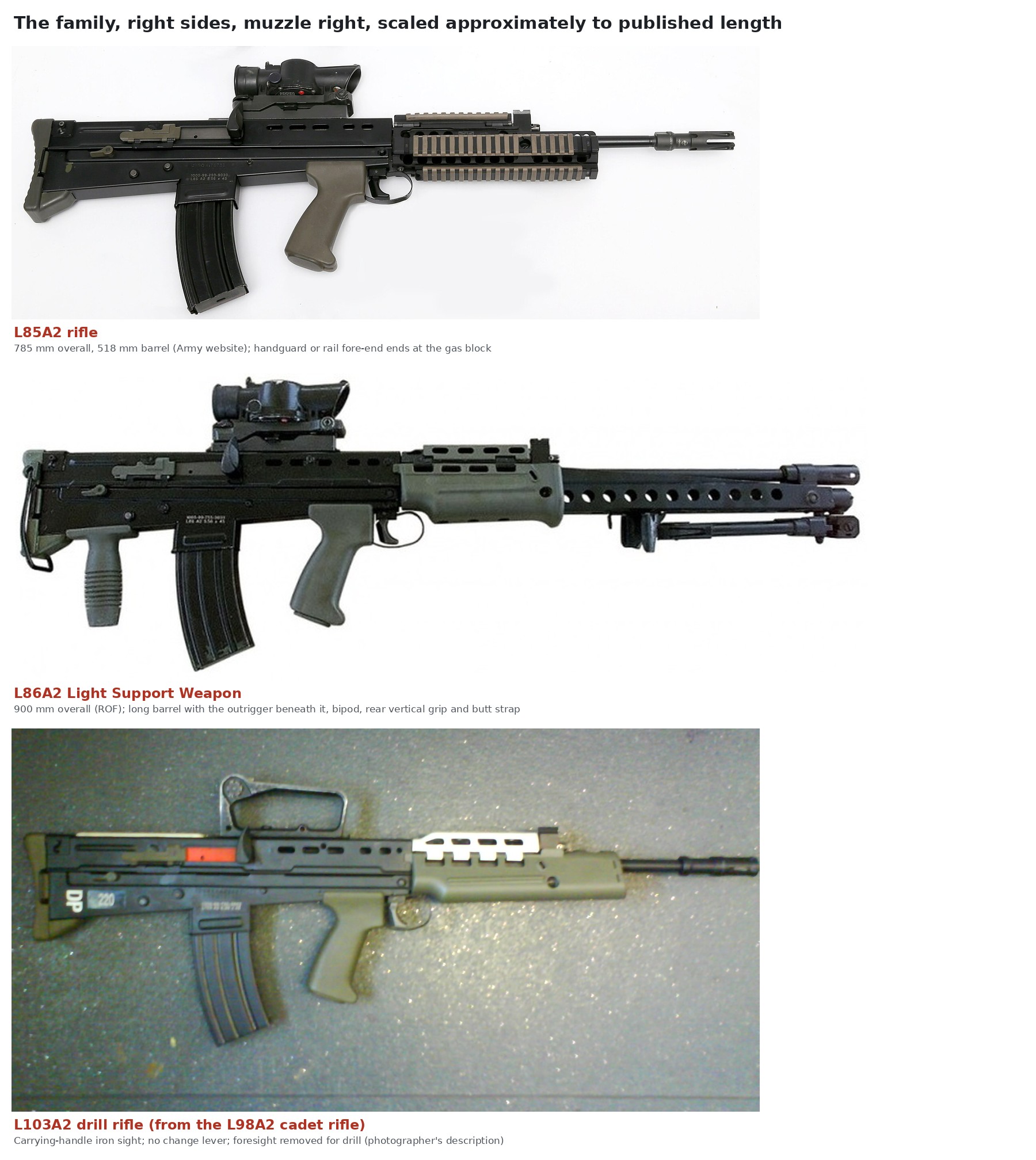
The three rifle standards share a body, a layout and almost every dimension. The plate below puts them side by side, right side, muzzle right, at approximately matched length.
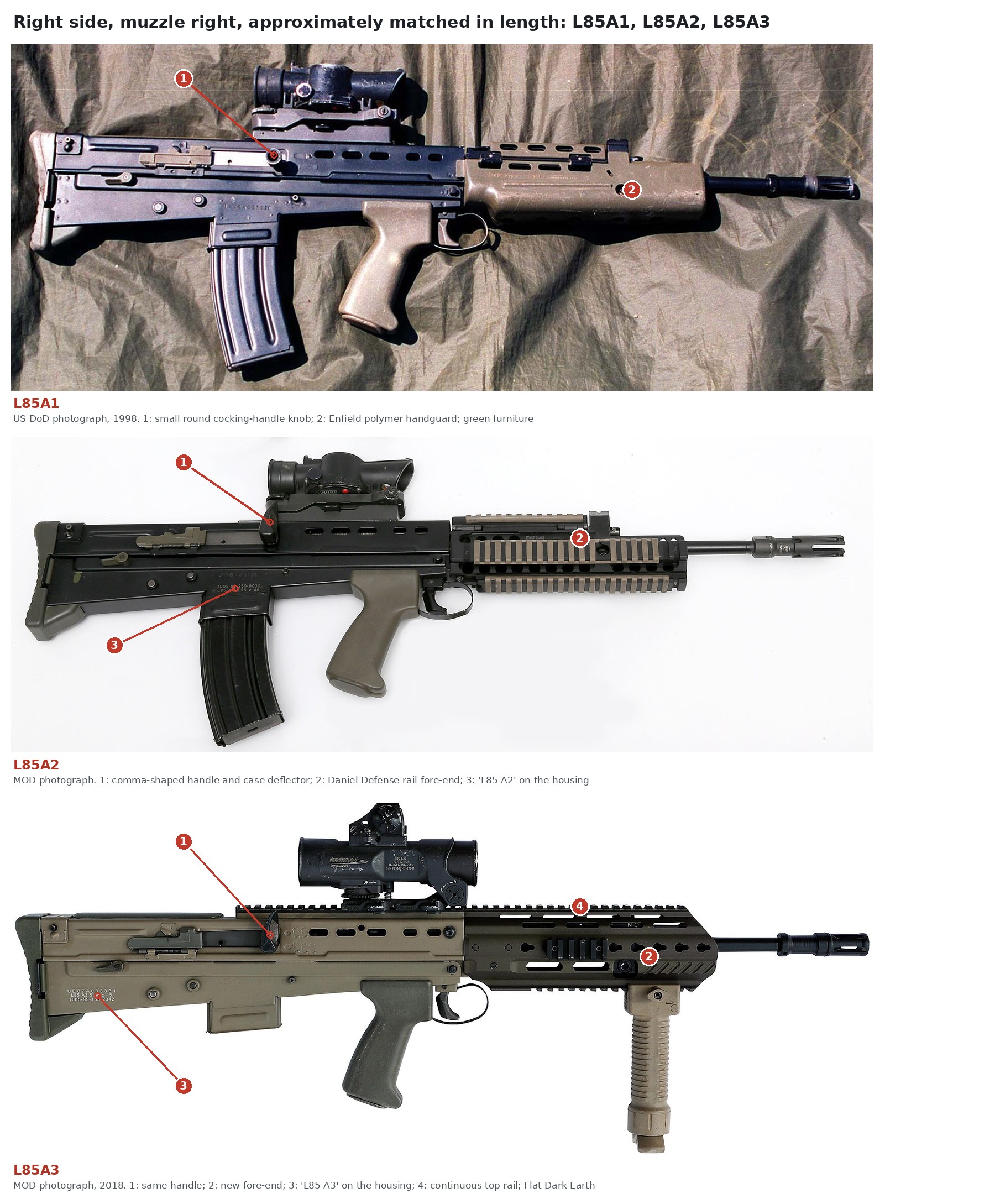
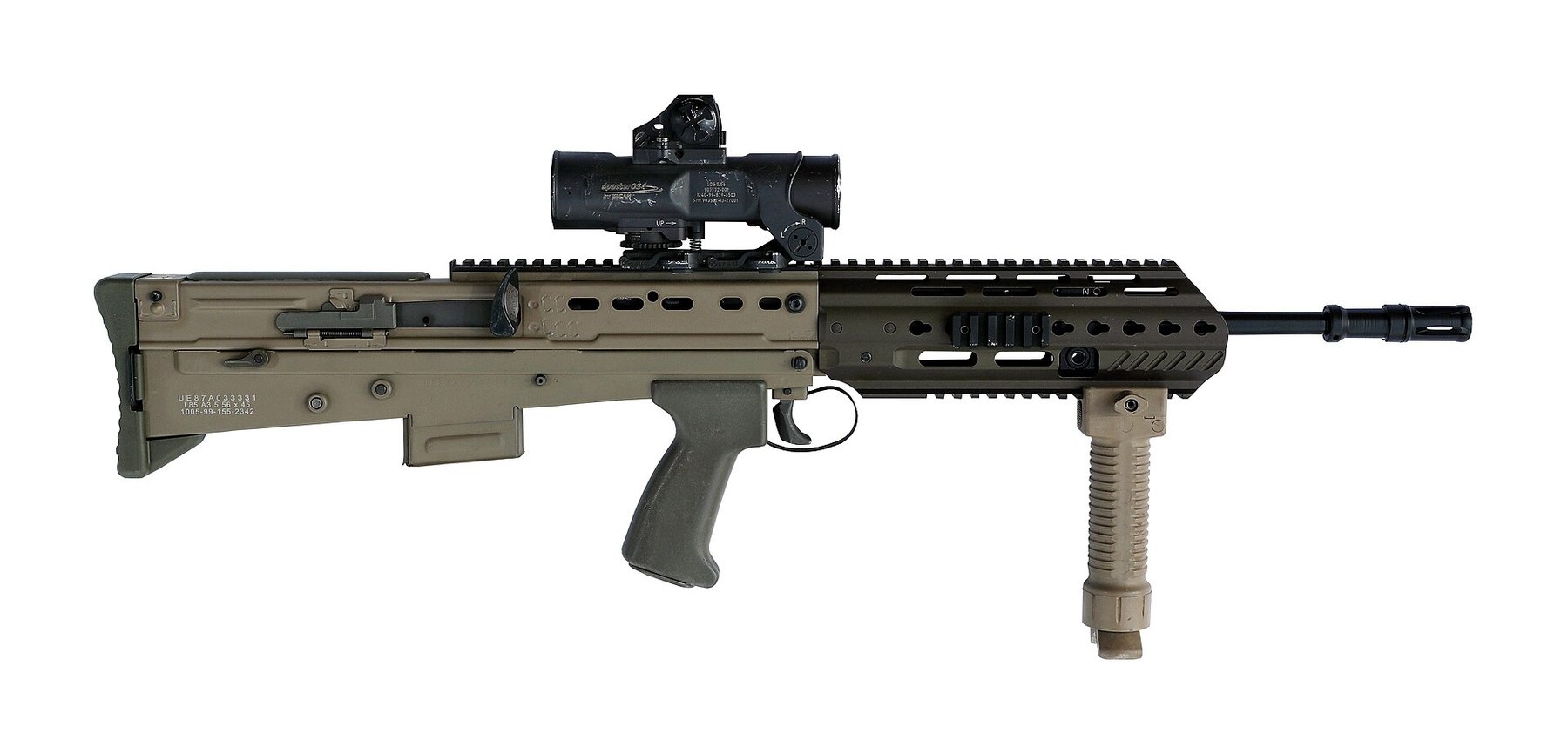
Read the plate in this order.
- Cocking handle. A small knob means an A1, or an A1-pattern rifle that has not been through the rebuild. A large comma-shaped handle that doubles as a case deflector means A2 or later. It is, in Ferguson’s words, the A2’s “only obvious external change”.1
- Fore-end. A continuous Picatinny rail running from the receiver top along the whole fore-end, with an H&K fore-end that has large lightening cut-outs, means A3.1 A railed fore-end that stops at the receiver, with separate rails at 12, 3, 6 and 9 o’clock, is the Daniel Defense rail of the A2 era. A plain polymer handguard can be on any of the three.
- Colour. Flat Dark Earth on the body means A3 (or a rifle repainted, which the photographs here do not show). Black with green or tan furniture is A1 or A2.2
- Marking. “L85 A2” or “L85 A3” on the right of the trigger mechanism housing, above the magazine, settles it where it is legible.
4.4 The cocking handle: the first thing to look at
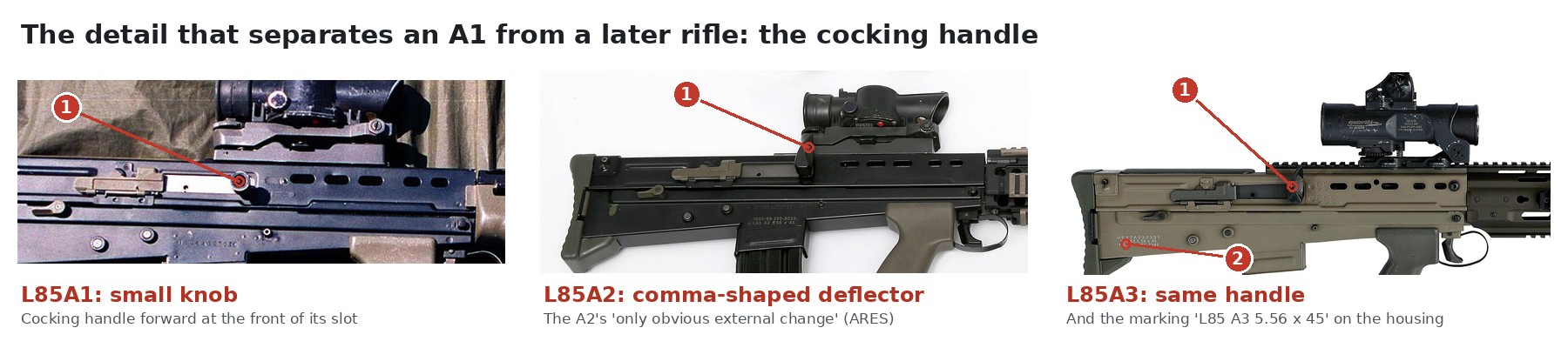
The A1 handle was a small cylindrical knob on a stem through the right side of the body. It reciprocated with the bolt carrier, beside the firer’s face, and it could not be fired from the left shoulder without risk of the handle hitting the face (Volume 2). Experiments with a “paddle-shaped” handle and case deflector were made on the post-acceptance XL80 test beds;3 the UK Historic Arms Resource Centre records that “From 1998 all in-service rifles were retro-fitted with modified cocking handles”.4 The large comma-shaped composite handle is the A2’s. A rifle in a 1998–2001 photograph with an intermediate handle should be described cautiously; the sources do not date the intermediate pattern closely enough to use it as an identifier, and this dive does not.
4.5 Handguards and fore-ends
The fore-end is the least reliable identifier because it was the most often changed.
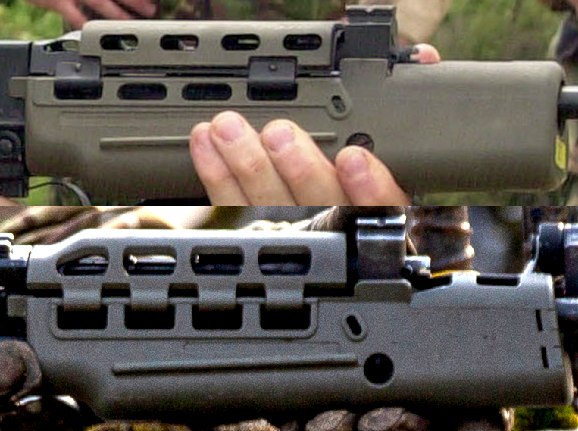
- Enfield polymer handguard (A1, kept on many A2s). Two-piece, with a top cover over the gas parts. On the A1 its upper was “plastic-covered sheet metal”.1
- H&K polymer handguard (A2 spare part). “Redesigned with larger vents, and a new upper with large plastic hinges”; introduced as a spare part only, so A2 rifles carry either pattern, and A1 handguards kept in service had “their old markings machined away”.1 Ferguson’s same article also says the number and size of vents “remained the same”, which conflicts with the list (Volume 3). The comparison photograph below shows visibly larger vents on the H&K pattern.
- Daniel Defense rail fore-end (A2, UOR from the mid-2000s), usually with a Grip Pod.1
- H&K negative-space fore-end with continuous top rail (A3, and the EFI prototypes before it), with a cut-away gas block.1
- L22 aluminium heat shield and rail, with rails at 6 and 3 o’clock only.5
4.6 Colour
The A1’s furniture went through two greens: the darker forest green of the XL80 and the brighter, cheaper plastic of the first production, replaced in service “with a more durable alternative” after complaints of breakage.1 A2 furniture in photographs is olive or tan; the A3’s coating is Flat Dark Earth, which the 2018 release named as one of its four changes.2 Furniture was swapped between rifles as parts wore, so colour alone is not decisive for the A1 and A2; it is decisive for an A3’s body.
4.7 Markings
Markings are the surest identifier and the least visible in photographs. What the sources record:
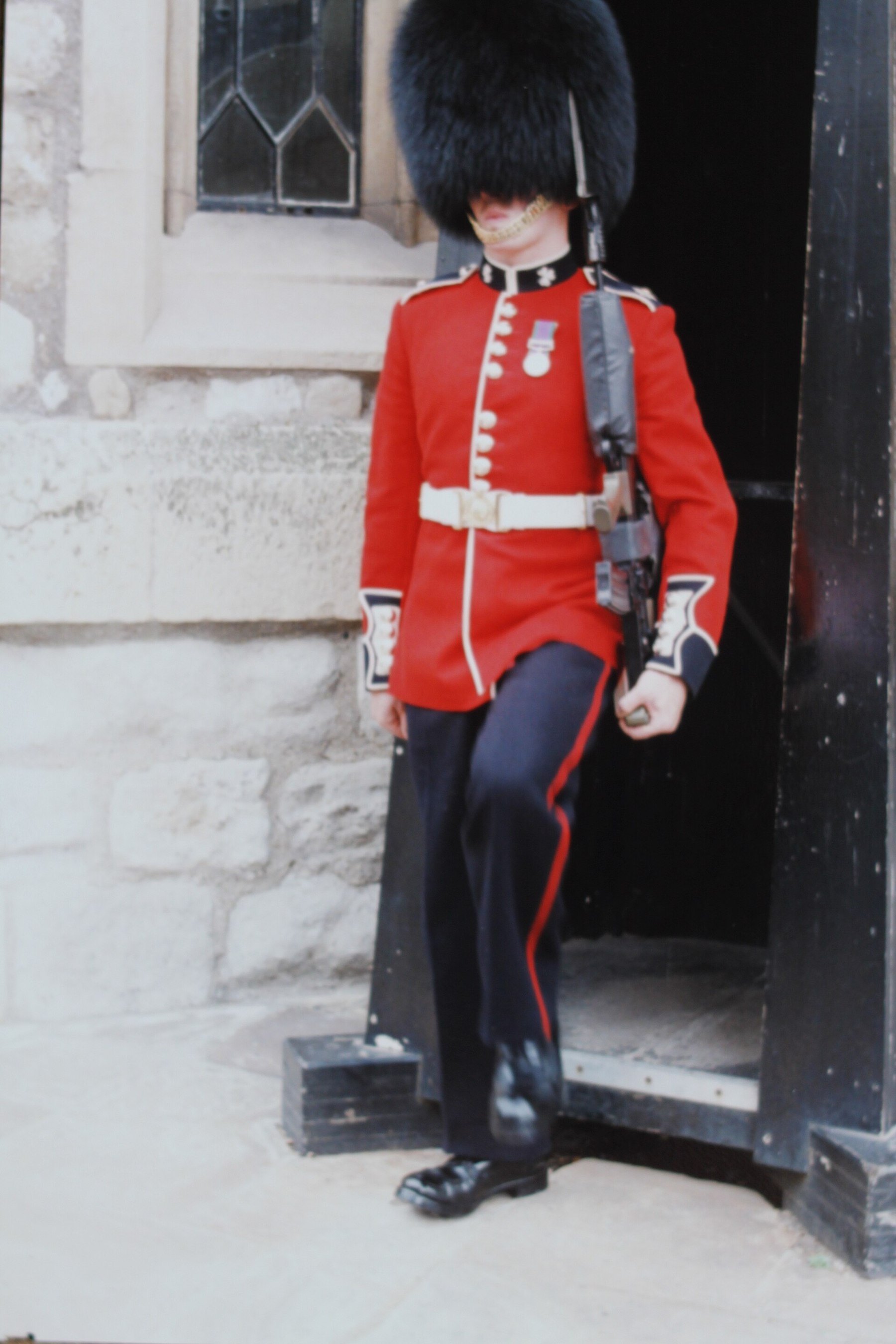
- Designation on the housing. “L85 A2 5.56 x 45” and “L85 A3 5.56 x 45” appear on the right of the trigger mechanism housing above the magazine, with a NATO Stock Number and a serial, in the MOD photographs in the plate above. The L22’s is “L22 A2 5.56 x 45”.5
- “HK A2” on upgraded components, “most obviously on the rear upper of the body”, even though the body itself was not modified.1
- “HK A3” on the newer A3 body, which was fitted to some rifles that stayed L85A2 by designation.1 An “HK A3” body is therefore not proof of an L85A3; the housing designation is.
- The A3’s NATO Stock Number is 1005-99-155-2342, from a written answer of 2023.6
- Original build. The housing of an L98A2 photographed by an Air Training Corps squadron revealed that it had been “built as an L85A1 at Royal Ordnance Nottingham, in 1990”.7 Rebuilt rifles keep their original build markings.
- “ENFIELD ®” on the housing appears on commercial demonstration rifles, not on service weapons.3
Serial numbers on British service rifles are visible in many MOD photographs. They identify a particular rifle, not a model, and this dive does not record them.
4.8 The L86 Light Support Weapon
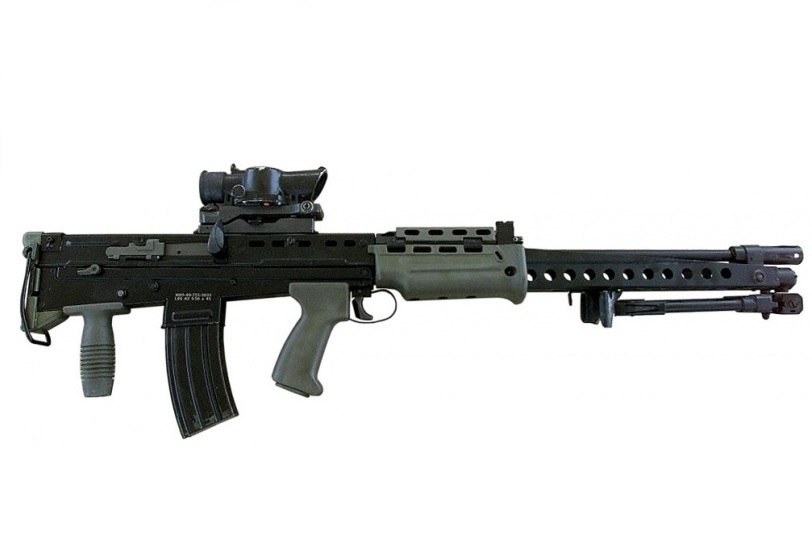
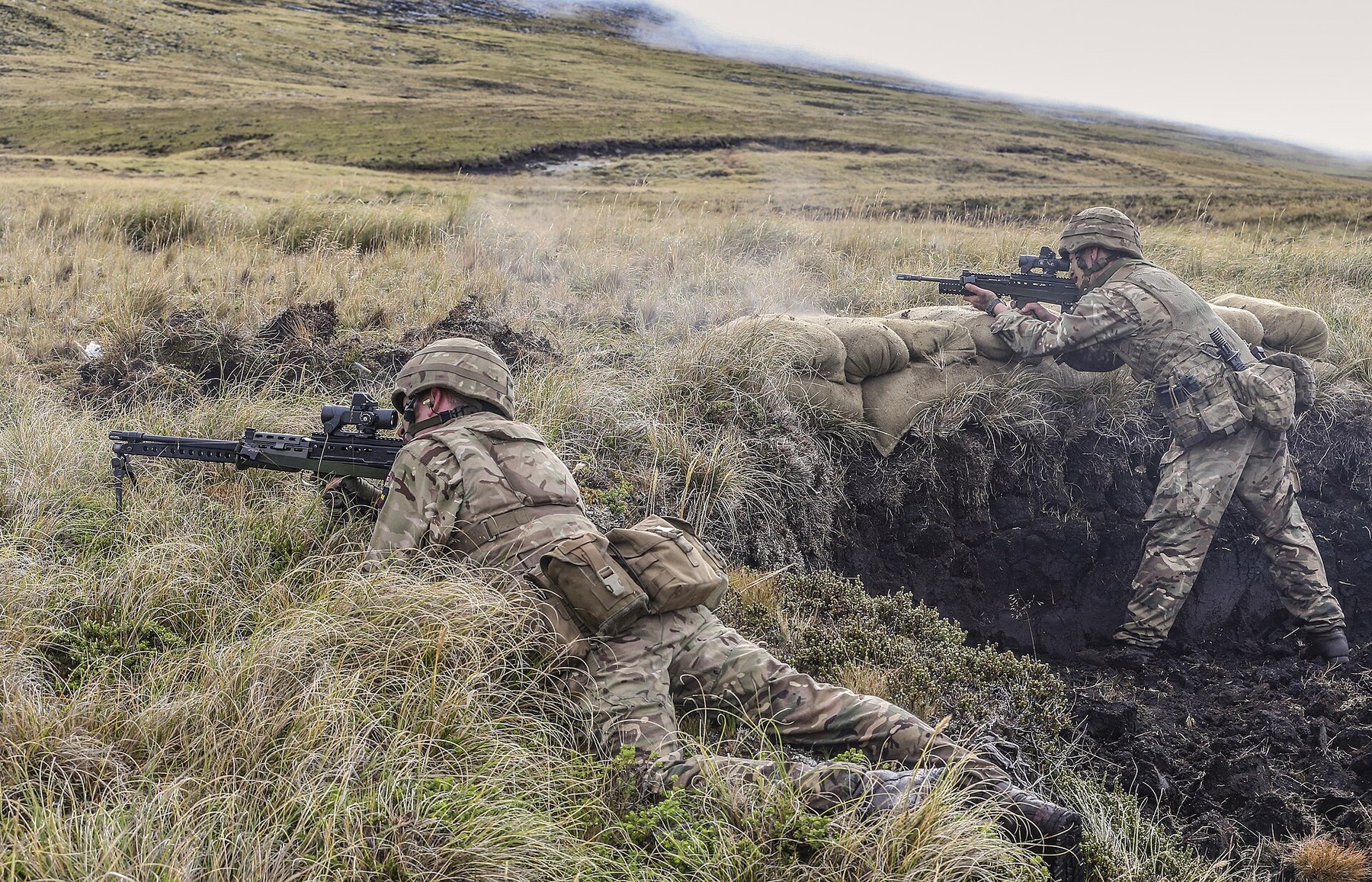
The LSW is the easiest member to recognise: a long barrel carried in an outrigger, with the bipod on the outrigger, a short front handguard, a vertical grip under the butt and a folding wire butt strap.83 The outrigger was the cure for “split groups”: it “effectively clamped the end of the barrel in place, producing a stiffer barrel without increasing its weight”.3 It is 900 mm long.8 In A1 form it fired from a closed bolt in both modes, as did the rifle.9
The L86A2 took the A2 parts and, by the July 2002 Lords question, “a new barrel and hammer”.10 Ferguson calls it “an anomaly … rarely seen in service outside of domestic training exercises”, studied in 2015 as a weapon for the second man of a sniper pair, with a reputation as a 5.56 mm sharpshooter’s rifle that “has been exaggerated”.1
4.9 The L22 carbine
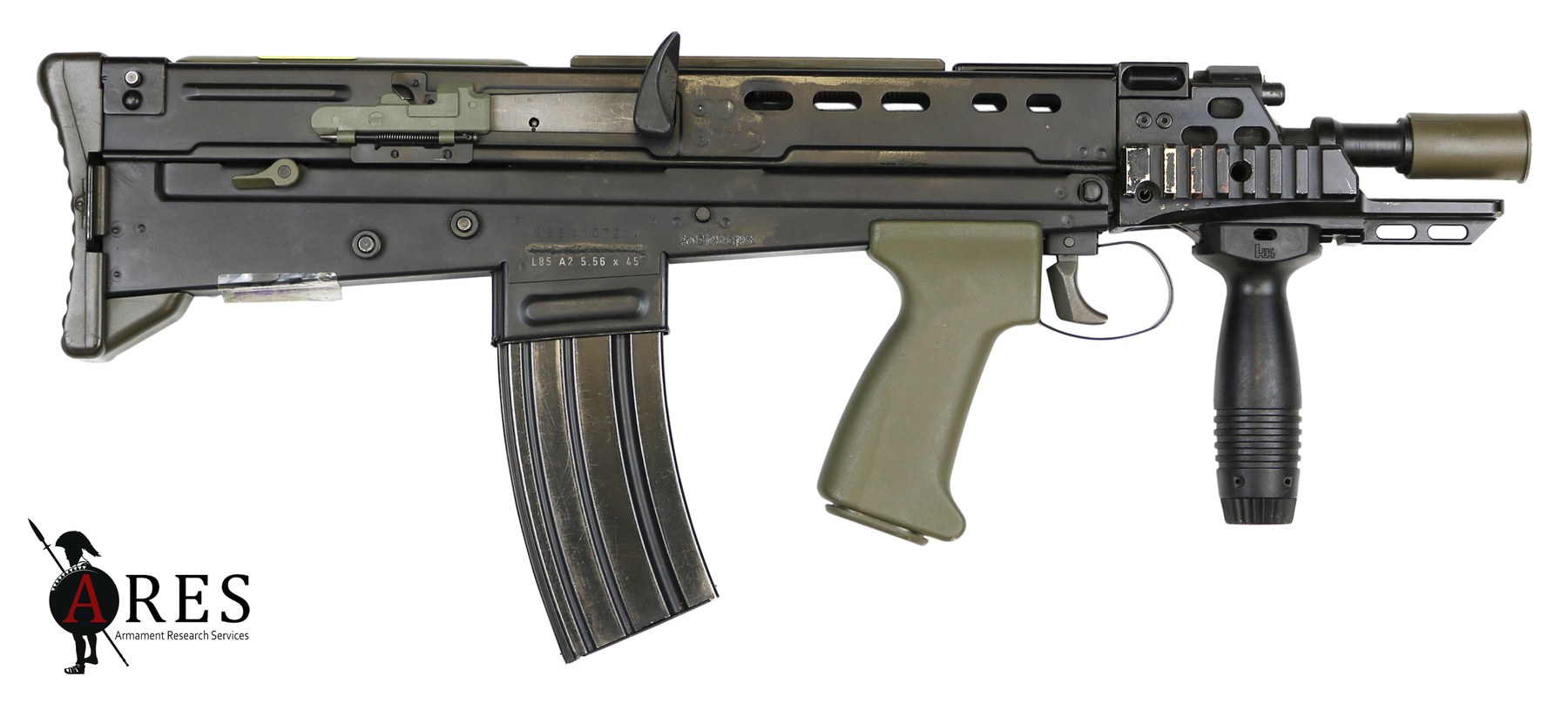
The L22A2 is 571 mm long, with a barrel of 285 mm without the flash suppressor.5 Its tells are the length, the aluminium heat shield and rail with rails at 6 and 3 o’clock, the H&K vertical foregrip fitted as standard, and the absence of iron sights.5 It is built from surplus L85A1 parts plus new H&K parts, and every example is marked “L22 A2 5.56 x 45” whatever the literature calls it.5
The close-quarter photograph in Volume 3 does not show the barrel; the side view below, from the National Firearms Centre’s reference collection, does.
4.10 The cadet rifles: L98A1 and L98A2
The cadet forces needed a rifle for teenagers in 5.56 mm. Ferguson records the trial: a straight-pull H&K SL6, the straight-pull Interarms EX2, bolt actions from BSA and Parker-Hale, and a short-throw bolt action by John Cross; Enfield won with the “L98A1 Cadet General Purpose Rifle”, “GP” to distinguish it from the inert drill-purpose model, known at Enfield as the “Ensign”.7
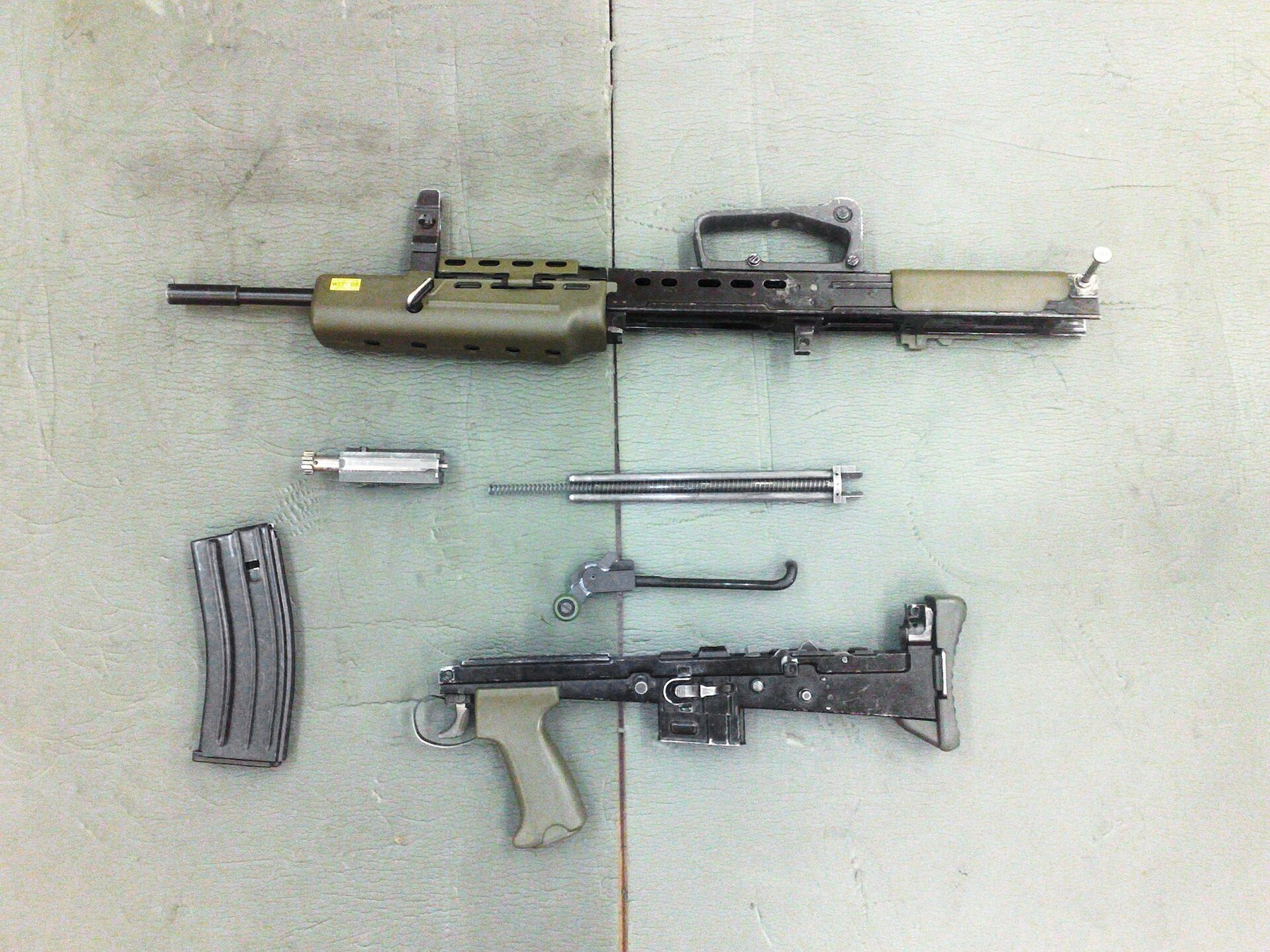
The L98A1 is a manually operated SA80. It “was built using L85A1 components, but critically without any ‘gas parts’”, and needed “a large external operating rod assembly to provide the leverage necessary to extract a fired case”. On production rifles the operating rod “was curved in and downward and inserted into the cocking handle aperture in the bolt carrier”; the new handle was “a polymer knob rotating on a central steel spindle” on a short lever that “pivots against a welded-on stop on the receiver, providing leverage whilst the bolt is withdrawn and rotated to unlock”.7 Other differences: no flash suppressor; an oil bottle in the handguard void left by the gas parts; a unique pistol grip with crescent cut-outs for the storage plug; a thinner foresight blade without the tritium element; and a rear sight with a rotating disc of apertures from 100 to 500 m.7 Its barrel, gas block and barrel extension were unique parts not drilled for gas, according to a UK shooting writer.11
The L98A2 is semi-automatic. It was “produced from A2 upgraded parts with a new semi-automatic only trigger mechanism (the change lever is still omitted)”, with the standard pistol grip and either the carrying-handle iron sight or a SUSAT, and it replaced the L98A1 from 2009.7 It is “distinguishable from the L85A2 only by its lack of change lever (selector switch) and the markings”.7 A UK reference site’s statement that the L98A2’s “gas system” is “not fitted” contradicts its own description of the rifle as self-loading and is not followed here.12
What became of the L98A1s is disputed. A 2015 MoD freedom-of-information reply said they “were converted to the L98A2 version”; the writer who obtained it disputed that and gave the reply’s figures as 2,488 converted to drill weapons and 4,015 in storage. MoD policy, the same reply said, is that “all weapons are disposed of by being destroyed”.11
4.11 Drill rifles
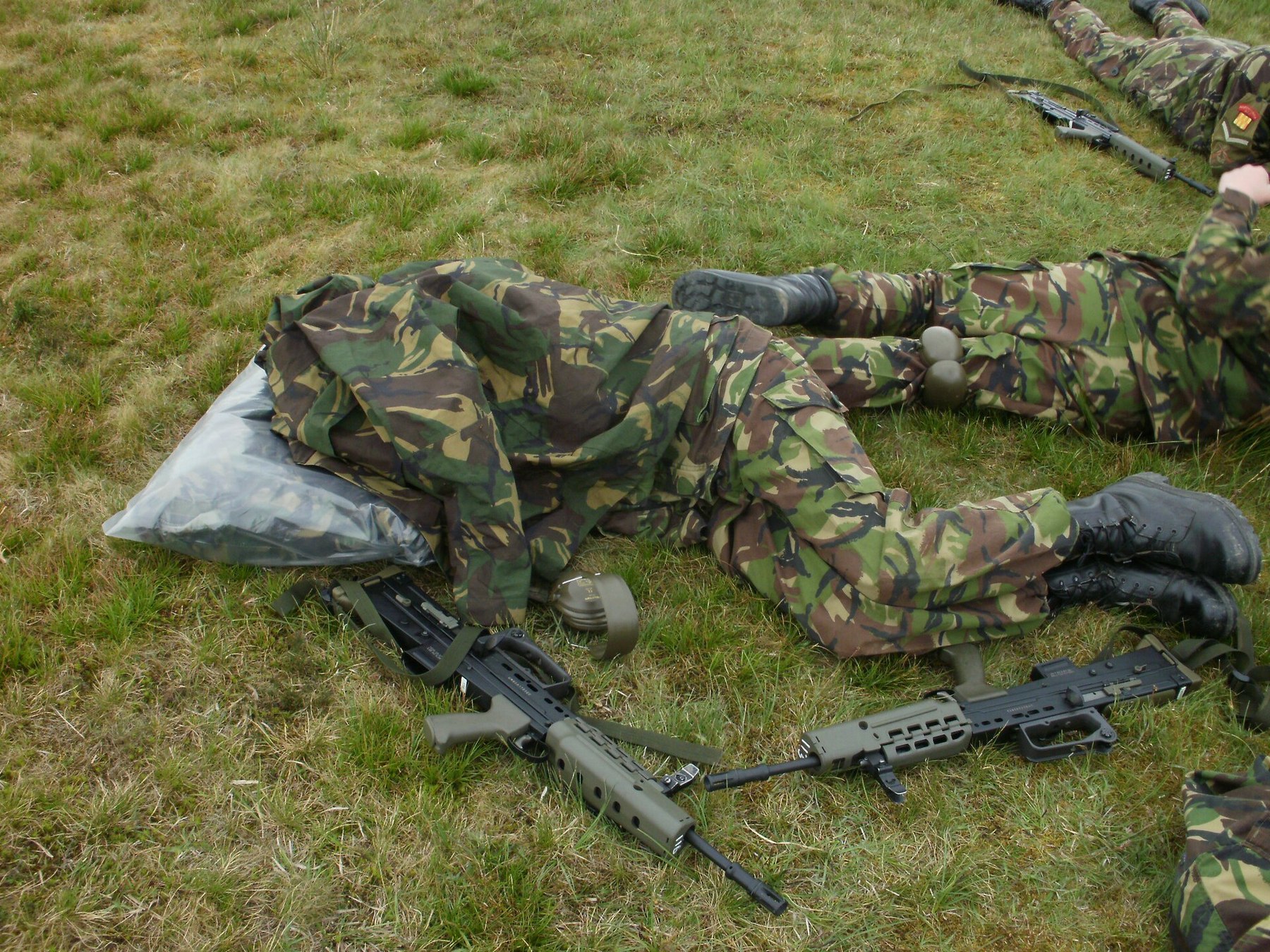
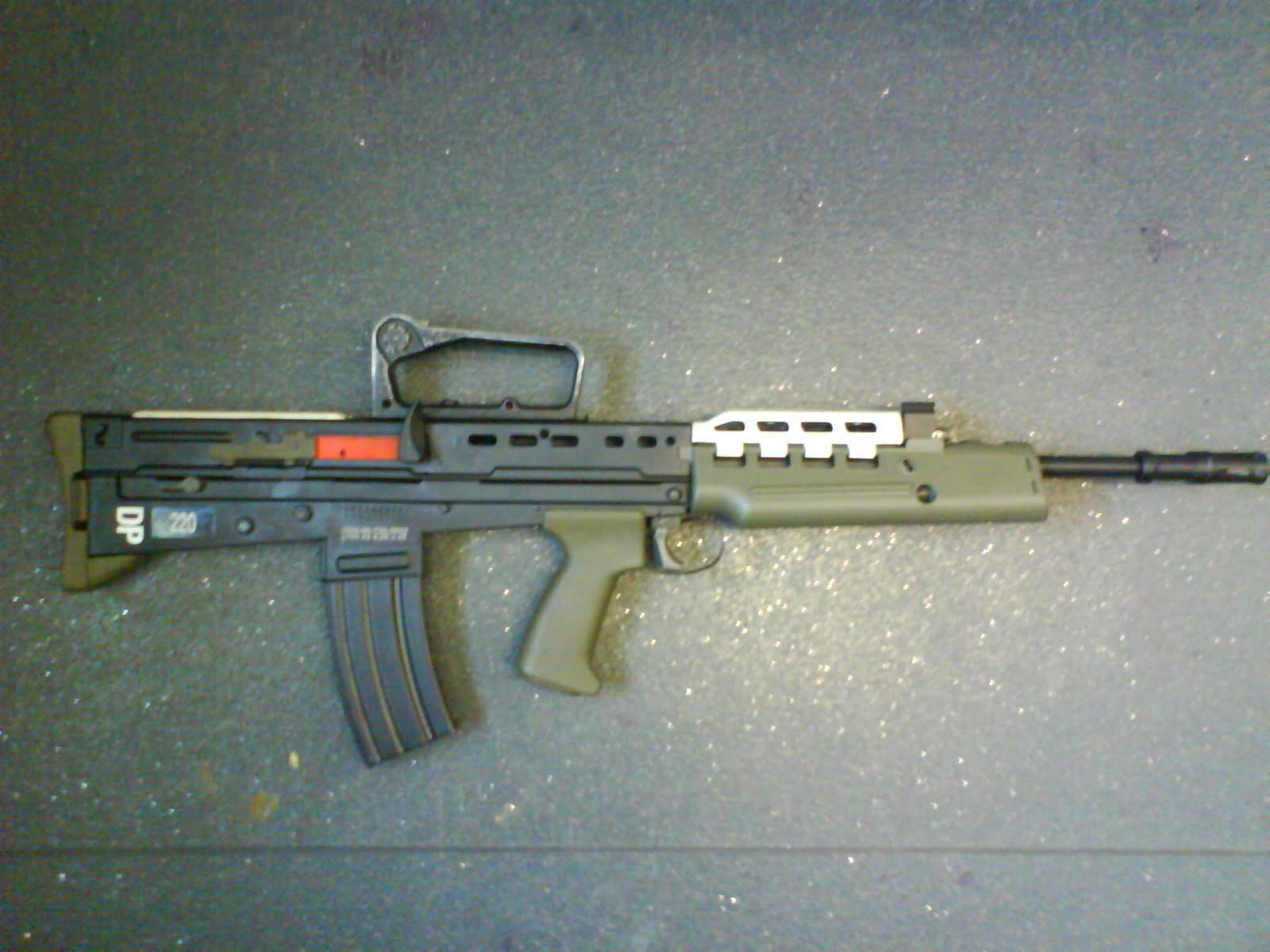
Inert drill-purpose (DP) rifles exist for drill and handling. The one photographed below is described by its photographer as “The L103A2 — a drill purpose version of the L98A2”, with the foresight removed because “the foresight obstructs a number of movements during drill”.13 No official source for the L103 designation was found; it is given as the photographer gave it.
4.12 Prototypes and the ones that never were
Three SA80 types exist that a collector might meet in a museum or a rumour:
- The XL-series prototypes (Volumes 1 and 2), slimmer and visibly different: the paddle magazine catch, prototype SUSATs and, on the XL60 series, a cross-bolt selector at the rear.14 The Royal Armouries holds the first prototype.
- The “Super Ensign”. Ferguson describes a “self-loading only ‘Super Ensign’ L85A1 variant … designed as a semi-automatic stablemate for the manually-operated Ensign (L98A1), reworked from the L85A1 as per typical civilian-legal designs sold around the world, in order to prevent ready conversion to automatic fire”. Only a few seem to have been made, and no advertisements are known, but “persistent unconfirmed rumours exist of a few examples in the hands of UK shooters prior to the 1988 ban, and even of examples in the US.”7 Volume 9 returns to it.
- The SA80 Competition Rifle, “essentially an LSW built as per the Cadet GP rifle without gas parts and with the crank handle”, meant for UK target shooters after self-loading rifles were banned in 1988. It never reached market; “the only complete weapon observed ‘in the wild’ was that used for a time by the Royal Ordnance Rifle Club”.7
4.13 Lookalikes and replicas
Photographs of airsoft replicas and of American lookalike rifles are widely mislabelled online as service SA80s. The replicas and the lookalikes are Volume 9. The rules that separate them in a photograph:
- Markings. A replica carries its maker’s name or a trademark-free fantasy marking; a service rifle carries the designation, a NATO Stock Number and a serial. A US-made rifle must carry its maker’s name, city and state under 27 CFR 478.92.
- Muzzle. Imitation firearms sold in the United States carry a blaze-orange muzzle marking under 15 U.S.C. 5001 and its regulation; a service rifle does not. The marking rule is covered in the hub’s E-11 dive, Volume 10.
- Mechanism visible through the ejection port. An AR-based lookalike shows an AR-type bolt carrier; an SA80 shows its own flat-sided carrier.
- Context. A rifle in a soldier’s hands on a dated MOD or DoD photograph is a service rifle; a rifle on a white background in a shop listing may be anything.
4.14 Tell them apart
Table 2 — Tell them apart
| Feature | L85A1 | L85A2 | L85A3 | L86A1/A2 | L22A2 | L98A1 | L98A2 | Where to look |
|---|---|---|---|---|---|---|---|---|
| Cocking handle | Small round knob | Comma-shaped deflector | Comma-shaped | A1 knob / A2 comma | Comma-shaped | Large cranked lever on an external track | Comma-shaped | Right side, above the grip |
| Change lever | Yes | Yes | Yes (modified against over-rotation on the EFI prototype) | Yes | Not stated | No | No | Trigger mechanism housing |
| Gas parts | Yes | Yes | Yes | Yes | Yes, short plug | None | Yes | Under the handguard top cover |
| Barrel | 518 mm | 518 mm | 518 mm | Long, in outrigger | 285 mm | Rifle length | Rifle length | Length against the body |
| Flash suppressor | Yes | Yes | Yes | Yes (not interchangeable) | Yes | None | Yes | Muzzle |
| Fore-end | Enfield polymer | Enfield, H&K polymer or DD rail | H&K fore-end, continuous top rail | Short handguard plus outrigger | Aluminium rail, 3 and 6 o’clock | Enfield polymer | Polymer | Ahead of the grip |
| Body colour | Black | Black | Flat Dark Earth | Black | Black | Black | Black | Body |
| Marking | — | “L85 A2”, “HK A2" | "L85 A3” | — | “L22 A2” | — | — | Right of housing; rear of body |
| Bipod | No | Grip Pod option | Grip-bipod option | On outrigger | No | No | No | Under fore-end |
Barrel lengths are the Army website’s 518 mm for the rifle and Ferguson’s 285 mm for the carbine, both excluding the flash suppressor.155 Dashes mean the sources consulted give no marking for that model, not that none exists.
4.15 Corrections this volume makes
- An “HK A3” body does not make a rifle an L85A3. A3-marked bodies were fitted to rifles that remained L85A2 (Ferguson); the housing designation decides.
- The L98A1 had no gas parts at all, and was cocked by an external lever acting through the cocking-handle aperture; the L98A2 is a self-loading rifle with the change lever omitted. A reference site’s “gas system not fitted” for the L98A2 is an error.
- The snow-clearing trigger does not identify an A2 (Volume 3); the cocking handle does.
- A semi-automatic L85A1, the “Super Ensign”, was designed and a few were made, according to Ferguson; its presence in the US is a rumour, not a record.
- The “L103A2” drill-rifle designation comes from a photographer’s description, not an official source found for this dive.
References
Footnotes
-
Jonathan Ferguson, “British Enfield SA80 Part 5: SA80 A1 vs A2”, The Hoplite, 20 May 2017. Wayback capture of 28 May 2017, http://web.archive.org/web/20170528111515/http://armamentresearch.com:80/british-enfield-sa80-part-5-sa80-a1vsa2/, consulted 2026-10-18. ↩ ↩2 ↩3 ↩4 ↩5 ↩6 ↩7 ↩8 ↩9 ↩10
-
Ministry of Defence and Defence Equipment and Support, “British Army’s rifle set for multi-million-pound upgrade”, 11 April 2018. https://www.gov.uk/government/news/british-armys-rifle-set-for-multi-million-pound-upgrade, consulted 2026-10-18. ↩ ↩2
-
Jonathan Ferguson, “British Enfield SA80 Part 4: XL80 Series”, The Hoplite, 17 May 2017. Wayback capture of 17 January 2026, http://web.archive.org/web/20260117090848/http://armamentresearch.com/british-enfield-sa80-part-4-xl80-series/, consulted 2026-10-18. ↩ ↩2 ↩3 ↩4
-
UK Historic Arms Resource Centre, “L85A1 (SA80) with SUSAT sight”, https://www.rifleman.org.uk/L85A1_SA80_with_SUSAT_Sight-roto.html, consulted 2026-10-18. ↩
-
Jonathan Ferguson, “British Enfield SA80 Part 6: Carbines”, The Hoplite, 24 May 2017. Wayback capture of 18 January 2026, http://web.archive.org/web/20260118060548/http://armamentresearch.com/british-enfield-sa80-part-6-carbines/, consulted 2026-10-18. ↩ ↩2 ↩3 ↩4 ↩5 ↩6
-
UK Parliament, written answer 202842, James Cartlidge, answered 24 October 2023. questions-statements.parliament.uk, consulted 2026-10-18. ↩
-
Jonathan Ferguson, “British Enfield SA80 Part 7: L98A1 Cadet GP Rifle”, The Hoplite, 27 May 2017. Wayback capture of 6 June 2017, https://web.archive.org/web/20170606131613/http://armamentresearch.com/british-enfield-sa80-part-7-l98a1/, consulted 2026-10-18. ↩ ↩2 ↩3 ↩4 ↩5 ↩6 ↩7 ↩8
-
Royal Ordnance, 5.56mm Enfield Weapon System: User Handbook, copyright Royal Ordnance plc 1985, Introduction pp. 4–5 and Technical Data pp. 2–3. Via the UK Historic Arms Resource Centre, https://www.rifleman.org.uk/Images/PDF-files/SA80-user-manual/index.html, consulted 2026-10-18. ↩ ↩2
-
Royal Ordnance, The Enfield Weapon System (sales brochure, c. 1985), via the UK Historic Arms Resource Centre, https://www.rifleman.org.uk/Images/PDF-files/Enfield_Weapons_System/index.html, consulted 2026-10-18. ↩
-
House of Lords, oral question “SA80-A2 Rifle”, 10 July 2002, Lord Redesdale. https://hansard.parliament.uk/Lords/2002-07-10/debates/055379da-b1c5-4186-8d5a-be17cce63893/, consulted 2026-10-18. ↩
-
Gaz Corfield, “Mystery of the L98A1 Cadet GP rifle’s fate”, UK Shooting News, 7 March 2016, https://ukshootingnews.wordpress.com/2016/03/07/mystery-of-the-l98a1-cadet-gp-rifles-fate/, consulted 2026-10-18. ↩ ↩2
-
UK Historic Arms Resource Centre, cadet GP rifle pages, rifleman.org.uk, consulted 2026-10-18. ↩
-
Wikimedia Commons, File:L98 A2 DP Rifle.JPG, description by the uploader, photographed 6 March 2010. https://commons.wikimedia.org/wiki/File:L98_A2_DP_Rifle.JPG, consulted 2026-10-18. ↩
-
Jonathan Ferguson, “British Enfield SA80 Part 2: XL60 series”, The Hoplite (Armament Research Services), 10 May 2017. Wayback capture of 17 January 2026, http://web.archive.org/web/20260117101829/http://armamentresearch.com/british-enfield-sa80-part-2-xl60-series/, consulted 2026-10-18. ↩
-
British Army, “Small arms and support weapons”, army.mod.uk. Wayback capture of 28 September 2024, http://web.archive.org/web/20240928000237/https://www.army.mod.uk/equipment/small-arms-and-support-weapons/, consulted 2026-10-18. ↩

Comments (0)