SA80 (L85 Family) · Volume 1
From the EM-2 to Enfield's 4.85 mm Rifle
The .280 calibre and its reversal, the SLR years, the 1970 study, the AR-18 conversions, the 4.85 × 49 mm cartridge, and the XL60 series that lost the NATO trials
1.1 What this volume covers
The SA80 family — the L85 rifle, the L86 Light Support Weapon, the L22 carbine and the L98 cadet rifle — entered British service in 1985 and is due to leave it around 2030.1 Its reputation was made by its troubles in the early 1990s and repaired by Heckler & Koch’s rebuild a decade later; those are Volumes 2 and 3. This volume covers what came before: Britain’s first bullpup service rifle, the decision that killed it, the twenty-five years with the Belgian FAL, and the decade at the Royal Small Arms Factory, Enfield, in which the rifle that became the SA80 was designed around a British cartridge that NATO then declined to adopt.
Two kinds of source carry the story. The first is Parliament: Hansard records what ministers said, and when, in their own words. The second is the specialist literature, above all Jonathan Ferguson’s eight-part series for Armament Research Services (ARES), written in 2017 with access to the Royal Armouries’ National Firearms Centre and its prototypes, which Ferguson later expanded into the book Thorneycroft to SA80: British Bullpup Firearms, 1901–2020 (Headstamp, 2021).2 Where the two disagree with popular accounts, the disagreement is set out.
1.2 Two bullpups, thirty years apart
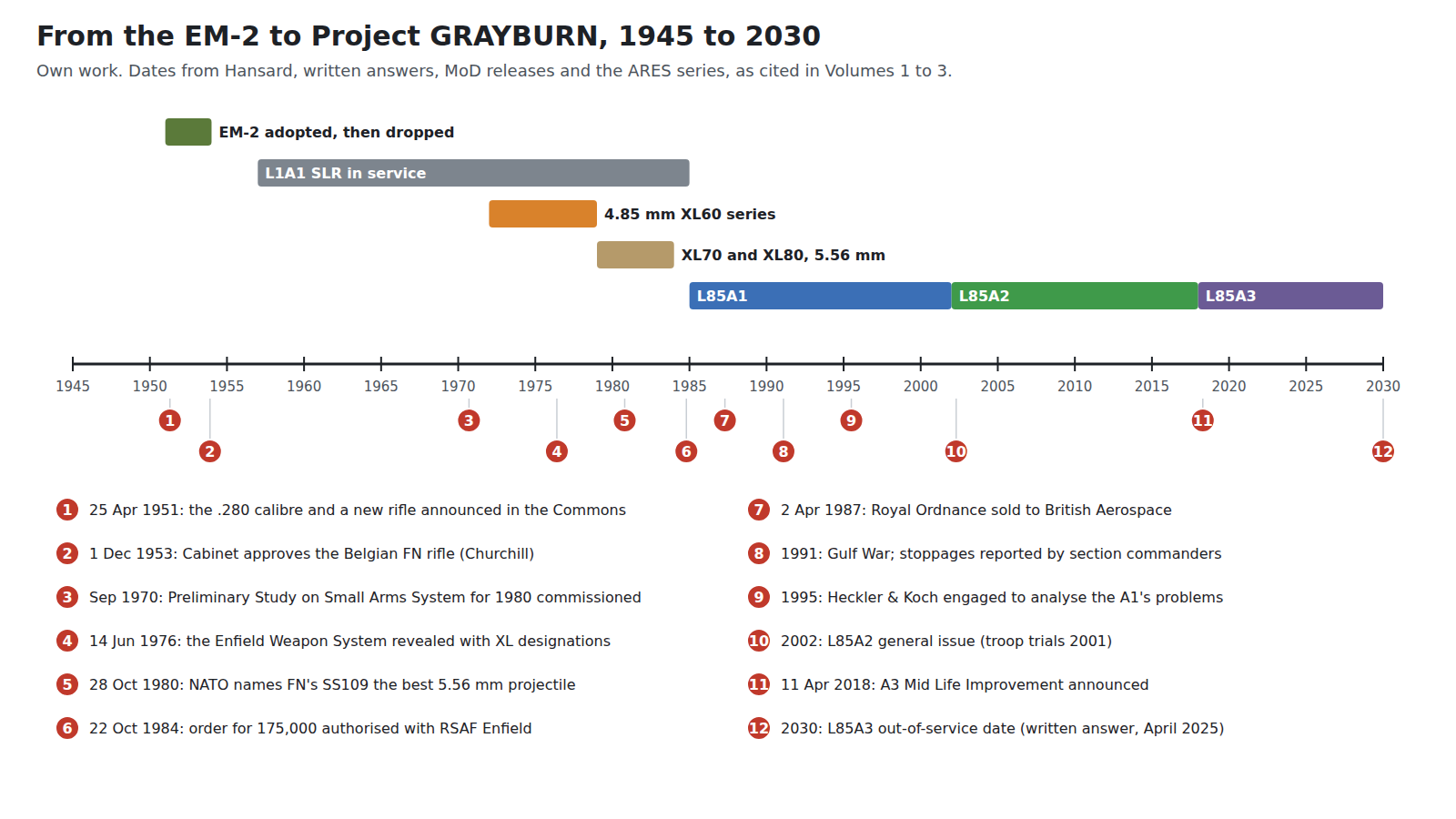
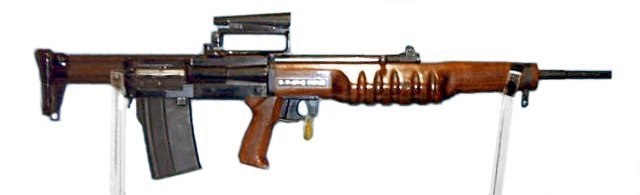
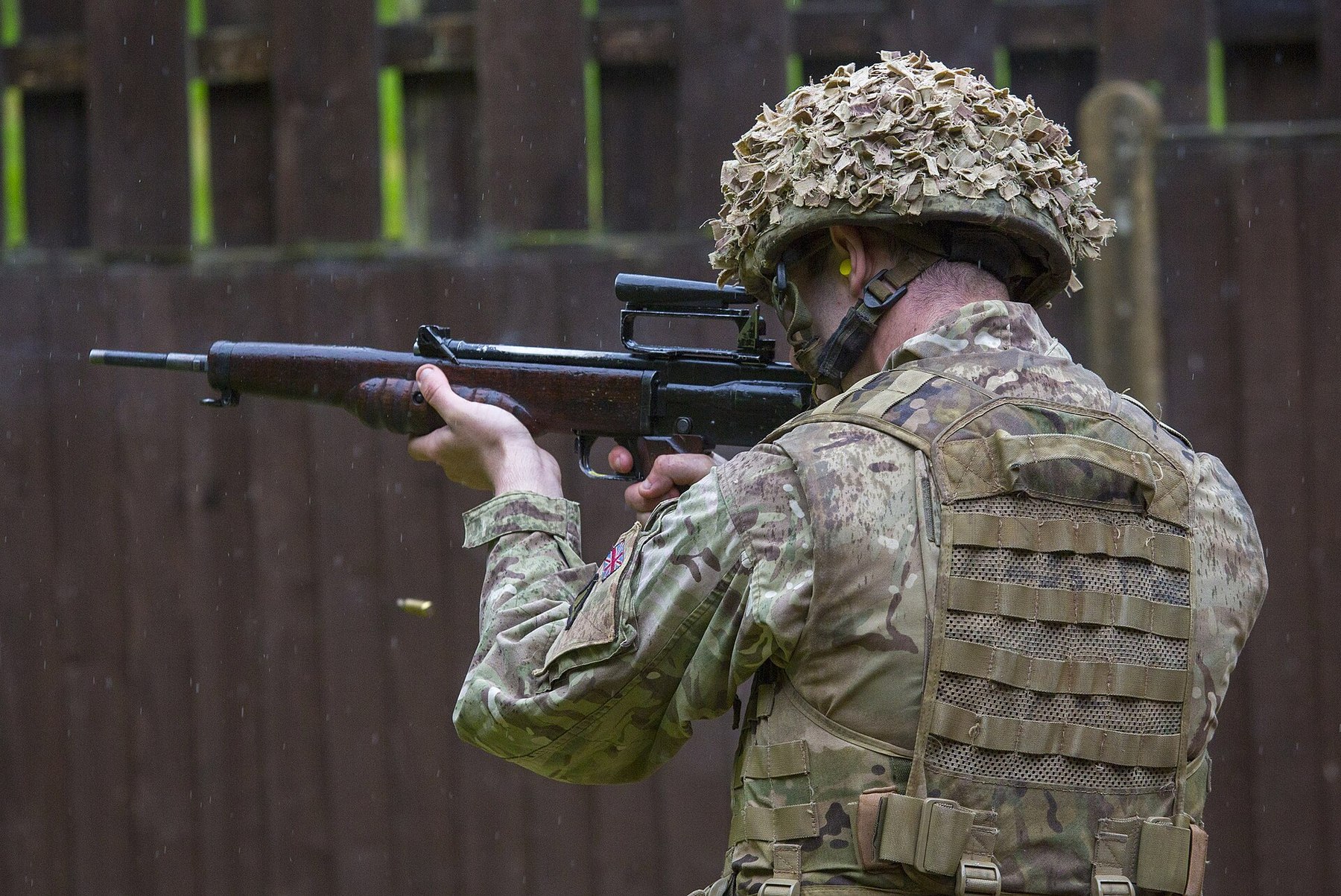
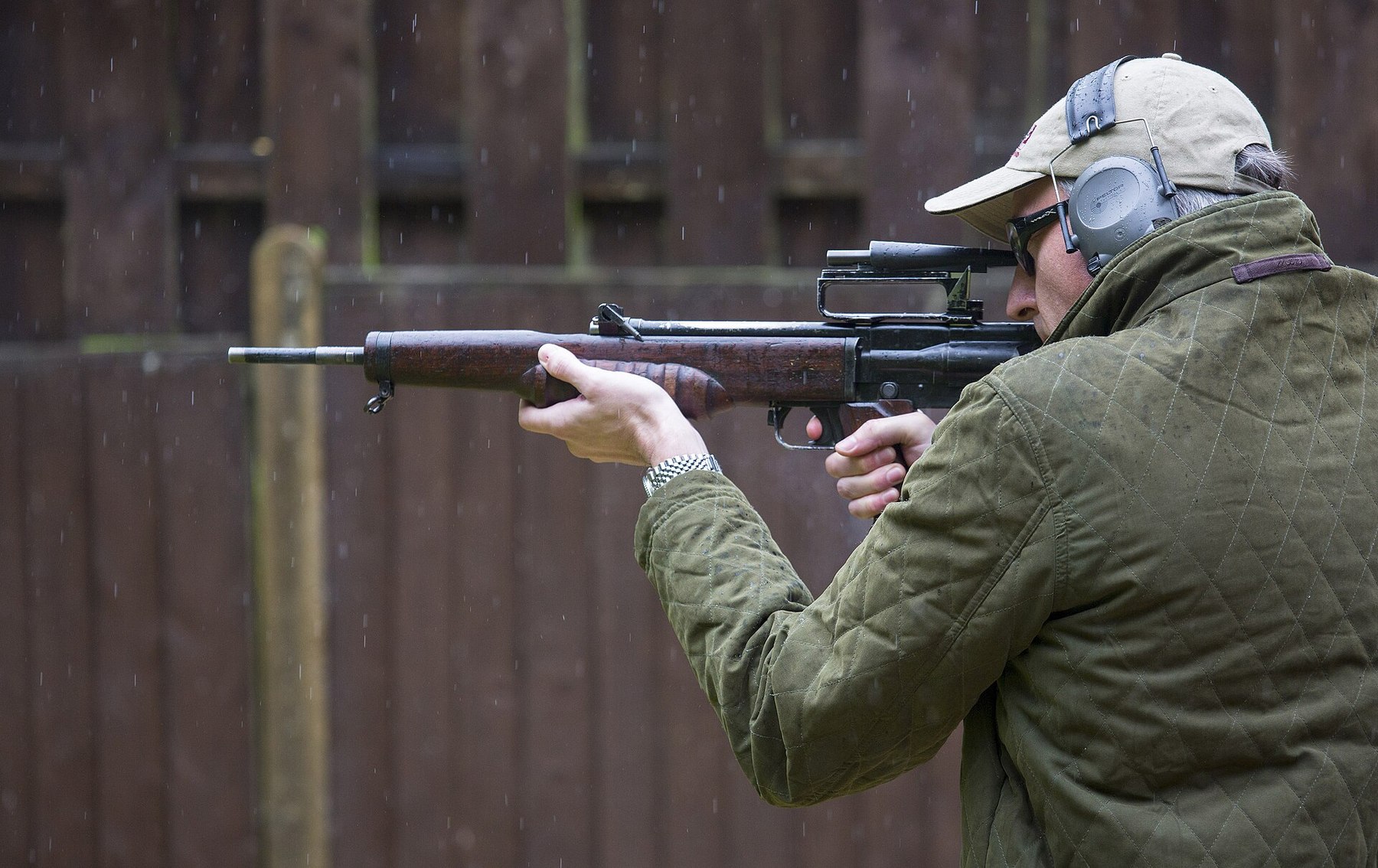
The SA80 was not Britain’s first bullpup. In April 1951 the Labour government announced that it would adopt a new calibre and “a light self-loading rifle” built for it; the rifle was the EM-2, a bullpup with an optical sight in its carrying handle, chambered for a 7 mm cartridge usually called the .280.3 The decision was reversed under the following Conservative government, and Britain adopted a version of the Belgian FN FAL in 7.62 × 51 mm as the L1A1 Self-Loading Rifle (SLR).42
Thirty years later Britain went back to the bullpup. The two rifles share a layout, an optical sight fitted as standard and one man in common — Sydney Hance, who assisted on the EM-2 and led the design team at Enfield in the 1970s.52 They share almost nothing else, and the common claim that the SA80 descends from the EM-2 is one this volume corrects.
1.3 The .280 calibre and the EM-2
On 25 April 1951 Emanuel Shinwell, Minister of Defence, told the Commons that the government had “decided, after extensive trials, to adopt the .280-inch calibre for small arms for the British Forces”, replacing the “.303-inch calibre which has been in use for the last 50 years.”3 He gave three reasons: the calibre “makes possible the design of a light self-loading rifle”; it “reduces the load the soldier is required to carry”; and it “is cheaper to manufacture.” On NATO he said there had been “full consultations with other North Atlantic Treaty Powers” and that “The Standing Group has formally approved the .280-inch rifle as ‘militarily acceptable.’” He also said that “Some of the other countries decided not to adopt it; they preferred another type of weapon.”
The statement does not name the rifle. It speaks of a calibre and of a “light self-loading rifle”. The formal designation — given by Ferguson as “Rifle, No.9 Mk I” and by the Wikipedia article on the EM-2, citing Thomas Dugelby’s EM-2: Concept and Design (Collector Grade, 1980), as “Rifle, Automatic, Calibre .280, Number 9” — comes from those sources, not from Hansard.56 The adopted cartridge was “Cartridge, 7mm S.A.A. Ball, Mk.1Z”.5
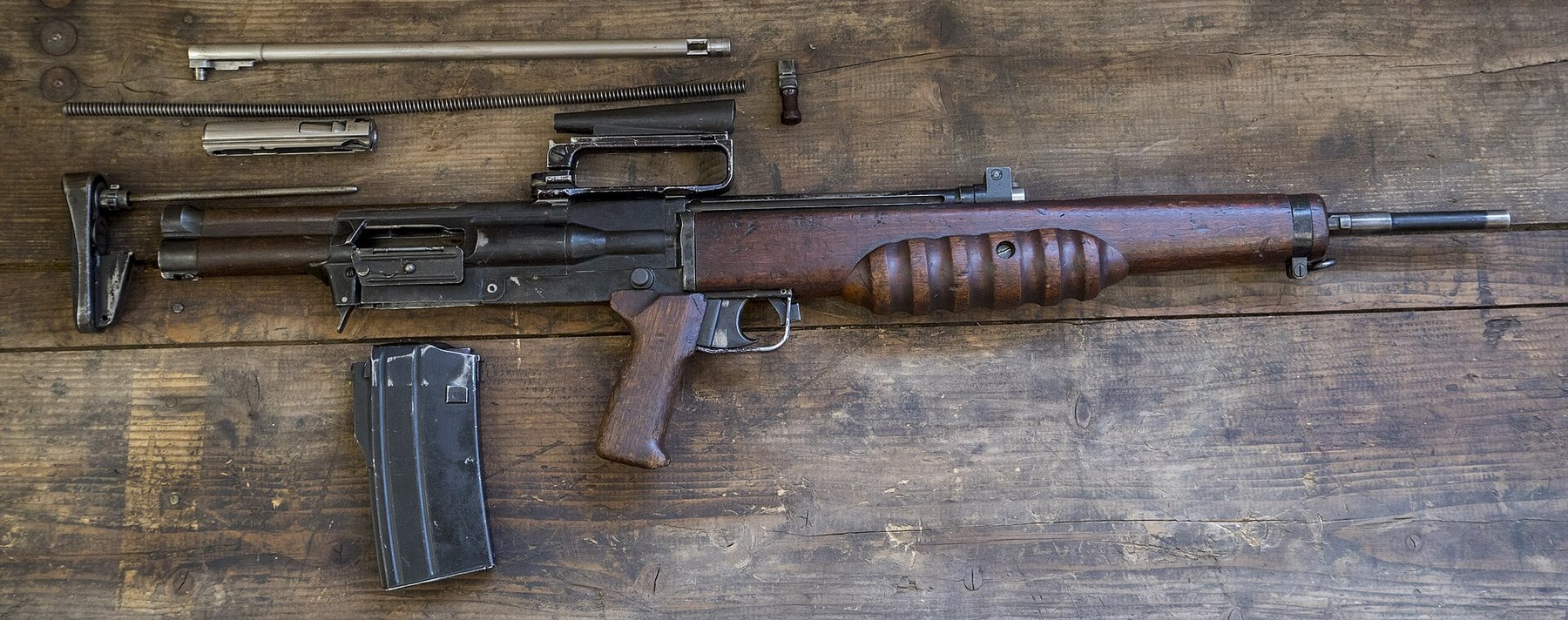
The design came from a team at the Armaments Design Establishment. Ferguson identifies its leader as “Stefan Kenneth Janson”, the anglicised name of Captain Kazimierz-Stefan Januszewski, who in 1949 headed “a team of immigrant firearms designers based at Cheshunt”, and the head of the establishment as Colonel Noel Kent-Lemon. There were two rifles called “E.M.2”: an earlier inertia-locked design by Lieutenant Jeziorański, “ordered stopped in 1947”, and Janson’s gas-operated rifle, which is the one usually meant.5 “Assisting was Sydney Hance, who would go on to design the original incarnation of the SA80.”5
How many EM-2s were made is not settled. The Wikipedia article, citing Dugelby, gives 59; an MHQ article gives “only 50”.6 The two figures are given separately here, as they are in the sources. Ferguson says flatly that “The E.M.2 was never to enter mass production.”5
1.4 The reversal, 1951 to 1953
The usual account compresses the next two and a half years into a sentence: Labour adopted the EM-2 in 1951 and Churchill cancelled it on taking office. The parliamentary record is more drawn out.
On 6 July 1951 Shinwell told the Commons that other NATO members had asked for ministerial discussion since the decision; that “There have, in fact, been no ministerial conversations on this subject”; that “The matter was dealt with by a joint military working party”; and — more revealing — that “We have not gone into actual production of the rifle on any scale.” He expected “fairly adequate supplies in the course of two years, not before then”, and said Britain had “an ample stock of the 303 rifle”.7 Ferguson records that “After the U.S. announced in January 1952 that they would not adopt the .280 caliber” the position became untenable, and that “Five thousand FAL rifles (X8E1) had already been ordered in December 1953.”5
The decisive debate came on 1 February 1954, on a motion moved by Woodrow Wyatt. Churchill, now Prime Minister, gave the dates himself. The Army Council “decided to recommend the adoption of the Belgian Fabrique National, the Belgian, rifle” on 30 October 1953; the Secretary of State “formally requested authority to proceed with its manufacture” on 4 November 1953; and “The policy received final Cabinet approval on 1st December last.”4 He added that “It was not until September, 1953, that the common round was achieved”, and that “The E.M.2 was now a .300” — that is, it had been converted to the common round. His summary was that “The British rifle was a fine piece of work, but it would have been fatal to adopt it in isolation.”4
The debate is worth reading for more than the dates. Churchill doubted “whether there is any real military advantage in these extraordinary rates” of automatic fire, and thought “The Belgian F.N. is considered to be a more soldierly weapon on the march”. Antony Head, Secretary of State for War, said a British technical board had concluded in April 1951 that “the F.N. rifle was efficient”. Wyatt complained that there had been no “comparative trials whatever” since 1951 and that “There are only about 20 of these rifles in existence”, meaning FN rifles in 7.62 mm.4 Ferguson writes that the motion failed “by only 34 votes”; the division itself was not checked for this volume.5
What the EM-2 cost was never established. Asked in 1954, the Minister of Supply, Duncan Sandys, said: “I regret that figures are not available”, because the rifle “was developed, produced and tested at several establishments, together with various other weapon projects.”8
1.5 How much of the EM-2 reached the SA80
Very little. Ferguson is direct: the EM-2 “is often incorrectly supposed to be a direct ancestor of Britain’s present-day L85, but in fact, only the concept was retained in the SA80.”5 In the ARES series he goes further: “given that the lead designer on the new project (Sydney Hance) had worked on the EM-2 bullpup of the 1950s, absolutely nothing of that design was carried through to the new weapon. The two weapons share only a bullpup configuration and, consequently, an optical sight fitted as standard.”2
There is one material link, and it is a curiosity. The wooden mock-up made for the 1970–71 preliminary study (below) carries a complete EM-2 “Unit, Optic, Sight” in a pivoting carrying handle, and the Stoner 63A conversion made at Enfield in about 1972 carries another.2 The EM-2’s optics were spare parts in a drawer; its mechanism was not.
1.6 The SLR years
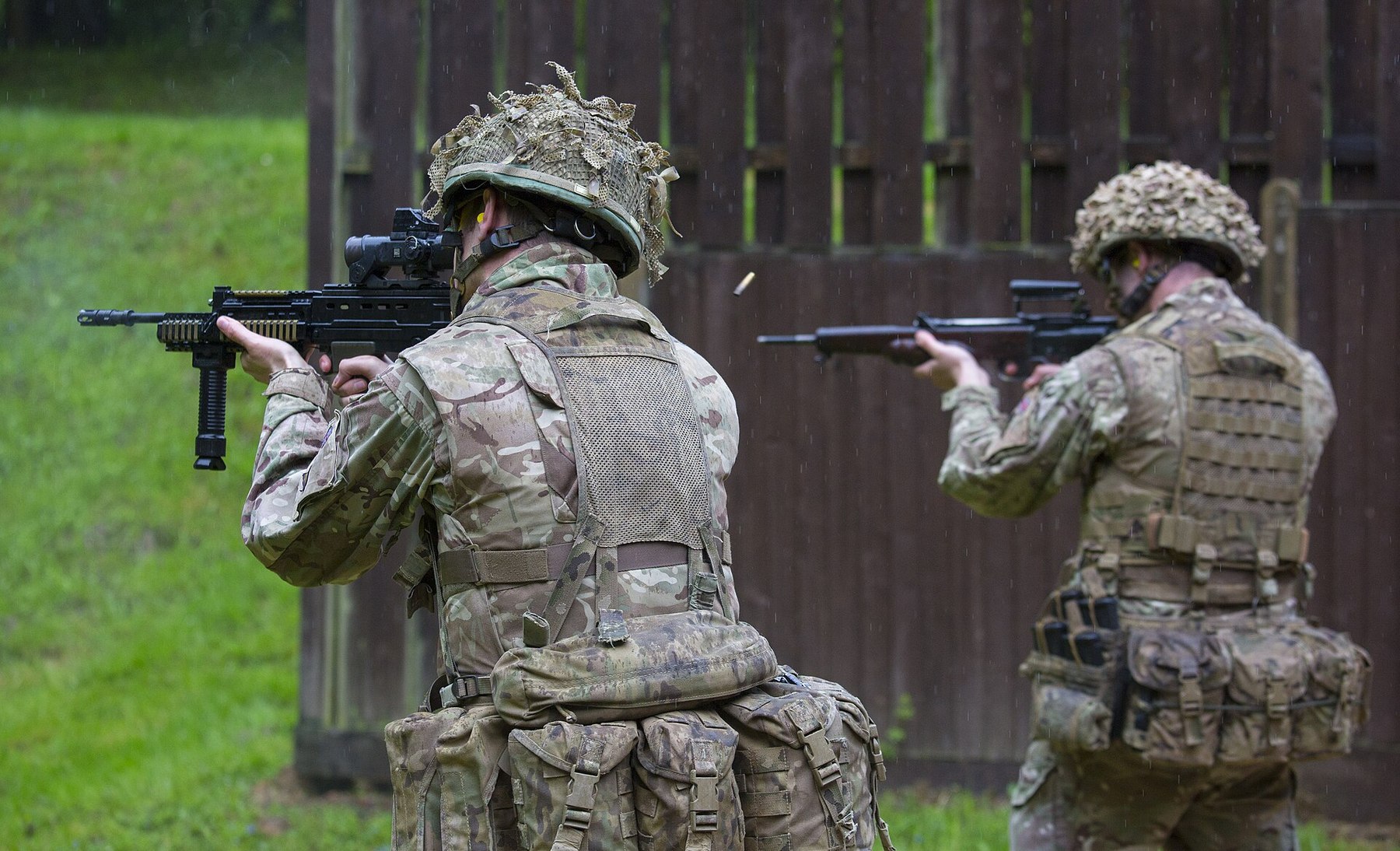
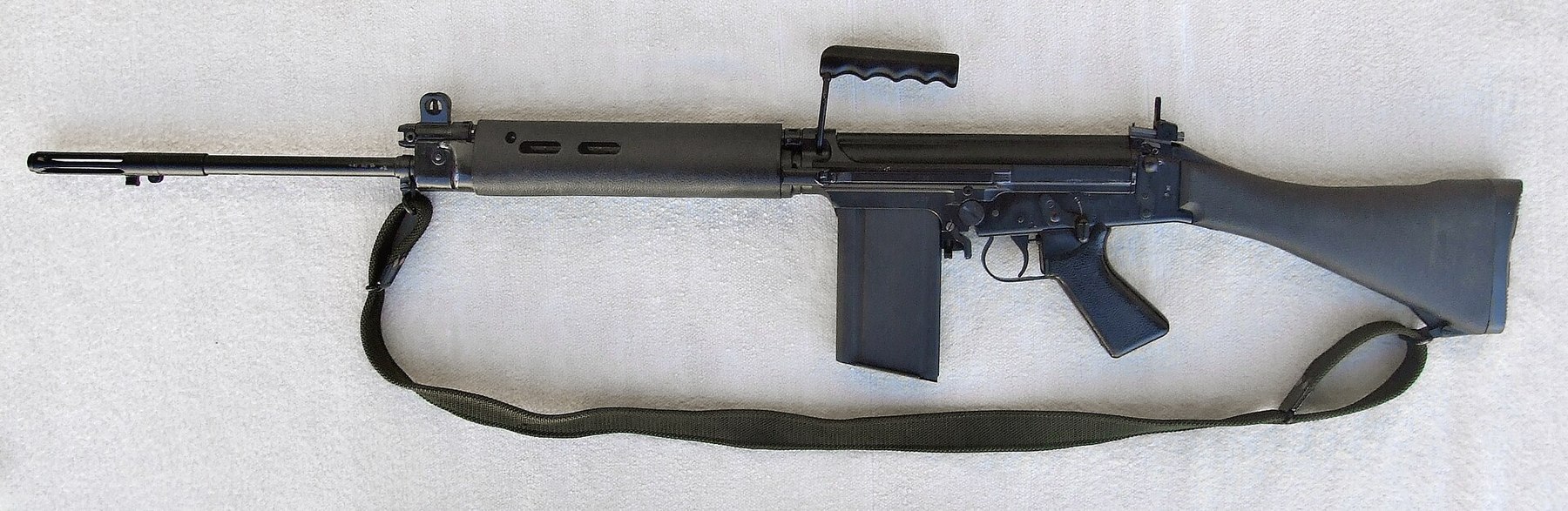
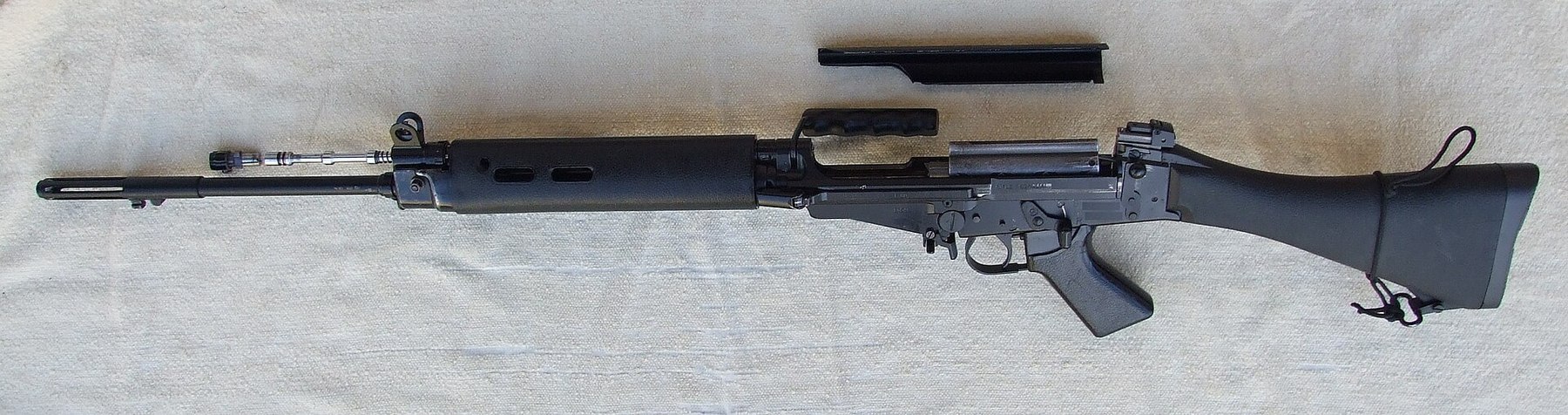
The L1A1 SLR was a semi-automatic version of the FAL in 7.62 × 51 mm. ARES dates its adoption to 1957.29 It served in Malaya, Aden, Borneo, Northern Ireland and the Falklands, and it is still remembered by the generation that carried it. Its weight, length and recoil are where the SA80’s design brief began.
The Royal Ordnance brochure for the new system tabulated the two rifles side by side, and its figures show what the bullpup bought. The SLR weighed 4.3 kg without magazine or optical sight against the new Individual Weapon’s 3.8 kg; it was 1,140 mm long against 785 mm; and its loaded 20-round magazine weighed 0.76 kg against the new rifle’s 0.48 kg for 30 rounds. Its cartridge weighed 25 g; the 5.56 mm round, 12 g. The SLR locked with a “Falling Breech Block, Rear Locking”; the new rifle with a “Rotary Bolt, Forward Locking”.10
The submachine gun that the SA80 was also meant to replace, the 9 mm L2A3 Sterling, has its own history elsewhere in this hub: the E-11 dive, Volume 3 covers the Sterling in detail and records the Dagenham factory’s closure in 1988 as the Army moved to the SA80.
1.7 Why the SLR had to go
By 1970 the SLR was, in the words of the ARES cartridge history, “becoming expensive to produce and difficult to maintain”; Ferguson adds that it was “seen as too heavy and too long for contemporary mechanised warfare, and too hard-recoiling to train troops to shoot well.”92 The intellectual case for a smaller round was older. Two American studies of 1952 — Donald Hall’s for the Ballistic Research Laboratories and Norman Hitchman’s for the Operations Research Office — had concluded, as ARES summarises them, “that small-arms fire was largely ineffective beyond 300 yards, and that the adoption of a ‘small-calibre, high-velocity’ (SCHV) cartridge would both improve hit probability within anticipated engagement ranges and significantly reduce the weight burden on the soldier”.9
The United States had acted on that case first. The US Air Force ordered AR-15s in 1960 and adopted them in 1964, and the Army followed in 1967.9 Britain also bought AR-15s: Ferguson writes that the AR-15 “was initially adopted as a substitute service rifle (as, indeed, it was adopted by the British in 1963)”.2 But the design brief at Enfield was never to buy one. “The AR-15 was to serve as a benchmark, but no serious thought went toward off-the-shelf procurement or licenced manufacture. There seems to have been a strong desire to design and build something in Britain … Cost was an issue, so a pressed steel and polymer construction was assumed from the outset.”2 That last sentence explains much of what followed.
1.8 The 1970 preliminary study
The programme’s starting document was the “Preliminary Study on Small Arms System for 1980”, commissioned in September 1970 and published in December 1971. ARES records that the Royal Armament Research and Development Establishment (RARDE) outlined “A rifle and a light machine gun … chambered for the new ‘optimum’ 5 mm calibre cartridge” on 16 September 1970.9 The study was informed by requirements drawn up by Finabel, a European interoperability body, and it set aside caseless ammunition and flechettes as too immature to arrive in time.2
It produced wooden mock-ups of five configurations:2
Table 1 — The 1970 preliminary study
| Mock-up | Description in the study |
|---|---|
| Orthodox Rifle Type A | ”straight line conventional configuration” (similar to an AR-18) |
| Orthodox LMG Pattern A | the same, as a light machine gun |
| Rifle (Pattern B) | “straight line unorthodox configuration” — a bullpup |
| Rifle (Pattern C) | “drop butt unorthodox configuration with area target capability” |
| LMG (Pattern B) | “drop butt unorthodox configuration” |
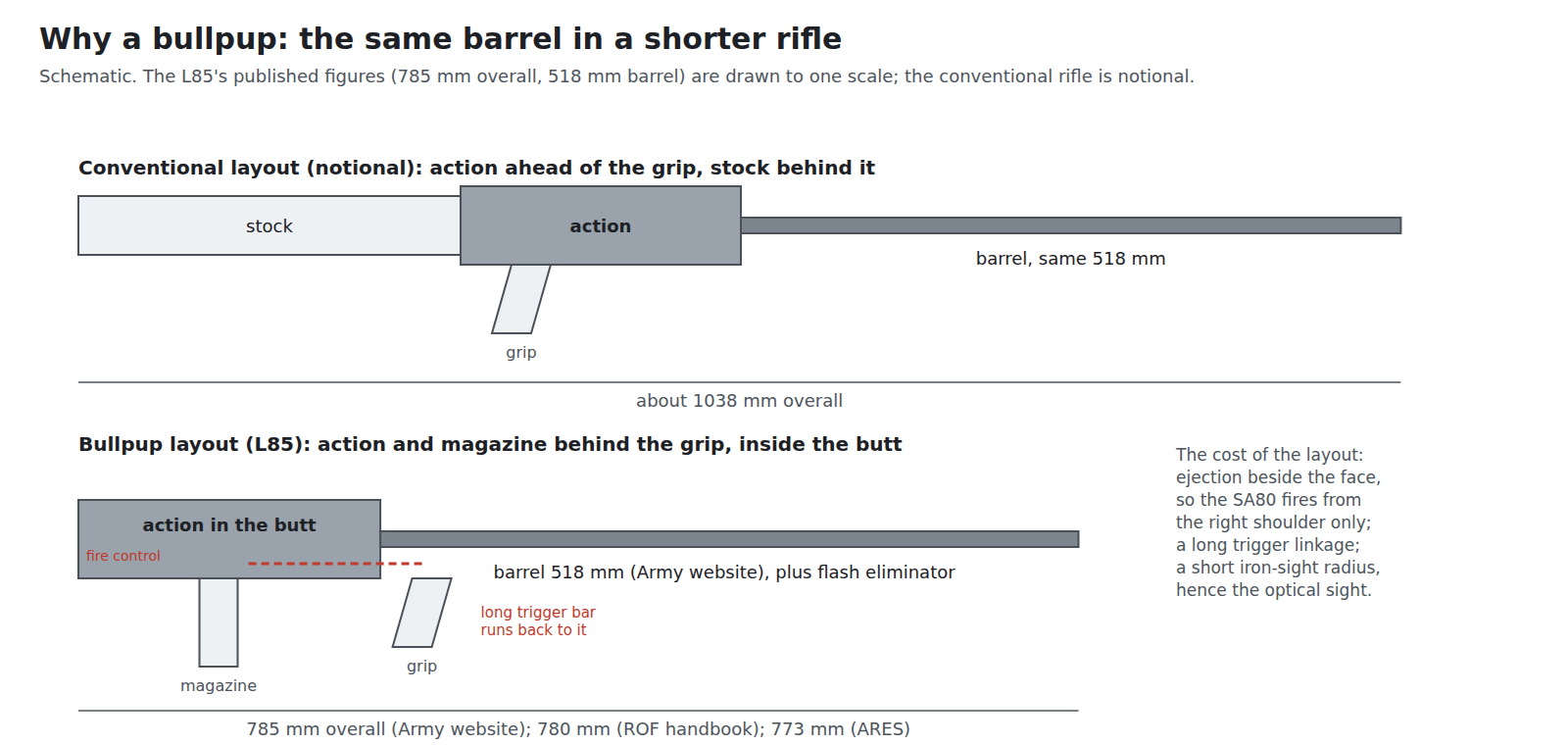
The study’s conclusions shaped everything after it. It advised a calibre “of between 5 and 5.25 mm”; it recommended a three-round burst; and it concluded that “the conventional layout offered no advantages compared with the bullpup”. Its recommended course was, oddly, not its own design but “that an existing weapon design be converted to a bullpup configuration”.2 The surviving Pattern B mock-up shows where the mechanism would come from: “The AR-18 heritage of the Pattern B rifle is plain in its gas system and working parts. The AR-18 gas system, in particular, was recommended in the study as a sound basis for that aspect of the weapon.” Its trigger mechanism, by contrast, was “based upon that of the FAL”.2 The optical sight was required, Ferguson notes, because of “the belief that iron sights would present too short a sight radius to be effective on a bullpup”.2
1.9 The AR-18 and Stoner conversions, and the Sterling story
Following the study’s recommendation, Enfield cut two real rifles into bullpups, probably in 1972. One was an AR-18 given a machined receiver extension, a relocated trigger and a scope mount; the other was a new Stoner 63A, converted into an approximation of the Pattern B light machine gun with an open-bolt trigger pack — “This may be the origin of the open bolt automatic operation of Enfield’s original LSW design.”2
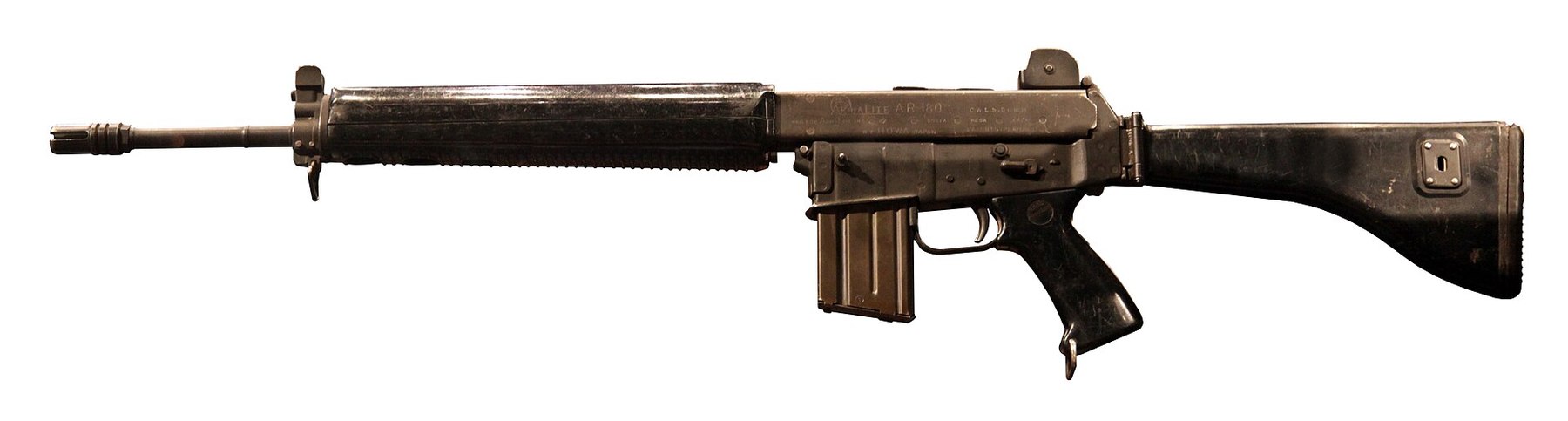
A persistent story says the AR-18 was built from parts obtained from Sterling, the British licensee of the AR-18, by deception. Ferguson examined the rifle and its Pattern Room records and identified it as serial number 000159, made in 1970 by the Howa Machinery Company of Japan, recorded at Enfield by November of the same year. “Sterling did not start production of the AR-18 until 1975, by which time Enfield had moved beyond experimental conversions.”2 A related claim — that the Enfield prototypes shown at Aldershot in 1976 contained Sterling bolt carriers — appeared in The Observer in 1992. Ferguson calls it “impossible”: the prototypes are “mechanically based on the AR-18 to be sure, but containing no interchangeable parts”, and Sterling’s managing director, in his own 1992 book, said only that the parts were close in design.11
Ferguson’s conclusion about the conversions turns the usual reading round: “far from proving that the SA80 is simply a bullpup conversion of an AR-18, these guns showed that directly converting an existing design was not practical or cost-effective.” The study’s own drawing was taken forward instead.2 On intellectual property he notes that ArmaLite’s UK patent of 1967 (GB1056056) claimed a particular receiver architecture in detail, not the gas system, so a design that merely borrowed the principles did not infringe it.11 The AR-18’s own history — ArmaLite, Sterling and Howa — is told in the hub’s ArmaLite AR-7 dive, Volume 2.
1.10 Searching for the optimum calibre: 6.25 mm to 4.85 mm
While the United States moved to the 5.56 × 45 mm M193, Britain ran its own search for an “optimum” calibre. The ARES history of the 4.85 mm cartridge, by Jack Dutschke, sets out the sequence:9
- 1969, 6.25 × 43 mm. Radway Green necked .280/30 cases down to .25 calibre. At least eight ball projectiles were tried; a 100-grain boat-tail was demonstrated to NATO in November 1969. The round was fired from an EM-2 and a No. 4 rifle rechambered for it, at about 2,680 ft/s (817 m/s). Tests were discontinued in October 1970.
- 1970–71, about 5 mm. RARDE’s outline of 16 September 1970 specified a 5 mm calibre. Radway Green delivered the first components in February 1971: a 5.56 × 45 mm case shortened to 44 mm and necked to 5 mm, with a 56-grain boat-tailed lead-core bullet whose shape came from the 6.25 mm work.
- 1972, renamed 4.85. “In early 1972, the nomenclature of the new 5 × 44 mm cartridge was changed. Re-designated the ‘4.85’, this reflected the bore diameter of the lands, rather than the grooves.” The bullet itself measured .197 in, about 5 mm.
- August 1972, lengthened. The short neck caused seating and accuracy problems, and the case was lengthened by 5 mm to 49 mm.
The renaming matters for anyone comparing figures. “4.85” is a land diameter; “5.56” is a nominal groove-related figure; the two names are not measured the same way, and the 4.85 mm bullet was larger than its name suggests.9
1.11 The 4.85 × 49 mm cartridge
The first purpose-made 4.85 × 49 mm rounds came from Radway Green in April 1973, still with the 56-grain bullet and 2.46 in (62.4 mm) overall. In March 1974 Enfield’s feasibility study reported that the cartridge met its design requirements and “outperformed the penetration of 5.56 × 45 mm M193 ammunition at range, whilst offering a slightly lower recoil impulse.” Two service types were developed for trial, the XL1E1 ball and XL2E1 tracer. The ball bullet had a gilding-metal-clad steel jacket and left the muzzle at 950 m/s (3,117 ft/s) with 1,640 J.9 Cases were Berdan-primed and, unusually, unheadstamped until 1976; case production ceased in 1978.9
The same feasibility study set the roles: an Individual Weapon to replace “both the standard-issue rifle (the L1A1) and the standard-issue sub machine-gun (the L2A3)”, and a Light Support Weapon to replace the 7.62 mm L7 general-purpose machine gun “in the light support role”.9 Ferguson’s account of the parallel requirement adds the L4A4 Bren to the list of guns the LSW would replace.11
The weakness in the plan was visible to some from the start. As Ferguson puts it, “any new British SCHV cartridge must, by necessity, be a derivative of 5.56 x 45 mm and could not be wholly original. It is surprising that those involved thought it possible that a slightly necked-down variant of an established cartridge type might prove superior in NATO’s decisive ammunition trials only a few years away.”2
1.12 The ‘00 series’ and the ‘0 series’
The first working rifles were the “485 Weapon System”, named for the calibre. The term was later replaced by “Enfield Weapon System” (EWS), used until about 1982, and finally by “SA80” — “Small Arms of the 1980s” — which the Ministry of Defence had used from the beginning.11
The 1972 requirement asked for 4.85 mm ammunition; a light “unorthodox” or “buttless” layout “capable of conversion at unit armourer level for left-handed users”; an optical sight at least as good as the Sight Unit, Infantry, Trilux (SUIT) then used on the SLR; provision for a night sight; and an area-target capability by rifle grenade or underbarrel launcher.11
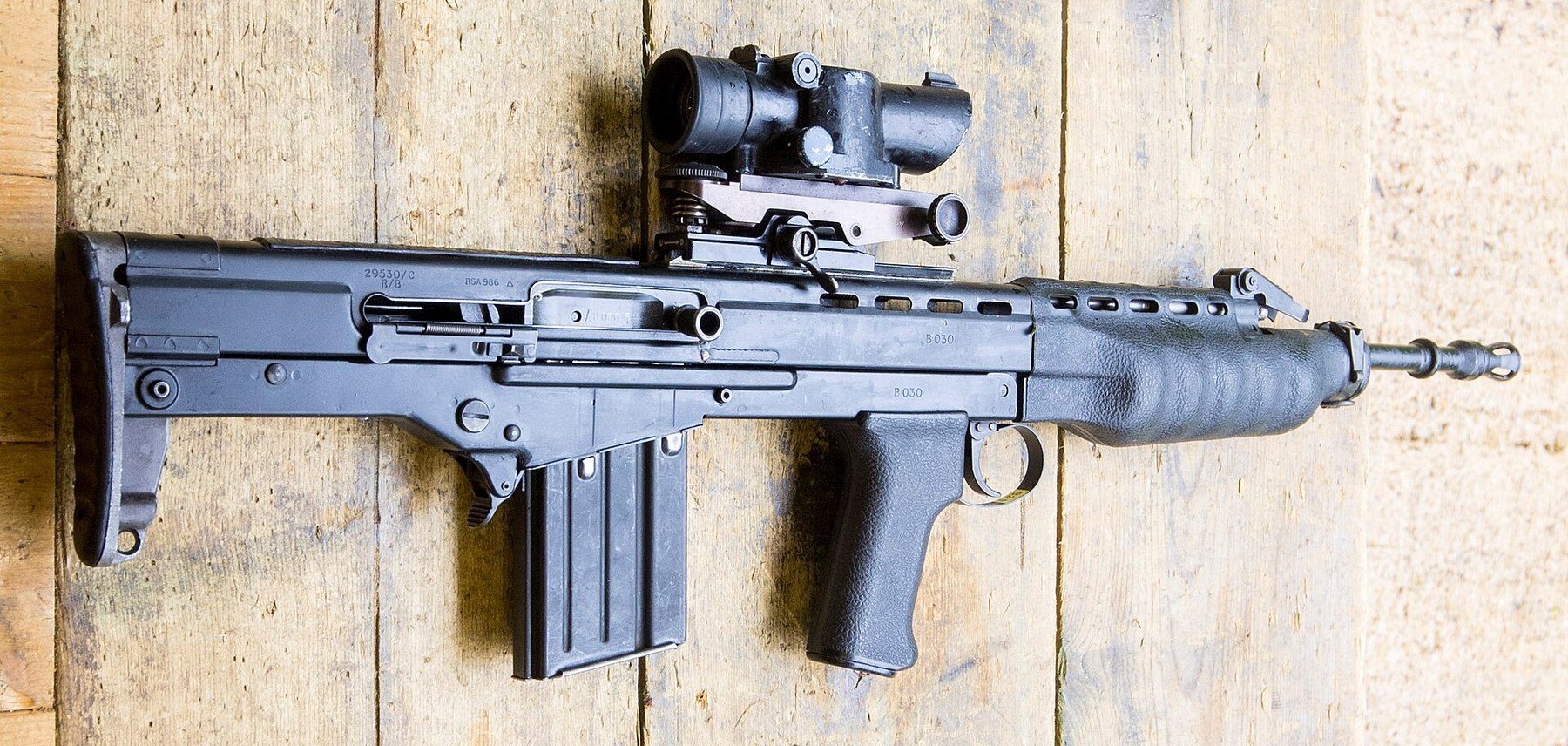
The ‘00 series’. Twelve prototypes were built, serials 001 to 012: eight rifles and four LSWs. One rifle was built in 5.56 × 45 mm “in an early acknowledgement that 5.56 already existed as a rival”. The first prototype, marked “R No. 001” on the body and “No. 001” on the trigger mechanism housing, is in the Royal Armouries.11 Ferguson’s description of it: spot-welded pressed steel, black paint over phosphate, a grey glass-reinforced Nylon 12 handguard and grip machined from solid, no dust cover, a 20-round steel magazine — “necessarily proprietary in design due to the greater overall length of the 4.85 x 49 mm cartridge” — and a prototype SUSAT, later designated XL9E1, serial 001. The cross-bolt selector at the rear of the receiver had three positions: “R” for repetition in the centre, “A” for automatic, and “3” for a three-round burst; the adjustable gas plug was marked “E”, “R” and “0”.11 The specification was 4.85 × 49 mm, 762 mm long, a 533 mm barrel with flash suppressor, 3.30 kg unloaded.11
The bolt head was weak — “a feature actually borrowed from the Stoner 63 bolt” — and the LSW suffered carrier bounce, which was cured by adding a tungsten pellet to the carrier as a reciprocating mass; that feature later went into both weapons.11
The ‘0 series’, built in 1975 and 1976, added rock-in magazines with a catch on the left for the support thumb; a flash suppressor machined integral with the barrel and fitted for 22 mm grenades; moulded furniture with a cheekpiece glued to the body; emergency iron sights, the rear stored in the grip; a bolt hold-open worked by the magazine follower; a reinforced bolt; and a standardised flat-sided carrier for both weapons. Some were marked “FOR TRIALS ONLY”.11
1.13 The Enfield Weapon System revealed: XL64E5 and XL65E4
The system was revealed to the public on 14 June 1976 as the Enfield Weapon System, with experimental Land Service (“XL”) designations. Strictly, the designations belong to the third iteration that followed, after a first round of “value engineering” for mass production:11
Table 2 — The Enfield Weapon System revealed: XL64E5 and XL65E4
| Designation | Role |
|---|---|
| XL64E5 | Individual Weapon, right-handed |
| XL68E2 | Individual Weapon, left-handed |
| XL65E4 | Light Support Weapon (“Machine Gun”), right-handed |
| XL69E1 | Light Support Weapon, left-handed |
These rifles had a FAL- or AK-style paddle magazine catch, revised furniture, a sheet-metal heat shield in the handguard, and optional extended butt-plates to adjust length of pull. The LSW was claimed to share 80 per cent of its parts with the rifle, though its handguard, gas plug, safety sear, change lever and carrier were all different.11
The left-handed variants are the beginning of a story that ends badly. The requirement was for armourer-convertible rifles, and separate left-handed versions were built. But “the SA80 family was never made ‘ambidextrous’ … None of these could be converted without replacing the entire barrelled upper, nor could they fired from the opposite shoulder without risk of injury, specifically the cocking handle striking the user in the face (to say nothing of hot brass cases). In the event, the requirement was dropped and all soldiers taught to fire from the right shoulder.”11 That decision is taken up in Volume 2.
1.14 Sydney Hance and the design patent
The team leader at Enfield was Sydney Hance. Ferguson writes that he “was apparently the only member of the original Enfield team with previous experience of designing firearms, and he retired in 1976”, and that according to Steve Raw’s The Last Enfield “he believed that his design was sound at that stage and had gone awry after his retirement”.12
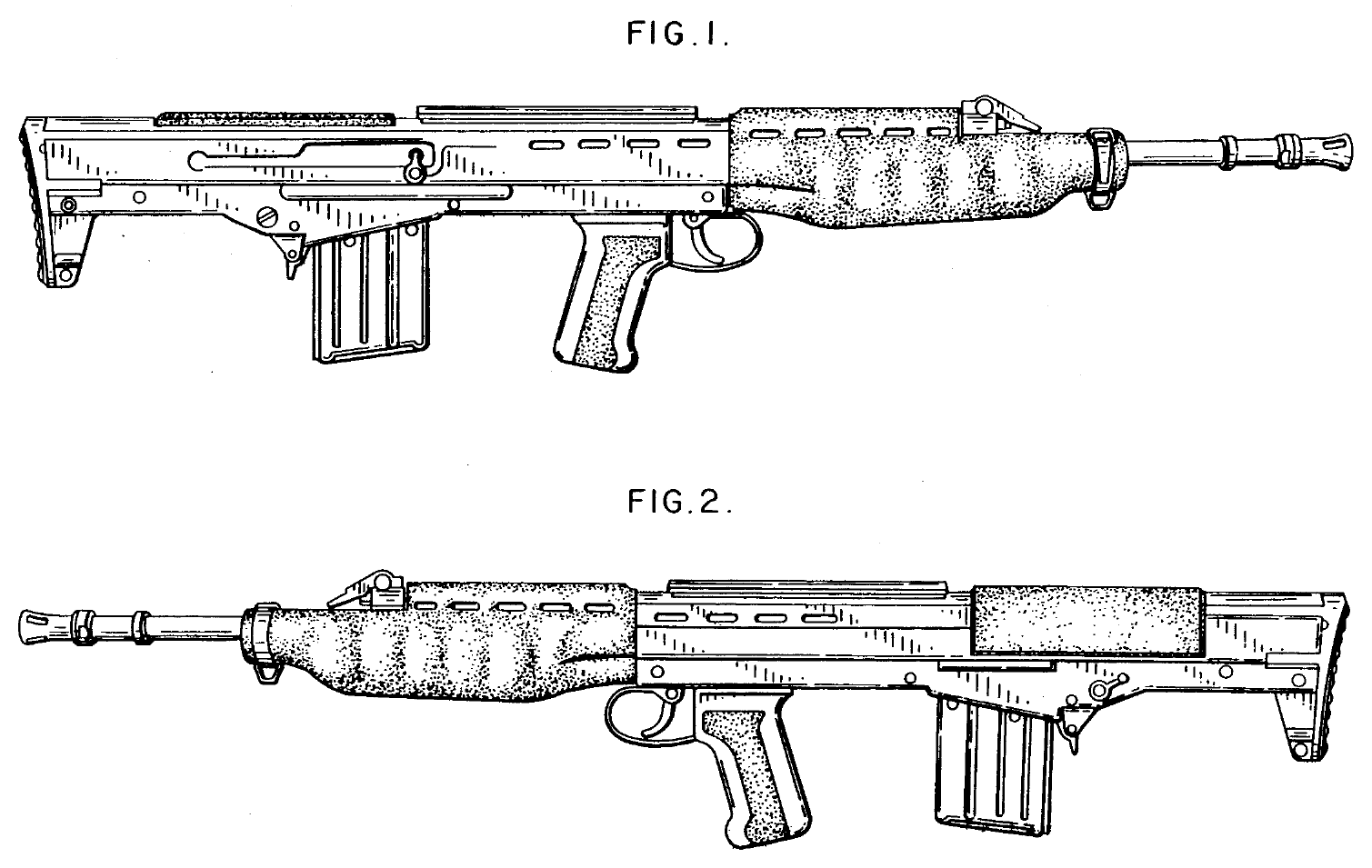
Hance’s US design patent, Des. 251,979, “Automatic firearm”, was filed on 6 June 1977 and published on 29 May 1979.13 It protects the ornamental appearance of the rifle, not its mechanism: its six figures are the two sides, top, bottom, front and rear. Ferguson identifies the rifle shown as “the finalised XL64E5”.12 The patent’s three citations are all American and none of them is ArmaLite’s receiver patent: a 1971 US Army pivoting stock, a 1976 forestock patent and the Army’s 1976 modular squad automatic weapon.13 Ferguson notes that “Hance even patented the EWS design with direct reference to one of Sullivan’s patents”, citing the AR-18’s 1964 folding-stock patent rather than its 1967 receiver patent, “very odd given that the Enfield (as a bullpup) had no butt-stock”.11 The patent drawings are US government documents and are reproduced here.
1.15 The NATO trials, 1977 to 1980
In 1976 NATO agreed to hold new standardisation trials, prompted by the spread of 5.56 mm among its members. The trials ran from 1977; 7.62 × 51 mm from the G3 and MAG and 5.56 × 45 mm M193 from the M16A1 served as controls; Britain entered the 4.85 × 49 mm in the XL64E5 and XL65E4.9 They concluded in early 1979, and on 28 October 1980 NATO announced that the Belgian FN SS109 62-grain projectile in the standard US case was the best of the contenders. That round became 5.56 × 45 mm NATO under STANAG 4172; the United States re-barrelled its M16s with a faster 1 in 7 twist for it.9
ARES’s verdict on the British round: “Whilst the British still considered the 4.85 × 49 mm cartridge to be superior, the advantage was very slight, and logistic and political pressures won over the perceived technical advantage the domestic design offered.”9 The same logic that had killed the .280 in 1953 — a common round with the United States — killed the 4.85 a generation later. The Enfield team turned the rifle over to 5.56 mm, and the project’s internal name became “Enfield Weapon System”, a tacit acknowledgement that 4.85 mm was dead.14
How the 5.56 mm NATO round relates to the commercial .223 Remington, and why the chamber rather than the powder is what matters, is covered in the hub’s AR-15 5.56 dive, Volume 4.
1.16 What the trials revealed about the rifle
The trials were about ammunition, but the rifles were tested too, and they did badly. Ferguson lists the trigger faults: “Weapon firing auto when set to single shot; and Trigger not returning to the fully forward position when released”, blamed on dirt — “Examining a trigger mechanism housing today, it is easy to see why the very tight fit of parts might result in problems of this nature.” There were failures to eject, poor welding, weak and out-of-specification parts, and barrel wear: “the 4.85 mm EWS barrel provided a service life of only 3,000 rounds, compared to 20,000 for the AR-15.”11
The reliability figure that emerged was worse still. The rifles had been expected to reach a mean of 2,500 rounds between failures for the IW and 8,000 for the LSW; “The early figure after the NATO trial was exceptionally low, at just 97 – indicating weapons unfit for military service.”14 Ferguson’s judgement on the XL60 family is nonetheless measured: “in many respects a promising, compact and lightweight design that reflected the cutting edge thinking of the day … However, as we shall see, the path to the truly capable SA80A2 series was to be a long and difficult one.”11 Volume 2 follows that path.
1.17 Corrections this volume makes
- The EM-2 is not the SA80’s ancestor. The two share a layout, a standard optical sight and Sydney Hance; “absolutely nothing of that design was carried through” (Ferguson).
- The EM-2 was not cancelled the moment Churchill took office. Churchill’s own dates: the Army Council recommended the FN on 30 October 1953 and Cabinet approved on 1 December 1953, after the common round was agreed in September 1953 — some two and a half years after the April 1951 announcement.
- The 1951 Commons statement names a calibre, not a rifle. “Rifle No. 9” comes from Dugelby and Ferguson, not Hansard.
- Enfield’s AR-18 conversion was a Japanese Howa rifle, serial 000159, made in 1970, not a rifle built from parts taken from Sterling, which began AR-18 production in 1975.
- “4.85” is a land diameter. The bullet measured .197 in, about 5 mm.
- The SA80’s left-handed requirement was real and was dropped. Left-handed XL variants were built; the decision to teach all soldiers to fire from the right shoulder came later.
References
Footnotes
-
UK Parliament, written answer 45196, Maria Eagle, Minister for Defence Procurement and Industry, answered 28 April 2025: “The British Army’s projected Out of Service Date for the L85A3 (SA80A3) variant of the L85 rifle family is currently 2030.” questions-statements-api.parliament.uk, consulted 2026-10-18. ↩
-
Jonathan Ferguson, “British Enfield SA80 Part 1: Mock-ups”, The Hoplite (Armament Research Services), 5 May 2017. Wayback capture of 13 February 2026, http://web.archive.org/web/20260213181825/https://armamentresearch.com/british-enfield-sa80-part-1-mock-ups/, consulted 2026-10-18. The article carries a note that it is superseded by Ferguson, Thorneycroft to SA80: British Bullpup Firearms, 1901–2020 (Headstamp Publishing, 2021). ↩ ↩2 ↩3 ↩4 ↩5 ↩6 ↩7 ↩8 ↩9 ↩10 ↩11 ↩12 ↩13 ↩14 ↩15 ↩16 ↩17 ↩18
-
House of Commons, “Small Arms (Calibre)”, 25 April 1951, oral answer by Emanuel Shinwell. Historic Hansard, https://api.parliament.uk/historic-hansard/commons/1951/apr/25/small-arms-calibre, consulted 2026-10-18. ↩ ↩2
-
House of Commons, “British Army (New Rifle)”, 1 February 1954, motion moved by Woodrow Wyatt; speeches by Churchill (cc52–64), Head (c58), Wyatt (cc45–51), Shinwell (c59). Historic Hansard, https://api.parliament.uk/historic-hansard/commons/1954/feb/01/british-army-new-rifle, consulted 2026-10-18. ↩ ↩2 ↩3 ↩4
-
Jonathan Ferguson, “The British Janson E.M.2 Automatic Rifle”, Small Arms Review vol. 23 no. 2, February 2019, posted 23 February 2019, https://smallarmsreview.com/the-british-janson-e-m-2-automatic-rifle, consulted 2026-10-18. ↩ ↩2 ↩3 ↩4 ↩5 ↩6 ↩7 ↩8 ↩9
-
“EM-2 rifle”, English Wikipedia, consulted 2026-10-18, citing Thomas B. Dugelby, EM-2: Concept and Design (Collector Grade, 1980), pp. 149 and 258–261. Dugelby was not seen. The “only 50” figure is attributed by the article to an MHQ / HistoryNet piece. ↩ ↩2
-
House of Commons, “280 Rifle (N.A.T.O. Discussions)”, 6 July 1951, vol. 489 cc2669–73. Historic Hansard, https://api.parliament.uk/historic-hansard/commons/1951/jul/06/280-rifle-nato-discussions, consulted 2026-10-18. ↩
-
House of Commons, written answer, “280 Rifle (Development Expenditure)”, 1 February 1954, Duncan Sandys. Historic Hansard, https://api.parliament.uk/historic-hansard/commons/1954/feb/01/280-rifle-development-expenditure, consulted 2026-10-18. ↩
-
Jack Dutschke, “A Cartridge in Brief: 4.85 × 49 mm British”, The Hoplite, 18 September 2018. Wayback capture of 13 December 2025, http://web.archive.org/web/20251213163030/http://armamentresearch.com/a-cartridge-in-brief-4-85-x-49-mm-british/, consulted 2026-10-18. Its sources include Raw (2003), Mancini (1979) and the British Army’s NATO Trials Edition User Handbook for the 4.85mm Weapon System, AC 61507 (1976), which was not seen for this dive. ↩ ↩2 ↩3 ↩4 ↩5 ↩6 ↩7 ↩8 ↩9 ↩10 ↩11 ↩12 ↩13
-
Royal Ordnance, The Enfield Weapon System (sales brochure, Royal Ordnance, Griffin House, The Strand, London, c. 1985), technical data table. Flip-book hosted by the UK Historic Arms Resource Centre, https://www.rifleman.org.uk/Images/PDF-files/Enfield_Weapons_System/index.html, consulted 2026-10-18. Royal Ordnance copyright; quoted, not reproduced. ↩
-
Jonathan Ferguson, “British Enfield SA80 Part 2: XL60 series”, The Hoplite, 10 May 2017. Wayback capture of 17 January 2026, http://web.archive.org/web/20260117101829/http://armamentresearch.com/british-enfield-sa80-part-2-xl60-series/, consulted 2026-10-18. ↩ ↩2 ↩3 ↩4 ↩5 ↩6 ↩7 ↩8 ↩9 ↩10 ↩11 ↩12 ↩13 ↩14 ↩15 ↩16
-
Jonathan Ferguson, “British Enfield SA80 Part 4: XL80 Series”, The Hoplite, 17 May 2017. Wayback capture of 17 January 2026, http://web.archive.org/web/20260117090848/http://armamentresearch.com/british-enfield-sa80-part-4-xl80-series/, consulted 2026-10-18. ↩ ↩2
-
Sydney R. Hance, “Automatic firearm”, US Des. 251,979, filed 6 June 1977 (application 05/803,782), published 29 May 1979; citations US3618249A, US3939589A, US3999461A. Google Patents, https://patents.google.com/patent/USD251979S/en, consulted 2026-10-18. ↩ ↩2
-
Jonathan Ferguson, “British Enfield SA80 Part 3: XL70 series”, The Hoplite, 13 May 2017. Wayback capture of 17 January 2026, http://web.archive.org/web/20260117101906/http://armamentresearch.com/british-enfield-sa80-part-3-xl70-series/, consulted 2026-10-18. ↩ ↩2
Comments (0)