SA80 (L85 Family) · Volume 7
Accuracy and Ammunition
From 4.85 mm to the L15 ball round, the 1-in-175 mm twist, muzzle velocities, the maker's zeroing standard and correct zero position, the marksmanship claims, the LSW's split groups, and what a US owner should feed an SA80-pattern rifle
7.1 What this volume covers
Accuracy is the one quality of the SA80 that nobody in the parliamentary record disputed. Its critics conceded it before turning to reliability, and ministers led with it. This volume sets out what the published evidence actually says: about the ammunition, about the barrel, and about how accuracy was measured. It finds less than the rifle’s reputation suggests. There is no published mechanical accuracy figure for any SA80 from an official source. What exists is a marksmanship statistic from 1988, a maker’s zeroing standard for the firer, and an engineering story about the LSW’s barrel.
7.2 The cartridge: from 4.85 mm to 5.56 mm NATO
Volume 1 told the cartridge history: Britain’s own 4.85 × 49 mm, designed in the early 1970s, which “outperformed the penetration of 5.56 × 45 mm M193 ammunition at range, whilst offering a slightly lower recoil impulse”, and which lost to the Belgian SS109 projectile in NATO’s trials. NATO announced the result on 28 October 1980, and the SS109’s 62-grain bullet in the US case became 5.56 × 45 mm NATO.1 By 1983 ministers said the SA80 weapons were “being manufactured to the new NATO small arms calibre of 5·56mm”.2
How 5.56 mm NATO relates to the commercial .223 Remington — the chamber and leade, not the powder, are what differ — is covered in the hub’s AR-15 5.56 dive, Volume 4, and is not repeated here.
7.3 The British service round
The Ministry of Defence has said very little in public about its ammunition, but two written answers of 2025–26 settle the basics.
- Bullet weight. “The standard 5.56 x 45mm ball round used by the UK Armed Forces has a bullet weight of four grams, equivalent to 62 grains.”3 That is the SS109 weight.
- Designations. “According to Defence General Munitions records, the following 5.56 x 45mm ball rounds heavier than four grams are in use by the UK’s Armed Forces: ROUND 5.56MM BALL CARTON L15A2; ROUND 5.56MM BALL CARTON L15A3; ROUND 5.56MM BALL CARTON L15A4.”4 The question asked for rounds heavier than four grams; the answer lists the L15 family. Whether the answer means the cartridge’s weight (the 12 g the Royal Ordnance documents give for a whole round) or the bullet’s is not explained, and the answer is quoted as given.
- Compatibility. When the L403A1 rifle was procured for the Rangers, “Safe and Suitable for Service assessments … against the UK standard L15A2 5.56.x 45mm round and the M855 5.56 x 45mm US round” found “No functional, reliability or safety issues”.5 The L15A2 is therefore the “UK standard” round in 2026, and the American M855 is its documented equivalent.
No official statement of the L15’s bullet construction, muzzle velocity in the L85A2, or its predecessors’ designations was found. The 4.85 mm rounds of the 1970s came from the Royal Ordnance factory at Radway Green (Volume 1);1 who has made the 5.56 mm service round since was not researched for this dive.
7.4 The maker’s ammunition claims
Royal Ordnance’s brochure for the Enfield Weapon System described the ammunition in sales language: it “meets the performance requirements of both the UK and NATO. In meeting operational requirements it is fully effective up to a range of 1000 metres as generally required in infantry operations … A variety of natures are available, i.e. Ball, Tracer, Blank Drill and Low Power Training. An important feature of the ammunition is that it is less than half the weight of the alternative standard NATO 7.62 mm ammunition.”6 The handbook gives the round’s weight as 12 g, against 25 g for the SLR’s 7.62 mm.76
The “1000 metres” is a maker’s claim for the cartridge and should be read against the Army’s own figure for the rifle: an effective range of 400 m (below).
7.5 Barrel and twist
The handbook’s technical data give the rifling as 4 grooves, right hand, “1 Turn in 175” mm — about 1 in 6.89 inches.7 It is usually quoted as “1 in 7”. The faster twist was chosen for the SS109; the first 5.56 mm XL70 barrels had been rifled 1 in 12 inches for the M193, with a faster twist “anticipated” for the new NATO bullet.8
The barrel is 518 mm long without the flash suppressor (Army website, ARES).910 Its profile is unusual: on the XL80 Ferguson notes that the barrel “tapers up drastically under handguards”, thin at the muzzle and thick near the chamber.11 The A2’s barrel was “remanufactured in higher grade steel”.10 Whether it is chrome-lined is not stated in the sources found; the XL70’s barrel wear had been blamed on “poor metallurgy and a lack of chrome lining”.8
The barrel screws into a barrel extension welded into the body (Volume 5), so headspace and the bolt’s lock-up are set between a barrel and a part of the receiver.
7.6 Velocity and range
Table 1 — Velocity and range
| Figure | Value | Source |
|---|---|---|
| Muzzle velocity, IW | 940 m/s | ROF handbook 1985; Army website |
| Muzzle velocity, LSW | 970 m/s | ROF handbook 1985 |
| Muzzle velocity, L22A2 carbine | about 780 m/s (from about 930) | ARES 6 |
| Effective range, L85A2 | 400 m | Army website |
| Effective range, L22A2, rapid fire | 200 m | ARES 6 |
| Recoil energy | 4 J | ROF handbook 1985 |
| Round weight | 12 g | ROF handbook and brochure |
Sources: handbook and brochure,76 Army website,9 ARES Part 6.12
The Army website’s figure is for the rifle with its standard 4× sight; it is an effective range for the soldier, not a maximum range for the bullet.
7.7 What “accurate” meant
The SA80’s reputation for accuracy rests on three statements, none of which is a mechanical test.
- The 1988 marksmanship figure. “Whereas an average of 8 per cent. of recruits would reach army marksmen standard using the SLR, the figure for the SA80 is 50 per cent.”13 The statement does not say how the comparison was made. The obvious confound is the sight: the SLR was fired with iron sights, the SA80 with a 4× SUSAT. A lighter recoil (4 J, by the maker’s figure) and a shorter, rear-balanced rifle are others.
- The Army website. “On its introduction, it proved so accurate that the Army marksmanship tests had to be redesigned.”9 No date or document is given for the redesign.
- The parliamentary consensus. Even the rifle’s sharpest critics in Parliament called it accurate — “a capable and accurate weapon” (Spellar, 2000), “It is an accurate weapon … but it is not as reliable” (Maginnis, 2000).1415
No official group size for an L85 at any distance was found: no acceptance standard for barrels, no test-target figure, no mechanical-rest result. The rifle is accurate enough to shoot well with — that is what the marksmanship figures measure — but how accurate the rifle itself is has not been published.
7.8 The maker’s zeroing standard
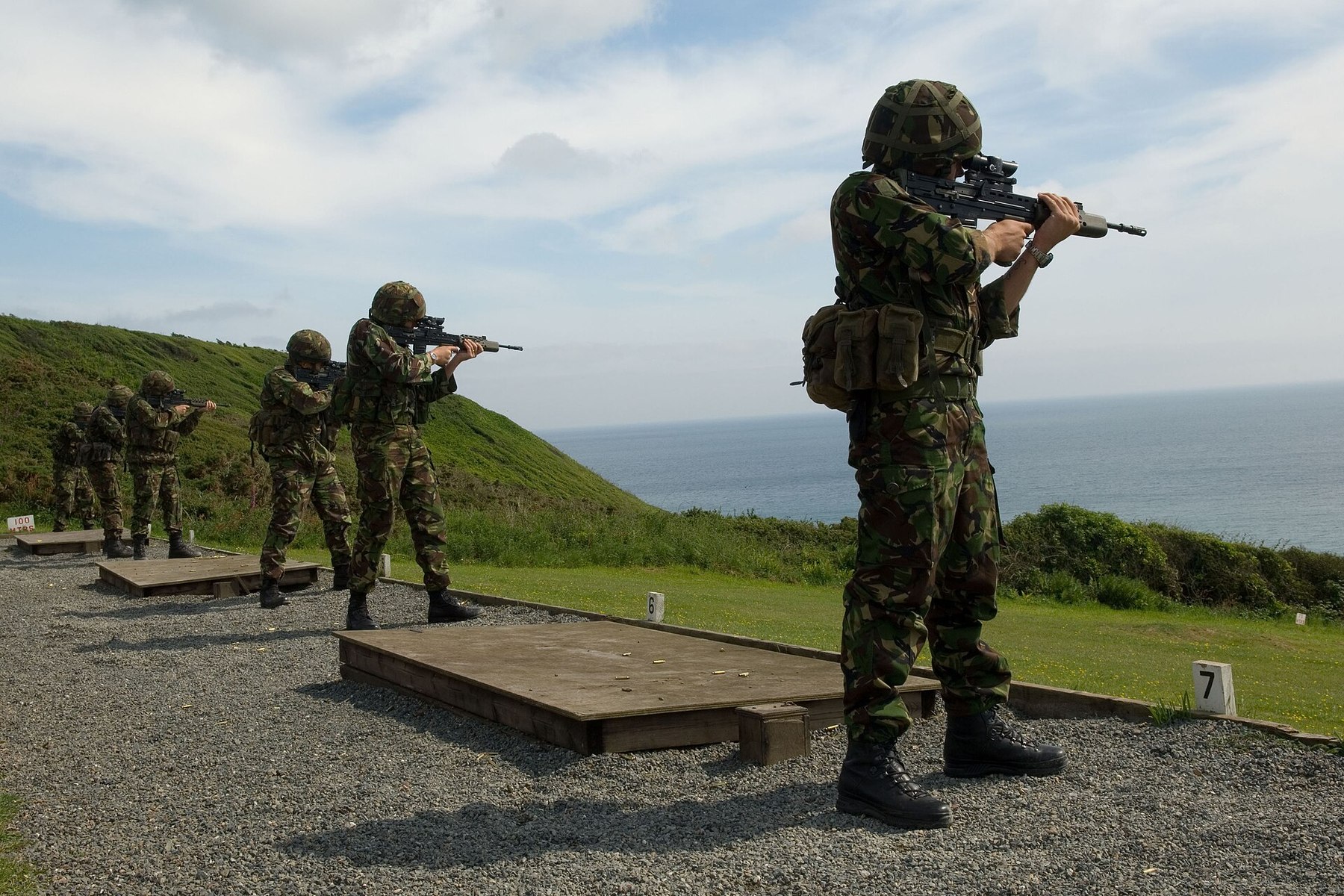
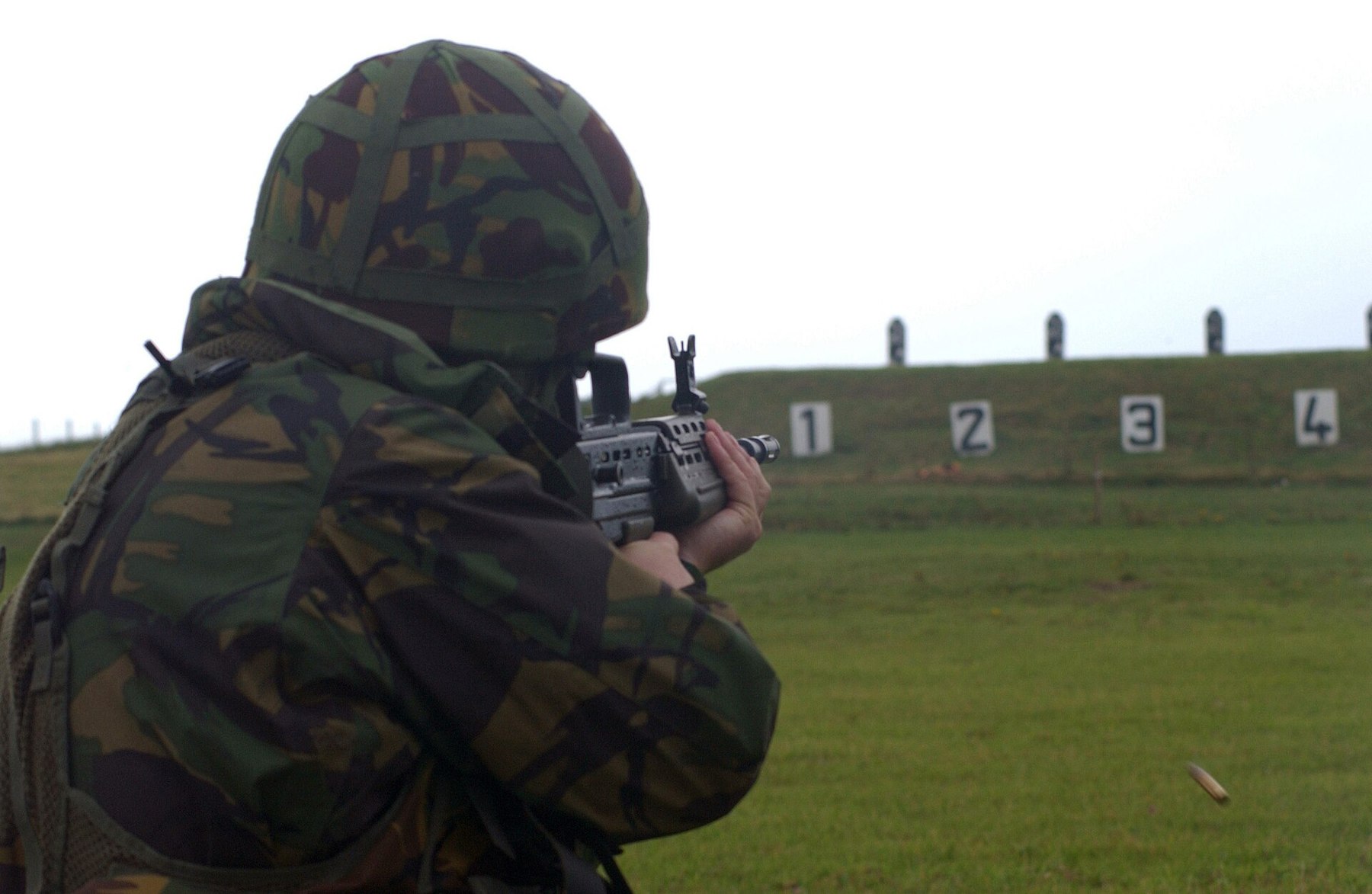
What the maker did publish is a standard for the firer. “To determine the true position of the MPI, a number of shots, not less than 20, should be fired at the same aiming mark under the same conditions. The firer must be capable of consistently achieving an average of 150mm group using the SUSAT sight or 200mm group using an Iron Sight, with 5 rounds at 100 metres.”7
A 150 mm group at 100 m is about 5.2 minutes of angle; 200 mm is about 6.9. These are not rifle accuracy figures. They are the threshold below which a soldier’s own wobble is small enough for a zero to mean anything. The figures do show how much the optic was expected to help: the same rifle, with the same firer, is expected to group a third tighter through the SUSAT than over its iron sights.
The handbook explains why zeroing is personal — “It is essential for each firer to zero his own weapon because: 1. Variations in aiming. 2. Effect of ‘weapon jump’, influenced by the build, firing position and grip of the firer” — and when it is done: “On initial issue of the weapon”; “Before and, whenever possible, during active service”; on change of sight; and “When accuracy of weapon is in doubt.”7
7.9 Correct zero position and sight adjustment
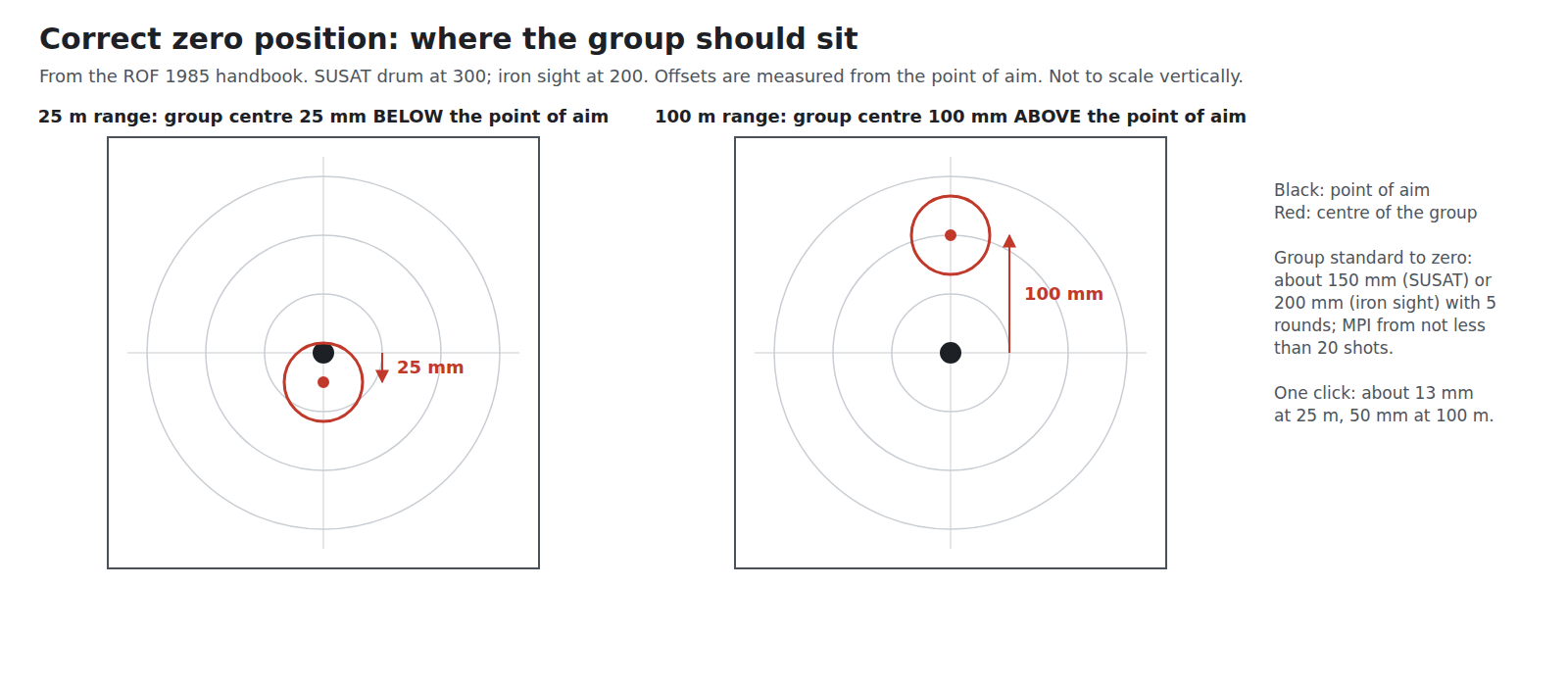
“The ideal range for zeroing is 100 metres, which combines clarity of aim with lack of wind effect. A range of 25 metres may be used if 100 metre range is not available.”7 The handbook’s correct zero position (CZP), the same for the IW and the LSW:
Table 2 — "The ideal range for zeroing is 100 metres, which combines clarity of aim with lack of wind effect. A range of 25 metres may be used if 100 metre range is not available."[^rohb] The handbook's correct zero position (CZP), the same for the IW and the LSW
| Sight | Sight setting | CZP at 100 m | CZP at 25 m |
|---|---|---|---|
| SUSAT | 300 m | 100 mm above the point of aim | 25 mm below the point of aim |
| Iron sight | 200 m | 100 mm above | 25 mm below |
The two offsets describe one trajectory: zeroed for 300 m on the SUSAT’s drum, the bullet is still rising at 100 m and has not yet crossed the line of sight at 25 m.
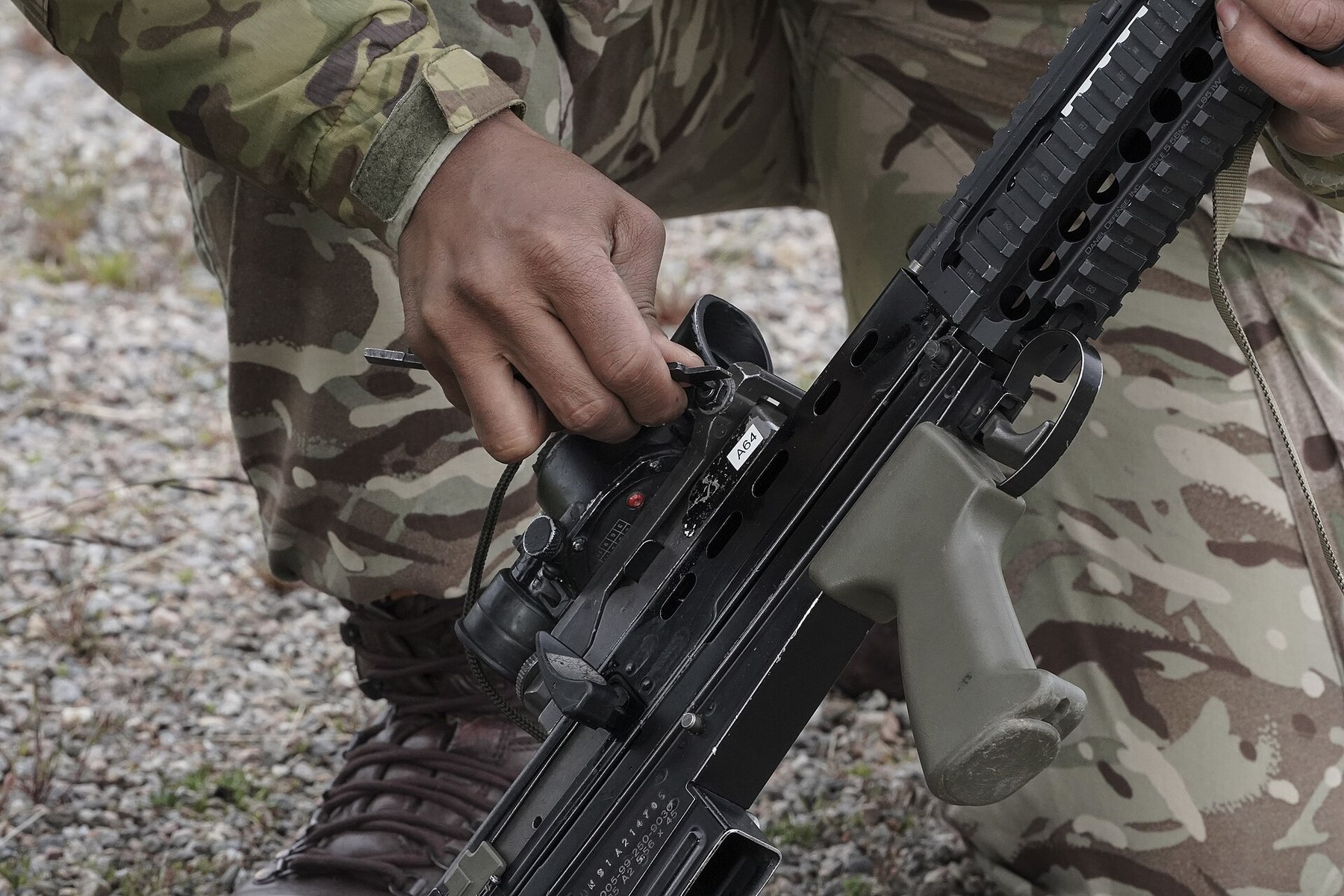
Adjustment, for both sights: “One graduation moves the MPI approximately 13mm vertically at 25 metres or 50mm at 100 metres”, and the same horizontally.7 That is 0.5 milliradian a click. On the SUSAT, elevation is a nut turned in the direction of arrow “U” or “D”; direction is a screw turned toward “L” or “R” after loosening its lock-nut, then “turn the opposite adjustment screw against the direction of its arrow, then tighten the lock-nuts”. On the iron sight, elevation is on the foresight, released by a locking plunger, and direction is on the carrying handle; the combination tool turns both.7
7.10 The LSW and its split groups
The LSW’s accuracy problem was diagnosed in development and fixed with hardware. The XL70 LSWs suffered “split groups”, where successive shots fell into two clusters.8 The cure on the XL80 was the outrigger, the frame under the barrel that carries the bipod: it “effectively clamped the end of the barrel in place, producing a stiffer barrel without increasing its weight”.11 The handbook gives the LSW 970 m/s against the IW’s 940 m/s.7
Its reputation as a precision rifle is another matter. Ferguson records a 2015 feasibility study of the L86A2 as a weapon for the second man of a sniper pair, to supplement the 7.62 mm L129A1, but adds that “its reputation as a 5.56 mm ‘sharpshooter’ substitute has been exaggerated”.10
7.11 The carbine
H&K’s L22A2 trades accuracy and velocity for length. Its gas plug was redesigned for the higher port pressure of the short system; its muzzle velocity is about 780 m/s against the rifle’s 930, by Ferguson’s figures, and its effective range for rapid fire is given as 200 m.12 It has no iron sights.
7.12 Training ammunition and the .22 adaptor
The brochure lists Ball, Tracer, Blank Drill and Low Power Training natures, and among the accessories a “0.22” training adaptor”.6 The UK Historic Arms Resource Centre records a .22 rimfire conversion unit for the L98A1 cadet rifle.16 Blank firing needs the blank-firing attachment (Volume 6). No details of the low-power training round were found.
7.13 What a US owner should feed an SA80-pattern rifle
The one US-made semi-automatic SA80 in production in 2026, Murdoch & Co.’s EM85 (Volume 9), is advertised as chambered in 5.56 with a 1-in-7 twist and a 20.0-inch barrel.17 On those figures it behaves as any 5.56 mm rifle with a fast twist: it stabilises the 62-grain M855/SS109 class and heavier bullets; the chamber, not the twist, decides whether .223 Remington and 5.56 mm NATO are interchangeable. The hub’s AR-15 5.56 dive, Volume 4 covers that.
Two points are specific to the SA80 pattern:
- Gas. The SA80’s gas plug has a normal and an excess setting, and the maker’s rule was to clean and gauge the gas parts every 200 rounds (Volume 6). Murdoch advertises an “Adjustable gas system” on its A3 rifle.18 Low-powered commercial loads that function an AR-15 may not function a rifle whose gas is set for military pressure; the owner’s manual, not this dive, is the authority.
- The AR-based lookalikes (Volume 9) are AR-15 or AR-180B-pattern rifles in SA80 furniture. Their ammunition behaviour is their donor upper’s, not an SA80’s.
No published load data or accuracy test of the EM85 was found.
7.14 What was not found
- Any official mechanical accuracy figure for the L85A1, A2, A3, L86 or L22.
- Barrel life of the A2 or A3 barrel; whether it is chrome-lined.
- The L15A2’s construction and velocity from an official source; the designations of earlier British 5.56 mm ball rounds.
- How the 1988 marksmanship comparison was made.
7.15 Corrections this volume makes
- The rifling twist is 1 turn in 175 mm, about 1 in 6.89 inches; “1 in 7” is a rounding.
- The “1000 metres” effective range is a maker’s sales claim for the cartridge; the Army’s figure for the rifle is 400 m.
- The maker’s 150 mm and 200 mm figures are firer standards for zeroing, not rifle accuracy specifications.
- The UK standard ball round in 2026 is the L15A2, with a 4-gram (62-grain) bullet, and the US M855 has been assessed as safe and suitable in the L403A1.
- No official group size for any SA80 has been published. The rifle’s reputation for accuracy rests on marksmanship statistics, not mechanical tests.
References
Footnotes
-
Jack Dutschke, “A Cartridge in Brief: 4.85 × 49 mm British”, The Hoplite, 18 September 2018. Wayback capture of 13 December 2025, http://web.archive.org/web/20251213163030/http://armamentresearch.com/a-cartridge-in-brief-4-85-x-49-mm-british/, consulted 2026-10-18. ↩ ↩2
-
House of Commons, “The Army”, 17 November 1983, John Stanley. https://hansard.parliament.uk/Commons/1983-11-17/debates/92e87d21-0431-4293-b74e-b38e4effa1d7/, consulted 2026-10-18. ↩
-
UK Parliament, written answer 77262, Luke Pollard, answered 13 October 2025. questions-statements-api.parliament.uk, consulted 2026-10-18. ↩
-
UK Parliament, written answer 16662, Luke Pollard, answered 13 July 2026. https://questions-statements.parliament.uk/written-questions/detail/2026-07-07/16662, read through the questions-statements API, consulted 2026-10-18. ↩
-
UK Parliament, written answer 16663, Luke Pollard, answered 13 July 2026. questions-statements-api.parliament.uk, consulted 2026-10-18. ↩
-
Royal Ordnance, The Enfield Weapon System (sales brochure, c. 1985), “Ammunition” and “Accessories”. Via the UK Historic Arms Resource Centre, https://www.rifleman.org.uk/Images/PDF-files/Enfield_Weapons_System/index.html, consulted 2026-10-18. ↩ ↩2 ↩3 ↩4
-
Royal Ordnance, 5.56mm Enfield Weapon System: User Handbook, copyright Royal Ordnance plc 1985: Technical Data pp. 2–3; Settings and Adjustments pp. 57–61. Via the UK Historic Arms Resource Centre, https://www.rifleman.org.uk/Images/PDF-files/SA80-user-manual/index.html, consulted 2026-10-18. ↩ ↩2 ↩3 ↩4 ↩5 ↩6 ↩7 ↩8 ↩9
-
Jonathan Ferguson, “British Enfield SA80 Part 3: XL70 series”, The Hoplite (Armament Research Services), 13 May 2017. Wayback capture of 17 January 2026, http://web.archive.org/web/20260117101906/http://armamentresearch.com/british-enfield-sa80-part-3-xl70-series/, consulted 2026-10-18. ↩ ↩2 ↩3
-
British Army, “Small arms and support weapons”, army.mod.uk. Wayback capture of 28 September 2024, http://web.archive.org/web/20240928000237/https://www.army.mod.uk/equipment/small-arms-and-support-weapons/, consulted 2026-10-18. ↩ ↩2 ↩3
-
Jonathan Ferguson, “British Enfield SA80 Part 5: SA80 A1 vs A2”, The Hoplite, 20 May 2017. Wayback capture of 28 May 2017, http://web.archive.org/web/20170528111515/http://armamentresearch.com:80/british-enfield-sa80-part-5-sa80-a1vsa2/, consulted 2026-10-18. ↩ ↩2 ↩3
-
Jonathan Ferguson, “British Enfield SA80 Part 4: XL80 Series”, The Hoplite, 17 May 2017. Wayback capture of 17 January 2026, http://web.archive.org/web/20260117090848/http://armamentresearch.com/british-enfield-sa80-part-4-xl80-series/, consulted 2026-10-18. ↩ ↩2
-
Jonathan Ferguson, “British Enfield SA80 Part 6: Carbines”, The Hoplite, 24 May 2017. Wayback capture of 18 January 2026, http://web.archive.org/web/20260118060548/http://armamentresearch.com/british-enfield-sa80-part-6-carbines/, consulted 2026-10-18. ↩ ↩2
-
House of Commons, “The Army”, 26 January 1988. https://hansard.parliament.uk/Commons/1988-01-26/debates/24f91e46-84c9-49ab-8aae-ae49353a0ecb/, consulted 2026-10-18. ↩
-
House of Commons, “Defence White Paper”, 22 February 2000, John Spellar. https://hansard.parliament.uk/Commons/2000-02-22/debates/c6530212-c613-4853-b085-326d9cd3087e/, consulted 2026-10-18. ↩
-
House of Commons, “Armed Forces Personnel”, 13 April 2000, Ken Maginnis. https://hansard.parliament.uk/Commons/2000-04-13/debates/b71b25a6-679a-4ccf-a108-47e9cbc58932/, consulted 2026-10-18. ↩
-
UK Historic Arms Resource Centre, “L85A1 (SA80) with SUSAT sight” and cadet GP rifle pages, https://www.rifleman.org.uk/L85A1_SA80_with_SUSAT_Sight-roto.html, consulted 2026-10-18. ↩
-
Murdoch & Co., “EM-85”, specifications, https://murdochandco.com/em-85/, consulted 2026-10-18. ↩
-
Murdoch & Co., “EM85A3”, https://murdochandco.com/em85a3/, consulted 2026-10-18. ↩
Comments (0)