Steyr AUG · Volume 11
The NylAUG — Route C in Printed Nylon
A community-designed printed receiver for the surplus kit: what it keeps from the box, the two denials it rests on and the order they must be done in, an AR-15 barrel extension as the locking interface, a gas system rebuilt from a press fit to a slip fit, the §922(r) count, and what is not settled
Vol 7 §7.4 set out three ways to get the one part an import kit cannot supply, the receiver, and left the third, a receiver made in the builder’s own shop, as a route this dive “can name but not solve”. There was no drawing, no known location for the semi-automatic interlock, and no account of how a home-made receiver would carry its loads. A published community design addresses all three. The NylAUG is a receiver printed in fibre-filled nylon and assembled around the parts of a surplus military AUG kit. Its release pack, version 1.0, contains two build guides, a print-orientation guide, a function checklist, a summary of a conversation with ATF, and the print files for the receiver, the jigs and a range of accessories.
This volume documents that design at reference depth: what it is, what it keeps from the kit, the legal reasoning it depends on, and where its engineering departs from Steyr’s. It does not reproduce the pack’s step-by-step procedures, jig dimensions or barrel drawing; those remain in the pack, and a builder works from the pack itself. The boundary set in Vol 7 still holds here: nothing in this dive describes how an AUG fires automatically, and the denials described below are described by what they prevent, not by the geometry of what they prevent.
11.1 What the NylAUG Is
The pack’s own description is “a groundbreaking hybrid material firearm”, “part surplus kit, equal parts innovative 3D printed design with a healthy addition of light metal fabrication”, intended to be “printed with ease (minimal supports)” in “heat resistant nylon filament”. It fires 5.56×45 mm only.1
The credits name two main developers of the receiver, four contributors to the barrel and gas block, seven to accessories and tooling, six to the documentation and the denials, and four “very high-round count tester[s] (1000+)”. All are pseudonyms.2 The pack is licensed piecemeal: “Different developers have opted to license their designs differently”, and a builder is asked to respect each designer’s licence and credit the designer.3 The guides are dated 4 September 2023 and the latest files in the archive 29 September 2023. The copy documented here was downloaded in September 2026, and nothing in it shows a later revision.
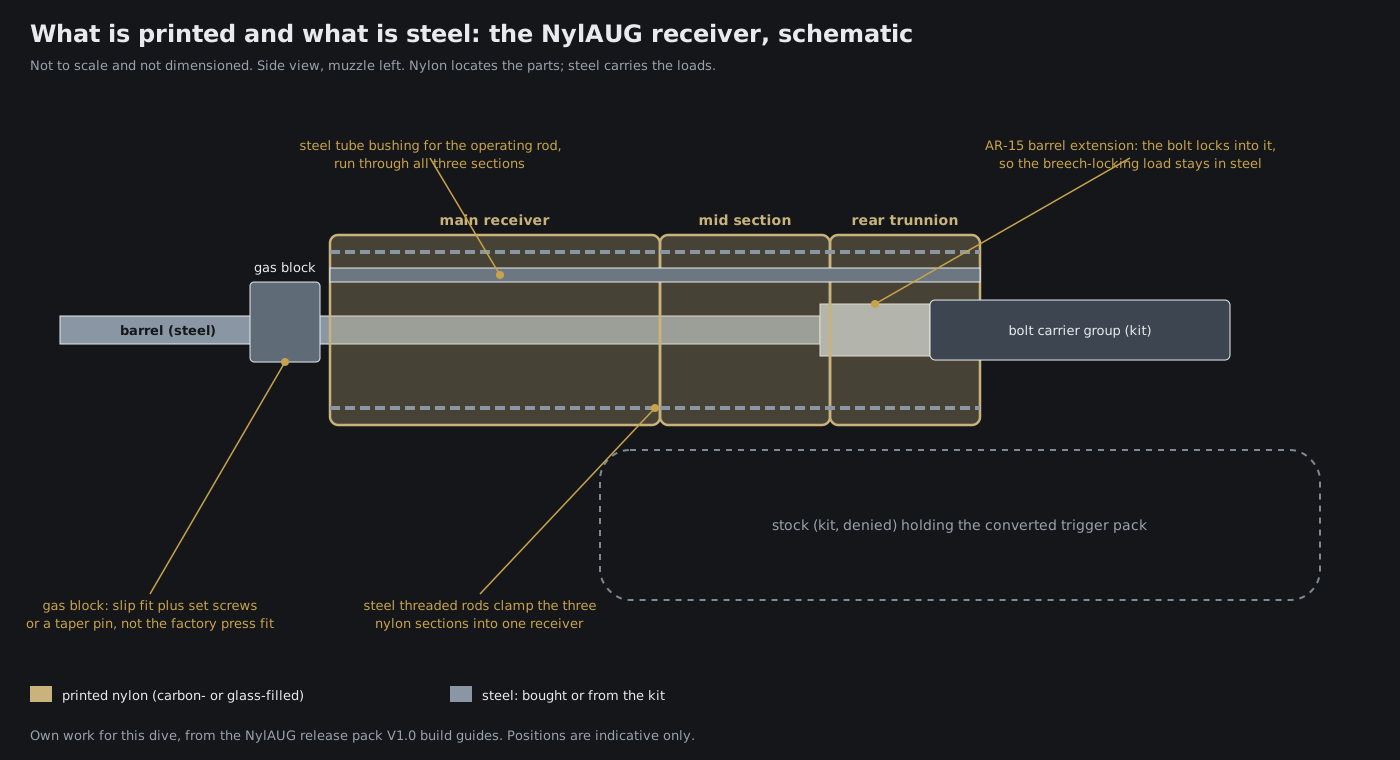
The architecture, from the build guide:1
- The receiver is three printed pieces: a main receiver at the front, a mid section, and a rear trunnion. The rear trunnion is slid onto the barrel extension on an alignment jig; the other two slide over the barrel to meet it.
- Steel threaded rods clamp the three together. Four M3 rods run the length of the receiver, two through its upper holes and two into heat-set inserts in the bottom of the trunnion, and are tightened with nuts at each end. The guide notes that the rods strip before the nylon is damaged.
- The breech is an AR-15 barrel extension. The AUG bolt locks into it (§11.6).
- The operating rod runs in a steel tube, a 1/2 in bushing pressed through all three receiver pieces on the right-hand side.
- The kit’s gas block goes on the new barrel, pressed off the kit’s cut barrel stub and refitted (§11.7).
- Everything else is the kit’s: the stock, the trigger pack after conversion, the bolt carrier group with its bolt, the magazine well and the controls.
Two receiver variants are supplied. One is for a surplus stock that the builder has denied (§11.4). The other, in a folder headed “FOR FACTORY SEMI AUTO STOCK”, fits a Steyr semi-automatic stock bought new; its readme says the shims are for the surplus stock only.4 For the main receiver the builder chooses between M3 nuts and brass heat-set inserts where it meets the gas block; the nut version “is what 99% of people are running.”4
11.2 The Answer to Vol 7’s Open Question: Where the Interlock Is
Vol 6 §6.6 and Vol 7 §7.4 both recorded that no source read for this dive said where the semi-automatic AUG’s refusal of military parts lies: in the receiver, the stock, the carrier or the pack. The NylAUG pack gives an answer. It is second-hand and unofficial, but it is specific.
According to the pack, Steyr “created several denials” for its imported semi-automatic rifles, “the most important being the receiver latch denial and the FCG denials.”1 (“FCG” is the fire-control group, the trigger pack.)
- The receiver latch. The pack’s ATF summary puts the military receiver’s latch at 0.8 in, which “will fit on an unmodified surplus lower and machine gun fcg and become a machine gun”, and says “This is why Steyr moved to the 0.675” latch”. A semi-automatic factory receiver therefore will not lock into a military stock.5
- The trigger pack. A military pack “can drop into a surplus stock”. The stock, not the receiver, is what holds the pack, which is why the pack’s author calls the AUG “a ‘1+1 design’ that needs to not only have the stock denied to prevent installation of the FCG, but also an additional denial to make sure the actual receiver does not fit an unmodified stock.”5
This fits Steyr’s parts nomenclature as Vol 6 §6.6 found it. Steyr Arms USA gives “SA” designations to the receiver, the receiver lock, the stock, the bolt carrier and the trigger mechanism body: the interlock is spread across several parts, and the stock is one of them. It also explains why the NylAUG needs a denial at each end of the stock (§11.4).
What this does and does not establish. The two latch widths come from one unsigned summary, not from a Steyr drawing or an ATF letter, and they were not measured for this dive. They are a claim to check with calipers on the parts in hand, not a figure to rely on.
11.3 The Legal Architecture the Pack Rests On
The pack is candid that its legal footing is guidance, not a ruling: “At this time the ATF has not issued any opinions that directly relate to the surplus Aug kits or builds regarding denials.”1 Its position rests on three things.
Informal guidance, reported by the pack. “Several SOTs in the development group have conferred with their IOIs” (industry operations investigators) “and received guidance that it appears this is one denial, but not the only possible denial.” The pack reports that guidance as “given both verbally and in writing from the IOIs” and says it “is not an official published opinion.”1
A conversation with ATF’s technology branch. A separate document in the pack, signed only “V from 3dprintfreedom.com”, summarises a conversation with the chief of ATF’s Firearms Technology Industry Services Branch. The summary opens: “Without an official determination letter nothing is guaranteed.” Its points, as the summary gives them:5
- the standard for a sufficient denial is “permanent and substantial”;
- the military latch width is what makes a receiver fit a military stock (§11.2);
- the nub-and-slot approach to keeping a new receiver out of an unmodified stock “should work as long as the bar is excess material and integrated into the receiver and is strong (CF reinforced Nylon similar to the Steyr Stock or a Glock lower)”;
- and, as the author’s conclusion: “You MUST deny the FCG before being in possession of a receiver and cutting the slot in the stock to accept the NylAUG.”
The federal definition of a machine gun. The pack’s reasoning reaches the “combination of parts” clause of 26 U.S.C. § 5845(b) quoted in Vol 6 §6.6. In the pack’s words: “Possession of a semi auto Nylaug receiver, a surplus stock without denials, and a FA FCG effectively makes the FCG housing into a Drop In Auto Sear and subject to NFA rules.” It compares the position to how ATF treats Glock frames, M14 stocks and the M1 carbine.1
How this sits against Vol 6. Vol 6 §6.6 recommends, as a matter of sequence, taking the select-fire pack, the military stock and any military carrier out of the build before a receiver is acquired, and keeping them only on a written classification from ATF. The NylAUG takes a different course: it modifies the military pack, stock and carrier so that they cannot function as select-fire parts, and keeps them in the rifle. The two are not in conflict about the danger; they differ in the remedy. The difference matters in one respect. Vol 6’s course needs no one’s opinion about whether a modification is enough. The NylAUG’s course relies on unpublished guidance that “permanent and substantial” denials suffice, which the pack itself says ATF could revisit: “even if you have one, the forces of politics can force the ATF to ‘redetermine’ something.”5
The pack offers a third course that avoids most of the question: a factory semi-automatic stock with its own receiver variant (§11.1). Steyr Arms USA listed its semi-automatic AUG stock at $360.00 and its semi-automatic trigger pack at $136.00 on 19 September 2026 (Vol 6 §6.6). With both, the builder has no military stock or pack in the rifle to deny, and the only military part left is the carrier, whose auto-sear trip the NylAUG replaces with a printed tail (§11.4). The dive’s position is unchanged: a written ATF classification is the only firm answer on keeping military parts, and until one exists, the factory semi-automatic stock and pack is the route that depends least on unpublished guidance. That route adds about $500 to the build.
11.4 The Denials, and the Order They Must Be Done In
The pack’s instruction is to “pay very serious attention to these denials and do not begin printing a receiver until you have completed these in full.”1 The order is part of the design, not a convenience, because at every stage the builder must not be in possession of a combination that could be assembled into a machine gun.
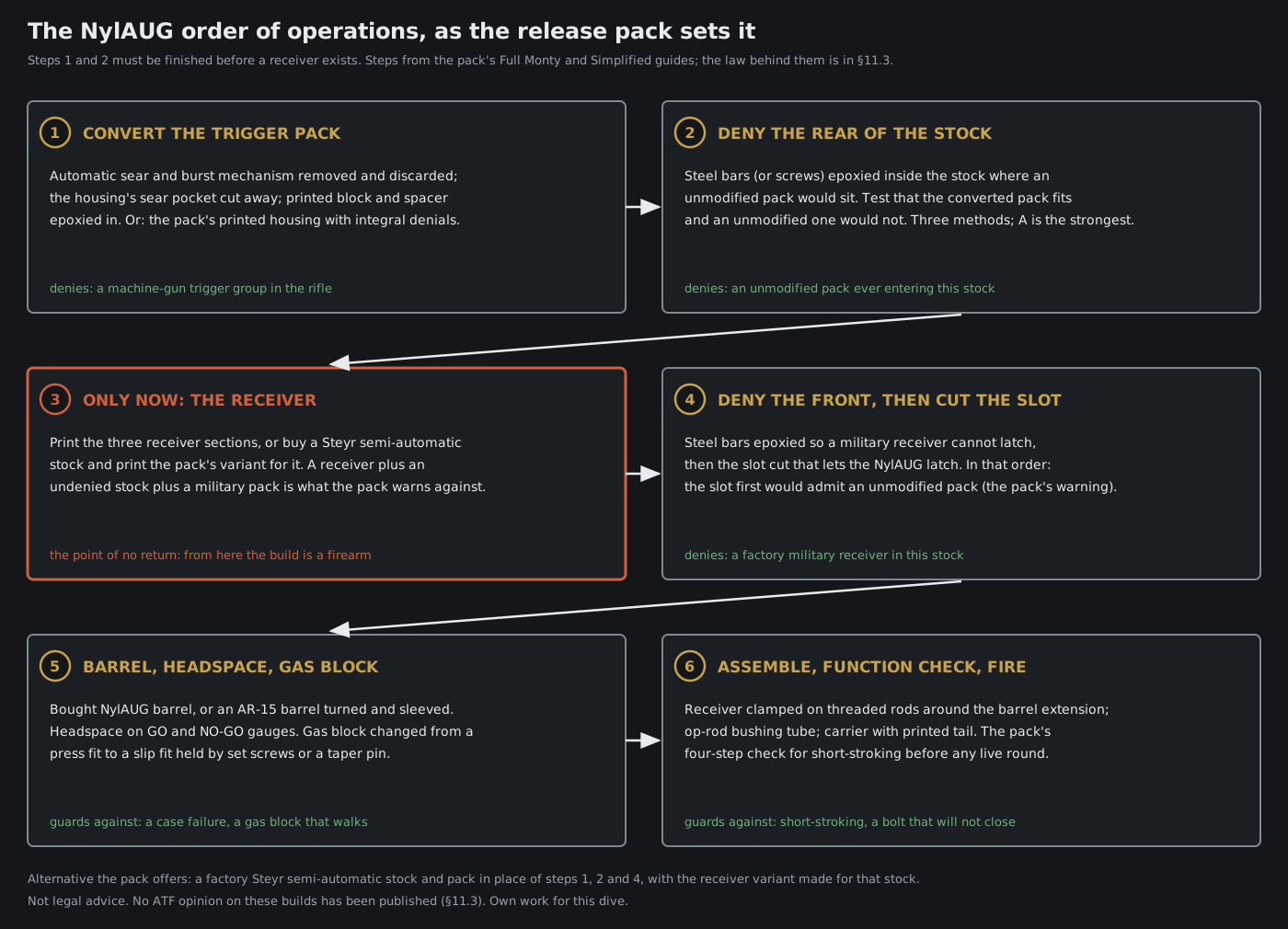
What each denial does, as the guide describes it:1
- The trigger pack is converted to semi-automatic only. The automatic sear and the burst mechanism are removed and discarded. The part of the housing where the automatic sear sat is cut away on a printed jig. A printed block is epoxied into the housing to do the one job the removed part also did, holding the hammer spring legs, and a printed spacer takes the place of the burst mechanism. The guide adds two optional steps: modifying the disconnector against hammer follow if the trigger is pulled fully back on the old automatic setting (or printing a semi-automatic-only safety that stops the trigger short of that point), and removing the hammer’s automatic-sear notch “if you want to be extremely judicious.” As an alternative the accessories include a printed trigger-pack housing “with integrated denials”, which leaves the factory housing uncut.
- The rear of the stock is denied. Steel is fixed inside the stock where an unmodified pack would sit, so a converted pack fits and an unmodified one will not. The guide gives three methods: A, steel key stock drilled, tapped and screwed through the stock wall and epoxied; B, screws alone set through the wall and epoxied; and C, key stock epoxied in place with no screws. It is explicit that Method B “is not as definitive of a denial as the key stock version” and recommends the strongest denial available to anyone “under scrutiny for a homemade firearm”. Method A is the one that best meets the “permanent and substantial” standard in §11.3. One contributor dry-fitted the denial first and trimmed the pack only after confirming that the planned placement would stop an unmodified one.
- The front of the stock is denied, and only then slotted. Steel key stock is epoxied at the front so that a factory military receiver cannot be fitted, and a slot is cut on a printed guide so that the NylAUG can. The guide’s warning is emphatic: “It is important that you complete the rear stock denial before cutting the receiver slot in the front of the stock. If you cut the front slot first, it is possible to use an unmodified full auto trigger pack with the NylAUG receiver and you have created a machine gun.”
- The bolt carrier gets a printed tail. The kit’s carrier tail is replaced with a printed “semi auto bolt carrier tail that has no auto sear trip.”
Every denial uses an epoxy “that is not acetone soluble”. The guide’s instructions for Method A are for the steel never to come out: “These bars will never ever come out.”1
11.5 What the Kit Supplies and What the Builder Supplies
The pack gives two hardware lists: an “Off the Shelf Build” using a bought barrel, and “The Full Monty”, which adds converting an AR-15 barrel on a lathe.16 Apart from the barrel section, the two guides are the same document.
Table 1 — 11.5 What the Kit Supplies and What the Builder Supplies
| From the kit | Printed | Bought |
|---|---|---|
| Stock (denied) and its controls | Receiver: main, mid and rear-trunnion sections | Barrel: the NylAUG barrel, a KAK barrel, or an AR-15 barrel converted |
| Trigger pack (converted) | Carrier tail, trigger-pack spacer, hammer-spring block | M3 threaded rod, nuts, washers, heat-set inserts |
| Bolt carrier group and bolt | Jigs: extension alignment, trigger-pack denial and clearance, receiver denial guide, key-stock tap jig, gas-block drilling guide | 1/2 in steel tube for the operating-rod bushing |
| Gas block and regulator, pressed off the kit’s barrel stub | A calibration cube | 3/16 in steel key stock, M3 flat-head screws, an M3 tap |
| Operating rod and cocking handle | Optional: handguards and rails, magazine, magazine release, brass deflector, charging handles, trigger, safety, butt pad | Epoxy that is not acetone-soluble |
| Magazine | GO and NO-GO gauges and a torque wrench for any barrel the builder headspaces |
Materials and printer. The guide asks for at least 75 g of high-temperature nylon (it names carbon- and glass-filled nylons as the most successful) for the receiver and at least 250 g of PLA for the jigs, on a printer whose hot end reaches 260 °C or more. The print-orientation guide specifies six walls and 95 to 100 per cent infill for the receiver sections and the small internal parts, and says those small parts may be printed in PLA but that nylon is the sensible choice when it is already on hand.7
Shop tools. The guide’s minimum is a vice, drill, rotary tool, hammer, punches, hacksaw, file, sandpaper and a soldering iron for the heat-set inserts. A drill press and bench grinder are “nice to have”. Pressing the barrel stub out of the gas block needs “12 ton minimum, 20 ton recommended” (§11.7). Converting an AR-15 barrel needs a lathe, a barrel-extension wrench, a way to clamp the barrel, and gauges.1 On a lab that already runs CNC mills and a lathe, the only items likely to be missing are the press and, perhaps, a 5.56 NO-GO gauge.
The bought barrel. The pack’s barrel link now redirects from 3dprintfreedom.com to 3d2a.com, where the “NylAUG 16” Barrel (5.56)” was listed at $149.99, in stock, on 25 September 2026. The listing gives no twist, material, maker or country of origin.8 Its origin matters for the count in §11.10 and should be asked.
11.6 The Barrel, the Extension and Headspace
The guide’s central mechanical claim is that the AUG’s bolt uses the AR-15’s locking pattern: “The AUG is basically a sideways AR-18 in a bullpup stock. Fortunately for us, that means the bolt lug pattern is exactly the same as an AR-15. AUG bolt lugs are a little bit longer though so an AUG bolt cannot lock into an AR-15 barrel extension without some work.”1 This fits what Vol 5 found independently: the AUG bolt locks into a barrel extension, not the receiver (§5.6); the military and US bolt has seven lugs (§5.5); and Steyr’s military manual gives the locking rotation as 22.5° (§5.5), which is also the AR-15’s. The lug-for-lug compatibility is the guide’s claim and was not checked for this dive against drawings of either bolt.
The consequence is that the NylAUG’s barrel has an AR-15 barrel extension, and headspace is set where an AR-15’s is:
- On the bought barrel, headspace is set by the maker, and the guide still says to “ALWAYS check headspace with GO/NO-GO gauges before assembling your build!”
- On a converted AR-15 barrel, the builder removes the threaded-on barrel extension, adds shims behind it until the AUG bolt, with its extractor removed, locks on a GO gauge and will not rotate on a NO-GO gauge, torques the extension to 150 ft-lbf, rechecks both gauges, and turns the shims down to the barrel diameter. The guide calls this “the most important part of the build to get right. This is what will determine whether or not you have made a gun or a bomb.”1
Vol 7 §7.8 covers the factory rifle’s headspace requirement, and the hub’s Headspace dive covers the gauges themselves. The shimmed extension is a gunsmithing job at the level of a barrel set-back, and it is the one step in the build where a shortcut is dangerous rather than merely unreliable.
The pack’s barrel drawing makes a point worth keeping in mind for a lathe-made barrel: “Most of this barrel is clearance, all that really matters is gas block location and diameter.” The drawing also gives the stock AUG flash-hider thread as M13×1 left-hand.9 That agrees with Steyr’s European manual (Vol 7 §7.12), though it still says nothing about US-made AUG barrels.
11.7 The Gas System, Rebuilt
On a factory AUG the gas block is held on the barrel by an interference fit alone: “it is not pinned to the barrel in any way.” The kits are sold with the barrel cut off behind the gas block, so the kit’s gas block arrives on a stub that must be pressed out. The guide’s figure is that “A 12-ton press will be maxed out”; it suggests freezing the parts overnight, grinding the cut face flat first (“Most of these parts kits have not had the barrel cut straight”), and supporting the block on a drilled plate or a 3/4 in washer.1
The NylAUG does not press the block onto the new barrel. It makes it a slip fit, as on an AR-15, and retains it mechanically. The guide says three set screws are required, not two: “You must use all three set screw holes for a total of 3 set screws for the gas block to remain secure.” Each screw sits in a dimple drilled into the barrel deep enough that “the set screws need to be deep enough so that they resist shear loading, NOT friction.” The guide gives the dimple depth as “0.1875” (3/16 or 5mm)”. The two are not equal: 3/16 in is 4.76 mm, so the inch figure is the one to work to. On a sleeved AR-15 barrel the dimples must reach the barrel steel, since “an aluminum sleeve is not enough to hold the set screw in shear.” Two alternatives are offered: pinning the block with taper pins, as on an AR-15 front sight base, which the guide recommends “for a rock solid gas block”, or a sleeve between the block and a torqued muzzle device.1
The gas port. The builder drills the port through the barrel on a printed guide, 3/32 in (2.38 mm) in the guide’s instructions. The function checklist gives the KAK barrels’ port as “2.3 or 2.4mm”. A rifle that short-strokes on the normal setting after cleaning, and runs on the adverse setting, can have its port opened in 0.1 mm steps. Testers went “all the way to 3.0mm, but you should not need to go past 2.7mm”, and the checklist’s author aims for 2.5 mm on home-made barrels.10
The regulator is the kit’s. The pack’s reference photograph marks its three positions: normal, adverse, and a grenade setting “approx. 180* from adverse” that “will result in short stroking”.11 This matches the US and military manuals’ descriptions in Vol 5 §5.3. The military manual’s grenade position blocks the gas cylinder entirely and makes the rifle manually operated.
11.8 A Receiver in Printed Nylon
Vol 7 §7.4 observed that on an AUG “the receiver does not carry the firing load and does not set headspace,” because the bolt locks into the barrel extension. The NylAUG is built on that fact. The locking load runs in a closed loop of steel, from bolt to extension to barrel. The nylon’s jobs are to hold the barrel on the rifle’s axis, guide the carrier and the operating rod, latch into the stock, and carry recoil and handling loads. The steel tube bushing and the threaded rods give it a steel skeleton for the two jobs that most need one: the operating rod’s bearing surface and holding the sections together.
What the pack’s own guidance says about the material’s limits:
- Dimensional accuracy matters. A calibration cube is supplied. The guide says the operating rod “should sit flush with the front of the receiver, or slightly recessed, when the bolt is locked”; more than “a mm or two” of recess can cause short-stroking, and the rod “should never protrude”. The remedy it gives is to “Make sure your printer is calibrated and is printing the parts to the correct dimensions.”1
- Nylon moves after printing. Printed shims between the mid section and the main receiver are provided “to fit the latch properly”, and the guide notes “reports of needed shims after a couple weeks with Polymaker PA6-CF”. That is consistent with nylon’s known behaviour: it absorbs water from the air and grows as it does. The hub’s Remington Nylon 66 dive gives DuPont’s figures for its own injection-moulded nylon 66. A printed, fibre-filled nylon 6 is a different material, and those figures should be taken as the direction of the effect, not its size.
- Heat. The receiver sections must be printed in the high-temperature nylon. PLA is for jigs.
The testing claim is the credits’ list of four testers at “1000+” rounds.2 No failure data, round counts per rifle, or record of which filament each tester used is in the pack. For a builder with the lab this hub assumes, the obvious next step is also the useful one: a NylAUG receiver can be inspected, measured and remade easily, so a builder can measure it before first firing and again after each few hundred rounds (latch fit, operating-rod position, bushing alignment) and keep the record in the rifle’s file (Vol 7 §7.11).
11.9 The Function Check, and Short-Stroking
The pack’s “General Function Check” names short-stroking as “The most common ‘failure’ people experience”, meaning the carrier not travelling far enough back to pick up a round. Its bench checks, in order:10
- With the gas selector removed from the gas block and the carrier locked back, press the gas piston in with a rod. It should enter the receiver without much force and spring back on its own. If not, the gas block is out of adjustment or the receiver needs reaming where the piston enters it.
- Release the carrier. The bolt should close fully. If not, the bolt guide cage modification may need more material removed. That modification is the guide’s relief of the area where the bolt’s cam pin rests, with its sharp tip rounded, “a little bit at a time” until the bolt rotates smoothly in the extension. The guide says the bolt will lock without it but runs smoother with it. Lubricate the cam pin and the operating rod.
- Draw the charging handle back about a third of its travel and release it. The bolt should still go fully into battery. If it needs more than half the travel, clean and lubricate.
Kits come dirty. The guide says the Malaysian kits in particular “are often incredibly gummed up”, and the checklist reports carriers whose recoil springs were packed solid with dirt and debris. It recommends stripping the bolt completely and, if short-stroking persists, removing the carrier’s recoil springs to clean them. Their guide-rod caps are thread-locked and need heat and a vice to remove. Only after that does it recommend the adverse gas setting and then a larger gas port (§11.7). The guide ends on the same note: “DON’T FORGET LUBE!”101
Vol 7 §§7.9–7.10 set out Steyr’s function check and a first-firing protocol for a factory receiver. Both apply to a NylAUG, with the pack’s checks run first.
11.10 The §922(r) Count for a NylAUG
Vol 6 §6.8 applied the twenty listed parts of 27 CFR 478.39(c) to the AUG and found about sixteen to nineteen on a rifle built all from imported parts. It concluded that a kit build needs seven to ten of them US-made to come under the ceiling of ten imported. The NylAUG changes the count in the builder’s favour, because much of what it adds is made by the builder, in the United States.
Table 2 — 11.10 The §922(r) Count for a NylAUG
| Listed part | On a NylAUG | Counts as |
|---|---|---|
| Receiver | printed | US |
| Barrel | NylAUG barrel, or an AR-15 barrel | US if made in the US; the NylAUG barrel’s origin is not stated (§11.5) |
| Barrel extension (if counted) | AR-15 extension | origin of the extension |
| Trigger housing | kit housing, converted; or the printed housing | imported; US if printed |
| Hammer | kit | imported |
| Disconnector | kit | imported |
| Trigger | kit; or a printed trigger from the accessories | imported; US if printed |
| Sear | kit part in the stock (Vol 6 §6.8) | imported |
| Buttstock (and pistol grip, if counted twice) | kit stock, denied | imported (1–2) |
| Bolt | kit | imported |
| Bolt carrier | kit, with a printed tail | imported |
| Gas piston | kit | imported |
| Forearm | kit folding grip; or a printed handguard | imported; US if replaced |
| Muzzle attachment | kit, or a US flash hider | imported, or US |
| Magazine body, follower, floorplate | printed magazine, or a US magazine | US (3) |
The parts removed in the trigger-pack conversion are not in the rifle and do not count; the count is of the rifle as it stands (Vol 6 §6.7). Worked, conservatively: take a printed receiver and a US-made barrel, with everything else from the kit: housing, trigger, sear, hammer, disconnector, bolt, carrier, piston, folding grip, flash hider, the stock counted twice, and the kit’s magazine. That rifle has fifteen imported parts. A US-made or printed magazine removes three, leaving twelve, still two over the ceiling. Any two of the following bring it to ten: a US flash hider, a printed handguard in place of the folding grip, a printed trigger, or the printed pack housing. Counting the stock once instead of twice saves one of those two changes, but the conservative count is the one to plan on. With a factory Steyr semi-automatic stock and pack (§11.3), the count depends on where Steyr Arms USA’s parts are made, which its store does not say (Vol 6 §6.8).
As in Vol 6, the count should be written part by part, with each part’s origin, and kept in the rifle’s file (Vol 7 §7.11). A later change can undo it.
11.11 Other Law: The Privately Made Firearm, and the Undetectable Firearms Act
A privately made firearm. A NylAUG made by its owner for the maker’s own use is a privately made firearm, with no federal duty to mark it while it stays with its maker (Vol 6 §6.3). The receiver is in three pieces, and 27 CFR 478.12’s AUG example names “the central part of the weapon that provides housing for the bolt” (Vol 6 §6.2). A builder who chooses to mark the rifle voluntarily, to the licensee standard in 27 CFR 478.92, has to decide which printed section that is. The regulation’s multi-piece provisions, discussed in the hub’s Sig P320 M17 dive, are the place to start, and the pack’s ATF summary reports that under the current rule a multi-piece receiver sold commercially would need “all receiver pieces to be serialized with the same serial if sold together”.5 Michigan’s position, as it stood on 19 September 2026, is in Vol 6 §6.10: no state serialisation requirement for a self-made firearm was found in the Penal Code or the Firearms Act, and pending bills were not checked. That search is six days old at this writing and should be repeated before the receiver is made, because state law on home-made firearms has been changing across the country.
The Undetectable Firearms Act. 18 U.S.C. § 922(p)(1) makes it unlawful to “manufacture, import, sell, ship, deliver, possess, transfer, or receive any firearm— (A) that, after removal of grips, stocks, and magazines, is not as detectable as the Security Exemplar, by walk-through metal detectors calibrated and operated to detect the Security Exemplar; or (B) any major component of which, when subjected to inspection by the types of x-ray machines commonly used at airports, does not generate an image that accurately depicts the shape of the component.” Paragraph (2) defines a “major component” as “the barrel, the slide or cylinder, or the frame or receiver of the firearm”, and the Security Exemplar as 3.7 ounces of 17-4 PH stainless steel.12
Limb (A) is not in doubt for a NylAUG. With the stock and magazine removed, the barrel, gas block, bolt carrier group, threaded rods and operating-rod bushing are several pounds of steel. Limb (B) is the open question. It applies to each major component separately, and the receiver is a major component. Whether a carbon- or glass-filled nylon receiver, with steel rods and a steel tube running through it, “generates an image that accurately depicts the shape of the component” under an airport x-ray was not found in any ATF ruling or case read for this dive, and the pack does not raise it. A builder seeking a classification on the denials (§11.3) should put this question in the same letter. The Act has repeatedly been extended by Congress with a sunset date. Senator Reed’s office gave its expiry as 8 March 2024 in a release of 19 February 2024, and later reports say it was extended again in March 2024, to 2031. The current termination date was not confirmed from the statute’s notes for this dive.13
11.12 The Build Documented Here, as of September 2026
As of 25 September 2026 the owner has adopted the NylAUG release pack V1.0 as the plan for the import-kit build recorded in Vol 7 §7.1. That answers the receiver question the earlier volumes left open (Route C, in printed form). Nothing else about the unit has been recorded yet: the kit’s generation and source, whether its stock and pack are military, which barrel will be used, and which of the three stock-denial methods, or the factory semi-automatic stock and pack, will be used. They will be recorded here as they are decided, dated, and kept distinct between on hand, installed and missing.
11.13 What Could Not Be Confirmed
- Any ATF position on these builds. The pack’s ATF material is an unsigned summary of a conversation and reported IOI guidance. No determination letter is in it, and none was found.
- The latch widths, 0.8 in military and 0.675 in semi-automatic, from the same summary. Not measured for this dive.
- Lug-for-lug compatibility of the AUG bolt with an AR-15 barrel extension. It is the guide’s claim, consistent with the lug count and locking angle in Vol 5, but not checked against drawings.
- The NylAUG barrel’s maker, material, twist and country of origin.
- The testing record. Four testers at “1000+” rounds, with no data behind the figure.
- How much printed nylon receivers move over time. One filament’s reports are in the guide; nothing is measured.
- Whether a nylon receiver satisfies 18 U.S.C. § 922(p)(1)(B), and the Act’s current termination date.
- Each designer’s licence terms, which differ across the pack’s folders and were not reviewed one by one.
Sources
Footnotes
-
NylAUG Release Pack V1.0, The Full Monty Guide (56 pp., “Updated: 9-4-23”), including the legal note signed “ANDYOUMAYCALLMEV, 3DPrintFreedom.com”; sections 1 (hardware), 2 (trigger pack semi-auto conversion), 3 (stock denials), 4 (bolt guide cage and carrier tail), 5 (barrel), 6 (stub pressing), 7 (gas block), 8 (receiver assembly) and 9 (tips). Archive
NYLAUG RELEASE PACK V1.0.zip, files dated to 29 September 2023, copy read 2026-09-25. ↩ ↩2 ↩3 ↩4 ↩5 ↩6 ↩7 ↩8 ↩9 ↩10 ↩11 ↩12 ↩13 ↩14 ↩15 ↩16 ↩17 -
NylAUG Release Pack V1.0, “LICENSE - READ.txt”, with individual licence files in each designer’s folder. ↩
-
NylAUG Release Pack V1.0, “Required/Receiver Assembly/RECIEVER README.txt”. ↩ ↩2
-
NylAUG Release Pack V1.0, “ATF Letter Summary - V.rtf”, signed “V from 3dprintfreedom.com”, undated. A summary of a conversation, not an ATF document. ↩ ↩2 ↩3 ↩4 ↩5
-
NylAUG Release Pack V1.0, The Simplified Build Guide (52 pp., “Updated: 9-4-23”). Identical to the Full Monty guide apart from the AR-15 barrel conversion and headspacing sections, which it omits. ↩
-
NylAUG Release Pack V1.0, “Reference/Nylaug Print Orientations.pdf” (17 pp.). ↩
-
3D2A (formerly 3DPrintFreedom), “NylAUG 16” Barrel (5.56)”, https://3d2a.com/AUG-Barrel-Preorder-16-p464529333 (redirected from the 3dprintfreedom.com address given in the build guide), read 2026-09-25: $149.99, in stock. ↩
-
NylAUG Release Pack V1.0, “Reference/barrel.JPG”, barrel drawing credited “Caska & Because2A”. ↩
-
NylAUG Release Pack V1.0, “General Function Check.txt”. ↩ ↩2 ↩3
-
NylAUG Release Pack V1.0, “Reference/Aug gas settings.jpg”, an annotated photograph of the regulator marked Normal, Adverse and the grenade setting. ↩
-
18 U.S.C. § 922(p)(1)–(2), Legal Information Institute, Cornell Law School, https://www.law.cornell.edu/uscode/text/18/922, retrieved 2026-09-25. ↩
-
Office of Senator Jack Reed, “Reed, Grassley Lead Effort to Renew the Undetectable Firearms Act Ahead of March 8 Deadline,” 19 February 2024, https://reed.senate.gov/news/releases/reed-grassley-lead-effort-to-renew-the-undetectable-firearms-act-ahead-of-march-8-deadline, read 2026-09-25. The March 2024 extension to 2031 is reported in secondary sources and was not confirmed in the statute’s notes. ↩
Comments (0)