SA80 (L85 Family) · Volume 8
Sights, Accessories and Fittings
The SUSAT and its pillar pointer, the carrying-handle iron sight, the ACOG and Elcan day sights, the A3's bracket, underslung grenade launchers, laser light modules, rails, magazines, the bayonet and its scabbard
8.1 What this volume covers
The SA80 was the first British service rifle issued with an optical sight as standard, and over forty years it carried more fittings than any British rifle before it. This volume describes them from the makers’ and the Army’s own documents: Royal Ordnance’s 1985 handbook and brochure for the SUSAT, iron sight, bayonet and accessories; Jonathan Ferguson’s ARES articles for the later Urgent Operational Requirement (UOR) fittings and the grenade launchers; the Army website for the current launcher; and the 2018 Mid Life Improvement release for the A3. Model numbers are given only where a source names them. The optics themselves — how a prism sight or a reflex sight works — are covered in the hub’s Scopes dive.
8.2 Why an optical sight was standard
The bullpup layout put the optic on the rifle before any sight was chosen. In the 1970 study, an optical sight was required because of “the belief that iron sights would present too short a sight radius to be effective on a bullpup” (Volume 1).1 The 1972 requirement asked for an optical sight at least as good as the SUIT then used on the SLR.2 Ministers made the point when the rifle was introduced: it would “be provided with a telescopic sight, together with a complementary night sight”.3
8.3 The sight base
Everything fitted to the top of an SA80 sits on one interface. “The sight is mounted on a bracket which incorporates range adjustment and zeroing. This bracket slides on to a dovetail base permanently fitted to the weapon body and permits sight position adjustment.”4 The handbook adds that a locating plunger in the sight’s shoe engages “one of three holes in the sight base”, and “Two clamping units secure the shoe to the sight base”; the three holes give three positions fore and aft for eye relief.5 “The dovetail top sight mounting will also accept mountings of a variety of night sights.”5
The later day sights, the ACOG and the Elcan, were fitted through “their respective Picatinny mount adaptors” on this base.6 The A3’s continuous top rail replaced the arrangement on the rifle itself.
8.4 SUSAT
The Sight Unit, Small Arms, Trilux, in the handbook’s figures:5
Table 1 — SUSAT
| Magnification | ×4 |
| Field of view | 177 mils |
| Eye relief | 24 mm (as printed) |
| Range settings | 300 to 800 m, in 100 m steps |
| Weight | 0.8 kg |
The handbook’s eye relief figure is printed as 24 mm. It is given as printed; the rubber eyepiece “of a length to ensure correct positioning of the eye” suggests the figure is measured from the eyepiece rather than the lens, but the handbook does not say.
The parts, in the handbook’s words:5
- The eyepiece, “made of rubber and … glued to the rear of the optics. It is designed to protect the lens from water and of a length to ensure correct positioning of the eye.”
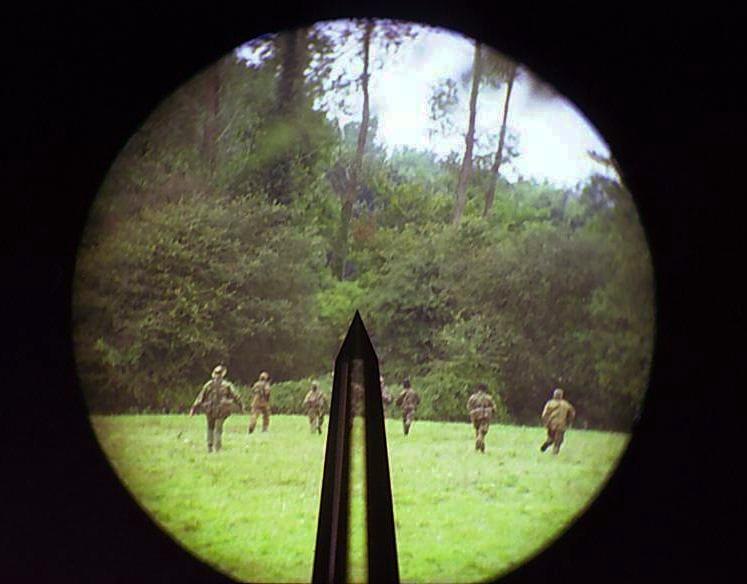
- The pointer. “In daylight the pointer appears as a dark pillar with a clear centre, at night the pointer tip can be illuminated by the TRILUX lamp. The light from the lamp is reflected up into the pointer and is seen as a reddish glow. A Brightness Control is located on the right rear of the body and can be rotated to change the light intensity from zero to full brightness.”
- The objective hood, which overhangs the front lens “so reducing reflections and also protecting the lens from rain”.
- The Emergency Battle Sight (EBS) on top: “a blade foresight and an aperture backsight, matched to the optical centre of the SUSAT lenses during manufacture and therefore no zeroing adjustment is provided. It is for use in an emergency should the SUSAT become damaged, until such time that the Iron Sight can be fitted in its place.”
- The mounting bracket: the dovetail shoe with its locating plunger and lifting plate, and the sight mount with a horizontal zeroing screw at the front, a vertical screw at the rear, and the range drum under the eyepiece.
The Trilux lamp contains tritium gas, and the handbook gives precautions in case of breakage.5 The brochure claimed that “The SUSAT sight requires no maintenance.”4 The prototype was designated XL9E1; the first had an “inverted pointer from above”, like the SUIT; the familiar rising pillar came later.2
8.5 The iron sight
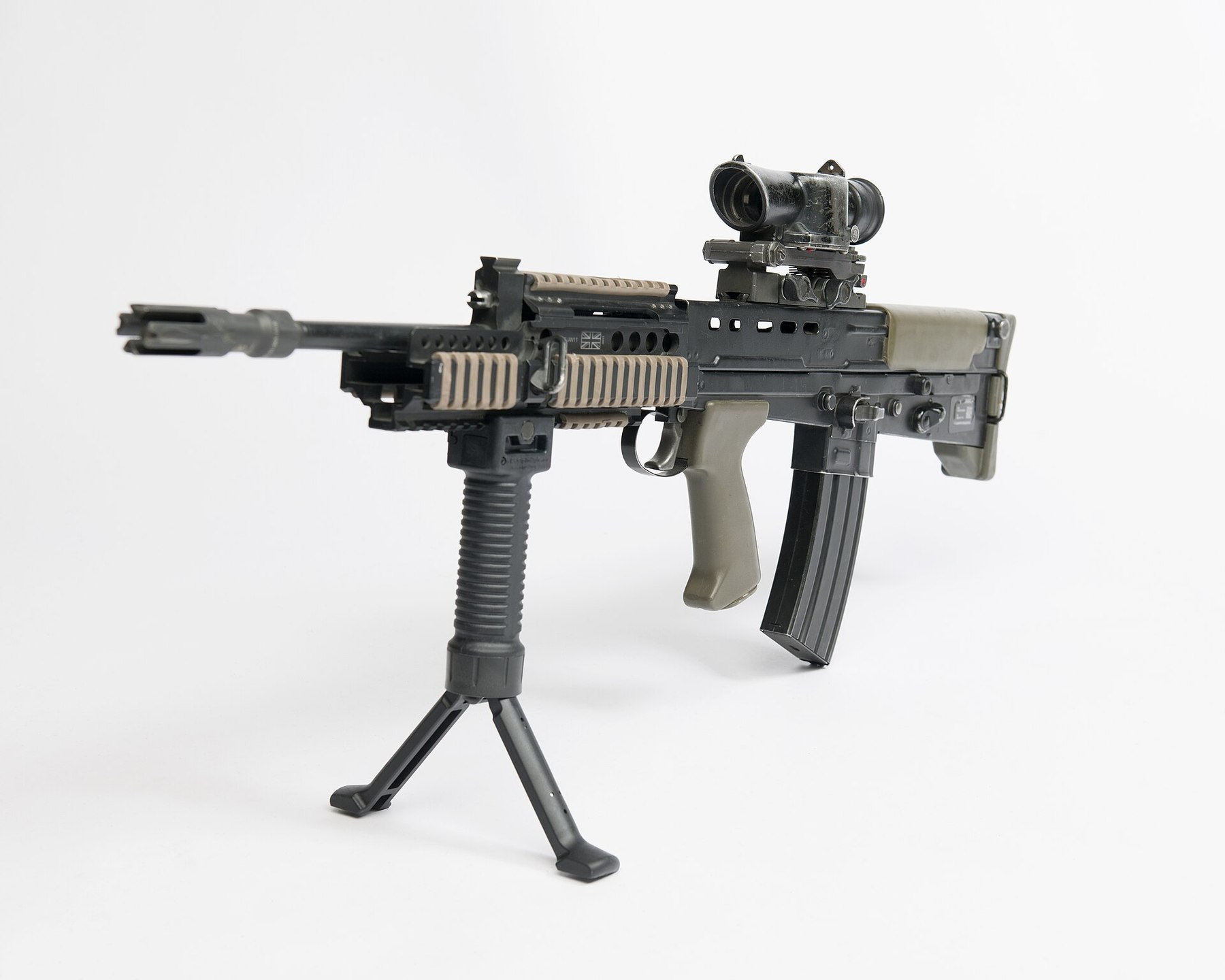
The alternative day sight is a carrying handle with a rear sight, and a foresight on the gas block:5
- Foresight: a blade in a block dovetailed onto “a matching male dovetail on the top of the weapon gas block”, with “a TRILUX element which emits light through a small hole” in the rear of the blade, and a vertical zeroing screw retained by a locking plunger.
- Backsight and carrying handle: dovetailed to the sight base, positioned by a locating screw in one of the three holes and secured by two retaining screws. “The backsight has two leaf apertures, a small one for ranges up to 200m and a larger one for use (in conjunction with the TRILUX element) in conditions of low light or darkness.” A horizontal zeroing screw is on the right.
The handbook gives the iron sight’s weight as 0.3 kg.5 The L98A1 cadet rifle’s version differs: a thinner blade without tritium, and a rotating disc of apertures for 100 to 500 m that folds to a single 100 m aperture.7 The L22 carbine has no iron sights.8 How the two sights are zeroed is Volume 7.
8.6 Night sights
The handbook says only that the sight base “will also accept mountings of a variety of night sights”, and the brochure that the weapon “can also be fitted with a suitable passive Night Sight”.54 Neither names one, and no official source for the night sights issued with the A1 or A2 was found for this dive. The A3’s change was a bracket for clip-on low-light sights (below).
8.7 After SUSAT: the ACOG and the Elcan Specter
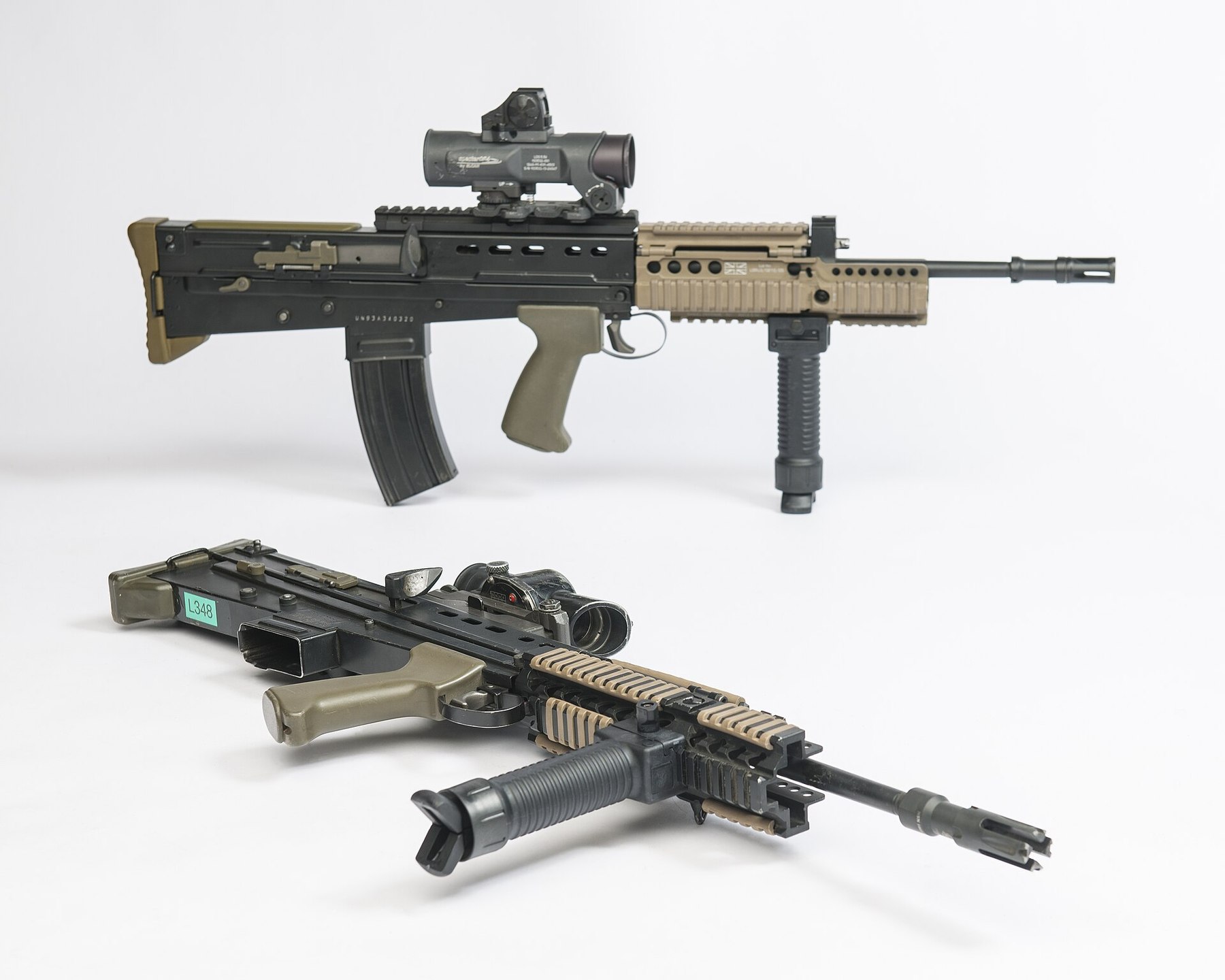
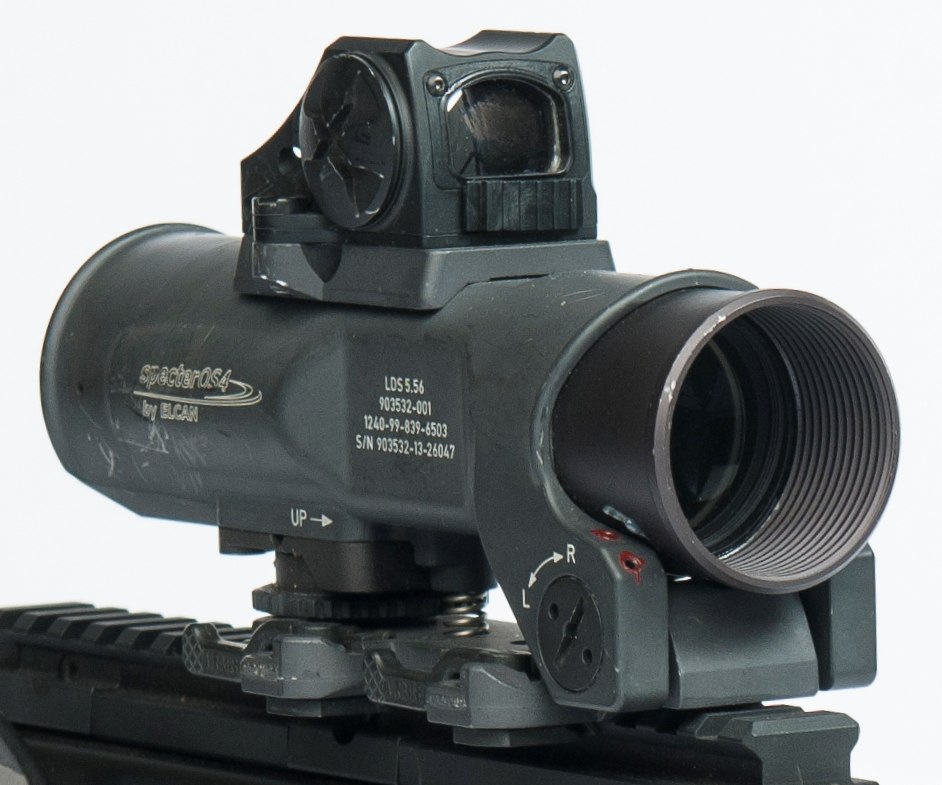
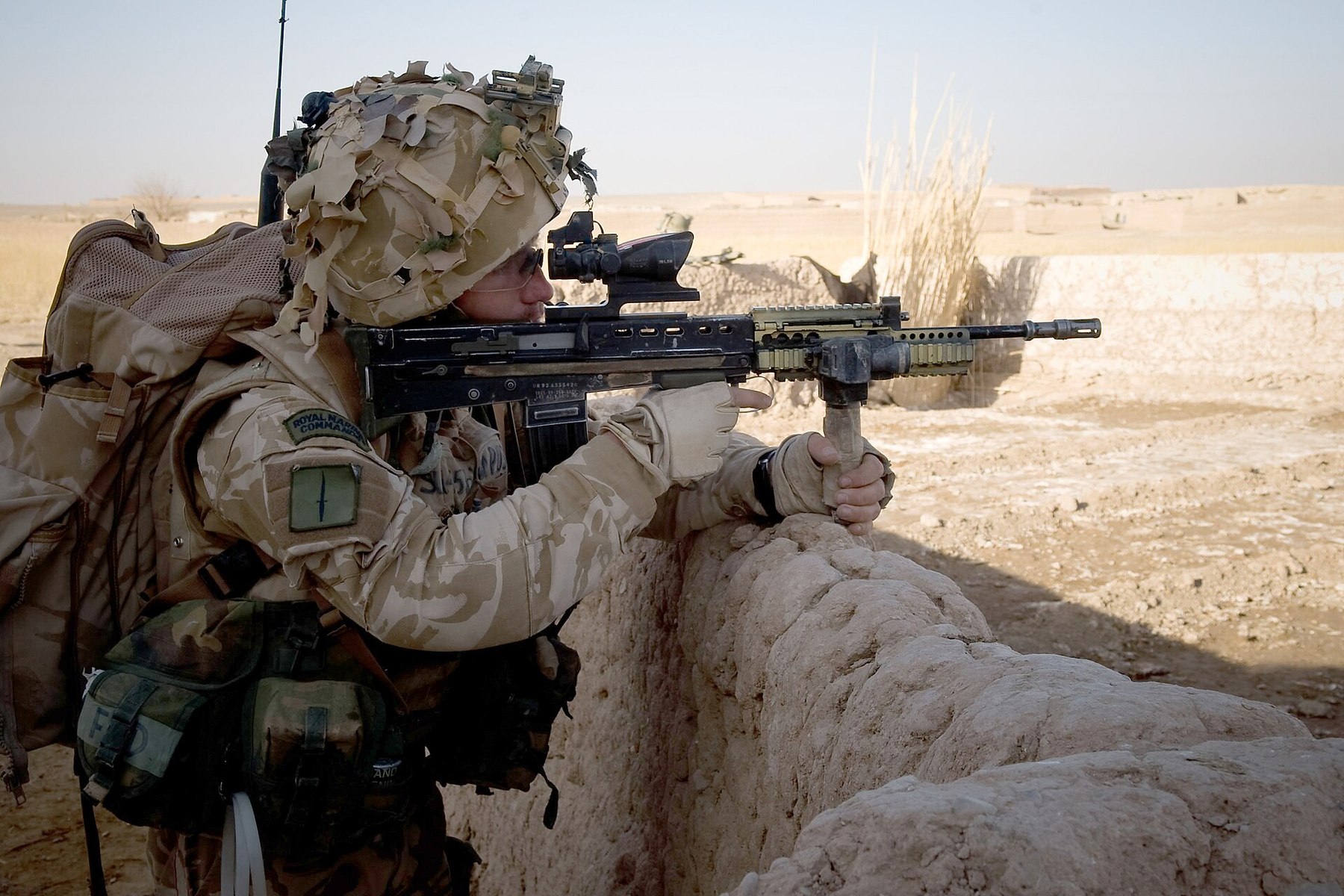
Ferguson lists the post-2002 day sights among the UOR and FIST changes: “the introduction of 4x ACOG and Elcan Specter OS4x ‘Lightweight Day Sight’ (LDS), with their respective Picatinny mount adaptors”.6 The Elcan is visible in MOD photographs of the A2 and on the A3 in the comparison plate of Volume 4, where its body reads “SpecterOS4x by ELCAN” and “LDS 5.56”. The EFI prototype of the A3 carried the LDS as standard.6
No MoD document giving the ACOG model or the dates of issue was found. Ferguson’s article names the type, not the model, and this volume does the same.
8.8 The A3’s low-light bracket
The 2018 release lists among the A3’s four changes “a bracket for new low-light sights that clip on or in front of the day sight”.9 It names no sight. The A3’s continuous rail along the top of the body and fore-end, visible in every MOD photograph of the rifle, is what makes an in-line clip-on possible.
8.9 Grenade launchers
The requirement for an “area target capability” dates from the 1970s. General Staff Requirement 3518 of 1974 asked that the rifle “be able to accept an area target capability for muzzle or tube-launched grenades”.10 The SA80 entered service with rifle grenades only: the 22 mm flash eliminator “enables the firing of rifle grenades from IW only”, and the gas plug’s “gas-off” position existed for them (Volume 5).54 Ferguson records the L15A1 grenade sight, which clipped over the SUSAT.10
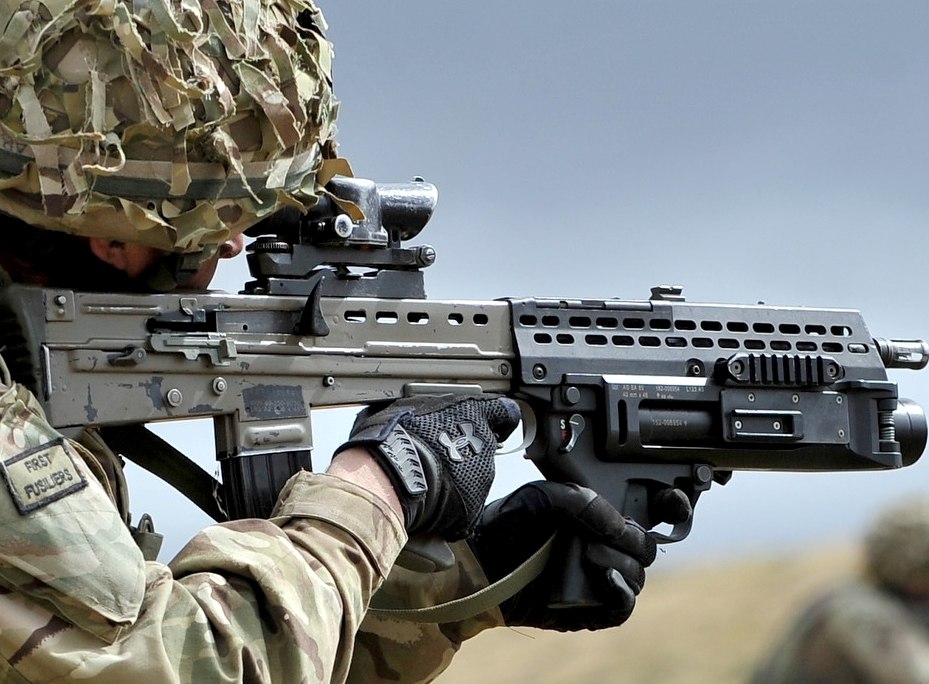
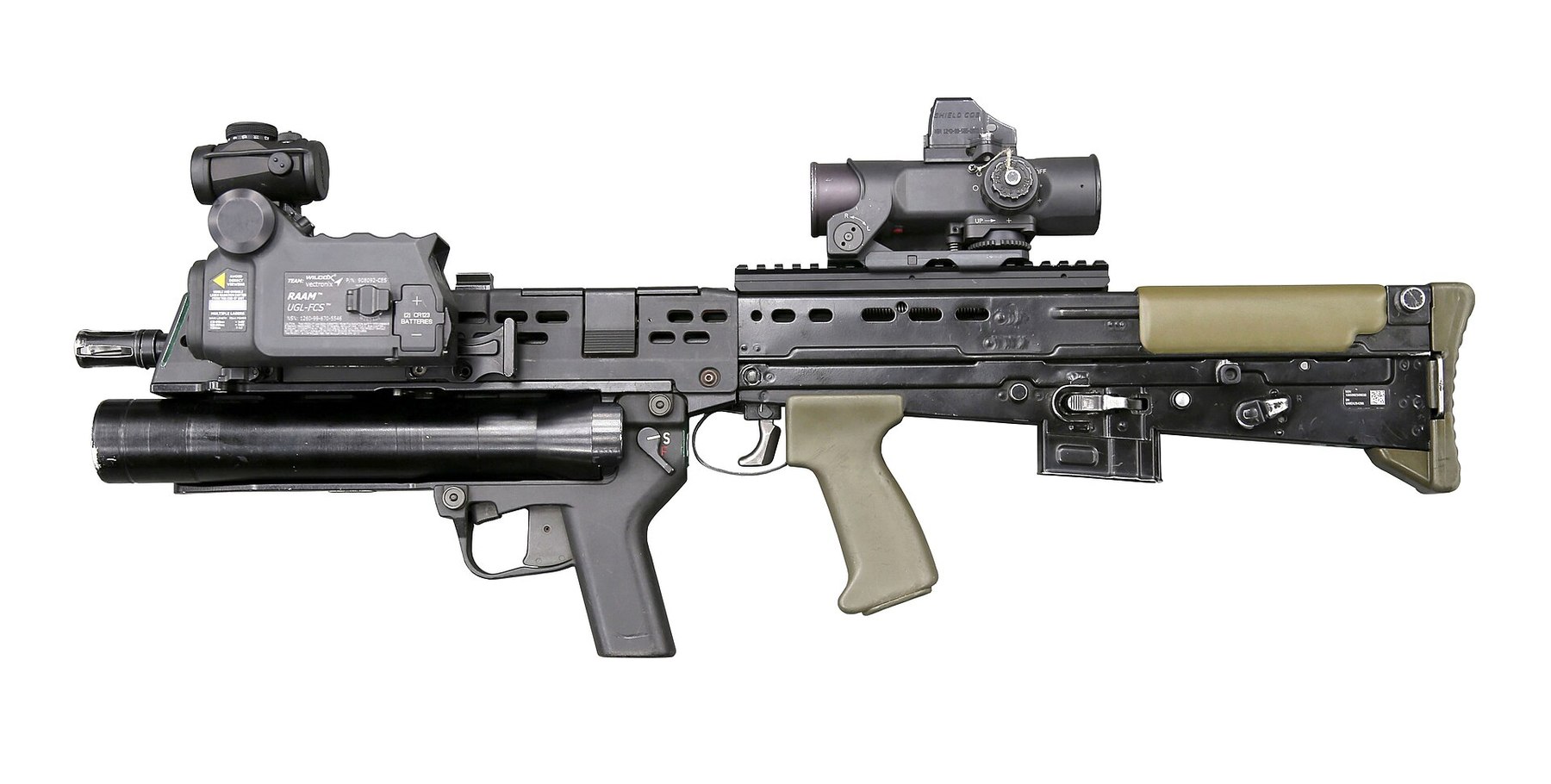
Underbarrel launchers were tried for twenty years: a side-opening rifled launcher on the XL64E5 (1976), an American M203 on the L85A1 (mid-1980s), Royal Ordnance’s ENCAW of 1988, and H&K’s HK79 among others.10 In 1995 H&K offered a version of its AG36, the “AG SA 80”, designated L17A2, and it was issued after the A2 programme as the L123, with a polymer mount replacing the handguard, a folding tangent sight graduated from 50 to 350 m, and a rail for the laser light module.10 Ferguson notes that the A3 prototype took the AG36 directly on its 6 o’clock rail, “rather than requiring the removal of the handguard”.6
The Army’s own description: the underslung grenade launcher is the H&K AG-36 with an EOTech holographic sight on an ISTEC range drum, effective “out to 350 metres”, weighing 1.12 kg, with a muzzle velocity of 76 m/s, and there are “six UGLs per platoon”.11
8.10 Laser light modules
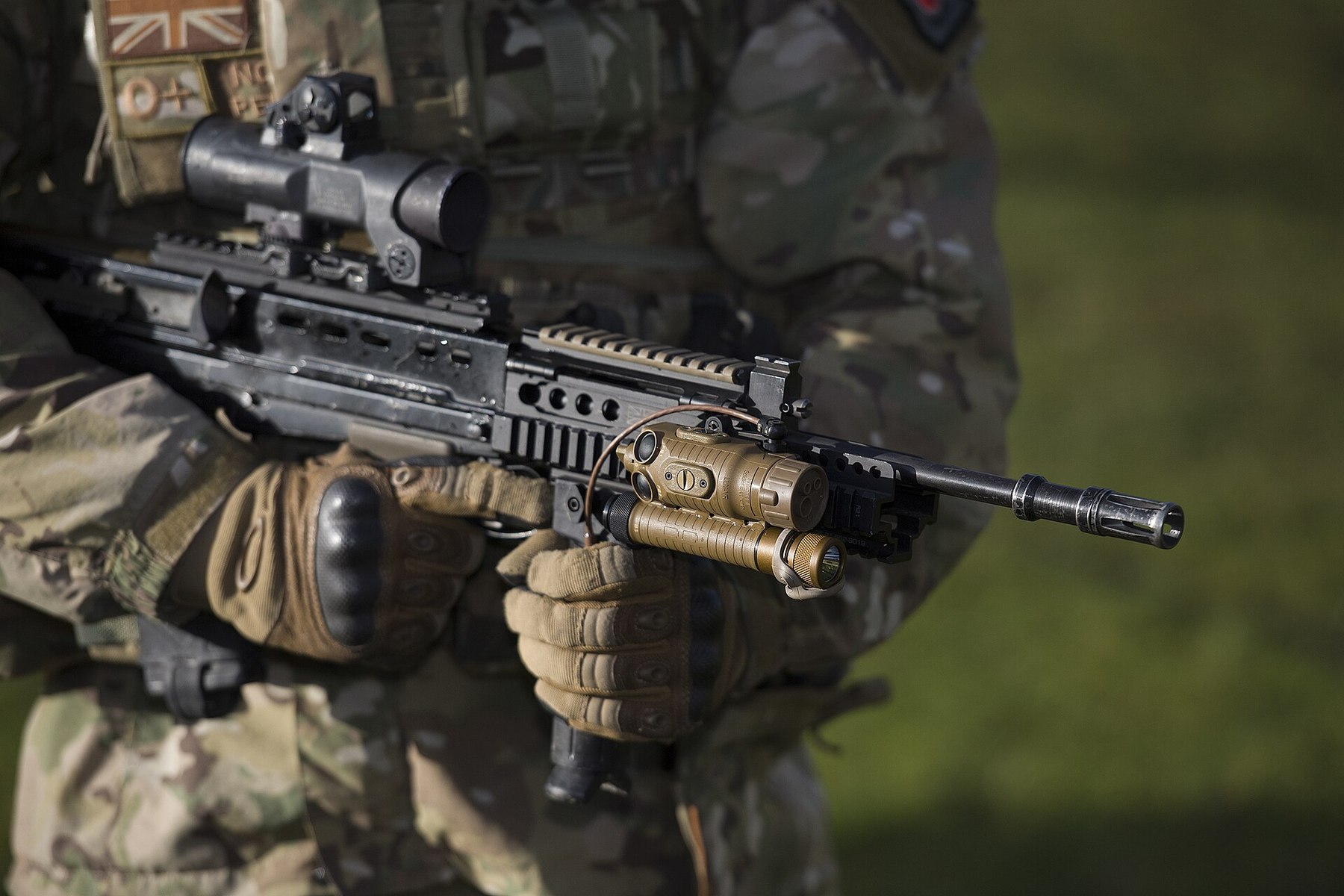
Ferguson lists “improved laser light modules (LLM) Marks 2 & 3” among the UOR fittings.6 The MOD photograph below, released with the description “An upgraded Laser Light Module Mk 3 mounted on the SA-80 Mk2”, shows one on the rail. No specification from the MoD or the maker was found.
8.11 Rails, grips and the Grip Pod
The A2’s railed fore-end was a Daniel Defense product, fitted with a Grip Pod vertical grip that opens into a bipod.6 The same supplier’s quad rail appears on the Murdoch & Co. A2-pattern rifle sold in the US (Volume 9), sourced, according to a 2026 report, “from original supplier Daniel Defense”.12 The L22 carbine’s rail is an H&K aluminium heat shield with rails at 6 and 3 o’clock and an H&K vertical grip.8 The A3’s fore-end is H&K’s, with a continuous top rail and a “more streamlined fore grip”.69 Volume 4 uses these fore-ends to tell the rifles apart.
8.12 Magazines
The magazine interface is the American M16’s: “a 30 round capacity box magazine with the same interface as the Colt 5.56 magazine (M16 fitting)”, filled by “Three chargers”.4 Four magazine types appear in the sources:
- Colt (USGI) aluminium magazines, with which the XL70 and XL80 were trialled.13
- Radway Green magazines, British, “identifiable by their plastic baseplates marked ‘RG’”, which “contributed a new weak point in the system”.13
- The H&K steel magazine of the A2, “based upon H&K G41 design”.6
- Magpul E-Mag polymer magazines, a UOR.6
The L22 has a 20-round magazine available.8 The 1987 magazine catch shroud stopped soldiers pressing the catch by accident (Volume 2).13
8.13 Flash suppressors and the blank-firing attachment
The IW’s flash eliminator is 22 mm in diameter to launch rifle grenades; the IW’s and the LSW’s are “not interchangeable”.513 A SureFire suppressor fitted to some A2s was withdrawn because it “appears to be incompatible with the issue Blank Firing Adaptor, although it was designed to accept the SA80 bayonet”.6 The blank-firing attachment is a yellow choke tube screwed onto the muzzle and tightened “a further 180°” with the combination tool (Volume 6).5
8.14 The bayonet and scabbard
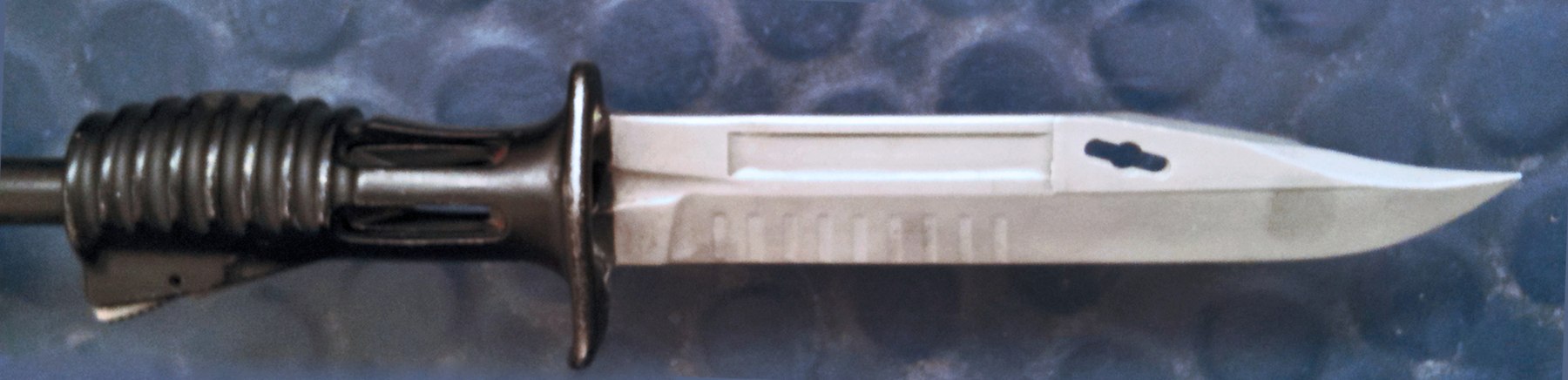
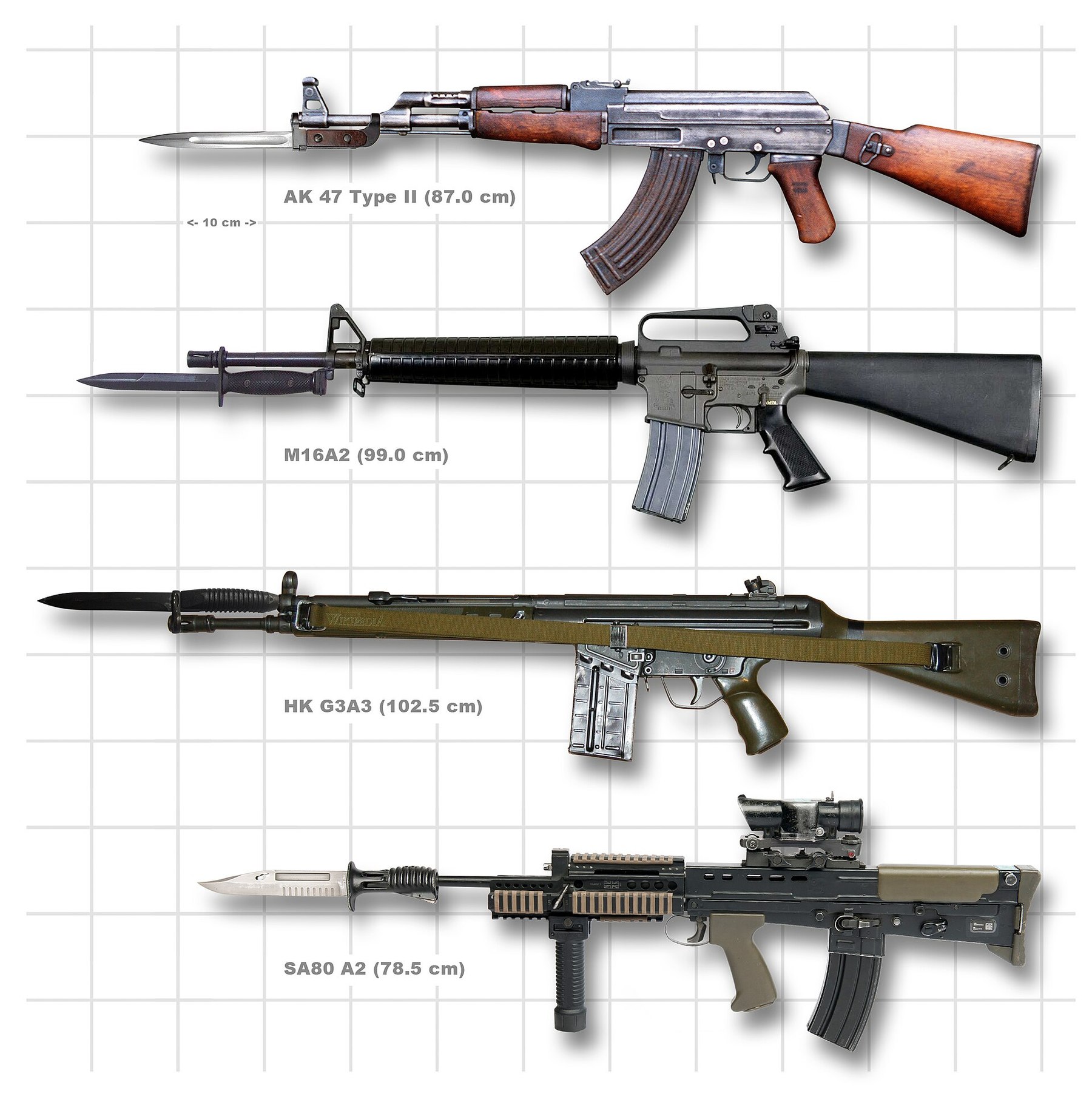
The SA80 bayonet is a socket bayonet: the brochure calls it “a one-piece stainless steel casting”.4 Ferguson: “a cast steel socket bayonet of utility knife pattern, [it] remains unchanged from original issue with the A1 rifle in 1985, although its wire-cutting scabbard was modified later”.6 The handle’s socket fits over the flash eliminator; the handbook’s accessory list notes a bottle opener.5
The brochure describes the blade and scabbard together. The back of the blade “is scalloped for rope cutting and the upper half of the blade has lightening cuts for use as a fighting knife. In conjunction with the scabbard it can be used as a barbed tape and wire cutter.” The scabbard “accepts the bayonet up to the hilt and is attached to the soldiers webbing belt by means of a fastex clip … A metal fixture at its lower end has a tungsten carbide insert for wire cutting and forms a steady for the saw blade, which cuts a variety of materials, including steel. The saw blade stows in the scabbard, on the upper side of which is a sharpening stone”.4 The handbook gives bayonet and scabbard together as 0.3 kg, the bayonet 300 mm long, and the rifle with bayonet fixed 980 mm.5
8.15 Sling and tool roll
The handbook’s sling is “two lengths of webbing type material” joined by a clip, with a quick-release buckle.5 The tool roll held the cleaning kit and combination tool, and “A complete Bolt Carrier Assembly, including firing pin, may be included in the tool roll” (Volume 6).5 The brochure also lists a “.22” training adaptor”.4
8.16 What reaches the US
Some genuine British fittings reach American buyers, though no source tracks how many.
- Furniture and magazine wells. Murdoch & Co.’s Collector Series rifles are reported to use “authentic, issued L85A1 handguards” and “original magazine-wells”.14
- Magazines and slings. Aly & Kaufman, a US maker of SA80-style lookalike kits, listed a “British MOD Surplus” H&K steel 30-round magazine at $95.00 and a surplus L85 sling at $20.00 on 18 October 2026.15
- SUSATs. No US dealer’s price for a SUSAT was found on 18 October 2026.
- Reproductions. Aly & Kaufman listed an L85-style carrying-handle iron sight set at $150.00 (or $160.00 on a micro mount), an extended buttpad at $68.00, and an “L85” flash hider for 1/2×28 threads at $42.99; Murdoch & Co.’s menu lists flash hiders and an “L3a1 Bayonet”.1516
Prices are the sellers’ own, as displayed on the date given. What can legally be fitted to which rifle is Volume 9.
8.17 Corrections this volume makes
- The SUSAT’s pointer is a rising dark pillar with a tritium-lit tip; the XL9E1 prototype’s pointer hung from above.
- The SUSAT’s emergency battle sight cannot be zeroed; it was matched to the optic’s centre in manufacture.
- The SA80 entered service with rifle grenades only; the underbarrel launcher came with the A2 as the H&K AG36 derivative, offered in 1995.
- The bayonet is unchanged since 1985; its scabbard was modified.
- The Lightweight Day Sight is the Elcan Specter OS4x, marked “LDS 5.56” on its body.
References
Footnotes
-
Jonathan Ferguson, “British Enfield SA80 Part 1: Mock-ups”, The Hoplite (Armament Research Services), 5 May 2017. Wayback capture of 13 February 2026, http://web.archive.org/web/20260213181825/https://armamentresearch.com/british-enfield-sa80-part-1-mock-ups/, consulted 2026-10-18. ↩
-
Jonathan Ferguson, “British Enfield SA80 Part 2: XL60 series”, The Hoplite, 10 May 2017. Wayback capture of 17 January 2026, http://web.archive.org/web/20260117101829/http://armamentresearch.com/british-enfield-sa80-part-2-xl60-series/, consulted 2026-10-18. ↩ ↩2
-
House of Commons, “The Army”, 22 October 1984, John Stanley. https://hansard.parliament.uk/Commons/1984-10-22/debates/0d94f7ba-ec02-46e1-b5e2-43a7ec770bba/, consulted 2026-10-18. ↩
-
Royal Ordnance, The Enfield Weapon System (sales brochure, c. 1985): “Sights”, “Bayonet”, “Scabbard”, “Accessories”. Via the UK Historic Arms Resource Centre, https://www.rifleman.org.uk/Images/PDF-files/Enfield_Weapons_System/index.html, consulted 2026-10-18. ↩ ↩2 ↩3 ↩4 ↩5 ↩6 ↩7 ↩8
-
Royal Ordnance, 5.56mm Enfield Weapon System: User Handbook, copyright Royal Ordnance plc 1985: Technical Data pp. 2–3; Accessories and Spares pp. 8–17; Sights (Figs. 9, 11) pp. 19–39. Via the UK Historic Arms Resource Centre, https://www.rifleman.org.uk/Images/PDF-files/SA80-user-manual/index.html, consulted 2026-10-18. ↩ ↩2 ↩3 ↩4 ↩5 ↩6 ↩7 ↩8 ↩9 ↩10 ↩11 ↩12 ↩13 ↩14 ↩15
-
Jonathan Ferguson, “British Enfield SA80 Part 5: SA80 A1 vs A2”, The Hoplite, 20 May 2017. Wayback capture of 28 May 2017, http://web.archive.org/web/20170528111515/http://armamentresearch.com:80/british-enfield-sa80-part-5-sa80-a1vsa2/, consulted 2026-10-18. ↩ ↩2 ↩3 ↩4 ↩5 ↩6 ↩7 ↩8 ↩9 ↩10 ↩11
-
Jonathan Ferguson, “British Enfield SA80 Part 7: L98A1 Cadet GP Rifle”, The Hoplite, 27 May 2017. Wayback capture of 6 June 2017, https://web.archive.org/web/20170606131613/http://armamentresearch.com/british-enfield-sa80-part-7-l98a1/, consulted 2026-10-18. ↩
-
Jonathan Ferguson, “British Enfield SA80 Part 6: Carbines”, The Hoplite, 24 May 2017. Wayback capture of 18 January 2026, http://web.archive.org/web/20260118060548/http://armamentresearch.com/british-enfield-sa80-part-6-carbines/, consulted 2026-10-18. ↩ ↩2 ↩3
-
Ministry of Defence and Defence Equipment and Support, “British Army’s rifle set for multi-million-pound upgrade”, 11 April 2018. https://www.gov.uk/government/news/british-armys-rifle-set-for-multi-million-pound-upgrade, consulted 2026-10-18. ↩ ↩2
-
Jonathan Ferguson with N. R. Jenzen-Jones, “British Enfield SA80 Part 8: Grenade Launchers”, The Hoplite, 3 June 2017. Wayback capture of 11 February 2026, http://web.archive.org/web/20260211165005/http://armamentresearch.com/british-enfield-sa80-part-8-grenade-launchers/, consulted 2026-10-18. ↩ ↩2 ↩3 ↩4
-
British Army, “Small arms and support weapons”, army.mod.uk. Wayback capture of 28 September 2024, http://web.archive.org/web/20240928000237/https://www.army.mod.uk/equipment/small-arms-and-support-weapons/, consulted 2026-10-18. ↩
-
“Murdoch & Co. EM85 rifles: a real civilian SA-80”, GUNSweek, 21 January 2026, https://gunsweek.com/en/rifles/news/murdoch-co-em85-rifles-real-civilian-sa-80, consulted 2026-10-18. ↩
-
Jonathan Ferguson, “British Enfield SA80 Part 4: XL80 Series”, The Hoplite, 17 May 2017. Wayback capture of 17 January 2026, http://web.archive.org/web/20260117090848/http://armamentresearch.com/british-enfield-sa80-part-4-xl80-series/, consulted 2026-10-18. ↩ ↩2 ↩3 ↩4
-
Matthew Moss, “[SHOT 2026] Murdoch & Co. launch American-made SA80s”, The Firearm Blog, 25 January 2026, https://www.thefirearmblog.com/blog/shot-2026-murdoch-co-launch-american-made-sa80s-44825827, consulted 2026-10-18. ↩
-
Aly & Kaufman LLC, home page product listings, https://aandk.llc/, consulted 2026-10-18. ↩ ↩2
-
Murdoch & Co., home page, https://murdochandco.com/, consulted 2026-10-18. ↩
Comments (0)