Smith & Wesson Model 41 · Volume 5
Against Its Rivals: High Standard, Ruger and the Plain Smith
The pistols the Model 41 was measured against, compared on the figures printed in a 1959 service manual and the maker's current specification, and what actually separates them
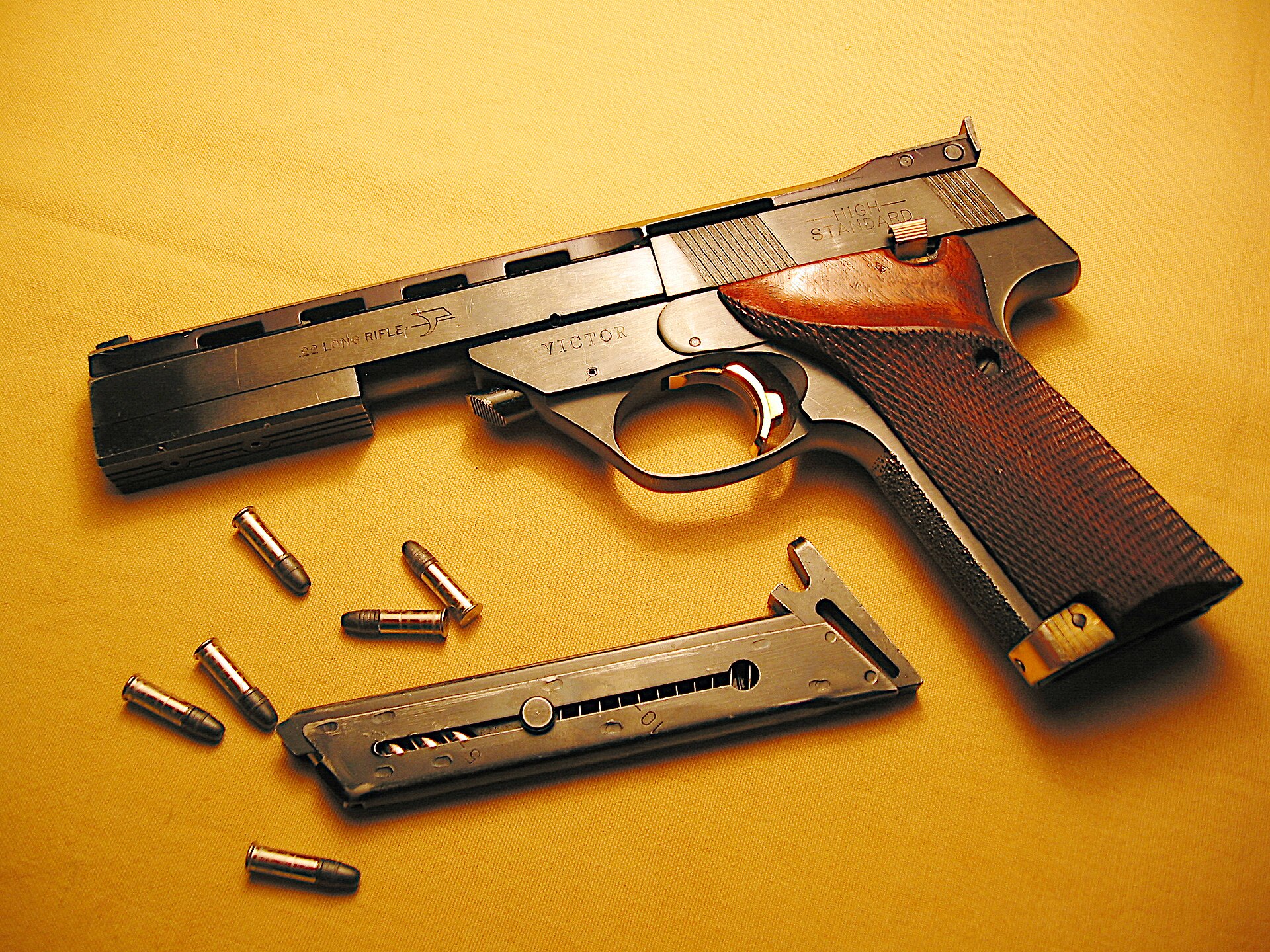
5.1 Three American .22 Target Pistols in 1959
In July 1959 the Army and the Air Force published a joint technical manual for the commercial match weapons their teams used. Its two .22 pistols are the High Standard Supermatic and the Ruger Mark I Target with the 6⅞-inch barrel.1 The Model 41, introduced in 1957, is absent. That single document fixes the field the Model 41 entered better than any retrospective does, and because it tabulates both rivals’ specifications in the same format, it allows a comparison on printed figures rather than on reputation.
This volume makes that comparison, adds the Model 41’s own current figures from Smith & Wesson, and then says what the numbers cannot. It does not retell the Ruger’s history, which belongs to the sibling Ruger Mark III and Mark IV dive, or the Model 46’s, which is in Volume 2.
5.2 The Figures Side by Side
The Supermatic and Ruger columns are from the 1959 manual’s description and tabulated data; the Model 41 column is from Smith & Wesson’s current product page and the published figures cited in Volume 1.
Table 1 — The Figures Side by Side
| High Standard Supermatic (1959) | Ruger Mark I Target (1959) | S&W Model 41 | |
|---|---|---|---|
| Barrel | 6¾ in, “ports near its muzzle to stabilize it against muzzle jump” | 6⅞ in | 5.5 in or 7 in (current); 7⅜ in in 1959 |
| Barrel weights | ”2 to 5 ounces may be added to a dovetailed slot in the barrel” | none described | offered for the 7⅜ in barrel until the late 1970s (Volume 2) |
| Weight | 42 oz (with 6¾ in barrel) | 42 oz | 41 oz (published figure for the pattern) |
| Magazine | 10 | 9 | 10 |
| Rifling | 6 grooves, right hand, 1 in 16 | 6 grooves, 1 in 14 | not published by S&W |
| Trigger pull | ”2–3 lb” (description); 2½–3 lb (inspection limits) | 2¼–3¼ lb | 2.75–3.25 lb, factory set |
| Rear sight | micrometer click | ”micro”, click; “attached to the receiver and does not move with the recoil action” | micrometer click, on the barrel |
| Front sight | adjustable ramp | Patridge, 0.125 in blade | undercut Patridge, on the barrel |
| Sight radius | not given | 9⅜ in | not published by S&W |
| Barrel removal | ”by depressing a barrel plunger cam” | barrel and receiver slide off the frame once the mainspring housing is removed | trigger guard down, barrel lifts off |
| Action | blowback, slide | blowback, bolt in a tubular receiver | blowback, short slide under the barrel |
Sources: TM 9-1005-226-14, paragraphs 3 and 5 and the inspection section;1 Smith & Wesson product page;2 Volume 1 for the Model 41’s weight.
Two things stand out. The three pistols were built to nearly the same envelope: about 42 oz, a 2½ to 3 lb trigger, a ten-shot (or nine-shot) magazine, a barrel between about 5½ and 7 inches, click-adjustable sights. That is what the bullseye .22 of the period was, and the Model 41 entered to the same specification rather than redefining it. And each maker solved the barrel’s attachment and the sight’s stability differently, which is where the real design differences are.
5.3 High Standard
High Standard was a Connecticut company that began making .22 pistols in 1932, trained a generation of wartime servicemen on its .22s, and won Olympic golds with them at Helsinki in 1952 (Joe Benner, free pistol, with a Supermatic) and at Rome in 1960 (Bill McMillan, rapid fire), according to the NRA’s Shooting Sports USA.3 By the 1950s its .22 was, in the same publication’s words, “the gun of choice” on the NRA competition circuit.4
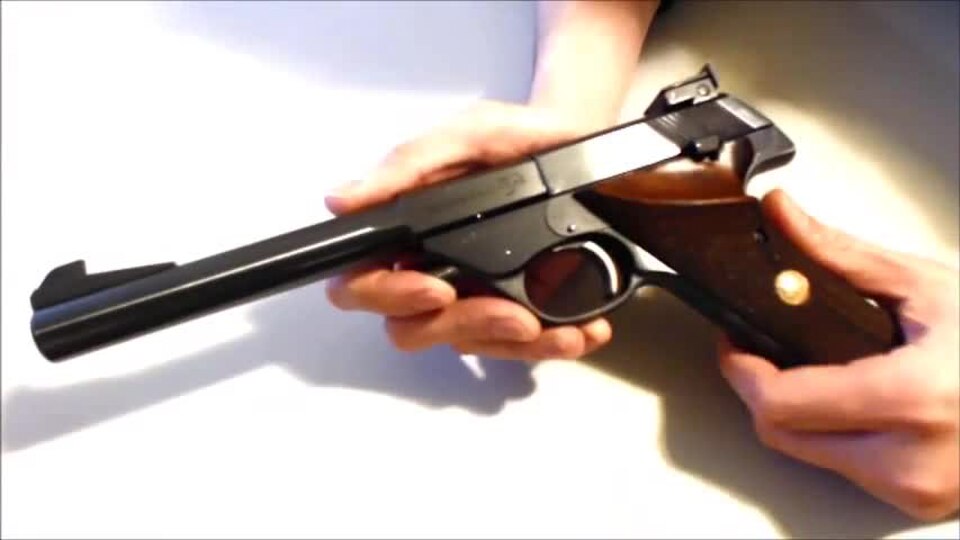
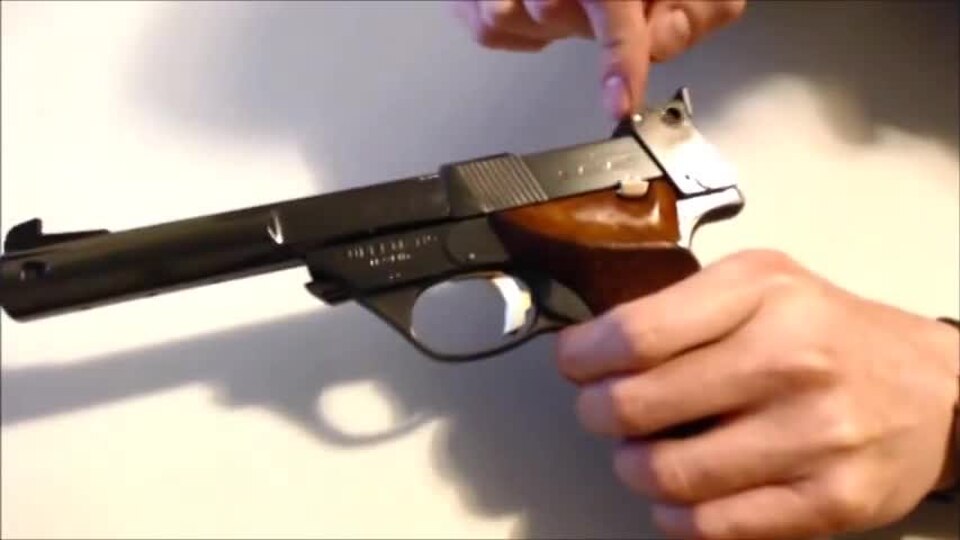
The company’s decline is part of the Model 41’s story, because it removed the incumbent. Shooting Sports USA records that the Gun Control Act of 1968 cost High Standard nearly 60 % of its business as mass merchandisers curtailed firearms sales, that the company moved to East Hartford in 1976, that its president led a management buyout from the Leisure Group in 1978, and that its assets were auctioned in December 1984.3 A Houston company acquired the assets and trademarks in 1993 and began shipping Texas-made pistols;3 the Library of Congress’s research guide gives the relocation to Texas as 1993 and the end of operations as 2018.5
For about a decade after 1984, then, there was no High Standard in production at all. The Model 41 was in production for most of that decade, stopping only in 1992. Whatever the relative merits of the two pistols, the Model 41’s position as the standard American bullseye .22 was helped by the simple fact of outlasting its main domestic rival.
A frequently repeated selling point of High Standard’s later “military” grip models is that they matched the 1911’s grip angle and safety location, the same argument made for the Model 41. It appears on Wikipedia in an article flagged as lacking citations,6 and is not relied on here.
5.4 The Ruger Mark Series
The Ruger Mark I Target of 1959 was, on the service manual’s figures, the Model 41’s equal in weight and trigger and one round short in the magazine, with a rear sight “attached to the receiver” so that it “does not move with the recoil action of the weapon”.1 Its design is fundamentally different: a round bolt reciprocating inside a tubular receiver, the barrel fixed in the front of that receiver, the whole upper assembly held to the grip frame by the mainspring housing. The lineage from the Standard through the Mark I, II, III and IV, and the two Ruger pistols owned alongside the Model 41, are the subject of the Ruger Mark III and Mark IV dive, which should be read for anything about the Ruger beyond this comparison.
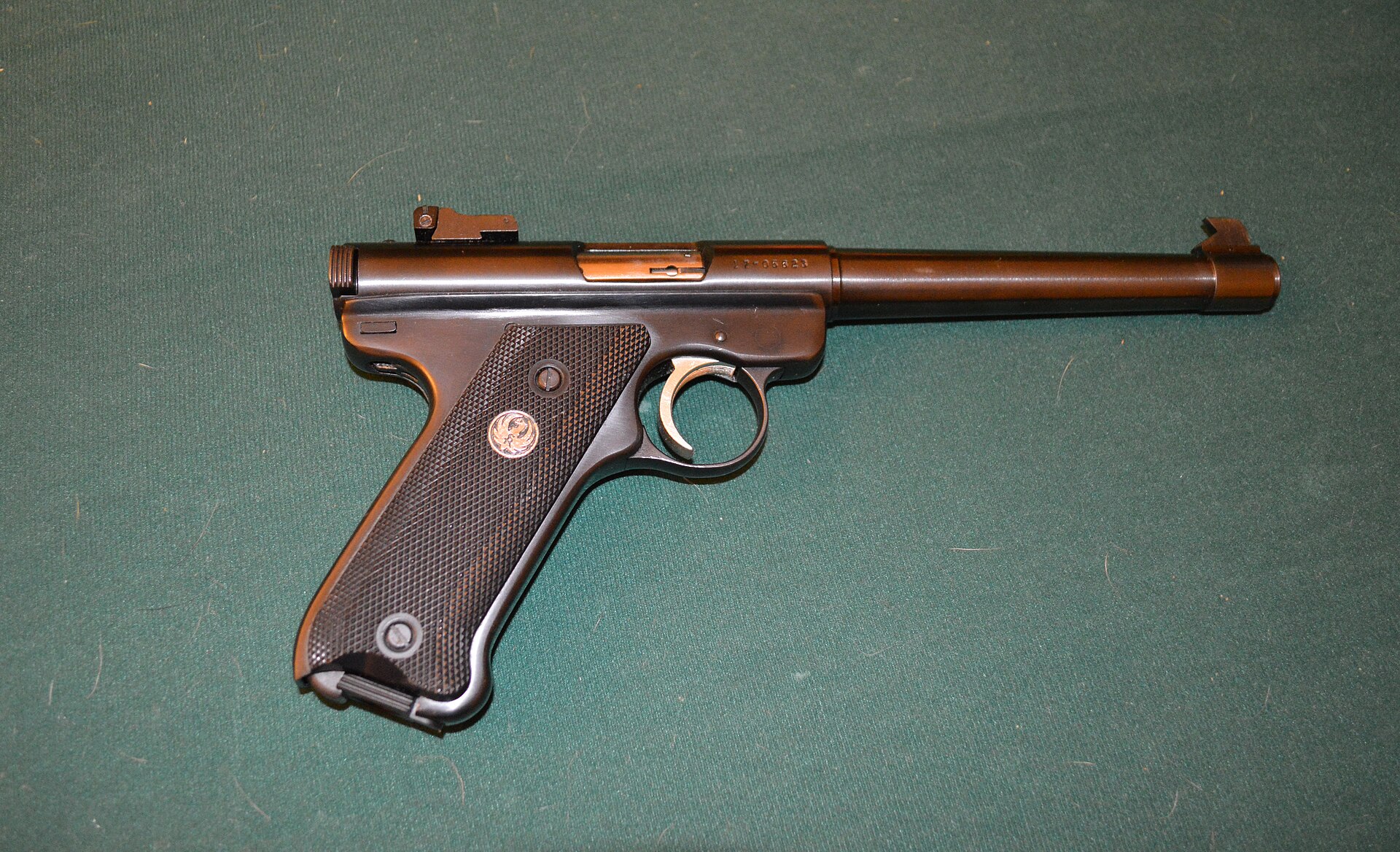
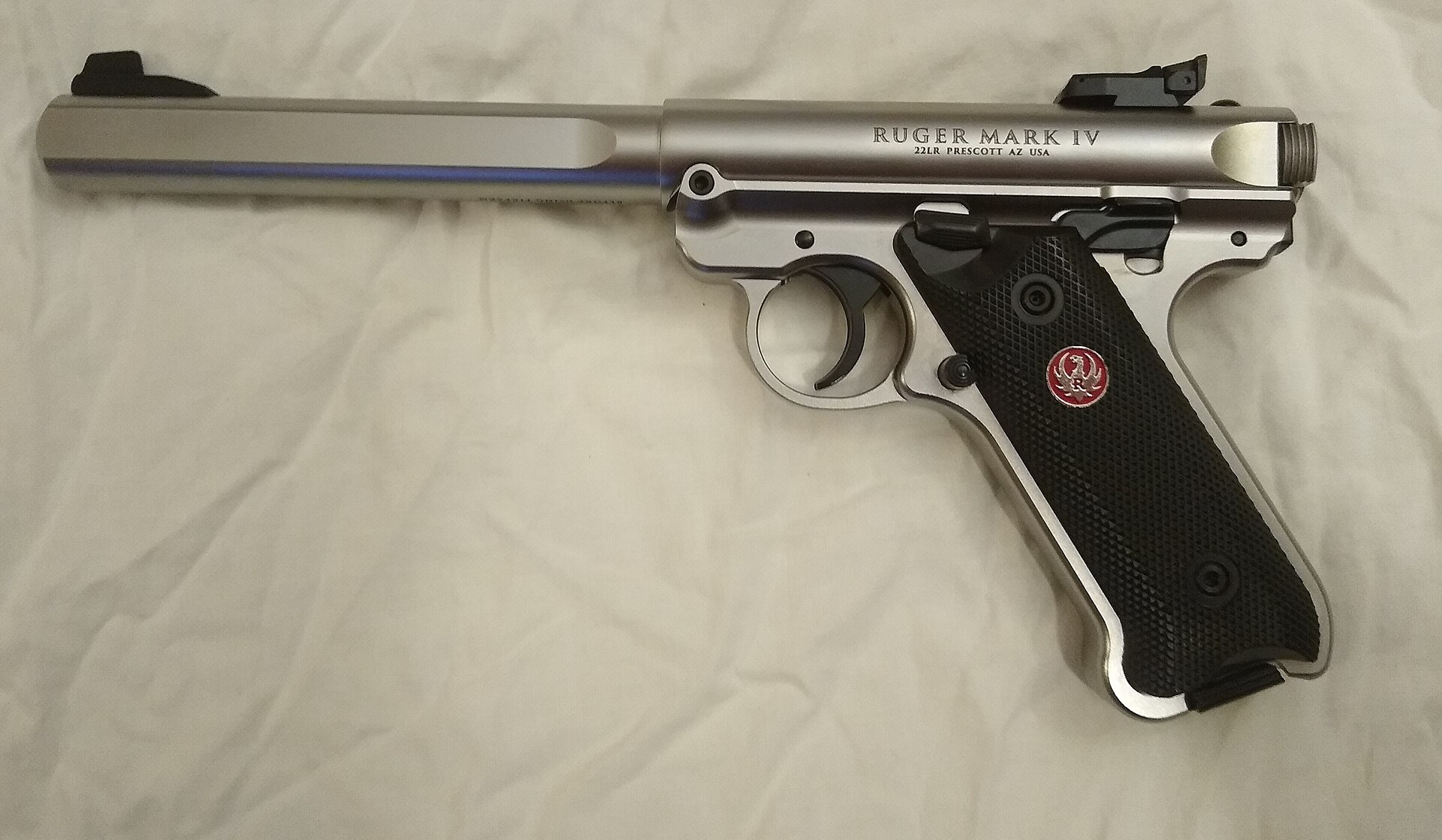
For the comparison that matters here, the Ruger and the Model 41 share the property the High Standard of 1959 did not state: in both, the rear sight is not on a reciprocating part. The Ruger’s bolt runs inside the receiver that carries the sight; the Model 41’s slide runs under the barrel that carries the sight. The difference between them is that the Model 41 puts both sights on the barrel, so a barrel change carries its own sight line, while the Ruger’s barrel and receiver are a single assembly that is changed as a unit if at all.
The Ruger’s standing advantage was price. No 1959 price for either pistol was located, and so the size of that advantage in the period is not stated here.
5.5 The Model 46
Smith & Wesson’s own rival to the Model 41 was the Model 46, the plain version: the same pistol without the high-polish bluing, with brown plastic grips, “machined with straight cut lines rather than radiused”, about 4,000 made between 1957 and 1966 on the Blue Book’s and the Standard Catalog’s figures, or 1959 to 1968 on American Rifleman’s.7 Mechanically it was the same gun, with the same trigger-guard barrel latch (Volume 3).
Its failure is instructive. A shooter choosing between a finished Model 41 and a plain Model 46 was choosing between two identical mechanisms at two prices, and chose the finished one often enough that the plain one was dropped within a decade. The comparison between the Model 41 and its real rivals was never only about mechanism.
5.6 Three Ways to Keep a Sight Still
Set side by side, the three designs are three answers to one problem: in a blowback pistol, something heavy has to move backwards on every shot, and the sights should not be on it.
Table 2 — Three Ways to Keep a Sight Still
| Design | What moves | Where the rear sight is | What a barrel change brings |
|---|---|---|---|
| High Standard Supermatic (1959) | A slide on the frame | Not stated in the 1959 manual. On the Victor photographed in this volume, on a ventilated rib running back from the barrel over the slide | Depends on model |
| Ruger Mark I Target | A round bolt inside a tubular receiver | On the receiver, which does not move | The barrel and receiver are one assembly |
| Smith & Wesson Model 41 | A short slide under the barrel’s rear extension | On the barrel’s rear extension | Its own front and rear sight |
Volume 3 describes the Model 41’s arrangement from the patent and the manual. The High Standard entry is left incomplete deliberately: the manual used here does not say where the Supermatic’s rear sight sat, High Standard’s models varied, and no High Standard primary source was consulted.
5.7 What the Service Accepted as Accurate Enough
The 1959 manual gives an acceptance test for the High Standard Supermatic after repair: five consecutive rounds from a bench rest at 15 yards, sights at six o’clock on a 3-inch bull, all five inside the bull.1 Three inches at fifteen yards is about 19 MOA. That is a function check, not an accuracy standard, and it would be passed by any serviceable .22 pistol; it is quoted because it is the only accuracy criterion printed by any of the sources for any of these guns, and because it shows how little the services’ maintenance literature concerned itself with measuring the difference between one match pistol and another. The Model 41’s published groups (Volume 4) are a fraction of that.
The same manual’s ammunition table authorises, for both .22 pistols and the service’s .22 match rifles, a single load: “ball, long rifle (40 grain) Western Super Match Mk II or equivalent Xpert or equivalent”.1 Match ammunition was specified by name in 1959 as it is now; the .22 Rimfire dive’s match-house volume covers where that ammunition comes from today.
5.8 The European Match Pistols
The 2015 Shooting Sports USA poll that put the Model 41 first on American bullseye lines put two Hämmerli models second and third, and listed the Pardini SP, Walther GSP, Hämmerli 280, Feinwerkbau AW93 and Benelli MP90S among the rest.4 These are imported match pistols, most designed for international (ISSF) events, with grips, triggers and prices of a different order. None was researched for this dive, and none is compared in detail. The one claim made about them here is the one the sources support: they share the American bullseye line with the Model 41 and, at the top of the sport, are commonly preferred.8
5.9 What Actually Separates Them
On the figures, very little. Three .22 target pistols of 1959 weighed within an ounce of one another, broke at the same trigger weights, carried the same magazine capacity within one round, and were all accurate enough that the shooter, not the pistol, set the score (Volume 4).
What separates them is everything else:
- Where the sight lives and what moves under it. Each design keeps the sight off the moving mass by a different route (above).
- How the barrel comes off, and what comes with it. The Model 41’s is the quickest and brings its own sights; the Supermatic’s plunger cam was the High Standard equivalent; the Ruger’s upper is a unit.
- Who kept making it. High Standard’s Connecticut production ended in 1984. The Model 41 was made, with gaps, until 2025. The Ruger Mark series is the subject of its own dive.
- What it cost and how it was finished. The Model 46 proves that the finish mattered to buyers even when the mechanism was identical.
References
Footnotes
-
Departments of the Army and the Air Force, TM 9-1005-226-14 / AFM 50-11, Operation and Unit Maintenance: Cal. .22 High Standard Automatic Pistol (Supermatic); Cal. .22 Ruger Mark I Automatic Pistol (Target Model) (6⅞-in. Barrel); …, 20 July 1959, paragraphs 3a–b, 5a–b, 57a and table V. Public domain; https://commons.wikimedia.org/wiki/File:TM-9-1005-226-14.pdf, accessed 2026-09-19. ↩ ↩2 ↩3 ↩4 ↩5
-
Smith & Wesson, “MODEL 41” product page (SKU 130511), https://www.smith-wesson.com/product/model-41, accessed 2026-09-19. ↩
-
Jim Gray, “The History of High Standard”, Shooting Sports USA, 27 April 2016, https://www.ssusa.org/content/the-history-of-high-standard/, accessed 2026-09-19. ↩ ↩2 ↩3
-
Chip Lohman, “The Best .22 Caliber Pistols for NRA Bullseye”, Shooting Sports USA, 15 September 2015, https://www.ssusa.org/content/the-best-22-caliber-pistols-for-nra-bullseye/, accessed 2026-09-19. ↩ ↩2
-
Library of Congress, “H&R Arms, High Standard, Ithaca”, American Firearms and Their Makers: A Research Guide, https://guides.loc.gov/american-firearms/gunmakers/hrarms-highstandard-ithaca, accessed 2026-09-19. ↩
-
“High Standard .22 pistol”, Wikipedia, https://en.wikipedia.org/wiki/High_Standard_.22_pistol, accessed 2026-09-19. The article carries a “lacks inline citations” notice. ↩
-
Blue Book of Gun Values, “Smith & Wesson Model 46”, https://bluebookofgunvalues.com/products/smith-and-wesson-model-46; Dave Campbell, “A Look Back at the Smith & Wesson Model 41”, American Rifleman, 9 October 2019, https://www.americanrifleman.org/content/a-look-back-at-the-smith-wesson-model-41/; both accessed 2026-09-19. ↩
-
Bullseye Forum threads on .22 pistols for bullseye, e.g. https://www.bullseyeforum.net/t23867-22-rimfire-pistols-for-bullseye-and-cmp, via search summary 2026-09-19. Forum opinion only. ↩
Comments (0)