Smith & Wesson Model 41 · Volume 8
Telling Them Apart: a Photographic Identification Guide
Model 41, Model 41-1 and Model 46 side by side at matched scale, the four barrels drawn to scale, the markings close up, and a table that says where to look
8.1 What This Volume Answers
A Model 41, a Model 41-1 and a Model 46 are the same pistol from ten feet away. So are a 1959 gun and a 1999 gun. The differences that matter to an owner — which model it is, which barrel is on it, and roughly when the frame was made — are all visible, but only if the reader knows which three inches of the pistol to look at.
This volume is that map. It does not repeat Volume 2’s dated chronology; it turns the parts of that chronology a camera can see into plates and a table.
8.2 How the Plates Were Built
The photographs are Rock Island Auction Company lot photographs. Wikimedia Commons holds two Model 41 photographs in total, one of them 562 pixels wide, and none of a Model 41-1 or a Model 46. The auction house’s catalogue is the only large, consistently lit, side-on photographic record of these pistols that could be reached, and its images are used here by the owner’s decision, credited in photo_credits.txt with the lot and auction number of each.1
The panels within a plate are at matched scale. Every Model 41, 41-1 and 46 shares one frame, so the outer width of the trigger-guard bow is a constant. Each photograph was measured across that bow and scaled so the bows match. The frames in Plate 2 therefore stand at the same size and the barrels can be compared directly. The measurement was made by eye from gridded thumbnails and is good to a few per cent, not to a thousandth of an inch.
Serial numbers are pixelated. Two of the lot photographs show the serial on the frame; both are masked in the plates. One of them is reproduced in the close-up plate precisely because the masked number and the model marking sit on the same side of the frame, which is itself a dating feature.
⚠ The auction descriptions are not measurements. Across the twenty-nine Model 41, 41-1 and 46 lots sampled for this dive1, the catalogue’s own barrel field gives “7 1/4 slab sided”, “5 5/8 inch slab sided”, “7 inch round”, “7 inch flat side” and “5 1/2 inch slab sided” — a spread of lengths and profile words that does not map onto Smith & Wesson’s four catalogue barrels. The plates are labelled from what the photographs show against the catalogue barrels in Volume 2, and where a lot’s own description is used it is named as the auction house’s.
8.3 Plate 1: Two Barrel Lengths on One Frame
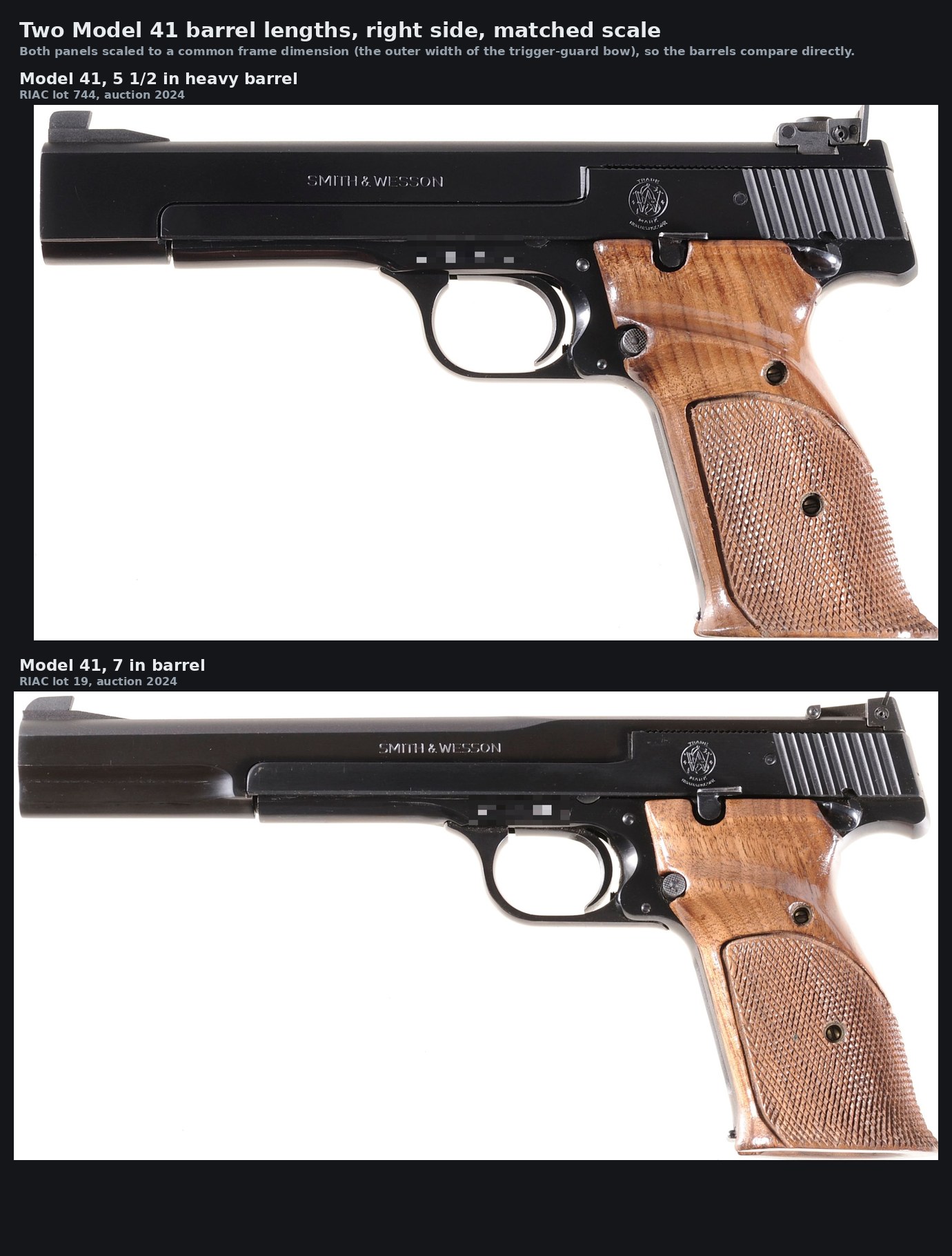
The two barrels a buyer meets most often are the 5½-inch heavy and the 7-inch. On the frame they are unmistakable once seen together:
- The heavy barrel is deep from top to bottom and the depth does not change along its length. Its muzzle is square and plain.
- The 7-inch barrel is longer and shallower, and its underside tapers toward the muzzle.
- Both put the front sight at the muzzle and the rear sight on the barrel’s rear extension, above the slide. That is the Model 41 signature and it is what Volume 3’s mechanism means in a photograph.
The pistol documented in this dive wears the 5½-inch heavy barrel, the upper panel’s configuration.
8.4 Plate 2: Model 41, Model 41-1 and Model 46
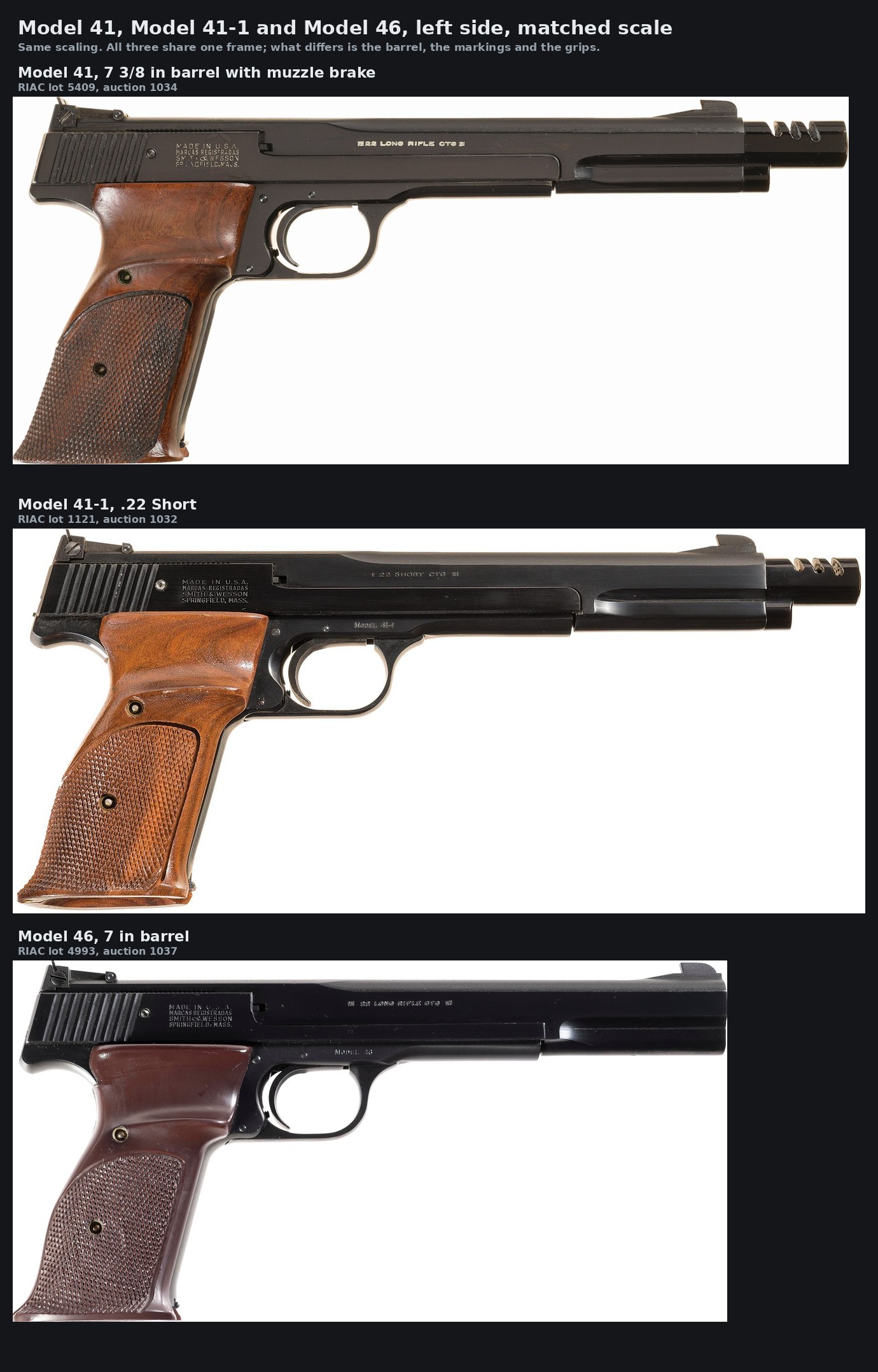
The hero plate at the top of this volume carries three pistols. What separates them:
Model 41 with the 7⅜-inch barrel (1957–1978). The longest barrel, and the only one with the muzzle brake: three slots cut into the top of the barrel behind the muzzle. Nothing else in the family has them.
Model 41-1, .22 Short (from 1960, under 1,000 made). It looks like a 7⅜-inch Model 41 — brake and all — and the tell is entirely in the markings: the barrel reads .22 SHORT CTG and the frame reads Model 41-1. American Rifleman reports an aluminium slide, which a photograph will not show.2
Model 46 (about 4,000 made, 1957–1966 or 1959–1968 depending on the source). The frame reads MODEL 46. The Blue Book’s description is the identification rule: no high-polish bluing, brown plastic grips, and machining with “straight cut lines rather than radiused”.3 In the plate the grips are the immediate cue — plain, reddish-brown, without the target grip’s palm shelf — and the general finish is duller.
8.5 The Barrels Themselves
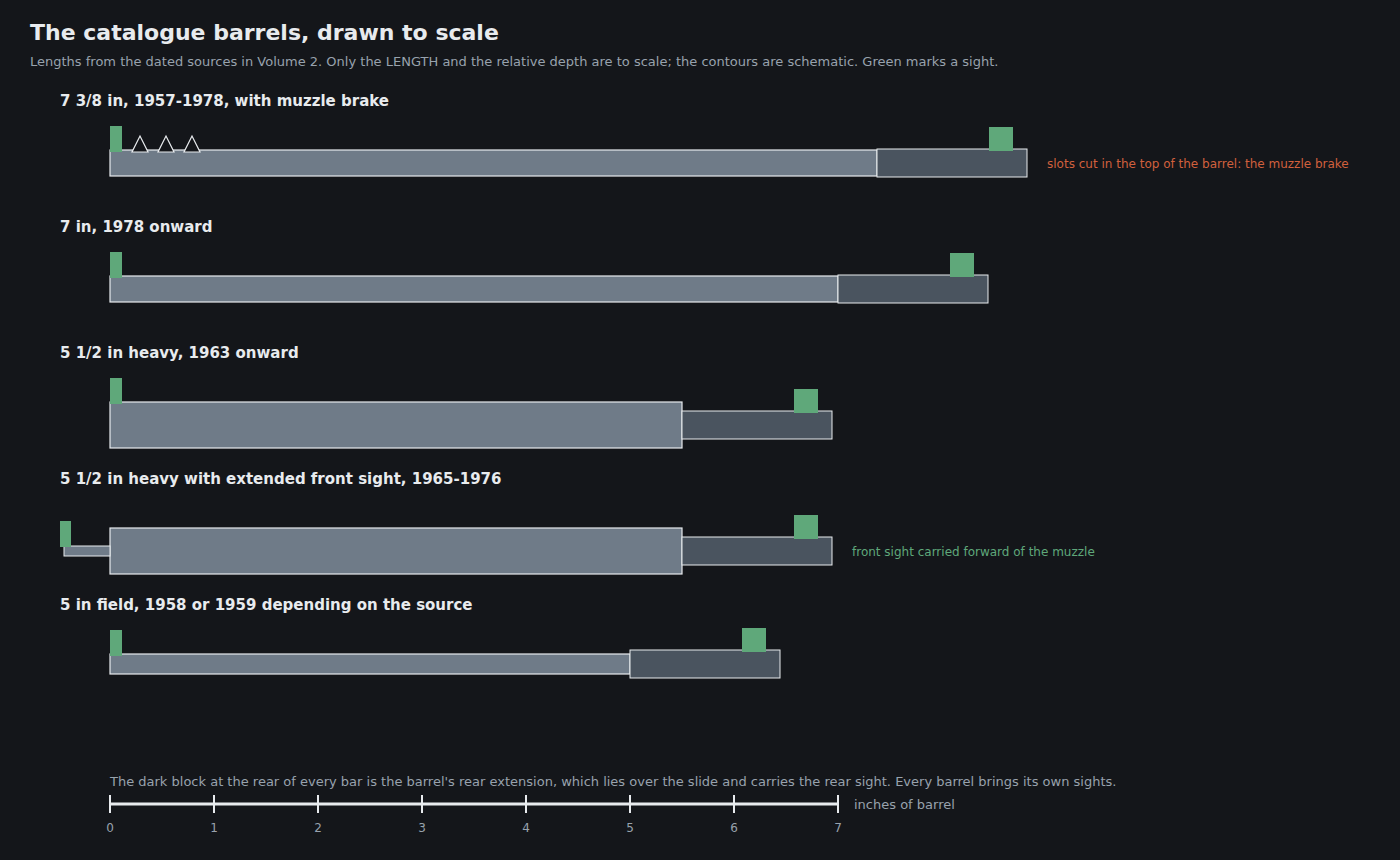
Five points that a reader inspecting a barrel should carry:
- Length is the first sort, and it is easy to get wrong by eye. The drawing above is to scale: the 7⅜-inch barrel is nearly half as long again as the 5-inch field barrel.
- Depth separates the heavy barrel from the rest. The 5½-inch heavy barrel is a deep slab; the 5-inch field barrel is slim.
- Slots at the muzzle mean the 7⅜-inch barrel and, by extension, a gun built before 1978 or a later frame wearing an earlier barrel.
- A front sight standing forward of the muzzle on a heavy barrel means the extended-sight barrel of 1965 to 1976.
- Every barrel carries its own rear sight on the rear extension. A barrel bought loose brings its sight settings with it, and a frame bought without its barrel has no sights at all.
8.6 Plate 3: the Markings, Close Up
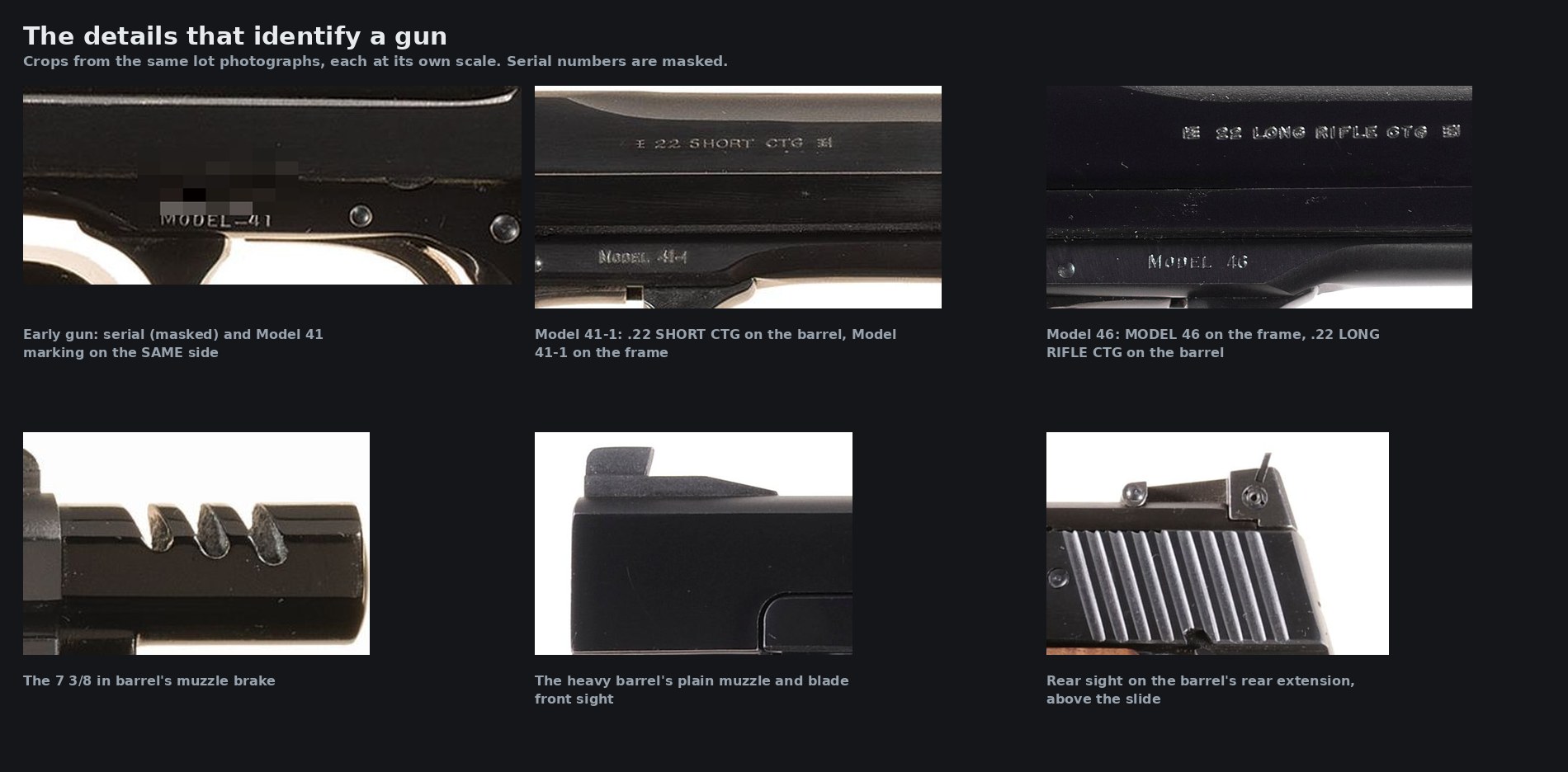
The markings do the work that silhouettes cannot.
- The barrel carries the cartridge:
.22 LONG RIFLE CTGor, on the 41-1,.22 SHORT CTG. A barrel is the fastest way to identify a 41-1 — and, because barrels move, the least reliable way to identify the frame. - The frame above the trigger guard carries the model marking on one side and the serial on the other, in current production. On the earliest guns both are on the same side, which the top-left crop shows.
- The slide carries
MADE IN U.S.A.,MARCAS REGISTRADAS,SMITH & WESSONandSPRINGFIELD, MASS.on all three models in these photographs, so it identifies nothing but the maker.
8.7 The Tell-Them-Apart Table
Table 1 — The Tell-Them-Apart Table
| Feature | Model 41 | Model 41-1 | Model 46 | Where to look |
|---|---|---|---|---|
| Cartridge marking | .22 LONG RIFLE CTG | .22 SHORT CTG | .22 LONG RIFLE CTG | Top of the barrel, ahead of the rear extension |
| Frame marking | Model 41 | Model 41-1 | MODEL 46 | Frame, above the trigger guard |
| Finish | High-polish blue | High-polish blue | Duller blue, no high polish | Flats of the slide and barrel |
| Grips | Checkered walnut target, usually with a thumbrest; laminated from 1997 | Checkered walnut target | Brown plastic | Grip panels |
| Machining | Radiused cuts | Radiused cuts | Straight cuts | Frame and slide edges |
| Muzzle brake | Only on the 7⅜ in barrel | Seen on the 7⅜ in barrel | Not seen in the lots sampled | Top of the barrel, behind the muzzle |
| Barrel depth | Heavy or slim, by barrel | As Model 41 | As Model 41 | Side view |
| Slide material | Steel | Aluminium, per American Rifleman | Steel | Not visible in a photograph |
| Numbers made | Hundreds of thousands, 1957–2025 | Under 1,000, plus 28 in 1976 | About 4,000 | Volume 2 |
Two cautions belong with the table. A refinished pistol can lose the finish distinction entirely, and grips are the most-replaced part on any target pistol, so plastic grips do not make a Model 46 and walnut grips do not unmake one. The markings are the evidence; everything else is corroboration.
8.8 Dating Features, in Photographic Terms
Volume 2 carries the dated chronology and its sources. In a photograph, the features that place a Model 41 in its era are:
Table 2 — Volume 2 carries the dated chronology and its sources. In a photograph, the features that place a Model 41 in its era are
| What a photograph shows | What it indicates |
|---|---|
| Model marking and serial on the same side of the frame | The earliest guns, before about serial 27500 |
| No relief cuts at the rear of the trigger guard | Before about serial 16000 |
| A cocking indicator at the rear of the pistol | Before the 1978 revision |
| A 7⅜ in barrel with a muzzle brake | A pre-1978 barrel, which may or may not be on its original frame |
| A heavy barrel with the front sight forward of the muzzle | The 1965–1976 extended-sight barrel |
| Drilled and tapped holes or a scope base on top | 1994 onward, per the Blue Book |
| An integral Picatinny rail | The Performance Center pistol of current production4 |
| Laminated grips | 1997 onward |
8.9 What No Photograph Settles
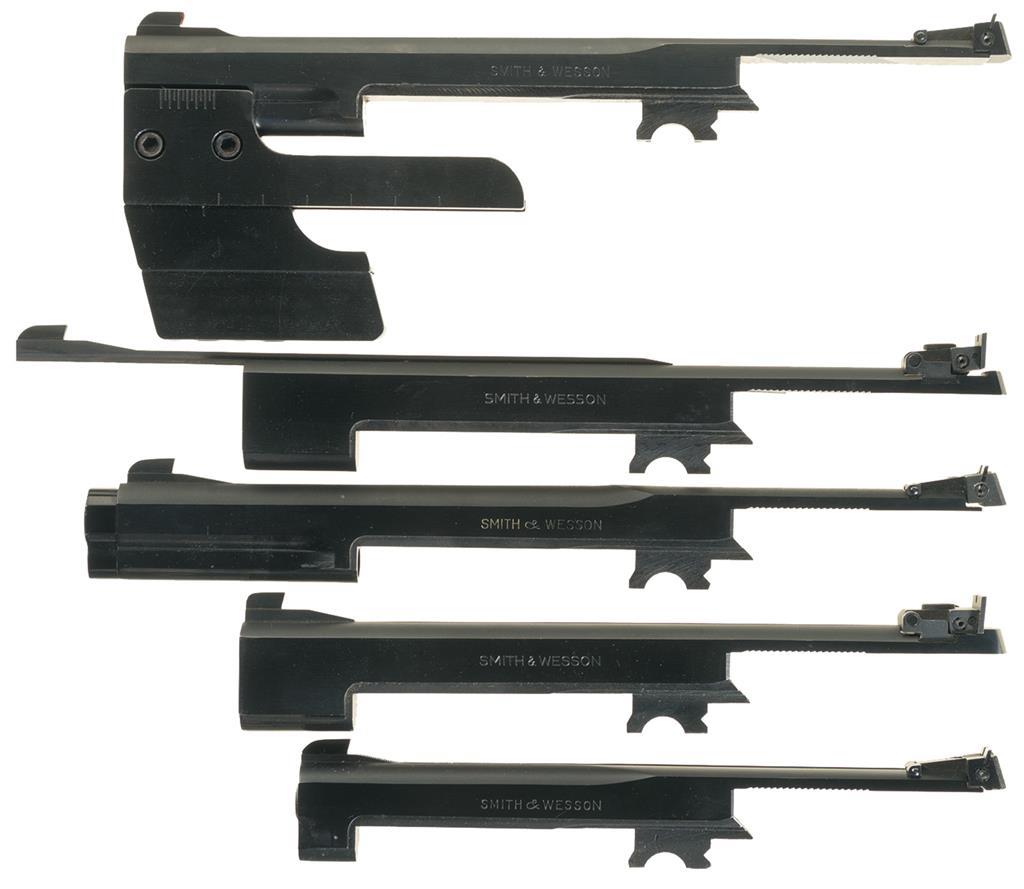
- Which barrel a frame left the factory with. Barrels come off without tools and circulate separately, as the five-barrel lot shows. Only a factory letter answers this, and Volume 2 says what one costs.
- Whether a barrel and frame of different eras will feed reliably together. They may fit and still not work; Volume 7 records a collector’s account of exactly that.
- The slide material of a Model 41-1, the internal changes of 1978 or 1994, or whether the safety is the pre- or post-1994 pattern.
- Whether a gun has been refinished, which a photograph can suggest but not prove, and which changes both the collector value and the finish-based identification above.
- The serial number, which is masked in every plate here on purpose. A reader identifying their own pistol should read their own frame.
References
Footnotes
-
Rock Island Auction Company lot photographs and lot data: lot 5409 of auction 1034 and lot 4607 of auction 1033 (Model 41, 7⅜ in barrel); lot 1121 of auction 1032 (Model 41-1); lot 4993 of auction 1037 (Model 46); lot 744 and lot 19 of auction 2024 (Model 41, 5½ in heavy and 7 in); lot 5521 of auction 1024 (five Model 41 barrels). Retrieved 2026-09-20; URLs and the full sampled list are in
photo_credits.txt. ↩ ↩2 -
Dave Campbell, “A Look Back at the Smith & Wesson Model 41”, American Rifleman, 9 October 2019, https://www.americanrifleman.org/content/a-look-back-at-the-smith-wesson-model-41/, for the Model 41-1’s aluminium slide and production figure. ↩
-
Blue Book of Gun Values, “Smith & Wesson Model 41/41-1” and “Smith & Wesson Model 46” model entries, https://bluebookofgunvalues.com/products/smith-and-wesson-model-4141-1 and https://bluebookofgunvalues.com/products/smith-and-wesson-model-46, accessed 2026-09-19. The Model 46 description and the dated changes. ↩
-
Smith & Wesson, “MODEL 41” and “PERFORMANCE CENTER® MODEL 41” product pages, https://www.smith-wesson.com/products/model-41, read 2026-09-20, for the current barrels and the integral rail. ↩
Comments (0)