Smith & Wesson Model 41 · Volume 1
Origins: Ten Years in the Toolroom, and the Game It Was Built For
Why Smith & Wesson built a .22 target pistol after the war, what it had to beat, and what the record actually says about 1947 to 1957
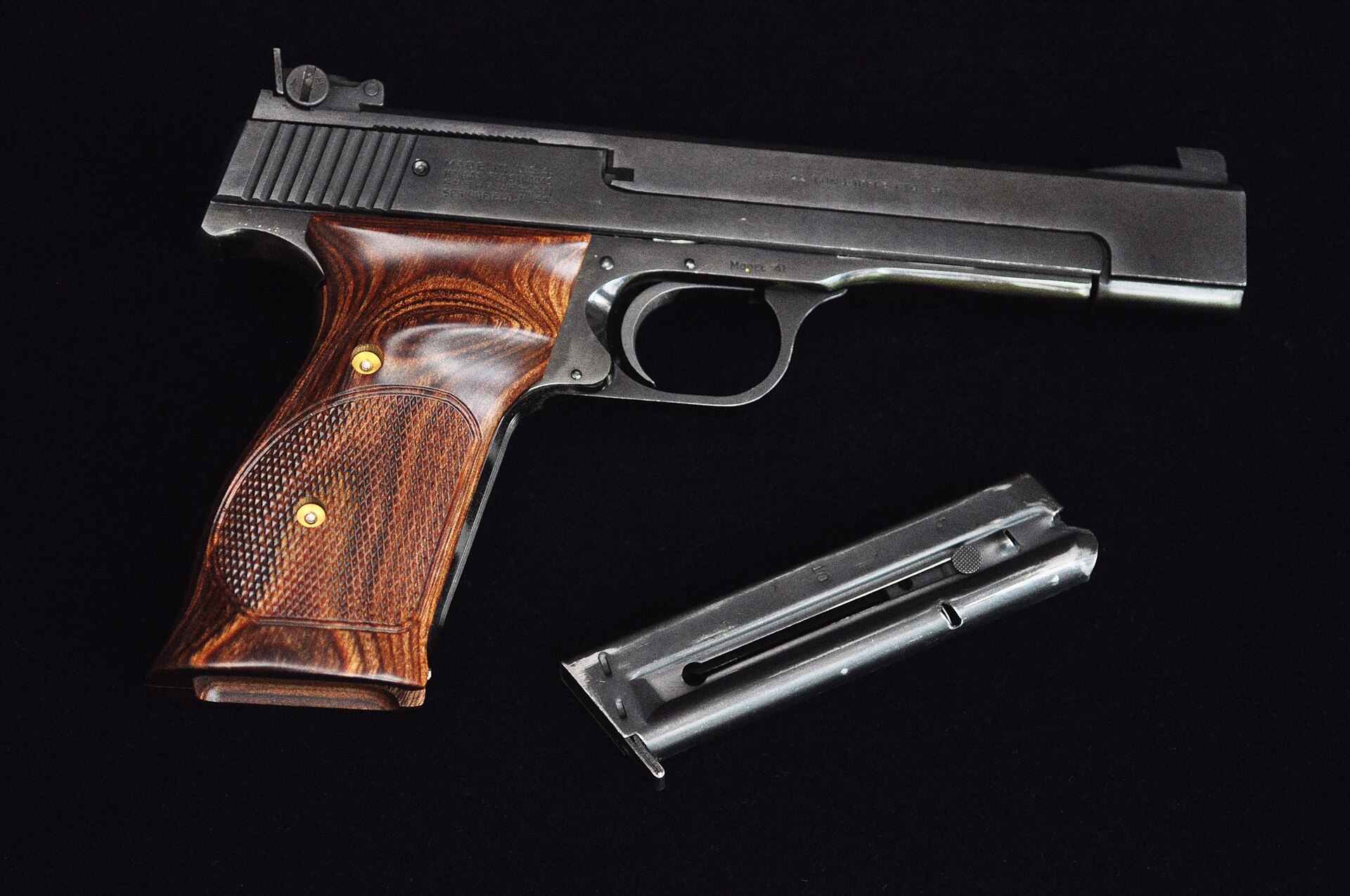
The Smith & Wesson Model 41 is a .22 Long Rifle semi-automatic target pistol, introduced in 1957 and made, with one two-year gap and several long stretches of thin supply, until Smith & Wesson announced in August 2025 that production would end with that year. It was built for one purpose, the .22 stage of American bullseye pistol shooting, and it is one of the few firearms whose reputation among the people who use it for that purpose has stayed high for nearly seventy years.
That reputation is the problem these volumes start from. Almost everything written about the Model 41 repeats the same half-dozen sentences, and a surprising number of them disagree with each other on dates while agreeing on adjectives. The dates in this dive are therefore attributed to whoever prints them, conflicts between sources are shown rather than averaged, and the claims that rest only on forum compilation or search summary are labelled as such. Where the maker’s own documents exist, they are used: three editions of the Smith & Wesson manual, the two patents Smith & Wesson filed on the pistol’s mechanism in May 1957, and the current product pages.
This volume sets the scene: the pistol in figures, the game it was built for, the gun it had to displace, and the ten years between the first prototypes and the first shipments.
1.1 The Pistol in One Table
Figures for the current pattern are from Smith & Wesson’s own product pages, read on 2026-09-19. Historical figures are attributed in their own rows.
Table 1 — The Pistol in One Table
| Maker | Smith & Wesson, Springfield, Massachusetts |
| Cartridge | .22 Long Rifle. A .22 Short variant, the Model 41-1, was made from 1960 in small numbers (Volume 2) |
| Operation | Straight blowback, single action, internal hammer |
| Barrels (current) | 5.5 in and 7 in, interchangeable on one frame (“Switch-Barrel Design Allows Both 5.5” and 7” Barrels on One Frame”)1 |
| Barrels (historical) | 7⅜ in (original, 1957), 5 in, 5½ in heavy, 5½ in heavy with extended front sight, 6 in briefly; dated in Volume 2 |
| Trigger | ”Crisp Target Trigger Factory Set at 2.75 to 3.25 lbs.”, with a “User Adjustable Trigger Stop”1 |
| Sights | ”Micrometer Click Adjustable Target Rear Sight with Undercut Patridge Front Sight”1 |
| Magazine | 10 rounds, single column. A 12-round magazine was offered 1992–1994 (Volume 2) |
| Weight | 41 oz, as published by American Rifleman and the Blue Book of Gun Values for the pattern.23 Smith & Wesson’s product pages, as fetched, carry no spec-sheet weight |
| Length | 10½ in (American Rifleman, 2019)2 |
| Current SKUs | 130511 (Model 41, 5.5 in), 130512 (Model 41, 7 in), 178031 (Performance Center Model 41, with an integral Picatinny rail)1 |
| Last list prices | $2,199 (both barrel lengths) and $2,499 (Performance Center)1 |
| Status | Production end announced August 2025, effective the end of 2025 (Volume 2) |
1.2 The Game: What a Bullseye .22 Has to Do
The Model 41 makes sense only against the discipline it was built for. American bullseye shooting, which the National Rifle Association now calls Precision Pistol, is one-handed, standing, slow and deliberate, and scored on concentric rings. Its full aggregate is fired with three guns: a .22 rimfire, a centerfire of .32 calibre or larger, and a .45. The .22 is one of the three.4 With the least recoil of the three guns, it is the one on which errors of hold and trigger show most plainly.
The course that defines the equipment is the National Match Course, as printed in the NRA’s 2020 Precision Pistol rulebook:4
Table 2 — The Game: What a Bullseye .22 Has to Do
| Distance | Stage | Time | Shots | Target |
|---|---|---|---|---|
| 50 yd | Slow fire | 10 minutes | 10 | B-6 |
| 25 yd | Timed fire | 20 seconds per string | 2 strings of 5 | B-8 |
| 25 yd | Rapid fire | 10 seconds per string | 2 strings of 5 | B-8 |
Thirty shots, 300 points. Three things about that table decide what a .22 target pistol must be.
The 50-yard ring is small. The B-6 target’s 10 ring is 3.36 inches across and its X ring 1.695 inches.4 At 50 yards one minute of angle is 0.524 in, so the 10 ring subtends about 6.4 MOA and the X ring about 3.2 MOA. The 25-yard B-8 uses the same ring dimensions,4 so at half the distance the same 10 ring is about 12.8 MOA wide. A pistol that cannot hold a small fraction of 6.4 MOA from a machine rest is spending the shooter’s margin before the shooter has made any error at all. Volume 4 returns to this, because it is the right yardstick for the Model 41’s accuracy reputation.
Rapid fire is five shots in ten seconds, one-handed. A .22 target pistol must therefore cycle reliably and return to the same place in the hand after every shot. The pistol’s weight, its balance forward of the hand, and how little it moves under recoil matter as much in rapid fire as mechanical accuracy does in slow fire.
The trigger is regulated. The 2020 rulebook’s rule 3.4 sets the .22 pistol’s trigger pull at not less than 2 pounds, its barrel at not more than 10 inches, and open sights at not more than 10 inches apart; any sight except one that projects an image on the target is permitted.4 That is the current rule; earlier editions were not consulted, and nothing here should be read as the 1957 rule. Smith & Wesson’s factory setting of 2.75 to 3.25 lb sits comfortably above the current minimum.
1.3 The Incumbent: High Standard
The Model 41 was not entering an empty field. In the 1950s the American .22 target pistol was a High Standard.
High Standard began making .22 pistols in 1932, supplied .22 training pistols to the armed forces in the Second World War, and by the 1950s held the position the Model 41 would later contest. Its own milestones as the NRA’s Shooting Sports USA records them are Olympic: Joe Benner’s gold in the 50-metre free pistol at Helsinki in 1952 with a Supermatic, and Bill McMillan’s gold in rapid fire at Rome in 1960.5 The same NRA publication, surveying the bullseye field in 2015, put it simply: by the 1950s the High Standard .22 was the gun of choice on the NRA competition circuit.6
The clearest single document of what the services themselves considered a match .22 at the moment the Model 41 appeared is a joint Army and Air Force technical manual dated 20 July 1959, TM 9-1005-226-14 / AFM 50-11, covering the commercial match weapons the services issued to their teams. Its two .22 pistols are the High Standard Supermatic and the Ruger Mark I Target. The Model 41, on sale for nearly two years by then, is not in it.7 That is not evidence against the Model 41’s quality. It is evidence of how entrenched the incumbent was, and of how much work the new pistol had to do to be taken up. Volume 5 compares the three pistols on the data that manual prints.
1.4 Smith & Wesson After the War
The other Smith & Wesson semi-automatic of the 1950s, the 9 mm Model 39, grew out of the Army’s search for a new service pistol in 1954 and reached the commercial market in 1955.8 The Model 41’s prototypes predate that programme by seven years; the pistol itself followed the Model 39 to market two years later, in 1957.8
The company’s president through this period was Carl Hellstrom. American Rifleman and The Gun Mag both place the Model 41’s introduction under his leadership.89 Neither source is specific about his personal role in the pistol, and none is claimed here.
1.5 to 1957: What Is Documented and What Is Repeated
The standard account is that two toolroom prototypes, numbered X-41 and X-42, were made in July 1947, and that the design was tested and refined for ten years before introduction. American Rifleman’s 2019 retrospective puts it as “By July 1947 a pair of tool-room-made semi-automatic .22s were made”, followed by “10 years of development and research”.2 Wikipedia gives the same dates and the prototype numbers, citing Supica and Nahas’s Standard Catalog of Smith & Wesson.10 The Standard Catalog itself could not be consulted for this dive: the editions held by the Internet Archive are lending copies whose search service refused automated access. Every Standard Catalog date in these volumes is therefore second-hand and is labelled as such.
Two further details circulate widely and could not be confirmed from any published source:
- That the project’s chief engineer was Dwayne Charron. This appears in a long collector’s post on the Smith & Wesson Forum and was not found in any maker’s or published reference source.11 It is not asserted here.
- That the first production pistol “came off the assembly line on September 13, 1957” as serial number 1,401, or that the first Model 41 shipped on 17 September 1957. Both dates come from forum compilations.1112 The serial number is corroborated by the Blue Book of Gun Values, whose model entry states that the Model 41 “was introduced in 1957 with a 7 3/8 in. barrel, starting with serial number 1401.”3 The two September dates are not corroborated and are given as reported.
What is documented, in Smith & Wesson’s own name, is the mechanism. On 28 May 1957, months before the first shipments, two patent applications were filed by Joseph W. Norman of Springfield, Massachusetts, assignor to Smith and Wesson: one for a “Firearm Barrel Latch” (US 2,887,810, granted 26 May 1959) and one for an “Adjustable Trigger Spring” (US 2,871,604, granted 3 February 1959).1314 The barrel-latch patent describes, part by part, the arrangement every Model 41 owner uses when field-stripping the pistol: a lug under the barrel with recesses front and rear, an abutment in the frame, a spring-loaded latch, and a trigger guard pivoted at its rear whose nose cams the latch home when the guard is closed. It is the Model 41’s most distinctive design feature and it was being protected in Smith & Wesson’s name in the same season the pistol went on sale. Volume 3 reads both patents in detail.
The ten-year gestation is therefore reasonably supported for its end points and thinly supported for its middle. What happened between 1947 and 1957, who did it, and why it took so long is not in any source consulted here.
1.6 The Pistol That Shipped in 1957
The numbers. Wikipedia (citing the Standard Catalog) and American Rifleman’s 2019 retrospective agree on the first two years: 679 Model 41s in 1957, and a cumulative 9,875 by the end of 1958.210 American Rifleman’s 2022 profile adds that the pistol “was on backorder for several years, despite staggering increases in production”.8
The configuration. The first guns had a 7⅜-inch barrel, blued steel, Patridge sights, checkered walnut grips and a muzzle brake, according to American Rifleman.8 A Stoeger Shooter’s Bible of 1964, as reported on Wikipedia, shows the 7⅜-inch barrel grooved to take Olympic-style centre weights.10 The Blue Book entry describes the grips as “checkered walnut grips with thumbrest”.3 The pistol was a single-action blowback .22 LR with a ten-round magazine, and its barrel came off by swinging the trigger guard down: the arrangement the Norman patent protects.
The price. The Gun Mag’s 2020 retrospective reports a 1966 catalogue price of $100, from that year’s Gun Digest.9 The same pistol listed at $2,199 in 2025. Volume 4 tabulates the prices between.
What it was not. It was not a service pistol and was not built as one. It was not the first American .22 target semi-automatic; High Standard and Ruger were both in the field, and the 1959 service manual documents both. And it was not cheap. A plainer version, the Model 46, appeared within two years at a lower price and did not sell well, a story told in Volume 2.
1.7 The Grip Angle, and Two Numbers for It
Almost every account of the Model 41 says that its grip angle is the same as the Colt 1911’s, so that a bullseye shooter moving from the .22 stage to the .45 stage does not have to relearn the hold. American Rifleman states it without a number: “The company wisely used the same grip angle as the 1911”.8
Two numbers are attached to that angle in circulation, and they are not the same measurement:
- Wikipedia: “an 18 degree grip angle, the same as the Colt M1911 pistol”.10
- The NRA’s Shooting Sports USA (2015), The Gun Mag (2020) and European trade press reporting the 2025 end of production: 105 degrees, again “the same as the 1911”.6915
A grip angle can be measured from the vertical, or as the included angle between the bore line and the grip’s backstrap, and different publications use different conventions and reference lines. The two figures are recorded here as their sources give them. Neither is Smith & Wesson’s own published figure, and neither is converted into the other. The substantive claim, that the Model 41 matches the 1911’s hold, is the one every source agrees on.
1.8 What These Volumes Argue
Table 3 — What These Volumes Argue
| Vol | Title | The point |
|---|---|---|
| 1 | Origins | This volume |
| 2 | Production History, and How to Date One | Every change with its date and its source; the gaps; the relatives; the 2025 end; reading a gun’s era from its features |
| 3 | How It Works | The exposed-barrel blowback, the trigger-guard barrel latch from the 1957 patent, the trigger, and why both sights ride on the barrel |
| 4 | The Reputation, Tested | Accuracy and collectability argued from measured groups, the target’s dimensions and dated prices, not from adjectives |
| 5 | Against Its Rivals | The High Standard, the Ruger Mark series and the Model 46, on the published data |
| 6 | Owning and Maintaining the Pistol Documented Here | Match ammunition (linked, not re-derived), the manual’s field strip and care, the trigger stop, Michigan, and the questions only the owner can answer |
Three findings run through them. The first is that the maker’s own manuals do not contain the ammunition prohibition most often attributed to them (Volume 6). The second is that the dates everyone quotes for the barrel options, the Model 46 and the .22 Short variant disagree from source to source by one to three years, and the disagreements are now tabulated rather than hidden (Volume 2). The third is that the pistol’s defining mechanical idea, a barrel carrying both sights and latched to the frame by the trigger guard, is documented in a primary source that the usual retellings never cite (Volume 3).
References
Footnotes
-
Smith & Wesson, product pages “MODEL 41” (SKU 130511), “MODEL 41 7” BARREL” (SKU 130512) and “PERFORMANCE CENTER® MODEL 41” (SKU 178031), https://www.smith-wesson.com/product/model-41 and https://www.smith-wesson.com/product/performance-center-model-41, accessed 2026-09-19. Feature lists and prices as quoted. The pages’ stored weight fields are shipping weights and are not quoted as the pistol’s weight. ↩ ↩2 ↩3 ↩4 ↩5
-
Dave Campbell, “A Look Back at the Smith & Wesson Model 41”, American Rifleman, 9 October 2019, https://www.americanrifleman.org/content/a-look-back-at-the-smith-wesson-model-41/, accessed 2026-09-19. ↩ ↩2 ↩3 ↩4
-
Blue Book of Gun Values, “Smith & Wesson Model 41/41-1” model entry, https://bluebookofgunvalues.com/products/smith-and-wesson-model-4141-1, accessed 2026-09-19. ↩ ↩2 ↩3
-
National Rifle Association, NRA Precision Pistol Rules, 2020 edition, https://competitions.nra.org/media/8365/nra-precision-pistol-rules.pdf, accessed 2026-09-19. Rule 3.4 (the .22 pistol); rules 4.7 and 4.8 (B-8 and B-6 targets); the National Match Course table. MOA conversions are computed here. ↩ ↩2 ↩3 ↩4 ↩5
-
Jim Gray, “The History of High Standard”, Shooting Sports USA, 27 April 2016, https://www.ssusa.org/content/the-history-of-high-standard/, accessed 2026-09-19. ↩
-
Chip Lohman, “The Best .22 Caliber Pistols for NRA Bullseye”, Shooting Sports USA, 15 September 2015, https://www.ssusa.org/content/the-best-22-caliber-pistols-for-nra-bullseye/, accessed 2026-09-19. ↩ ↩2
-
Departments of the Army and the Air Force, TM 9-1005-226-14 / AFM 50-11, Operation and Unit Maintenance: Cal. .22 High Standard Automatic Pistol (Supermatic); Cal. .22 Ruger Mark I Automatic Pistol (Target Model) (6⅞-in. Barrel); …, 20 July 1959. Public domain; https://commons.wikimedia.org/wiki/File:TM-9-1005-226-14.pdf, accessed 2026-09-19. ↩
-
Guy J. Sagi, “Smith & Wesson Model 41: An Iconic Rimfire Target Pistol”, American Rifleman, 22 June 2022, https://www.americanrifleman.org/content/smith-wesson-model-41-an-iconic-rimfire-target-pistol/, accessed 2026-09-19. ↩ ↩2 ↩3 ↩4 ↩5 ↩6
-
John Markwell, “The Model 41: S&W’s Masterpiece 22 Auto”, The Gun Mag, 20 April 2020, https://www.thegunmag.com/the-model-41-s-ws-masterpiece-22-auto/, accessed 2026-09-19. ↩ ↩2 ↩3
-
“Smith & Wesson Model 41”, Wikipedia, https://en.wikipedia.org/wiki/Smith_%26_Wesson_Model_41, accessed 2026-09-19, citing Jim Supica and Richard Nahas, Standard Catalog of Smith & Wesson, 3rd ed. (2007). The Standard Catalog was not itself consulted. ↩ ↩2 ↩3 ↩4
-
“All about the Model 41 target pistol…”, Smith & Wesson Forum, post by PALADIN85020, https://smith-wessonforum.com/threads/all-about-the-model-41-target-pistol.323443/, accessed 2026-09-19. A collector’s compilation; no sources cited for the engineer’s name or the assembly-line date. ↩ ↩2
-
“Model 41 Changes”, Smith & Wesson Forum, list compiled by Bastogne71, https://smith-wessonforum.com/threads/model-41-changes.654193/, accessed 2026-09-19. No source cited. ↩
-
Joseph W. Norman, assignor to Smith and Wesson Inc., “Firearm Barrel Latch”, US Patent 2,887,810, filed 28 May 1957, granted 26 May 1959, https://patents.google.com/patent/US2887810A/en. ↩
-
Joseph W. Norman, assignor to Smith and Wesson Inc., “Adjustable Trigger Spring”, US Patent 2,871,604, filed 28 May 1957, granted 3 February 1959, https://patents.google.com/patent/US2871604A/en. ↩
-
“Smith & Wesson Model 41: the end of an era”, GUNSweek.com, 21 August 2025, https://gunsweek.com/en/pistols/news/smith-wesson-model-41-end-era; “Smith & Wesson about to end production of the Model 41 pistol”, all4shooters.com, 28 August 2025, https://www.all4shooters.com/en/shooting/pistols/smith-wesson-model-41-is-nearing-the-end-of-its-storied-production-run/; both accessed 2026-09-19. ↩
Comments (0)