Smith & Wesson Model 41 · Volume 7
Keeping It Working: Diagnosis, Wear, Repair and Parts
What goes wrong on a 1957 target-pistol design, how to tell which part is at fault, what the owner may touch, what a gunsmith or the factory must do, and what can still be bought now that production has ended
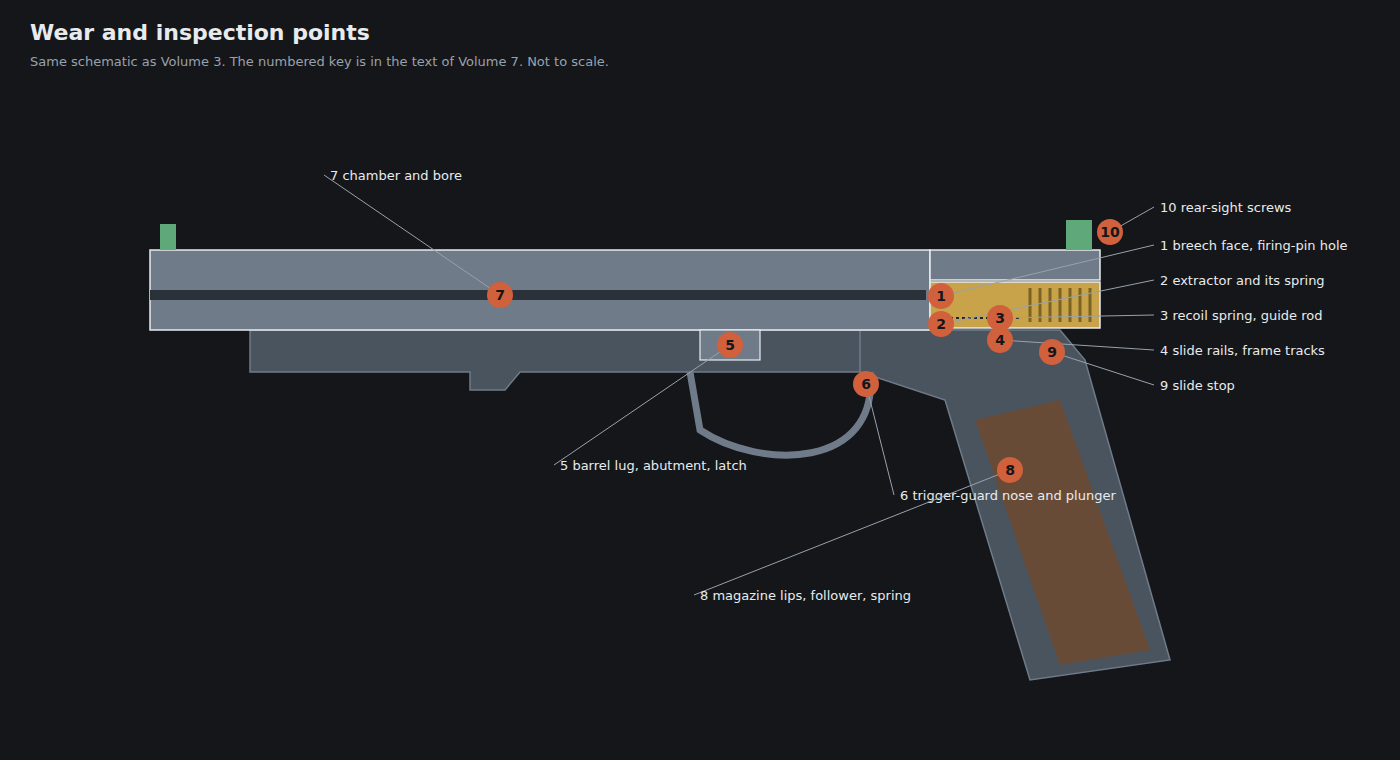
Key to the figure. 1 breech face and firing-pin hole. 2 extractor and its spring. 3 recoil spring and guide rod. 4 slide rails and frame tracks. 5 barrel lug, frame abutment and latch. 6 trigger-guard nose and its plunger. 7 chamber and bore. 8 magazine lips, follower and spring. 9 slide stop. 10 rear-sight screws and their detents.
7.1 What This Volume Is Built From
No Smith & Wesson armorer’s manual for the Model 41 was located during this work, and none of the owner’s manuals goes past the field strip. That limit shapes this volume, and it is stated here rather than papered over with a plausible-sounding repair sequence.
What is used instead, in order of authority:
- Smith & Wesson’s own manuals (2004, 2014, 2020 editions) — the inspection steps, the misfire drill, the ammunition advice, the warranty and the service route. These are the maker speaking about this pistol.1
- US Patent 2,887,810 — the barrel latch, part by part, which is what an owner is inspecting when the trigger guard feels wrong.2
- TM 9-1005-226-14 (20 July 1959) — the Army and Air Force manual for the service’s match pistols. ⚠ Its troubleshooting table and maintenance paragraphs are written for the High Standard Supermatic and the Ruger Mark I, not for the Model 41. They are used here for the class — a blowback .22 target pistol with a slide, an extractor, a driving spring and a detachable magazine — and every borrowing says so.3
- Named collectors and gunsmiths on the Smith & Wesson Forum, used only where nothing better exists and always attributed.4
7.2 First Principles: the Manual’s Own Diagnostic Steps
Three of the manual’s routine steps are diagnostic, and they come before any theory about what is wrong.1
The firing-pin protrusion check. With the slide locked open, look at the breech face: the firing pin must not protrude. If it does, the manual’s instruction is to stop, unload, and have the pistol “inspected and test fired by a gunsmith qualified to perform service on Smith & Wesson firearms”. On a blowback pistol a firing pin standing proud of the breech face can fire a round as the slide chambers it.
The free-travel check. The slide must move freely through its full length of travel. A slide that drags, catches or needs help to return to battery is reporting a fault, not a preference — and the 1959 manual’s list of causes for exactly that symptom on the Supermatic is burrs, a spring that no longer returns the slide, or lack of lubrication.3
The “stop firing” rule. If the pistol “gives any indication that it is not performing properly or the operation … has changed ‘the way it feels or sounds’, stop firing”, unload, and have it inspected.1 On a target pistol fired in strings, a change in feel or sound is usually the first sign of a spring, an extractor or a fouled chamber.
For a failure to fire, the manual’s drill is: wait ten seconds with the muzzle safe, remove the magazine, then draw the slide briskly to eject the round, without catching it over the port.1 The 1959 manual gives the same ten seconds for pistols and explains why: a hangfire cannot be told from a misfire at the moment it happens.3
7.3 The Diagnosis Table
Symptoms and causes below are drawn from the three sources named above. The column headings matter: the middle column says who reported the cause, and the right column keeps the owner’s hands off anything the manual reserves to a gunsmith.
Table 1 — The Diagnosis Table
| Symptom | Likely causes, and whose list they are on | Action |
|---|---|---|
| Failure to fire; light strikes | Defective primer, or a broken or short firing pin, a weak driving spring, a defective sear or hammer, or a firing-pin hole out of position so the pin strikes off the rim (1959 manual, Supermatic and Ruger). Extractor “deadheading” against the breech-face radius, retarding breech closure (forum, JKeefer). S&W adds that .22 LR brands vary widely in primer sensitivity and that a brand change may cure failures to fire (S&W manual) | Discard the cartridge; change brand and retest; if it persists, a gunsmith. Never dismantle the lockwork |
| Failure to feed | Rough chamber or a bur on the chamber edge; sticking firing pin; weak driving spring; weak magazine spring; broken magazine catch; a battered cartridge; dirt in the magazine or on the magazine catch (1959 manual) | Clean the magazine, chamber and catch; inspect the magazine lips; otherwise a gunsmith |
| Failure to extract; case left in the chamber | A dirty chamber, or ammunition the chamber does not like — S&W’s own words: “Some brands of ammunition may cause difficulty in extracting spent cartridge cases from the chamber”, cured by cleaning the chamber with solvent and, failing that, by changing brand (S&W manual, 2014 and 2020). A deformed extractor or a kinked or set extractor spring (1959 manual’s Supermatic maintenance) | Scrub the chamber; change brand; extractor work is a gunsmith’s |
| Slide does not return fully to battery | The 1959 manual’s test is blunt: the driving spring’s “tension should be great enough to return slide to battery. Replace a set or kinked spring.” Burrs on the slide’s central rib from the hammer, or at the sear-bar or slide-lock contacts, also bind a slide | Clean and lubricate first; a spring or burr is a gunsmith’s job on this pistol |
| Slide binds or drags | Lack of lubrication; burrs; and one cause worth quoting because it is self-inflicted: a slide that binds “as a result of attempt to remove slide side play by squeezing slide in vise” (1959 manual) | Lubricate the two points; do not squeeze anything in a vise |
| Slide fails to lock open on the last round | The slide stop is lifted by the magazine follower, so a worn follower, a weak magazine spring or a damaged stop are the candidates (mechanism, Volume 3; magazine wear items from the 1959 manual) | Try another magazine — this is the fastest single test on the whole pistol |
| Slide releases when a magazine is seated hard | Not a fault. S&W’s manuals warn in every edition that excessive upward force on a loaded magazine “could cause the slide to move forward, chambering a round” | Seat firmly, then pull on the floorplate to check |
| Trigger will not fire a second shot | The trigger must be allowed to move fully forward between shots or “the lockwork” will not cycle (S&W manual) | Release the trigger fully; if it will not reset by itself, stop and see a gunsmith |
| Barrel loose, or the trigger guard will not close | The latch is held by a spring that the guard’s nose compresses through a plunger and pin; the guard’s front lug enters an opening in the frame (patent). Dirt, a bent guard or a damaged plunger stops the latch seating | Clean and reseat the barrel; a latch part is a gunsmith’s or the factory’s |
| Accuracy falls off suddenly | Fouling in bore and chamber first; then sights and their screws; then the ammunition lot (Volume 4’s evidence on lot sensitivity) | Clean, check screws, retest with a known lot before suspecting the pistol |
7.4 Ammunition Is the First Test, Not the Last
Smith & Wesson’s manual makes two statements that between them cover a large share of .22 malfunctions, and both point at the ammunition rather than the pistol:1
- Primer sensitivity varies by brand and type, and the manual tells the owner to fire several boxes of a chosen brand before relying on it, and to try other brands if failures to fire occur.
- Extraction difficulty may be a brand problem: clean the chamber, and if it persists, change brand.
Collectors report the same pattern from the other direction: one owner’s Model 41s ran only with Fiocchi or high-velocity ammunition and choked on CCI Standard Velocity, and a replacement barrel did not fix it, which points at the slide assembly rather than the barrel.4 Another reports running soft match ammunition only after cutting two coils from the mainspring and fitting a 6.5 lb recoil spring.4 These are forum reports, not measurements, and the springs involved are not parts Smith & Wesson sells to owners (below). They are quoted because they show the shape of the problem: a blowback pistol’s reliability is a relationship between the load’s impulse and the slide’s mass and spring, which is Volume 3’s argument arriving in the form of a malfunction.
The practical order, therefore: clean, then change lot, then change brand, then suspect the pistol. Ammunition selection itself belongs to the .22 Rimfire dive’s volume on choosing by job and by gun and is not repeated here.
7.5 What Wears on This Design
The numbered points in the figure at the top of this volume, with what is known about each.
1. Breech face and firing-pin hole. The rimfire firing pin strikes the case rim against the chamber mouth. The 1959 manual’s practice for the Supermatic was to inspect the firing pin for mushrooming, to check that it protrudes “approximately three-quarters of the way from the shoulder to front of the slide”, to stone the shoulder if protrusion was short, to ream the firing-pin hole if required, and to replace worn pins.3 That is unit-armorer work, and on the Model 41 it is a gunsmith’s; the figure and the numbers are the High Standard’s, not S&W’s.
2. Extractor and extractor spring. The 1959 manual’s Supermatic maintenance is short and applies in spirit to any blowback .22: inspect the extractor for deformation and replace if necessary; check the extractor spring’s tension and “replace if kinked or set”.3 A gunsmith quoted on the Smith & Wesson Forum singles out extractor timing and cam-out as the Model 41’s significant reliability variable.4
3. Recoil spring and guide rod. The only published test is functional: the spring must return the slide to battery.3 No replacement interval is published by Smith & Wesson for the Model 41, and none is invented here. A target pistol that has fired tens of thousands of rounds on its original spring is a candidate for replacement by a gunsmith, on the same reasoning that applies to any recoil spring, but that reasoning is not a published figure.
4. Slide rails and frame tracks. These are the surfaces the manual’s two drops of lubricant serve (Volume 6), and the surfaces on which burrs cause binding.3
5. Barrel lug, frame abutment and latch. See the next section.
6. Trigger-guard nose, plunger, spring and pin. The parts that hold the barrel on. Their condition shows as a guard that will not close cleanly or a barrel with perceptible movement.
7. Chamber and bore. Rimfire fouling collects wax and lead; the chamber is where extraction problems begin. The 1959 manual’s acceptance standard for a service match pistol’s bore is a useful yardstick for judging an old gun: “Pitting less than width of a land or groove and less than 1/8 inch long is acceptable.”3 One gunsmith on the forum reports stock Model 41 bores measuring .214–.215 in where he prefers .216–.217 in, and relines or replaces on that basis — a claim about groove diameter that no maker’s figure was found to test.4
8. Magazine lips, follower and spring. The single most replaceable failure point, and the one part Smith & Wesson still sells (below). The 1959 manual’s magazine maintenance for the Supermatic is the right checklist: remove dents from the tube, “check spacing of lips on the front of tube for tightest fit of cartridge”, and replace a worn spring, follower or button.3 S&W’s own manual adds the cleaning routine and warns against loading past capacity.1
9. Slide stop. Worked by the magazine follower on the last round and by the thumb otherwise (Volume 3).
10. Rear-sight screws. Click adjustments depend on detents and screws that can loosen on a pistol fired in long strings; the manual gives the directions but no torque and no maintenance instruction.1
7.6 The Barrel Latch in Service
The barrel is held by a spring-loaded latch in a recess at the rear of the barrel lug, with a fixed frame abutment in the recess at the front, and the trigger guard’s nose is the cam that loads the latch spring through a plunger and pin (Volume 3, from the patent).2 Three service consequences follow.
The guard must close fully and positively. If it does not, the latch is not being pressed home. A guard that closes but feels soft, or a barrel with movement at the breech, is a latch problem and not something to adjust by bending anything.
The guard is a working part, not a finger guard. Debris between the nose and the pin head, or a bent guard, changes how hard the latch is pressed into its recess. This is the one place where an ordinary knock to the trigger guard has a mechanical consequence beyond cosmetics.
Nothing here is torqued or shimmed. No Smith & Wesson figure for latch spring force, barrel fit or permissible movement was located, and none is given. An owner can clean the lug recesses, the abutment and the latch face with solvent and a brush, and can confirm that the barrel seats without force and the guard closes without force. Anything beyond that is a gunsmith’s.
7.7 The Interchange Trap
Smith & Wesson sells the Model 41 as a switch-barrel pistol, and Volume 3 explains why the design makes that clean: each barrel carries its own sights.5 There is a documented limit, and it is worth knowing before a second-hand barrel is bought.
A collector on the Smith & Wesson Forum reports that a 1959 frame and a 1977 barrel, and the reverse pairing, fitted but would not feed reliably, while each barrel worked perfectly on its own frame.4 That is one owner’s account of two guns, not a general rule, and it is contradicted by nothing located here — but it is a sharp reminder that “interchangeable” means the latch accepts the lug, not that feeding geometry from one era matches another. A barrel bought separately should be function-tested on the frame that will carry it before it is trusted in a match.
The same caution applies to catalogue descriptions. Rock Island Auction’s own lot data for Model 41s, sampled for Volume 8, describes barrels as “7 1/4”, “5 5/8”, “7 inch round”, “7 inch flat side” and “5 1/2 inch slab sided” — a spread of measured lengths and profile words that does not map cleanly onto Smith & Wesson’s four catalogue barrels.6 Auction descriptions are not measurements.
7.8 Owner, Gunsmith, Factory
Smith & Wesson’s position is explicit and it is worth reading as written, because it decides what an owner may do without voiding the warranty:1
- “NEVER DISASSEMBLE YOUR FIREARM beyond the field stripping procedure outlined in this manual.”
- “NEVER MANIPULATE, ADJUST OR CHANGE ANY OF THE INTERNAL COMPONENTS … UNLESS SPECIFICALLY INSTRUCTED TO DO SO IN THIS MANUAL.” The only internal adjustment the manual instructs is the trigger stop.
- “NEVER ALLOW ANY ALTERATION OR REPLACEMENT OF PARTS … UNLESS PERFORMED BY A QUALIFIED GUNSMITH using genuine Smith & Wesson parts.”
- On accessories: “YOU MUST NEVER ATTEMPT TO MODIFY YOUR FIREARM OR INSTALL REPLACEMENT PARTS IN YOUR FIREARM. ALWAYS USE A QUALIFIED SMITH & WESSON GUNSMITH EVEN IF THE REPAIR SEEMS TO BE SIMPLE.”
So the division is:
Table 2 — So the division is
| Task | Whose |
|---|---|
| Cleaning, lubrication (two drops), magazine care, sight adjustment, trigger-stop adjustment, barrel change | Owner, per the manual |
| Anything inside the frame or slide: extractor, firing pin, springs, sear and hammer, burr removal, latch parts, barrel fitting or relining | Gunsmith, and the manual says a gunsmith qualified on Smith & Wesson firearms |
| Warranty and Lifetime Service Policy work; a pistol that fires out of battery, doubles, or shows a protruding firing pin | The factory, via the RMA route below |
An experienced gunsmith will read the second and third bullets as a liability position as much as a technical one. They are also, read carefully, a statement that Smith & Wesson publishes no owner-level repair procedure for this pistol at all.
7.9 Warranty and the Lifetime Service Policy
From the manual’s warranty pages, quoted because the detail matters:1
- Limited warranty: one year from the date of purchase, to the original owner, for defects in material and workmanship, on written notice.
- Lifetime Service Policy: it “begins after the warranty period has expired”, and Smith & Wesson “will repair, without charge, for the lifetime of the original owner, any Smith & Wesson handgun purchased on or after February 1, 1989 … that is found to have a defect in material or workmanship”. ⚠ Eligibility “requires returning the Product Registration Card within 30 days of purchase”, and the policy “covers functional defects; it does not include the firearm’s finish, grips, magazines or sights.”
- Excluded throughout: careless handling, unauthorised adjustment or modification by anyone other than a qualified gunsmith following S&W procedures, failure to follow the disassembly instructions, improper ammunition, corrosion, neglect, abuse and ordinary wear and tear.
- There is a “911 Priority Repair Service” for an upcoming match — the manual names it and gives the customer-service number.
- The return route is an RMA obtained before shipping; the letter must give the serial number and the problem including the brand and type of ammunition in use; optics and custom parts come off first; the package must carry no marking identifying the contents; non-warranty work is quoted before it is done.
Smith & Wesson’s product pages for the Model 41 still carried the line “ALL BACKED BY OUR SMITH & WESSON LIFETIME SERVICE POLICY” when they were read on 2026-09-20, nine months after production ended.5 Whether factory service and spares for the Model 41 will continue, and for how long, is not stated anywhere that could be found, and nothing here should be read as a promise that they will.
7.10 Parts, and What Can Still Be Bought
Checked on Smith & Wesson’s own site on 2026-09-20. The “Compatible with Model 41” listing contains two items:7
Table 3 — Parts, and What Can Still Be Bought
| Part | SKU | Price | Status |
|---|---|---|---|
| Magazine, 10 rd, .22 LR (Model 41, 422, 622, 2206) | 190500000 | $28 | listed as available |
| Classic wood target grips for Model 41 | 14770 | $79 | listed as available |
That is the whole of it: no springs, no extractor, no firing pin, no slide stop, no barrel is offered to owners by the maker. Anything else goes through the factory service route or a gunsmith’s own sources.
Two negatives that matter and are stated as negatives rather than guessed at: Numrich’s and Wolff’s catalogues could not be checked for this dive — the URLs tried returned 404 and 403 respectively — so nothing is claimed about what either stocks for a Model 41. Collectors name Clark, 10 Ring Precision and Heffron as sources of replacement or relined barrels, and report Bully Barrels as out of production; those are forum attributions and no current price or availability was verified.4
The practical reading for an owner in 2026: magazines and grips are catalogue items; everything else is a repair, not a purchase. A spare magazine or two at $28 is the cheapest insurance on the list, and the magazine is both the most-used consumable and, by the 1959 manual’s failure table, the component behind a large share of feeding faults.
7.11 An Inspection Routine Built Only From Sourced Items
Nothing in this list is invented; each item traces to a source already cited.
Every time the pistol is picked up or put down (S&W manual): magazine out, slide back, chamber and bore checked, firing pin not protruding, slide free through its travel, slide locked open.1
Before a match or a session (S&W manual, plus the 1959 manual’s pre-firing checks for the class): the bore and chamber clean and dry of excess oil; two drops of lubricant at the manual’s points and no more; the barrel seated and the trigger guard closing positively; the magazine lips undamaged and the follower moving freely; the rear-sight screws where they were left.13
After firing (1959 manual’s after-firing routine for the Supermatic, and S&W’s cleaning section): unload; clean and lubricate bore and chamber; remove fouling from the breech face and slide; report — in an owner’s case, note — any malfunction and what ammunition was in use when it happened.13
Periodically, and always on a gun of unknown history: inspect the bore against the 1959 manual’s pitting standard; inspect the firing pin for mushrooming and the extractor for deformation, which on this pistol means having a gunsmith do it; confirm the trigger breaks where it should — the service standard for the Supermatic was 2½ to 3 lb, and Smith & Wesson’s own figure for the Model 41 is 2.75 to 3.25 lb.35
The service acceptance test, as a sanity check. After a repair, the 1959 manual required the Supermatic to be function-fired with ten rounds and then to put five consecutive rounds inside a 3-inch bull at 15 yards from a bench rest.3 That is about 19 MOA and it is a serviceability check, not an accuracy standard — but a Model 41 that cannot do it after work has something wrong that the work did not fix.
7.12 What Is Not Published
Stated plainly, because a reader hunting for these figures should stop hunting:
- No Smith & Wesson armorer’s or detail-strip manual for the Model 41 was located.
- No spring replacement interval, no torque figure, no headspace specification from Smith & Wesson. The 0.043 in figure quoted in this volume’s sources is a gunsmith’s on a forum, alongside a reported 0.060 in measurement from an owner who was asking whether it was too much.4
- No parts diagram or parts list from Smith & Wesson for owners; the 1959 manual’s exploded views are of the High Standard and the Ruger, not the Model 41.
- No published figure for the Model 41’s slide mass, recoil-spring rate, groove diameter or rifling twist.
- No statement of how long factory service and spares for the Model 41 will continue after the end of production.
References
Footnotes
-
Smith & Wesson, Safety & Instruction Manual, Model 41 Pistol, © 2020 (and the © 2014 edition and the owner’s manual with revision code SW41_022504): inspection, clearing misfires, loading warnings, lubrication, cleaning, magazine care, trigger stop, limited warranty, Lifetime Service Policy, and contact and shipping sections. Copies retrieved 2026-09-19 from https://s3.amazonaws.com/files.ammunitiondepot.com/smith-and-wesson-firearms/pistols/sw-model-41-pistol.pdf, https://www.krale.shop/media/blfa_files/Smith_Wesson_Model_41_manual_EN-min.pdf and http://pdf.textfiles.com/manuals/FIREARMS/s&w_41.pdf. ↩ ↩2 ↩3 ↩4 ↩5 ↩6 ↩7 ↩8 ↩9 ↩10 ↩11 ↩12
-
Joseph W. Norman, assignor to Smith and Wesson Inc., “Firearm Barrel Latch”, US Patent 2,887,810, filed 28 May 1957, granted 26 May 1959, https://patents.google.com/patent/US2887810A/en. ↩ ↩2
-
Departments of the Army and the Air Force, TM 9-1005-226-14 / AFM 50-11, 20 July 1959: paragraph 42 (failures to fire), paragraph 43 and table III (troubleshooting), paragraphs 57a (inspection standards), 60–62 (barrel, slide and magazine maintenance). ⚠ Written for the High Standard Supermatic and the Ruger Mark I Target, not the Model 41. Public domain; https://commons.wikimedia.org/wiki/File:TM-9-1005-226-14.pdf. ↩ ↩2 ↩3 ↩4 ↩5 ↩6 ↩7 ↩8 ↩9 ↩10 ↩11 ↩12 ↩13
-
“Model 41 Tuning”, Smith & Wesson Forum, posts by JKeefer, boatbum101, Leonard, SweetSauer and Hamden, https://smith-wessonforum.com/threads/model-41-tuning.209593/, read 2026-09-20. Named owners and gunsmiths; no sources cited by them, and none of these claims could be checked. ↩ ↩2 ↩3 ↩4 ↩5 ↩6 ↩7 ↩8
-
Smith & Wesson, “MODEL 41” product page (SKU 130511) and the Model 41 series listing, https://www.smith-wesson.com/products/model-41, read 2026-09-20. ↩ ↩2 ↩3
-
Rock Island Auction Company, lot data for Smith & Wesson Model 41, 41-1 and 46 pistols, sampled 2026-09-20; the lots used are listed in Volume 8 and in
photo_credits.txt. ↩ -
Smith & Wesson, “Compatible with Model 41” parts listing, https://www.smith-wesson.com/products/compatible-with-model-41, and the individual pages for SKU 190500000 (magazine, $28) and SKU 14770 (grips, $79), all read 2026-09-20. ↩
Comments (0)