Smith & Wesson Model 41 · Volume 4
The Reputation, Tested: Accuracy, Popularity and Value
What the published groups show against the size of the target, what the popularity evidence is and is not, and Model 41 prices from 1966 to 2026 with a date and a source on every figure
4.1 The Claim
Smith & Wesson’s own description of the Model 41 is that it “is considered one of the best .22 target pistols ever manufactured” and is “used by national level competitors for acute precision in competition”.1 That is a maker’s claim, and it is also the received opinion. Very little of what repeats it offers evidence. This volume separates the reputation into three parts that can each be tested: that it is mechanically accurate, that it is what serious shooters use, and that it holds and gains value. It then states what the evidence supports and what it does not.
4.2 The Yardstick: the Target, Not the Adjective
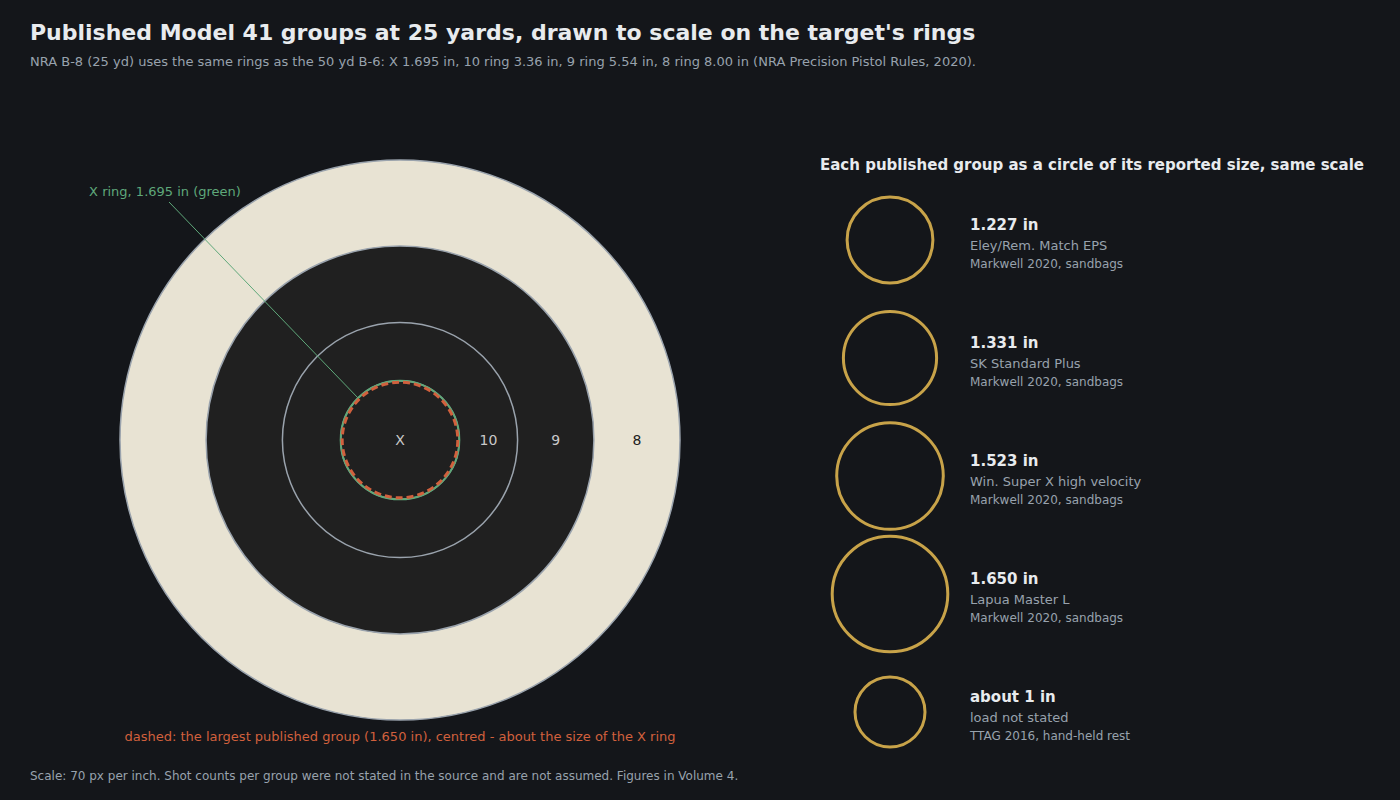
“Accurate” is meaningless without a target, and the Model 41 was built for a specific one. The NRA’s 2020 Precision Pistol rulebook gives the 50-yard slow-fire target, the B-6, a 3.36-inch 10 ring and a 1.695-inch X ring; the 25-yard timed and rapid-fire target, the B-8, uses the same ring dimensions.2
Converted to angle, which is what a mechanical group should be compared in:
Table 1 — Converted to angle, which is what a mechanical group should be compared in
| Target and distance | 10 ring | X ring |
|---|---|---|
| B-6 at 50 yd | 3.36 in = 6.4 MOA | 1.695 in = 3.2 MOA |
| B-8 at 25 yd | 3.36 in = 12.8 MOA | 1.695 in = 6.5 MOA |
(One minute of angle is 0.524 in at 50 yd and 0.262 in at 25 yd; the conversions are computed here.)
The question is therefore not “is it accurate?” but “how much of a 6.4-MOA circle does the pistol use up before the shooter has done anything wrong?” A pistol that shoots 2 MOA from a machine rest consumes a small fraction of the 10 ring. A pistol that shoots 5 MOA is already larger than the 3.2-MOA X ring at 50 yards before the shooter contributes anything.
4.3 The Published Groups
Every group that could be found with its conditions stated, and what those conditions were.
Table 2 — The Published Groups
| Source | Date | Barrel | Rest | Distance | Ammunition | Group | In MOA |
|---|---|---|---|---|---|---|---|
| Markwell, The Gun Mag3 | 2020 | 5½ in | Sandbags, by hand | 25 yd | Eley/Remington Match EPS | 1.227 in | 4.7 |
| Markwell | 2020 | 5½ in | Sandbags | 25 yd | SK Standard Plus | 1.331 in | 5.1 |
| Markwell | 2020 | 5½ in | Sandbags | 25 yd | Winchester Super X high velocity | 1.523 in | 5.8 |
| Markwell | 2020 | 5½ in | Sandbags | 25 yd | Lapua Master L | 1.650 in | 6.3 |
| The Truth About Guns4 | 2016 | 5½ in | Hand-held rest | 25 yd | not stated | ”five shots in around an inch” | about 3.8 |
| The Truth About Guns | 2016 | 5½ in | Hand-held | 10 yd | not stated | ”one-inch or less” | about 9.5 or less |
The number of shots per group in Markwell’s test was not captured from the article and should not be assumed. He also scored the ammunition on a 25-yard pistol centre target, recording 100-8X with SK Standard Plus, 100-5X with Eley match (black box) and 98-7X with the Eley/Remington Match EPS.3
Forum reports, which are not measurements anyone can check, but which point the same way: a heavy-barrel Model 41 shooting “one ragged hole” from a Ransom rest at 25 yards with Winchester Super X and Eley Tenex, and Model 41s in a Ransom rest shooting “1 to 1.12 in” groups at 50 yards with CCI Standard Velocity, which would be about 2 MOA.5 These are attributed to forum posts only and are not relied on.
4.4 What the Groups Do and Do Not Show
They show that the pistol is not the limiting factor for nearly anyone. Every published group in the table was shot by a person holding the pistol. The worst, 1.650 inches at 25 yards, is under half the 3.36-inch 10 ring it was shot at, and it includes the shooter’s own error and a load that the particular pistol did not favour. The figure at the top of this volume draws those groups to scale on the target’s rings.
They show ammunition sensitivity inside one gun. In Markwell’s test four good loads, three of them match grade, ranged from 1.227 to 1.650 inches: a 34 % spread in group size from the ammunition alone, in the same pistol, on the same day. That is exactly the phenomenon the .22 Rimfire dive’s match-house volume is about, and the reason it argues that a match lot must be tested in the gun that will shoot it. Smith & Wesson makes a related point in its own manual about ignition: it “has found wide variations in primer sensitivity between different brands and types of 22LR ammunition” and tells the owner to fire several boxes of a chosen brand before relying on it.6
They do not show that the Model 41 is more accurate than its rivals. No machine-rest comparison of a Model 41 against a High Standard, a Ruger Mark series target pistol or a European match pistol, under the same conditions and with the same ammunition, was found in any source. Without one, the claim that the Model 41 is more accurate than the others is a reputation, not a finding. What the evidence supports is narrower and more useful: a Model 41 in normal condition, with ammunition it likes, groups well inside the 10 ring at 25 yards when shot by hand, and the reports of machine-rest performance place it at roughly a third of the 50-yard 10 ring or better.
They do not show that sandbag groups measure the pistol. A sandbag group at 25 yards is a test of the combination of pistol, ammunition and shooter. The only way to isolate the pistol is a machine rest, and none of the published machine-rest results located here gives its conditions in a checkable form.
4.5 The Popularity Evidence
The claim that serious shooters use the Model 41 rests mostly on one published survey. In 2015 the NRA’s Shooting Sports USA reported a web poll run by Amanda Carter of Larry’s Guns asking which .22 pistols were most often seen on the bullseye firing line. The Smith & Wesson Model 41 came first, the Hämmerli 208 second and the Hämmerli X-Esse third; the article also lists the Pardini SP, Ruger Mark II and Mark III, Marvel 1911 conversions, High Standards, the Benelli MP90S, Walther GSP, Hämmerli 280, Beretta Neos, Browning Buck Mark Plus UDX and Feinwerkbau AW93 among the guns mentioned.7
Three cautions go with it. It is a web poll of what people see, not a census of equipment at a championship, so it measures prevalence, not performance. It is from 2015, before the Model 41’s 2025 end of production and before the price reached $2,199. And prevalence is exactly what one would expect of a pistol that had been in continuous American production for sixty years, sold through every gun shop in the country, while its European rivals were imported and far more expensive. The survey is good evidence that the Model 41 is the standard .22 of American bullseye. It is not evidence that it is the best one, and collectors on the specialist forums say plainly that at the very top of the sport the European match pistols dominate.8
4.6 Why Shooters Rate It: the Features Behind the Reputation
If the accuracy evidence cannot separate the Model 41 from its rivals, something else explains its standing. Volume 3’s mechanism does.
Table 3 — Why Shooters Rate It: the Features Behind the Reputation
| Feature | Evidence | Why it matters in bullseye |
|---|---|---|
| Sights on the barrel, barrel latched to the frame | Smith & Wesson field-strip figure; US Patent 2,887,81069 | The sight line never reciprocates, so the aiming reference does not depend on the slide’s fit |
| A trigger set at 2.75 to 3.25 lb with an adjustable over-travel stop | S&W product page; measured at 2.7–3 lb in 201614 | Legal for the .22 stage with margin (the NRA minimum is 2 lb) and adjustable where the rules allow |
| The 1911 grip angle | American Rifleman and others, Volume 1 | The same hold as the .45 stage of the same match |
| Weight forward | Heavy barrel, or weights on the 7⅜ in barrel (Volume 3) | Steadier at arm’s length, and it returns to the aiming area in rapid fire |
| Switch barrels without tools | S&W: “Switch-Barrel Design Allows Both 5.5” and 7” Barrels on One Frame”1 | One frame serves more than one role, each barrel with its own sights |
| An American maker with a domestic parts and service network | Smith & Wesson’s lifetime service policy on the current product pages1 | The practical advantage over an imported match pistol, for most of the sixty-eight years |
None of these is unique to the Model 41. The combination, in one domestically made pistol at a price below the imported match guns, is.
4.7 The Collector Reputation
The collector’s Model 41 is a set of variants, and the premiums attach to them rather than to the model as a whole. Every premium below is a dated figure from the source that printed it.
Table 4 — The Collector Reputation
| Variant or feature | Premium | Source and date |
|---|---|---|
| Model 41-1 (.22 Short) | “upward of a 300- to 400-percent premium” | American Rifleman, 201910 |
| Early gun with cocking indicator (pre-1978) | “Add 15%–40%“ | Blue Book, as quoted by a collector, January 201411 |
| 5½ in barrel with extended front sight (1965–1976) | “Add $100” | Blue Book, as quoted, January 201411 |
| 7⅜ in barrel with muzzle brake | ”add $35” | Blue Book, as quoted, January 201411 |
| Original box and papers | ”significantly reduced collector value” when absent | collectors’ consensus, Smith & Wesson Forum, 201411 |
The Model 46 is the curiosity. As a plainer, cheaper pistol that sold poorly and was made in far smaller numbers (about 4,000, Volume 2), it now carries a higher value range on the Blue Book’s model page, $585 to $1,665, than the Model 41/41-1 page does, $440 to $1,250.1213 Those ranges are printed without their grade-by-grade detail, which is behind a paywall, so they cannot be read as saying what a given gun in a given condition is worth.
4.8 Prices and Values by Era
Every figure carries its date and source. New means a list or catalogue price for a new pistol; used means a value or asking price for a used one.
Table 5 — Prices and Values by Era
| Date | Figure | Kind | Source |
|---|---|---|---|
| 1966 | $100 | New, catalogue | Gun Digest 1966, as reported by Markwell (2020)3 |
| Jan 2014 | about $865 at 90 % condition, before premiums | Used, guide value | Blue Book, as quoted on the Smith & Wesson Forum11 |
| Jan–Feb 2014 | $795 (dealer listing), $900 (reported sale of an early gun), $975–$1,125 and $1,300 (forum estimates) | Used, asking and anecdotal | Smith & Wesson Forum thread11 |
| Oct 2019 | $1,369; Performance Center $1,619 | New, MSRP | American Rifleman10 |
| Apr 2020 | ”just a hair over $1600” | New, MSRP (which version not stated) | The Gun Mag3 |
| Jun 2022 | $1,429; Performance Center $1,679 | New, MSRP | American Rifleman14 |
| Aug 2025 | $2,199 (either barrel); Performance Center $2,499 | New, MSRP at the end-of-production announcement | all4shooters15 |
| Sep 2026 | $2,199 and $2,499 | New, MSRP, pages marked “where to buy” | Smith & Wesson product pages1 |
| Sep 2026 | $1,899 (5.5 in), $2,003–$2,099 (7 in), $2,155 (Performance Center 5.5 in) | New, dealer listings | as displayed on the Blue Book’s model page, 2026-09-1913 |
| Sep 2026 | $440–$1,250 (Model 41/41-1 entry); $585–$1,665 (Model 46) | Used, guide range, no grade detail | Blue Book model pages1213 |
Two observations the table supports. The list price rose about 61 % between 2019 and 2025 ($1,369 to $2,199), far faster than in the preceding five years, and the rise preceded the end-of-production announcement rather than following it. And new-stock dealer prices in September 2026 sat below the final list price, which does not suggest an immediate end-of-production scramble for new guns, although a handful of dealer listings on one day is thin evidence.
The Markwell 2020 figure and the Sagi 2022 figure do not sit comfortably together (a “hair over $1600” in 2020, $1,429 in 2022). The likeliest reading is that Markwell was quoting the Performance Center price, but his article does not say so, and neither figure is adjusted here.
4.9 What Could Not Be Established
- Any machine-rest comparison of the Model 41 against another pistol under the same conditions.
- Current used values by era or variant. The Blue Book’s grade-by-grade values are paywalled; the sold-price aggregators and GunBroker’s own pages refused automated access. The 2026 used ranges above are the only current used figures with a stated source, and they are ranges, not grades.
- Any effect of the 2025 end-of-production announcement on used prices. Nothing with dates and sources was found. It is not asserted.
- Production totals after 1958. No source gives annual production for the Model 41 after the second year, so scarcity by era cannot be quantified except for the named rarities (the Model 41-1 under 1,000 plus 28, the Model 46 at about 4,000, the “Classic 41” at ten).
References
Footnotes
-
Smith & Wesson, product pages “MODEL 41” (SKU 130511), “MODEL 41 7” BARREL” (SKU 130512) and “PERFORMANCE CENTER® MODEL 41” (SKU 178031), https://www.smith-wesson.com/products/model-41, accessed 2026-09-19. ↩ ↩2 ↩3 ↩4 ↩5
-
National Rifle Association, NRA Precision Pistol Rules, 2020 edition, rules 4.7 and 4.8, https://competitions.nra.org/media/8365/nra-precision-pistol-rules.pdf. ↩
-
John Markwell, “The Model 41: S&W’s Masterpiece 22 Auto”, The Gun Mag, 20 April 2020, https://www.thegunmag.com/the-model-41-s-ws-masterpiece-22-auto/, accessed 2026-09-19. ↩ ↩2 ↩3 ↩4
-
“Gun Review: Smith & Wesson Model 41 Pistol”, The Truth About Guns, 12 August 2016, https://www.thetruthaboutguns.com/gun-review-smith-wesson-model-41-pistol/, accessed 2026-09-19. ↩ ↩2
-
As summarised from Smith & Wesson Forum and RimfireCentral threads on Model 41 accuracy, including “Accuracy of S&W Model 41 Part 1 - 25 Yards”, https://smith-wessonforum.com/threads/accuracy-of-s-w-model-41-part-1-25-yards.496341/, accessed 2026-09-19. Not independently checked; not relied on. ↩
-
Smith & Wesson, Safety & Instruction Manual, Model 41 Pistol, © 2020, ammunition section and figure 22, retrieved from https://s3.amazonaws.com/files.ammunitiondepot.com/smith-and-wesson-firearms/pistols/sw-model-41-pistol.pdf. ↩ ↩2
-
Chip Lohman, “The Best .22 Caliber Pistols for NRA Bullseye”, Shooting Sports USA, 15 September 2015, https://www.ssusa.org/content/the-best-22-caliber-pistols-for-nra-bullseye/, accessed 2026-09-19. ↩
-
For example “.22 rimfire pistols for bullseye and cmp”, Bullseye Forum, https://www.bullseyeforum.net/t23867-22-rimfire-pistols-for-bullseye-and-cmp, accessed via search summary 2026-09-19. Forum opinion only. ↩
-
Joseph W. Norman, assignor to Smith and Wesson Inc., “Firearm Barrel Latch”, US Patent 2,887,810, filed 28 May 1957, https://patents.google.com/patent/US2887810A/en. ↩
-
Dave Campbell, “A Look Back at the Smith & Wesson Model 41”, American Rifleman, 9 October 2019, https://www.americanrifleman.org/content/a-look-back-at-the-smith-wesson-model-41/, accessed 2026-09-19. ↩ ↩2
-
“Model 41 value”, Smith & Wesson Forum, January–February 2014, https://smith-wessonforum.com/threads/model-41-value.356025/, accessed 2026-09-19. ↩ ↩2 ↩3 ↩4 ↩5 ↩6
-
Blue Book of Gun Values, “Smith & Wesson Model 46”, https://bluebookofgunvalues.com/products/smith-and-wesson-model-46, accessed 2026-09-19. ↩ ↩2
-
Blue Book of Gun Values, “Smith & Wesson Model 41/41-1”, https://bluebookofgunvalues.com/products/smith-and-wesson-model-4141-1, accessed 2026-09-19. ↩ ↩2 ↩3
-
Guy J. Sagi, “Smith & Wesson Model 41: An Iconic Rimfire Target Pistol”, American Rifleman, 22 June 2022, https://www.americanrifleman.org/content/smith-wesson-model-41-an-iconic-rimfire-target-pistol/, accessed 2026-09-19. ↩
-
“Smith & Wesson about to end production of the Model 41 pistol”, all4shooters.com, 28 August 2025, https://www.all4shooters.com/en/shooting/pistols/smith-wesson-model-41-is-nearing-the-end-of-its-storied-production-run/, accessed 2026-09-19. ↩
Comments (0)