Smith & Wesson Model 41 · Volume 2
Production History, and How to Date One
Every change with its date and whose date it is; the barrels, the .22 Short gun and the Model 46; the gaps; the 2025 end; and how a reader places a Model 41 in its era
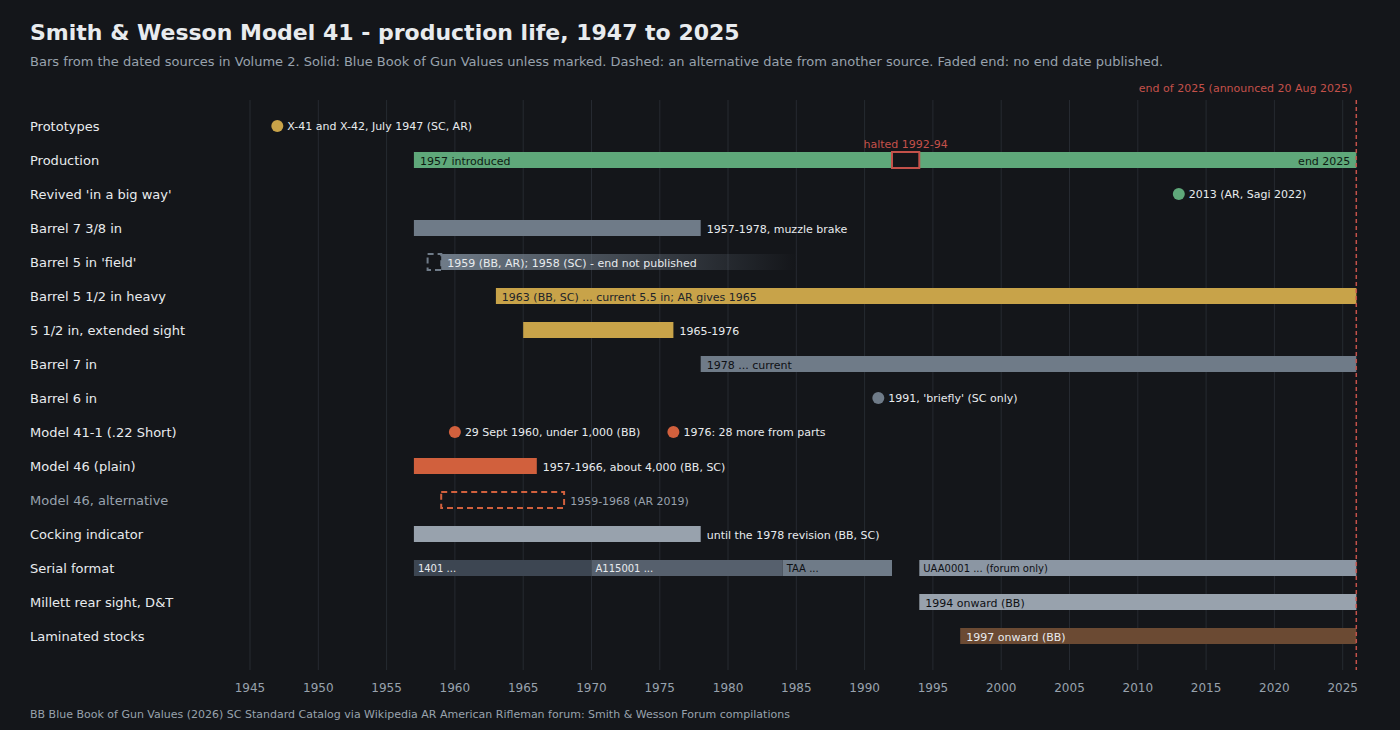
The Model 41 was made for sixty-eight years with one formal gap, and in that time its barrels, sights, serial system, safety, magazine and grips all changed. None of the changes altered what the pistol fundamentally is. All of them matter to a collector, and several are the only practical way to place an undocumented gun in its era.
2.1 How the Dates in This Volume Are Handled
Four kinds of source print Model 41 dates, and they are not of equal weight.
- Smith & Wesson itself. The current product pages, the manuals and the 1957 patents. These fix the current specification and the mechanism, not the history.
- The Blue Book of Gun Values model entry, read directly from the publisher’s site. It is the most detailed dated chronology that could be read at first hand, and it gives serial numbers for several changes.1
- Supica and Nahas’s Standard Catalog of Smith & Wesson, the reference collectors cite. It could not be consulted for this dive (Volume 1 explains why), so its figures appear only as reported by Wikipedia or by collectors quoting it, and are labelled accordingly.2
- Collector compilations on the Smith & Wesson Forum. Some are detailed and plausibly drawn from the Standard Catalog or from factory records, but they cite no source.34 They are used only where nothing better exists, and are labelled.
Where two sources give different dates for the same event, both are given. They are not averaged.
2.2 The Chronology
Sources are keyed: BB Blue Book entry;1 SC Standard Catalog as reported by Wikipedia;2 AR American Rifleman (Campbell 2019,5 Sagi 20226); F forum compilation.34
Table 1 — The Chronology
| Year | Event | Source |
|---|---|---|
| 1947 (July) | Prototypes X-41 and X-42 | SC, AR |
| 1957 | Introduced with a 7⅜ in barrel; serials begin at 1401; 679 made in the year | BB (serial), SC and AR (679) |
| 1957 (Sept) | First shipment, 17 Sept 1957 | F only |
| 1958 | 9,875 made by year’s end | SC, AR |
| 1958 | False muzzle cap | F only |
| 1958 or 1959 | 5 in “field” barrel | SC 1958; BB and AR 1959; F “9/2/1959 first 5” field barrel shipped” |
| c. 1959 | Relief cuts at the rear of the trigger guard, about SN 16000 (BB) or 16200 (F) | BB, F |
| 1959 | Two-piece magazine replaced by one-piece | F only |
| 1960 (29 Sept) | Model 41-1, .22 Short, introduced; “total production under 1,000 units” | BB |
| c. 1961 | Model-number stamping moves, about SN 27500 | BB, F |
| 1962 | Shipped with two magazines | F only |
| 1963 | 5½ in heavy barrel (F: 26 Aug 1963, about SN 43500) | BB, SC, F. AR says 1965 |
| 1965 | 5½ in heavy barrel with extended front sight | BB |
| 1968 | Barrel lapping ended | F only |
| 1970 | ”A” serial prefix begins at A115001 | F |
| 1976 | Extended-sight barrel discontinued; 28 Model 41-1s assembled from leftover parts | BB |
| 1978 | Revised Model 41 at about SN A494000: 7⅜ in barrel replaced by 7 in; cocking indicator discontinued | BB; SC agrees on the year |
| late 1970s | Muzzle brakes, caps and weights dropped as options | F only |
| 1984 | Three-letter serial prefixes; Model 41s start at “TAA” | BB |
| 1985 | Magazine followers change from metal to plastic | F only |
| 1991 | 6 in barrel “offered briefly” | SC only |
| 1992 | Production halted; 12-round magazine introduced (BB) | SC; BB |
| 1994 | Returned to production as the “Model 41 (New Model)”; 12-round magazine discontinued; Millett rear sights replace S&W rear sights; slide drilled and tapped for a scope mount (BB); serials restart at UAA0001 (F) | SC, BB, F |
| 1994 | Safety changed so it no longer locks the slide when on safe | F only |
| 1996 | 5 in “optics only” version with a Weaver base | BB |
| 1997 | Laminated hardwood stocks | BB, F |
| 1998 | Ten Model 41s made in the Performance Center as the “Classic 41” | BB |
| 2011 | Performance Center “Super Target Special” | BB |
| 2013 | Revived “in a big way” after years in which production “stopped or reduced to a mere trickle with annoying regularity” | AR (Sagi) |
| 2025 (20 Aug) | End of production announced for the end of 2025 | trade press reporting S&W’s social-media posts7 |
2.3 Where the Sources Disagree
Six disagreements are worth stating plainly, because each is repeated in print as if settled.
Table 2 — Where the Sources Disagree
| Question | One source | Another source |
|---|---|---|
| When did the 5 in barrel appear? | 1958 (Standard Catalog, via Wikipedia) | 1959 (Blue Book; American Rifleman 2019; a forum shipping date of 2 Sept 1959) |
| When did the 5½ in heavy barrel appear? | 1963 (Blue Book; Standard Catalog; forum “26 Aug 1963”) | 1965 (American Rifleman 2019, which may be conflating it with the 1965 extended-sight barrel) |
| When was the Model 46 made? | 1957–1966 (Blue Book; Standard Catalog) | 1959–1968 (American Rifleman 2019) |
| When did the 7⅜ in barrel end? | 1978 (Blue Book’s own narrative; Standard Catalog; forum) | “7 3/8 (disc. 2004)” (the Blue Book’s own summary line, in the same entry) |
| What was drilled and tapped in 1994? | The slide (Blue Book) | The barrels (forum) |
| Which way did the model number move around 1961? | “the model number stamping moved to the right side of frame” (Blue Book) | The 1972 pistol in Volume 1’s opening photograph, and the current manual’s identification figure, both show the model marking on the frame’s left side, above the trigger guard, with the serial on the other side |
The last row is the one that matters for dating a gun, and it resolves in a way that is useful whichever wording is right. The dependable clue is not which side carries the model number but whether the model number and the serial number are on the same side (earliest guns) or on opposite sides (from about serial 27500). The Blue Book’s “2004” for the 7⅜ in barrel contradicts its own narrative and three other sources and is almost certainly a typographical slip for 1978, but it is recorded rather than silently corrected.
2.4 The Barrels
The Model 41’s barrel carries both sights and is removed without tools (Volume 3). That made barrel interchange a design feature from the start, and it means that the barrel on any given frame is not proof of what that frame left the factory with. A factory letter (below) is the only way to know.
Table 3 — The Barrels
| Barrel | Years (source) | Notes |
|---|---|---|
| 7⅜ in | 1957–1978 (BB, SC) | The original. Muzzle brake; grooved for Olympic-style centre weights according to a 1964 Shooter’s Bible reported on Wikipedia2 |
| 5 in “field” | 1958 or 1959 onward (see above) | Lighter. The Blue Book lists it as discontinued without a date; a 5 in “optics only” version with a Weaver base appears in 19961 |
| 5½ in heavy | 1963 onward (BB, SC) | The configuration of the pistol documented in these volumes. Carried into current production as the 5.5 in barrel |
| 5½ in heavy, extended front sight | 1965–1976 (BB) | The front sight carried forward of the muzzle to lengthen the sight radius. The 2014 Blue Book (as quoted by a collector) added $100 for it8 |
| 7 in | 1978 onward (BB, SC) | Replaced the 7⅜ in; Wikipedia says it was introduced “without muzzle brake provision”2 |
| 6 in | 1991, “briefly” (SC only) | Not in the Blue Book entry |
| Current | 5.5 in and 7 in (S&W) | “Switch-Barrel Design Allows Both 5.5” and 7” Barrels on One Frame”; the Performance Center gun has an integral Picatinny rail9 |
Muzzle brakes, muzzle caps and barrel weights were separate accessories for the 7⅜ in barrel and are reported to have been dropped as options in the late 1970s (forum only).3 Their presence with a gun is a collector’s point, and the 2014 Blue Book added $35 for a 7⅜ in barrel with its muzzle brake.8
2.5 The Model 41-1: the .22 Short Gun
Wikipedia, citing the Standard Catalog, describes the Model 41-1 as a .22 Short version made for International Rapid Fire competition, the Olympic event in which Bill McMillan won gold for the United States with a High Standard in 1960 (Volume 1).2 The Blue Book gives its introduction as 29 September 1960 and its total as “under 1,000 units”, and adds that 28 more were assembled from leftover parts in 1976.1 American Rifleman (2019) says “fewer than 1,000” and describes an aluminium slide. The reason is not stated in the sources, but it follows from Volume 3’s blowback arithmetic: a weaker cartridge needs a lighter slide to cycle. The same article put the Model 41-1’s premium at “upward of a 300- to 400-percent” over a standard gun in 2019.5 A collector quoting the Standard Catalog reports that 41-1s were made with 7⅜, 5 and 5½ in barrels.3
The “-1” is, unusually, not a routine engineering-change suffix here. At Smith & Wesson a dash number normally marks an engineering change to the same model. On the Model 41 the -1 marks a different chambering, and one collector argues that the 1994 safety change should really have been called a Model 41-2 because its safety does not interchange with older guns.4 No Model 41-2 marking was found in any source consulted.
2.6 The Model 46: the Plain One
Smith & Wesson also sold a cheaper version. The Blue Book describes the Model 46 as “similar to the Model 41, but does not have high polish bluing, has brown plastic grips, and machined with straight cut lines rather than radiused”, and gives its production as 4,000, 1957–1966: 1,000 with 5 in barrels, 500 with 5½ in and 2,500 with 7 in.10 Wikipedia, citing the Standard Catalog, gives the same numbers and dates.2 American Rifleman (2019) instead dates it 1959 to 1968 and describes it as having a 7 in barrel instead of the 7⅜ in.5
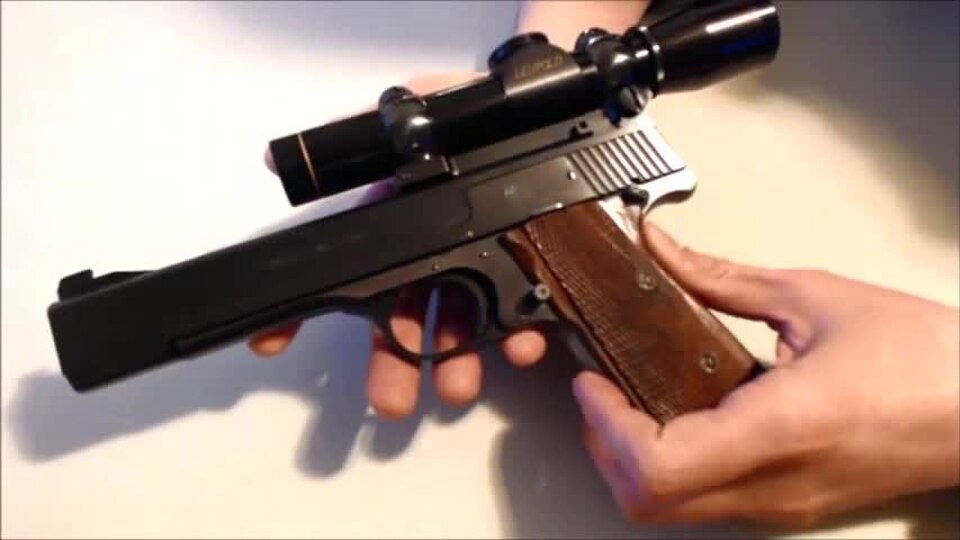
Wikipedia states that “in 1959 the U.S. Air Force selected it for basic marksmanship training”.2 That could not be traced to a primary source. It is not contradicted by the joint Army–Air Force match-weapons manual of July 1959, which lists no Smith & Wesson semi-automatic at all, because that manual covers team match weapons rather than training pistols;11 but nothing located here confirms it either.
The Model 46 matters for two reasons. It shows that the Model 41’s price was a real barrier even in 1957: a plain version was thought worth making. And it shows the mechanism was the same: a Model 46 comes apart exactly as a Model 41 does, trigger guard down and barrel off (Volume 3). Today the plain gun is the rarer one, and the Blue Book’s value range for it ($585–$1,665) sits above its range for the Model 41/41-1 entry ($440–$1,250).110 Those are ranges printed on a model page without grade detail, and Volume 4 says what can and cannot be read from them.
2.7 Interruptions: 1992 to 1994, the Thin Years, and 2013
The formal gap. Wikipedia (citing the Standard Catalog) and the trade press agree that production stopped in 1992 and resumed in 1994, the resumed pistol being called the “Model 41 (New Model)”.27 A forum compiler adds that the production facility was moved during the gap; another collector’s account places a move from Springfield, Massachusetts to Houlton, Maine in the late 1980s, which a third collector questions.34 Neither move is confirmed here. The Blue Book’s 1994 changes (Millett rear sight, drilled and tapped for a scope mount) and the forum’s 1994 safety change and new serial range starting at UAA0001 mark the New Model.14
The thin years. American Rifleman’s 2022 profile says production “stopped or reduced to a mere trickle with annoying regularity until 2013”.6 No source gives annual production figures after 1958, so the depth of the trickle cannot be quantified.
2013. In 2013 “the company revived the classic in a big way”,6 and the Performance Center version with an integral Picatinny rail became a standing catalogue item. The Blue Book dates a Performance Center “Super Target Special” to 2011.1
2.8 The End of Production, 2025
On 20 August 2025, Smith & Wesson announced on its official Facebook and X accounts that the Model 41 would be phased out at the end of 2025. This is as reported by GUNSweek on 21 August and by all4shooters on 28 August; the latter paraphrases the announcement as the Model 41 “nearing the end of its storied production run” and a “last chance to own the legend”.7 The original posts were not retrieved, so no wording beyond those short phrases is quoted as Smith & Wesson’s.
At the announcement, list prices were $2,199 for either barrel length and $2,499 for the Performance Center pistol.7 On 2026-09-19 Smith & Wesson’s product pages for all three SKUs were still live at those prices, marked “WHERE TO BUY” rather than orderable.9 That status is not in itself evidence either way: Smith & Wesson sells through dealers, and the pages were last modified on 1 January 2026. Whether any Model 41s have been made in 2026 was not established.
This is the second time the Model 41 has been declared finished. The first ended in 1994.
2.9 How to Date a Model 41
These volumes do not date the pistol documented here: the owner’s sheet does not record its era, and the question is put to the owner in Volume 6. What follows is the method, in the order that gives the most information for the least effort.
1. The serial number’s format. Smith & Wesson’s serial system changed twice during the Model 41’s life, and the format alone places a gun in a broad band.
Table 4 — How to Date a Model 41
| Format | Era | Source |
|---|---|---|
| Plain number, from 1401 | 1957 to 1969 | BB (start); F (end) |
| “A” prefix, from A115001 | 1970 to 1984; the 1978 revision at about A494000 | F; BB |
| Three letters, from TAA | 1984 to the 1992 suspension | BB |
| Three letters, from UAA0001 | 1994 onward (“New Model”) | F only |
A forum table assigns specific years to specific serial ranges within the plain and A-prefix eras (for example A145801 in 1972 and A265001 in 1975).12 It is not reproduced as a table here because its source is not stated. It is a reasonable first guess, not a date.
2. The features, which corroborate or contradict the serial.
Table 5 — 2. The features, which corroborate or contradict the serial.
| Feature | Indicates |
|---|---|
| Cocking indicator present | Before the 1978 revision (BB, SC). The 2014 Blue Book added 15–40 % for early guns with one8 |
| Model number and serial on the same side of the frame | The earliest guns, before about SN 27500 |
| No relief cuts at the rear of the trigger guard | Before about SN 16000 |
| 7⅜ in barrel with muzzle-brake provision | Pre-1978 barrel (but barrels move between frames) |
| 5½ in heavy barrel with the front sight forward of the muzzle | 1965–1976 barrel |
| Millett rear sight; slide drilled and tapped for a mount | 1994 onward (BB) |
| Laminated stocks | 1997 onward (BB) |
| Integral Picatinny rail | Performance Center, current pattern |
| Plastic magazine follower | 1985 onward (forum) |
| Twelve-round magazine | 1992–1994 (BB); a magazine, not a frame, so weak evidence |
3. The box, label and papers, where they survive. The Model 46 video in this volume shows a period end-label with model, finish, barrel and serial fields. Collectors in 2014 were explicit that the absence of the box and papers cost a Model 41 real money (Volume 4).8
4. A factory letter. The Smith & Wesson Historical Foundation provides a Letter of Authenticity drawn from the company’s archives, documenting, “for most manufacturing periods”, finish, barrel length, grip style, shipping destination and shipping date. On 2026-09-19 its page gave the price as $100, less $10 for members of the S&W Collectors Association or the Foundation and $25 for members of both.13 (The Blue Book’s boilerplate still gives $50 and an 8–12 week turnaround; that figure is out of date.)1 A letter is the only way to learn which barrel a frame shipped with.
References
Footnotes
-
Blue Book of Gun Values, “Smith & Wesson Model 41/41-1” model entry, https://bluebookofgunvalues.com/products/smith-and-wesson-model-4141-1, accessed 2026-09-19. The chronology, serial numbers, value range and letter boilerplate as quoted. ↩ ↩2 ↩3 ↩4 ↩5 ↩6 ↩7 ↩8
-
“Smith & Wesson Model 41”, Wikipedia, https://en.wikipedia.org/wiki/Smith_%26_Wesson_Model_41, accessed 2026-09-19, citing Jim Supica and Richard Nahas, Standard Catalog of Smith & Wesson, 3rd ed. (2007), which was not itself consulted. ↩ ↩2 ↩3 ↩4 ↩5 ↩6 ↩7 ↩8
-
“All about the Model 41 target pistol…”, Smith & Wesson Forum, posts by PALADIN85020, Aussie Collector, civil1977, chisels and others, https://smith-wessonforum.com/threads/all-about-the-model-41-target-pistol.323443/, accessed 2026-09-19. ↩ ↩2 ↩3 ↩4 ↩5
-
“Model 41 Changes”, Smith & Wesson Forum, compiled by Bastogne71, https://smith-wessonforum.com/threads/model-41-changes.654193/; and “Differences in Early Production Model 41 Pistols vs Later Models?”, same forum, posts by Bastogne71 and Chief38, https://smith-wessonforum.com/threads/differences-in-early-production-model-41-pistols-vs-later-models.722407/; both accessed 2026-09-19. No sources cited in either. ↩ ↩2 ↩3 ↩4 ↩5
-
Dave Campbell, “A Look Back at the Smith & Wesson Model 41”, American Rifleman, 9 October 2019, https://www.americanrifleman.org/content/a-look-back-at-the-smith-wesson-model-41/, accessed 2026-09-19. ↩ ↩2 ↩3
-
Guy J. Sagi, “Smith & Wesson Model 41: An Iconic Rimfire Target Pistol”, American Rifleman, 22 June 2022, https://www.americanrifleman.org/content/smith-wesson-model-41-an-iconic-rimfire-target-pistol/, accessed 2026-09-19. ↩ ↩2 ↩3
-
“Smith & Wesson Model 41: the end of an era”, GUNSweek.com, 21 August 2025, https://gunsweek.com/en/pistols/news/smith-wesson-model-41-end-era; “Smith & Wesson about to end production of the Model 41 pistol”, all4shooters.com, 28 August 2025, https://www.all4shooters.com/en/shooting/pistols/smith-wesson-model-41-is-nearing-the-end-of-its-storied-production-run/; both accessed 2026-09-19. ↩ ↩2 ↩3 ↩4
-
“Model 41 value”, Smith & Wesson Forum, January–February 2014, including a quotation of the then-current Blue Book by ultra45 (26 January 2014), https://smith-wessonforum.com/threads/model-41-value.356025/, accessed 2026-09-19. ↩ ↩2 ↩3 ↩4
-
Smith & Wesson, product pages for SKUs 130511, 130512 and 178031, https://www.smith-wesson.com/products/model-41, accessed 2026-09-19. ↩ ↩2
-
Blue Book of Gun Values, “Smith & Wesson Model 46” model entry, https://bluebookofgunvalues.com/products/smith-and-wesson-model-46, accessed 2026-09-19. ↩ ↩2
-
Departments of the Army and the Air Force, TM 9-1005-226-14 / AFM 50-11, 20 July 1959, https://commons.wikimedia.org/wiki/File:TM-9-1005-226-14.pdf. ↩
-
“Model 41 - serial numbers and dates”, Smith & Wesson Forum, https://smith-wessonforum.com/threads/model-41-serial-numbers-and-dates.125290/, accessed 2026-09-19. The poster attributes the table to a RimfireCentral compilation. ↩
-
Smith & Wesson Historical Foundation, “Letters”, https://swhistoricalfoundation.com/letters-new/, accessed 2026-09-19. ↩
Comments (0)