Traditions Blunderbuss Kits · Volume 2
What Is a Blunderbuss? Period Accuracy — How Real, and to When
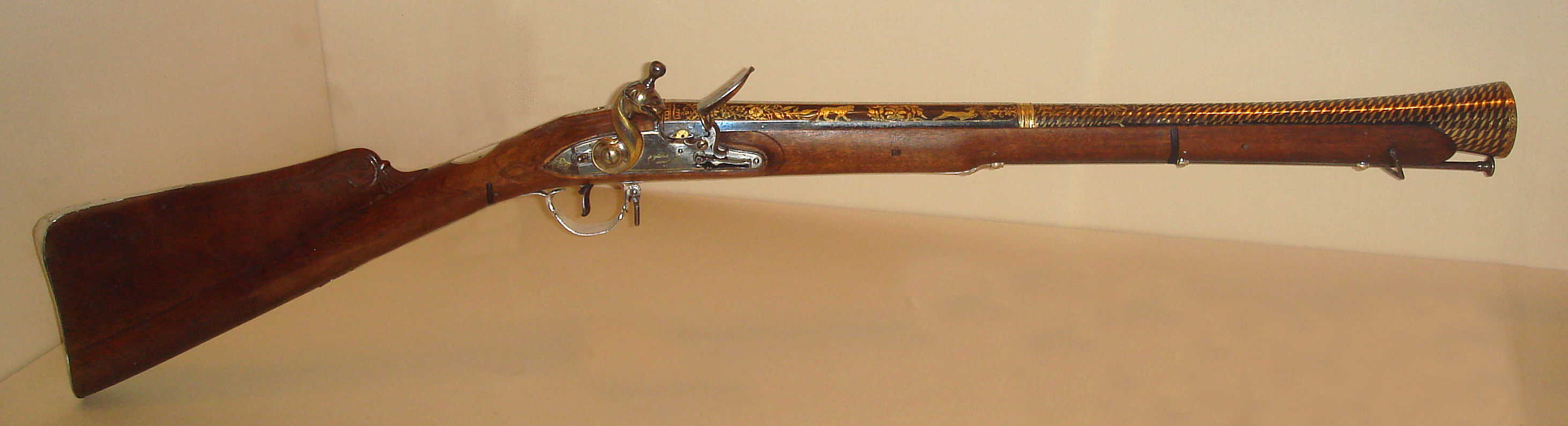
Before you spend money on a reproduction of a historical object, it’s worth knowing what the original actually was — and, since this dive promised to be honest about it, exactly how close each Traditions kit gets. The short answer: the flintlock is a faithful evocation of a real 18th-century gun; the percussion version is a modern convenience wearing period clothes. Here’s the long answer.
2.1 The name is a joke about noise
“Blunderbuss” is an English mangling of the Dutch donderbus — donder, “thunder,” plus bus, “gun” or “tube.” A thunder-gun. English speakers heard donder as “blunder” (which then meant “to confuse”), a pun that suited a weapon whose main virtues were a terrifying report and a wide, menacing mouth. The concept is old: a 1556 Frankfurt book already describes a short smoothbore firing a dozen-odd balls at once, a matchlock blunderbuss survives that may have been used at the Battle of the Zuiderzee in 1573, and a Dutchman named Henrick Theilmans patented a “Donderbus” in 1598. The type became common in the mid-1600s once the flintlock made a reliable, one-handed ignition possible.
2.2 What it actually was: a short-range loading-in-a-hurry gun
A blunderbuss is a short, large-bore, muzzle-loading smoothbore with a barrel that flares at the muzzle into a bell or trumpet. It fired a handful of shot, or several buckshot with a ball (“buck-and-ball”), at close range. It was never a mainline infantry musket — it was a specialist’s gun for people who needed to load fast and fire once at something near:
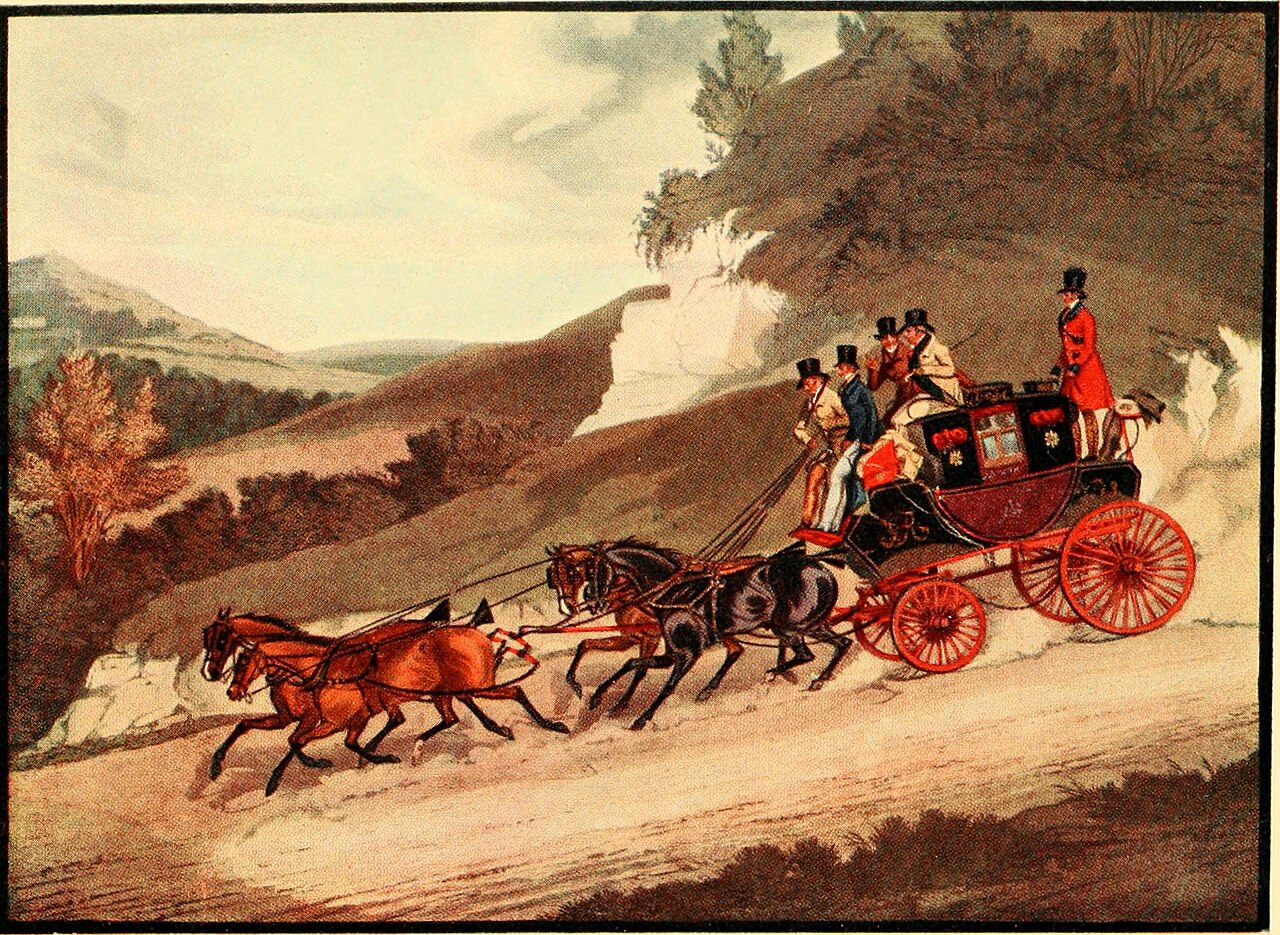
- Coach guards. By the 1700s coachmen and mail guards carried blunderbusses against highwaymen. The British Royal Mail issued flintlock blunderbusses from roughly 1788 to 1816 — a flared brass barrel, brass trigger guard, iron lock — and the guard who carried one, in his scarlet-and-gold coat, was riding shotgun in the original sense. These were literally called coach guns.
- Ships and pirates. Naval officers, privateers, and pirates carried them for the chaos of a boarding action, often mounted on a swivel at the rail. A gun you can reload on a pitching, wet, crowded deck without measuring anything precisely is exactly what that fight wants.
- Dragoons. The pistol-sized blunderbuss was called a dragon — which is where mounted “dragoons” got their name.
- Home defense. It was a common house-gun of the era, the thing you kept by the door.
Formal military adoption was mostly a naval story (the US Navy’s Model 1814, made at Harpers Ferry and Springfield, is the clearest example). Armies never lined up with them.
2.3 The flared muzzle: the most misunderstood feature in gun history
Everyone “knows” the bell mouth spreads the shot. It essentially doesn’t — and this is worth getting right, because it’s the single most repeated myth about these guns. The flare’s real, documented purpose is loading: a wide funnel lets you dump powder and a fistful of shot down the bore quickly, which matters enormously when you’re doing it on a moving coach, on horseback, or on a rocking ship. It is also plainly intimidating, which for a coach guard was half the job. There is one much-cited old experiment claiming the flare widened a pattern from about 21 inches to 38 inches at ten yards — but even Wikipedia, citing it, flags that its methodology has been questioned, and most careful summaries conclude the flare has little to no effect on the pattern. The physics agrees: shot has already left the constriction and is moving as a column by the time it reaches the last inch of a gently-flaring bell; the flare doesn’t have room to “aim” it outward. So: the flare is for fast loading and for looking frightening. Any spreading effect is marginal and disputed, not the point of the design. Your Traditions barrel flares because a blunderbuss flares — not because it will pattern wider than a straight cylinder bore.
2.4 The ignition timeline — and the whole period-accuracy question
Muzzleloader ignition evolved in a clear sequence: matchlock and wheellock (1500s–early 1600s), then flintlock (common from the mid-1600s, and the classic era of the blunderbuss), then the percussion cap (from the 1820s). That timeline is the entire reason this volume exists, because it splits the two Traditions kits cleanly:
The flintlock KR510 is period-correct. The flintlock blunderbuss is the blunderbuss of the coach-and-boarding era, roughly 1700 to 1820. If you build the flintlock, you are building the real thing in period terms — the mail-coach gun, the boarding gun, the dragoon’s dragon.
The percussion KR500 is, strictly, an anachronism. The percussion cap wasn’t developed until about 1822 (Joshua Shaw’s copper cap), and by then the blunderbuss was already on its way out — the double-barreled flintlock shotgun of the 1790s and then the percussion cap itself were among the things that replaced it. So a purpose-built percussion blunderbuss was never a common historical gun. Genuine percussion blunderbusses do exist, but almost entirely as two narrow cases: conversions of older flintlocks (the US Model 1814 was converted to percussion in the 1830s and some served the Navy into the Civil War, destroying Confederate naval mines), and niche late arms like the spring-bayonet percussion blunderbusses carried by the Nottingham City Police around 1840. A fresh, factory percussion blunderbuss is a modern idea, not a snapshot of any widespread historical pattern.
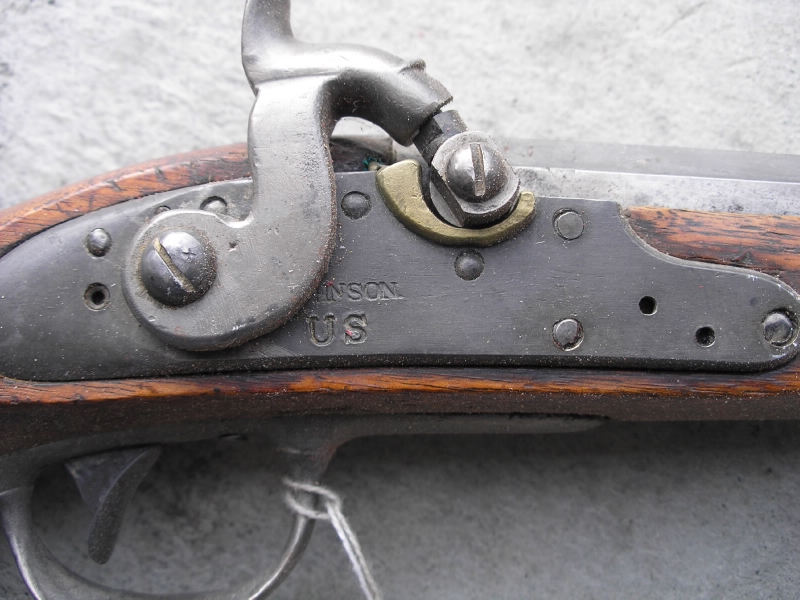
None of this makes the KR500 a bad gun — it’s cheaper, more reliable, and easier to shoot, and Volume 3 makes the case for it. It just isn’t the “1700s coach gun” the flintlock is. If period authenticity is the goal, that difference is the whole decision.
2.5 The caliber tells the same story: close, not exact
There’s one more honest caveat. A real blunderbuss was typically a big bell-mouth throwing a handful of shot or buck-and-ball — individual pellets around .25–.35 inch, a dozen or so per charge, out of a bore you could drop a walnut into, with muzzle flares sometimes two inches across. The Traditions kits are .54 caliber firing a single patched round ball. That’s a real and useful load, but it’s lighter and smaller than a historic buck-and-ball coach gun — it behaves more like a light smoothbore musketoon or trade gun than a room-sweeping blunderbuss. The good news: you can load these as shot guns (Volume 9), and a shot charge is actually closer to authentic blunderbuss use than a single ball is.
2.6 The verdict
The Traditions kits — brass furniture, hardwood stock, short flared smoothbore barrel — broadly and handsomely evoke a late-18th / early-19th-century English or Continental blunderbuss. They look right on a wall and right in a re-enactor’s hands. But be clear-eyed: they are modern Spanish-made reproductions (built by Ardesa for Traditions), “faithful in design to their eighteenth-century ancestry” as Traditions puts it, but manufactured to modern standards with modern steel — not museum-exact copies. The bore is smaller than a historic buck-and-ball gun, the parts are production parts, and only the flintlock corresponds to the type’s real heyday. Build the flintlock for authenticity, the percussion for ease — but either way you’re building a tribute to the thunder-gun, not a duplicate of one. That’s exactly enough history to make finishing it well (Volumes 7 and 8) feel worth the trouble.
Sources
Wikipedia, “Blunderbuss”; UK Postal Museum, “Arming the Post”; Wikipedia, “Percussion cap”; NRA Museum and Royal Armouries collection notes. Full URLs in the dive’s research file.
Comments (0)