Traditions Blunderbuss Kits · Volume 1
Overview: The Two Kits and the Honest Verdict
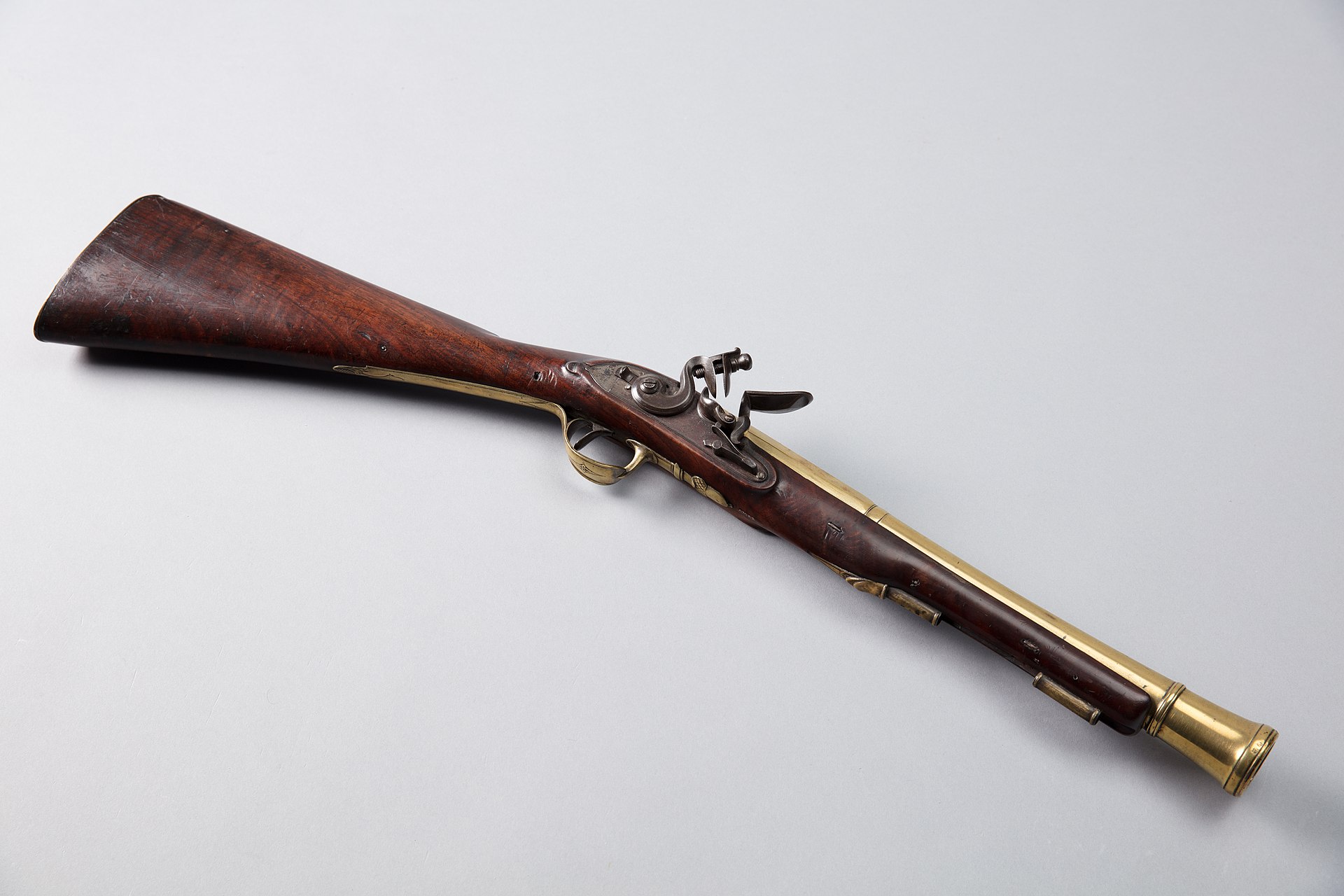
This dive is about building one specific thing: a Traditions blunderbuss kit, in .54 caliber, from the box on your bench to a finished piece you can hang on a wall or take out and fire. There are two kits, and they are the same gun wearing two different locks — a percussion version (the KR500) and a flintlock version (the KR510). This series treats them as a pair throughout, because ninety percent of the build is identical and the differences are exactly the interesting part.
It is written for someone who is about to buy at least one of these, has never assembled a muzzleloader, and wants the whole picture before ordering: how period-correct these actually are, what you’re really getting for the money, how the thing goes together, how to finish the wood and the steel so it looks like something you’re proud of rather than a hardware-store project, and then — the part the catalog never covers honestly — how to load and fire a smoothbore black-powder gun without hurting yourself.
1.1 The two kits, side by side
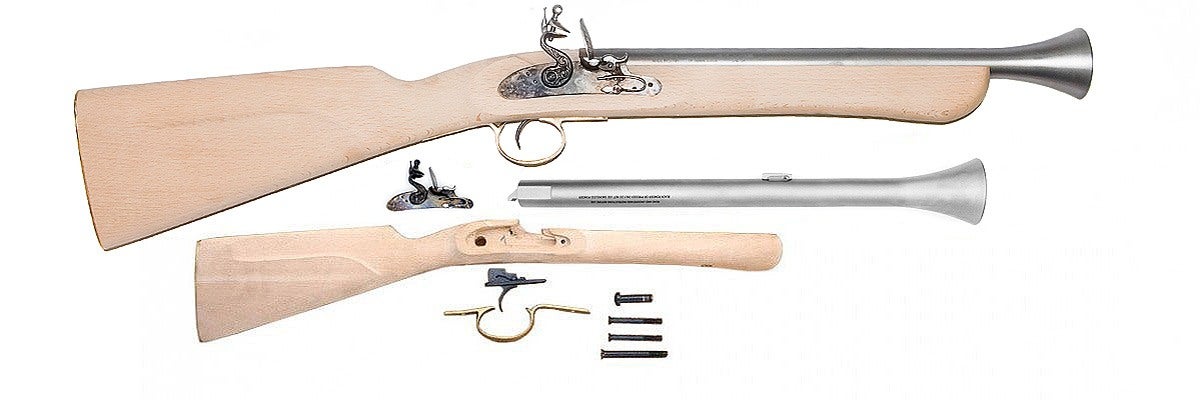
Both kits ship from Traditions Performance Firearms (the guns are made in Spain by Ardesa, Traditions’ long-time manufacturing partner). They are sold as a box of parts that requires assembly and finishing — you stain the stock and finish the barrel yourself, which is the whole appeal of a kit and the reason this dive runs as long as it does.
Table 1 — The two kits, side by side
| KR500 — Percussion | KR510 — Flintlock | |
|---|---|---|
| Ignition | Sidelock percussion (#11 or musket cap) | Flintlock (sidelock, flint + frizzen) |
| Caliber | .54 | .54 |
| Barrel | 16.75”, white steel, smoothbore, flared | 16.75”, white steel, smoothbore, flared |
| Overall length | 29¼” | 29¼” |
| Stock | Select hardwood | Select hardwood |
| Furniture | Solid brass trigger guard + buttplate | Solid brass trigger guard + buttplate |
| Trigger / sights | Single trigger, no sights | Single trigger, no sights |
| Typical price | ~$469 | ~$529 |
| State shipped | Unassembled, wood + steel to finish | Unassembled, wood + steel to finish |
The flintlock costs a little more because a flint lock is a more complicated mechanism than a percussion lock — more parts, a frizzen, a frizzen spring — and because the flintlock is the one that actually belongs to the blunderbuss’s own century. More on that in a moment.
1.2 What a blunderbuss is, in one paragraph
A blunderbuss is a short, large-bore, muzzle-loading smoothbore with a barrel that flares out at the muzzle into a bell or trumpet. It is a close-range weapon — a coach guard’s gun, a ship’s boarding gun, an innkeeper’s or homeowner’s gun — designed to be loaded quickly, often on a moving vehicle, and fired once at something close. The flared muzzle is the signature and it is also the most misunderstood feature of the whole design, which Volume 2 takes apart in detail. The Traditions kits capture the silhouette faithfully: the flare, the brass furniture, the stubby overall length. What they don’t capture is the scale — a real blunderbuss often threw a fistful of buckshot from a bore you could drop a walnut into, where these fire a single .54 ball or a modest shot charge.
1.3 The honest verdict, stated up front
Because this is a reference and not a sales page, here are the two things worth knowing before you spend the money — both stated here so nothing downstream has to soft-pedal them:
On period accuracy. The flintlock KR510 sits squarely in the blunderbuss’s real heyday, roughly 1700 to 1820. If you want a gun that could plausibly be mistaken for the thing it imitates, buy the flintlock. The percussion KR500 is, strictly speaking, a bit of an anachronism: percussion caps didn’t become common until the 1820s–40s, by which point the blunderbuss was already being retired in favor of better close-range guns. Genuine percussion blunderbusses exist, but they’re a late, transitional oddity, not a common historical pattern. None of this makes the KR500 a bad buy — it is easier to shoot, cheaper, and needs no flint-knapping — it just isn’t the “1700s coach gun” that the flintlock is. Volume 2 lays out the whole history so you can decide which story you want to own.
On what it is as a shooter. This is a smoothbore with no sights. It will never be a target gun. Loaded with a patched round ball it is a short-range point-and-shoot arm; loaded with shot it is effectively a crude, short single-barrel shotgun. That’s not a criticism — it’s exactly what a blunderbuss was — but go in wanting a wall-hanger you can occasionally boom off at the range, not a deer rifle.
If those two things don’t bother you, these are genuinely satisfying kits: inexpensive, good-looking when finished well, and a low-risk way to learn muzzleloader assembly and black-powder shooting on a gun with real character.
1.4 Where this dive goes from here
- Volume 2 — What a blunderbuss actually is, where the flared muzzle myth comes from, and exactly how period-correct each kit is.
- Volume 3 — KR500 vs KR510 in depth: how flint and percussion ignition each work, and which one to buy for which purpose.
- Volume 4 — Unboxing and inventory: what’s in the box, what tools you need, and how to plan the build.
- Volumes 5–6 — Assembly, in order: barrel and lock fitting first, then trigger, guard, buttplate, ramrod, and final fit.
- Volume 7 — Finishing the stock: whiskering, staining, and an oil finish that looks right.
- Volume 8 — Bluing and browning the barrel: why you do it at all, and step-by-step methods from a ten-minute cold blue to a period-correct rust brown.
- Volume 9 — Powder, ball, and shot: what to feed a .54 smoothbore.
- Volume 10 — Loading and firing, step by step, with the safety rules that actually matter.
A note that recurs throughout: every powder charge in this series is a starting reference, not a prescription. The Traditions owner’s manual that ships with your kit is the authority for that specific gun. Read it first, work loads up from the bottom, and treat the whole thing as a firearm — because both of these, the flintlock and the percussion alike, absolutely are.
Comments (0)