Chauchat · Volume 9
The Reputation and the Record
How the Chauchat became \"the worst machine gun ever\", what the French and American documents of 1916–1920 actually say, ten common claims checked one by one, a quotation that is not in the oral history it is attributed to, and an assessment that separates the French gun from the American one
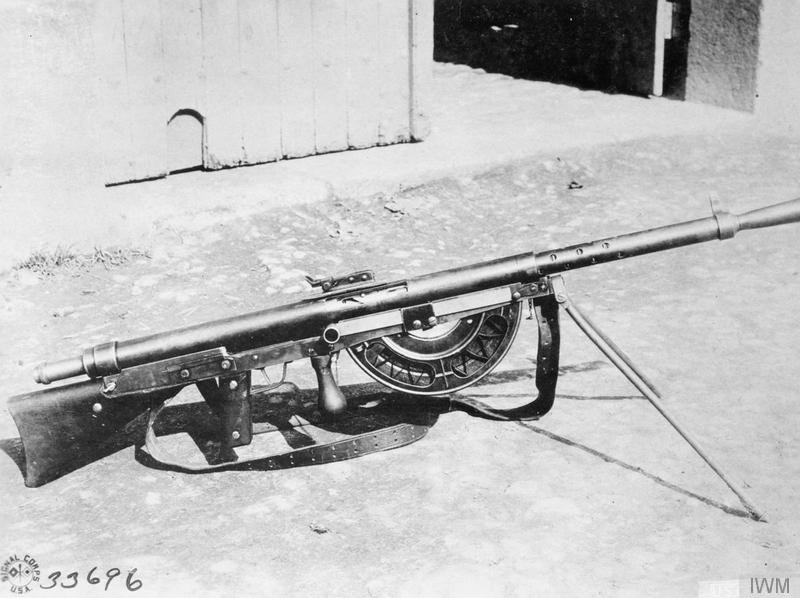
9.1 Two verdicts
In 1919 the Assistant Secretary of War who had bought the guns wrote that “the Hotchkiss heavy machine gun and the Chauchat light automatic rifle” were “both effective weapons”.1 In 1951 the US Navy’s Bureau of Ordnance published George Chinn’s judgement: “No more crudely designed nor uglier automatic weapon has ever been put in the hands of soldiers of a first-rate power than this weapon”, “incomparably the worst machine gun of its class used by any belligerent in World War I”, and, in a later chapter, “the worst automatic weapon ever designed”.2
Both men were Americans writing for their government. One was defending a purchase; the other was writing thirty years later with the Browning automatic rifle as his measure. Neither verdict is evidence on its own. This volume sets out what the record does show.
9.2 Where the reputation comes from
The hard reputation is American, and it has three roots.
- The American soldiers’ experience of 1918. Henri Vuillemin, writing for the gun’s French centenary, says that “Les plus acharnés à ternir la réputation du F.M 15 ont été sans conteste les Américains”, who called it “damned jammed shosho”.3 The AEF’s own Automatic Arms Section recorded in September 1918 that the gun “has proved to be not at all satisfactory”, according to Tom Laemlein, who quotes the record.4
- The Model 1918 in .30-06. The American-ordered version was a failure by every account, with up to 40 % rejected by American inspectors (Volume 3). Much English-language writing does not distinguish it from the French gun. Chinn’s chapter discusses both together.2
- Post-war writers. Chinn in 1951; Vuillemin names the British writer Ian Hogg as the best known of the English-language authors who, in his view, made an instrument of the gun’s reputation (“l’instrumentalisation par de nombreux auteurs de langue anglaise, à commencer par Ian Hogg”).3 Hogg’s text was not read for this dive. By 2012 the American internet had made “the worst gun ever” a standing joke, which Ian McCollum took apart in an article of that name (below).5
Since about 2012 a revision has run the other way: McCollum (2012), Morgan (2017, “Not Really One of the Worst Guns Ever”) and Vuillemin (2015) all argue that the French gun was better than its name.563
9.3 What the period documents say
The documents of the war years are more measured than either camp.
- The French instruction of 1916 treats the magazine as the gun’s weak point and says so: load eighteen, not twenty; “The last two incidents being caused by the clips, the gunner’s attention must be brought to the imperative necessity of keeping the clips in a perfect state”.7
- The US Army board of May 1917, quoted by Crozier, saw “the drift of the French Army … decidedly towards greater use of automatic rifles of highly portable type, such as the Chauchat”.8
- Pershing’s cable of 5 August 1917 chose the Chauchat as the stopgap “until … a successful automatic rifle is furnished by Ordnance Department”.8
- The 40th Division’s armourers in February 1918 passed on the French experience: regiments “at Verdun and Somme fronts who had well trained rifle teams were enthusiastic in their praise of it. Those who had untrained men operating the guns, due to insufficient instruction, were the ones who complained of it.”9 The same pamphlet expected the barrel sleeve to stick from heat after 300 to 400 rounds of automatic fire.
- Crowell (1919) called the Chauchat effective; Ayres (1919) recorded it without comment; Crozier (1920) classed it with the light Browning as the true “automatic rifles”, against the heavier Lewis.1108
- The French Army kept it in its teaching manuals until at least 1933, when Muller described it in full beside its replacement, the 24/29.11
None of these is an independent trial report. The French Army’s own reports from the front, and the American test reports, were not found online.
9.4 Ten claims checked
Table 1 — Ten claims checked
| # | Claim | Who makes it | What the record shows | Verdict |
|---|---|---|---|---|
| 1 | ”Incomparably the worst machine gun of its class used by any belligerent” | Chinn 19512 | An opinion with no comparative test cited. Contemporary American officials called it “effective” and the US board admired the French trend towards it.18 | Opinion, not a finding |
| 2 | It jammed constantly | Widespread | The manuals themselves list magazine stoppages as the main problem and prescribe 18 rounds and careful magazine care.79 A real weakness, acknowledged from 1916. | Supported, with cause: the magazine |
| 3 | It overheated and locked up | Laemlein: seized after “only 300 rounds of rapid fire”, or about 100 when dirty4 | The 1918 notes: sleeve expansion “after 300 or 400 rounds have been fired automatically or 700 to 1000 rounds of single shots”, cured by oiling the sleeve.9 Demaison, in a comment on McCollum’s article: “4 or 5 full magazines in quick succession”.5 Muller’s practical rate is 120 a minute.11 | Supported; the limit was known and taught |
| 4 | The open-sided magazine let in mud | Laemlein; McCollum45 | The windows were deliberate, “allowing a view of the internal part of the clip”.7 Every post-war user replaced the magazine with an enclosed box (Volume 6). | Supported |
| 5 | Soldiers threw them away; “issue … nearly twice what was anticipated” | Chinn: “a matter of record”2 | No record is cited and none was found. | Unverified |
| 6 | ”No interchangeability of parts”; “anything could be accepted” | Chinn2 | Vuillemin agrees that fit and tolerances were “à la limite de l’acceptable”, but no inspection record was found to measure it.3 The 1918 armourers expected to file a trigger bar to time it.9 | Plausible, unmeasured |
| 7 | It was very inaccurate | Chinn; Laemlein (“beyond 100 meters was quite an achievement”)24 | The French Army planned to use it at 0–400 m and set an acceptance standard for single-shot groups at 200 m.11 No published group sizes were found. | Unmeasured |
| 8 | The .30-06 Model 1918 was a disaster | Chinn; Laemlein; Morgan; McCollum; Vuillemin | Every source agrees: up to 40 % rejected, cases stuck when hot; the cause is given three ways (Volume 3). | Supported |
| 9 | General Lemuel Shepherd said “That BAR was so much better than that damned Chauchat” | English Wikipedia; a dealer’s listing | Shepherd’s Marine Corps oral-history memoir (interviews of 1966–1967) was searched in full. It does not contain the word “Chauchat”. It says only “Oh, the BAR, that was a weapon! Really that was the finest weapon we had, I think.”12 | Not traced |
| 10 | Three Medals of Honor were won with the Chauchat | Laemlein, citing Stallings; Morgan46 | The citations mention an “automatic rifle” for two men and none for the third; none names the Chauchat (Volume 3).13 | Plausible, not stated in the citations |
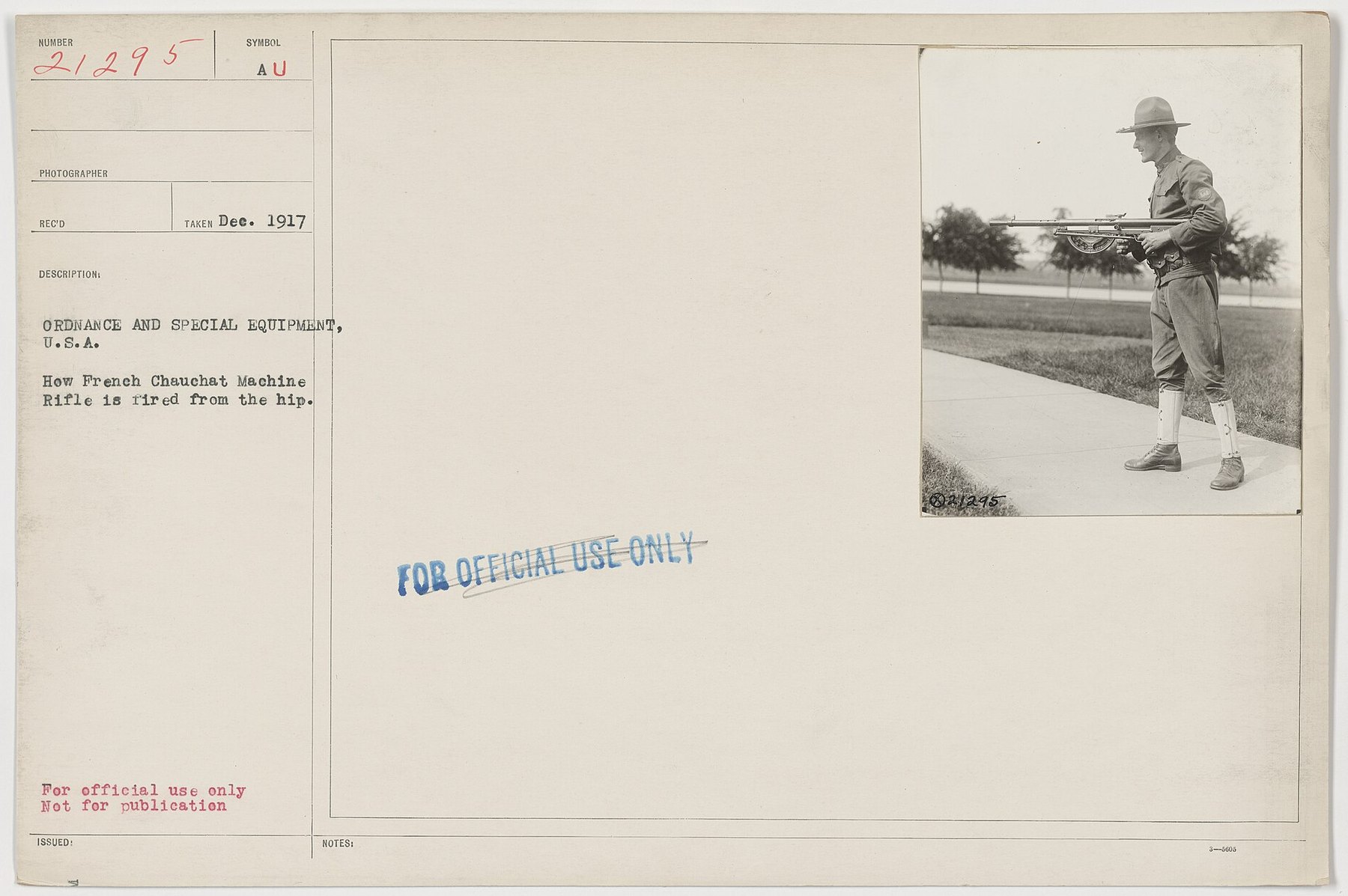
9.5 Firing one today
Two modern accounts were read.
- Martin Morgan (2017) fired an 8 mm gun on the set of American Rifleman Television with Prvi Partizan 200-grain 8×50R. It had stoppages, but fewer than a .30-caliber Lewis gun on the same set; one stovepiped ejection was cured by tightening the end cap and spring bushing.6
- Ian McCollum (2012), before he had fired one: “Take a decent condition Chauchat to the range with a good mag, and you are unlikely to have the gun give you any mechanical trouble”, calling it “a decent gun crippled by terrible magazines”.5
English reference works also cite an Aberdeen Proving Ground test of 1973 that found no specific problem, and a 1994 firing by Keller and Garofalo that found severe extraction problems. Neither report was found, so neither is relied on.
9.6 Assessment
On the documents found, the record supports these statements:
- The French 8 mm gun worked as a light automatic rifle when it was clean, held firmly, fed from good magazines, and served by trained men. The French and American manuals of 1916–1918 say so in effect, and say what each of those conditions guards against.79
- Its magazine was its weakest part, and the French Army knew it from the first manual. The open side, the weak spring and the fragile lips are documented by the gun’s own instruction, which told gunners to load eighteen.7
- It had a heat limit of a few hundred rounds of automatic fire, after which the barrel sleeve stuck in the jacket. That too was documented and taught.9
- It was made fast and cheaply, by methods new to arms-making, and quality suffered. That was the point of the design: about a quarter of a million were built, more than any other automatic weapon of the war.3
- The American Model 1918 in .30-06 was a failure, for reasons the sources do not agree on, and it is the source of much of the gun’s American reputation.
- The strongest condemnations are later than the war, are American, and cite no tests. Chinn’s “worst” claims, the thrown-away guns, and the Shepherd quotation could not be traced to a document.
The fair short verdict is that the Chauchat was a crude, cheap, fragile but workable gun, whose real faults were set down by its own makers in 1916, and whose worst reputation belongs to a different gun, the American Model 1918, and to writers who did not separate the two.
9.7 What could not be established
- French front-line reports on the gun, and the late-1916 survey of stoppages attributed to General Pétain.
- Any American Ordnance test report on either model.
- The source of the Shepherd quotation.
- The 1973 and 1994 test firings.
- Measured accuracy figures.
References
Footnotes
-
Benedict Crowell, America’s Munitions 1917–1918 (GPO, 1919), “Machine Guns”. Project Gutenberg #48428, accessed 2026-10-19. ↩ ↩2 ↩3
-
George M. Chinn, The Machine Gun, Vol. I (Bureau of Ordnance, 1951), pp. 240–241, and ch. 18. https://archive.org/details/TheMachineGunVolume1ByGeorgeMChinn, accessed 2026-10-19. ↩ ↩2 ↩3 ↩4 ↩5 ↩6
-
Henri Vuillemin, “Centenaire du Chauchat”, La Gazette des Armes no. 475, May 2015, pp. 16–21, via Wayback copies of fr.1001mags.com “texte intégral” pages, accessed 2026-10-19. ↩ ↩2 ↩3 ↩4 ↩5
-
Tom Laemlein, “That ‘Damned, Jammed Chauchat’: France’s Infamous Light Machine Gun”, American Rifleman, 17 September 2012, https://www.americanrifleman.org/articles/2012/9/17/that-damned-jammed-chauchat/, accessed 2026-10-19. ↩ ↩2 ↩3 ↩4 ↩5
-
Ian McCollum, “The Worst Gun Ever”, Forgotten Weapons, 3 July 2012, https://www.forgottenweapons.com/the-worst-gun-ever/, accessed 2026-10-19. Gerard Demaison’s remark is a reader comment on that page. ↩ ↩2 ↩3 ↩4 ↩5
-
Martin K. A. Morgan, “The Chauchat Light Machine Gun: Not Really One of the Worst Guns Ever”, American Rifleman, 6 February 2017, https://www.americanrifleman.org/articles/2017/2/6/the-chauchat-light-machine-gun-not-really-one-of-the-worst-guns-ever/, accessed 2026-10-19. ↩ ↩2 ↩3
-
Provisional Instruction on the Automatic Rifle, Model 1915 (Chauchat), War Department Document No. 732 (Army War College, January 1918). https://archive.org/details/provisionalinst00deptgoog, accessed 2026-10-19. ↩ ↩2 ↩3 ↩4 ↩5
-
Maj. Gen. William Crozier, Ordnance and the World War (Scribner, 1920), pp. 75–76, 106–109. Internet Archive
cu31924030758829, accessed 2026-10-19. ↩ ↩2 ↩3 ↩4 -
School of Automatic Arms, 40th Division, Camp Kearny, Notes on Mechanism of the Chauchat Machine Rifle, Model 1915, February 1918, pp. 18, 21, 23. https://archive.org/details/chauchatautomaticriflemodel1915notesonmechanism, accessed 2026-10-19. ↩ ↩2 ↩3 ↩4 ↩5 ↩6
-
Col. Leonard P. Ayres, The War with Germany: A Statistical Summary (GPO, 1919), pp. 66–67. https://archive.org/details/warwithgermanyst0000leon, accessed 2026-10-19. ↩
-
Cdt G.-H. Muller, Exposé schématique du fonctionnement des armes de petit calibre (Berger-Levrault, 1933), pp. 47–48. https://archive.org/details/expose-schematique-du-fonctionnment-des-armes-de-petit-calibre-by-tanant-1933, accessed 2026-10-19. ↩ ↩2 ↩3
-
Gen. Lemuel C. Shepherd Jr., oral-history memoir, Marine Corps Oral History Program (interviews 1966–1967), Marine Corps University, https://www.usmcu.edu/Portals/218/Gen%20Lemuel%20C_%20Shepherd%20Jr.pdf, full text searched 2026-10-19. ↩
-
US Army Center of Military History, “Medal of Honor Recipients: World War I”, as archived 12 December 2007, https://web.archive.org/web/20071212022816/http://www.army.mil/cmh/html/moh/worldwari.html, accessed 2026-10-19. ↩
Comments (0)