Chauchat · Volume 10
Owning One: Transferables, DEWATs, Display Guns and the Law
Why every Chauchat is a machine gun in federal law, the closed register of 1986, the four kinds of Chauchat on the American market, deactivated war trophies and what ATF says about reactivating them, the late-1950s imports, and the Michigan statute that does not mention unserviceable guns
10.1 Not legal advice
This volume sets out the statutes and ATF’s published guidance as they read on 19 October 2026, so that a reader can take them to someone qualified. The hub’s general treatment of machine-gun law, including the Hughes Amendment, the four categories of machine gun, the Form 4 transfer and the $200 transfer tax that Public Law 119-21 did not remove for machine guns, is in MP 40, Volume 6. It is not repeated here. This volume covers what is particular to the Chauchat.
10.2 A Chauchat is a machine gun
Every Chauchat was built to fire automatically. The National Firearms Act defines a machinegun as “any weapon which shoots, is designed to shoot, or can be readily restored to shoot, automatically more than one shot, without manual reloading, by a single function of the trigger”, and the term “shall also include the frame or receiver of any such weapon”.1 The Chauchat’s selector has an automatic position and its single-shot setting is a modification of the automatic trigger (Volume 5). No semi-automatic-only military Chauchat was found in any source consulted.
What makes the definition bite on old guns is “designed to shoot” and “readily restored”. A Chauchat that has stopped working is still a machine gun if it can be readily restored. A receiver alone is a machine gun.
10.3 Curio and relic, not antique
The federal antique exemption covers firearms “manufactured in or before 1898”.2 The Chauchat was made from 1913 to the 1920s, so no Chauchat is an antique.
Every Chauchat is old enough to be a curio or relic: the regulations include “Firearms which were manufactured at least 50 years prior to the current date, but not including replicas thereof”.3 That status matters for licensed collectors under the Gun Control Act. It does not take a gun out of the National Firearms Act.
10.4 The closed register
Under 18 U.S.C. § 922(o), “it shall be unlawful for any person to transfer or possess a machinegun”, except for government and “any lawful transfer or lawful possession of a machinegun that was lawfully possessed before the date this subsection takes effect”, 19 May 1986.4 A private person can own a Chauchat only if it was lawfully registered before that date. MP 40 Vol 6 explains the arithmetic.
One historical point is particular to old foreign guns: the 1968 amendments to the National Firearms Act opened “a 30-day amnesty period immediately following the law’s effective date during which persons possessing unregistered firearms could register them”. The law allowed further amnesties of up to 90 days, but “To date, no additional amnesty periods have been declared.”5 A Chauchat brought home in 1919 and never registered could not be registered after that month and cannot be now.
10.5 Four kinds of Chauchat
Table 1 — Four kinds of Chauchat
| Kind | What it is | Status | Transfer |
|---|---|---|---|
| Registered transferable | A working gun on the National Firearms Registration and Transfer Record, lawfully possessed before 19 May 1986 | A machine gun, lawfully transferable | ATF Form 4, $200 tax, approval before transfer (MP 40 Vol 6) |
| Registered DEWAT | A registered gun rendered unserviceable | Still an NFA firearm | ATF Form 5, tax-exempt “as a curio or ornament”5 |
| Display gun | A gun assembled on a receiver that the seller says was destroyed (torch-cut and part replaced with solid steel) | Not a firearm if, and only if, no receiver survives in law | Sold without paperwork; the burden is on the receiver’s destruction |
| Unregistered gun | A working or “deactivated” gun not on the register, including foreign deactivations | Contraband | None lawful |
Martin Morgan says that of the registered transferable Chauchats, “Almost none … are of the Model 1918 in .30-‘06”.6 A registered American Model 1918 is a great rarity; most registered guns are French Model 1915s.
10.6 Deactivated war trophies (DEWATs)
ATF’s National Firearms Act Handbook explains the DEWAT:
“Deactivated War Trophy (DEWAT) firearms are still firearms under the NFA, but have been rendered unserviceable (i.e., incapable of discharging a shot by means of an explosive and incapable of being readily restored to a firing condition). The deactivation may have been accomplished by various means such as (but not limited to) welding of the chamber, cutting the barrel/chamber/breech, plugging the barrel, welding the bolt to the chamber, or some combination of these actions which rendered the firearm incapable of firing a shot. Regardless of being unserviceable, the DEWAT firearm must be registered and approved for transfer as any other NFA firearm.”5
The handbook adds that “rendering a firearm unserviceable does not remove it from the definition of an NFA firearm”, and that the transfer is tax-free only because the gun is transferred “as a ‘curio or ornament’”.5
On reactivation the handbook says that “Deactivated War Trophy (DEWAT) firearms may be returned to a serviceable condition”, that a reactivated gun is often called a REWAT, and that “The act of returning a DEWAT to a serviceable condition is considered the ‘making’ or ‘manufacturing’ of a firearm by ATF”. It names the ATF forms for doing so, and says that the Form 1 “may be used to reactivate a properly registered unserviceable firearm, including registered unserviceable machineguns.”5 That is ATF’s published position on the legal route. This dive gives no information on how any gun is reactivated, and anyone contemplating it must get the paperwork approved first and the work done by someone licensed to do it. An unregistered deactivated gun has no such route.
10.7 Display guns on destroyed receivers
International Military Antiques, a large dealer in display guns, describes its Chauchats as built “on an original BATF compliant non-firing display receiver”, created “by using portions of the original torch cut receiver, including the barrel bushing, combined with some new made steel portions”, with “a 25% section of the total length completely replaced entirely with solid steel bar stock”, and many internal parts “demilitarized long ago, and welded in place”. It describes such a gun as “totally legal to own without a license of any kind”.7 That is the dealer’s statement. The legal point it rests on is that the original receiver has been destroyed, so that the gun has no frame or receiver within the federal definition. A buyer should ask the seller what was cut, where, and how, and get it in writing.
A gun sold abroad as deactivated under European rules is a different object. The hub’s position, set out in MP 40 Vol 6, is that a foreign deactivation certificate does not make a machine gun lawful in the United States.
10.8 How the guns got here
Two routes are documented:
- Brought home after 1918. Chauchats were used in American training camps and issued to the AEF (Volume 3). Some will have come home as trophies; only those registered, at the latest in the 1968 amnesty, can be lawfully held.
- Surplus imports in the late 1950s. Morgan writes that “thousands entered the US in the late 1950s as DEWATs, many were reactivated and added to the NFA registry”.6 The Finnish record documents one source: Finland traded 2,117 Chauchats to the American importer Interarmco in about 1957–1958 and sold it the remaining 2,115 in 1959–1960 (Volume 4).8 Ex-Finnish guns are stamped “SA” (Volume 7).
10.9 Michigan
Michigan’s machine-gun statute, MCL 750.224, as published by the Legislature on 19 October 2026 (“Complete Through PA 91 of 2026”), provides that “A person shall not manufacture, sell, offer for sale, or possess … (a) A machine gun or firearm that shoots or is designed to shoot automatically more than 1 shot without manual reloading, by a single function of the trigger.” A violation is a felony “punishable by imprisonment for not more than 5 years, or a fine of not more than $2,500.00, or both.” The exemption that matters reads: “(c) A person licensed by the secretary of the treasury of the United States or the secretary’s delegate to manufacture, sell, or possess a machine gun”.9
MP 40 Vol 6 already flags the first open question: whether the licensee exemption in (3)(c) covers a private individual who owns a registered transferable machine gun but holds no federal licence. The Chauchat raises a second question that this dive found nowhere discussed:
- The Michigan text reaches a firearm that “is designed to shoot automatically”. Unlike the federal definition, it has no “readily restored” test and no exemption for unserviceable guns. A Chauchat was designed to shoot automatically whether or not it still can. Whether a registered DEWAT, or a display gun, is a “machine gun” under MCL 750.224 is a question the statute’s words do not answer. No Michigan court decision, Attorney General opinion or Michigan State Police statement on it was found.
A Michigan resident should get a Michigan lawyer’s opinion before buying any Chauchat, including a deactivated or display gun, and should not rely on a dealer’s general statement that a display gun is legal “without a license of any kind”.
10.10 What to check before buying
- Which of the four kinds it is. For a registered gun, the registration paperwork decides it, including whether it is recorded as unserviceable.
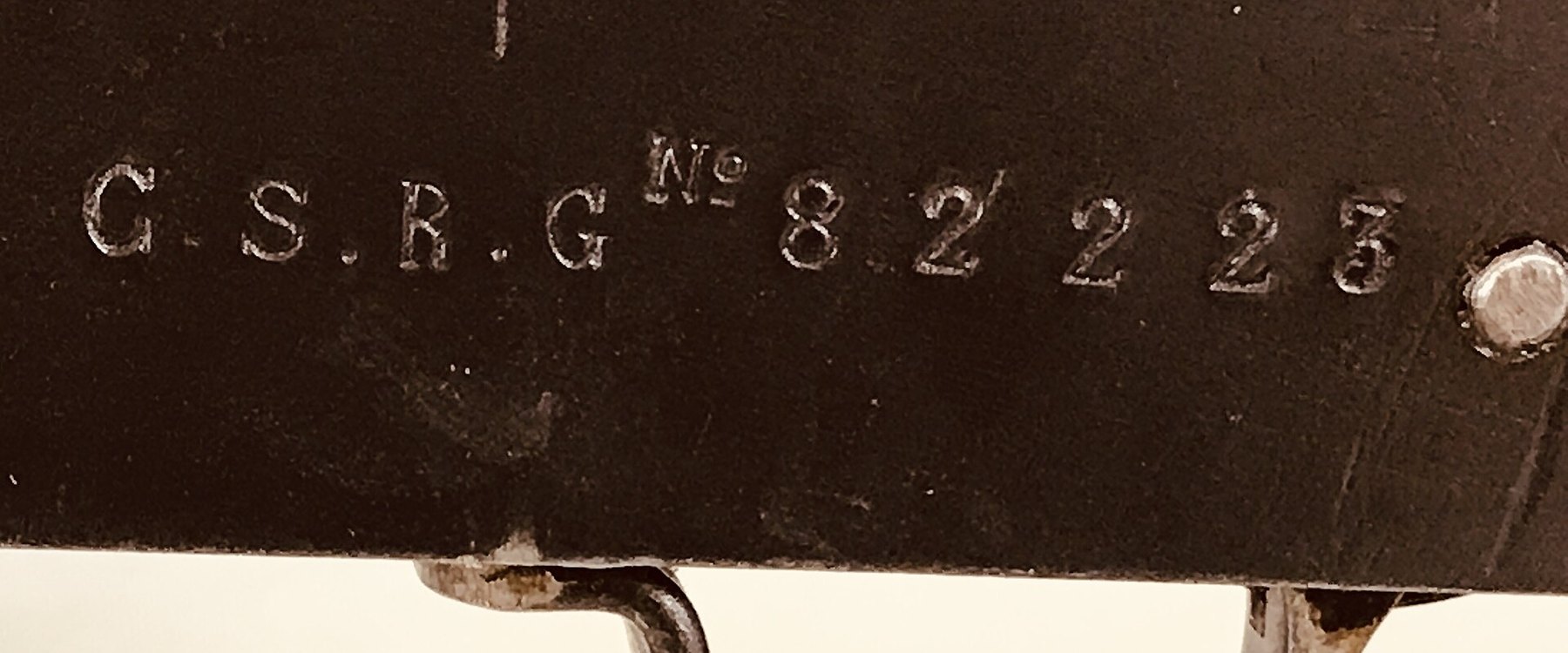
- The serial number on the paperwork against the gun. Chauchats carry the serial in several places: the left of the trigger housing, the end cap, the assembly yoke, and often the cocking handle (Volume 7).
- The model and calibre against the paperwork. An “A” after C.S.R.G. does not by itself make a gun an American Model 1918 (Volume 7).
- For a display gun: what the seller says was destroyed and replaced, in writing.
- For a Michigan buyer: a Michigan lawyer’s view on MCL 750.224 for the kind of gun in question.
10.11 What could not be established
- How many Chauchats are on the register, and how many of them are registered DEWATs.
- How many of the late-1950s imports were ex-Finnish.
- Any Michigan authority on whether MCL 750.224 reaches a registered DEWAT or a display gun, and on whether (3)(c) covers private owners.
- Current prices. Vuillemin wrote in 2015 that a Chauchat in the United States often fetched “4000/4500 $”, without saying what kind of gun.10 No checkable current figure was found.
References
Footnotes
-
26 U.S.C. § 5845(b), Legal Information Institute, Cornell Law School, https://www.law.cornell.edu/uscode/text/26/5845, accessed 2026-10-19. ↩
-
18 U.S.C. § 921(a)(16), Legal Information Institute, Cornell Law School, https://www.law.cornell.edu/uscode/text/18/921, accessed 2026-10-19. ↩
-
27 C.F.R. § 478.11, “Curios or relics”, Legal Information Institute, Cornell Law School, https://www.law.cornell.edu/cfr/text/27/478.11, accessed 2026-10-19. ↩
-
18 U.S.C. § 922(o), Legal Information Institute, Cornell Law School, https://www.law.cornell.edu/uscode/text/18/922, accessed 2026-10-19. ↩
-
Bureau of Alcohol, Tobacco, Firearms and Explosives, National Firearms Act Handbook, ATF E-Publication 5320.8 (revised April 2009), §§ 2.1.9, 3.2.1, 4.2.2.1, 6.6 and 10.1.5–10.1.5.1. Copy hosted by the US Court of Appeals for the First Circuit, https://www.ca1.uscourts.gov/sites/ca1/files/citations/ATFNationalFirearmsActHandbook.pdf, accessed 2026-10-19. ↩ ↩2 ↩3 ↩4 ↩5
-
Martin K. A. Morgan, “The Chauchat Light Machine Gun: Not Really One of the Worst Guns Ever”, American Rifleman, 6 February 2017, https://www.americanrifleman.org/articles/2017/2/6/the-chauchat-light-machine-gun-not-really-one-of-the-worst-guns-ever/, accessed 2026-10-19. ↩ ↩2
-
International Military Antiques, listing for a SIDARME Model 1915 display gun, https://www.ima-usa.com/products/original-french-wwi-fusil-mitrailleur-modele-1915-csrg-chauchat-display-lmg-with-magazine-serial-no-23468, accessed 2026-10-19. ↩
-
Jaeger Platoon: Finnish Army 1918–1945, “8 mm LMG M/15 Chauchat”, http://www.jaegerplatoon.net/LMG2.htm#800PK15, accessed 2026-10-19. ↩
-
MCL 750.224, Michigan Legislature, https://www.legislature.mi.gov/Laws/MCL?objectName=mcl-750-224, accessed 2026-10-19 (last amended 2006 PA 401). ↩
-
Henri Vuillemin, “Centenaire du Chauchat”, La Gazette des Armes no. 475, May 2015, p. 21, via Wayback copy of https://web.archive.org/web/20211128145705/http://fr.1001mags.com/parution/gazette-des-armes/numero-475-mai-2015/page-20-21-texte-integral, accessed 2026-10-19. ↩
Comments (0)