Chauchat · Volume 1
Chauchat, Sutter and the C.S.: Origins to 1915
An artillery officer and an arms inspector at the Puteaux workshop, a long-recoil machine rifle tried at Châlons in January 1913, a handful flown over the front in 1914, and the 1915 order that turned it into the Fusil-Mitrailleur Modèle 1915 C.S.R.G.
1.1 What this dive covers
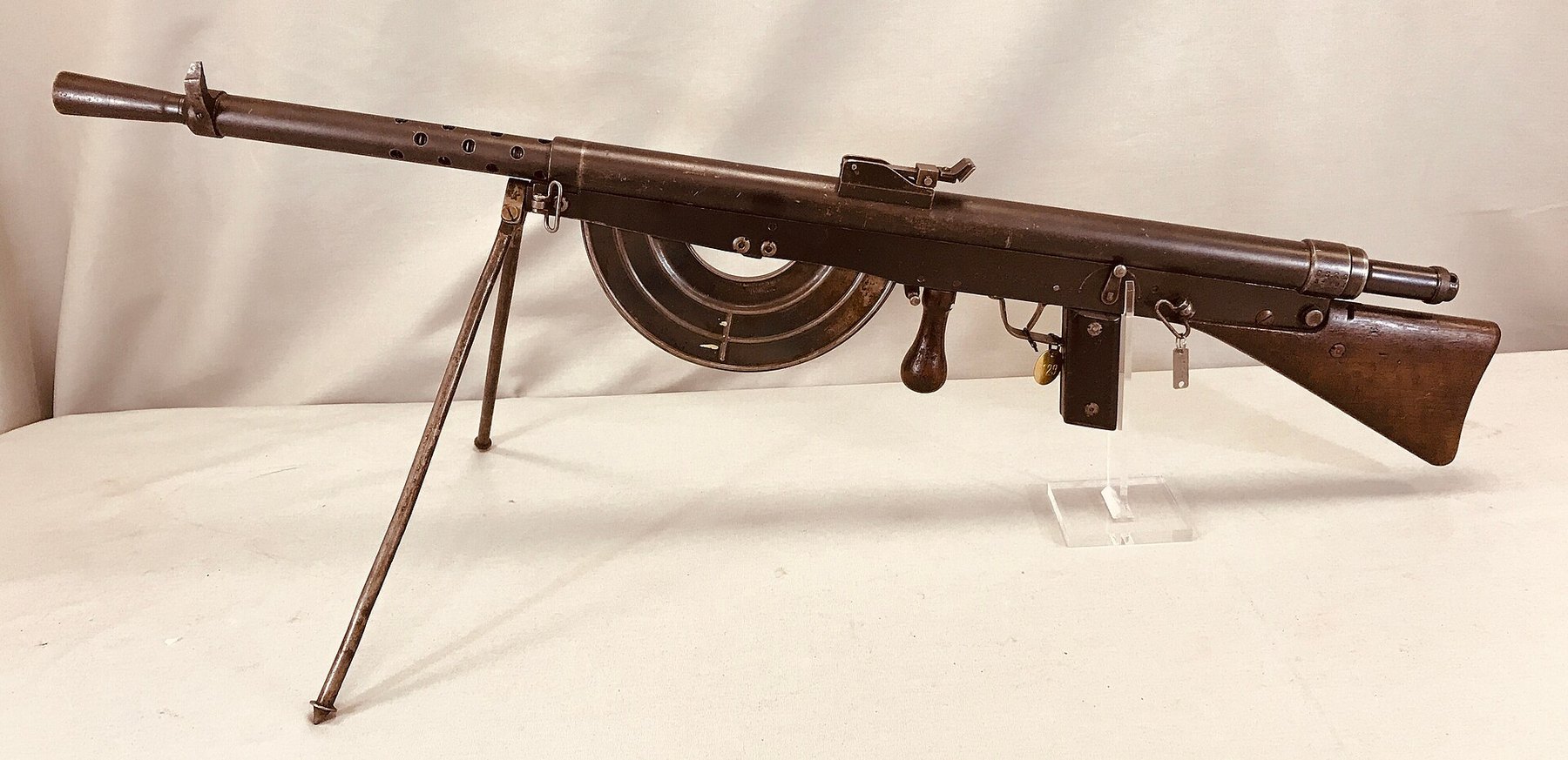
The Chauchat is the light automatic weapon that France fought the second half of the First World War with, and the one the American Expeditionary Forces borrowed when they arrived without one of their own. Its official name was Fusil-mitrailleur modèle 1915, its markings read C.S.R.G., and nearly everyone since has called it the Chauchat, after one of its designers. Contemporary US manuals call it the “Automatic Rifle, Model 1915 (Chauchat)” or the “Chauchat Machine Rifle”.12
It has the worst reputation of any service weapon of its war. English-language writing since the 1950s has called it “incomparably the worst machine gun of its class used by any belligerent in World War I”.3 This dive sets that reputation beside the documents: the French Army’s own instruction, two American training manuals of 1917–1918, a French schematic manual of 1933, the US War Department’s statistical and munitions reports of 1919 and 1920, and the collector and museum record. Where those sources disagree, the figures are set side by side.
This is a select-fire weapon. The dive covers history, mechanism, identification, maintenance and law. It contains no build, replica-making or conversion content of any kind.
The volumes run: this one on the designers and the pre-war gun; Volume 2 on mass production at Gladiator and SIDARME and on French service; Volume 3 on the Americans, including the Model 1918 in .30-06; Volume 4 on Belgium, Serbia, Greece, Poland, Finland and the other users; Volume 5 on how the mechanism works; Volume 6 on the half-moon magazine and the cartridge that forced its shape; Volume 7 on telling the models, makers and national variants apart; Volume 8 on field stripping, care, stoppages and repair, from the period manuals; Volume 9 on the reputation measured against the record; and Volume 10 on the law of owning one in the United States and in Michigan.
1.2 The gun in one paragraph
The Chauchat is a shoulder-fired automatic rifle of about 9 kg, firing the French 8 mm Lebel cartridge from a 20-round semicircular magazine that hooks under the receiver. It works by long recoil: on firing, the barrel and the bolt, locked together, run back further than the length of a cartridge; the bolt is caught and held; the barrel runs forward alone, which unlocks the bolt and pulls the barrel off the empty case; and when the barrel is home, the bolt is released to chamber the next round and fire it. It fires from an open bolt. A three-position lever gives safe, full automatic and single shots. Its body is mostly tube and stamped sheet steel, screwed and riveted together, with a wooden butt, a pistol grip and a wooden front grip, and a folding bipod. The French manual of 1916 describes all of this; the American manuals of 1917 and 1918 translate and expand it.12
1.3 The four letters
C.S.R.G. stands for four names. The US Army’s 40th Division armourers’ school at Camp Kearny, California, printed them plainly in February 1918:2
“The Chauchat Rifle, Model of 1915, is also called ‘Rifle C. S. R. G.’ These capital letters are the abbreviations or the names of Inventors and Manufacturer. C—Col. Chauchat S—Capt. Suter R—Mr. Ribeyrolles G—Gladiator Factory”
Three of the letters are people and one is a firm. C is Louis Chauchat. S is Charles Sutter, whose name the American pamphlet spells “Suter” and gives a captain’s rank; the French magazine historian Henri Vuillemin calls him a Contrôleur d’Armes, an arms inspector of the state arsenal system.4 R is Paul Ribeyrolles, who ran the Gladiator company.4 G is Gladiator, the Paris bicycle and motor firm (the Société des Cycles Gladiator) that built the great majority of the guns.45
1.4 Louis Chauchat and Charles Sutter
Vuillemin’s centenary article in La Gazette des Armes (May 2015) gives Louis Chauchat’s dates as 17 March 1863 to 5 September 1917.4 He was an artillery officer at the Atelier de Construction de Puteaux (APX), the state workshop west of Paris where the French artillery service designed weapons. Vuillemin describes him as a commandant (major) in 1911 and a lieutenant-colonel by 1914; the American pamphlet of 1918 calls him “Col. Chauchat”.42 He died a year before the war ended, before his gun’s American chapter had properly begun.
Charles Sutter’s role, on Vuillemin’s account, was as Chauchat’s assistant in the 1911 trials at Puteaux.4 The Czech Military History Institute (VHU) in Prague names both men as the designers of the 1913 aircraft gun it holds, “kulomet konstruktérů Louise Chauchata a Charlese Suttera”.6 No independent biography of Sutter was found for this dive.
1.5 The C.S. machine rifle, 1911 to 1914
The gun that became the Chauchat existed before the war, under the two initials C.S. Vuillemin’s sequence is:4
- 1911: trials at the Atelier de Puteaux of a “fusil mitrailleur” under Commandant Chauchat, assisted by Contrôleur d’Armes Sutter.
- 13 January 1913: after many adjustments, two examples tested at the camp de Châlons.
- To February 1914: Lieutenant-Colonel Chauchat supervised the building of 188 C.S. guns at the Saint-Étienne arms factory before being recalled to Puteaux.
- 1914–1916: 65 of them armed reconnaissance aircraft. Vuillemin notes that the C.S. had been meant for the defence of fortresses and ended up on aeroplanes instead.
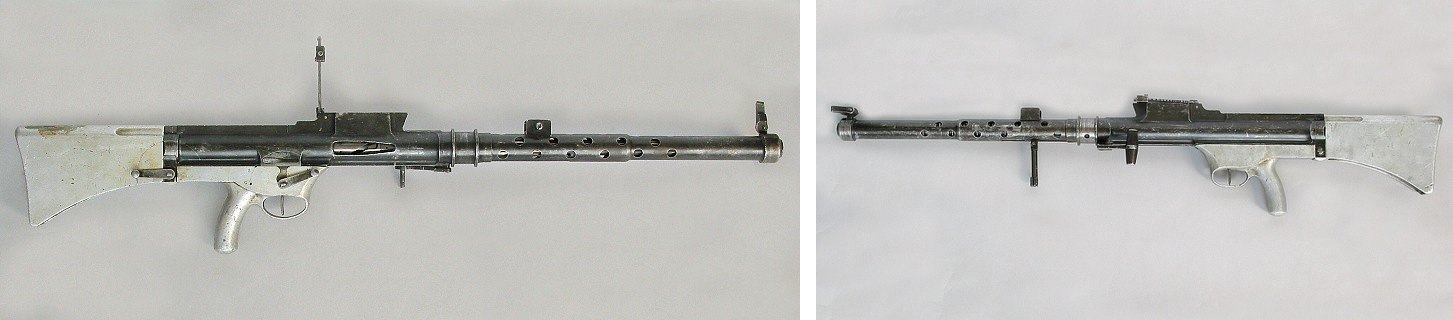
The VHU in Prague holds what it believes is the only surviving example: a “Modéle 1913” aircraft gun, serial number 34, which it acquired in December 1981 by transfer from a military unit at Babice u Říčan. Its exhibit text says that the Gladiator firm in Paris “made only 186” of the M 1913.6
The two accounts of the pre-war production do not agree:
Table 1 — The two accounts of the pre-war production do not agree
| Source | How many | Who built them |
|---|---|---|
| Vuillemin, Gazette des Armes 475 (2015) | 188, built by February 1914 | Manufacture d’armes de Saint-Étienne, under Chauchat’s supervision |
| VHU Prague exhibit text | 186 | Gladiator, Paris |
The figures are close enough to be the same batch counted differently, but the makers are not. Neither source cites a document. Both are given here and neither is preferred. (A figure of 100 built by Saint-Étienne in 1913–1914 circulates in English reference works, attributed to Demaison and Buffetaut’s 1995 book Honour Bound; that book could not be read for this dive.)
The surviving 1913 gun already shows the 1915 gun’s essentials: a long tubular receiver with a perforated jacket over the barrel, a pistol grip under the rear of the receiver, and the long-recoil mechanism inside. What it lacks is everything an infantryman needs: a shoulder stock of the 1915 pattern, a bipod and a front grip.
1.6 Where the long-recoil idea came from
Long recoil was not new in 1911. John M. Browning’s US patent 659,507, “Recoil-operated firearm”, filed 8 February 1900 and issued 9 October 1900, describes a gun in which “the barrel, barrel extension, and breech-bolt will recoil together”, after which the bolt is held back while the barrel returns forward under its spring. That is the sequence of the Browning Auto-5 shotgun and of the Remington Model 8 rifle, and it is the sequence of the Chauchat.7 The Hungarian designer Rudolf Frommer used long recoil in his pistols in the same years.
Two later writers each name a single source of inspiration, and they name different men:
Table 2 — Two later writers each name a single source of inspiration, and they name different men
| Claim | Who makes it | Evidence offered |
|---|---|---|
| ”undoubtedly inspired by the experimental weapon invented by the Hungarian arms designer, Rudolf Frommer” | George M. Chinn, The Machine Gun, Vol. I (US Navy Bureau of Ordnance, 1951)3 | None; the argument is that France otherwise favoured gas operation |
| Built “sur les bases d’un brevet dû à l’ingénieur Hongrois Rudolf FROMMER” | Armes Françaises reference site (undated)5 | None cited |
| ”largely based on John Browning’s patented design” for the Remington Model 8 | Martin K. A. Morgan, American Rifleman (2017)8 | None cited |
No document in which Chauchat, Sutter or the Puteaux workshop credits either man was found. What can be said is that the Chauchat’s cycle is the long-recoil cycle that Browning patented in 1900, carried out with a rotating bolt head rather than Browning’s tilting lock. Volume 5 describes the mechanism part by part.
1.7 1915: Joffre, the first order and Gladiator
The war turned a fortress and aircraft gun into an infantry weapon. Vuillemin credits General Joffre with pushing the programme, and gives April 1915 as the date of a first official order for 50,000 guns.4 (A caption later in the same article gives “50 000 exemplaires … commande en fin janvier 1916”, which may be a second order; the article does not reconcile the two.) The gun was adopted as the Fusil-mitrailleur modèle 1915, and the first French instruction for it, the Instruction provisoire, is dated February 1916.14
The order went not to a state arsenal but to Gladiator, a private firm whose trade was bicycles and motor vehicles, run by Paul Ribeyrolles.4 The reason given by both French sources consulted is method: Gladiator knew stamping, tube work, brazing and riveting, which the state arsenals, built around machining from the solid, did not use for weapons. The state factories at Saint-Étienne and Châtellerault were to supply the barrels.45 Volume 2 follows the production.
Ribeyrolles’s initial joined Chauchat’s and Sutter’s, and the factory’s joined all three. The resulting four-letter mark, C.S.R.G., is stamped on the guns; the name “Chauchat” is not.
1.8 What “fusil-mitrailleur” meant
Fusil-mitrailleur means, literally, a “machine-gunner rifle”: a rifle-sized weapon that fires automatically. The French Army’s own 1933 teaching manual classifies the Mle 1915 as a weapon of automatic loading and fire, used “par petites rafales” (in short bursts), “exceptionnellement” single shots.9 The American Ordnance chief of the war, Major General William Crozier, put the category plainly in 1920: the Vickers, the heavy Hotchkiss and the heavy Browning, “weighing in the neighborhood of 36 pounds each, are examples of machine guns; the Chauchat and the light Browning, weighing 16 to 19 pounds, are automatic rifles”.10 The American Army used both names for it, “automatic rifle” and “machine rifle”, sometimes in the same document.
The idea was that one man could carry the gun forward with the assaulting infantry and fire it on the move. That is why it has a pistol grip and a front grip, why the French manual describes firing it from the hip while walking, and why it weighs half what a Lewis gun weighs. It is also why so many of its compromises were accepted. Volume 2 covers the doctrine.
1.9 Errors in the standard English account
Chinn’s 1951 chapter is the most widely repeated English-language account and was published by the US Navy’s Bureau of Ordnance. Checked against the period manuals, three of its statements are wrong:
- “The board was composed of Messrs. Chauchat, Suterre, Ribeyrolle, and Gladiator. The last named member of the board at a later date went to Greece and manufactured the identical weapon with his own name on the piece.”3 Gladiator was not a person. The 1918 American pamphlet already gives “G—Gladiator Factory”.2 The story of “Mr. Gladiator” going to Greece is a misreading of the factory name; Greece did use the gun (Volume 4).
- “The gun got its name from Colonel Chauchat, chairman of the French commission that adopted it.”3 Chauchat was one of its designers, from 1911, at Puteaux; he did not merely chair the board that adopted it.46
- “To fire single shot, the fire regulator is changed from ‘S,’ or safe … to ‘C,’ or control (‘contrôle’ in French).”3 The C stands for coup par coup, shot by shot. The French manual of 1933 says so; the 1918 American translation renders the C setting as “round by round”; Vuillemin labels the selector “Sureté - Mitrailleuse - Coup par coup”.914 Volume 5 describes the selector.
Chinn also says the bolt “has four locking lugs”. The 1918 American pamphlet says “two locking lugs on the bolt head”.2 That conflict is taken up in Volume 5.
1.10 What could not be established
- The primary record of the 1911–1914 C.S. programme: no French order, test report or drawing was found online. Gallica, the French national library’s digital collection, refused automated access during this work.
- Whether the 186 or 188 pre-war guns were built by Saint-Étienne or by Gladiator.
- Sutter’s career and rank. The American “Capt.” and the French “Contrôleur d’Armes” may describe the same man at different dates.
- The exact date and size of the first 1915 order, beyond Vuillemin’s April 1915 and 50,000.
- Any documentary basis for the Frommer or Browning “inspiration” claims.
References
Footnotes
-
Provisional Instruction on the Automatic Rifle, Model 1915 (Chauchat), “No. 8. Translated from the French Edition of February, 1916. Revised to June 9, 1917, at Headquarters American Expeditionary Forces, France”; reprinted by the US Army War College, January 1918, as War Department Document No. 732. Internet Archive
provisionalinst00deptgoog(University of Michigan copy, scanned by Google), https://archive.org/details/provisionalinst00deptgoog, accessed 2026-10-19. ↩ ↩2 ↩3 ↩4 -
School of Automatic Arms, 40th Division, Camp Kearny, Cal., Notes on Mechanism of the Chauchat Machine Rifle, Model 1915, February 1918 (Machine Gun Instruction and Inspection Division, Ordnance Depot, 40th Division), p. 9. Internet Archive
chauchatautomaticriflemodel1915notesonmechanism, https://archive.org/details/chauchatautomaticriflemodel1915notesonmechanism, accessed 2026-10-19. ↩ ↩2 ↩3 ↩4 ↩5 ↩6 -
George M. Chinn, The Machine Gun, Vol. I (Bureau of Ordnance, Department of the Navy; US Government Printing Office, 1951), ch. 13, “Chauchat Machine Gun”, pp. 238–242. Internet Archive
TheMachineGunVolume1ByGeorgeMChinn, https://archive.org/details/TheMachineGunVolume1ByGeorgeMChinn, accessed 2026-10-19. ↩ ↩2 ↩3 ↩4 ↩5 -
Henri Vuillemin (text) and Marc de Fromont (photographs), “Centenaire du Chauchat”, La Gazette des Armes no. 475, May 2015, pp. 12–21. Read from the magazine’s “texte intégral” pages at fr.1001mags.com via Internet Archive Wayback Machine copies (2020–2022), e.g. https://web.archive.org/web/20220325002758/http://fr.1001mags.com/parution/gazette-des-armes/numero-475-mai-2015/page-12-13-texte-integral, accessed 2026-10-19. ↩ ↩2 ↩3 ↩4 ↩5 ↩6 ↩7 ↩8 ↩9 ↩10 ↩11 ↩12 ↩13
-
“Le fusil-mitrailleur de 8 mm CSRG modèle 1915”, Armes Françaises (armesfrancaises.free.fr), undated, http://armesfrancaises.free.fr/FM%20Chauchat.html, accessed 2026-10-19. ↩ ↩2 ↩3
-
Vojenský historický ústav Praha, exhibit “Francouzský letecký kulomet M 1913”, https://www.vhu.cz/exhibit/francouzsky-letecky-kulomet-m-1913, accessed 2026-10-19. ↩ ↩2 ↩3
-
John M. Browning, US Patent 659,507, “Recoil-operated firearm”, filed 8 February 1900, issued 9 October 1900. Google Patents, https://patents.google.com/patent/US659507A/en, accessed 2026-10-19. ↩
-
Martin K. A. Morgan, “The Chauchat Light Machine Gun: Not Really One of the Worst Guns Ever”, American Rifleman, 6 February 2017, https://www.americanrifleman.org/articles/2017/2/6/the-chauchat-light-machine-gun-not-really-one-of-the-worst-guns-ever/, accessed 2026-10-19. ↩
-
Commandant G.-H. Muller, preface by Général Tanant, Exposé schématique du fonctionnement des armes de petit calibre (Nancy-Paris-Strasbourg: Berger-Levrault, 1933), ch. II, “Le fusil-mitrailleur, modèle 1915”, pp. 47–62. Internet Archive
expose-schematique-du-fonctionnment-des-armes-de-petit-calibre-by-tanant-1933, accessed 2026-10-19. ↩ ↩2 -
Major General William Crozier, Ordnance and the World War: A Contribution to the History of American Preparedness (New York: Scribner, 1920), pp. 75–76. Internet Archive
cu31924030758829, accessed 2026-10-19. ↩
Comments (0)