Chauchat · Volume 6
The Half-Moon Magazine and the 8 mm Lebel Cartridge
Why the 8 mm Lebel round forced a semicircular magazine, how the magazine is built with one side open, why the French manual itself said to load eighteen rather than twenty, the spring test with four fingers, the cartridge the gun was regulated for, and the box magazines that later users built
6.1 The cartridge that shaped the gun
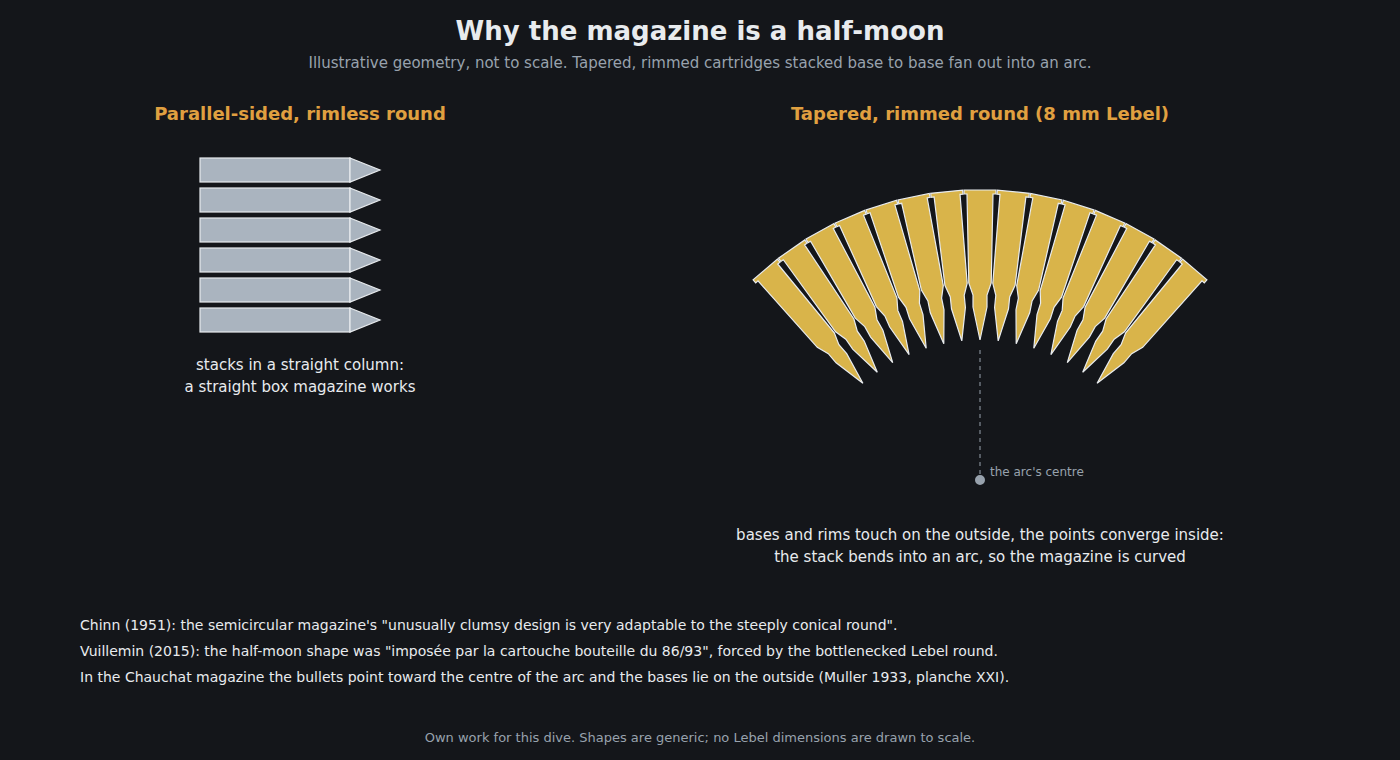
The Chauchat fires the French Army’s 8 mm rifle cartridge, the 8×50R Lebel of 1886. It is a rimmed, bottlenecked round with a pronounced body taper, designed for the tube magazine of the Lebel rifle. Two period writers say plainly that the cartridge dictated the magazine. Chinn: the feed “is semicircular in construction and holds twenty 8-mm Lebel cartridges. Its unusually clumsy design is very adaptable to the steeply conical round.”1 Vuillemin: the magazine’s “configuration en demi-lune” was a “forme imposée par la cartouche ‘bouteille’ du 86/93”, forced by the bottlenecked 1886/93 round, and was its great but “malheureusement inévitable” drawback.2
The hub has no dedicated 8 mm Lebel dive; this volume gives only what the gun needs.
6.2 Why a half-moon
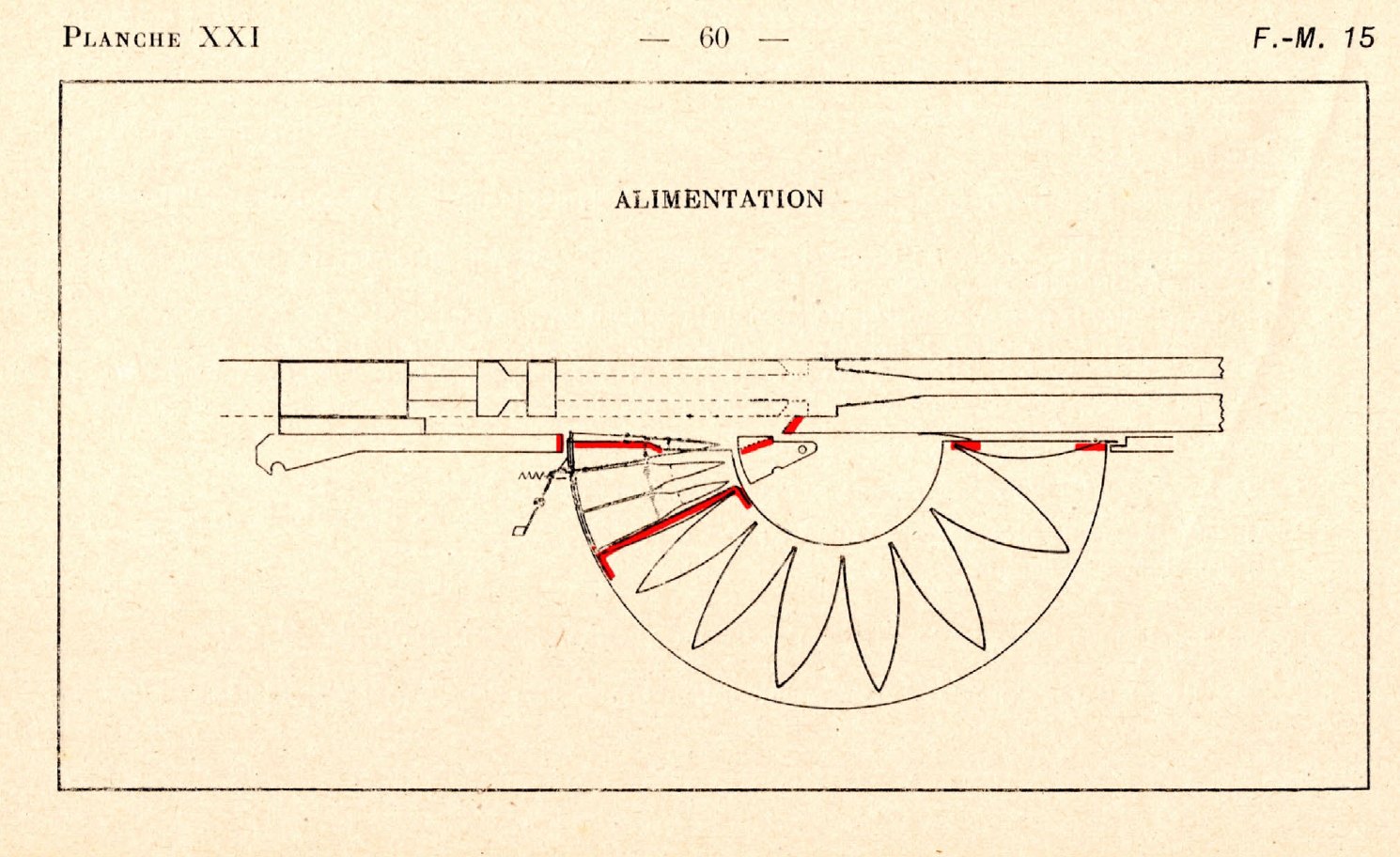
Stack rounds whose base is wider than their shoulder, base to base, and the stack bends. A box magazine for a tapered round (the Kalashnikov’s is the familiar example) curves for this reason. The Lebel’s body taper is steep enough that a stack of twenty bends through a half circle. In the Chauchat magazine the cartridges lie like the spokes of a half-wheel, bullets pointing toward the centre of the arc and bases on the outside; the top round, at the rear end of the arc where the magazine meets the receiver, lies horizontal and points forward into the gun. Muller’s Planche XXI draws it so.3
6.3 How the magazine is built
The 1916 French instruction describes it:4
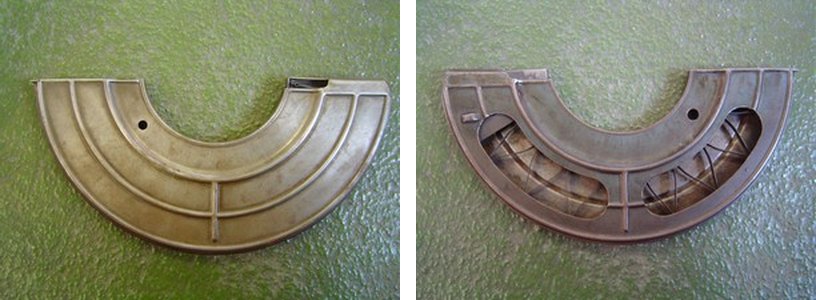
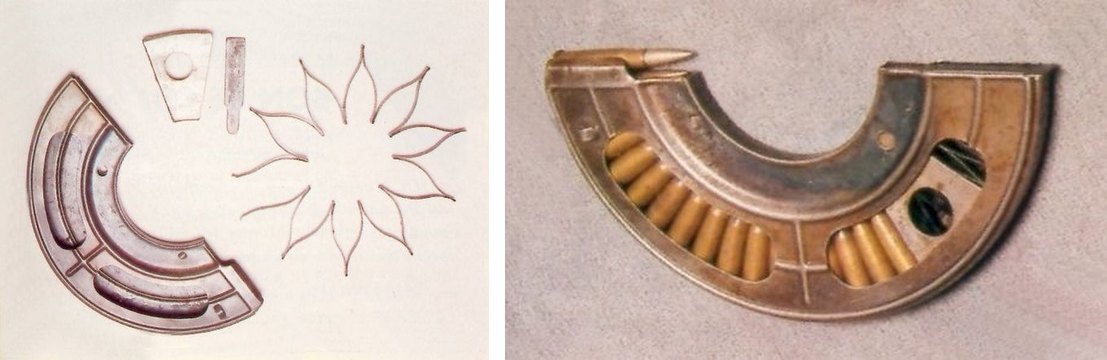
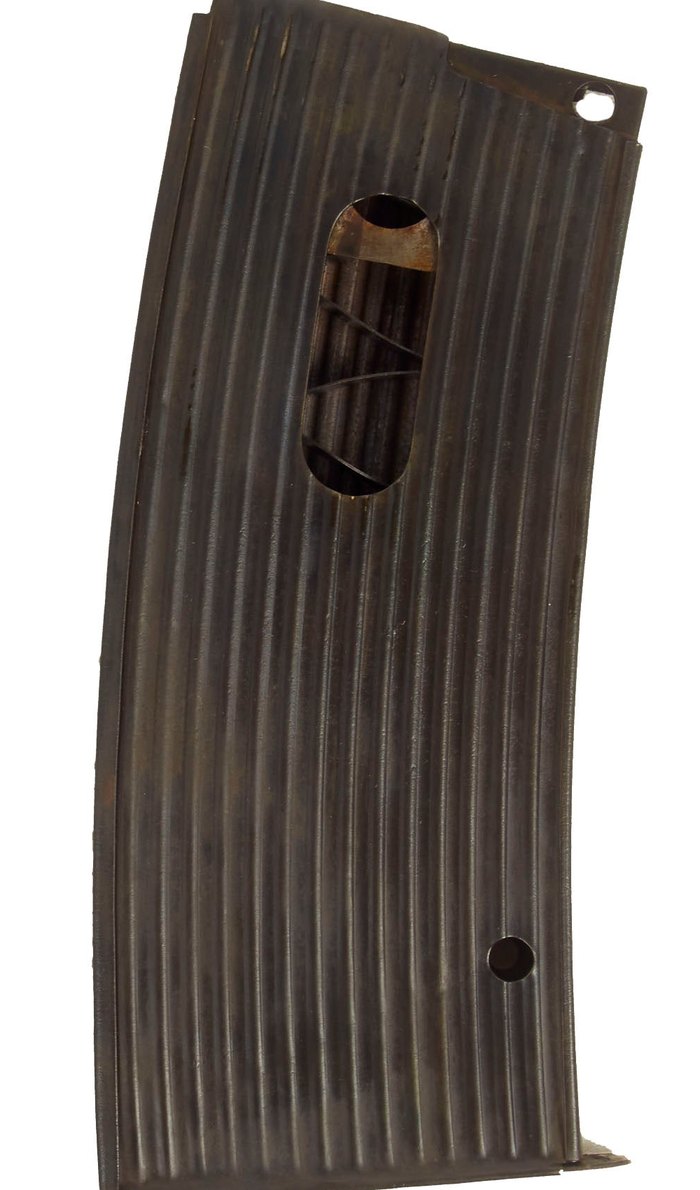
“The clip is made out of sheet steel. Its shape is that of a segment. It is composed of two side plates and two bottom plates, forming a transom. One of the side plates is full; the other is bored through, allowing a view of the internal part of the clip. Ribs secure the stiffness of the clips and the guiding of the cartridges. One of the ends is closed with a stop plate (used as a support for the spring). The nose of the plate, protruding externally from the clip, is used to fasten the clip on the receiver. The other end is open to permit the passing of the cartridges. Two ears, extending the side plates, make it impossible for the cartridges to come out from the clip unless they are forced to do so by pressure on the cartridge base. Inside of the clip there is a follower, whose part is to push the cartridges continuously toward the hole. This follower is moved by a double bow spring”.
The American translation calls the magazine a “clip”; the American notes of 1918 call it a magazine. The “double bow spring” is a flat zig-zag spring bent into a near-circle; it can be seen through the windows of an empty magazine, and laid out flat in the stripped magazine below. The 1918 notes add that “Near the rear end of the magazine is a hole through the side plates into which the bullet end of a cartridge can be put to hold back the magazine follower while the magazine is being filled”, and that “On the top of the rear end of the magazine the sides are turned over forming lips”.5
6.4 The open side
Every English-language criticism of the Chauchat mentions the windows. Tom Laemlein: “The open right side let in mud and grime”.6 Ian McCollum calls the gun “a decent gun crippled by terrible magazines”.7 The windows were deliberate: the French instruction gives their purpose as “allowing a view of the internal part of the clip”, so the gunner can see how many rounds are left and whether the cartridges sit straight.4 On the gun the open side faces right, toward the carriers who reloaded magazines in action (Volume 4 shows a gun from that side).
What the windows cost is stated by the manuals themselves, not just by critics. Both list a dirty or bent magazine as the cause of the gun’s feed stoppages. The French instruction ends its section on incidents: “The last two incidents being caused by the clips, the gunner’s attention must be brought to the imperative necessity of keeping the clips in a perfect state of preservation and order.”4 The 1918 notes: “The magazine is one of the most delicate parts of the gun and great care should be exercised by both the carrier and gunner to see that the magazine is not mistreated.”5 Laemlein says canvas magazine covers were issued but the design was never corrected during the war.6
6.5 Twenty, or eighteen
The magazine holds twenty. The French Army did not ask for twenty. The 1916 instruction, on loading:4
“The clip is filled up when it contains twenty cartridges. (Usually eighteen gives the best result.)”
and immediately after: “It will be found advantageous not to keep the clips filled up without necessity, so as not to strain the spring.”4
This is the most important single fact about the magazine, and it is not a veteran’s complaint or a modern reassessment. It is the manufacturer’s own instruction of February 1916, telling gunners to under-load by two. Later sources say the same in other numbers: the Finnish Army listed the capacity as 18 because that was the normal maximum loaded; Ian McCollum says “effective combat units often only loaded them with 16 rounds”, without a source; and Armes Françaises photographs one with seventeen.879 The practical capacity of the Chauchat was eighteen at best.
6.6 The spring test
The French instruction gives a field test for the spring, repeated almost word for word in the American notes of 1918:45
“To be good, the spring must, when it is taken out of the clip, have the shape of an incompletely closed crown. The interruption between the two ends of the spring must not exceed four fingers. In case of greater spacing, increase the spring’s strength by opening with the hand the angles having the vertex on the internal circumference of the crown. If, in spite of this operation, the spring remains weak, it must be replaced.”
A spring that has taken a set opens up; the test measures how far. Volume 8 covers the rest of the magazine care.
6.7 Fitting and removing it
From the French instruction:4
- Fitting: cock the gun first. Hold the magazine curved downward, follower to the rear; put the stop plate, nose up, between the bipod transom and the shuttle transom; then push the rear up until the catch engages.
- Removing: pull the operating handle fully back so the bolt is held, press the magazine-catch handle forward, and take the magazine in the hand. “The clip would, without this precaution, fall down by itself under the action of the clip support spring.”
The catch handle has a lug on each side, which Armes Françaises reads as making it usable by either hand.9
6.8 Weight
The 1918 American notes give two different weights for the magazine, on two pages of the same pamphlet:5
Table 1 — Weight
| Page | Full | Empty |
|---|---|---|
| p. 6, “Parts of magazine” | 852 g, “or 1 lb. 14 oz.” | 360 g |
| p. 13, “Magazine” | 1 lb 15 oz | 12 oz |
The two differ by about 30 g full and 20 g empty. Both are given as printed.
6.9 The ammunition: Balle D, “modified priming”, and Balle N
The French manuals specify one cartridge: the “Cartouche modèle 1886 D (am)” in Muller, the “French regulation cartridge 86 D. (with modified priming)” in the American translation.34 The D is the solid pointed Balle D of 1898; the “(am)” is translated as “modified priming”. Why the gun needed a modified primer is not stated. The 1918 American notes describe the failure it would guard against, a premature discharge “if the primer is not securely seated in the cartridge, that is, the primer is protruding beyond the level of the base of the cartridge”, which “causes breakages on the head of the extractor, or will explode the breech casing”.5 In an open-bolt gun whose bolt slams a cartridge forward from the magazine, a proud primer is an obvious hazard; the connection between that and the “(am)” cartridge is this dive’s reading, not a statement in either manual.
The period figures for the cartridge and for its performance in this gun:
Table 2 — The period figures for the cartridge and for its performance in this gun
| Item | Figure | Source |
|---|---|---|
| Bullet | 195 grains, “90% brass, 10% zinc”, 1.54 in long | US notes, 19185 |
| Bullet | 12.8 g, pointed, brass; charge 3 g of BN3F powder | Armes Françaises9 |
| Whole cartridge | 434 grains | US notes, 19185 |
| Chamber pressure | 34,800 lb per sq in | US notes, 19185 |
| Muzzle velocity | 2,375 ft/s (724 m/s) | US notes, 19185 |
| Muzzle velocity, Chauchat with Balle D | ”637 mètres par seconde environ” | Muller, 19333 |
| Muzzle velocity | 630 m/s | Armes Françaises9 |
| Rifling | 4 grooves, right hand, 240 mm twist | Armes Françaises9 |
The American velocity is about 90 m/s higher than the French figures for this gun. The 1918 pamphlet may have copied a figure for the cartridge from a longer rifle barrel, since the Chauchat’s barrel is about 45 cm; that is an inference, and the pamphlet does not say what barrel its figure belongs to.
Muller also lists a drill cartridge “à balle fraisée” and the Mle 1905 blank.3
The 8 mm cartridge was later loaded with a different bullet, the Balle N. When France gave Finland its Chauchats in 1940 it sent ammunition of the type the Finns recorded as m/1932N, and the Finnish record says the guns “reportedly did not work reliably” with it.8 English reference works add that the Chauchat was never regulated for Balle N and should use only Balle D; no French document saying so was found. The Finnish experience is the only specific evidence found.
6.10 Box magazines: the M1918 and the national variants
Every army that kept the Chauchat after the war replaced the half-moon magazine, usually with a new cartridge:
Table 3 — Every army that kept the Chauchat after the war replaced the half-moon magazine, usually with a new cartridge
| Variant | Cartridge | Magazine | Source |
|---|---|---|---|
| French Mle 1915 | 8×50R Lebel | 20-round half-moon, one side open; 18 recommended | French instruction 19164 |
| US Model 1918 | .30-06 | 16-round box | Chinn 1951; IMA listing110 |
| Belgian 1915/27 | 7.65×53 | Enclosed box, developed with Gladiator | McCollum 2019; Historical Firearms1112 |
| Yugoslav M.15/26 | 7.9×57 M88, shortened 2 mm | 12-round curved | Bogdanović 201813 |
| Polish wz. 15/27 | 7.92×57 | Not verified | (Volume 4) |
All of these are rimless cartridges, and all of the replacement magazines are near-straight boxes. The American box for the .30-06 has a window in one side, like the French magazine.
6.11 What could not be established
- What “(am)”, “modified priming”, consisted of, and when it was introduced.
- The magazine’s exact dimensions and the material thickness; no drawing was found.
- Whether the French Army ever issued an enclosed 8 mm magazine. English reference works say dirt-proof magazines were tested in May–June 1918, too late for service; not verified.
- Why the Finnish guns worked badly with Balle N, and whether any French document restricts the gun to Balle D.
References
Footnotes
-
George M. Chinn, The Machine Gun, Vol. I (Bureau of Ordnance, 1951), pp. 239, 242. https://archive.org/details/TheMachineGunVolume1ByGeorgeMChinn, accessed 2026-10-19. ↩ ↩2
-
Henri Vuillemin, “Centenaire du Chauchat”, La Gazette des Armes no. 475, May 2015, p. 14, via Wayback copy of https://web.archive.org/web/20211128153540/http://fr.1001mags.com/parution/gazette-des-armes/numero-475-mai-2015/page-14-15-texte-integral, accessed 2026-10-19. ↩
-
Cdt G.-H. Muller, Exposé schématique du fonctionnement des armes de petit calibre (Berger-Levrault, 1933), pp. 47, 60. https://archive.org/details/expose-schematique-du-fonctionnment-des-armes-de-petit-calibre-by-tanant-1933, accessed 2026-10-19. ↩ ↩2 ↩3 ↩4
-
Provisional Instruction on the Automatic Rifle, Model 1915 (Chauchat), War Department Document No. 732 (Army War College, January 1918), ch. I, ch. II § IV, ch. IV § II, Part II. https://archive.org/details/provisionalinst00deptgoog, accessed 2026-10-19. ↩ ↩2 ↩3 ↩4 ↩5 ↩6 ↩7 ↩8 ↩9
-
School of Automatic Arms, 40th Division, Camp Kearny, Notes on Mechanism of the Chauchat Machine Rifle, Model 1915, February 1918, pp. 6, 9, 13, 19–22, 24. https://archive.org/details/chauchatautomaticriflemodel1915notesonmechanism, accessed 2026-10-19. ↩ ↩2 ↩3 ↩4 ↩5 ↩6 ↩7 ↩8 ↩9
-
Tom Laemlein, “That ‘Damned, Jammed Chauchat’”, American Rifleman, 17 September 2012, https://www.americanrifleman.org/articles/2012/9/17/that-damned-jammed-chauchat/, accessed 2026-10-19. ↩ ↩2
-
Ian McCollum, “The Worst Gun Ever”, Forgotten Weapons, 3 July 2012, https://www.forgottenweapons.com/the-worst-gun-ever/, accessed 2026-10-19. ↩ ↩2
-
Jaeger Platoon: Finnish Army 1918–1945, “8 mm LMG M/15 Chauchat”, http://www.jaegerplatoon.net/LMG2.htm#800PK15, accessed 2026-10-19. ↩ ↩2
-
“Le fusil-mitrailleur de 8 mm CSRG modèle 1915”, Armes Françaises, http://armesfrancaises.free.fr/FM%20Chauchat.html, accessed 2026-10-19. ↩ ↩2 ↩3 ↩4 ↩5
-
International Military Antiques, listing for a Model 1918 .30-06 display gun, https://ima-usa.com/products/original-u-s-wwi-french-automatic-rifle-model-1915-c-s-r-g-a-30-06-chauchat-display-lmg-with-magazine-serial-3812, accessed 2026-10-19. ↩
-
Ian McCollum, “Belgian Model 1915/27 Improved Chauchat”, Forgotten Weapons, 9 December 2019, https://www.forgottenweapons.com/belgian-model-1915-27-improved-chauchat/, accessed 2026-10-19. ↩
-
“The Belgian Chauchat”, Historical Firearms, https://www.historicalfirearms.info/post/166619060194/the-belgian-chauchat-throughout-the-first-world, accessed 2026-10-19. ↩
-
Branko Bogdanović, “Prvi puškomitraljez u naoružanju srpske vojske – CSRG M1915 ‘Šoša’”, Oružje Online, 29 August 2018, https://oruzjeonline.com/2018/08/29/prvi-puskomitraljez-u-naoruzanju-srpske-vojske-csrg-m1915-sosa/, accessed 2026-10-19. ↩
Comments (0)