Chauchat · Volume 2
Gladiator: Making a Quarter of a Million, and Fighting With Them
A bicycle factory at Le Pré-Saint-Gervais, barrels from the state arsenals, tube and stamped steel instead of machined forgings, a second maker at Saint-Chamond, three-man teams that fired from the hip while walking, and a gun that stayed in the French manuals until the 1930s
2.1 Why a bicycle firm
The 1915 contract for the Fusil-mitrailleur went to the Société des Cycles Gladiator, a Paris maker of bicycles, motorcycles and cars run by Paul Ribeyrolles, rather than to one of the state arms factories at Saint-Étienne, Châtellerault or Tulle.1 Henri Vuillemin, writing for the gun’s centenary in 2015, explains the choice by the method rather than the firm: the gun was to be made with techniques “jusque là totalement inédites dans le domaine de l’armement” (until then entirely new to arms-making), and he lists them: “utilisation maximum du tube, estampage, emboutissage, rivetage, soudure” (maximum use of tube, stamping, pressing, riveting, welding).1 The undated French reference site Armes Françaises makes the same argument: stamping and riveting were little known to arms-makers in 1915 but routine to “les fabricants de vélocipèdes”.2
Vuillemin calls Gladiator’s works the “usine mère du Pré St-Gervais”, the parent factory at Le Pré-Saint-Gervais on the north-eastern edge of Paris.1 He also notes that the workforce on the Chauchat lines was “essentiellement féminine”.1
2.2 Barrels from the arsenals
The barrel was the one part Gladiator did not make. On Vuillemin’s account the contract required the state factories at Saint-Étienne and Châtellerault to deliver a first lot of 103,000 finished barrels, reckoned at “deux canons par F.M et 3% de perte” (two barrels per gun and 3 % loss).1 To save steel and machine time, he writes, the barrels were to come preferably from machining rejects of the 07/15 rifle or from Lebel rifles brought back from the front with bulged muzzles; “il en existait 145.000 de ce genre”, stored at the Ateliers de Construction de Rennes. The barrel was cut to the length of the 1892 carbine’s.1
That last point explains why the period sources do not agree on the barrel length:
Table 1 — That last point explains why the period sources do not agree on the barrel length
| Source | Barrel length |
|---|---|
| Provisional Instruction (US translation of the French edition of February 1916)3 | “42 centimeters long” |
| Notes on Mechanism, 40th Division, Camp Kearny, February 19184 | 17¼ inches (438 mm) |
| Muller, Exposé schématique, 1933 (French Army teaching text)5 | 45 cm |
| Armes Françaises (undated)2 | 450 mm |
All four are copied here as printed. The 42 cm of the American translation may be a translation or printing slip; the scan was checked and the figure is printed as 42. No source states whether the length was measured from the breech face or the end of the chamber, which could account for a few millimetres but not for 3 cm.
2.3 How the rest was made
Everything except the barrel was either made at Gladiator or bought from subcontractors and assembled at Gladiator on a line.12 The receiver, or carcasse, is two stamped steel side plates joined by cross-pieces (“transoms” in the American translation) and screwed to the wooden butt.3 The barrel jacket is two sheet-steel tubes joined by a collar, perforated with eighteen holes at the front to let air reach the barrel’s aluminium radiator.3 The pistol grip is two plates of wood screwed to a sheet-metal frame.
Vuillemin’s verdict on what this did to quality is blunt: “Les contrôles n’ont plus la rigueur du temps de paix, l’ajustage et les tolérances mécaniques se situent à la limite de l’acceptable”. Inspection lost its peacetime rigour, and fit and tolerances were at the limit of the acceptable. He adds that “le principe fera école”: the principle set a pattern, which the Sten, the PPSh and the M3 “Grease Gun” followed a quarter-century later.1 The hub’s STEN dive tells that later story from the British side.
The American Ordnance writer George Chinn, in 1951, said worse: that the tolerances were “of such a nature that anything could be accepted”, and that “there was no interchangeability of parts”.6 No inspection record or gauge drawing was found to test either claim. Volume 9 returns to it.
2.4 How many
No production ledger was found. The figures in print are:
Table 2 — No production ledger was found. The figures in print are
| Source | Total | Notes |
|---|---|---|
| Vuillemin, 20151 | ”environ 265.000”, mainly Gladiator | SIDARME total “n’est pas connu précisément” |
| Armes Françaises2 | ”225 000 exemplaires … avant l’armistice”; elsewhere on the same page “entre 225 000 et 400 000” | No source cited |
| English Wikipedia, citing Demaison and Buffetaut, Honour Bound (1995) | 262,000 or 262,300 (Gladiator 225,700 in 8 mm and 19,000 in .30-06; SIDARME 18,600) | The book could not be read for this dive; the article’s own sub-totals add to 263,300 |
On any of these counts it was the most numerous automatic weapon of the First World War, as Vuillemin says.1 The German MG 08/15, its nearest enemy equivalent, reached about 127,000 by the Armistice on his figure.1
Vuillemin also prints that “Dès octobre 1915, la production mensuelle atteint un total de 13.500 exemplaires”.1 That cannot be squared with his own total: 13,500 a month for the 37 months from October 1915 to November 1918 would be about 500,000. It is recorded here as printed and not relied on.
2.5 SIDARME, the second maker
From 1918 a second firm made the gun: SIDARME, at Saint-Chamond in the Loire, a subsidiary of the Compagnie des Forges et Aciéries de la Marine et d’Homécourt (FAMH), the steel and artillery company.1 Guns from this maker carry “SIDARME” and FAMH’s six-pointed star with “ST CHAMOND” on the left of the trigger housing (Volume 7).7 Vuillemin reports that collectors who have compared the two think SIDARME guns better made than Gladiator’s, without saying who or on what evidence.1
2.6 Into service, 1916
On Vuillemin’s account the first gunners were trained at Maisons-Laffitte in the winter of 1915–1916, and general issue began on 1 March 1916, in time for Verdun.1 By November 1917 every unit had at least eight per infantry company and four per cavalry squadron, rising to twelve per company by the end of the war.1 Armes Françaises gives March 1916 and eight per company for the start.2
The first French instruction, the Instruction provisoire sur le fusil-mitrailleur, is dated February 1916, and Vuillemin illustrates a copy marked “confidentiel”.1 The American Expeditionary Forces had it translated in 1917; the War Department reprinted the translation in January 1918, and that text is the main primary source for this dive.3
An American pamphlet of February 1918 passes on what the French had told its authors about the gun’s first year at the front:
“The regiments which used this gun at Verdun and Somme fronts who had well trained rifle teams were enthusiastic in their praise of it. Those who had untrained men operating the guns, due to insufficient instruction, were the ones who complained of it.”4
That is a training document, written to make men take care of the gun, and it should be read as such. It is still the earliest judgement of the gun’s combat record found for this dive.
2.7 The team and its load
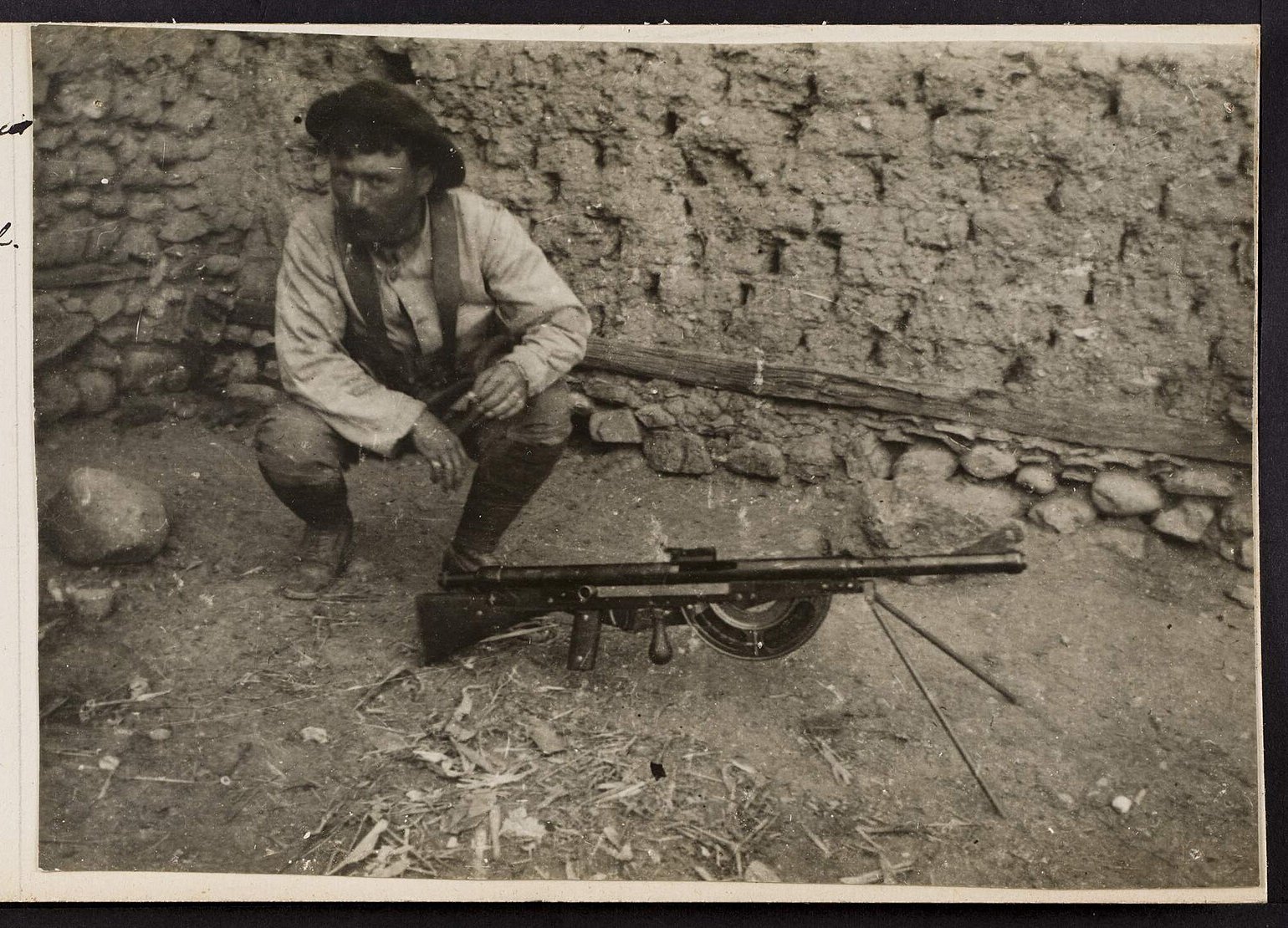
The 1916 instruction mans each gun with three men: the gunner and two carriers, all trained alike so that any one could fire it, and “in case of necessity, one carrier only can secure the service of the gun”.3 It specifies how they were chosen: “among vigorous, intelligent men, having excellent sight and sharpshooters. Never take left-handed men.”3 (The ejection port is on the right and the gun is fired with the cheek on the receiver; Volume 5.)
What each man carried, in the instruction’s own figures:3
Table 3 — The team and its load
| Man | Arms | Cartridges carried |
|---|---|---|
| Gunner | The gun in its sheath; an automatic pistol, caliber 7.65 mm, with three 9-round magazines | 160 (8 magazines: 2 pouches of 2, a bag of 4) |
| First carrier | Automatic pistol, 7.65 mm, three magazines | 480 (8 magazines and a 64-round packet in the haversack; 4 packets in a bag) |
| Second carrier | Rifle | 400 (4 packets and 4 magazines in a haversack, a fifth packet in his pouches) |
| Team | 1,040 |
The 7.65 mm automatic pistol is the Ruby, the Spanish-made pistol the French Army bought by the hundred thousand for exactly these men; the hub’s Ruby pistol dive covers it. Armes Françaises illustrates the Mle 1916 cartridge pouch made for it.2
The 40th Division’s American pamphlet of 1918 gives a different team, with a corporal added and different loads (corporal 136, gunner 160, first carrier 384, second carrier 304: “Total ammunition carried by team 848 rounds, exclusive of the ammunition carried by the corporal”4), which is the American organisation of 1918 rather than the French one of 1916. Armes Françaises gives a theoretical 984 rounds for a French group in 1918 and a scale of 36 magazines per gun.2
2.8 Marching fire
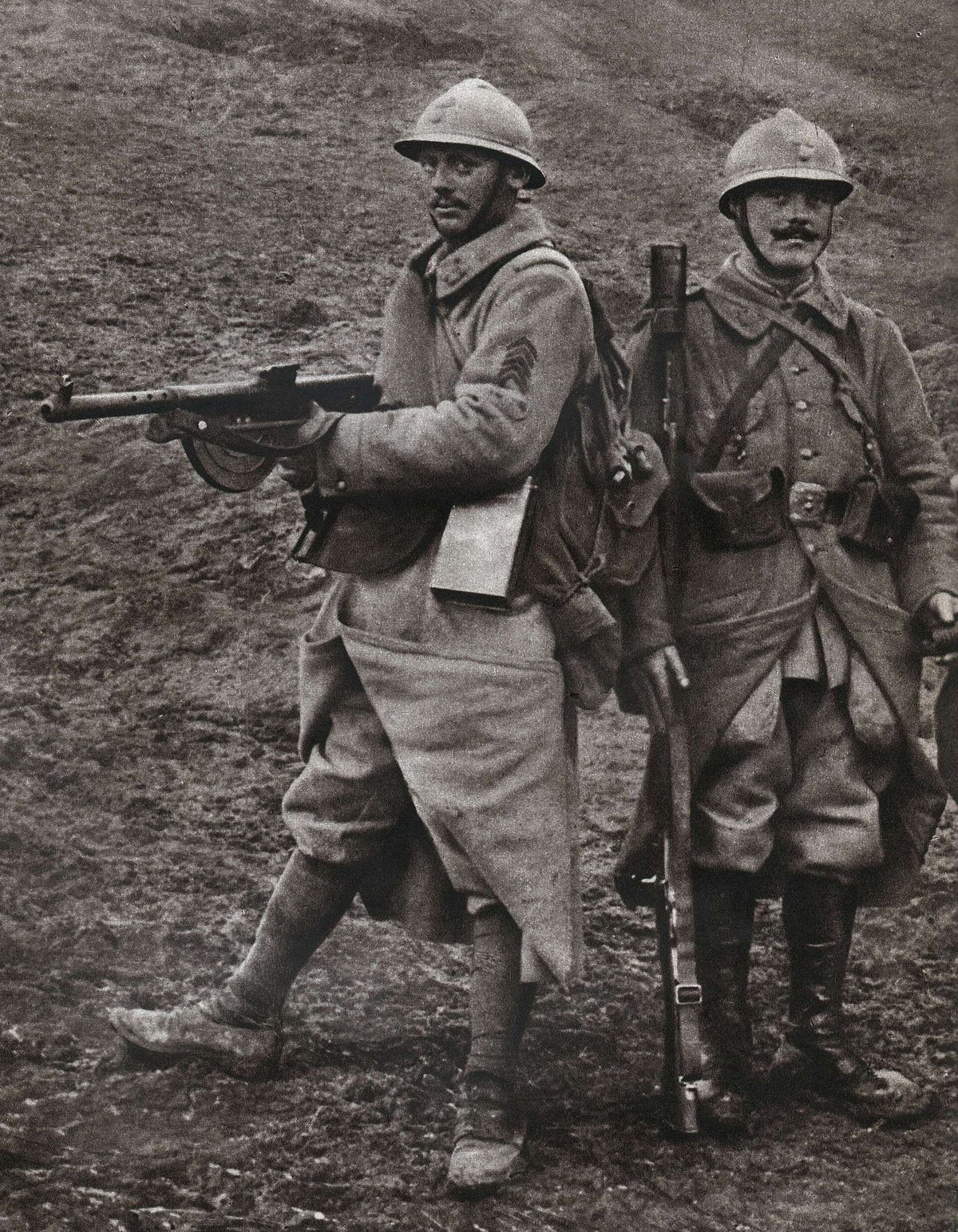
The Chauchat’s design brief was to go forward with the assault, and the 1916 instruction describes firing it on the move:3
“It is generally executed, round by round, and in critical moments by short rafales, exceptionally by long rafales. It is of great use during the advance of a wave … A well trained valorous gunner, can, by marching on the parapet parallel to the trench or the communication trench, help considerably in the cleaning up”.
The gun was carried horizontal on the sling, the right elbow pressing the butt, right hand on the pistol grip and left hand on the front grip. A metal triangle of 7 mm wire, 55 mm a side inside, slid on the sling and hooked to the shoulder-strap so the gun hung at the right height.3 Armes Françaises dates the triangle to March 1917.2 In single shots the gunner was to fire “when the foot strikes the ground”; “the rate of fire is accelerated by increasing in rate of the march”.3
The American pamphlet adds a mechanical reason to hold on hard. “If the gun is not held tightly the whole gun will move back and the barrel will not recoil far enough to engage the feed piece in the sear.”4 A long-recoil gun needs a firm mount to cycle; held loosely at the hip, it can fail to cock (Volume 8).
2.9 Rate of fire and range: what the French Army expected
The French Army’s own figures, from Muller’s 1933 teaching text, are modest:5
Table 4 — Rate of fire and range: what the French Army expected
| Item | Muller 1933 |
|---|---|
| Practical rate of fire | 120 rounds per minute |
| Cyclic rate | 240 |
| Weight | ”(8,865 kg) — 9 kg environ” |
| Muzzle velocity, balle D | ”637 mètres par seconde environ” |
| Employment | ”petites distances : 0 à 400 m, exceptionnellement moyennes distances 400 à 1200 m” |
| Sights | Notch graduated 200 to 2,000 m |
| Normal fire | ”Tir automatique par petites rafales”; single shots “exceptionnellement” |
Vuillemin gives a practical rate “entre 250 et 300 coups/minute”, twice Muller’s.1 The two are set side by side; Muller’s is the French Army’s teaching figure. A cyclic rate of 240 is slow even for its day, a direct result of long recoil: the whole barrel has to travel back and return before each shot.
2.10 Changes during and after the war
Table 5 — Changes during and after the war
| Change | Date | Source |
|---|---|---|
| Triangle for firing on the march | March 1917 | Armes Françaises2 |
| Flash hider at the muzzle | ”à compter de septembre 1917” | Vuillemin1 |
| Flash hider and anti-aircraft sighting device | 1918 | Armes Françaises2 |
| Covers for the magazine well, barrel jacket and ejection port | 1920 | Armes Françaises2 |
The flash hider’s date is given two ways; Vuillemin also illustrates a manual of September 1917 that shows it. Muller’s 1933 text lists the metal covers as standard (“Obturateur du tube-enveloppe; Obturateur du logement du chargeur; Couvre-fenêtre d’éjection”) along with a canvas sheath, and it gives an anti-aircraft sighting method using an eccentric bead fitted to the front sight.5 Volume 7 shows how these changes date a gun.
2.11 After 1918
The Chauchat was replaced in the French Army by the gas-operated Fusil-mitrailleur modèle 1924, later 24/29.62 It was not dropped at once: Muller’s French Army teaching text still describes it in full, with eight plates, in 1933, alongside the 24/29.5 Armes Françaises says some were brought out again in 1939 and that the Germans, who took over many French weapons in 1940, mostly left Chauchats in the depots.2 Martin Morgan gives the German designation for captured French guns as LeMG 156(f).8 Large numbers went abroad, to Belgium, Poland, Greece, Finland and others (Volume 4).
2.12 What could not be established
- A production ledger, by year and by maker; SIDARME’s total.
- The 13,500-a-month figure for October 1915.
- Whether the barrels really came from rejected and bulged Lebel barrels, and in what proportion. It is plausible, and the 1892 carbine barrel length fits, but no contract text was found.
- The barrel length: 42, 43.8 or 45 cm.
- The regiment-by-regiment survey of stoppages that English-language sources attribute to General Pétain in late 1916. It is cited only through Honour Bound, which could not be read.
References
Footnotes
-
Henri Vuillemin (text) and Marc de Fromont (photographs), “Centenaire du Chauchat”, La Gazette des Armes no. 475, May 2015, pp. 12–21; read from fr.1001mags.com “texte intégral” pages via Internet Archive Wayback Machine copies, e.g. https://web.archive.org/web/20211128153540/http://fr.1001mags.com/parution/gazette-des-armes/numero-475-mai-2015/page-14-15-texte-integral, accessed 2026-10-19. ↩ ↩2 ↩3 ↩4 ↩5 ↩6 ↩7 ↩8 ↩9 ↩10 ↩11 ↩12 ↩13 ↩14 ↩15 ↩16 ↩17 ↩18 ↩19
-
“Le fusil-mitrailleur de 8 mm CSRG modèle 1915”, Armes Françaises, undated, http://armesfrancaises.free.fr/FM%20Chauchat.html, accessed 2026-10-19. ↩ ↩2 ↩3 ↩4 ↩5 ↩6 ↩7 ↩8 ↩9 ↩10 ↩11 ↩12 ↩13
-
Provisional Instruction on the Automatic Rifle, Model 1915 (Chauchat), translated from the French edition of February 1916, revised to 9 June 1917 at HQ AEF; reprinted by the Army War College, January 1918 (War Department Document No. 732), ch. I, Part IV and Part V. https://archive.org/details/provisionalinst00deptgoog, accessed 2026-10-19. ↩ ↩2 ↩3 ↩4 ↩5 ↩6 ↩7 ↩8 ↩9 ↩10
-
School of Automatic Arms, 40th Division, Camp Kearny, Notes on Mechanism of the Chauchat Machine Rifle, Model 1915, February 1918, pp. 1–3, 10, 18. https://archive.org/details/chauchatautomaticriflemodel1915notesonmechanism, accessed 2026-10-19. ↩ ↩2 ↩3 ↩4
-
Cdt G.-H. Muller, Exposé schématique du fonctionnement des armes de petit calibre, preface by Gén. Tanant (Berger-Levrault, 1933), ch. II, pp. 47–49, and annex p. 115. https://archive.org/details/expose-schematique-du-fonctionnment-des-armes-de-petit-calibre-by-tanant-1933, accessed 2026-10-19. ↩ ↩2 ↩3 ↩4
-
George M. Chinn, The Machine Gun, Vol. I (Bureau of Ordnance, 1951), pp. 240–241 and ch. 18. https://archive.org/details/TheMachineGunVolume1ByGeorgeMChinn, accessed 2026-10-19. ↩ ↩2
-
International Military Antiques, listing “Original French WWI Fusil Mitrailleur Modèle 1915 CSRG Chauchat Display LMG with Magazine”, https://www.ima-usa.com/products/original-french-wwi-fusil-mitrailleur-modele-1915-csrg-chauchat-display-lmg-with-magazine-serial-no-23468, accessed 2026-10-19. ↩
-
Martin K. A. Morgan, “The Chauchat Light Machine Gun: Not Really One of the Worst Guns Ever”, American Rifleman, 6 February 2017, https://www.americanrifleman.org/articles/2017/2/6/the-chauchat-light-machine-gun-not-really-one-of-the-worst-guns-ever/, accessed 2026-10-19. ↩
Comments (0)