Chauchat · Volume 3
The Americans: The AEF's Chauchat and the Model 1918 in .30-06
An army that arrived in France without a light automatic weapon, French guns issued to training camps from Michigan to California, the twenty-odd divisions that fought with the 8 mm gun, the 25,000-gun .30-06 order that went wrong, three disagreeing explanations of why, and the Brownings that Pershing held back
3.1 An army without an automatic rifle
When the United States declared war in April 1917 its Army had no light automatic weapon in quantity. Benedict Crowell, the Assistant Secretary of War who ran munitions, wrote in 1919 that the first division sent to France “necessarily” went armed with “the machine guns at hand, which in this case proved to be the Benét-Mercié machine rifles”, and that the French Army’s standard guns were by then “the Hotchkiss heavy machine gun and the Chauchat light automatic rifle, both effective weapons”.1
An Army board tested machine guns in May 1917. Its report, quoted by the wartime Chief of Ordnance, Major General William Crozier, recommended the new Browning automatic rifle and noted that, according to observers, “the drift of the French Army is decidedly towards greater use of automatic rifles of highly portable type, such as the Chauchat. In the British Army the Lewis gun is used in much the same way, but, on account of its weight and size, not with equal facility.”2 The Browning was right, but it would not be made in numbers for a year.
3.2 The decision of August 1917
Crozier prints the cable from Paris that settled the question for the first divisions, dated 5 August 1917:2
“With reference to paragraph 4 your 67, and in connection with paragraph 1 my 61, arrangements completed to equip first two divisions with Hotchkiss machine guns and Chauchat automatic rifles. Subsequent divisions should be equipped in same manner until Vickers machine guns and a successful automatic rifle is furnished by Ordnance Department. … Lewis machine gun more suitable as automatic rifle, but recommended as armament for aeroplanes”.
The same cable put the American-made Lewis guns into aircraft. The Chauchat was, from the start, the stopgap until an American automatic rifle arrived.
3.3 Training at home
French guns reached the training camps before the troops were ready for them. Crowell: within two months of the first draftees arriving, each National Army camp had 50 Colt guns, then “20 Lewis guns of the ground type, and 30 Chauchat automatic rifles which we bought from the French”; in the autumn of 1917 each National Guard camp got “30 Colt machine guns, 30 Chauchat automatic rifles, and some 50 to 70 Lewis ground guns”.1 A camp report Crozier reproduces says the “Automatic rifles (Lewis and Chauchat) were received before troops were ready to use them.”2
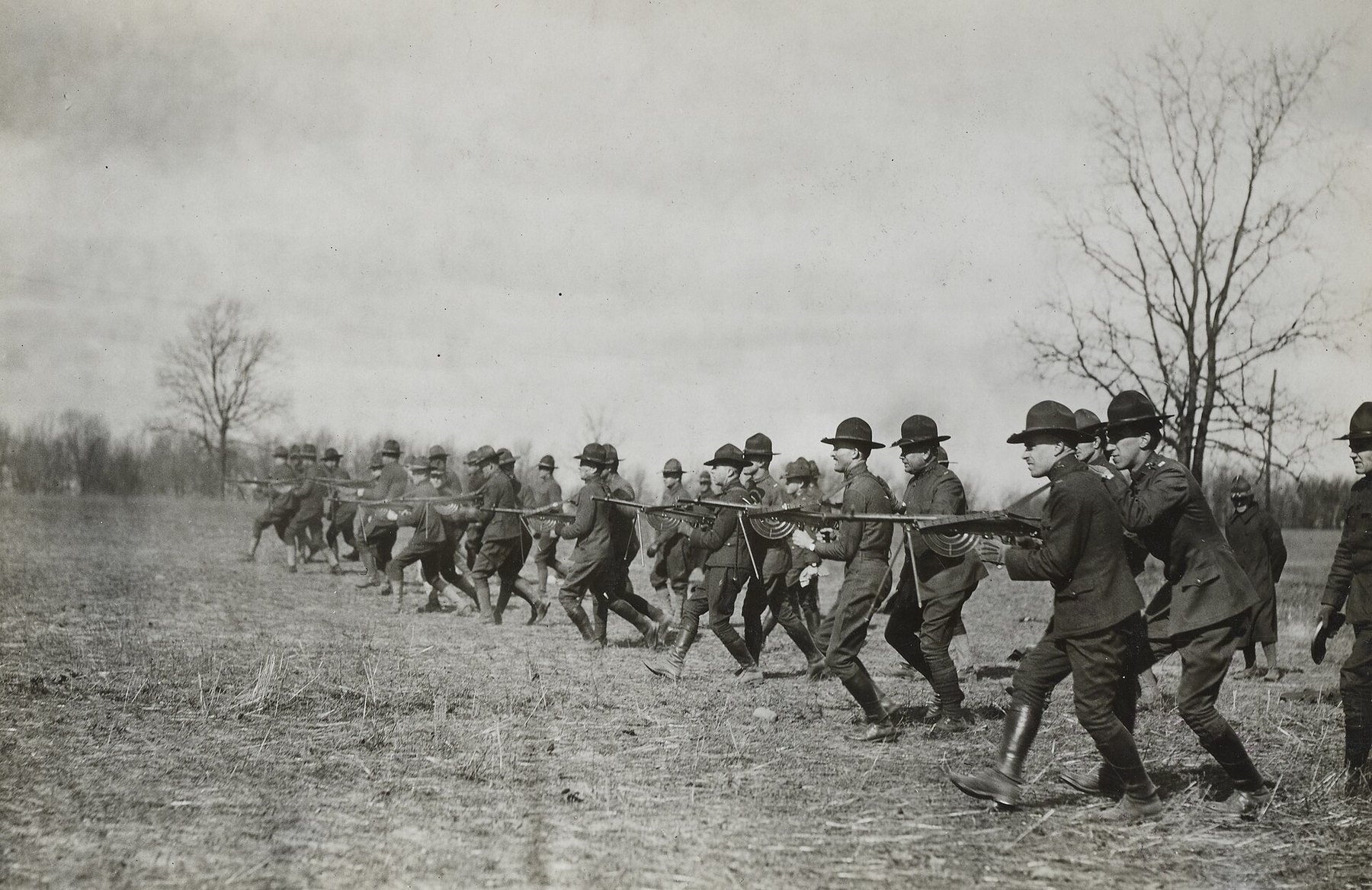
Camp Custer, at Battle Creek, Michigan, was one of those camps; the photograph above, from the National Archives series on infantry drill, shows its men practising the French marching fire. The War Department reprinted the AEF’s translation of the French Instruction provisoire in January 1918 as Document No. 732.3 Divisions wrote their own notes as well: the 40th Division’s School of Automatic Arms at Camp Kearny, California, printed a 26-page Notes on Mechanism of the Chauchat Machine Rifle, Model 1915 in February 1918, which this dive uses throughout.4
3.4 Which divisions had it
Three War Department sources describe the sequence, and their dates do not quite agree:
Table 1 — Three War Department sources describe the sequence, and their dates do not quite agree
| Source | What it says |
|---|---|
| Crozier, 19202 | French supplied Hotchkiss and Chauchat “as long as they were needed, which was until the end of April, 1918. The divisions which went over in May and June of that year were all armed with Chauchat automatic rifles, but they had American-made Vickers machine guns. The divisions which went over after June were all armed with Browning machine guns and Browning automatic rifles”. |
| Crowell, 19191 | ”By May, 1918, the first 12 divisions of American troops had reached France. They were all equipped with Hotchkiss heavy machine guns and Chauchat automatic rifles … During May and June, 11 American divisions sailed … For their light machine guns these 11 divisions received the French Chauchat rifles in France. After June, 1918, all American troops to sail were supplied with a full equipment of Browning guns”. |
| Ayres, 19195 | ”The earliest needs of our troops in France were met by French Hotchkiss machine guns and Chauchat automatic rifles. A little later, divisions going over were provided with Vickers heavy guns and Chauchat automatic rifles. After July 1, divisions embarking were equipped with light and heavy Brownings.” |
On Crowell’s count, 23 divisions went into the line with Chauchats. Tom Laemlein, writing in American Rifleman in 2012, quotes a record of the AEF’s Automatic Arms Section dated 8 September 1918, “At the present time 18 U.S. divisions have been equipped with the Chauchat”, which “has proved to be not at all satisfactory”.6 He also gives 27 divisions overall and nine with the .30-caliber gun, without reconciling the figures; that record was not seen for this dive.
3.5 How many the Army got
No two sources give the same total:
Table 2 — No two sources give the same total
| Source | Figure | What it counts |
|---|---|---|
| Crowell, America’s Munitions, 19191 | 29,000 | ”We had bought 29,000 Chauchats from the French”, to 11 November 1918 |
| Ayres, The War with Germany, 19195 | 34,000 | ”secured from the French” |
| Chinn, The Machine Gun, 19517 | 37,864 | ”From 31 December 1917 to 3 April 1918 … purchased in 8-mm or altered to caliber .30” |
| Laemlein, 20126 | about 16,000 in 8 mm and about 19,000 in .30 | Delivered by Gladiator, August 1917 to November 1918 |
| Vuillemin, 20158 | 18,000 in .30-06 | ”établis dans ce calibre” |
Crowell and Ayres were both official War Department reports of 1919, and they are 5,000 apart. Chinn’s total falls in a three-month window that would have ended before most of the deliveries others describe. The figures are given as printed.
3.6 The Model 1918 in .30-06
Two American cartridges in one division was a supply problem, and the Ordnance Department set out to remove it. Chinn: “On 17 August 1917, 5 months after we were in the war, an order was placed with the French commission to alter 25,000 weapons in such a manner. The revised gun was to be known as the caliber .30 Model 1918, with the reworking to be carried out by the original producers of the basic mechanism.”7 Laemlein quotes a letter from the French High Commissioner of 5 December 1917 referring to “the factory manufacturing the 25,000 Chauchat rifles for the American Army”.6
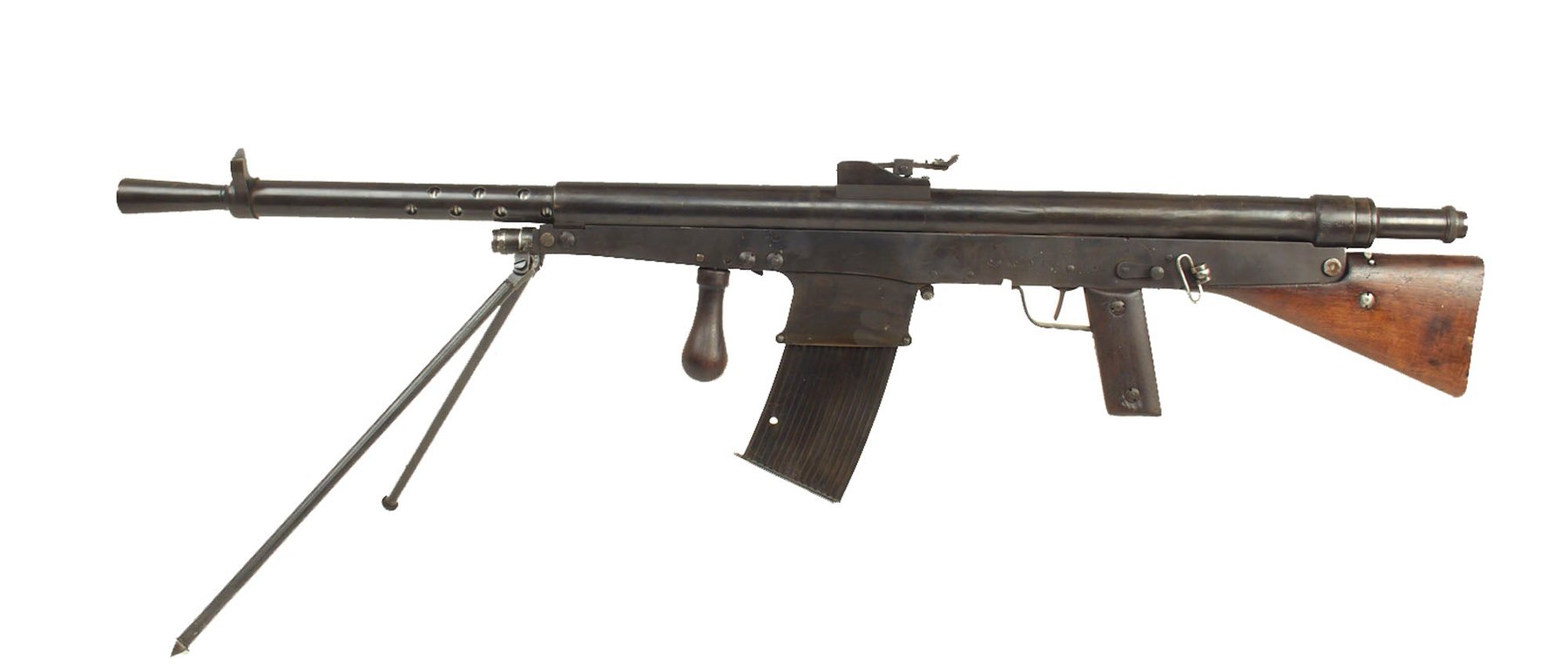
The Model 1918 kept the mechanism and changed the feed. Where the French gun took a 20-round half-moon magazine of 8 mm Lebel, the American gun took a shallow-curved box of .30-06: Chinn says “The magazine was cut from 20- to 16-cartridge capacity”, and a dealer’s description of a surviving gun also gives 16.79 Morgan adds that the conversion “required a different magazine, a modified magazine well, and a relocated foregrip”.10 The wooden front grip moved ahead of the magazine, as the photograph below shows. Volume 7 sets the two models side by side.
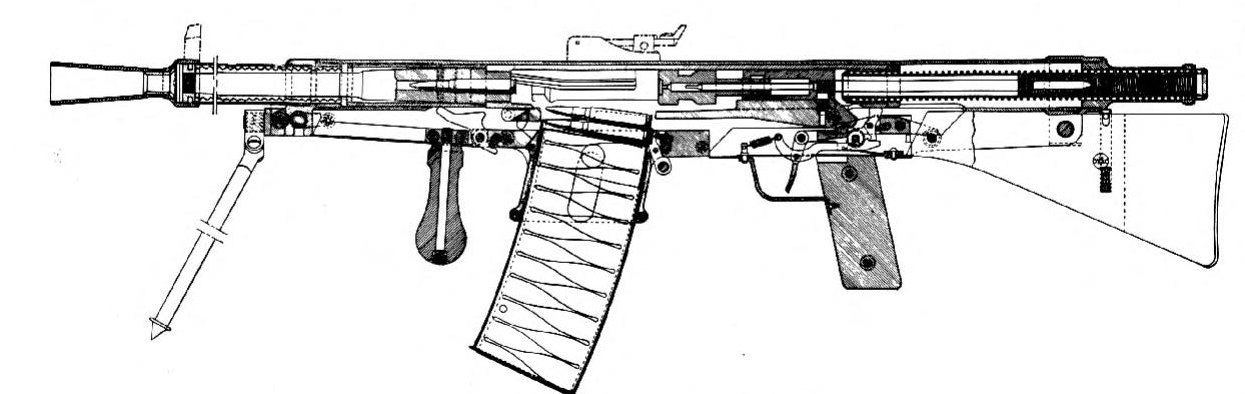
Chinn printed a sectional drawing of the Model 1918, the only one found for this dive:
The result was worse than the original. Chinn: “The modified gun did not even approach expectations, being more unreliable than the original. The most prevalent malfunctions were parts breakage, feed jams, and cartridges sticking in the chamber as soon as the barrel became slightly hot.” The contract left “All modification and inspection … in their hands”, so the Americans could not get changes made.7 Laemlein and Vuillemin both say American inspectors rejected about 40 % of the .30-caliber guns.68
3.7 Why the Model 1918 failed: three explanations
Everyone agrees the .30-06 gun stuck cases. Nobody quotes the same reason, and none of the writers cites a test report or a drawing:
Table 3 — Everyone agrees the .30-06 gun stuck cases. Nobody quotes the same reason, and none of the writers cites a test report or a drawing
| Source | Explanation |
|---|---|
| Chinn, 19517 | Cartridges stuck “as soon as the barrel became slightly hot”; also parts breakage and feed jams. No mechanical cause given. |
| Laemlein, 20126 | ”Crippling extraction problems were caused by incorrect chamber measurements.” |
| Morgan, 201710 | ”the chambers in the .30-cal. Chauchat Model 1918 were not reamed deeply enough”. |
| McCollum, Forgotten Weapons, 201211 | Chambers “cut slightly too short, which meant that the neck of the cartridge case was jammed too tightly into the end of the chamber”; the extractor then tore off the rim; and the barrels “did not have extractor cuts in the barrel face”. |
The last three point the same way, a chamber cut short at the neck or shoulder, but they are three phrasings of a claim none of them sources. It is consistent with Chinn’s symptom: a case already tight in a short chamber grows tighter as the barrel heats. The French 1916 instruction lists the same failure on the 8 mm gun (“Difficult extraction … chamber’s too large diameter”), and the American 1918 pamphlet warns that a stuck case makes the extractor “tear off the rim” (Volume 8), so the 8 mm gun was not immune either.34 The Ordnance Department’s own report on the Model 1918 was not found. McCollum adds that the guns “rarely made it into combat, being exchanged for French 8mm guns before units went up to the lines”.11 That is consistent with Laemlein’s nine divisions with the .30 gun only if those divisions handed them in before going into the line; no source settles it.
3.8 Why the Brownings came so late
The American divisions of September and October 1918 fought with French Chauchats although light Brownings were in France. Ayres, the War Department’s statistician, says this was deliberate:5
“Although the light and the heavy Browning guns were brought into production in February and April of 1918, they were not used in battle until September. This was not because of any shortage of supply in the later summer months but because of a deliberate and most significant judgment on the part of Gen. Pershing. … What he feared was that if the first of the guns to reach the expeditionary forces were used in battle there would always be some chance that one might be captured by the Germans.”
Crowell gives a different reason for the same fact: the Brownings arrived while “the fighting against the retreating German Army was at its height, and there was no time for the troops on the line to exchange their British-built and French-built machine guns for Brownings, nor to replace their Chauchat automatic rifles with light Brownings, of which there was also an ample supply in France”.1 Laemlein dates the first recorded combat use of the BAR to the 79th Division on 22 September 1918.6
3.9 Three Medals of Honor
Three American soldiers who won the Medal of Honor in the autumn of 1918 are often described as Chauchat gunners: Laemlein, citing Laurence Stallings’s The Doughboys (1963), and Morgan both name them.610 Their official citations, as published by the Army’s Center of Military History, read:12
- Private Frank J. Bart, Company C, 9th Infantry, 2nd Division, near Médéah Ferme, 3 October 1918: “being on duty as a company runner, when the advance was held up by machinegun fire voluntarily picked up an automatic rifle, ran out ahead of the line, and silenced a hostile machinegun nest, killing the German gunners”, and then did it again.
- Private Thomas C. Neibaur, 42nd Division, near Landres-et-St. Georges, 16 October 1918: “sent out on patrol with his automatic rifle squad to enfilade enemy machinegun nests”, wounded in both legs, “kept his automatic rifle in operation”, then killed four attackers and took eleven prisoners with his pistol. The Center’s page prints his regiment as the 107th Infantry, which belonged to the 27th Division; the 42nd Division’s regiments were the 165th to 168th, and Morgan gives the 167th.
- Private Nels Wold, Company I, 138th Infantry, 35th Division, near Cheppy, 26 September 1918: helped silence machine-gun nests, brought back eleven prisoners, rescued a comrade, and was killed rushing a fifth nest.
None of the three citations names the Chauchat, and Wold’s does not mention an automatic rifle at all. All three divisions were Chauchat-equipped in September and October 1918 on the War Department’s own account, so the identification is plausible, but it comes from later writers, not from the citations.
3.10 After the Armistice
Crowell reports that by 15 February 1919 a report of the AEF’s Chief Ordnance Officer showed “Chauchat automatic rifles had been replaced by light Brownings”.1 The Model 1918 left no service history in the United States. Martin Morgan notes that of the Chauchats now on the American National Firearms Registration and Transfer Record, “Almost none … are of the Model 1918 in .30-‘06”.10 Volume 10 explains why that matters.
3.11 What could not be established
- The AEF Automatic Arms Section record of 8 September 1918, and the reconciliation of 18, 23 and 27 divisions.
- A single authoritative total of Chauchats received by the Americans.
- The Ordnance Department’s own report or chamber drawings for the Model 1918, and therefore the true cause of its failure.
- Whether any Model 1918 was fired in action.
- Which weapons the three Medal of Honor recipients actually carried.
References
Footnotes
-
Benedict Crowell, America’s Munitions 1917–1918: Report of Benedict Crowell, the Assistant Secretary of War, Director of Munitions (Washington: GPO, 1919), “Machine Guns”. Project Gutenberg #48428 (Internet Archive
americasmunition48428gut), accessed 2026-10-19. ↩ ↩2 ↩3 ↩4 ↩5 ↩6 -
Maj. Gen. William Crozier, Ordnance and the World War (New York: Scribner, 1920), pp. 71, 75–76, 106–107, 109, 203. Internet Archive
cu31924030758829, accessed 2026-10-19. ↩ ↩2 ↩3 ↩4 -
Provisional Instruction on the Automatic Rifle, Model 1915 (Chauchat), War Department Document No. 732 (Army War College, January 1918), ch. II § IV. https://archive.org/details/provisionalinst00deptgoog, accessed 2026-10-19. ↩ ↩2
-
School of Automatic Arms, 40th Division, Camp Kearny, Notes on Mechanism of the Chauchat Machine Rifle, Model 1915, February 1918, p. 21. https://archive.org/details/chauchatautomaticriflemodel1915notesonmechanism, accessed 2026-10-19. ↩ ↩2
-
Col. Leonard P. Ayres, The War with Germany: A Statistical Summary (Washington: GPO, 1919), pp. 66–67. Internet Archive
warwithgermanyst0000leon, https://archive.org/details/warwithgermanyst0000leon, accessed 2026-10-19. ↩ ↩2 ↩3 -
Tom Laemlein, “That ‘Damned, Jammed Chauchat’: France’s Infamous Light Machine Gun”, American Rifleman, 17 September 2012, https://www.americanrifleman.org/articles/2012/9/17/that-damned-jammed-chauchat/, accessed 2026-10-19. ↩ ↩2 ↩3 ↩4 ↩5 ↩6 ↩7
-
George M. Chinn, The Machine Gun, Vol. I (Bureau of Ordnance, 1951), pp. 239, 241–242. https://archive.org/details/TheMachineGunVolume1ByGeorgeMChinn, accessed 2026-10-19. ↩ ↩2 ↩3 ↩4 ↩5
-
Henri Vuillemin, “Centenaire du Chauchat”, La Gazette des Armes no. 475, May 2015, p. 20, via Wayback copy of https://web.archive.org/web/20211128145705/http://fr.1001mags.com/parution/gazette-des-armes/numero-475-mai-2015/page-20-21-texte-integral, accessed 2026-10-19. ↩ ↩2
-
International Military Antiques, listing “Original U.S. WWI French Automatic Rifle Model 1915 C.S.R.G. A .30-06 Chauchat Display LMG with Magazine”, https://ima-usa.com/products/original-u-s-wwi-french-automatic-rifle-model-1915-c-s-r-g-a-30-06-chauchat-display-lmg-with-magazine-serial-3812, accessed 2026-10-19. ↩
-
Martin K. A. Morgan, “The Chauchat Light Machine Gun: Not Really One of the Worst Guns Ever”, American Rifleman, 6 February 2017, https://www.americanrifleman.org/articles/2017/2/6/the-chauchat-light-machine-gun-not-really-one-of-the-worst-guns-ever/, accessed 2026-10-19. ↩ ↩2 ↩3 ↩4
-
Ian McCollum, “The Worst Gun Ever”, Forgotten Weapons, 3 July 2012, https://www.forgottenweapons.com/the-worst-gun-ever/, accessed 2026-10-19. The article cites no sources. ↩ ↩2
-
US Army Center of Military History, “Medal of Honor Recipients: World War I”, army.mil/cmh/html/moh/worldwari.html, as archived 12 December 2007 (https://web.archive.org/web/20071212022816/http://www.army.mil/cmh/html/moh/worldwari.html), accessed 2026-10-19. Citations: Bart and Wold, G.O. No. 16, W.D., 1919; Neibaur, G.O. No. 118, W.D., 1918. ↩
Comments (0)