Chauchat · Volume 7
Telling Them Apart: Models, Makers and Markings
The pre-war C.S., the French Model 1915 with and without its flash hider, the post-war covers, Gladiator against SIDARME, the American Model 1918, the Belgian, Yugoslav and Polish rechamberings, the Finnish-modified guns, and why an \"A\" after C.S.R.G. does not by itself mean American
7.1 The family at a glance
Table 1 — The family at a glance
| Model | Years | Calibre | Magazine | Made by |
|---|---|---|---|---|
| C.S. aircraft gun (“Modèle 1913”) | 1913–1914 | 8 mm Lebel | Half-moon | Saint-Étienne or Gladiator (Volume 1) |
| Fusil-mitrailleur Mle 1915 C.S.R.G., first type | 1915–1917 | 8 mm Lebel | 20-round half-moon | Gladiator |
| Mle 1915, second type (flash hider) | 1917/1918 on | 8 mm Lebel | 20-round half-moon | Gladiator; SIDARME from 1918 |
| US Model 1918 | 1918 | .30-06 | 16-round box | Gladiator |
| Belgian 1915/27 | 1917–1930s | 7.65×53 | Enclosed box | Belgian rework of French guns |
| Yugoslav M.15/26 | 1926–1928 rework | 7.9×57, shortened M88 | 12-round curved | Kragujevac rework of Belgian guns |
| Polish wz. 15/27 | mid-1920s rework | 7.92×57 | Not verified | Polish rework |
Sources are given in the sections below.
7.2 French Model 1915 against US Model 1918
Seen from the same side, the two main models differ in two places, and both are obvious once known.
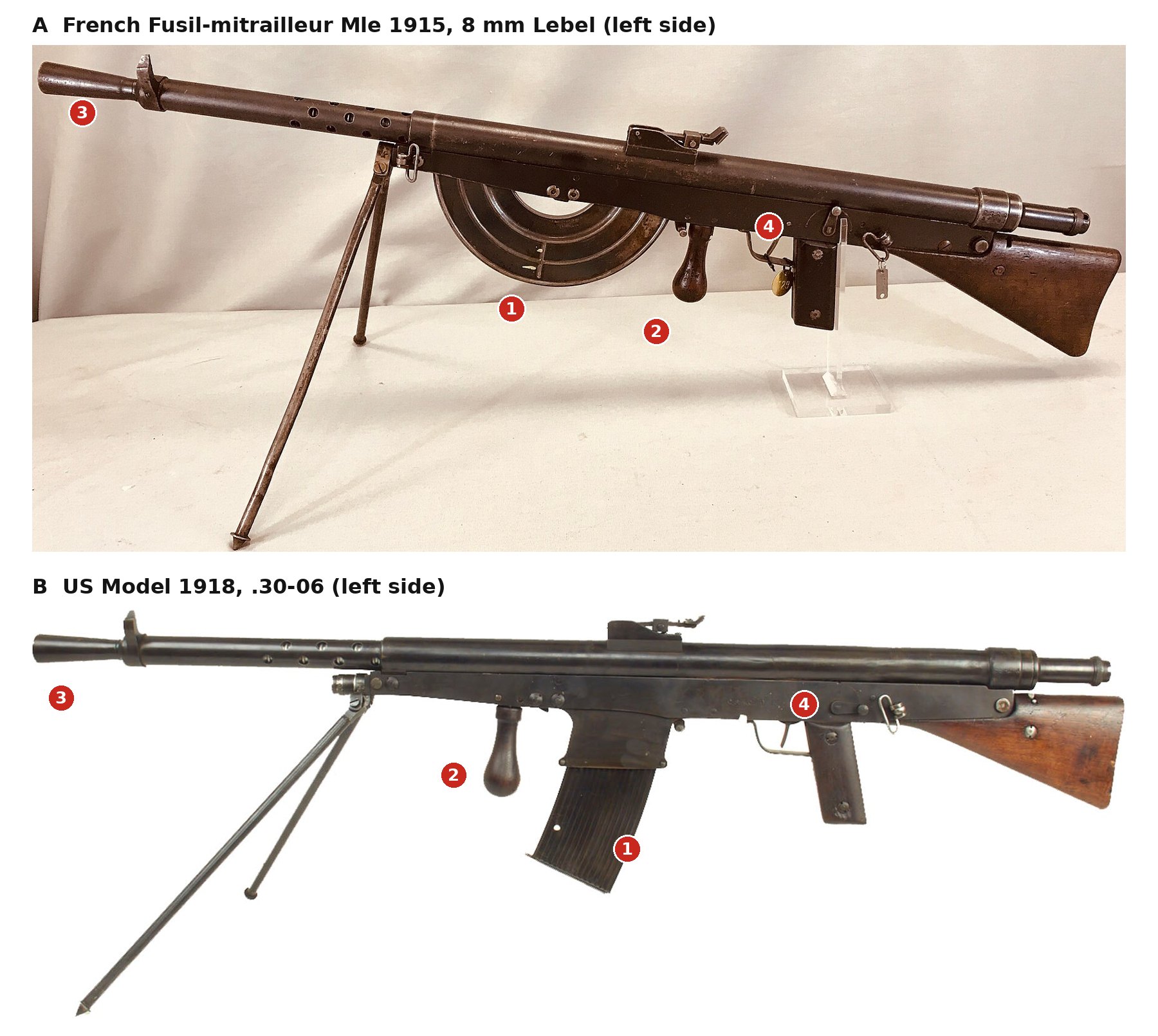
- Magazine. The French gun takes the 20-round half-moon; the American takes a 16-round box.12 On a gun without its magazine, look at the magazine well, which on the Model 1918 was modified for the box.3
- Front grip. On the French gun the wooden front grip hangs behind the magazine, just ahead of the trigger housing. On the Model 1918 it is moved forward, ahead of the magazine.3
- Calibre. The Model 1918 is chambered for .30-06. Marking alone does not settle calibre (below); the chamber does.
Martin Morgan, writing in 2017, says that “Almost none” of the Chauchats registered in the United States are Model 1918s.3 An American collector will far more often meet a French Model 1915.
7.3 Dating a French gun: first type, flash hider, covers
Table 2 — Dating a French gun: first type, flash hider, covers
| Feature | When it appeared | What to look for | Source |
|---|---|---|---|
| No flash hider | 1915 to 1917 | The muzzle ends at the front-sight carrier, the recoil intensifier | Vuillemin; Armes Françaises45 |
| Flash hider | ”à compter de septembre 1917” (Vuillemin) or 1918 (Armes Françaises) | A conical flash hider screwed on in front of the front sight | 45 |
| Anti-aircraft sighting device | 1918 | An eccentric bead on the front sight; a cup support, grid and peep sight in the gun’s equipment | Armes Françaises; Muller56 |
| Covers | 1920 | A flap closing the magazine well, a cover on the ejection port, a stopper for the barrel jacket | Armes Françaises; Muller56 |
A flash hider can be added to an early gun, and covers can be added to any gun, so these features date the gun’s last French configuration, not its manufacture. The serial number cannot yet be used to date a gun: no list of serial ranges by year was found. The photograph of a French gunner in Volume 2 shows a gun without a flash hider; the hero image of Volume 1 shows one with it.
7.4 The maker: Gladiator or SIDARME
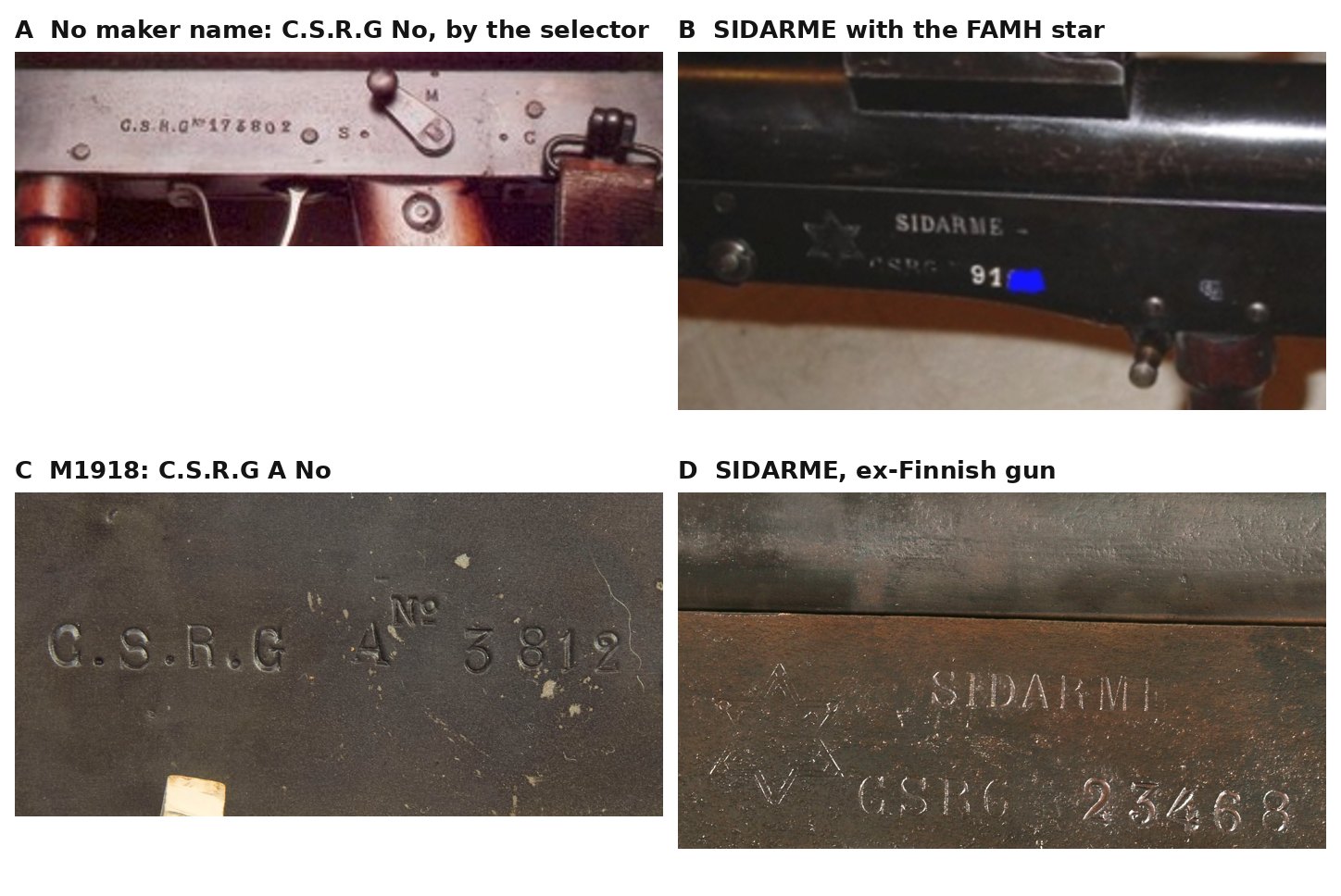
- SIDARME guns are marked “SIDARME” with the six-pointed star of the Forges et Aciéries de la Marine et d’Homécourt and “ST CHAMOND”, on the left of the trigger housing, above the model and serial number.75 The SIDARME plant, at Saint-Chamond, made the gun from 1918 (Volume 2).
- Gladiator guns are the great majority. The guns photographed for this dive without SIDARME’s name are marked only “C.S.R.G” and a number by the selector. Whether every Gladiator gun is unmarked by maker was not established; Armes Françaises shows a “variante de marquage” and a gun whose maker’s mark is hidden under a reinforcing plate.5
7.5 Where the serial number is
Armes Françaises says the model and serial number are on the left of the receiver (carcasse) and on the screwed end cap (bouchon de culasse), and that the serial is “non précédé d’une lettre” (not preceded by a series letter), unlike guns from the state factories.5 Vuillemin adds the assembly yoke.4 International Military Antiques adds the rear end of the recoil assembly and the cocking handle.7 A gun whose numbers match in those places has probably not been assembled from parts; the dealers say so of their own guns.78
7.6 The “A” marking
A Model 1918 sold by International Military Antiques is marked “C.S.R.G A No” with its serial on the trigger housing, and “C.S.R.G. A” on the receiver end cap.8 It is tempting to read the “A” as “American”. But the Serbian historian Branko Bogdanović says the Yugoslav guns rechambered to 7.9 mm in 1926–1928 had “A” added after “CSRG” too.9 An “A” after C.S.R.G. is therefore not proof of a US Model 1918. The box magazine well, the moved front grip and the chamber are the tests. The meaning of the “A” on the American guns was not found in any source.
7.7 National variants after the war
- Belgian 1915/27 (7.65×53). Ian McCollum lists dust covers over the magazine well, ejection port, charging-handle slot and jacket vents; a new bipod like the FN BAR’s; a box magazine; a simplified feed; and a tension latch.10 The cover over the charging-handle slot and the FN-type bipod are the visible tells.
- Yugoslav M.15/26 (7.9×57). A Belgian gun reworked at Kragujevac: re-chambered by removing the rear 40 mm of the rifling, a 12-round curved magazine, a new rear sight, and “CSRGA” in the marking.9
- Polish wz. 15/27 (7.92×57). Reported as a mid-1920s conversion of about half the Polish guns; no description was verified (Volume 4).
- Finnish-modified guns (8 mm, unchanged calibre). From October 1940 about 2,400 guns had their front and rear sight bases moved further to the left, a new front blade, a new rear notch, and a leather cheek piece.11 Finnish property is stamped “SA”; a SIDARME gun sold by International Military Antiques has “S A in a rectangle” on receiver and magazine.7 Finland sold its remaining guns to Interarmco in 1957–1960 (Volume 4).
- German captures were designated LeMG 156(f) for French and LeMG 126(b) for Belgian guns.3 No German marking scheme was found.
7.8 The selector
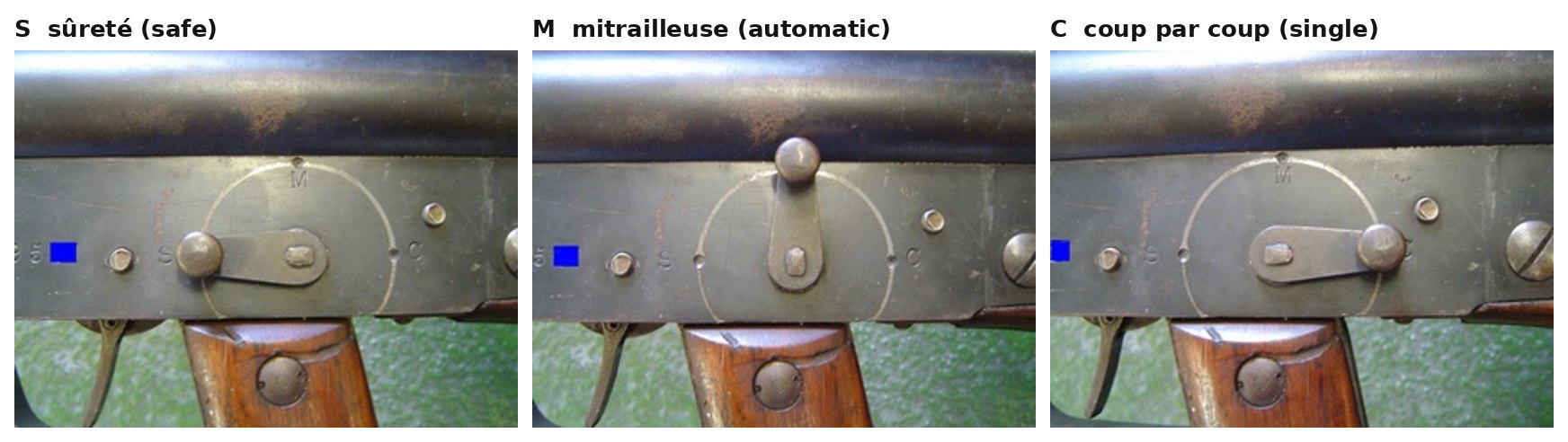
On every pattern the selector is a lever on the left of the trigger housing, turning over an arc marked S, M and C. The 1916 manual: “He sets his safety lock at the rear position if he wants to fire round by round, or at the vertical position if he wants to fire automatically, in front of the marks C (round by round) or M (automatic).”1 Safe is the forward position. Volume 5 explains what each position does inside.
7.9 Display guns and deactivated guns
A Chauchat for sale in the United States is usually one of three legal objects, and they look much the same: a registered transferable machine gun, a registered deactivated war trophy, or an unregistered display gun built on a destroyed receiver. International Military Antiques describes its display guns as built “on an original BATF compliant non-firing display receiver”, made “by using portions of the original torch cut receiver … combined with some new made steel portions”, with “a 25% section of the total length completely replaced entirely with solid steel bar stock”.7 A welded-in steel section in the receiver and welded internal parts are the signs of such a gun. The legal differences are in Volume 10; the paperwork, not the look of the gun, decides which a given gun is.
7.10 Tell them apart: the table
Table 3 — Tell them apart: the table
| Feature | Mle 1915 (French) | Model 1918 (US) | Belgian 1915/27 | Yugoslav M.15/26 | Where to look |
|---|---|---|---|---|---|
| Calibre | 8 mm Lebel | .30-06 | 7.65×53 | 7.9×57 (shortened M88) | Chamber; marking |
| Magazine | 20-round half-moon, one side open | 16-round box | Enclosed box | 12-round curved | Under the receiver |
| Front grip | Behind the magazine | Ahead of the magazine | Not verified | Not verified | Under the receiver |
| Marking | ”C.S.R.G No”; SIDARME + star on SIDARME guns | ”C.S.R.G A No” (one example) | Not verified | ”CSRGA” | Left of trigger housing |
| Covers | From 1920 only | None seen | Magazine well, port, handle slot, vents | Not verified | Magazine well, ejection port |
| Bipod | French folding bipod | Folding bipod | FN-BAR type | Not verified | Front of receiver |
| Sights | Offset left of the bore | As French | Not verified | Rear sight changed | Top of jacket |
| Extra | Finnish guns: sights moved further left, cheek piece, “SA” | — | — | — | Sights; stamps |
7.11 What could not be established
- Serial ranges by year and by maker.
- What the “A” means on the American guns.
- Whether all Gladiator guns lack a maker’s name.
- Descriptions of the Polish wz. 15/27 and the details of the Belgian and Yugoslav front grips and bipods.
References
Footnotes
-
Provisional Instruction on the Automatic Rifle, Model 1915 (Chauchat), War Department Document No. 732 (Army War College, January 1918), Part V. https://archive.org/details/provisionalinst00deptgoog, accessed 2026-10-19. ↩ ↩2
-
George M. Chinn, The Machine Gun, Vol. I (Bureau of Ordnance, 1951), pp. 239, 242. https://archive.org/details/TheMachineGunVolume1ByGeorgeMChinn, accessed 2026-10-19. ↩
-
Martin K. A. Morgan, “The Chauchat Light Machine Gun: Not Really One of the Worst Guns Ever”, American Rifleman, 6 February 2017, https://www.americanrifleman.org/articles/2017/2/6/the-chauchat-light-machine-gun-not-really-one-of-the-worst-guns-ever/, accessed 2026-10-19. ↩ ↩2 ↩3 ↩4
-
Henri Vuillemin, “Centenaire du Chauchat”, La Gazette des Armes no. 475, May 2015, pp. 17–18, via Wayback copies of fr.1001mags.com “texte intégral” pages, accessed 2026-10-19. ↩ ↩2 ↩3
-
“Le fusil-mitrailleur de 8 mm CSRG modèle 1915”, Armes Françaises, http://armesfrancaises.free.fr/FM%20Chauchat.html, accessed 2026-10-19. ↩ ↩2 ↩3 ↩4 ↩5 ↩6 ↩7
-
Cdt G.-H. Muller, Exposé schématique du fonctionnement des armes de petit calibre (Berger-Levrault, 1933), pp. 48 and 115. https://archive.org/details/expose-schematique-du-fonctionnment-des-armes-de-petit-calibre-by-tanant-1933, accessed 2026-10-19. ↩ ↩2
-
International Military Antiques, listing for a SIDARME Model 1915 display gun, https://www.ima-usa.com/products/original-french-wwi-fusil-mitrailleur-modele-1915-csrg-chauchat-display-lmg-with-magazine-serial-no-23468, accessed 2026-10-19. ↩ ↩2 ↩3 ↩4 ↩5
-
International Military Antiques, listing for a Model 1918 .30-06 display gun, https://ima-usa.com/products/original-u-s-wwi-french-automatic-rifle-model-1915-c-s-r-g-a-30-06-chauchat-display-lmg-with-magazine-serial-3812, accessed 2026-10-19. ↩ ↩2
-
Branko Bogdanović, “Prvi puškomitraljez u naoružanju srpske vojske – CSRG M1915 ‘Šoša’”, Oružje Online, 29 August 2018, https://oruzjeonline.com/2018/08/29/prvi-puskomitraljez-u-naoruzanju-srpske-vojske-csrg-m1915-sosa/, accessed 2026-10-19. ↩ ↩2
-
Ian McCollum, “Belgian Model 1915/27 Improved Chauchat”, Forgotten Weapons, 9 December 2019, https://www.forgottenweapons.com/belgian-model-1915-27-improved-chauchat/, accessed 2026-10-19. ↩
-
Jaeger Platoon: Finnish Army 1918–1945, “8 mm LMG M/15 Chauchat”, http://www.jaegerplatoon.net/LMG2.htm#800PK15, accessed 2026-10-19. ↩
Comments (0)