Chauchat · Volume 4
Belgium, Serbia, Greece, Poland, Finland and the Others
The armies that used the Chauchat during and after the First World War, the national rechamberings to 7.65 mm and 7.92 mm with their new magazines, the Finnish guns that ended up with an American importer, and the honest limits of what is known
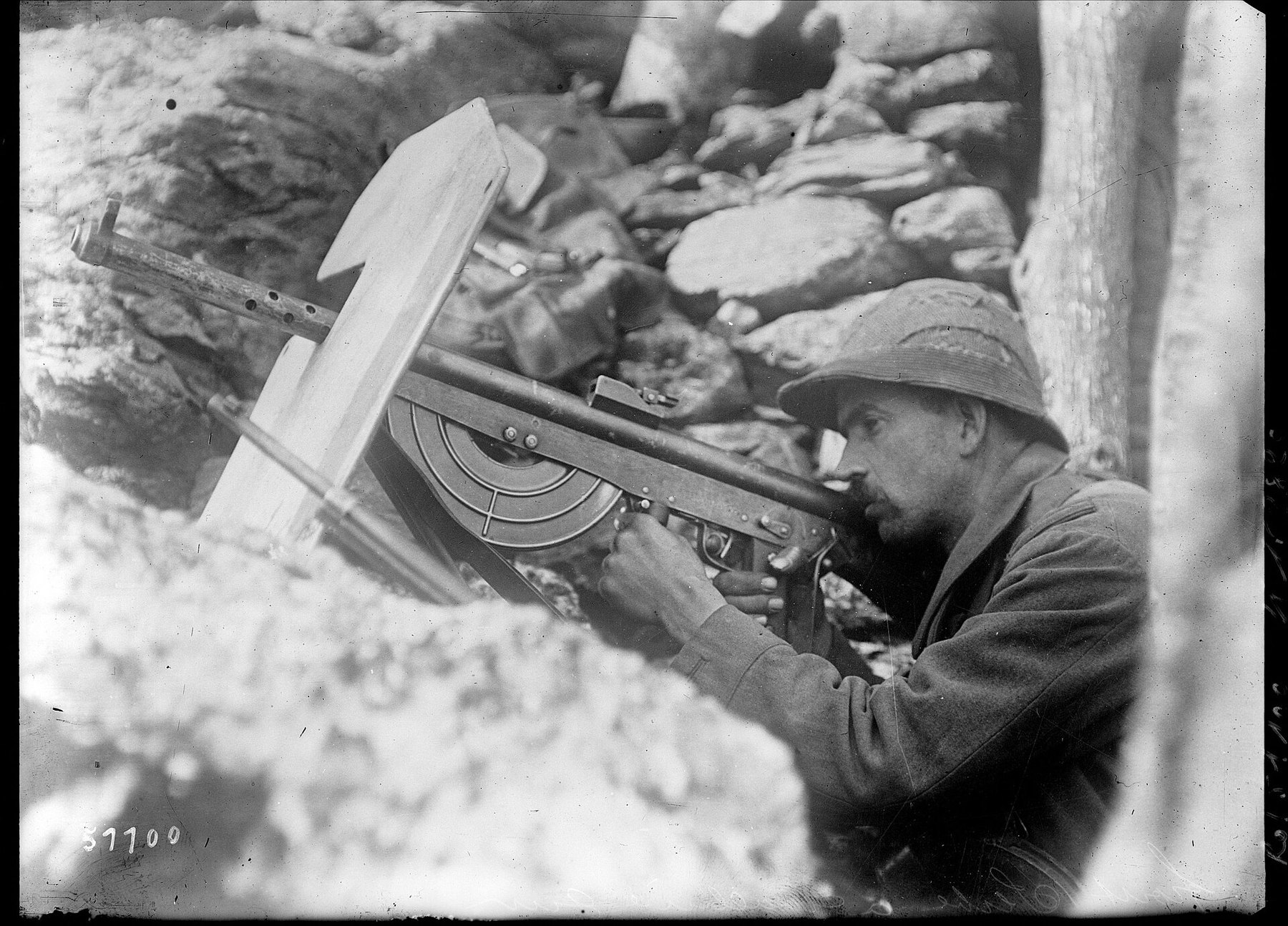
4.1 How far the gun travelled
Henri Vuillemin lists Belgium, Italy, Romania, Russia and Serbia, besides France and the United States, as wartime users.1 Martin Morgan counts eleven countries in all, and “two World Wars and five other conflicts”.2 This volume takes the users for whom something checkable was found. For several of them the numbers circulating in English come only from Demaison and Buffetaut’s Honour Bound (1995), as cited by others; where that is so, it is said.
The pattern is the same everywhere: a country received French guns in 8 mm Lebel, and those that kept them long enough rechambered them for their own rifle cartridge, which meant a new magazine.
4.2 Belgium: the first to rechamber it
Belgium, its army fighting on the strip of country the Germans had not taken, depended on French supply. Ian McCollum, filming a Belgian gun at the Liège arms museum (Grand Curtius), calls Belgium the second country to adopt the Chauchat.3 The Historical Firearms blog, citing Honour Bound, gives these steps:4
- first Model 1915s received in spring 1916, in 8 mm Lebel;
- 1,413 received by April 1917;
- in spring 1917 a gun rechambered for the Belgian 7.65×53 mm Mauser cartridge passed its tests, with a new box magazine developed with Gladiator’s engineers;
- 3,250 rechambered guns in service by the end of the war.
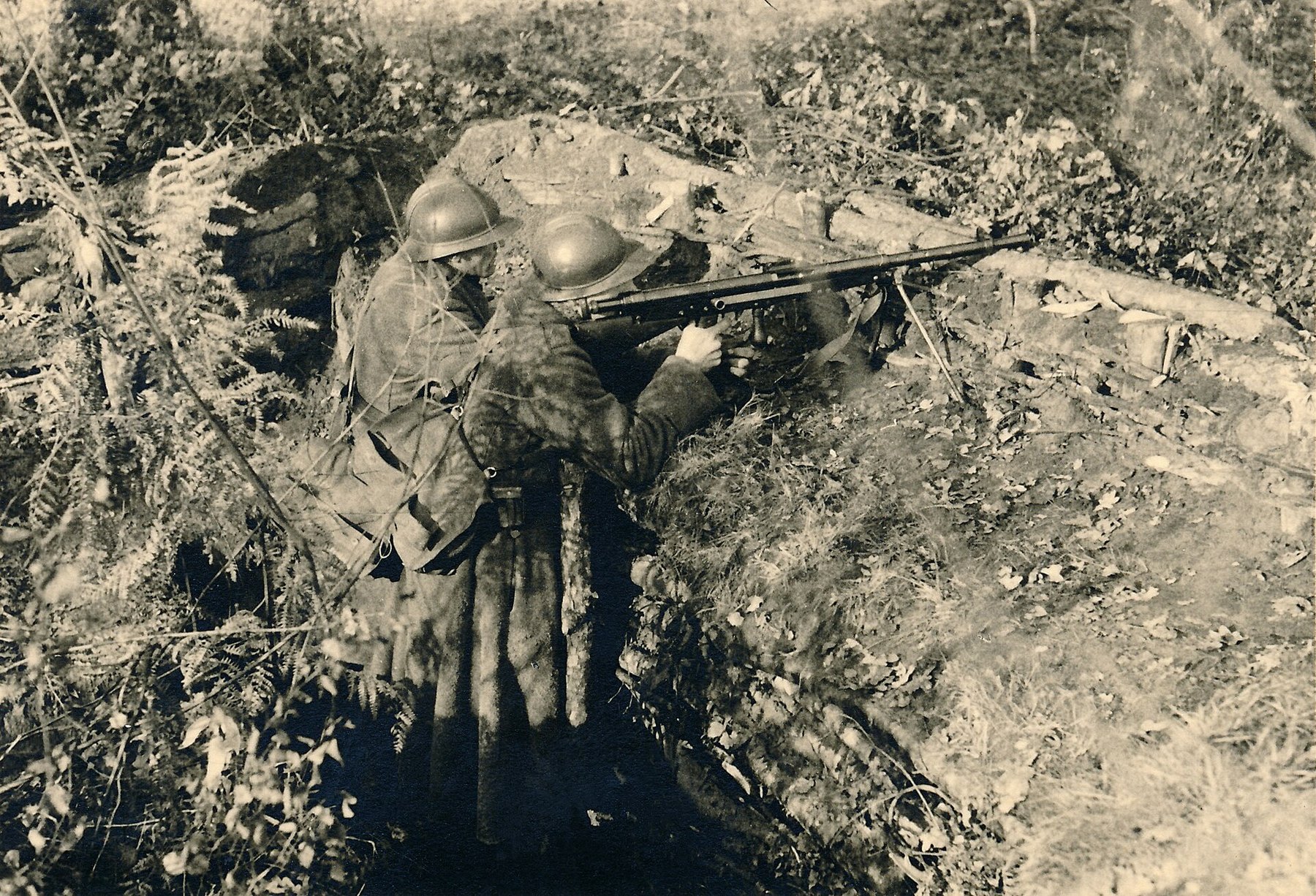
The 1915/27 pattern followed. McCollum lists its changes: 7.65 mm; magazines he calls the best made for any Chauchat; dust covers over the magazine well, ejection port, charging-handle slot and jacket vents; a new bipod like the later FN BAR’s; a simplified feed; and a tension latch.3 He says it stayed the standard Belgian automatic weapon until the FN Browning was adopted in 1930; Historical Firearms says “mid-1930s”.34 A photograph of 1934 shows a Belgian artillery regiment still training with one.
4.3 Serbia and Yugoslavia
The Serbian historian Branko Bogdanović, writing from the Serbian archives in 2018, gives the fullest account found for any user other than France:5
- At the Allied conference in Paris on 8–10 February 1916, France took on the supply of the Serbian army, which was refitting at Salonika after its retreat through Albania.
- None of the guns had arrived by 14 July 1916, or by a French list of 1 October 1916.
- On 18 December 1916 the Serbian Supreme Command ordered training courses (order O.Br. 8927), and in mid-December the army received 1,962 of them. The soldiers called the gun the Šoša.
- In 1920 and 1921 the French military attaché, Raymond Deltel, reported 1,900 Model 1915s in the new Kingdom of Serbs, Croats and Slovenes.
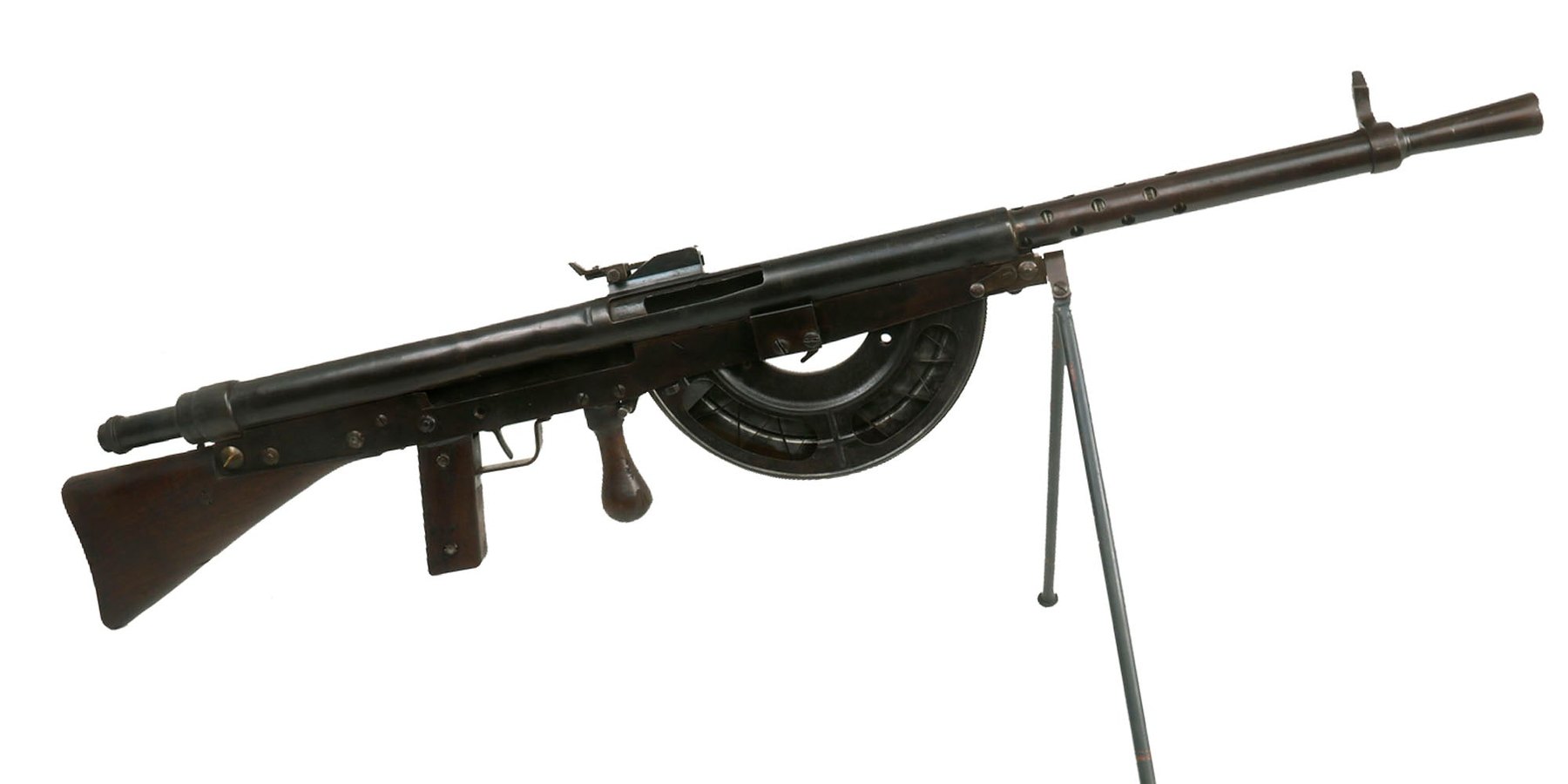
Yugoslavia then did what Belgium had done, with Belgian guns. On Bogdanović’s account a Yugoslav delegation saw FN’s improved Belgian Chauchats at Liège, and Yugoslavia bought 4,000 Belgian 7.65 mm guns from FN. Because it held large stocks of captured German 7.9×57 mm Model 1888 ammunition, it had them converted at the Military Technical Institute at Kragujevac: the rear 40 mm of the rifling was removed to re-form the chamber, the arc magazine was replaced by a 12-round curved one, and the rear sight was changed. The ammunition was altered to fit the guns: from 1924 to 1928 the Kragujevac works shortened Model 1888 cartridges by 2 mm for these guns, in crates marked with a red triangle. Deliveries ran to 1,700 by February 1927 and all 4,000 by early 1928, designated M.15/26, with an “A” added after “CSRG” in the marking.5 McCollum’s 2016 photographs show these guns in Yugoslav hands during the Second World War.6
The “A” matters for identification: an “A” after C.S.R.G. also appears on a .30-06 Model 1918 sold in the United States (Volume 7).
4.4 Greece
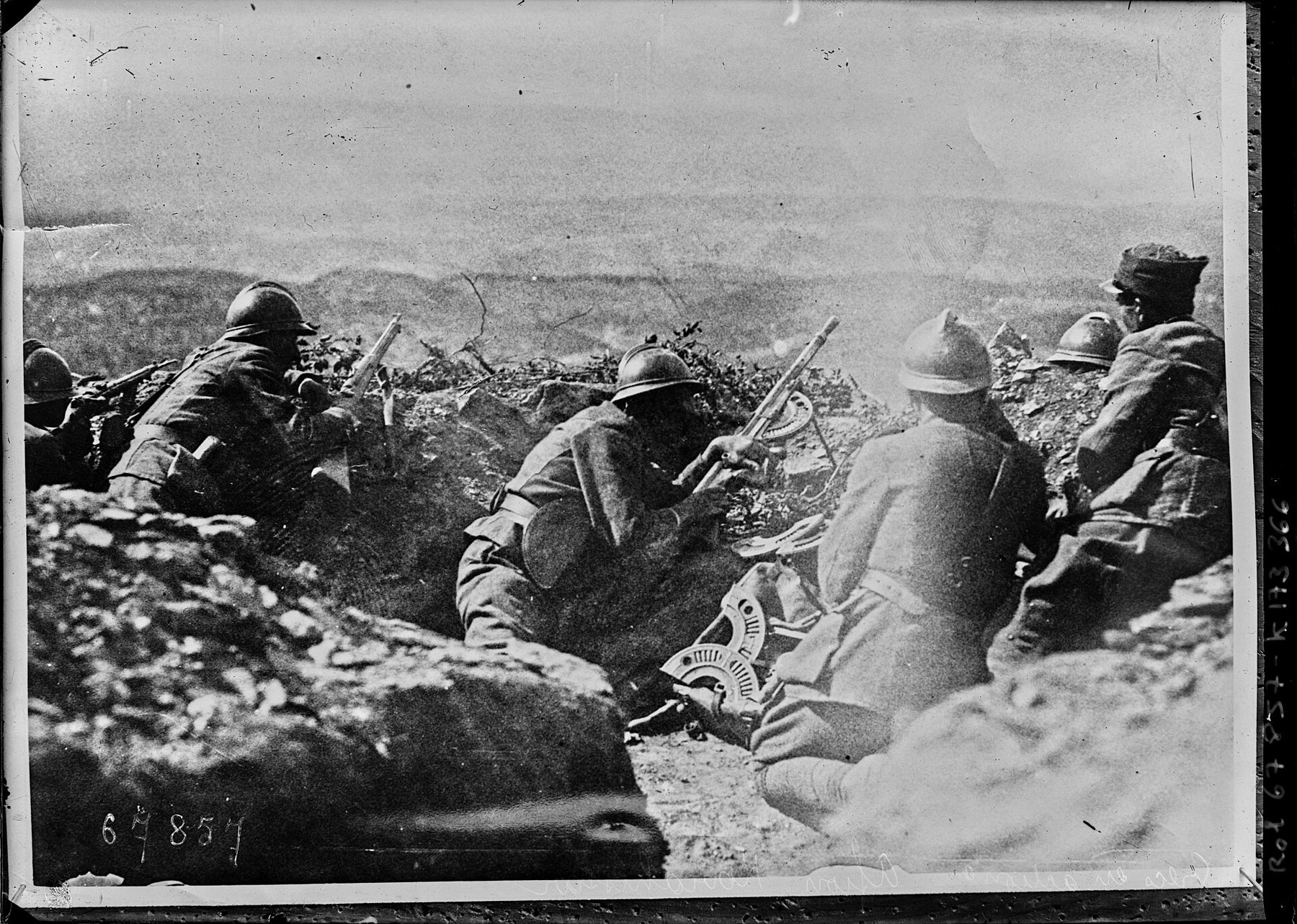
Greece entered the war on the Allied side in 1917 and took the Chauchat into service. The photographs of the Agence Rol in the Bibliothèque nationale de France show Greek troops with it in Anatolia in 1921–1922, during the Greco-Turkish War (above). English reference works, citing Honour Bound and Osprey titles, say that Greece received a further 3,950 from Poland and used the gun in the Greco-Italian War of 1940–1941; those sources were not read for this dive. The Athens War Museum displays an example.
4.5 Poland
Martin Morgan names Poland among the main users and gives its calibre as 7.92×57 mm Mauser.2 The Polish figures in circulation in English (over 2,000 received from France during the Polish–Soviet War; 11,869 acquired in all as the rkm wz. 15; about half converted to 7.92 mm in the mid-1920s as the wz. 15/27; about 2,650 sold abroad in 1936–1937) are attributed to a Polish monograph by Andrzej Konstankiewicz (2003) and to Honour Bound. Neither could be read for this dive, so they are recorded here as reported, not verified. Examples survive at the Museum of the Polish Army in Warsaw and at Fort Va in Poznań.
4.6 Finland, and the road to America
The Finnish record is unusually complete, thanks to the archive-based site Jaeger Platoon:7
- About 15 Chauchats were in Finnish hands by the end of the 1918 civil war. Passed to the Civil Guard, they were down to 13 guns and 141 magazines by October 1936 and were sold in 1937.
- During the Winter War France gave Finland about 5,000 guns and 10 million rounds of 8 mm Lebel (the site gives January–February and February–March 1940 for the delivery). They arrived too late and were not issued, except about 100 to coastal artillery.
- The French ammunition was the m/1932N, with which the guns “reportedly did not work reliably” (Volume 6 explains why).
- In the Continuation War some went to front-line infantry, who disliked them and swapped them for captured Soviet DP light machine guns; the rest went to home-front units and to artillery, often as improvised anti-aircraft guns. They came with French anti-aircraft sights.
- In September–October 1940 a sight modification was approved: front and rear sight bases moved further left, a new front blade, a new rear notch, and a leather cheek piece. Oy Uuttausty Ab was ordered to modify 2,800 guns and had done almost 2,400 by February 1941.
- The 1955 inventory counted 4,234 guns, 3,740 of them needing repair. About 1957–1958, 2,117 Chauchats were traded with other surplus to the American importer Interarmco for Sten guns, and in 1959–1960 the remaining 2,115 were sold to Interarmco.
That sale is one documented source of the Chauchats that entered the United States in the late 1950s, many of them as deactivated “war trophies” (Volume 10). Martin Morgan describes the same wave of late-1950s imports without naming the seller.2 Ex-Finnish guns can be recognised by the Finnish Army’s “SA” stamp. One SIDARME gun sold by International Military Antiques carries “S A in a rectangle” on the receiver and on its magazine.8
4.7 Russia, Romania, Italy and others in the First World War
- Russia and Romania received French guns during the war; Vuillemin lists both.1 A Commons photograph shows Crown Prince Carol of Romania training with one. The often-quoted delivery figures (6,100 to Russia, 4,495 to Romania) were not traced to a source that could be read.
- Italy: Vuillemin lists Italy;1 the Italian War Ministry was still printing an Istruzione provvisoria sul fucile mitragliatore C.S.R.G. in 8 mm in 1942, according to a bibliographic listing that could not be opened. Examples are displayed at the Tre Sassi museum at Passo di Valparola and at the Forte di San Leo.
- Czechoslovak Legion: the legion that fought its way out of Russia brought guns home in 1920, according to English reference works citing the Prague Military History Institute; not verified here.
- Later appearances in museum collections and photographs include French Indochina (a 1923 photograph of Indochinese automatic riflemen), Israel (Batey ha-Osef Museum, Tel Aviv), Argentina (Museo de Armas de la Nación, Buenos Aires) and Portugal (Museu Militar, Lisbon). These show where guns ended up, not how many were issued.
4.8 Germany and the Second World War
The Germans captured Chauchats in each campaign of 1939–1941. Morgan gives the designations LeMG 156(f) for French guns and LeMG 126(b) for Belgian ones.2 Vuillemin illustrates a German attempt during the First World War to convert a captured gun to 7.92 mm Mauser, with an improvised magazine; he calls the result “une bizarrerie armurière”.1 Armes Françaises says the Germans largely left captured Chauchats in store in 1940 while issuing Lebel rifles to second-line troops.9 Yugoslav guns were used by all sides in occupied Yugoslavia.6
4.9 Summary table
Table 1 — Summary table
| User | Period | Calibre | Figures found | Strength of the source |
|---|---|---|---|---|
| France | 1916–1940 | 8 mm Lebel | 225,000–265,000 made (Volume 2) | Secondary, conflicting |
| USA | 1917–1919 | 8 mm; .30-06 (M1918) | 29,000 / 34,000 / 37,864 (Volume 3) | Official, conflicting |
| Belgium | 1916–1930s | 8 mm, then 7.65×53 | 1,413 by April 1917; 3,250 by 1918 | Blog citing Honour Bound |
| Serbia / Yugoslavia | 1916–1941 | 8 mm; 7.9×57 (M.15/26) | 1,962 (Dec 1916); 1,900 (1920); 4,000 M.15/26 | Archive-based article |
| Greece | 1917–1941 | 8 mm | Not verified | Photographs |
| Poland | 1919–1937 | 8 mm; 7.92×57 (wz. 15/27) | Not verified | Reported via others |
| Finland | 1918–1960 | 8 mm | about 5,000 (1940); 4,234 (1955); 4,232 sold 1957–60 | Archive-based site |
| Russia, Romania, Italy | 1916–1918 | 8 mm | Not verified | Vuillemin lists them |
| Germany | 1939–1945 | as captured | LeMG 156(f), 126(b) | Morgan |
4.10 What could not be established
- Any delivery figure for Greece, Poland, Russia, Romania, Italy or the Czechoslovak Legion from a source that could be read.
- The Belgian figures independent of Honour Bound.
- The date the Belgians adopted the FN Browning in place of the Chauchat: 1930 or the mid-1930s.
- Which Belgian guns Yugoslavia bought (Bogdanović’s “M1915/17”) and how they differed from the 1915/27.
- How many of the Chauchats now in the United States are ex-Finnish.
References
Footnotes
-
Henri Vuillemin, “Centenaire du Chauchat”, La Gazette des Armes no. 475, May 2015, pp. 18–21, via Wayback copies of fr.1001mags.com “texte intégral” pages, accessed 2026-10-19. ↩ ↩2 ↩3 ↩4
-
Martin K. A. Morgan, “The Chauchat Light Machine Gun: Not Really One of the Worst Guns Ever”, American Rifleman, 6 February 2017, https://www.americanrifleman.org/articles/2017/2/6/the-chauchat-light-machine-gun-not-really-one-of-the-worst-guns-ever/, accessed 2026-10-19. ↩ ↩2 ↩3 ↩4
-
Ian McCollum, “Belgian Model 1915/27 Improved Chauchat”, Forgotten Weapons, 9 December 2019, https://www.forgottenweapons.com/belgian-model-1915-27-improved-chauchat/, accessed 2026-10-19. ↩ ↩2 ↩3
-
“The Belgian Chauchat”, Historical Firearms (unsigned blog post, c. 2017, citing Demaison and Buffetaut, Honour Bound), https://www.historicalfirearms.info/post/166619060194/the-belgian-chauchat-throughout-the-first-world, accessed 2026-10-19. ↩ ↩2
-
Branko Bogdanović, “Prvi puškomitraljez u naoružanju srpske vojske – CSRG M1915 ‘Šoša’”, Oružje Online, 29 August 2018, https://oruzjeonline.com/2018/08/29/prvi-puskomitraljez-u-naoruzanju-srpske-vojske-csrg-m1915-sosa/, accessed 2026-10-19 (in Serbian). ↩ ↩2
-
Ian McCollum, “Yugoslav 8mm Chauchat M1915/26 Photos”, Forgotten Weapons, 25 March 2016, https://www.forgottenweapons.com/yugoslav-8mm-chauchat-m191526-photos/, accessed 2026-10-19. ↩ ↩2
-
Jaeger Platoon: Finnish Army 1918–1945, “Light machineguns part 2: 8 mm LMG M/15 Chauchat”, http://www.jaegerplatoon.net/LMG2.htm#800PK15 (last updated 6 January 2026), accessed 2026-10-19. ↩
-
International Military Antiques, listing for a SIDARME Model 1915 display gun, https://www.ima-usa.com/products/original-french-wwi-fusil-mitrailleur-modele-1915-csrg-chauchat-display-lmg-with-magazine-serial-no-23468, accessed 2026-10-19. ↩
-
“Le fusil-mitrailleur de 8 mm CSRG modèle 1915”, Armes Françaises, http://armesfrancaises.free.fr/FM%20Chauchat.html, accessed 2026-10-19. ↩
Comments (0)