Girardoni Air Rifle · Volume 8
Replicas, Building One, and the Law
What can be bought (a resin casting, and big-bore descendants), what was made by hand (four museum copies), a lab build path in which the reservoir is treated as the pressure vessel it is, why the original riveted and brazed flask must not be copied for charging, and what federal and Michigan law say about a big-bore air rifle
This volume covers the three practical questions a reader with a workshop will ask: can a reproduction be bought, can one be built, and what does the law make of it. The answers are short for the first and third, and long for the second, because the part that makes the rifle work, a reservoir of compressed air held at the shooter’s cheek, is the part that can kill the builder.
8.1 What can be bought
No working reproduction of the Girardoni rifle was found for sale. Searches of makers’ sites, auction listings and dealer listings in October 2026 found none from any of the Italian reproduction houses or from airgun makers.
What is for sale is a non-firing resin casting. The seller replicaweapon.com lists a “Girardoni replica Lewis and Clarke air gun”, item 170061, “made of resin fiberglass”, 48.75 × 4 × 4.25 inches and 1.80 kg, “cast from original weapons”, with a blaze-orange barrel plug and “no moving parts”, at $199.00 plus $25 freight to the lower 48 states, as listed on the seller’s page on 18 October 2026.1 The same casting appears at other prices in other listings that could not be opened; the seller’s own page is the price given here. Whose original it was cast from is not stated.

At the other end of the market, originals and Girardoni-system sporting rifles are sold at auction for estimates from $5,000 to $50,000 (Volume 7).
8.2 What has been made by hand
Working copies exist, but none was made for sale:
- Ernest Cowan and Richard Keller, of Chambersburg, Pennsylvania, made “just four ultra precise, museum copies of the Beeman Girandoni” over about two years from 2003, after dismantling the original. Beeman photographed the work: the receiver patterned from the original and sand-cast in brass, the flask made from heavy iron sheet, riveted and then brazed, the thimbles cast, and the pump built from the Vienna drawings.2 Beeman’s own copy, “G4”, fired 64 balls from an 800 psi charge (Volume 6).
- Geoffrey Baker and Colin Currie built a working replica, in .51 calibre according to Beeman, which fired 35 shots from one charge “before they got tired” and, in early 2004, discharged unexpectedly when its hammer was lowered (Volume 5).2
- A Lukens replica was proposed. A circular reprinted by Baker Airguns asks for expressions of interest in a replica of the VMI Lukens rifle, “measured up” with VMI’s agreement, to be made “by one of the well known Italian replicators, such as Uberti or Pedersoli”, at an estimated $1,000 to $1,500, with the reservoir filled “from an outside source via an adapter”. No sign was found that it was ever made.3
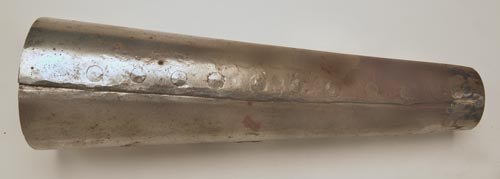
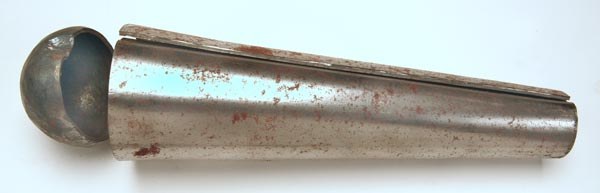
Those copies reproduce the original construction because their purpose was fidelity. That is exactly what this volume says not to do with a flask that will be charged (section 7).
8.3 The descendants: big-bore air rifles today
The Girardoni is often called the ancestor of today’s big-bore pre-charged air rifles. The connection is one of principle, not of documented descent: no source traces a line from Vienna in 1780 to any modern maker. The principle is the same, though. A modern big-bore pre-charged pneumatic stores air in a reservoir behind or under the barrel, opens a valve for an instant with a blow from a hammer, and drives a heavy lead projectile. The Daisy dive explains the type (Daisy, Volume 5).
As an example of the modern form, AirForce Airguns lists the Texan SS .457 and Texan LSS .457 in its “CF Series” at $1,392.95 and $1,412.95, and its Texan SS in .257 at $1,239.95, on its own site on 18 October 2026.4 The .257 page gives specifications that make the comparison with Girardoni’s flask direct: “a 500cc air tank and a maximum fill pressure of 3,000 PSI”, or “3,000 psi / 206 bar”, and a “Pressure Relief Device”.4 German Wikipedia, after Baker and Currie, gives the Girardoni flask as about 500 ml (unverified here).5 On those figures the modern rifle holds about the same volume of air at nearly four times the pressure usually given for the original, in a reservoir made and marked to modern standards and fitted with a relief device. The 1780s flask had neither.
8.4 The law: federal and Michigan
The hub’s Diana 34 dive sets out the airgun law that applies here, read from the statutes, and it is not repeated; the essentials:
- Federal: an air rifle is not a “firearm” under 18 U.S.C. § 921(a)(3), because it does not expel a projectile “by the action of an explosive”. There is no federal licensing, background check or transfer record for buying, making or owning one, whatever its calibre (Diana 34, Volume 7). A reproduction built in this lab is not a firearm and needs no federal paperwork.
- A sound moderator is different. A “firearm muffler or firearm silencer” is a firearm in its own right under the same definition; the Diana dive explains why nothing should be assumed about a moderator fitted to an air rifle, and the hub’s Suppressor Law dive covers the definition (Diana 34, Volume 7; Suppressor Law).
- Michigan: not a firearm under MCL 750.222, which uses the same explosive test. Michigan’s separate category is the “pneumatic gun”, defined in MCL 123.1101(d) and adopted by MCL 750.222(g) as “any implement, designed as a gun, that will expel a BB or pellet by spring, gas, or air”.6 The Diana dive covers the 2015 provisions that treat a pneumatic gun like a firearm for some offences, the preemption of local ordinances, and the vehicle-transport rules that apply to a pneumatic gun firing a metallic BB or pellet “greater than .177 caliber” (Diana 34, Volume 7).
- Hunting in Michigan: the 2026 deer regulations allow a pneumatic gun “if it meets the firearm requirements for the season, species hunted and zone”, as the Diana dive quotes (Diana 34, Volume 7). Whether a reproduction Girardoni meets those requirements is a question for the current Department of Natural Resources digest, not for this dive.
One open question is specific to this rifle. Michigan’s definition speaks of a gun that expels “a BB or pellet”. A Girardoni fires a round lead ball of about 0.46 in. Neither MCL 123.1101 nor MCL 750.222 defines “pellet”, as read on the Michigan Legislature’s site on 18 October 2026.6 Whether a 0.46 in lead ball is a “pellet” for these sections, and so whether a Girardoni reproduction is a “pneumatic gun” with all that follows, has not been answered by any statute, court decision or agency guidance found. The cautious course is to treat it as a pneumatic gun for transport and conduct, which is the stricter reading for a calibre over .177. Nothing in this volume is legal advice.
8.5 A build path for this lab
The lab’s capabilities, from the hub’s catalogue: a Shapeoko 3 XXL CNC router and a Nomad 3 CNC mill; a HiTorque 7×16 mini lathe and a HiTorque 3990 mini mill with DRO; several 3D printers; a 60 W CO2 laser (a 100 W tube on hand, not yet fitted) and a 10 W diode laser with rotary; a press brake, a press and a stick welder; full gunsmithing tools; and a powder-coat oven that is not for heat treating, so hardening and tempering go out to a heat-treat shop.7
The hub’s Volcanic dive works through a similar machinist’s path for another early repeater from the same lab; the difference here is that one part holds compressed air. Against those capabilities, the rifle divides into four kinds of part.
Table 1 — A build path for this lab
| Part | Make, buy or send out | Notes |
|---|---|---|
| Reservoir | Buy a seamless cylinder made and marked to a recognised specification | Sections 6–8. Hidden in a cosmetic flask-shaped shell. Never home-made by riveting, brazing or welding |
| Flask shell (cosmetic) | Make: printed, laminated or turned in wood; leather cover cut on the laser | Carries no pressure; must not touch or load the cylinder |
| Valve body and valve | Make the body on the Nomad 3 or mini lathe; buy seals | Pressure-bearing: design and prove like the reservoir (sections 6, 8). Modern seat, not leather and water |
| Barrel | Buy a rifled barrel blank or liner of about .45–.46 bore | The 834 mm barrel is longer than the 7×16 lathe’s 16 in between centres; rifling a barrel is beyond the listed tooling. Shallow rifling suits a round ball |
| Receiver | Make: machine from bronze or brass bar on the mini mill or Nomad 3; or print a pattern and have it cast outside | No foundry is listed. The air passage sees full pressure during each shot, so the receiver is a pressure part around the passage and threads |
| Loading bar and housing | Make on the mini mill: lapped, close-fitting steel bar | Fit is the seal; Beeman’s original slid home under its own weight (Volume 5) |
| Magazine tube and lid | Make or buy tube; turn the lid | Tube on the right of the barrel |
| Flat springs (mainspring, bar spring) | Make from spring steel; heat treat out of house | Spring temper is beyond the powder-coat oven |
| Lock: tumbler, sear, bridle, striker latch and pin | Make on the mini mill and lathe; harden out of house | Sections 9 |
| Stock | Make on the Shapeoko XXL from walnut | A full-length forend nearly as long as the barrel: check it against the router’s travel, or plan two setups |
| Brass furniture (thimbles, guard, nose cap) | Make: machine, or print patterns for outside casting | The laser can cut templates and engrave |
| Sights | Make | Notch rear, blade front |
8.6 The reservoir is a pressure vessel
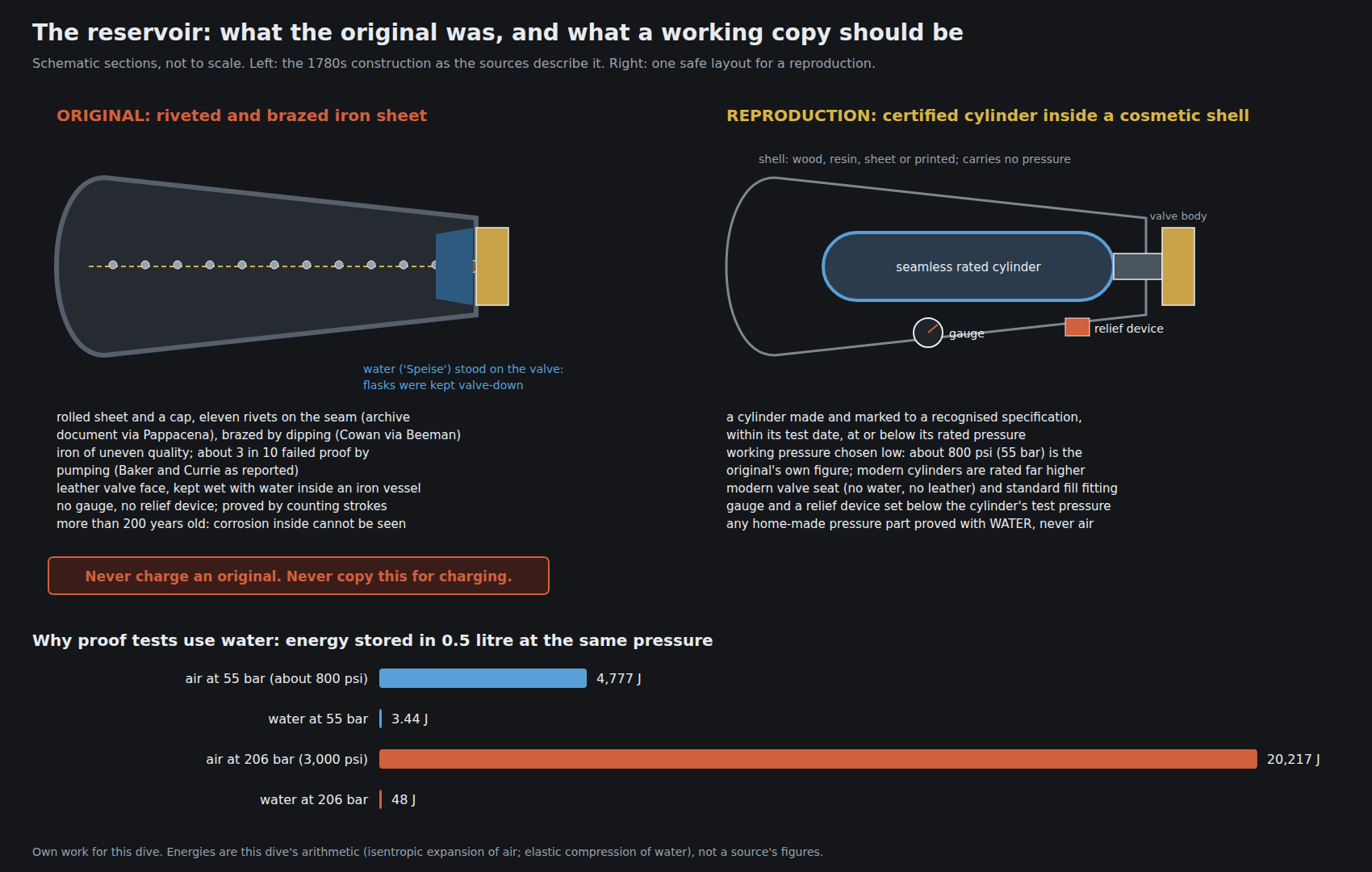
Everything else on this rifle can fail with no more than a jam or a broken part. The reservoir can kill. The arithmetic in Volume 6 and on the figure above: half a litre of air at 55 bar (about 800 psi), the pressure usually given for the original, holds roughly 4.8 kJ if it expands to atmosphere; at 206 bar (3,000 psi), the rating of a modern big-bore tank, roughly 20 kJ. For scale, the same half-litre of water at 55 bar stores about 3.4 J. A ruptured gas reservoir throws fragments and the reservoir itself; a ruptured water-filled one spills water. These figures are this dive’s own calculation (isentropic expansion of air; elastic compression of water), not a source’s.
The safe principle, therefore, is the one the modern cylinder industry works to: the reservoir is made to a specification, tested to a margin above its working pressure, marked, and re-tested on a schedule. The US Department of Transportation’s cylinder rules for seamless steel cylinders (specification 3AA, 49 CFR § 178.37) show what that means in practice, and they are a useful yardstick even though an air-rifle reservoir in a private workshop is not a transport cylinder:8
- Seamless. “Welding or brazing for any purpose whatsoever is prohibited”, except for attaching non-pressure neck and foot rings on low-pressure cylinders.
- Wall stress limited. For a service pressure of 900 psig or more, the wall stress at the minimum test pressure “may not exceed 67 percent of the minimum tensile strength of the steel”, calculated by a formula given in the rule.
- Heat treated and inspected. Quenched and tempered to stated temperatures, and inspected for quench cracks.
- Threads. Straight threads must have “at least 6 engaged threads” and “a calculated shear strength of at least 10 times the test pressure”, with gaskets.
- Proof tested with water. “Each cylinder must be tested to a minimum of 5/3 times service pressure”, by the water-jacket or direct-expansion method, held at least 30 seconds, and “permanent, volumetric expansion may not exceed 10 percent of the total volumetric expansion at test pressure.”
- Re-tested. Under 49 CFR § 180.209, 3AA cylinders are requalified at 5/3 service pressure every five years (ten or twelve under stated conditions); aluminium 3AL cylinders every five or twelve.9
- Fatigue tested in design. For seamless aluminium cylinders (3AL), sample cylinders must survive “100,000 pressure reversal cycles between zero and service pressure or 10,000 … between zero and test pressure”.10
The practical conclusion for this build is to buy the pressure part: a commercially made cylinder, marked to a recognised specification, within its test date, used at or below its marked service pressure, with its own fittings. Running it at the original’s 55 bar rather than at the 200-plus bar modern cylinders are commonly rated for adds a large margin and costs nothing but shots. The flask-shaped shell around it is decoration.
8.7 Why the original flask must not be copied
The original flask fails every one of those principles, and the sources say so in their own words:
Table 2 — The original flask fails every one of those principles, and the sources say so in their own words
| Principle | Original Girardoni flask | Source |
|---|---|---|
| Seamless | Rolled sheet and a cap, eleven rivets on the seam | Pappacena, from the war-archive document11 |
| No brazing on pressure parts | Brazed by immersion in molten brazing metal | Cowan via Beeman2 |
| Known material | Iron of variable quality; “the quality of the sheet” the critical problem | German Wikipedia after Baker and Currie5 |
| Proof to a margin | Proved by a set number of pump strokes, with no gauge; about 30 per cent failed | German Wikipedia after Baker and Currie5 |
| No corrosion source | Water put in by regulation every 100 shots and kept on the valve | 1788 regulation (Haller)12 |
| Relief device, gauge | None | — |
| Re-testing | None recorded | — |
A copy made the same way, however skilfully, would reproduce all of those weaknesses, and Cowan’s own experience shows how hard the brazing is to get right: his first dozen or so flasks cracked.2 A riveted and brazed flask is acceptable for a museum copy that will never be charged. For a reproduction that will hold air, the original’s construction must not be copied, and an original flask must never be charged at all (Volume 5).
The same applies to the lab’s own joining methods. A stick weld on a pressure part made at home has no qualified procedure, no inspection and no proof behind it. Silver brazing, soft soldering and adhesive joints are no better. None belongs on anything that holds compressed air.
8.8 Proof testing, and the margin to burst
If any part that holds pressure is made in the lab (the valve body is the likeliest), it must be proved before it is used, and proved with water, never with air.
Why water. Water is almost incompressible, so a part that fails during a hydrostatic test releases almost no energy (the figure’s 3.4 J against 4.8 kJ). The DOT rules specify water-jacket or direct-expansion testing for exactly this reason.8 A part should never be “proved” by pumping it with air to see whether it holds.
What a proof test does and does not show. A proof test at 5/3 of working pressure shows the part did not fail, leak or permanently stretch beyond a limit at that pressure on that day. It is not a measure of the margin to bursting, and it does not show fatigue life under repeated filling, which is why the DOT rules add design fatigue tests and periodic re-testing.810
The margin to burst. The DOT wall-stress rule gives a feel for the margin a designed cylinder carries. If the wall stress at 5/3 of service pressure may not exceed 67 per cent of tensile strength, then at service pressure the wall works at no more than about 40 per cent of tensile strength (0.67 ÷ 5/3). On a simple thin-wall view that is a margin of roughly 2.5 times service pressure to the point at which the wall reaches its tensile strength. That figure is this dive’s arithmetic from the rule, not a burst factor stated in the regulations, and it applies only to a cylinder designed and made to the rule.
A home-made valve body, if one is made: design it so that threads meet the “at least 6 engaged threads” and “10 times the test pressure” shear guidance; hydrostatically test it to at least 5/3 of the intended working pressure behind a shield with no trapped air; hold for at least 30 seconds; and reject it for any leak, visible deformation or permanent set. A cylinder-test facility can do this with proper equipment and records, and is the better choice.8
8.9 Valve, lock and loading bar: designing out the old faults
The original’s recorded faults (Volume 5) suggest what a reproduction should change, and what it can keep for authenticity:
- Lowering the hammer. The original can fire if the hammer is lowered with the trigger held, because the tumbler’s wedge bears on the striker latch.212 A reproduction can keep the original geometry and its user can follow the 1788 rule (take the reservoir off before lowering the hammer), or the design can add a stop that keeps the wedge off the latch at the lowered position. Either way, a charged reproduction is loaded whatever the hammer’s position.
- Half cock. Make the half-cock notch deep and hard, and harden the tumbler (out of house).
- The valve seat. Leather kept wet with water was the original’s answer to sealing. A modern seat and a dry reservoir avoid the corrosion that water caused.
- The striker pin. A stainless pin in a matched sleeve avoids the sticking that Beeman attributes to condensation corrosion.2
- Gauge and relief device. The original had neither; a reproduction should have both, with the relief set below the reservoir’s test pressure.
- The loading bar. Its close fit is the breech seal. Lap it to fit; the original’s tolerance, by Beeman’s account, let it slide home under its own weight.2
8.10 Balls, charging and a performance target
Balls. The measured original took a pure-lead ball of 0.464 in, 154 gr (Beeman), slightly over bore so that it would not roll out and would take the shallow rifling.2 A reproduction’s ball should be sized to its own barrel; the barrel chosen sets the figure.
Charging. The regulation’s 2,000 strokes on a long pump are a historical curiosity, not a method. A modern hand pump or compressor with a regulator and a gauge, filling to a set pressure through a standard fitting, is safer and repeatable. Never exceed the reservoir’s marked service pressure.
Performance. No original has been chronographed (Volume 6). Replica and related-gun tests reported by Beeman suggest a full-charge shot of the order of 500–600 ft/s and 100–200 ft-lb at about 800 psi. That is enough to kill. A reproduction is a weapon, and the hub’s usual range rules apply to it in full.
8.11 Before cutting metal
The questions to settle first:
- Which reservoir? Identify a commercially made cylinder of about the right volume, its specification and marked service pressure, its test date, and how its valve and fill fitting will be packaged inside a flask-shaped shell.
- Which barrel? A rifled blank or liner of about .45–.46, and how its length compares with the original’s 834 mm.
- Which pressure? The original’s 55 bar is recommended, well below any modern cylinder’s rating.
- Who heat-treats the springs, tumbler and sear, and who would proof-test a lab-made valve body?
- Is it a “pneumatic gun” in Michigan? The open question in section 4.
- How will it be stored? Unloaded, reservoir off, as the 1788 regulation already said.
References
Footnotes
-
replicaweapon.com, “Girardoni replica Lewis and Clarke air gun”, item 170061, https://replicaweapon.com/product/girandoni-air-rifle-lewis-and-clark-sale/ . Price and description as listed on 2026-10-18. ↩
-
Robert D. Beeman, “New Evidence on the Lewis and Clark Air Rifle” (updated 15 May 2008) and “Austrian Large Bore Airguns: Girandoni style air rifles and pistols” (updated 17 July 2007), formerly at beemans.net, read through the Internet Archive: https://web.archive.org/web/2022/http://www.beemans.net/lewis-assault-rifle.htm and https://web.archive.org/web/2022/http://www.beemans.net/Austrian%20airguns.htm . Accessed 2026-10-18. ↩ ↩2 ↩3 ↩4 ↩5 ↩6 ↩7 ↩8
-
“Lewis and Clark Air Rifle”, Bryan and Associates archive, Baker Airguns blog, posted 24 July 2015, https://www.bakerairguns.com/informational/lewis-and-clark-air-rifle/ . Accessed 2026-10-18. ↩
-
AirForce Airguns, product listings, https://www.airforceairguns.com/texan (listing Texan SS .457 and Texan LSS .457, CF Series) and “Texan SS .257 Cal PCP Air Rifle”, SKU U202571, https://www.airforceairguns.com/texan-ss . Prices and specifications as shown on 2026-10-18. ↩ ↩2
-
“Girandoni-Windbüchse”, German Wikipedia, https://de.wikipedia.org/wiki/Girandoni-Windb%C3%BCchse , citing Baker and Currie, The Austrian Army Repeating Air Rifle (2nd ed., 2006), pp. 75–98. Accessed 2026-10-18. ↩ ↩2 ↩3
-
Michigan Compiled Laws § 123.1101(d), https://www.legislature.mi.gov/Laws/MCL?objectName=mcl-123-1101 , and § 750.222(g), https://www.legislature.mi.gov/Laws/MCL?objectName=mcl-750-222 . Read 2026-10-18. ↩ ↩2
-
Firearms hub,
_shared/lab_capability.md(started 2026-10-18), listing the machine shop from the Model Shop catalogue and the owner’s notes on the press brake, press, stick welder and powder-coat oven. ↩ -
49 CFR § 178.37, “Specification 3AA and 3AAX seamless steel cylinders”, paragraphs (e), (f), (g), (h) and (i), via the Legal Information Institute, https://www.law.cornell.edu/cfr/text/49/178.37 . Read 2026-10-18. The rule refers to CGA C-1 for test methods; CGA C-1 was not read. ↩ ↩2 ↩3 ↩4
-
49 CFR § 180.209, “Requirements for requalification of specification cylinders”, Table 1 and paragraph (b), https://www.law.cornell.edu/cfr/text/49/180.209 . Read 2026-10-18. ↩
-
49 CFR § 178.46, “Specification 3AL seamless aluminum cylinders”, https://www.law.cornell.edu/cfr/text/49/178.46 . Read 2026-10-18. ↩ ↩2
-
Roberto Pappacena, “I benemeriti di Cortina d’Ampezzo: 1) Bartolomeo Gilardoni”, after F. H. Baer, Internet Archive capture of 10 May 2006, https://web.archive.org/web/20060510055333/http://staff.sunrise.it/polovalboite/giacomel/benemeriti1.htm . Accessed 2026-10-18. ↩
-
August Haller, “Die österreichische Militär-Repetir-Windbüchse des vorigen Jahrhunderts”, Organ der Militärwissenschaftlichen Vereine, vol. 42 (Vienna, 1891), pp. 42–44 (the 1788 regulation). Internet Archive item bub_gb_XF0-AQAAMAAJ. Accessed 2026-10-18. ↩ ↩2
Comments (0)