Girardoni Air Rifle · Volume 7
Surviving Examples, Markings and Identification
Where the military rifles are, what the G and the numbers mean, how to tell an Austrian service rifle from a Viennese or London sporting gun on the same system, a Lukens, a museum copy or a resin casting, and what the auction rooms have asked for them
7.1 How many survive
Rock Island Auction, in its catalogues of 2023 and 2024, says that “only less than 25” of the Austrian military rifles “are known to exist today”, attributing the figure to Robert Beeman.1 Beeman’s own pages give no single count. He wrote that “not more than a handful of these guns have ever left Europe”, that by March 2005 he and his colleagues “had examined virtually all of them, directly or by detailed photos”, and that he knew of only two military rifles without the Girardoni markings: his own and “one recently purchased at auction in Europe”.2 No published census of surviving military Girardonis was found. The “fewer than 25” is best read as an experienced collector’s estimate.
Civilian rifles on the Girardoni system, made in Vienna, London and elsewhere into the nineteenth century, are more numerous, and many auction descriptions of “a Girardoni” mean one of them.
7.2 Where they are
Collections reported to hold military rifles, civilian rifles on the system, or equipment. Each entry gives its source; none was visited for this dive.
Table 1 — Where they are
| Collection | What | Source |
|---|---|---|
| Heeresgeschichtliches Museum, Vienna | Military rifles (“a few”, Beeman); one labelled “Repetier-Windbüchse M 1780, System Girandoni, Kaliber 11,4 mm”; in 1891 a rifle marked G. 162 was in the then k.u.k. Heeres-Museum and drawn for Haller’s plate; the original drawings of the pump and flask | Commons photographs (2018); Haller; Beeman342 |
| US Army Heritage and Education Center, Carlisle, Pennsylvania | The Beeman rifle (unmarked military), given 2006–07; a recreated accoutrement bag | Army photographs; Beeman52 |
| British collections | Baker’s scale drawings are based on “two British specimens” (not named); Beeman studied air guns at the Tower of London; the Royal Armouries at Leeds charged and tested the privately owned Heiberger conversion | Beeman2 |
| Museo Nazionale Storico d’Artiglieria, Turin | The only original accoutrement pouch known | Beeman, courtesy of Giancarlo Melano2 |
| Armémuseum, Stockholm | A Girandoni-system pump | Commons photograph6 |
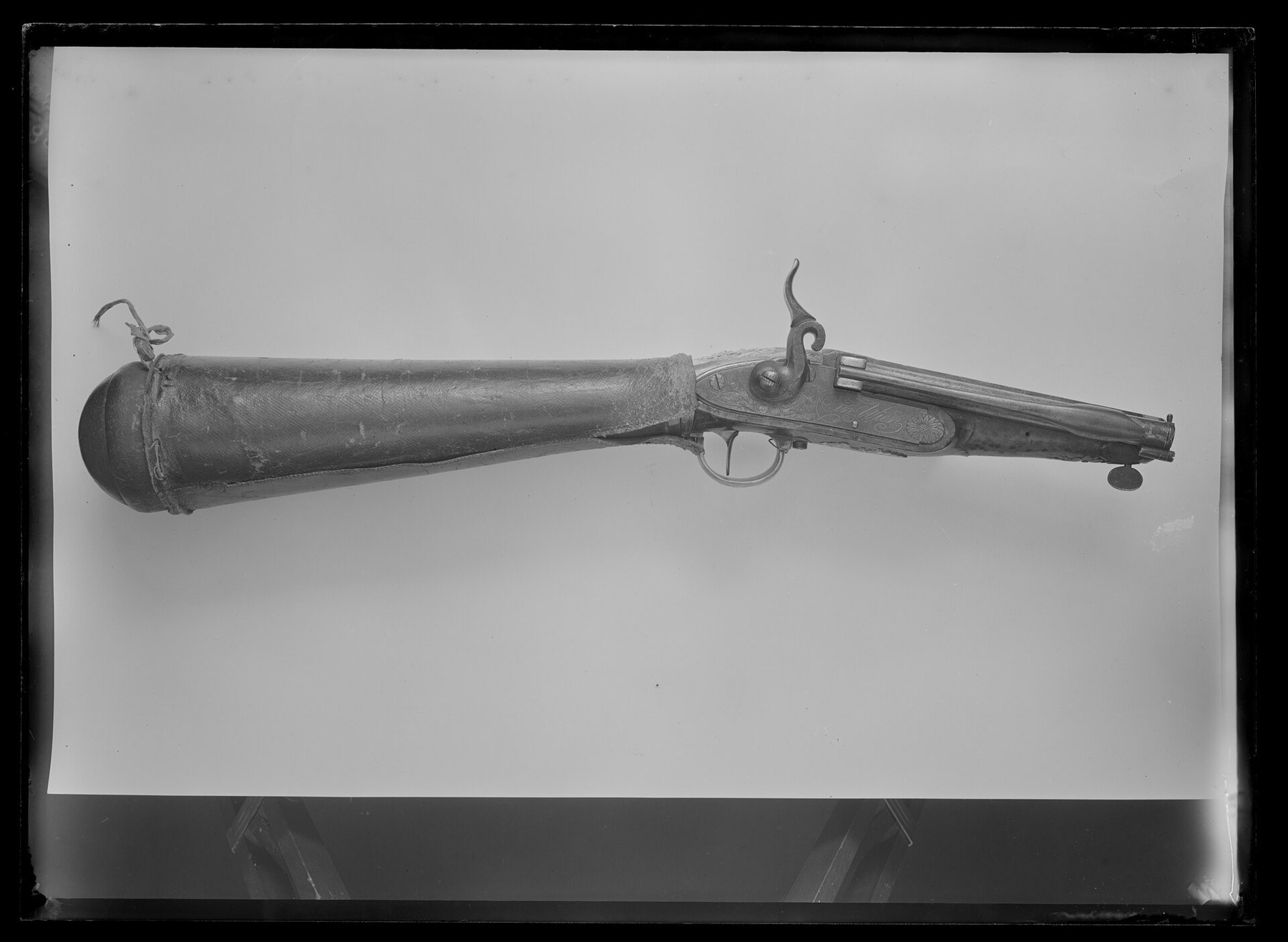
| Livrustkammaren, Stockholm | A Girandoni-system repeater by Contriner, Vienna, about 1800 (civilian) | Museum description on Commons7 |
| Deutsches Jagd- und Fischereimuseum, Munich; Waffenmuseum Suhl | ”Girardoni-Windbüchsen” on display (type not stated) | German Wikipedia8 |
| Turin, Castel Sant’Angelo (Rome), London, St Petersburg | Civilian carbines marked “Girardoni” | Pappacena (local essay)9 |
| Museo delle Regole, Cortina d’Ampezzo | A muzzle-loading air gun by Andrea Lacedelli, 1831, 11 mm (not Girardoni’s work) | Pappacena9 |
| The Girardoni family | One rifle, according to a family member writing to Beeman | Beeman2 |
| Private (sold 2023–24 and earlier) | Military rifles marked G 1493 (Christie’s), G and 382 (Rock Island lot 272), G and 356 (lot 357, ex-Beeman) | Auction catalogues101 |
7.3 The marks: G, a number, an eagle
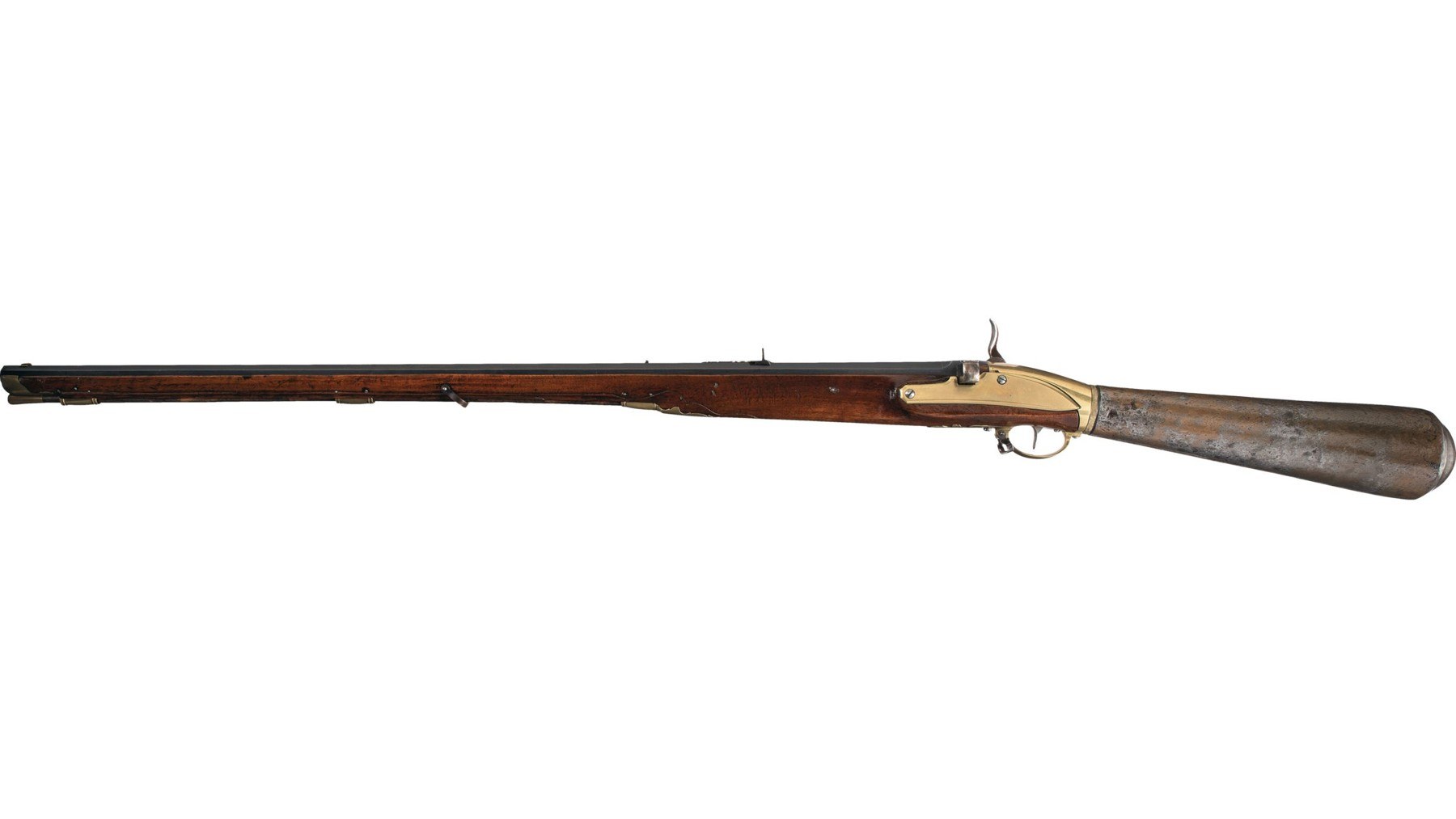
The military rifles that have been described in print carry a consistent set of marks:
Table 2 — The military rifles that have been described in print carry a consistent set of marks
| Mark | Where | Seen on | Source |
|---|---|---|---|
| G (Girardoni’s mark) | Top of the brass receiver; sometimes on the flask | Lots 272 and 357; G 1493; the HGM rifle “versehen mit dem Zeichen G. 162” | Rock Island; Christie’s; Haller1104 |
| A number, preceded on two rifles by a “tree-like symbol (possibly acting as a ‘1’)“ | Rear of the receiver, near the flask | 382 (lot 272), 356 (lot 357), 1493 (Christie’s) | Rock Island; Christie’s110 |
| A separate number on the flask | Flask collar or threads | ”263” with the tree-like symbol (lot 272); “2” (lot 357); “3” (G 1493) | Rock Island; Christie’s110 |
| Austrian military eagle | Top of the barrel at the breech; front flat of the flask’s threaded section | Lots 272 and 357 | Rock Island1 |
| Fleur-de-lis | Stock, left side above the side plate | Lots 272 and 357 | Rock Island1 |
| Assembly marks: a series of punched or drilled pits | All key parts, matching | The Beeman rifle and, Beeman says, other authentic military specimens | Beeman2 |
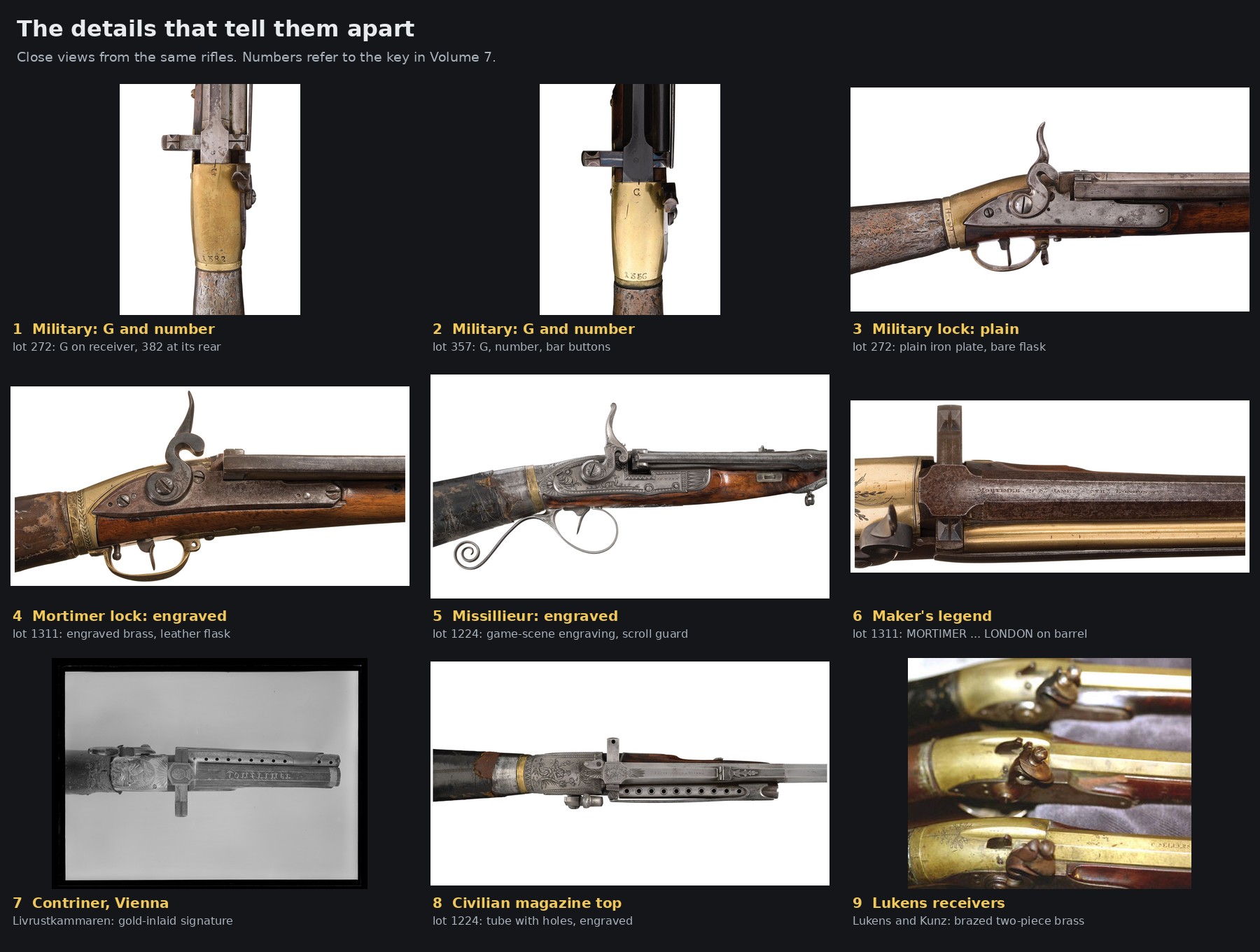
The fleur-de-lis on both Rock Island rifles is unexplained in the catalogues. It could be an arsenal or inspection mark, or a later collection mark; lot 357 came from the Beeman collection and lot 272’s provenance is not given. Two rifles are not enough to say.
The Beeman rifle has no G and no number. Ernest Cowan judged that its receiver is “somewhat lower and thinner in the locations where the serial number would be expected” and that the front of the flask’s end cap “appears to have been filed shorter”, and concluded that the marks had been removed.2 That conclusion is Cowan’s, reported by Beeman; no photograph of the area was found.
7.4 What the numbers suggest
If the “tree-like symbol” before 382 and 356 is a 1, as Rock Island’s cataloguer suggests it may be, the three published receiver numbers are 1356, 1382 and 1493, and the Vienna museum’s rifle of 1891 is 162.1104 Read that way:
- Numbers above 1,300 fit the documented stock of 1,313 rifles in March 1790 and an order that production was to continue (Volume 2).4
- A number of 1493 fits the “about 1,500” that Beeman, citing Hoff and Hummelberger and Scharer, gives as the total made.2
- The numbering would run consecutively through the whole production.
This is an inference from three published numbers and an auction cataloguer’s tentative reading of a symbol. It is offered as a line of enquiry, not a finding. A register of every surviving military rifle’s receiver and flask numbers, which does not appear to have been published, would settle it, and would also show whether flasks stayed with their rifles: the separate flask numbers (263, 2, 3) suggest they did not.
7.5 Military or civilian: the comparison plates
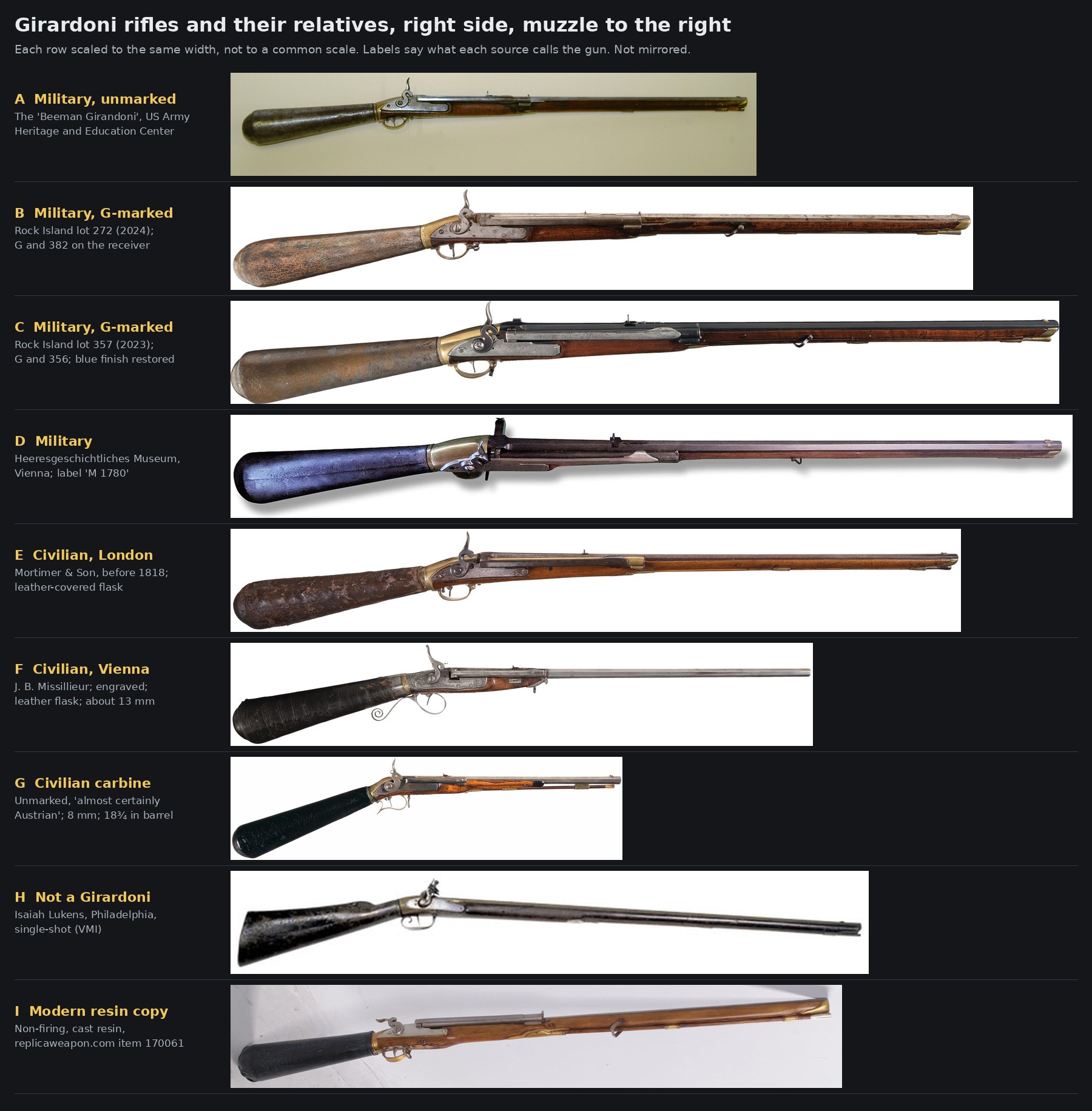
The two plates in this volume follow the hub’s identification rule: same side, same orientation, labelled as each source labels the gun, scaled to equal width rather than to a common scale, nothing mirrored. Each photograph was inspected and its label checked against the identification rules below; rejected images and the reasons are listed in photo_credits.txt.
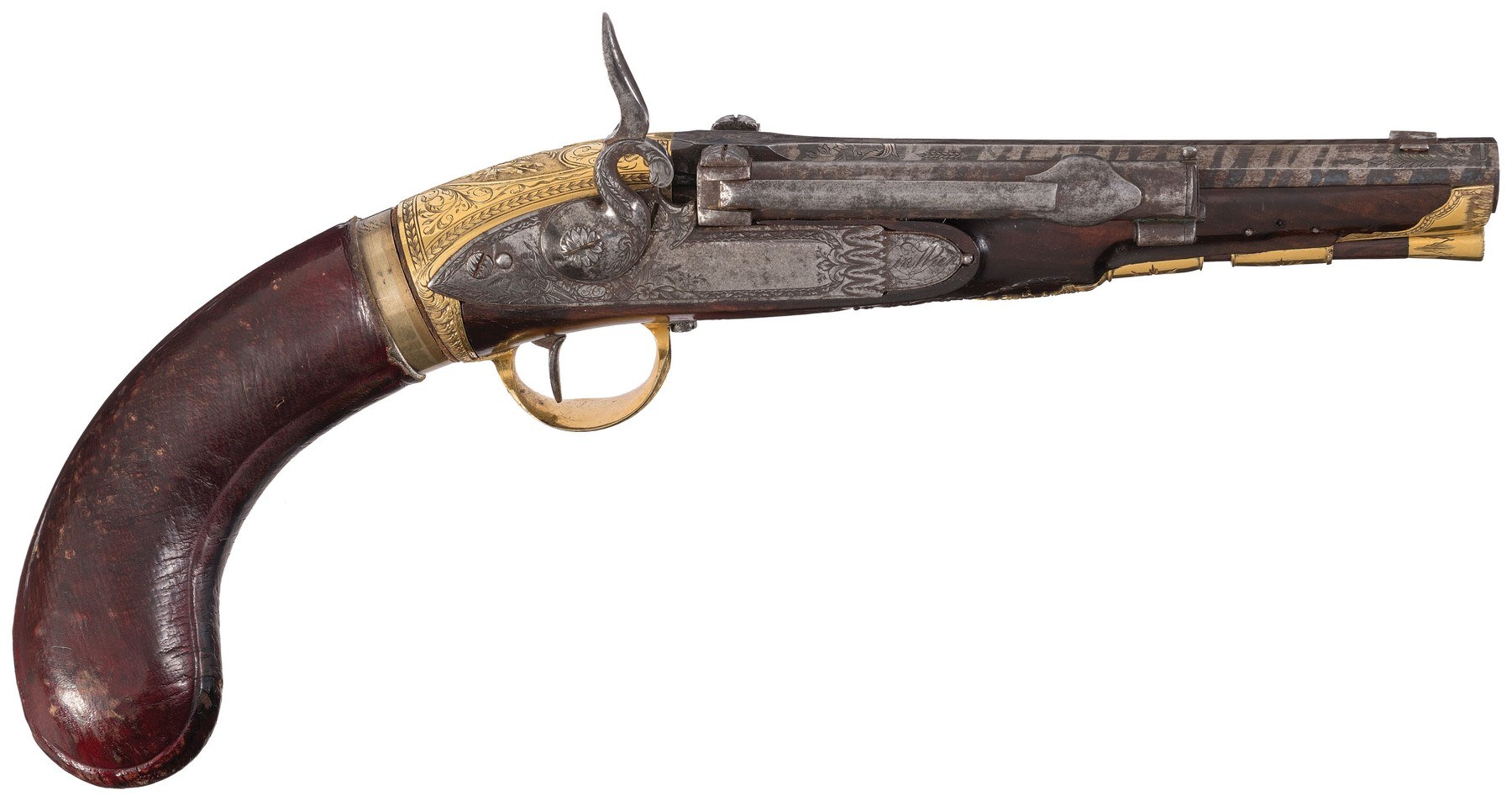
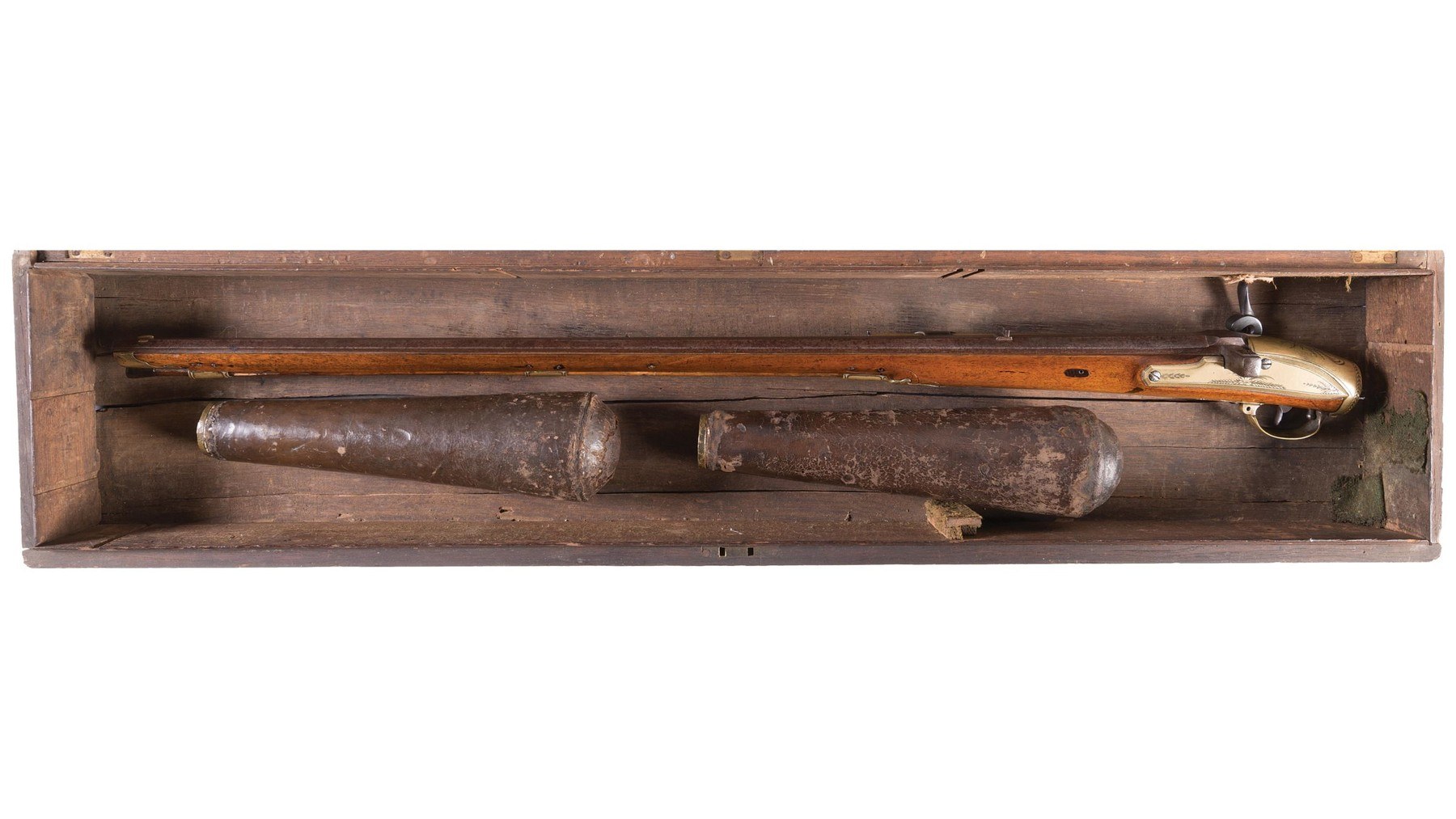
The plates show that the military pattern is a plain, utilitarian rifle: bare iron flask with a brass collar, cast brass receiver with a plain side plate, plain iron lock plate and S-hammer, walnut full stock with plain or lightly incised border carving, sling swivels, and the G and number on top. The civilian rifles on the system keep the mechanism and change everything else: leather-covered flasks, engraved brass or steel, gold and silver inlay, makers’ names, scrolled trigger guards, shorter magazines (Beeman reports 16 to 20 balls, “probably to make these gentleman’s guns lighter”), and, on Beeman’s evidence, air-release bypass levers and V-shaped mainsprings instead of the military’s flat spring.2
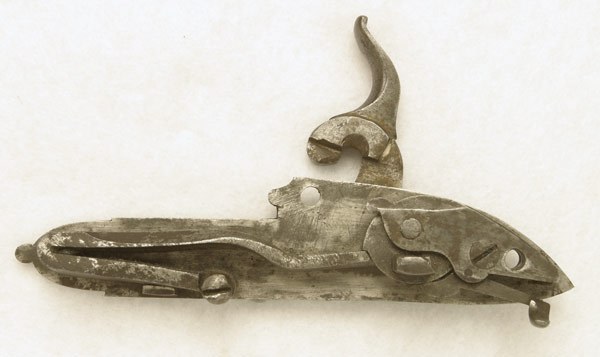
7.6 Tell them apart
Table 3 — Tell them apart
| Feature | Austrian military (M1780) | Civilian on the Girardoni system | Lukens / Kunz (Philadelphia) | Modern museum copy | Resin casting | Where to look |
|---|---|---|---|---|---|---|
| Flask | Bare iron, brass collar; removable leather cover issued | Leather fixed on the flask | Butt reservoir in a Kentucky-style stock line, copper or iron | As original (Cowan copied the bare flask) | Cast, painted black | Butt |
| Magazine | Tube on the right of the barrel, about 20–21 balls | Tube on the right, often shorter (16–20); some perforated along the top | None: single shot, muzzle-loaded | As original | Moulded, solid | Right side of barrel |
| Loading bar | Plain bar with ridged buttons each end | Same system, often engraved | None | As original | Moulded, no movement | Top of the breech |
| Lock | Plain iron plate, S-hammer, flat mainspring inside | Engraved; often a V mainspring; may have an air-release bypass lever | Flintlock-style external lock, gooseneck or double-neck hammer | As original | Moulded | Right side |
| Receiver | One-piece brass casting forming the top only | Brass or steel, often engraved or gilt | Two brass halves brazed on the centre line, enclosing top and bottom | Sand-cast brass from the original | Moulded | Underside with lock off; the joint with the flask |
| Marks | G on receiver; number; eagle on barrel and flask; matching pit assembly marks | Maker’s name and city (“Contriner”, “MORTIMER … LONDON”, “J:B:MISSILLIEUR A VIENNE”) | “LUKENS” on some lock plates | Cowan’s copies are marked to match; Beeman says even the Beeman rifle’s carvings were copied | Seller’s casting; no marks of its own | Top of receiver, barrel, lock plate |
| Calibre | About 11.5–11.8 mm (.45–.46) | Varies: 8 mm to 13 mm in examples above | About .31–.36 | As original | No bore | Muzzle |
| Sling swivels | Yes | Usually not (Beeman) | No | As original | Moulded | Underside |
Sources for the table: Beeman; Rock Island Auction lots 272, 357, 1224, 1311, 3294; Christie’s; Livrustkammaren; the resin seller’s page.2110711
Beeman adds one more test for authenticity: the junction between the iron flask and the brass receiver. On an authentic specimen the lines run smoothly from one to the other; “corrupted or non-original copies may display significant differences at this point”.2
7.7 The makers of Girardoni-system arms
After 1801, and especially after 1815, Viennese and London gunmakers built sporting rifles, shotguns and pistols on Girardoni’s system. Those named in the sources read:
Table 4 — After 1801, and especially after 1815, Viennese and London gunmakers built sporting rifles, shotguns and pistols on Girardoni's system. Those named in the sources read
| Maker | Place, dates as given | Known pieces, as described | Source |
|---|---|---|---|
| Joseph Contriner | Vienna, about 1800–1815 | Repeating rifles (Livrustkammaren; Beeman collection, about 16 balls, V mainspring); one bought by the Danish king at the Congress of Vienna, 1815 (Hoff via Beeman); a pistol signed “JC” | Livrustkammaren; Beeman; Rock Island lot 223721 |
| Joseph Lowentz (Lowenz) | Vienna, about 1810 | A repeater with a 17-ball magazine and .464 bore (Beeman collection); single shots | Beeman2 |
| Schembor | Vienna | Named among the makers | Beeman2 |
| J. B. Missillieur | Vienna by 1821; Prague by 1834 | Engraved sporting repeater, about 13 mm | Rock Island lot 12241 |
| Samuel Staudenmayer | London, about 1805/1806–1832 | Modified versions, magazines of 16 to 20 | Beeman2 |
| Mortimer & Son | London, before 1818 | Engraved repeater, cased, with two flasks, one possibly a Girardoni original | Rock Island lot 13111 |
| Fisher | London | Named among the makers | Beeman2 |
| E. A. Stormer | Herzberg | Repeating rifle/shotgun and a pistol on the system | Rock Island blog12 |
| ”Girandony” / “JG” | Vienna, about 1800 | A gold-plated repeating pistol, lock marked “JG”, barrel signed “Girandony”; Beeman suggests Girardoni’s son Johann | Beeman2 |
7.8 Restorations, composites, copies and castings
Four kinds of object can be mistaken for an original military rifle:
- Restored originals. Rock Island’s descriptions are frank: lot 357 has “restored blue finish” and “recut incised carvings”; the Missillieur has “professionally recut engraving” and “rewrapped” leather; the Beeman rifle had an American-walnut forend splice (Volume 4).12 Restoration does not make a rifle a fake, but it changes what its surfaces can tell.
- Composites and conversions. The Heiberger rifle in the Royal Armouries test was a single-shot Viennese air rifle of about 1750–60 converted, perhaps in 1815–40, by fitting a barrel, magazine and loading bar “from a disabled Girandoni-system airgun”; Beeman knew of no other.2 Flask numbers that do not match receiver numbers (above) show that flasks were exchanged. Beeman notes that surviving rifles may have been fitted with non-original flasks after failures.2
- Museum copies. Ernest Cowan and Richard Keller made four “ultra precise” copies of the Beeman rifle, marked with matching assembly pits and, Beeman writes, with the Beeman rifle’s carved lines “very carefully copied … onto the four museum copies”.2 Baker and Currie built at least one working replica. Such copies are deliberately faithful; their makers’ records are the only sure way to separate them from an original.
- Resin castings. A non-firing resin copy “cast from original weapons” is sold by replicaweapon.com (item 170061; $199.00 plus $25 freight in the lower 48, as listed on the seller’s page on 18 October 2026), with a blaze-orange barrel plug and “no moving parts”.11 It weighs 1.8 kg, under half a real rifle, and is no risk to an informed buyer, but photographs of it circulate with Lewis and Clark captions.
Beeman also warns that 20th-century copies of the system “generally are unsigned and some are crude, even clumsy”.2
7.9 The market
Prices realised at Rock Island are shown only to logged-in users and could not be read. The pre-sale estimates, from the catalogue pages:1
Table 5 — The market
| Lot | Date | Object | Estimate |
|---|---|---|---|
| 272 | 17 May 2024 | Austrian military M1780, G and 382 | $30,000–50,000 |
| 357 | 8 Dec 2023 | Austrian military M1780, G and 356, ex-Beeman, restored finish | $20,000–40,000 |
| 1311 | 12 Sep 2020 | Mortimer & Son, London, cased | $14,000–22,500 |
| 223 | 19 May 2023 | ”JC” Girardoni-system pistol, ex-Beeman | $12,000–20,000 |
| 1224 | 20 May 2023 | J. B. Missillieur, Vienna, ex-Beeman | $9,500–16,000 |
| 3294 | 2 Dec 2018 | Unmarked Girandoni-system carbine | $5,000–8,000 |
Christie’s offered the military rifle marked G 1493 as lot 129; the sale date and result were not shown on the page read.10 Beeman records an auction appraisal of £1,000–1,200 for a lot of three Viennese air guns including a Lowentz Girandoni-system repeater in about 2004.2 Estimates are not prices, and the military rifles’ estimates already carry the Lewis and Clark association; Rock Island’s catalogues of 272 and 357 lead with it.
7.10 Owning one
An antique air gun is not a firearm under federal law or Michigan’s, because nothing in it is an explosive; the hub’s Diana 34 dive sets out both definitions and Michigan’s separate “pneumatic gun” category (Diana 34, Volume 7). Buying, owning or shipping an original raises no firearms-law question. Whether a .46 round ball counts as a “pellet” within Michigan’s pneumatic-gun definition is taken up in Volume 8.
The practical rules for an owner come from Volume 5: never charge an original flask; keep the flask off the rifle; do not use a steel rod in the bore; do not let the leather dry out; and leave dismantling the lock, with its flat mainspring, to someone who knows to restrain the spring with a punch.
References
Footnotes
-
Rock Island Auction Company, lot pages, accessed 2026-10-18: lot 272, 17 May 2024, https://www.rockislandauction.com/detail/4091/272 ; lot 357, 8 December 2023, https://www.rockislandauction.com/detail/4090/357 ; lot 1311, 12 September 2020, https://www.rockislandauction.com/detail/80/1311 ; lot 1224, 20 May 2023, https://www.rockislandauction.com/detail/88/1224 ; lot 223, 19 May 2023, https://www.rockislandauction.com/detail/88/223 ; lot 3294, 2 December 2018, https://www.rockislandauction.com/detail/75/3294 . ↩ ↩2 ↩3 ↩4 ↩5 ↩6 ↩7 ↩8 ↩9 ↩10 ↩11 ↩12 ↩13 ↩14
-
Robert D. Beeman, “Austrian Large Bore Airguns: Girandoni style air rifles and pistols” (updated 17 July 2007) and “New Evidence on the Lewis and Clark Air Rifle” (updated 15 May 2008), formerly at beemans.net, read through the Internet Archive: https://web.archive.org/web/2022/http://www.beemans.net/Austrian%20airguns.htm and https://web.archive.org/web/2022/http://www.beemans.net/lewis-assault-rifle.htm . Accessed 2026-10-18. ↩ ↩2 ↩3 ↩4 ↩5 ↩6 ↩7 ↩8 ↩9 ↩10 ↩11 ↩12 ↩13 ↩14 ↩15 ↩16 ↩17 ↩18 ↩19 ↩20 ↩21 ↩22 ↩23 ↩24
-
Photographs by M11rtinb, 2 May 2018, Category:Girandoni air rifle and Category:Firearms in the Heeresgeschichtliches Museum, Wikimedia Commons, https://commons.wikimedia.org/wiki/Category:Girandoni_air_rifle . Accessed 2026-10-18. ↩
-
August Haller, “Die österreichische Militär-Repetir-Windbüchse des vorigen Jahrhunderts”, Organ der Militärwissenschaftlichen Vereine, vol. 42 (Vienna, 1891), pp. 34–45, and the volume’s list of plates (“Tafel 2. Darstellung einer mit dem Zeichen G. 162 versehenen Windbüchse aus dem k. und k. Heeres-Museum”). Internet Archive item bub_gb_XF0-AQAAMAAJ. The plate itself is not captured in that scan. Accessed 2026-10-18. ↩ ↩2 ↩3 ↩4
-
“Girandoni Air Rifle.jpg” and “Austrian Girandoni system Accouterments Bag.jpg”, Army Heritage Museum, U.S. Army, public domain, Wikimedia Commons. Accessed 2026-10-18. ↩
-
“Girandoni air rifle pump.jpg”, Armémuseum (Swedish Army Museum), CC BY-SA 3.0, Wikimedia Commons, https://commons.wikimedia.org/wiki/File:Girandoni_air_rifle_pump.jpg . Accessed 2026-10-18. ↩
-
Livrustkammaren, “Luftbössa med kulmagasin, Contriner, Wien ca 1800”, museum description and photographs LSH 17703 and 34827, Wikimedia Commons, https://commons.wikimedia.org/wiki/File:Luftb%C3%B6ssa_med_kulmagasin,_Contriner,_Wien_ca_1800_-_Livrustkammaren_-_17703.tif . Accessed 2026-10-18. ↩ ↩2 ↩3
-
“Girandoni-Windbüchse”, German Wikipedia, https://de.wikipedia.org/wiki/Girandoni-Windb%C3%BCchse . Accessed 2026-10-18. ↩
-
Roberto Pappacena, “I benemeriti di Cortina d’Ampezzo: 1) Bartolomeo Gilardoni”, Internet Archive capture of 10 May 2006, https://web.archive.org/web/20060510055333/http://staff.sunrise.it/polovalboite/giacomel/benemeriti1.htm . Accessed 2026-10-18. ↩ ↩2
-
Christie’s, “A Rare 50-Bore Austrian Breech-Loading Military Repeating Air Rifle On The Girandoni System, Circa 1780–90”, lot 129, https://www.christies.com.cn/lot/lot-842927 . Accessed 2026-10-18. ↩ ↩2 ↩3 ↩4 ↩5 ↩6 ↩7
-
replicaweapon.com, “Girardoni replica Lewis and Clarke air gun”, item 170061, https://replicaweapon.com/product/girandoni-air-rifle-lewis-and-clark-sale/ . Price as listed on 2026-10-18. ↩ ↩2
-
Joe Engesser, “The Girardoni Air Rifle”, Rock Island Auction Company, 21 November 2023, https://www.rockislandauction.com/riac-blog/girardoni-air-rifle . Accessed 2026-10-18. ↩

Comments (0)