Girardoni Air Rifle · Volume 3
Lewis and Clark's Air Gun — What the Journals Actually Say
Every dated passage found in the expedition journals, quoted as written: a woman wounded at Brunot's Island, a judge's description at Wheeling, 'great medicine' from the Missouri to the Columbia, a broken mainspring, knocked-off sights, a signal for a lost man, a wounded captain's last resort, and a box sent east
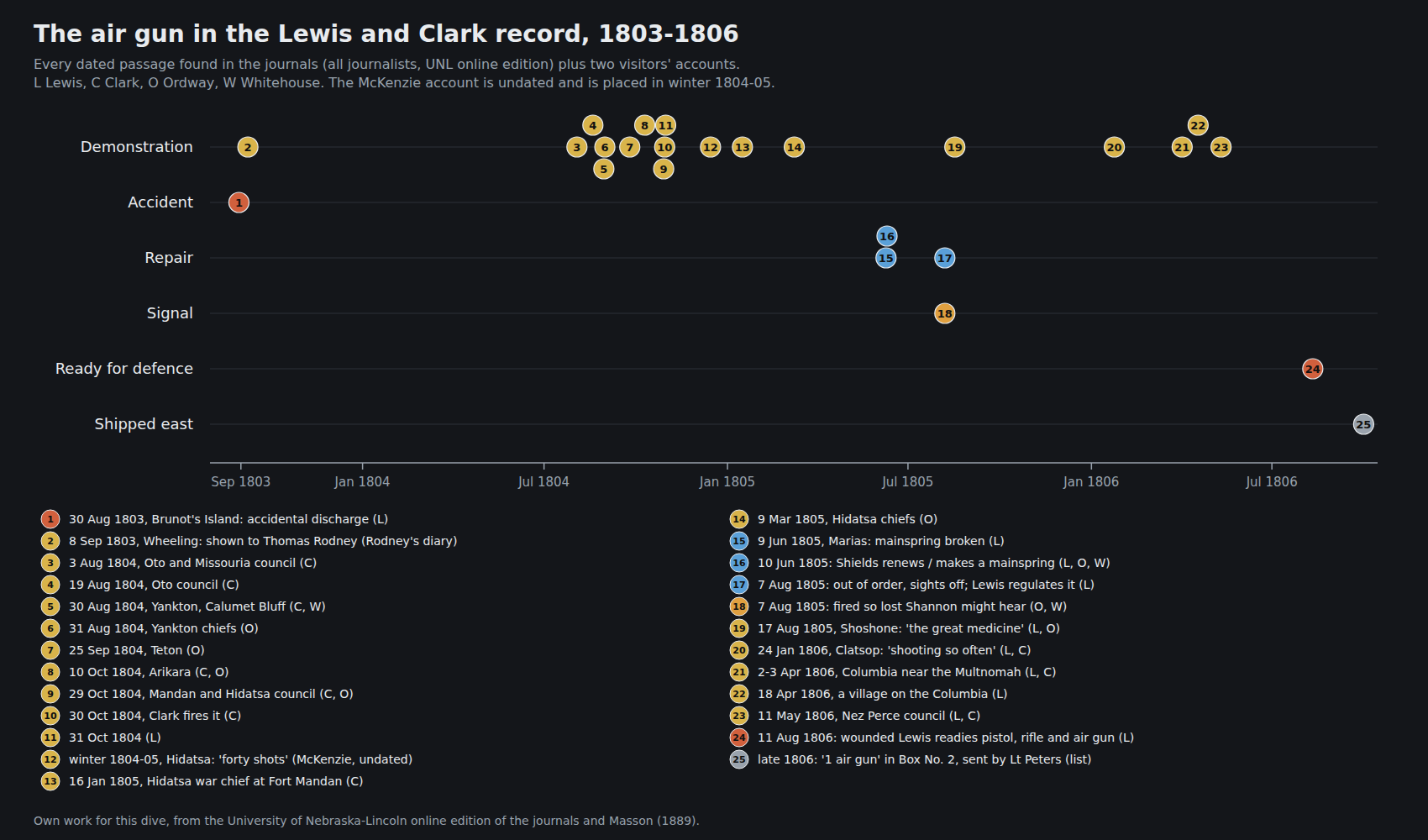
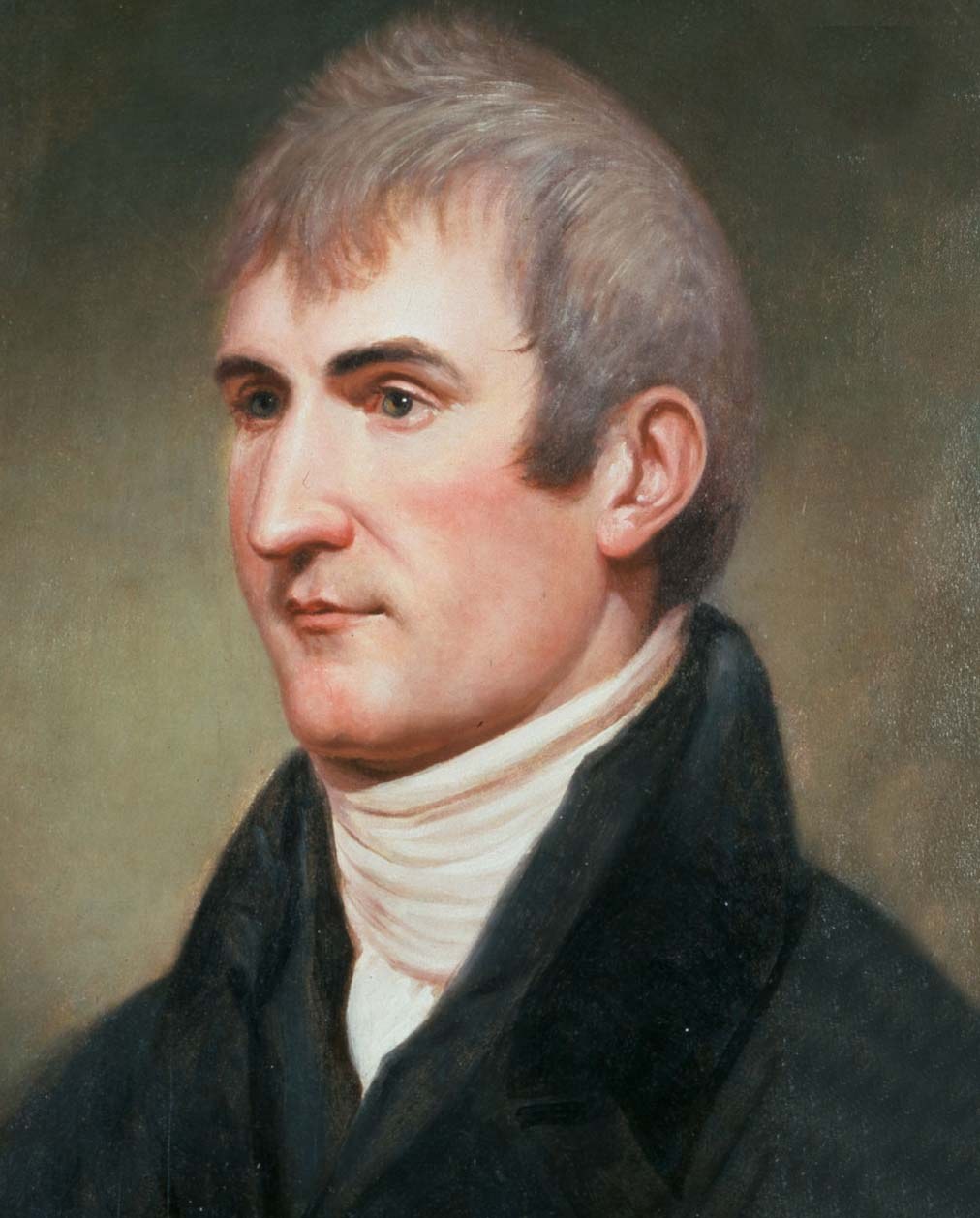
The Lewis and Clark Expedition of 1803–1806 carried one air gun across the continent and back, and its journals mention it more often than any other single weapon. They never say who made it. That silence is the subject of the next volume. This one sets out what the record does say, passage by passage, so that a reader can judge the arguments in Volume 4 against the words they are built on.
3.1 How the passages were found
The text here is from the University of Nebraska–Lincoln’s online edition of The Journals of the Lewis and Clark Expedition, edited by Gary E. Moulton, which prints every journalist’s entry for a date on one page.1 The site’s search is fuzzy and returns different dates for “airgun”, “air gun”, “air-gun” and “air* gun”. The union of those searches, 69 dates, was taken, every one of those date pages was read, and only paragraphs that actually contain the words were kept. That found 39 paragraphs on 25 dates across Lewis, Clark, Sergeant John Ordway and Private Joseph Whitehouse, plus a list of items sent east at the end of 1806. The extracted text is kept with this dive’s research notes.
Two often-quoted counts should be read with that in mind. Robert Beeman wrote that the air gun “was mentioned 39 times in the expedition journals (Moulton, 1986–2001), more than any other weapon on the trip”, and Philip Schreier of the NRA’s National Firearms Museum that “there are 39 passages in the journals where Lewis runs through the same routine”.23 The search here also found 39 paragraphs, which is close to a coincidence: several are two journalists describing the same event, one is an editor’s footnote, and several are repairs or other uses, not demonstrations. The firm figure from this search is 25 dated days on which some journalist mentions the gun, of which 19 are demonstrations to Native audiences or visitors.
3.2 August 1803: “my airgun which I had purchased”
Lewis’s very first journal entry, written as the keelboat left Pittsburgh, is about the air gun:1
“Left Pittsburgh this day at 11 ock with a party of 11 hands 7 of which are soldiers, a pilot and three young men on trial they having proposed to go with me throughout the voyage. Arrived at Bruno’s Island 3 miles below halted a few minutes. went on shore and being invited on by some of the gentlemen present to try my airgun which I had purchased brought it on shore charged it and fired myself seven times fifty five yards with pretty good success; after which a Mr. Blaze Cenas being unacquainted with the management of the gun suffered her to discharge herself accedentaly the ball passed through the hat of a woman about 40 yards distanc cuting her temple about the fourth of the diameter of the ball; shee fell instantly and the blood gusing from her temple we were all in the greatest consternation supposed she was dead by [but] in a minute she revived to our enespressable satisfaction, and by examination we found the wound by no means mortal or even dangerous …”
Five points in this entry carry weight later:
- “which I had purchased.” Lewis bought the gun. He does not say from whom, where or when.
- “charged it”: he pumped it up on the spot.
- “fired myself seven times fifty five yards”: seven shots in a short demonstration, at about 50 metres, “with pretty good success”.
- “being unacquainted with the management of the gun suffered her to discharge herself”: the gun went off in an unfamiliar man’s hands. How that can happen with a Girardoni-type lock, and why the Austrian regulation of 1788 warned against it, is in Volume 5.
- The wound: a ball through a woman’s hat at about 40 yards that cut her temple “about the fourth of the diameter of the ball”. She was stunned, not badly hurt.
Moulton’s footnotes add that the entry is probably misdated, since Lewis told Jefferson he left on the 31st; that Brunot’s Island was named for Dr Felix Brunot, a French physician settled in Pittsburgh; and that Blaze Cenas was related to Brunot by marriage. On the gun itself, footnote 5 gives the edition’s view, which Volume 4 examines: it “was probably manufactured by Isaiah Lukens, horologist and gunsmith of Philadelphia”.1
3.3 September 1803: Thomas Rodney at Wheeling
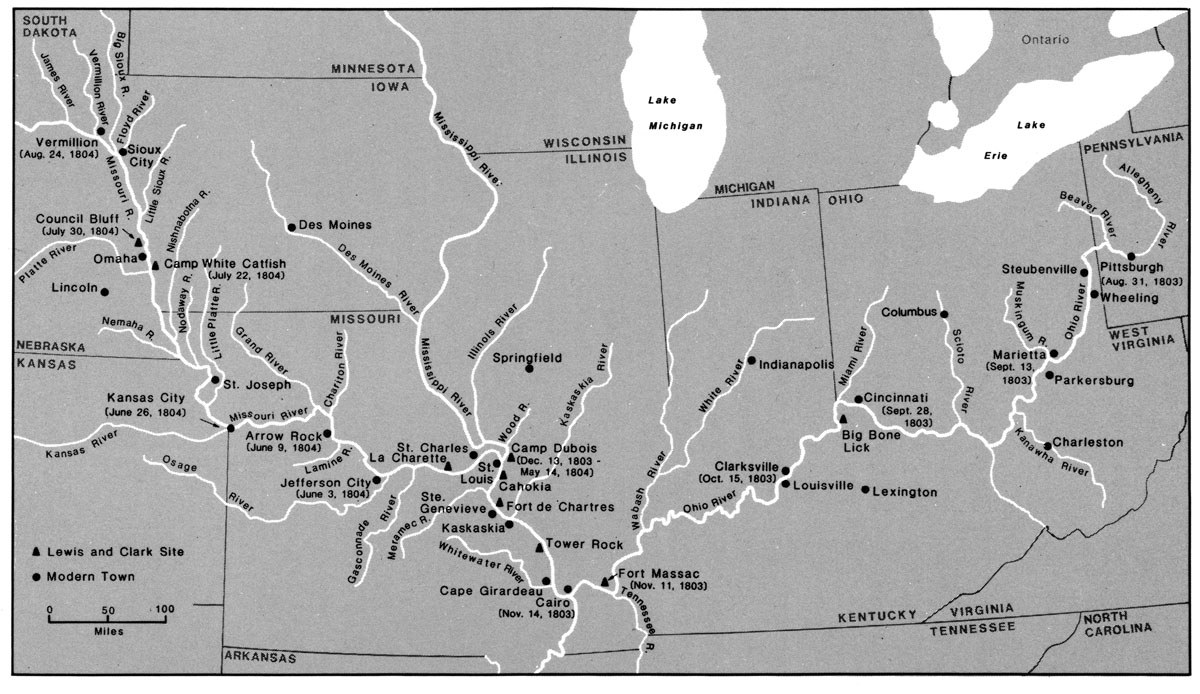
Nine days later, at Wheeling on the Ohio, Lewis wrote only that he “dined with Colo. Rodney and his suit, in the evening they walked down to my boat and partook of some watermellons”.1 The visitor was Thomas Rodney of Delaware, a judge travelling to the Mississippi Territory on a Jefferson appointment. His travel journal, published in 1997 as A Journey Through the West, edited by Dwight L. Smith and Ray Swick, describes the same evening at length. It was brought to the notice of Lewis and Clark students by Michael Carrick, then a staff editor of The Gun Report, in 2002.23 The book was not available for this dive; the passage is quoted here as Beeman transcribed it:2
“Visited Captain Lewess barge. He shewed us his air gun which fired 22 times at one charge. He shewed us the mode of charging her and then loaded with 12 balls which he intended to fire one at a time; but she by some means lost the whole charge of air at the first fire. He charged her again and then she fired twice. He then found the cause and in some measure prevented the airs escaping, and then she fired seven times; but when in perfect order she fires 22 times in a minute. All the balls are put at once into a short side barrel and are then droped into the chamber of the gun one at a time by moving a spring; and when the triger is pulled just so much air escapes out of the air bag which forms the britch of the gun as serves for one ball. It is a curious peice of workmanship not easily discribed and therefore I omit attempting it.”
Schreier’s American Rifleman article quotes the same passage in modernised spelling.3 Its details are specific:
- “fired 22 times at one charge” / “22 times in a minute”: a repeater with a large magazine and enough air for twenty-odd shots.
- “loaded with 12 balls”: the balls go in as a load, several at a time.
- “All the balls are put at once into a short side barrel”: a tubular magazine alongside the barrel.
- “droped into the chamber of the gun one at a time by moving a spring”: a sprung feed moved by hand.
- “the air bag which forms the britch of the gun”: a reservoir that is the butt.
- “just so much air escapes … as serves for one ball”: a valve opened briefly by each pull of the trigger.
- Faults: the whole charge lost at the first shot; then two shots; then, after Lewis “found the cause”, seven.
Every one of those features matches the Girardoni system (Volume 5), and the side magazine with a sprung transverse feed matches nothing else known from the period. That is why the passage is the foundation of the case that Lewis carried a Girardoni. Its weaknesses are just as specific, and Volume 4 sets them out: Rodney’s own editors warned that “creative exaggeration and rich embellishment had their share in coloring his memory”, according to Beeman, who for that reason rejected the passage in 2004 before changing his mind.2 Lewis’s own entry for the day confirms the visit to the boat but does not mention the gun.
3.4 The demonstrations, 1804–1806
Once the expedition was on the Missouri, the air gun became part of a ritual repeated at council after council: a speech, presents and medals for the chiefs, a parade, and then the air gun. The journals record it this way, in each writer’s spelling:1
Table 1 — The demonstrations, 1804–1806
| Date | Where, with whom | Writer | Words |
|---|---|---|---|
| 3 Aug 1804 | Oto and Missouria council | Clark | ”after Cap Lewis Shot his air gun a few times which astonished the nativs, we Set Sail” |
| 19 Aug 1804 | Oto council | Clark | ”We Showed them many Curiosities and the air gun which they were much asstonished at” |
| 30 Aug 1804 | Yankton, Calumet Bluff | Clark | ”the air gun astonished them verry much” |
| 30 Aug 1804 | the same | Whitehouse | ”Capt. Lewis Shot his air gun told them that their was medician in hir & that She would doe Great execution” |
| 31 Aug 1804 | Yankton chiefs | Ordway | ”the Commanding officers Shewed them the air gun and a great many other curiousityes” |
| 25 Sep 1804 | Teton | Ordway | ”Capt. Lewis Shewed them the air Gun. Shot it Several times.” |
| 10 Oct 1804 | Arikara | Clark; Ordway | ”we Shot the Air gun, which astonished them”; “our Capts. Shot the air Gun. they appeared to be astonished at the Site of it & the execution it would doe” |
| 29 Oct 1804 | Mandan and Hidatsa council | Clark; Ordway | ”Shot the air gun which both Surprised and astonished the nativs”; “Capt. Lewis Shot the air Gun which pleased them much” |
| 30 Oct 1804 | Mandan | Clark | ”after my Shooting the air gun he departed” |
| 31 Oct 1804 | Mandan | Lewis | ”spoke to them shot my airgun” |
| 16 Jan 1805 | Hidatsa war chief at Fort Mandan | Clark | ”we Shot the Air gun, and gave two Shots with the Cannon which pleased them verry much” |
| 9 Mar 1805 | Hidatsa chiefs at Fort Mandan | Ordway | ”Capt. Lewis Shewed them the air Gun quadron & Spy Glass &.C. which they thought was Great Medicines” |
| 17 Aug 1805 | Shoshone | Lewis; Ordway | ”I also shot my air-gun which was so perfectly incomprehensible that they immediately denominated it the great medicine”; “they thought a great meddicine” |
| 24 Jan 1806 | Clatsop, Fort Clatsop | Lewis; Clark | ”My Air-gun also astonishes them very much, they cannot comprehend it’s shooting so often and without powder” |
| 2–3 Apr 1806 | Columbia, near the Multnomah | Lewis; Clark | ”I shot my air gun, with which they were much astonished”; “Capt Lewis fired his Air gun which astonished them in Such a manner that they were orderly and kept at a proper distance” |
| 18 Apr 1806 | a village on the Columbia | Lewis | ”I shot my airgun in the presents of the natives at the village which excited great astonishment” |
| 11 May 1806 | Nez Perce council | Lewis; Clark | ”shewing them the power of magnetism, the spye glass, compass, watch, air-gun and sundry other articles equally novel and incomprehensible to them” |
The fullest description of a single demonstration is Whitehouse’s fair copy for 30 August 1804, at the Yankton council at Calumet Bluff:1
“After they had finished dancing Captain Lewis took his Air Gun and shot her off, and by the Interpreter, told them that there was medicine in her, and that she could do very great execution, They all stood amazed at this curiosity; Captain Lewis discharged the Air Gun several times, and the Indians ran hastily to see 〈if to see〉 the holes that the Balls had made which was discharged from it. at finding the Balls had entered the Tree, they shouted a loud at the sight and the Execution that was done surprized them exceedingly.”
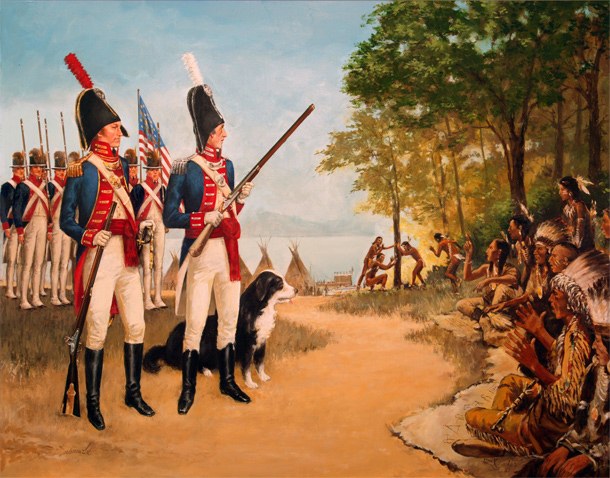
Three things stand out across the table. Lewis did almost all the shooting, and Clark only once in his own words (“after my Shooting the air gun”, 30 October 1804). The gun was shown with the other “curiosities” (a magnet, a spyglass, a compass, a watch, a quadrant) as evidence of power and knowledge, not as a weapon. And the reaction was always the same word: astonished. Beeman’s reading is that Lewis was conducting “air power diplomacy” with an implied threat of firepower; the journals themselves are content to record that it impressed.2
One entry contains a slip that has been read as evidence of more than one air gun. On 10 October 1804 Clark wrote “we Shot the air guns”. Moulton’s note says: “This is the only indication that there may have been more than one air gun with the party, and it is very likely a slip of the pen.”1 Every other passage, by every writer, says “the air gun” or “my air gun”.
3.5 “Forty shots out of one load”: a trader’s account
One outsider besides Rodney described the gun. Charles McKenzie, a North West Company trader who was among the Hidatsa (the “Gros Ventres”) in the winter of 1804–05, wrote an account later printed in Louis-Rodrigue Masson’s Les Bourgeois de la Compagnie du Nord-Ouest (1889). Telling of Lewis’s visit to the Hidatsa villages, he wrote:4
“The Indians admired the air gun, as it could discharge forty shots out of one load, but they dreaded the magic of the owners. ‘Had I these white warriors in the upper plains’ said the Gros Ventres chief, ‘my young men on horseback would soon do for them, as they would do for so many wolves,’ for, continued he, ‘there are only two sensible men among them, the worker of iron and the mender of guns.’”
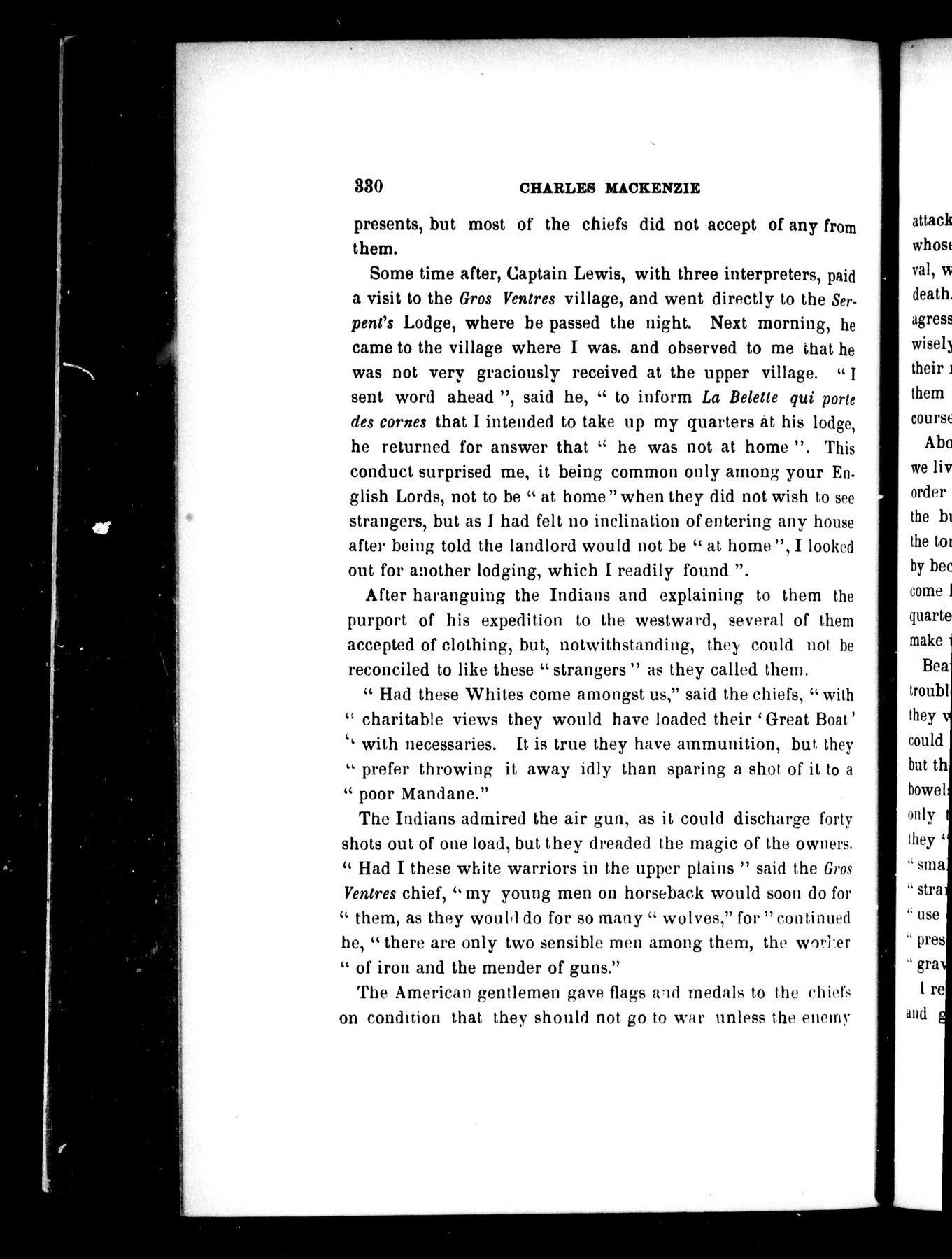
“Forty shots out of one load” is ambiguous. Beeman reads “load” as a charge of air, the way modern pre-charged rifles are described, and takes it as evidence of a large butt reservoir; he also suggests it may simply be what Lewis told McKenzie, or two magazine loads of twenty.2 It cannot mean forty balls in the magazine, which no Girardoni-system rifle had. The Austrian army’s own regulation of 1788 said that a flask “holds 40 shots, but they are not effective at the same distance” (Volume 6), which is the most striking match in the record: McKenzie’s forty is the Austrian army’s forty.5 A single-shot butt-reservoir gun pumped full could also fire forty times from one charge, reloaded by hand each time, so the figure supports a butt reservoir of Girardoni size more firmly than it supports a repeater. The chief’s remark about the “worker of iron and the mender of guns”, the expedition’s smiths, is the most quoted line in McKenzie’s account and has nothing to do with the gun.
3.6 June 1805: the broken mainspring
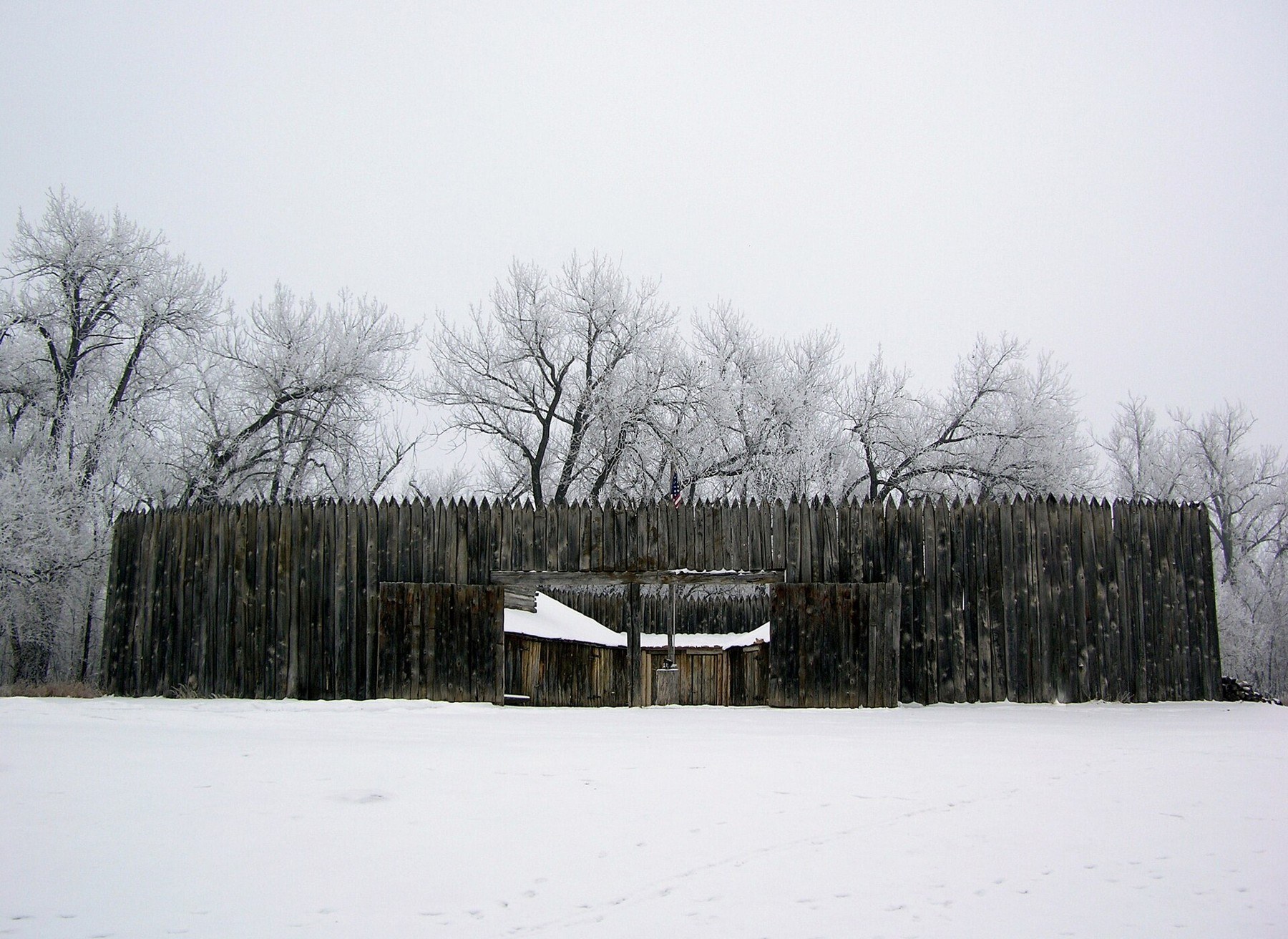
At the mouth of the Marias River in June 1805, preparing to cache heavy stores and leave the blacksmith’s bellows behind, Lewis wrote on 9 June:1
“as we had determined to leave our blacksmith’s bellows and tools here it was necessary to repare some of our arms, and particularly my Airgun the main spring of which was broken, before we left this place.”
The next day, 10 June:1
“Shields renewed the main Spring of my air gun we have been much indebted to the ingenuity of this man on many occasions; without having served any regular apprenticeship to any trade, he makes his own tools principally and works extreemly well in either wood or metal …”
The enlisted men saw the same job. Ordway: “the blacksmiths fixed up their bellowes & repaired the air gun & Several other fire arms.” Whitehouse: “The black Smiths fixed up the bellowses & made a main Spring to Capt. [Lewis’s] air Gun, as the one belonging to it got broke.”1
Whitehouse’s “made a main Spring” is the most precise of the three: Shields did not mend the broken spring, he made a new one. That is the passage behind the strongest physical claim in Volume 4, that the Beeman rifle has an old replacement mainspring made from a farrier’s file. Note what it does and does not establish: the gun had a mainspring that could break and be replaced by a camp smith. A Girardoni-type lock has a large flat mainspring; a Lukens-type lock has a mainspring too. The passage alone does not distinguish them.
3.7 August 1805: sights knocked off, and a signal for a lost man
On 6 August 1805 canoes overturned in rapids on the Jefferson River and the expedition’s goods were soaked. On 7 August Lewis wrote:1
“my air gun was out of order and her sights had been removed by some accedent I put her in order and regulated her. she shot again as well as she ever did.”
The same day, Private George Shannon was missing, and the gun was used to call him in. Ordway recorded “Capt. Lewis took an observation & Shoot the air gun”; Whitehouse’s fair copy explains why: “he also fired off his air gun several times in order that the Man that went out a hunting from the party that was with Captain Clarke up the North fork Yesterday & who we suppose is lost might hear the report, he having as yet not returned.”1 It is the only recorded use of the gun as a signal, and the plainest evidence in the record that it made a report loud enough to be worth firing for a man out of sight (Volume 2’s “silent rifle” legend).
The first entry is the basis of the second physical claim in Volume 4: that the Beeman rifle shows impact damage to its forend, barrel lug and front sight, and rough field file marks, consistent with an accident like this one and with Lewis’s “put her in order and regulated her”. “Regulated” in a gun context then meant adjusting the sights to the point of impact.
3.8 “Shooting so often and without powder”
At Fort Clatsop on the Pacific, on 24 January 1806, Lewis wrote of the Clatsop men who had watched George Drouillard shoot elk:1
“My Air-gun also astonishes them very much, they cannot comprehend it’s shooting so often and without powder; and think that it is great medicine which comprehends every thing that is to them incomprehensible.”
Clark copied the passage into his own journal as “our air gun”. “Shooting so often” is quoted as evidence of a repeater, and it fits one well. It is also exactly what a single-shot butt-reservoir gun does that a flintlock does not: it fires again and again from one charge of air, with no powder and no priming between shots. The sentence supports a reservoir gun of either kind more than it proves a magazine.
3.9 August 1806: a weapon after all
On the return journey Lewis was shot through the thigh while hunting with Pierre Cruzatte. Believing for some minutes that Indians had fired on him, Lewis wrote:1
“I now got back to the perogue as well as I could and prepared my self with a pistol my rifle and air-gun being determined as a retreat was impracticable to sell my life as deerly as possible.”
Beeman argued that the air gun was never seriously considered as a weapon on the expedition and was kept for show.2 This passage shows that when Lewis thought his life depended on it, he picked up the air gun with his rifle and pistol. It is the only passage in which the gun is treated as a weapon of defence.
3.10 Box No. 2
After the return to St Louis in September 1806, Lewis listed the items to be sent forward to Washington by Lieutenant Peters. The list, printed in the edition among the post-expedition documents, includes: “No. 2 — 2 Boxes Containing Various articles 1 Tin Case do do 1 air gun 4 Robins 1 Clat sop hat”.1 It is the last mention of the gun in any expedition document. What happened to it after that is the subject of the next volume.
3.11 What the journals never say
The silences are as important as the passages:
- No maker. No journalist names who made the gun, where it was bought, or what it cost.
- No description. Apart from “her sights” and “the main spring”, no part of the gun is named. Nothing in the journals mentions a magazine, a reservoir, a pump, balls by number or a calibre.
- No repeater. No journalist says the gun fired several shots without reloading; “shooting so often” (Lewis, 1806) is the nearest. The description of a repeater comes only from Rodney.
- No hunting. No passage found records game killed with it. Statements that the air gun was “used in hunting” or “to take game” (the VMI museum page; Rock Island Auction’s blog) have no support in the journal passages found.67
- No pump. The gun was charged (“charged it”, 1803) but no journal mentions a pump, how long charging took, or who did it.
These gaps are why the gun’s identity is still argued two centuries later. The Rodney passage, if it is accurate, describes a Girardoni. The journals describe a reservoir air gun that Lewis bought, that broke a mainspring and lost its sights, that astonished everyone, and that went east in a box.
References
Footnotes
-
The Journals of the Lewis and Clark Expedition, ed. Gary E. Moulton, 13 vols (Lincoln: University of Nebraska Press, 1983–2001), online edition by the Center for Digital Research in the Humanities, University of Nebraska–Lincoln, https://lewisandclarkjournals.unl.edu/ . Entries read for the dates cited, at https://lewisandclarkjournals.unl.edu/item/lc.jrn.YYYY-MM-DD (for example lc.jrn.1803-08-30, lc.jrn.1805-06-10, lc.jrn.1806-01-24), and the post-expedition list at lc.jrn.1806.postexpedition.part2. Accessed 2026-10-18. Quotations keep the journalists’ spelling; editorial marks are the edition’s. ↩ ↩2 ↩3 ↩4 ↩5 ↩6 ↩7 ↩8 ↩9 ↩10 ↩11 ↩12 ↩13 ↩14 ↩15
-
Robert D. Beeman, “New Evidence on the Lewis and Clark Air Rifle – an ‘Assault Rifle’ of 1803”, updated 15 May 2008, formerly at beemans.net, read through the Internet Archive, https://web.archive.org/web/2022/http://www.beemans.net/lewis-assault-rifle.htm . Accessed 2026-10-18. Beeman’s transcription of Thomas Rodney’s journal is from Dwight L. Smith and Ray Swick (eds.), A Journey Through the West: Thomas Rodney’s 1803 Journal from Delaware to the Mississippi Territory (Athens: Ohio University Press, 1997), which was not read. ↩ ↩2 ↩3 ↩4 ↩5 ↩6 ↩7
-
Philip Schreier, “The Airgun Of Meriwether Lewis”, American Rifleman, originally published October 2006, posted 21 April 2011, https://www.americanrifleman.org/content/the-airgun-of-meriwether-lewis/ . Accessed 2026-10-18. ↩ ↩2 ↩3
-
Charles McKenzie, “The Mississouri Indians: a narrative of four trading expeditions to the Mississouri, 1804–1805–1806”, in L.-R. Masson, Les Bourgeois de la Compagnie du Nord-Ouest, vol. 1 (Québec, 1889), p. 330. Internet Archive item cihm_30414, https://archive.org/details/cihm_30414 . Accessed 2026-10-18. The OCR’s “warier of iron” is read from the page image as “worker of iron”. ↩
-
August Haller, “Die österreichische Militär-Repetir-Windbüchse des vorigen Jahrhunderts”, Organ der Militärwissenschaftlichen Vereine, vol. 42 (Vienna, 1891), p. 43, printing the “Vorschrift zum Gebrauche der Windbüchse” of 1788. Internet Archive item bub_gb_XF0-AQAAMAAJ. Accessed 2026-10-18. ↩
-
Virginia Military Institute Museum, “Henry Stewart Collection”, https://www.vmi.edu/?p=2456 . Accessed 2026-10-18. ↩
-
Joe Engesser, “The Girardoni Air Rifle”, Rock Island Auction Company, 21 November 2023, https://www.rockislandauction.com/riac-blog/girardoni-air-rifle . Accessed 2026-10-18. ↩
Comments (0)