Girardoni Air Rifle · Volume 6
The Flask, the Pump and the Numbers
Calibre, pressure, strokes, shots, range and energy as each source gives them, side by side and never averaged; why Haller's six to eight atmospheres cannot be right; what the army's own regulation implies; and how the flasks were made, proved and lost

6.1 Why the numbers disagree
Almost every number attached to this rifle in print is contested, and for three reasons. First, the rifles were made by hand over twenty years by more than one workshop, and the surviving specimens differ. Second, the modern figures come from very different kinds of evidence: an army regulation of 1788, a historian’s sentence of 1891, measurements of individual originals, tests of a converted antique, tests of modern replicas, and auction catalogues repeating each other. Third, the arithmetic linking them (pressure to velocity to energy) is rarely shown, so inconsistent figures are copied together.
The rule for this volume, as for the dive: each figure is given with its source, figures that disagree are shown separately, and none is averaged. Where a source gives velocity and ball weight but not energy, the energy is computed here and labelled as computed, using E = w v² / 450,240 (w in grains, v in feet per second, E in foot-pounds).
6.2 Calibre
Table 1 — Calibre
| Calibre | Source | Basis |
|---|---|---|
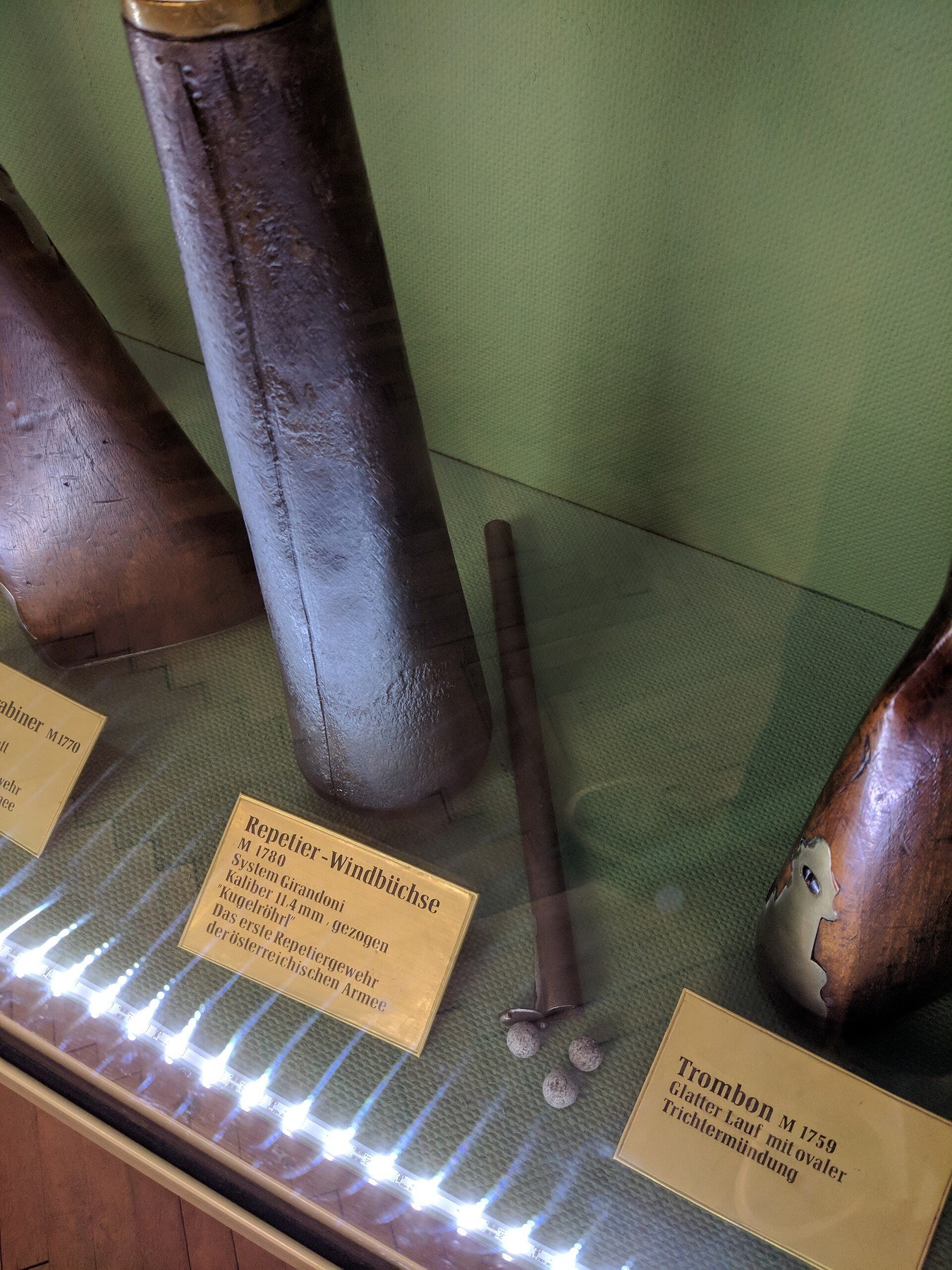
| 11.4 mm | Heeresgeschichtliches Museum, Vienna, exhibit label | Museum’s label for its rifle1 |
| Bore 0.452 in (11.48 mm), groove 0.462 in (11.73 mm); ball 0.464 in (11.79 mm), 154 gr, 45 to the pound | Beeman, citing Ernest Cowan’s measurements of the Beeman rifle, 2005 | Measurement of one original2 |
| .46 / 11.5 mm | Rock Island Auction, lots 272 (2024) and 357 (2023) | Catalogue of two originals3 |
| 50-bore (about 0.45 in) | Christie’s, the rifle marked G 1493 | Catalogue of one original4 |
| About 12 mm | German Wikipedia, citing Baker and Currie p. 1 | Reported5 |
| 13 mm | Pappacena after Baer, from “a document in the Austrian war archive” | Reported6 |
| .46 or .51 | English Wikipedia; Baker and Currie’s replica was .51 (via Beeman) | Compilation72 |
The measured originals cluster tightly at about 11.5–11.8 mm (0.45–0.46 in). The “13 mm” and “.51” figures could reflect a second pattern, a document giving ball size rather than bore, or simple error; no source found explains them. Beeman, who had measured an original, called .46 “the correct” calibre and noted that Baker and Currie’s .51 replica was built before their revised second edition.2 A ball slightly larger than the bore is not an error: German Wikipedia, after Baker and Currie, explains that the ball was made a little over bore size so that it would not roll out of the breech with the muzzle down and would be pressed into the shallow rifling when fired.5
6.3 Length, barrel, weight and twist
Table 2 — Length, barrel, weight and twist
| Measure | Figure | Source |
|---|---|---|
| Overall length | 1.227 m | Pappacena after Baer, from the war-archive document6 |
| 1,231 mm | German Wikipedia after Baker and Currie5 | |
| about 4 ft / 48 in / 120 cm | English Wikipedia; Markowitz78 | |
| Barrel length | 834 mm | German Wikipedia after Baker and Currie5 |
| 934.06 mm | Pappacena after Baer (almost certainly a misprint for 834)6 | |
| 32¾ in (832 mm) | Rock Island Auction, lots 272 and 3573 | |
| 28 in (711 mm) | Christie’s, G 14934 | |
| Weight | 4.23 kg loaded, 4.18 kg unloaded | Pappacena after Baer, from the war-archive document6 |
| 4.23 kg “with maximum equipment” | German Wikipedia after Baker and Currie5 | |
| 9.2 lb (4.17 kg) unloaded, 9.6 lb (4.35 kg) loaded with 21 balls; empty flask assembly 3.0 lb (1.36 kg) | Beeman, of his rifle2 | |
| 10 lb / 4.5 kg | English Wikipedia; Markowitz78 | |
| Rifling | 12 grooves, one turn in the barrel’s length | Pappacena after Baer; German Wikipedia after Baker and Currie65 |
| 12 grooves, one turn in about two-thirds of a metre (26.25 in) | Beeman, of his rifle2 |
Two points stand out. The 4.23 kg loaded figure appears in both the archive document Pappacena summarises and Baker and Currie’s book as German Wikipedia reports it, and Beeman’s weighing of an original (4.35 kg loaded) is close to it; the round “10 lb” of popular accounts is an overstatement. And the twist is contested: one turn in a barrel of 834 mm, or one in 667 mm. Beeman measured his rifle; the other figure comes from a document. Both may be right for different rifles.
6.4 Pressure
The pressure in a full flask is the most argued number of all, because no original was ever fitted with a gauge. The figures, and their basis:
Table 3 — The pressure in a full flask is the most argued number of all, because no original was ever fitted with a gauge. The figures, and their basis
| Pressure | Source | Basis |
|---|---|---|
| ”sechs bis acht Atmosphären” (6–8 atmospheres; about 90–120 psi) | Haller, 1891 | Haller’s own statement, not attributed to a document9 |
| about 55 bar (“Pump und Druckbehälter sind auf einen Druck von etwa 55 bar ausgelegt”), “more could not be reached with human strength” | German Wikipedia after Baker and Currie | Reported5 |
| ”topped at about 800 psi” | Cowan and Keller, via Beeman | Opinion of the copyists2 |
| ”well above 1000 psi, perhaps to double of that” | Baker and Currie, via Beeman | Opinion2 |
| 800 psi | Schreier (American Rifleman); English Wikipedia; Markowitz | Repeated1078 |
| ”upwards of 800 psi” | Rock Island Auction blog | Repeated11 |
| about 800 psi (the Heiberger conversion, charged by the Royal Armouries) | Currie, via Beeman | Test of a related antique2 |
| 750 psi (a Lowentz Girandoni-system rifle) | Larry Hannusch, via Beeman | Owner’s figure2 |
| ”circa 200 atmosfere” | Pappacena | Not credible; see below6 |
Fifty-five bar is 798 psi, so the 800 psi of the popular accounts and Baker and Currie’s design figure are the same number in different units. The real disagreement is between that family of figures and Haller’s six to eight atmospheres, roughly seven times lower. Pappacena’s 200 atmospheres (about 2,900 psi) would put a riveted and brazed iron flask of 1780 at the working pressure of a modern carbon-fibre cylinder, and is not considered further.
6.5 Why six to eight atmospheres cannot be right
Haller is the most reliable source in this dive on dates and orders, because he quotes the files. His pressure figure is a different matter: it is a sentence in his own description, attributed to nothing. A simple calculation shows it cannot describe a full flask.
Take the most generous case. If the whole flask pressure pushed the ball the whole length of the barrel, with no fall in pressure and no losses at all, the work done on the ball would be the pressure times the bore area times the barrel length. With Beeman’s 0.464 in ball and an 834 mm barrel:
Table 4 — Take the most generous case. If the whole flask pressure pushed the ball the whole length of the barrel, with no fall in pressure and no losses at all, the work done on the ball would be the pressure times the bore area times the barrel length. With Beeman's 0.464 in ball and an 834 mm barrel
| Pressure (gauge) | No-loss ceiling on muzzle energy |
|---|---|
| 73 psi (6 atm absolute) | about 34 ft-lb |
| 118 psi (8 atm gauge) | about 55 ft-lb |
| 800 psi (about 55 bar) | about 370 ft-lb |
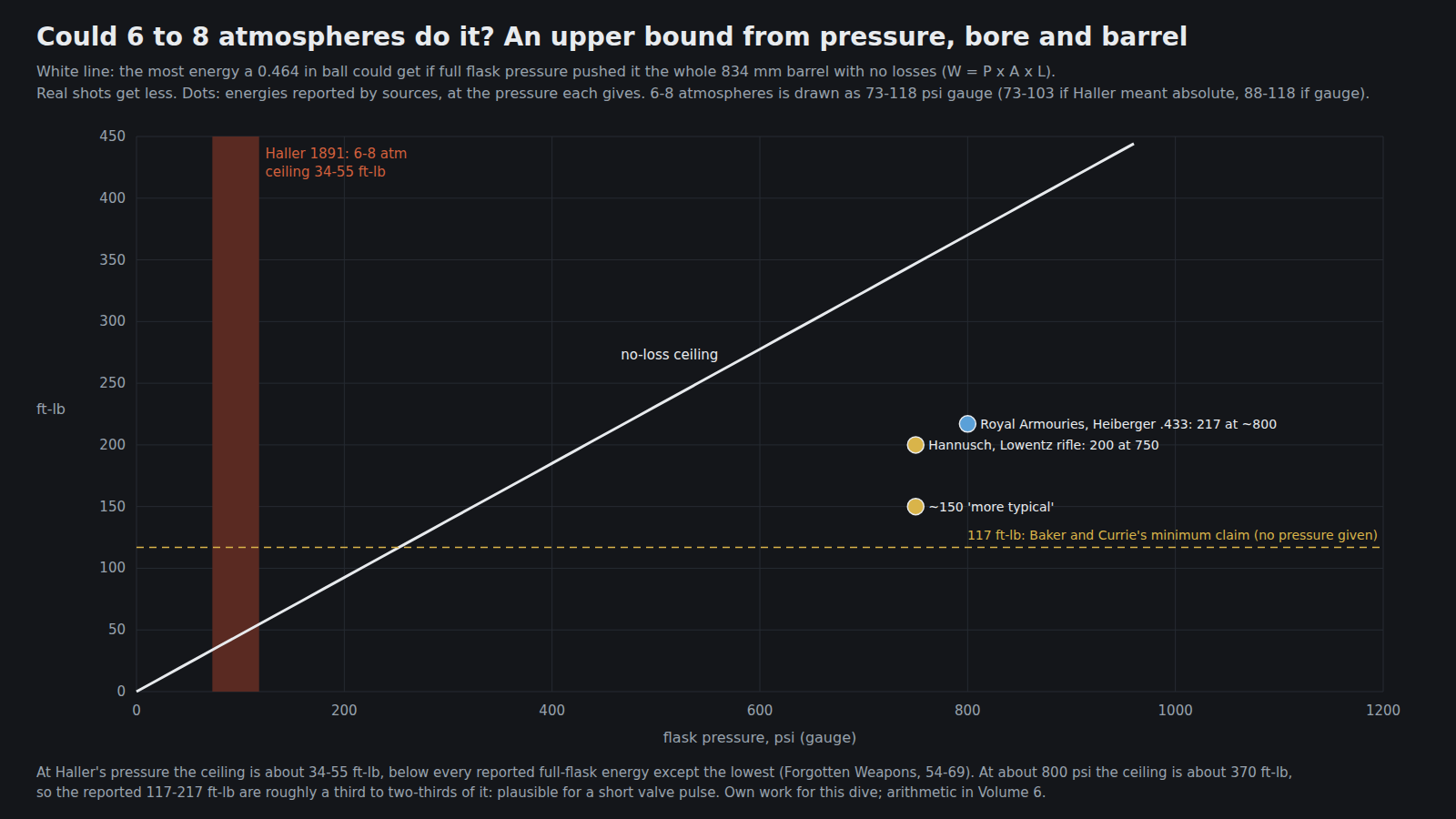
At Haller’s pressure the ceiling is 34–55 ft-lb. Every energy reported for a full flask by anyone who has tested a Girardoni-type gun is higher: 117 ft-lb as Baker and Currie’s minimum, 150–200 for Hannusch’s Lowentz, 217 for the Heiberger conversion. The Austrian regulation’s ranges point the same way: a ball “effective” at 150 paces for its first ten shots (below) needs more than a few tens of foot-pounds. And with a flask of the size usually given, six to eight atmospheres would not hold forty useful shots. At about 800 psi, by contrast, the ceiling is about 370 ft-lb and the reported energies are a third to two-thirds of it, which is what one would expect of a valve that opens for an instant.
The likeliest explanation is that Haller, writing in 1891 without a gauge reading, gave a figure that was wrong, perhaps confusing a pump or valve figure with the flask pressure. The calculation does not tell us what the pressure was. It does show that the army’s own description of the rifle’s performance requires a pressure of several hundred psi, and that the 55 bar / 800 psi figure is physically consistent with it.
6.6 Pumping: 2,000 strokes or 1,500?
The 1788 regulation is the only primary source on charging, and it gives 2,000 strokes to fill an empty flask with the issue hand pump, with the man finishing “with all his strength” and his body laid across the pump.9 Almost every modern account gives 1,500 strokes (Schreier, English Wikipedia, Markowitz, German Wikipedia, and Beeman’s “about 1500 times”).107852 Beeman also gives “about 4500 strokes” for three flasks, and Currie reported that 1,500 strokes refilled the Heiberger conversion after twenty shots, which is a different measurement.2 Rock Island and Beeman put the time at about half an hour per flask.32
The regulation’s figure is to be preferred: it is the army’s own instruction to the men who did it. The 1,500 may come from Baker and Currie’s tests or from a different pump; the source of the figure is not given in any account read here.
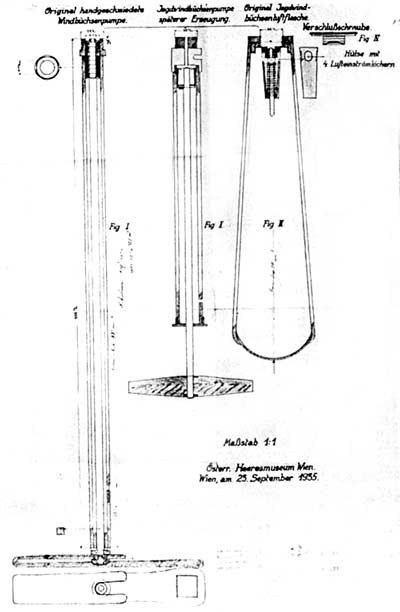
The regulation’s description also gives an indirect check on the pressure. The last strokes, it says, need the man’s full strength and his body weight. If the force at the end of the stroke is of the order of a man’s weight, the pressure reached depends on the bore of the pump. On simple arithmetic (pressure equals force divided by piston area), about 70–100 kg of force on a piston of about 15 mm diameter gives roughly 40–55 bar; the same force on a 25 mm piston gives only 14–20 bar. The pump’s bore was not found in any source, so this check is offered as an illustration of why a long, slim pump makes sense, not as evidence of the pressure. Beeman describes the issue pump as “extremely long” and “thin”, with seven oiled leather washers on its piston, and says that tests by himself, Cowan and Currie showed that “rapping” a flask against the pump to force in extra air does not work with Girardoni equipment.2

6.7 Shots from one flask
Table 5 — Shots from one flask
| Shots | Source | Of what |
|---|---|---|
| ”holds 40 shots”, but not equally effective; change after 30 | 1788 regulation (Haller) | Issue rifle and flask9 |
| ”50 times in a row” without pumping | Hübner 1786, quoted by German Wikipedia (not checked) | Girardoni’s rifles5 |
| ”22 times at one charge” | Rodney, 1803 | Lewis’s gun, as told to him2 |
| ”forty shots out of one load” | McKenzie, 1804–05 | Lewis’s gun, as told to him12 |
| 30 “at useful pressure” | English Wikipedia | Unstated basis7 |
| 30–40; “one source claims more than 60” | Rock Island Auction | Catalogue3 |
| ”up to 80” | Markowitz | Unstated basis8 |
| 35, “before they got tired” | Baker and Currie’s .51 replica, via Beeman | Replica2 |
| 64 from 800 psi | Beeman’s Cowan copy | Replica2 |
The regulation’s “holds 40”, with the advice to change after 30, is the figure the army worked to. It matches McKenzie’s “forty shots out of one load” exactly, which is the most striking coincidence in the Lewis and Clark record (Volume 3). The replica figures show that 35 to 64 balls can be driven from one charge; the regulation’s point is that the later ones are not worth firing at an enemy.
Rodney’s “22 times at one charge” is the magazine, not the flask: twenty-two balls is Beeman’s count of what his rifle holds, twenty-one in the tube and one in the bar.2 The regulation gives twenty in the tube.9
6.8 Range
The regulation is again the only primary source:9
“Die Flasche hält zwar 40 Schuss, sie sind aber nicht auf gleiche Distanz wirksam. Man kann rechnen, dass die ersten 10 Schüsse, wo die Flasche ihre volle Ladung hat, auf 150 Schritte wirken, die folgenden 10 Schüsse auf 120 bis 125 Schritte, die ferners folgenden 10 auf 100 Schritte; von den übrigen 10 Schüssen kann eigentlich keine Distanz mehr bestimmt werden, indem die allerletzten nur ganz in der Nähe noch Wirkung behalten.”
“The flask does hold 40 shots, but they are not effective at the same distance. One can reckon that the first 10 shots, while the flask has its full charge, are effective at 150 paces, the next 10 at 120 to 125 paces, the next 10 at 100 paces; for the remaining 10 no distance can really be set, as the very last keep their effect only quite close.”
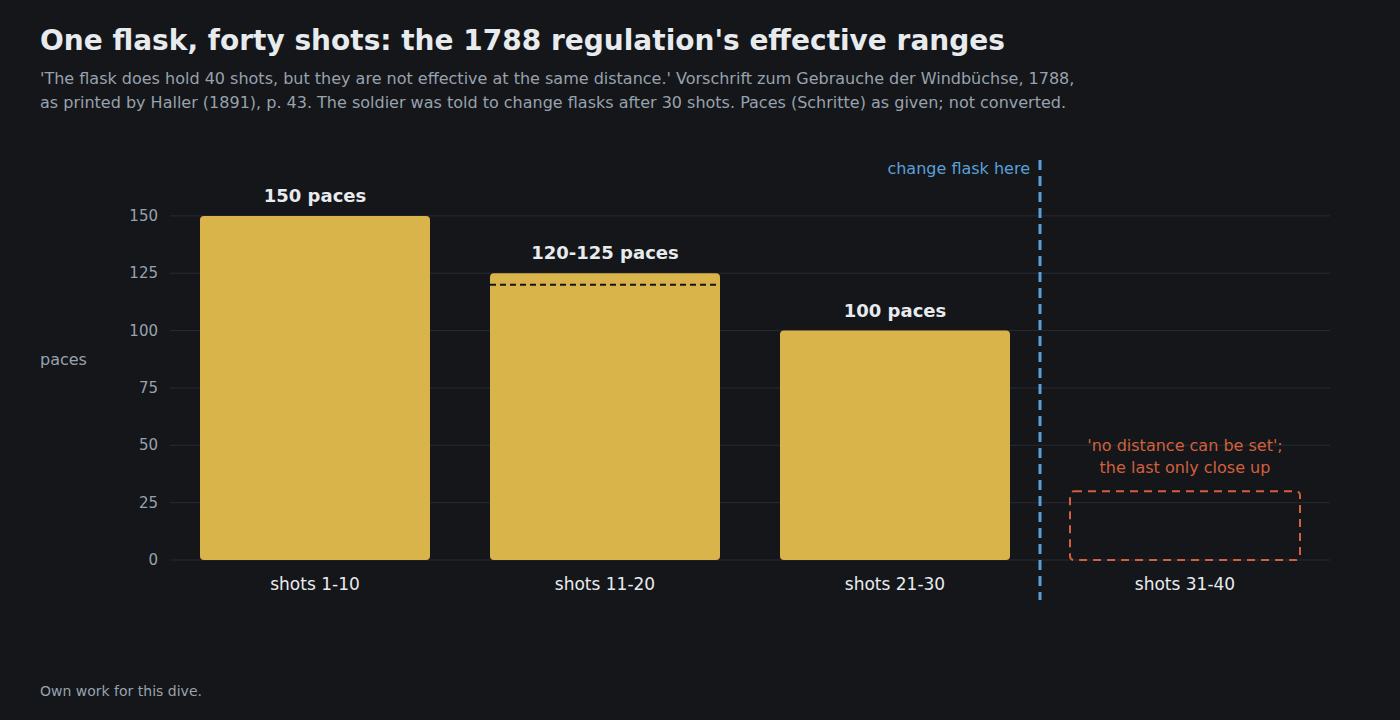
The army’s Schritt, or pace, is not converted here: its length in 1788 is not given in the sources, and an assumed conversion would add a precision the regulation does not have. Later accounts give “lethal combat ranges of 125 to 150 yards” (Beeman, “all references”; Rock Island), “approximately 125 yd … on a full air reservoir” (English Wikipedia), 150 yards (Markowitz), or “about 90 m” for twenty precise shots (German Wikipedia).23785 All of them appear to descend from the regulation’s 150, 125 and 100 paces. Hübner’s 1786 claim that the first twenty shots would go through a thick board at 500 paces, if correctly quoted, is the outlier.5
6.9 Velocity and energy
No velocity measured with an original military Girardoni was found. The figures:
Table 6 — No velocity measured with an original military Girardoni was found. The figures
| Figure | Source | Basis |
|---|---|---|
| ~210 gr ball at ≥500 ft/s, ~117 ft-lb | Baker and Currie, “as of May 2003”, via Beeman | Their minimum claim2 |
| 120.4 gr at >900 ft/s, 217 ft-lb, ~800 psi | Royal Armouries test of the Heiberger conversion (.433), via Currie and Beeman | A related antique, not a Girardoni2 |
| 200 ft-lb at 750 psi; up to 150 “more typical at conservative pressures” | Hannusch, of his Lowentz rifle, via Beeman | Civilian Girandoni-system rifle2 |
| .46, ~153 gr, 400–450 ft/s (54–69 ft-lb computed) | Forgotten Weapons, 2014 | Unstated basis13 |
| ~600 ft/s, .46, ~146 gr (117 ft-lb computed) | Rock Island Auction, 2024 | Catalogue3 |
| 500 fps, .462 | Markowitz, 2013 | Unstated basis8 |
| ~690 fps, 117 ft-lb, with a 146.3 gr .46 ball | English Wikipedia infobox | Inconsistent: 146.3 gr at 690 ft/s is 155 ft-lb7 |
| ”.38 Special … or even into the range of the .45 ACP” | Baer, 1973, via Beeman | Comparison; Beeman calls it “probably overstated”2 |
Two of these are worth a sentence each. The English Wikipedia infobox’s 690 ft/s and 117 ft-lb cannot both be true of a 146 gr ball; 117 ft-lb at 146 gr is about 600 ft/s, which is Rock Island’s figure, so the 690 looks like a stray. And Baker and Currie’s 117 ft-lb comes from a 210 gr ball, which is heavier than any measured original’s ball (154 gr): at 154 gr the same energy is about 585 ft/s. Taken together, the figures from people who have measured something put a full-flask shot from a military-size Girardoni somewhere around 500–600 ft/s and 100–200 ft-lb. That is a range of reported figures, not an average, and no original has been chronographed.
6.10 How the flasks were made and proved
The flask was the rifle’s weakest part. The construction, as the sources describe it:
- Sheet iron, riveted and brazed. Pappacena, from the war-archive document, describes “hammered sheet in two parts joined with eleven rivets and soldered for air-tightness”, covered in leather.6 German Wikipedia, after Baker and Currie, says brass-coated wrought-iron sheet, a rolled rectangle and a hemispherical cap, riveted and hard-soldered, about 500 ml.5 Beeman’s photograph of his rifle’s flask shows rivet marks along the seam.2
- Brazed by immersion. Ernest Cowan, making flasks for his reproductions, found his first dozen or so cracked when brazed; old gunsmith literature, Beeman reports, showed that the makers immersed the whole white-hot flask in molten brazing metal and drew it out slowly, which explains the brazing-metal coat inside and out.2
- Proved by pumping. Before issue, each flask had to pass a test on a special pump that enclosed it in case it burst; with no pressure gauges, the test was a set number of pump strokes. About 30 per cent failed, the quality of the iron sheet being the critical problem. (German Wikipedia, after Baker and Currie.)5 Beeman, without a source, writes that flask failures “alone would have eliminated over 40%” of the rifles in service.2
- Leather-covered. The 1787 order provided leather covers (“Lederflaschen-Futterale”) for the flasks of all 1,000 rifles (Volume 1); Beeman says military flasks were bare with a removable cover, and fixed covers belong to civilian rifles.92
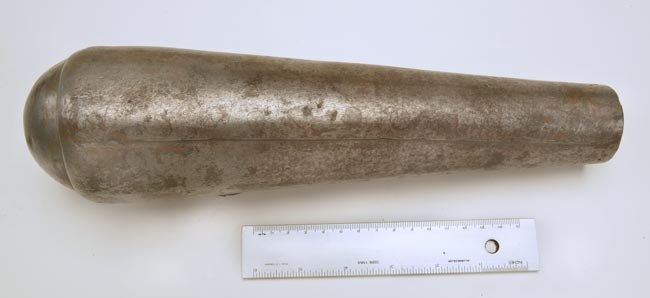
None of this would pass as a pressure vessel today, and that is the central fact of Volume 8.
6.11 The charging machines
Three kinds of charging equipment appear in the documents:
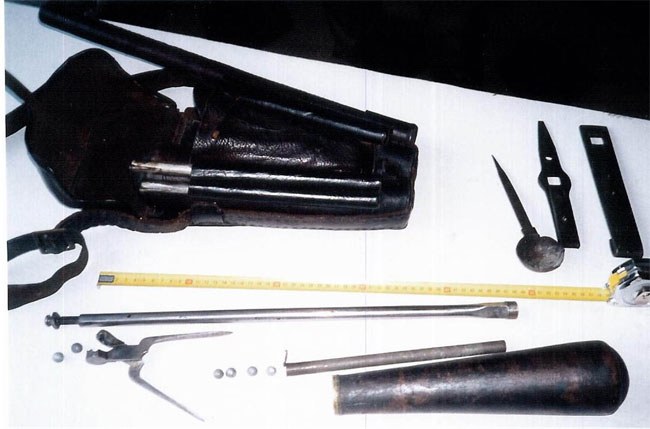
- The issue hand pump, one to two rifles (Volume 1). Long and slim, worked by standing on its foot-plate and moving the flask up and down on it.92
- The wheeled pump (“Pumpmaschine mit einem Rad”, “Radmaschine”), which Girandoni undertook to build in 1787 “by which the filling of the flask with air goes more quickly”. The emperor’s order planned one hand pump to five rifles if enough wheeled machines were ready.9 Beeman, through Hummelberger and Scharer, says only two were built.2
- The “Luftpressmaschine”, one per 500-rifle consignment, 58 Vienna pounds in its crate (Volume 1).9 Whether it is the same as the wheeled pump is not said.
A commenter on Forgotten Weapons describes a hand-cranked charging machine with a large wheel and wooden legs on display in the Heeresgeschichtliches Museum, and German Wikipedia says a compressor for filling the flasks is exhibited there.135 Neither was seen for this dive.
6.12 What the numbers support
From the sources that measured or ordered something:
- Calibre about 11.5–11.8 mm (0.45–0.46 in), ball about 0.464 in and 154 gr on the one rifle measured; 13 mm and .51 are unexplained outliers.
- About 4.2 kg loaded, from both an archive document and a weighed original.
- A flask pumped by about 2,000 strokes of the issue pump to a pressure that the rifle’s recorded performance shows must have been several hundred psi; 55 bar (about 800 psi) is the figure consistent with the physics and with Baker and Currie. Haller’s 6–8 atmospheres is not.
- Forty shots per flask, thirty of them useful, with effective range falling from 150 paces to 100 over the first thirty.
- Roughly 500–600 ft/s and 100–200 ft-lb for a full-flask shot, a reported range from replica and related-gun tests, unconfirmed on an original.
- Flasks that failed proof about three times in ten, according to Baker and Currie’s research as reported.
References
Footnotes
-
Heeresgeschichtliches Museum, Vienna, exhibit label “Repetier-Windbüchse M 1780, System Girandoni, Kaliber 11,4 mm, gezogen”, as photographed by M11rtinb, 2 May 2018, “Girandoni air rifle reservoir 2.jpg”, Wikimedia Commons, https://commons.wikimedia.org/wiki/File:Girandoni_air_rifle_reservoir_2.jpg . Accessed 2026-10-18. ↩
-
Robert D. Beeman, “New Evidence on the Lewis and Clark Air Rifle” (updated 15 May 2008) and “Austrian Large Bore Airguns” (updated 17 July 2007), formerly at beemans.net, read through the Internet Archive: https://web.archive.org/web/2022/http://www.beemans.net/lewis-assault-rifle.htm and https://web.archive.org/web/2022/http://www.beemans.net/Austrian%20airguns.htm . Accessed 2026-10-18. Includes Beeman’s reports of Baker and Currie, Cowan and Keller, Colin Currie’s Royal Armouries test and Larry Hannusch’s figures, all as personal communications to Beeman. ↩ ↩2 ↩3 ↩4 ↩5 ↩6 ↩7 ↩8 ↩9 ↩10 ↩11 ↩12 ↩13 ↩14 ↩15 ↩16 ↩17 ↩18 ↩19 ↩20 ↩21 ↩22 ↩23 ↩24 ↩25 ↩26 ↩27 ↩28
-
Rock Island Auction Company, lot 272, 17 May 2024, https://www.rockislandauction.com/detail/4091/272 , and lot 357, 8 December 2023, https://www.rockislandauction.com/detail/4090/357 . Accessed 2026-10-18. ↩ ↩2 ↩3 ↩4 ↩5 ↩6
-
Christie’s, “A Rare 50-Bore Austrian Breech-Loading Military Repeating Air Rifle On The Girandoni System, Circa 1780–90”, lot 129, https://www.christies.com.cn/lot/lot-842927 . Accessed 2026-10-18. ↩ ↩2
-
“Girandoni-Windbüchse”, German Wikipedia, https://de.wikipedia.org/wiki/Girandoni-Windb%C3%BCchse , citing Baker and Currie, The Austrian Army Repeating Air Rifle (2nd ed., 2006), pp. 1, 75–98, and quoting Hübner (1786). Accessed 2026-10-18. ↩ ↩2 ↩3 ↩4 ↩5 ↩6 ↩7 ↩8 ↩9 ↩10 ↩11 ↩12 ↩13 ↩14
-
Roberto Pappacena, “I benemeriti di Cortina d’Ampezzo: 1) Bartolomeo Gilardoni”, after F. H. Baer, Internet Archive capture of 10 May 2006, https://web.archive.org/web/20060510055333/http://staff.sunrise.it/polovalboite/giacomel/benemeriti1.htm . Accessed 2026-10-18. ↩ ↩2 ↩3 ↩4 ↩5 ↩6 ↩7
-
“Girardoni air rifle”, English Wikipedia, revision 1380085400, https://en.wikipedia.org/wiki/Girardoni_air_rifle . Accessed 2026-10-18. ↩ ↩2 ↩3 ↩4 ↩5 ↩6 ↩7 ↩8
-
Mike Markowitz, “The Girandoni Air Rifle: A weapon ahead of its time?”, Defense Media Network, 14 May 2013, https://www.defensemedianetwork.com/stories/the-girandoni-air-rifle/ . Accessed 2026-10-18. ↩ ↩2 ↩3 ↩4 ↩5 ↩6 ↩7
-
August Haller, “Die österreichische Militär-Repetir-Windbüchse des vorigen Jahrhunderts”, Organ der Militärwissenschaftlichen Vereine, vol. 42 (Vienna, 1891), pp. 34–45, including the 1788 regulation (pp. 42–44) and the weight plan (p. 45). Internet Archive item bub_gb_XF0-AQAAMAAJ. Accessed 2026-10-18. ↩ ↩2 ↩3 ↩4 ↩5 ↩6 ↩7 ↩8 ↩9
-
Philip Schreier, “The Airgun Of Meriwether Lewis”, American Rifleman, October 2006, posted 21 April 2011, https://www.americanrifleman.org/content/the-airgun-of-meriwether-lewis/ . Accessed 2026-10-18. ↩ ↩2
-
Joe Engesser, “The Girardoni Air Rifle”, Rock Island Auction Company, 21 November 2023, https://www.rockislandauction.com/riac-blog/girardoni-air-rifle . Accessed 2026-10-18. ↩
-
Charles McKenzie, “The Mississouri Indians”, in L.-R. Masson, Les Bourgeois de la Compagnie du Nord-Ouest, vol. 1 (Québec, 1889), p. 330, Internet Archive item cihm_30414. Accessed 2026-10-18. ↩
-
Ian McCollum, “Girardoni Air Rifle”, Forgotten Weapons, 2014, https://www.forgottenweapons.com/girardoni-air-rifle/ , including readers’ comments. Accessed 2026-10-18. ↩ ↩2

Comments (0)