Girardoni Air Rifle · Volume 4
Girardoni or Lukens? The Attribution Debate
Two rifles in two museums each said to be Lewis's: a Philadelphia single-shot at VMI and an Austrian repeater at the Army Heritage Center. The 1847 sale notice read from its photograph, the Rodney passage, a farrier's-file mainspring, American walnut in a European stock, and what each piece of evidence actually proves
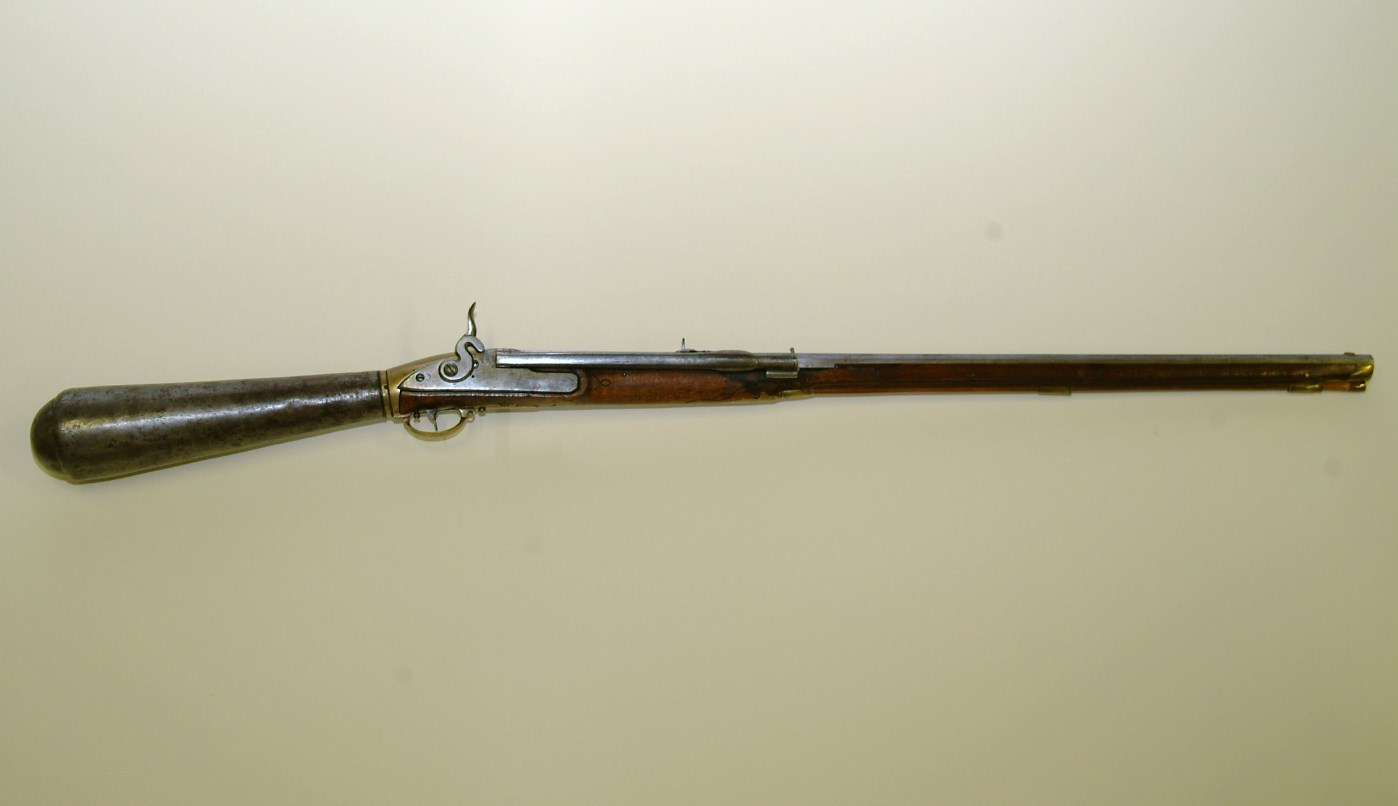
4.1 Two rifles, two museums
Two American institutions each hold a rifle presented as the air gun of the Lewis and Clark Expedition.
- The Virginia Military Institute Museum, in Lexington, Virginia, holds in its Henry Stewart Collection an air rifle by Isaiah Lukens of Philadelphia. Its page says plainly: “The collection includes the air rifle carried by Lewis and Clark during their 1803 Northwest Expedition”, and that “Clock and gun maker Isaiah Lukens of Philadelphia, PA, provided Meriwether Lewis and William Clark one of his air rifles”. It describes a .31-calibre gun whose butt is “a metal canister designed with a needle valve to hold compressed air” at “between 700 and 900 pounds per square inch”, charged by “a few hundred strokes on the pump”.1
- The US Army Heritage and Education Center at the Army War College, Carlisle, Pennsylvania, holds the “Beeman Girandoni”, an Austrian military repeating air rifle. Its photograph on Wikimedia Commons, released as an Army image, is captioned “A Girandoni System Austrian Repeating Air Rifle, Circa 1795, believed to have been taken on the Lewis & Clark Army Corps of Discovery Expedition 1803-1806.”2
They cannot both be right, and neither has a document tying it to Lewis by name. Philip Schreier, then senior curator of the NRA Museums, counted four institutions that had claimed the original gun in the previous fifty years.3 This volume sets out the evidence for each claimant as its advocates give it, and what each piece is worth.
4.2 Seventy years of searching, in brief
The order of events, from the advocates’ own accounts:
Table 1 — The order of events, from the advocates' own accounts
| Year | Event | Source |
|---|---|---|
| 1956–57 | Charter Harrison, a Milwaukee airgun collector, starts the search | Beeman4 |
| 1957 | A ball-reservoir airgun given to the Smithsonian by a donor who believed it was Lewis’s; the same donor had just named a Lukens-marked gun now at VMI as “The Lewis & Clark air gun” | Schreier3 |
| 1962–65 | Fort Clatsop museum buys a ball-reservoir airgun ($225, 1962) and a pump (1965) to display as the type carried | Beeman5 |
| 1973, 1977 | Roy Chatters, “The Enigmatic Lewis and Clark Airgun” and “The Not So Enigmatic Lewis and Clark Air Gun” (We Proceeded On, May 1977) | Beeman5 |
| 1976–77 | Henry M. Stewart Jr. finds the 1847 Lukens estate sale notice at the Franklin Institute; publishes it February 1977 | Beeman5 |
| 1982 | Stewart, speaking in Philadelphia: “I do not claim it as the Lewis and Clark gun …” | Beeman5 |
| 1984 | American Rifleman article; “most experts” conclude a Lukens butt-reservoir rifle of .31–.36 | Bryan and Associates reprint6 |
| 1997 | Rodney’s journal published by Smith and Swick | Beeman; Schreier43 |
| 2002–03 | Michael Carrick draws attention to the Rodney passage | Beeman; Schreier43 |
| 2004 | Beeman publishes a rejection of the Girardoni idea, calling Rodney’s passage likely spurious | Beeman4 |
| Nov 2003–Mar 2005 | Ernest Cowan and Richard Keller borrow and dismantle Beeman’s Girardoni to copy it; find the replaced mainspring and other evidence | Beeman4 |
| 19 Mar 2005 | Announcement at the Baltimore Antique Arms Show | Beeman4 |
| May 2006 | Beeman, “Meriwether Lewis’s Wonder Weapon”, and Cowan and Keller in We Proceeded On | Beeman4 |
| Sep 2006 – 2007 | Beeman rifle given to the Army Heritage Center Foundation (26 September 2006) and on to the Army War College; final transfer ceremony 2007 | Beeman; Rock Island Auction47 |
Two of the people at the centre of the story changed their minds. Stewart, who found the Lukens notice, told the Lewis and Clark Trail Heritage Foundation’s 1982 meeting that he did not claim the VMI gun was the Lewis gun.5 Beeman, who championed Lukens for twenty-five years, rejected the Girardoni in 2004 and championed it from 2005.4
4.3 The Lukens case
The case for a Lukens rests on four things.
1. Lewis bought the gun, and Lukens made air guns in Philadelphia. Lewis’s first journal entry calls it “my airgun which I had purchased” (Volume 3). Lewis spent the spring of 1803 in Philadelphia gathering equipment and instruction for the expedition. Isaiah Lukens (1779–1846) was a Philadelphia clockmaker, instrument maker and air-gun maker, later a founder and first vice-president of the Franklin Institute, and, Stewart noted, a close friend of the painter Charles Willson Peale, whose museum received many of the expedition’s specimens.5 Beeman, when he still favoured Lukens, wrote that it would have been almost impossible for Lewis and Lukens not to have met.5
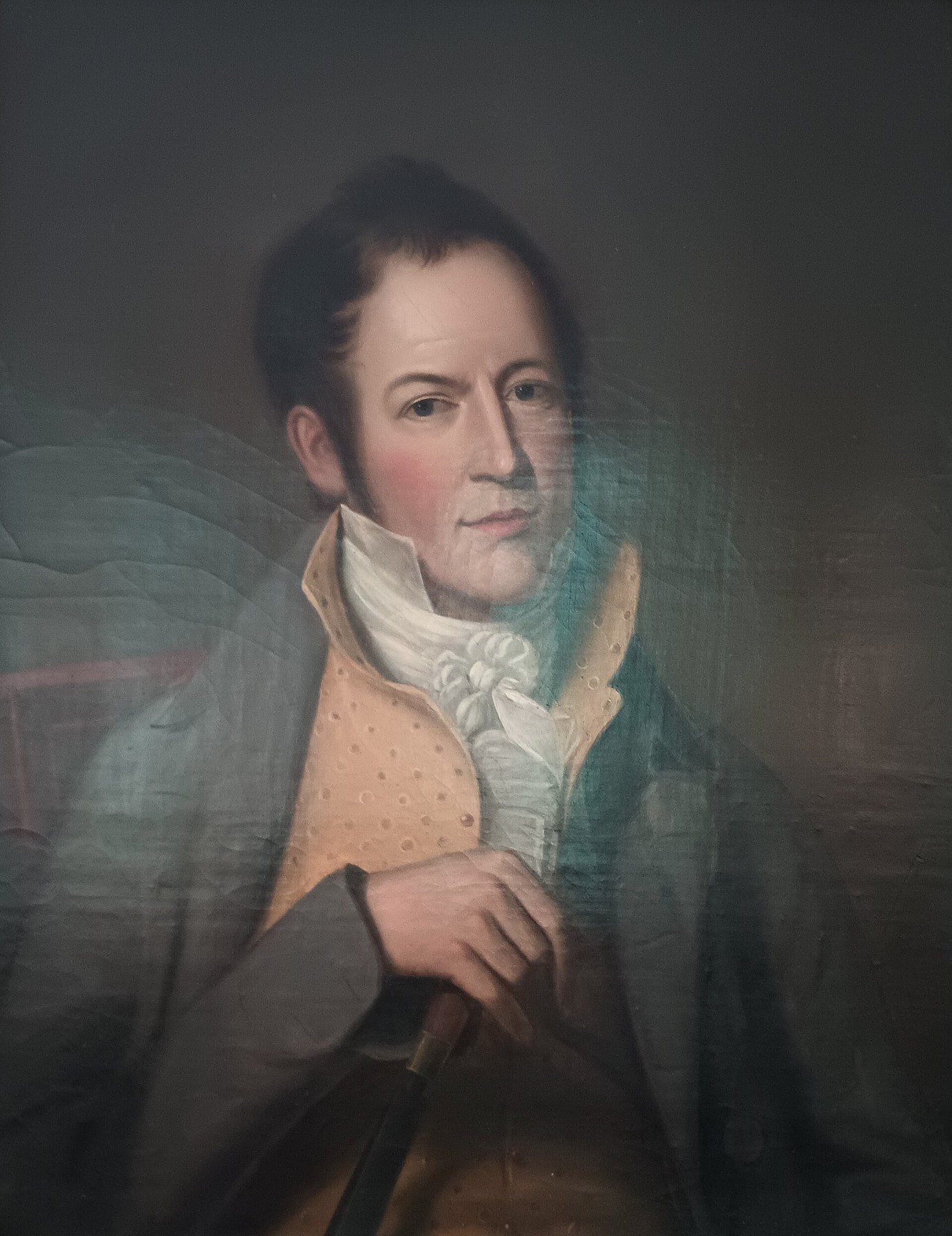
2. The 1847 sale notice lists, among Lukens’s effects, a large air gun made for and used by Lewis and Clark. It is the only document that connects any maker to the expedition’s gun. It is examined closely in the next section.
3. The standard edition of the journals follows it. Moulton’s note to Lewis’s first entry says the gun “was probably manufactured by Isaiah Lukens, horologist and gunsmith of Philadelphia; it was returned to him after Lewis’s death in 1809, sold at auction on Lukens’s death in 1847, and discovered and identified in 1976”, and describes it as having “a butt reservoir” and being “much like a Kentucky rifle in appearance”, citing Stewart, Chatters, Halsey and Wolff.8
4. A Lukens rifle survives in a public collection and is claimed. VMI’s Henry Stewart Collection holds a Lukens air rifle, presented as the expedition’s gun.1

4.4 The 1847 sale notice, read from its photograph
The notice is usually quoted in a paraphrase. Beeman, following Stewart, gives it as “1 large air gun made for and used by Messrs. Lewis and Clark in their exploring expeditions”.5 His photograph of the printed notice shows the actual wording, and the items around it:
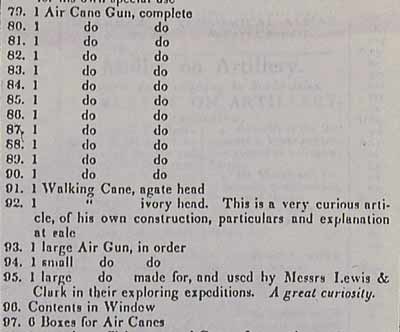
Transcribed from the photograph:
- 1 Air Cane Gun, complete / 80.–90. 1 do do / 91. 1 Walking Cane, agate head / 92. 1 ” ivory head. This is a very curious article, of his own construction, particulars and explanation at sale / 93. 1 large Air Gun, in order / 94. 1 small do do / 95. 1 large do made for, and used by Messrs Lewis & Clark in their exploring expeditions. A great curiosity. / 96. Contents in Window / 97. 6 Boxes for Air Canes
“do” is ditto: item 95 is “1 large Air Gun”. Read in place, the entry says more than the paraphrase:
- It sits among Lukens’s own products: twelve air canes, a walking cane “of his own construction”, two other air guns “in order”, and boxes for air canes. The cataloguer was listing the stock of an air-gun maker.
- “made for, and used by”: the cataloguer, writing in 1846–47 for the estate, believed the gun had been made for Lewis and Clark. That is the strongest phrase in the document for a Lukens attribution. A Girardoni could not have been made for them.
- “A great curiosity”: the same phrase-making as item 92. It is a sale catalogue selling, not an inventory recording.
- Item 93 is not “in order” for 95. Items 93 and 94 are marked “in order”; 95 is not. Whether that means the expedition gun did not work is not said.
Stewart reported that his friend Bruce Madson found the sale advertised in the Pennsylvania Inquirer and Gazette of 4 January 1847, and a report of the prices paid, and that item 95 appears to have been withdrawn from the sale.5 Beeman’s account adds that Joseph Saxton, a Philadelphia friend of Lukens, obtained many of the estate items, and that some, including an air rifle, later passed into Charter Harrison’s collection in Milwaukee.5 Where item 95 went after January 1847 is not documented.
Which publication the photograph shows, the Franklin Institute pamphlet or the newspaper advertisement, is not stated on Beeman’s page.
4.5 Against Lukens
The objections to a Lukens, set out by Beeman after 2005 and in part by Stewart before him:
- No Lukens repeater is known. Every Lukens and Kunz air rifle Beeman examined, including all eight Lukens-type rifles in the Stewart collection at VMI and two at what Beeman calls the Buffalo Bill Cody Firearms Museum, is a single-shot muzzle-loader.5 A Lukens could not have done what Rodney describes.
- The VMI gun’s hammer is later than 1803. Stewart and Charter Harrison both concluded that the VMI rifle’s double-neck hammer came from a US pistol of 1836, so the gun as it stands was altered after 1836; Stewart “could not find any features which clearly pointed to this particular Lukens airgun as the very one carried by Captain Lewis”.5
- Stewart withdrew the claim. In 1982: “I do not claim it as the Lewis and Clark gun … but we now know who made it, whether it is Lukens or his man Kunz…”.5 Beeman notes that Jacob Kunz, a Philadelphia gunsmith associated with Lukens’s air guns, is recorded in the trade only from 1814.5
- “Made for” may be a cataloguer’s flourish. The notice was written forty years after the expedition, for a sale, by someone who called the next item “a great curiosity”. It records what the estate believed or wished buyers to believe.
- A gun in Lukens’s shop need not be a Lukens. Beeman’s explanation for the notice is that the expedition’s gun went to Lukens after the expedition, perhaps for repair as the only air-gun maker in the area, and stayed there.4 That is a hypothesis; it fits the notice no better and no worse than Moulton’s “returned to him”.
4.6 The Girardoni case: the written evidence
The case for a Girardoni begins with documents and then turns to a rifle.
- Rodney, 8 September 1803. A visitor’s detailed description of a 22-shot repeater with a “short side barrel” magazine, a sprung transverse feed, and an “air bag which forms the britch” (Volume 3). Nothing but the Girardoni system matches it. Beeman argues that its credibility rests not on Rodney’s character but on three things: the number 22, which he says is the true capacity of a Girardoni military rifle with one ball in the breech, when every published account then said 20; the unprompted detail of leaks and partial firing, which is not the kind of thing an embellisher invents; and the existence of a specimen that matches.4
- McKenzie, 1804–05. “Forty shots out of one load” (Volume 3). The Austrian regulation of 1788 says a full flask “holds 40 shots” (Volume 6).
- Lewis, 24 January 1806. “Shooting so often and without powder” (Volume 3).
- Lewis, June 1805. A broken mainspring, replaced by Shields (Volume 3).
- Lewis, 7 August 1805. The gun “out of order and her sights … removed by some accedent” after the canoe accident (Volume 3).
4.7 The Girardoni case: the Beeman rifle
The second half of the case is a particular rifle. Robert and Toshiko Beeman bought it, Beeman wrote, “from the private collection of an American antique gun dealer about 1975 without any provenance”.4 In November 2003 Ernest Cowan and Richard Keller, makers of museum-grade reproductions in Chambersburg, Pennsylvania, borrowed it to copy, took it completely apart, and over the following eighteen months reported the findings that Beeman organised as “six areas of new evidence”.4 All six are given here in Beeman’s words or close paraphrase, with his photographs.
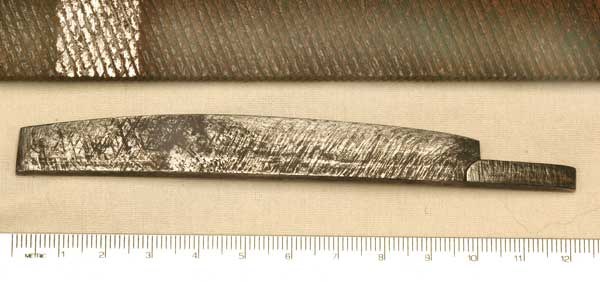
Area 1: the replaced mainspring. The rifle’s flat mainspring is “a very old replacement that apparently had been made using a farrier’s file”, identified by “the almost completely removed diamond shaped groove pattern of such a double cut file” on its underside.4 Beeman links it to the journals’ “Shields renewed the main Spring” and Whitehouse’s “made a main Spring”, and argues that a farrier’s file is exactly the steel a frontier smith would have had to hand and a city gunsmith would not have used. He also notes that the original assembly marks on the lock are punched dots and the replacement spring carries chiselled “hash marks” instead.
Area 2: shots per charge. Beeman had argued in 2004 that a Girardoni could not fire McKenzie’s forty shots from one charge. Baker and Currie’s .51 replica then gave 35 shots “before they got tired”, and Beeman’s own Cowan-made copy, charged to 800 psi, fired 64.4 The objection fell away.
Area 3: damage. The rifle shows what Beeman reads as a single severe impact to the front of the gun, matching the canoe accident of 6 August 1805 and Lewis’s “her sights had been removed by some accedent”: the forward barrel lug “torn open and later partially repaired”; stock wood broken out beside the loading slide; the cast brass middle thimble replaced by “an inconsistent rolled brass thimble, of American styling”; a replacement cleaning rod; rough transverse file marks over the original longitudinal draw-filing on the left front barrel flats and the front sight; and the front of the forend replaced with a long scarf joint, the new wood identified by Cowan as American walnut spliced into an original stock of European walnut.4
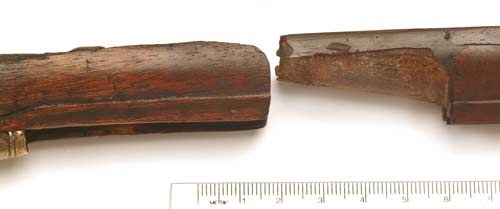
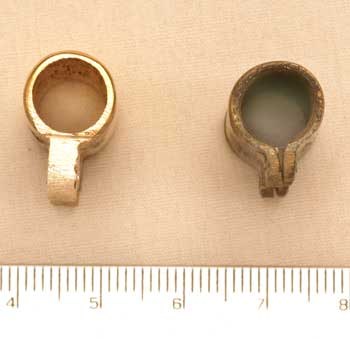
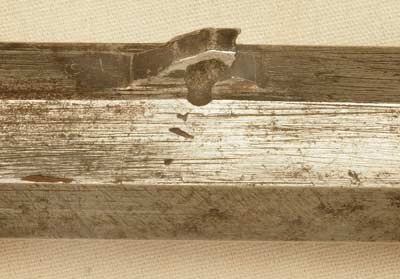
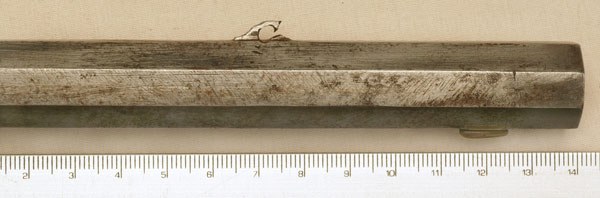
Area 4: the accidental discharge. Cowan found that the half-cock notch of the rifle’s tumbler is broken, “about 1.5 mm of the half-cock notch lip is missing”, so the gun “could fire most unexpectedly from the half-notch position”.4 Beeman offers this, and a second mechanism worked out by Baker and Currie (lowering the hammer with the trigger held can press the valve open), as explanations of the Brunot’s Island accident. The second mechanism is the very hazard the Austrian regulation of 1788 warned against (Volume 5).
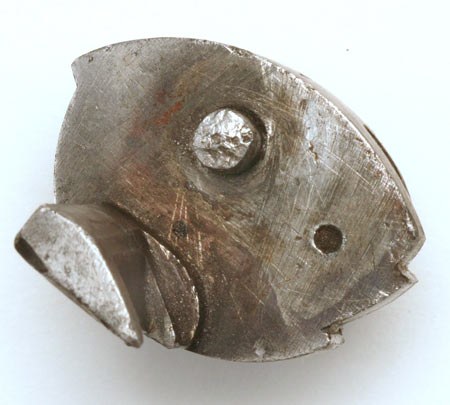
Area 5: firing faults. The striker pin, steel in an iron-lined sleeve, can stick with condensation corrosion at low pressure, which Beeman says explains the failures Rodney saw at Wheeling and Lewis’s quick fix.4
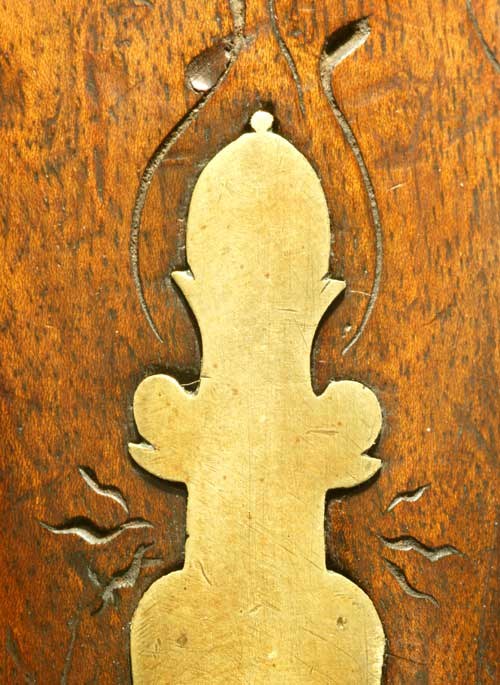
Area 6: markings, and their absence. The underside of the forend bears carved lines, “lightning bolts” and a “string of beads”, found on no other known Girardoni, which Cowan and Keller, “in consultation with museum experts on Indian marks”, interpret as carved during the expedition to heighten the gun’s “powerful magic”.4 And the rifle has no “G” maker’s mark and no serial number; Cowan judged the receiver thinner where the number would be and the reservoir end-cap filed shorter, suggesting they were removed. Beeman knew of only two unmarked military Girardonis.4
Beeman’s summary of the case was that the Beeman rifle “apparently has removed all of the objections” and that the conclusion had become “the core of a consensus” of Cowan, Keller, Currie, Baker, himself “and a wide group of other arms experts”.4 Schreier’s conclusion in the American Rifleman: “We may never be 100 percent sure, but the circumstantial evidence is overwhelming.”3
4.8 Against the Beeman rifle
The case is circumstantial throughout, and the advocates say so. Taking the six areas in turn:
- The mainspring. Every lock has a mainspring that can break, and every frontier smith could make one. A replacement made from a file proves a repair made where a file was the best steel available. It does not prove Shields, 1805 or the Missouri. That the gun has a flat spring of Girardoni type is consistent with a Girardoni, which it undoubtedly is; it does not connect it to Lewis.
- Shots per charge. Settles only that a Girardoni could have fired forty shots; it is not evidence that Lewis’s did.
- Damage. Beeman’s reading of a single violent impact, followed by field filing and later an expert repair in American walnut, fits the canoe accident. It equally fits any accident to the gun at any time before it reached the American dealer from whom Beeman bought it. The American walnut shows the repair was made where American walnut was used; it does not date it.
- The broken half-cock. A common fault on any old lock. The lowering-the-hammer hazard is a property of the whole Girardoni design, so it explains how any Girardoni could go off unexpectedly, not this one in particular.
- The carvings. The interpretation as “lightning bolts” made for Native audiences comes from unnamed “museum experts on Indian marks”, consulted by the rifle’s copyists, and is offered without a comparison. Beeman wrote that he considered them “even stronger support for ownership of this gun by Captain Lewis than if we had found a gun with his name carved on it”.4 That is an advocate’s weighting, not a finding.
- No marks. An unmarked military Girardoni is consistent with a rifle that left the service privately, which the emperor’s order of 1779 forbade on pain of dismissal (Volume 1), or with marks removed later, or with a rifle assembled from parts. It shows that the rifle is unusual. It is not a link to Lewis.
- Provenance. Nothing is known of the rifle before about 1975. The chain from Lieutenant Peters’s Box No. 2 in 1806 to an American dealer in 1975 is entirely inferred.
And on the written side: the Rodney passage stands alone. Lewis’s entry for the same day mentions the visit and the watermelons and not the gun. Rodney’s own editors warned, in the words Beeman quoted, that “it is impossible to sift fact from fancy in some of his descriptions”.4 Beeman’s 2004 objections included the question of why, if the gun was a repeater, no expedition member ever said so.4 No journalist did (Volume 3).
4.9 How would a Girardoni have reached Philadelphia?
If Lewis’s gun was a Girardoni, it had to get from Vienna to Philadelphia by mid-1803. Possibilities that have been suggested:
- A rifle diverted from production, which Baer is said to have suspected Girardoni of selling privately, as Beeman reports; Beeman’s “reportedly up to 200 guns” has no source.4 Against: the 1779 secrecy order (Volume 1).
- A rifle lost from the service. Hundreds were lost in the Netherlands and on the Rhine in 1793–96 (Volume 2), and the French used air rifles at Mainz in 1793 (Volume 2). A captured rifle could have reached the trade.
- A civilian rifle on the Girardoni system. Beeman argues these were too ornate and too costly for an army captain and largely postdate 1803.4
None is documented. Each is possible.
4.10 Where the institutions stand
As read on their own pages or in their own publications, October 2026:
Table 2 — As read on their own pages or in their own publications, October 2026
| Institution or work | Position | Source |
|---|---|---|
| VMI Museum (Henry Stewart Collection) | The Lukens rifle in its collection is “the air rifle carried by Lewis and Clark” | VMI page1 |
| Moulton, Journals (University of Nebraska Press) | “probably manufactured by Isaiah Lukens” | note to 30 Aug 18038 |
| US Army (Army Heritage and Education Center) | The Beeman rifle is “believed to have been taken” on the expedition | Army photograph caption2 |
| NRA Museums (Schreier, 2006) | “the circumstantial evidence is overwhelming” for the Beeman rifle | American Rifleman3 |
| Rock Island Auction (2024) | “widely believed that Meriwether Lewis carried either a Girardoni or a very similar design by Isaiah Lukens” | lot 2727 |
| Lewis & Clark research database (Garry, 2004) | Girardoni; “probable acquisition by Lewis through U.S. Army channels” (database summary of the article; article not read) | lewisandclarkresearch.org9 |
The Garry summary’s “through U.S. Army channels” adds a route not proposed by Beeman. The article itself was not available, so its evidence for that route is unknown.
4.11 The evidence, scored
Each piece of evidence, what it proves, and which way it points:
Table 3 — Each piece of evidence, what it proves, and which way it points
| Evidence | What it establishes | Points to | Weight |
|---|---|---|---|
| Lewis: “my airgun which I had purchased” | Lewis bought a reservoir air gun before August 1803 | Neither | Firm, but neutral |
| Rodney: 22 shots, side barrel, sprung feed, air bag breech | A Girardoni-system repeater, if accurate | Girardoni | Strong if Rodney is reliable; single uncorroborated witness |
| McKenzie: “forty shots out of one load” | A large-capacity reservoir; matches the Austrian regulation’s “40 shots” | Girardoni-sized reservoir; does not need a repeater | Moderate |
| Lewis: “shooting so often and without powder” | A reservoir gun fired repeatedly | Either | Weak |
| Journals: no mention of a repeater by any member | Silence | Slightly against a repeater | Weak (silence) |
| Mainspring broken, new one made by Shields | A lock spring was replaced in the field in 1805 | Either | Neutral by itself |
| Beeman rifle: farrier’s-file mainspring | That rifle had a field-made spring | Consistent with Lewis’s gun; not specific | Moderate as coincidence, weak as proof |
| Beeman rifle: impact damage, filing, American walnut scarf | That rifle was damaged and repaired, the repair in America | Consistent; not dated | Moderate as coincidence |
| Beeman rifle: carvings | Unusual carved lines | Interpretation only | Weak |
| Beeman rifle: no marks | Unusual; possibly diverted or altered | Consistent | Weak |
| Beeman rifle: no provenance before c.1975 | The chain is broken | Against identification | Serious |
| 1847 notice: “made for, and used by Messrs Lewis & Clark” | Lukens’s estate held a gun believed to be the expedition’s | Lukens as maker, or as later holder | Moderate; written 40 years on, for a sale |
| No Lukens repeater known | A Lukens could not match Rodney | Against Lukens if Rodney is right | Strong conditional |
| VMI rifle altered after 1836; Stewart’s 1982 retraction | The VMI gun is not shown to be Lewis’s | Against the VMI rifle | Strong against that specimen |
4.12 What can fairly be said
From the documents and arguments read for this dive:
- Lewis carried one reservoir air gun, which he bought in or before 1803. That is certain.
- If Thomas Rodney’s description is accurate, it was a Girardoni-system repeater. No other gun of the period matches it. Rodney is a single witness whose editors called some of his descriptions embellished, and no expedition member described a repeater.
- The only document naming a maker connects the gun to Isaiah Lukens, in a sale notice of 1847 that says “made for, and used by”. That is evidence that Lukens’s estate held, or believed it held, the expedition’s gun; it is weaker evidence that Lukens made it.
- Neither surviving rifle has a documented chain back to Lewis. The VMI Lukens was disowned as the Lewis gun by the man who found the notice; the Beeman Girardoni has no history before about 1975.
- The Beeman rifle’s evidence is a set of coincidences with the journals, each individually weak and collectively suggestive. Whether a reader finds them “overwhelming”, as Schreier did, depends on how improbable they think such a set would be on a random Girardoni. That judgement has not been tested, for example by examining other surviving military Girardonis for similar repairs, and no such survey was found.
The safest one-line statement is the one Rock Island Auction’s cataloguers used in 2024: Lewis carried either a Girardoni or a Lukens.7 The weight of the written evidence, resting on Rodney, favours a Girardoni-system rifle. Whether that rifle is the one now at Carlisle is not proven.
References
Footnotes
-
Virginia Military Institute Museum, “Henry Stewart Collection”, https://www.vmi.edu/?p=2456 . Accessed 2026-10-18. ↩ ↩2 ↩3
-
“Girandoni Air Rifle.jpg”, Army Heritage Museum, U.S. Army, public domain, Wikimedia Commons, https://commons.wikimedia.org/wiki/File:Girandoni_Air_Rifle.jpg . Accessed 2026-10-18. ↩ ↩2
-
Philip Schreier, “The Airgun Of Meriwether Lewis”, American Rifleman, October 2006, posted 21 April 2011, https://www.americanrifleman.org/content/the-airgun-of-meriwether-lewis/ . Accessed 2026-10-18. ↩ ↩2 ↩3 ↩4 ↩5 ↩6
-
Robert D. Beeman, “New Evidence on the Lewis and Clark Air Rifle – an ‘Assault Rifle’ of 1803”, updated 15 May 2008, formerly at beemans.net, read through the Internet Archive, https://web.archive.org/web/2022/http://www.beemans.net/lewis-assault-rifle.htm . Accessed 2026-10-18. Photographs from this page are reproduced from the Internet Archive’s copy with credit to Robert D. Beeman, under the hub owner’s any-source rule. ↩ ↩2 ↩3 ↩4 ↩5 ↩6 ↩7 ↩8 ↩9 ↩10 ↩11 ↩12 ↩13 ↩14 ↩15 ↩16 ↩17 ↩18 ↩19 ↩20 ↩21 ↩22 ↩23 ↩24 ↩25 ↩26
-
Robert D. Beeman, “‘Proceeding On’ To The Lewis and Clark Airgun – III”, updated 6 May 2008, formerly at beemans.net, read through the Internet Archive, https://web.archive.org/web/2022/http://www.beemans.net/Lewis%20&%20Clark%20Airgun.htm . Accessed 2026-10-18. The page reports Stewart’s, Chatters’s, Halsey’s and Madson’s findings; none of their publications was read. ↩ ↩2 ↩3 ↩4 ↩5 ↩6 ↩7 ↩8 ↩9 ↩10 ↩11 ↩12 ↩13 ↩14
-
“Lewis and Clark Air Rifle”, Bryan and Associates archive, Baker Airguns blog, posted 24 July 2015, reprinting material “with permission from V.M.I.” and from American Rifleman, August 1984, https://www.bakerairguns.com/informational/lewis-and-clark-air-rifle/ . Accessed 2026-10-18. ↩
-
Rock Island Auction Company, lot 272, “Austrian Military Model 1780 Girardoni Repeating Air Rifle”, 17 May 2024, https://www.rockislandauction.com/detail/4091/272 ; Joe Engesser, “The Girardoni Air Rifle”, 21 November 2023, https://www.rockislandauction.com/riac-blog/girardoni-air-rifle . Both accessed 2026-10-18. ↩ ↩2 ↩3
-
Gary E. Moulton (ed.), The Journals of the Lewis and Clark Expedition, note 5 to Lewis’s entry of 30 August 1803, online at https://lewisandclarkjournals.unl.edu/item/lc.jrn.1803-08-30 . Accessed 2026-10-18. ↩ ↩2
-
Lewis & Clark Research Database, summary of Jim Garry, “The Air Gun of Lewis and Clark”, We Proceeded On (2004), https://lewisandclarkresearch.org/research-articles/the-air-gun-of-lewis-and-clark/ . Accessed 2026-10-18. The article itself was not read. ↩

Comments (0)