Motors and Rumble · Volume 1
What a Motor Adds — Rumble, Its Jobs in a Light Gun, the Four Actuator Families and the Hand That Feels Them
Why a gun that already kicks still wants a motor, what eccentric masses, resonant actuators, voice coils and cranks each do, and the two facts about the gripping hand that decide which of them is worth fitting
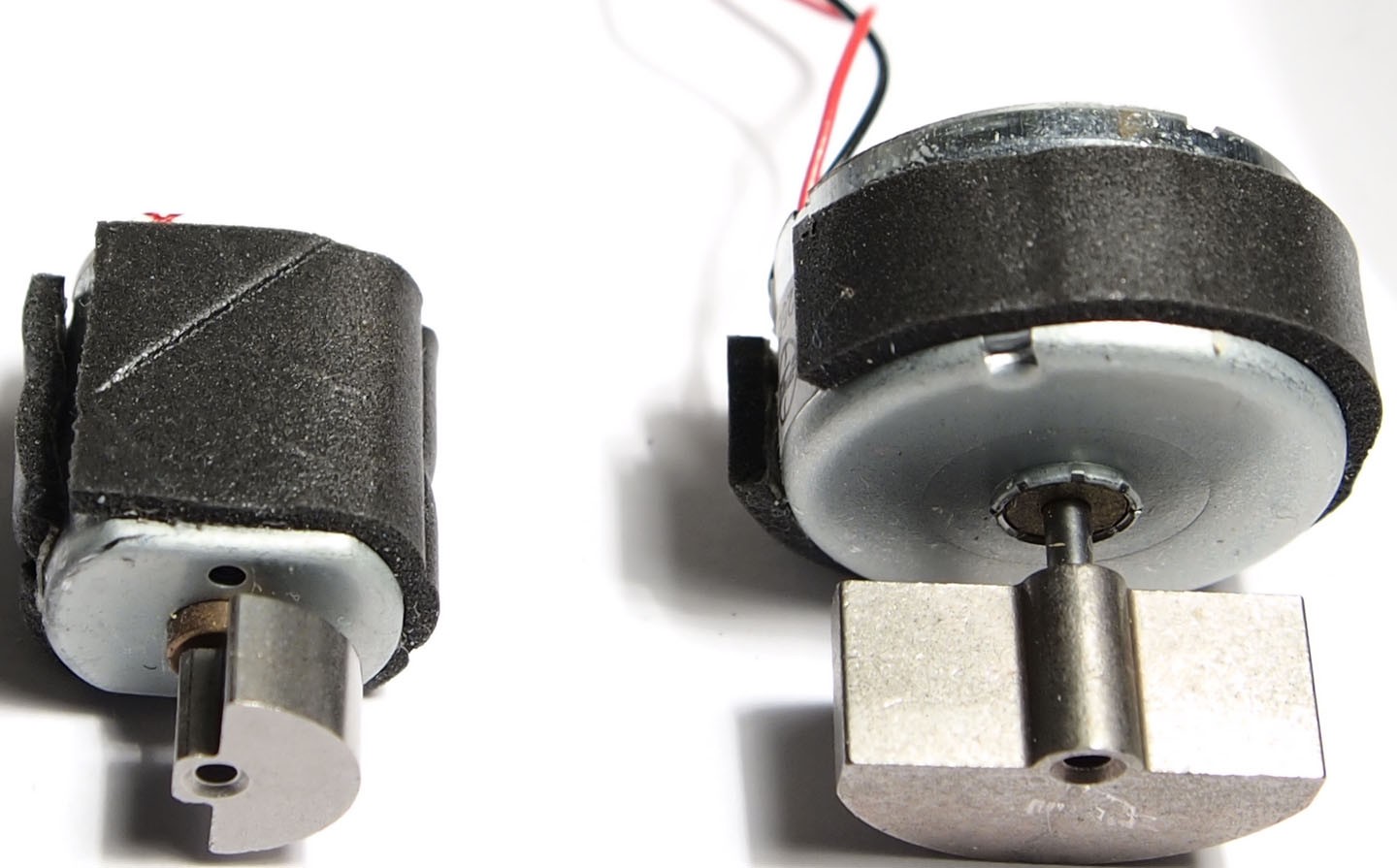
A light gun that kicks has a solenoid in it, and Solenoid Recoil is the dive about that. This dive is about everything else a motor can do to the hand: the buzz of an eccentric weight, the crisp tap of a resonant actuator, the wide-band shake of a voice coil, and the motor-driven recoil mechanisms some arcade and airsoft guns use instead of a coil. It covers the physics in numbers that can be designed with, the real parts with their published figures and dated prices, the driver stages, where a motor goes in the printed MP7 that is the first build (decision D35), what it draws from the gun’s supplies, and how to measure it on the bench.
1.1 The dive in one table
Table 1 — The dive in one table
| Volume | Title | What it settles |
|---|---|---|
| 1 | What a motor adds | The jobs, the four actuator families, the hand, and why a gun’s mass changes everything |
| 2 | Eccentric rotating mass motors | Force against speed, the makers’ “normalised amplitude”, start-up and stop times, real parts and prices |
| 3 | Linear resonant actuators and voice-coil exciters | Resonance, bandwidth, the parts, and why they suit a grip panel better than a whole gun |
| 4 | Driving a haptic motor | MOSFET and PWM, the TI and Renesas haptic driver ICs, and an H-bridge on the 24 V rail |
| 5 | Motor-driven recoil | Crank and weight, cam and spring, the airsoft “recoil engine”, against a solenoid |
| 6 | Rumble in the printed MP7 | Where the motor goes, isolation, noise, the USB and 24 V budgets, the one-stage rule, firmware cues |
| 7 | Measuring it and keeping it working | An accelerometer on the shell with the ADP3450, a sled test, wear, failure and replacement |
1.2 Kick and rumble are different things
A solenoid kick is an impulse: a striker crosses a few millimetres in 10 to 30 ms and stops against a buffer, handing the gun a momentum of a few hundredths of a kilogram-metre per second in a fraction of a millisecond (Solenoid Recoil Vol 5). The hand feels one hit per shot, and the firmware times it in milliseconds.
Rumble is a sustained oscillation: a force that reverses tens or hundreds of times a second for as long as the drive lasts. Its net momentum over a cycle is zero, so it cannot push the gun into the shoulder. What it can do is say “something is happening” for as long as something is happening: a reload, a hit taken, an engine running, a weapon spinning up. It can also carry texture, because a motor’s speed (and a resonant actuator’s waveform) can be changed while it runs.
The two are complements, not substitutes. OpenFIRE, the firmware the build uses, treats them that way: it has exactly two force-feedback outputs, “Solenoid Signal” and “Rumble Signal”, and by default fires the solenoid for on-screen shots and runs the motor for off-screen pulls (Open-Source Firmware Vol 5, §5.8). A “Rumble FF” setting lets the motor take the solenoid’s place for on-screen shots when the solenoid is off: the quiet mode.
1.3 What rumble is for in a light gun
Controls and Inputs Vol 7 lists the gun’s feedback channels and gives rumble three jobs: an off-screen shot, damage, and a game event. In practice, the uses break down as follows:
Table 2 — [Controls and Inputs Vol 7](/light-guns/building-the-electronics/controls-and-inputs/vol-7/) lists the gun's feedback channels and gives rumble three jobs: an off-screen shot, damage, and a game event. In practice, the uses break down as follows
| Use | What the player feels | What it needs from the actuator | Who drives it |
|---|---|---|---|
| Off-screen pull (reload in most games) | One short buzz, distinct from a kick | Fast start: it must be felt within about 50 ms of the pull | Gun firmware (default 150 ms event) |
| Quiet mode (Rumble FF) | A buzz per shot instead of a kick | Starts and stops inside one shot period: 75 ms at OpenFIRE’s default (half the rumble length) | Gun firmware |
| Damage taken, explosion, vehicle | A longer shake whose strength follows the game | Proportional control of strength; a low, heavy frequency reads as “big” | The game, through serial force feedback (Open-Source Firmware Vol 6) |
| Automatic fire between kicks | A continuous texture under the solenoid’s hits | Runs alongside the kick without fighting it for current (Volume 6) | Either |
| Menu, calibration, “gun connected” cues | A click or two | Very short, crisp pulses | Gun firmware |
The first two rows are where the choice of actuator shows. A buzz that starts 100 ms after the pull feels disconnected from it, and a buzz that is still running when the next shot’s buzz begins blurs into a hum. Volume 2 shows that a typical small eccentric-mass motor takes 40 ms to begin moving and another 90 ms to reach full amplitude, which is longer than OpenFIRE’s whole Rumble FF event.
1.4 Where motors have already been used
Three lines of practice lead to this dive, and each is documented elsewhere on the site.
- Arcade guns. Taito’s Operation Wolf (1987) kicked with a geared motor driving a weight back and forth through a crank, and Sega’s Laser Ghost (1991), Alien3: The Gun (1993) and The House of the Dead 4 (2005) had vibration motors in the gun, with fuses, test-menu entries and replacement procedures; Alien3’s manual even has a section on replacing the motor’s brushes. All of this is in Arcade Light Guns Vol 5, which records the mechanisms from the manuals. Volume 5 of this dive takes the motor-and-crank idea and puts numbers on it.
- Game controllers. The photograph above is the standard rumble device: two brushed motors with unequal half-moon weights. The controller is light, which is why so small a motor is enough in a gamepad (1.8).
- Hobby light guns. OpenFIRE’s Hardware Guide drives a rumble motor from USB 5 V through one transistor (Open-Source Firmware Vol 3, §3.9); the reference board does the same with a MOSFET (Reference Electronics Vol 5, §5.8). GUN4IR’s GunCon 2 kit ships a rumble motor with a printed holder (Modding Classic Light Guns Vol 6, §6.7), and RetroShooter’s RS3 Reaper has DIP switches for its rumble motor (Solenoid Recoil Vol 1). None of these documents names the motor by part number or says how strong it is; OpenFIRE’s README asks only for a “5V gamepad rumble motor” (Power Supplies Vol 3).
That last gap is the reason for most of this dive. A “5 V rumble motor” is not a specification, as Reference Electronics Vol 5 puts it, and neither its current nor its strength in a 1.3 kg gun can be read from the phrase.
1.5 The four families
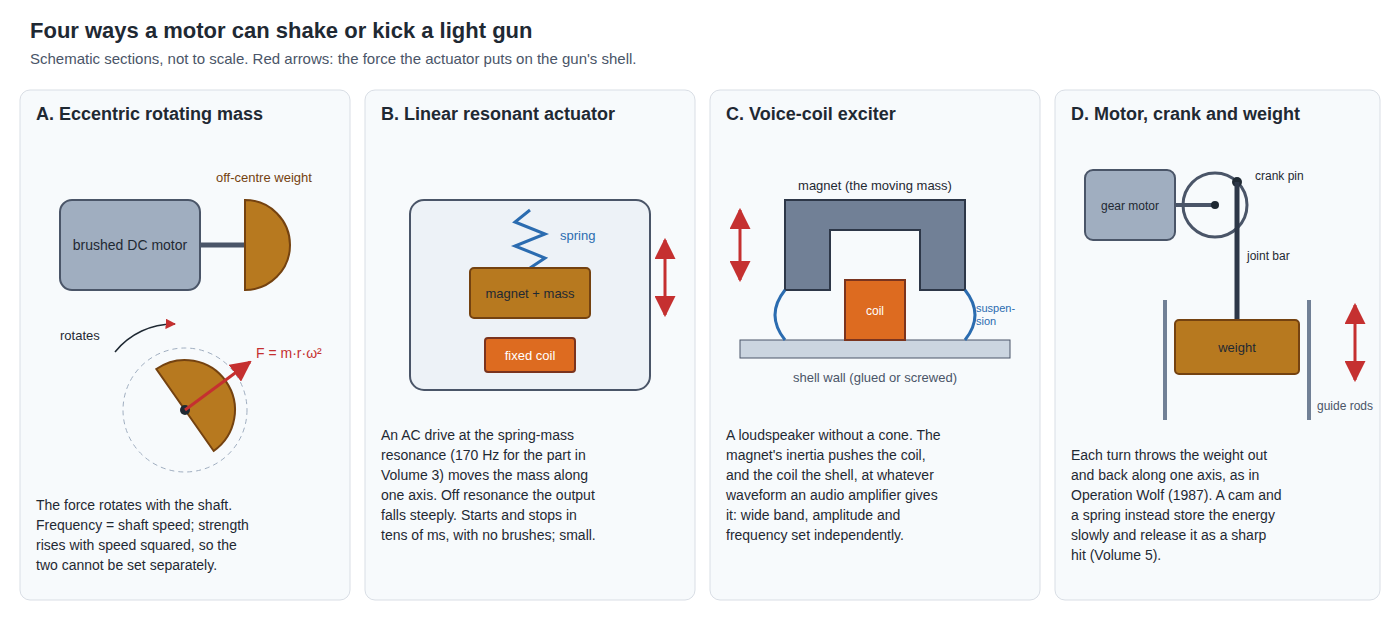
A. Eccentric rotating mass (ERM). A small brushed DC motor with an off-centre weight. The weight’s centripetal force, m·r·ω², rotates with the shaft, so the gun is shaken in the plane perpendicular to the shaft at the shaft’s rotation frequency. Speed sets both the frequency and the strength, and strength rises as the square of speed. ERMs are cheap, strong for their size, and run from DC with nothing more than a switch, which is why every hobby gun uses one. Their faults are slowness to start and stop, brush wear, and the coupling of frequency to strength. Volume 2.
B. Linear resonant actuator (LRA). A magnet and mass on a spring inside a sealed can, driven by a fixed coil with an AC signal at the spring-mass resonance, typically somewhere between about 125 and 300 Hz. It moves along one axis only, starts in about 10 ms, has no brushes, and is quiet. It is efficient only near its resonance, so it needs an AC drive that tracks that frequency, which is what the haptic driver ICs of Volume 4 do. Small LRAs are built for phones. Volume 3.
C. Voice-coil exciter. A loudspeaker motor with no cone: a magnet on a suspension over a coil fixed to whatever it is screwed or glued to. Driven by an audio amplifier, it reproduces any waveform in its band, so frequency and amplitude can be set independently and the game’s own audio can be used as a vibration signal. The tactile transducers sold for gaming chairs (“bass shakers”) are large versions. Volume 3.
D. Motor-driven recoil. A gear motor turning a crank that throws a weight back and forth (Operation Wolf), or a cam that compresses a spring and lets it go as a sharp hit, which is how the airsoft “recoil” guns are described. Unlike A to C, these can give a one-directional hit like a solenoid, at a fraction of a solenoid’s peak current, at the price of a gearbox, noise and latency. Volume 5.
1.6 The hand: where it is most sensitive
The best single source for how a gripping hand perceives vibration is Michael Griffin’s review of hand-transmitted vibration research at the Institute of Sound and Vibration Research, Southampton, published in Industrial Health in 2012. Its abstract states the headline: “for a typical hand grip the thresholds show greatest sensitivity to acceleration around 125 Hz.”1
The mechanism is the four-channel model of touch, set out by Bolanowski, Gescheider, Verrillo and Checkosky in 1988,2 which the review summarises: a slowly adapting channel (Merkel endings) most sensitive below about 2 Hz; a fast-adapting channel (Meissner corpuscles) that mediates threshold perception from about 2 to 40 Hz; the Pacinian channel, which “often mediates perception at frequencies greater than about 40 Hz”, with absolute thresholds that are U-shaped in frequency and “greatest sensitivity in the range 100 to 300 Hz”; and a fourth, less sensitive channel (Ruffini endings) over a similar range.1
Three findings in the review bear directly on a gun:
- Gripping a handle behaves like pressing a palm on a plate. Thresholds for a hand gripping a vibrating cylindrical handle are “broadly similar” to those for the palm pressed on a vibrating flat surface. A light gun’s grip is exactly the case the research measured.1
- The best band on a handle is about 80 to 160 Hz. Morioka and Griffin’s 2006 study of subjects gripping a cylindrical handle found acceleration thresholds “U-shaped” with “greatest sensitivity around 80 to 160 Hz”, and broadly the same in all three axes.1 So an ERM’s shaking plane, or an LRA’s single axis, matters much less than its frequency.
- Area matters at high frequency. The Pacinian channel sums over area, so a small vibrating contactor surrounded by a rigid surface is felt less well at high frequencies than a whole handle moving.1 A small actuator that vibrates only a button-sized patch of the shell will feel weaker than its acceleration figure suggests.
The ERMs on sale run from about 40 Hz (large slow motors) to over 230 Hz (small fast ones), and small LRAs sit at 150 to 240 Hz. The hand’s best band, 80 to 160 Hz, is between them. Volume 2’s chart puts each part on that axis.
1.7 The hand: what “stronger” means above threshold
Thresholds say what can just be felt. A rumble is meant to be felt clearly, and there the review reports something less obvious. Morioka and Griffin also measured how strong supra-threshold vibration felt, and found that “with increasing vibration magnitude, equivalent sensation approximated towards constant velocity”, while at low magnitudes it followed the threshold curve.1 The abstract states the same for discomfort: at higher magnitudes it “is similar when the vibration velocity is similar (at frequencies between about 16 and 400 Hz)”.
Velocity is acceleration divided by 2πf. So at the same acceleration, a 100 Hz vibration feels about twice as strong as a 200 Hz one once both are well above threshold. That is the physical reason a large, slow gamepad motor feels “heavier” than a small fast one, and the reason Volume 2 plots each motor’s velocity as well as its acceleration. The review’s comfort contours use 5.0 m/s² r.m.s. at 50 Hz as the reference for a sensation magnitude of 100,1 which is a velocity of about 16 mm/s r.m.s.; it serves below as a marker for “strong”, not as a limit.
Two cautions. The review’s experiments used a rigid handle on a shaker, not a hollow plastic gun, and its subjects held still. And the review stresses that “no single linear frequency weighting” predicts the judgements at every magnitude. The figures here are design guidance to be checked by hand on the bench (Volume 7), not a perceptual model.
1.8 The first number: a gun is heavy
Every maker’s vibration figure is measured on a test mass. Precision Microdrives, the UK maker whose datasheets are the most complete in this field, measures each motor on a “standard test sled” of 100 g, 250 g or 1,000 g and also publishes a “normalised amplitude”, the peak-to-peak acceleration “normalised by the inertial test load”, which comes to the figure for a 100 g load.3 The LRA datasheet in Volume 3 uses a 100 g jig. A phone weighs about that much, and a game controller a few times more.
A printed MP7 is estimated at 0.9 to 1.3 kg before ballast, and the real MP7A1 with an empty magazine is about 2.05 kg (MP7 Printed Build Vol 7). If the gun moves as one rigid body, a given motor’s acceleration falls in proportion to the mass it shakes: a part rated at 1.3 G peak-to-peak on 100 g gives about 0.1 G on a 1.3 kg gun. A coin motor from a phone is about thirteen times weaker in a light gun than its datasheet says. That is the single most important number in this dive, and it is why Volume 2 ends up recommending a motor much larger than any hobby build names.
Two things soften it. The hand holds only part of the gun, and a motor mounted close to the grip in a shell that is not perfectly rigid shakes the grip more than the far end; and an actuator that moves only a grip panel (Volume 3) shakes a few tens of grams, not the whole gun. Both are design levers, and both are things to measure (Volume 7) rather than assume.
1.9 How the rest of this dive is arranged
Volume 2 is the eccentric-mass motor: the force law, the makers’ figures, start-up and stop times, brushes and lifetime, and the parts with their prices. Volume 3 covers the linear resonant actuator and the voice coil. Volume 4 drives them: the reference board’s MOSFET stage, the PWM frequency, haptic driver ICs with overdrive and braking, and an H-bridge on the 24 V rail. Volume 5 is motor-driven recoil. Volume 6 puts a motor in the printed MP7 and checks it against the power budgets and the one-stage-at-a-time rule (decision D16). Volume 7 is the bench: an accelerometer on the shell with the Analog Discovery Pro ADP3450, a sled test that reproduces the makers’ method, and the wear and failure of motors in service.
Every pick carries a “why this, and why not the others” table, in line with the category’s decision log, and each proposed row is numbered MR-n.
1.10 What could not be verified
- The motors in commercial light guns (GUN4IR’s kit, the RS3 Reaper, Sega’s House of the Dead 4 gun): none of the documents read names a part number, voltage or amplitude.
- Absolute perception thresholds in m/s² for a gripped handle: the review gives them in figures, which were not transcribed here; only the frequency of best sensitivity and the velocity finding are quoted.
- How much of a motor’s force reaches the grip of a hollow printed shell, rather than a rigid body: an estimate only, until measured (Volume 7).
Sources
Footnotes
-
M. J. Griffin, “Frequency-dependence of Psychophysical and Physiological Responses to Hand-transmitted Vibration”, Industrial Health 50 (2012) 354–369, Human Factors Research Unit, ISVR, University of Southampton. Abstract; “Frequency-dependence of thresholds”; “Equivalent comfort contours” and Fig. 10, citing Morioka and Griffin (2006). https://www.jniosh.johas.go.jp/en/indu_hel/doc/IH_50_5_354.pdf, read 2026-10-19. ↩ ↩2 ↩3 ↩4 ↩5 ↩6 ↩7
-
S. J. Bolanowski, G. A. Gescheider, R. T. Verrillo and C. M. Checkosky, “Four channels mediate the mechanical aspects of touch”, Journal of the Acoustical Society of America 84(5) (1988) 1680–1694, doi:10.1121/1.397184, PMID 3209773. Record read on Europe PMC, 2026-10-19. ↩
-
Precision Microdrives, 312-107 product data sheet, R002: “Rated Inertial Test Load — Mass of standard test sled 250 g”; “Typical Norm. Amplitude — Peak-to-peak vibration amplitude normalised by the inertial test load at rated voltage”. https://precisionmicrodrives.com/cdn/catalog_product/3aee1d35-6a45-411f-8188-b85793c9c24e/312-107-datasheet.pdf, read 2026-10-19. ↩
Comments (0)