Motors and Rumble · Volume 3
Linear Resonant Actuators and Voice-Coil Exciters — Crisp, Quiet, and Sized for Something Smaller Than a Gun
How a spring-mounted magnet makes vibration, why a resonant actuator is strong only at one frequency and an exciter only above one, what the published parts deliver on a 1.3 kg shell, and the case for using one on a floating grip panel rather than on the whole gun
3.1 One mechanism, two kinds of part
A linear resonant actuator and a voice-coil exciter are the same machine: a coil and a permanent magnet, one of them carried on a spring or suspension, the other fixed to the thing to be shaken. Current in the coil pushes the moving part one way; reversing the current pushes it back. The reaction on the fixed part is the vibration. Nothing rotates, so there are no brushes, no commutator noise and no start-up lag of a rotor coming up to speed.
The difference is the spring. In a linear resonant actuator (LRA) the spring is stiff and the moving mass small, so the system has a sharp resonance, usually somewhere between about 125 and 300 Hz, and it is driven at that resonance where a little power gives a lot of motion. In a voice-coil exciter the suspension is soft enough, or the moving mass large enough, that the resonance sits at one edge of a wide useful band, and the part is driven like a loudspeaker by an audio amplifier.
3.2 How a linear resonant actuator works
The cycle of operation, for a typical coin-shaped LRA:
- A magnet and a tungsten or steel mass hang on a flat spring inside a sealed can; a coil is fixed to the can’s base below them.
- The driver applies an AC voltage at the spring-mass resonance. Each half-cycle the coil’s field pushes the magnet up or pulls it down.
- At resonance the spring’s stiffness and the mass’s inertia cancel, and the motion builds until the energy the coil puts in each cycle equals what damping takes out. The reaction on the can, and so on whatever the can is glued to, is the vibration, along one axis, perpendicular to the coin’s face.
- Off resonance the output falls steeply, because the coil is fighting the spring (below) or the mass (above).
- Removing the drive leaves the mass ringing down at its own rate. A driver that reverses the phase for a cycle or two (Volume 4) stops it in a few milliseconds.
Because the useful band is narrow, and because the resonance moves with the part’s tolerance, its temperature and how it is mounted, a good LRA driver tracks the resonance: it watches the back-EMF of the moving magnet and keeps its drive in phase. TI’s DRV2605L does this for LRAs between 125 and 300 Hz, a range its datasheet narrowed from an earlier “50 Hz” minimum in a revision.1 Volume 4 covers the drivers.
3.3 A real LRA, from its datasheet
The best-documented hobby-available LRA is the 10 mm coin part sold today as the Vybronics VG1040003D, whose predecessor was the Jinlong G1040003D. SparkFun hosts the Jinlong datasheet:2
Table 1 — A real LRA, from its datasheet
| Parameter | G1040003D |
|---|---|
| Rated input | 2.5 V r.m.s. AC sine; range 0.1–2.5 V r.m.s. |
| Input frequency | 150–200 Hz; resonance f0 170 ±5 Hz |
| Rated current | 170 mA r.m.s. maximum |
| Acceleration (minimum) | 0.9 G r.m.s. at 150 Hz; 1.0 G r.m.s. at 200 Hz; 1.8 G r.m.s. at f0 |
| Test fixture | 100 g “dummy jig”, 15 × 45 × 105 mm, on a sponge, with a Brüel & Kjær 4393 accelerometer, vibrating along its 15 mm direction |
| Rise time | ≤ 10 ms to 50 % of normal |
| Brake time | ≤ 50 ms to 10 % of normal |
| Noise | ≤ 50 dB(A) |
| Life | 1,000,000 cycles of 2 s on, 1 s off |
Three things stand out. First, the rise is fast: 10 ms to half amplitude, against 40 ms of lag before a coin ERM even begins to move (Volume 2). That is the LRA’s real advantage. Second, the band is narrow: half the output at 150 Hz, 20 Hz below the resonance. Read as three points on one curve, the minimum figures are consistent with a quality factor of about 5 to 6. Third, the strength is a phone’s: 1.8 G r.m.s. on 100 g is about 5.1 G peak-to-peak, the same order as a 9 mm coreless ERM.
DigiKey lists the current part as “VIBRATION LRA MOTOR 170HZ 2G”, 2.5 V AC (part 1670-VG1040003D-ND), according to a search of its pages; the page itself could not be read on the day, and no price was captured. Whether the Vybronics revision carries the same acceleration table as the Jinlong sheet was not confirmed.
3.4 Wideband actuators
A second class of linear actuator is built with a lower Q and a wider band, so that the waveform can change frequency: a game can play a 90 Hz thump and a 300 Hz click through the same part. Renesas’ DA7280 driver supports both narrowband and “wideband” LRAs; its product page gives resonance tracking up to 300 Hz and a wideband drive from 25 Hz to 1 kHz.3
PUI Audio’s HD-VA3222 is a flat actuator sold in this space. Its datasheet gives:4
Table 2 — Wideband actuators
| Parameter | HD-VA3222 |
|---|---|
| Maximum input | 1.5 V r.m.s. |
| DC resistance; impedance | 8.3 Ω; 8.4 ±0.9 Ω |
| Resonance; frequency range | 133 ±13 Hz; 80–500 Hz |
| Acceleration | ”Max Acceleration (@133 Hz) 2.52 Gp-p”; at 0.5 V, 2.52 G at 133 Hz, 0.41 G at 300 Hz, 0.33 G at 400 Hz, 0.28 G at 500 Hz |
| Rise (0–90 %) / fall (100–10 %) | 46 ms / 36 ms |
| Mass | 8.5 g |
The sheet does not state the test mass, so the acceleration cannot be compared with the 100 g figures; it gives the same 2.52 G both as the maximum and as the 0.5 V figure, which is inconsistent; and its rise time is far slower than the narrowband LRA’s. Its resonance at 133 Hz sits in the hand’s best band, which is the attraction. Its availability was unclear: DigiKey’s listing appeared active in a search, PUI’s own page said stock was unavailable, and one broker marked it obsolete.
3.5 Voice-coil exciters and tactile transducers
An exciter is a loudspeaker motor with no cone, made to turn a panel into a speaker. Fixed to a gun’s shell it shakes the shell instead. Dayton Audio, whose exciters are the common hobby part, gives these figures on its own pages:567
Table 3 — Voice-coil exciters and tactile transducers
| Part | Size | Resonance (free air) | Impedance; power | MSRP |
|---|---|---|---|---|
| DAEX13CT-8 coin exciter | Ø26.3 × 9.5 mm | 775 Hz | 8 Ω (Re 7.3 Ω); 3 W r.m.s. | $5.99 |
| DAEX25CT-4 coin exciter | Ø48 × 15 mm | 306 Hz | 4 Ω (Re 3.6 Ω); 10 W r.m.s. | $15.99 |
| TT25-8 PUCK tactile transducer | 3½ in diameter × 1 in (89 × 25 mm) | 40 Hz; “usable” 20–80 Hz | 8 Ω (Re 7.7 Ω, Le 1.30 mH); 15 W r.m.s., 30 W max | $23.99 |
Dayton’s own pages warn that an exciter’s response “is completely dependent” on the surface it drives, so the free-air resonance is a starting point only.
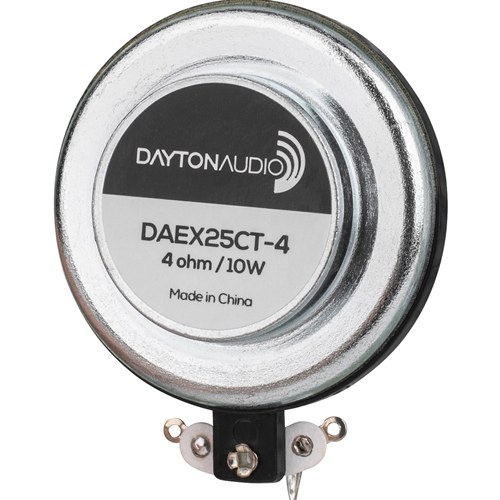
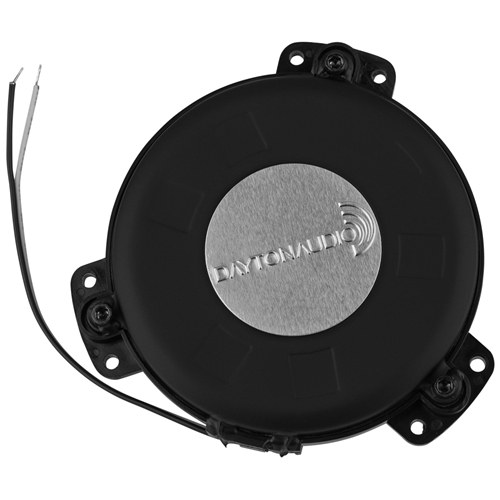
The coin exciters are built to make sound, and their resonances (306 and 775 Hz) sit well above the band the gripping hand feels best. The PUCK is built to make furniture shake, with exactly the low, heavy band a rumble wants, and is twice the width of the gun.
3.6 Where each delivers its force
The force an inertial actuator puts on its mounting, for a constant drive, follows the response of a spring-mounted mass: it rises as the square of frequency below the resonance, peaks at the resonance by a factor set by the Q, and settles to a constant above it.
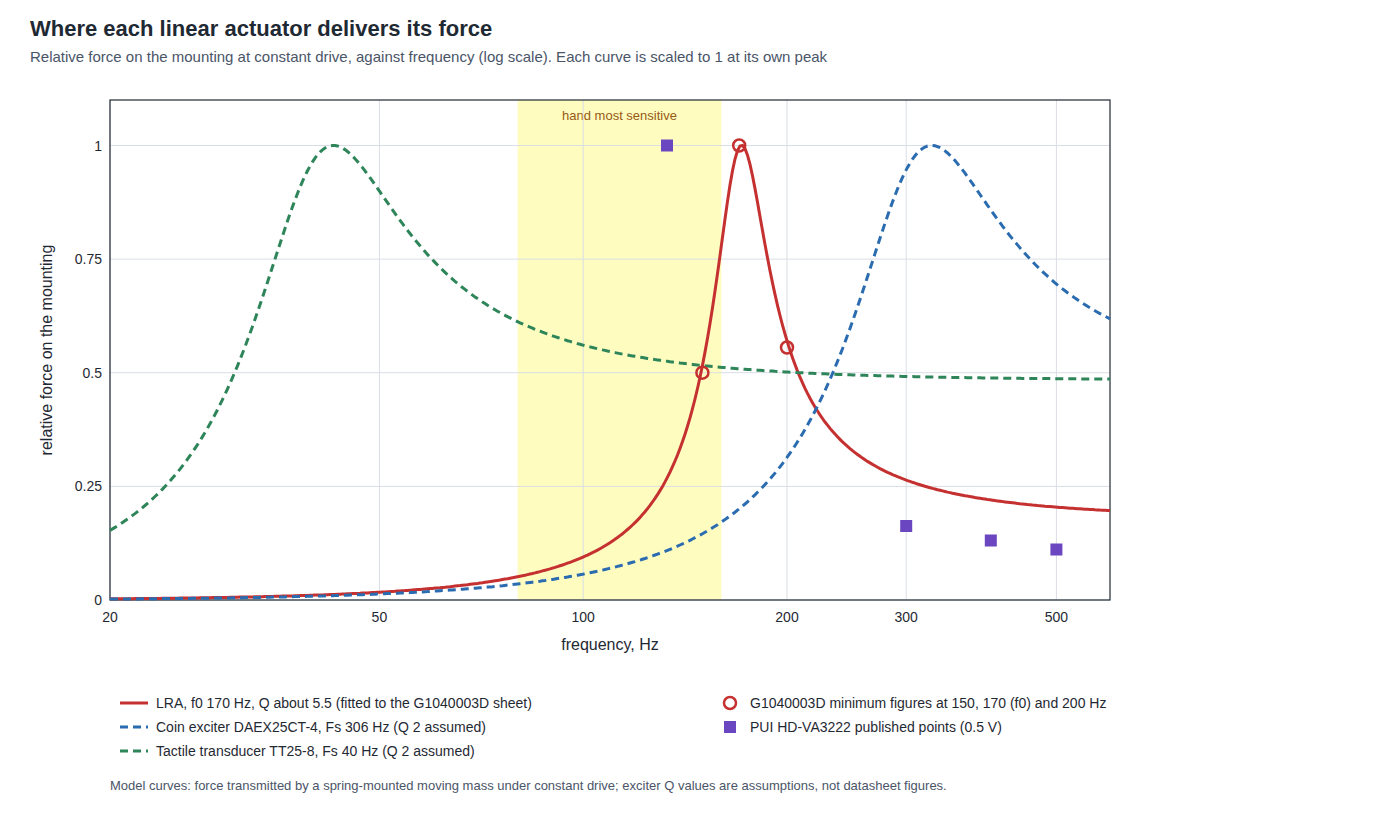
The chart is the argument of this volume in one picture:
- An LRA is a tuning fork. Driven at its resonance it is efficient and fast; 30 Hz either side it gives half or less. Its resonance is fixed by its construction, and the common parts sit at 170 Hz or higher, just above the hand’s best band.
- A coin exciter is a tweeter. Below its resonance its force falls as the square of frequency, so a 306 Hz exciter gives about a ninth of its plateau force at 100 Hz.
- A tactile transducer is the right shape of curve, at a size that does not fit.
3.7 On a gun: the mass problem again, and a way round it
Scaled to a 1.3 kg gun as in Volume 2, the G1040003D’s 1.8 G r.m.s. on 100 g becomes about 0.14 G r.m.s., 1.4 m/s² r.m.s., at 170 Hz: the same group as the small ERMs, and well short of the 34 mm ERM. Every LRA and coin exciter on sale is sized for a phone or a controller, and none of them shakes a 1.3 kg gun hard.
There is a way round this that the ERM does not offer as neatly. Shake less of the gun. If the actuator is mounted not to the receiver but to a grip panel or a backstrap insert carried on soft mounts (silicone grommets, a TPU frame), the moving mass is the panel, tens of grams, and the hand’s palm is on exactly the part that moves. Volume 1’s third finding from the hand research applies: the Pacinian channel sums over area, so the panel should be large (the whole grip side, not a button-sized patch), and the rest of the gun should not be a rigid surround pressing on the same skin.
On a 50 g floating panel, the same LRA would give in the region of 1.8 × 0.1 / 0.05 ≈ 3.6 G r.m.s., an estimate that ignores the soft mount’s own stiffness and the hand’s damping. That is stronger at the palm than the 34 mm ERM shaking the whole gun, from a part that starts in 10 ms, makes no brush noise, and draws 170 mA. The costs are mechanical: a grip that moves relative to the gun, gaps that must not pinch, and a realism question, since the real MP7’s grip is one moulding with the receiver.
This is a local cue channel, not a rumble: crisp, quiet, fast, suited to “reload”, “click” and menu cues and to a per-shot tap in quiet play. The whole-gun shake for explosions and damage still wants an ERM (Volume 2). The two can coexist, with OpenFIRE’s single rumble output driving one and the fork’s serial commands the other (Volume 6).
3.8 Where to buy, and what it costs
Prices as read on 19 October 2026:
Table 4 — Prices as read on 19 October 2026
| Part | Seller | Price | Note |
|---|---|---|---|
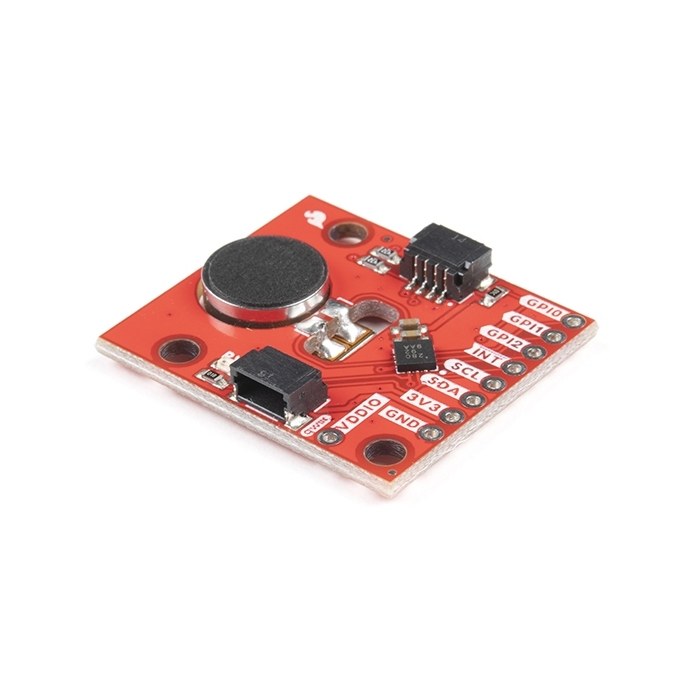
| SparkFun Qwiic Haptic Driver DA7280 (ROB-17590), LRA fitted | SparkFun | $11.50 (10+ $10.93; 25+ $10.35; 100+ $9.78)8 | The cheapest way to try an LRA with a tracking driver; page showed both “In stock” and “Backorder” |
| Vybronics VG1040003D LRA | DigiKey (1670-VG1040003D-ND) | not captured | Page not readable on the day |
| PUI HD-VA3222 | DigiKey | not captured | Availability unclear (3.4) |
| Dayton DAEX13CT-8 | Dayton Audio | $5.99 MSRP | |
| Dayton DAEX25CT-4 | Dayton Audio | $15.99 MSRP | A Parts Express category page showed $17.99 |
| Dayton TT25-8 PUCK | Dayton Audio | $23.99 MSRP |
3.9 Why this, and why not the others
Criteria: as Volume 2, plus speed of start and stop, and quietness for the cue channel.
Table 5 — Why this, and why not the others
| Candidate | For | Against | Decision |
|---|---|---|---|
| LRA on a floating grip panel (G1040003D class, on the SparkFun DA7280 board for the trial) | Fast (≤ 10 ms rise), quiet, brushless, low current; strong at the palm if only a panel moves | Weak on a whole gun; narrow band at 170 Hz; moving grip is a realism and pinch question; needs an AC driver | Testing: a second, local cue channel (MR-2), after the ERM |
| LRA on the receiver (whole gun) | As above, simpler | ≈ 1.4 m/s² r.m.s. on 1.3 kg: a tingle | Rejected |
| PUI HD-VA3222 | 133 Hz, in the best band; wideband | No test mass; inconsistent sheet; slow rise; uncertain supply | Rejected until a readable stock listing and a clearer sheet exist |
| DAEX13CT-8, DAEX25CT-4 exciters | Wideband, cheap, driven by any audio amplifier | Resonance 306–775 Hz, above the band; the 25 mm part is 48 mm across | Rejected |
| TT25-8 PUCK | The right band and strength | 89 mm across; the MP7 is 42 mm wide | Rejected for the gun; usable as a shaker under a seat or pedal, which is outside this dive |
3.10 What could not be verified
- Whether the Vybronics VG1040003D matches the Jinlong G1040003D sheet read here.
- Prices for the Vybronics and PUI parts.
- The Q of the exciters: assumed for the chart.
- The floating-panel estimate: an arithmetic upper bound; the mount and the hand will reduce it. A bench test is in Volume 7.
- Tactile Labs’ Haptuator, often used as a research reference actuator: no maker specification or price could be read, so it is left out.
Sources
Footnotes
-
Texas Instruments, DRV2605L 2- to 5.2-V Haptic Driver for LRA and ERM With Effect Library and Smart-Loop Architecture, SLOS854D: Recommended Operating Conditions (LRA frequency range 125–300 Hz) and revision history. https://www.ti.com/lit/ds/symlink/drv2605l.pdf, read 2026-10-19. ↩
-
Jinlong Machinery & Electronics, G1040003D linear vibrator specification (hosted by SparkFun). https://cdn.sparkfun.com/assets/d/0/4/c/d/G1040003D.pdf, read 2026-10-19. ↩
-
Renesas, DA7280 product page. https://www.renesas.com/en/products/da7280, read 2026-10-19. ↩
-
PUI Audio, HD-VA3222 data sheet, revision B, 25 October 2022. https://api.puiaudio.com/filename/HD-VA3222.pdf, read 2026-10-19. ↩
-
Dayton Audio, “DAEX25CT-4 Coin Type 25mm Exciter 10W 4 Ohm”. https://daytonaudio.com/product/1175/daex25ct-4-coin-type-25mm-exciter-10w-4-ohm, read 2026-10-19. ↩
-
Dayton Audio, “DAEX13CT-8 Coin Type 13mm Exciter 3W 8 Ohm”. https://www.daytonaudio.com/product/1173/daex13ct-8-coin-type-13mm-exciter-3w-8-ohm, read 2026-10-19. ↩
-
Dayton Audio, “TT25-8 PUCK Tactile Transducer Mini Bass Shaker”. https://www.daytonaudio.com/product/1104/tt25-8-puck-tactile-transducer-mini-bass-shaker, read 2026-10-19. ↩
-
SparkFun Electronics, “SparkFun Qwiic Haptic Driver - DA7280”, ROB-17590. https://www.sparkfun.com/sparkfun-qwiic-haptic-driver-da7280.html, read 2026-10-19. ↩
Comments (0)