Motors and Rumble · Volume 5
Motor-Driven Recoil — Crank and Weight, Cam and Spring, and the Airsoft Recoil Engine
What a motor can do that a vibration cannot: a one-way hit. Why a crank gives a rhythmic shove rather than a kick, why a cam and spring gives the same hit as a solenoid for a twentieth of the electrical energy, what that costs in latency, noise and parts, and why it is not the first build's mechanism
5.1 Three ways to make a hit
Rumble shakes; it cannot push the gun into the shoulder, because its force averages to zero every cycle (Volume 1). A kick is different only in shape: a moving mass inside the gun is accelerated one way and stopped hard the other way, and the hand feels the stop. Solenoid Recoil Vol 5 sets this out for the solenoid: no recoil mechanism can give the gun net momentum, and “what varies is how that exchange is distributed in time”. The hit is the momentum handed over at the stop, divided by how long the stop takes.
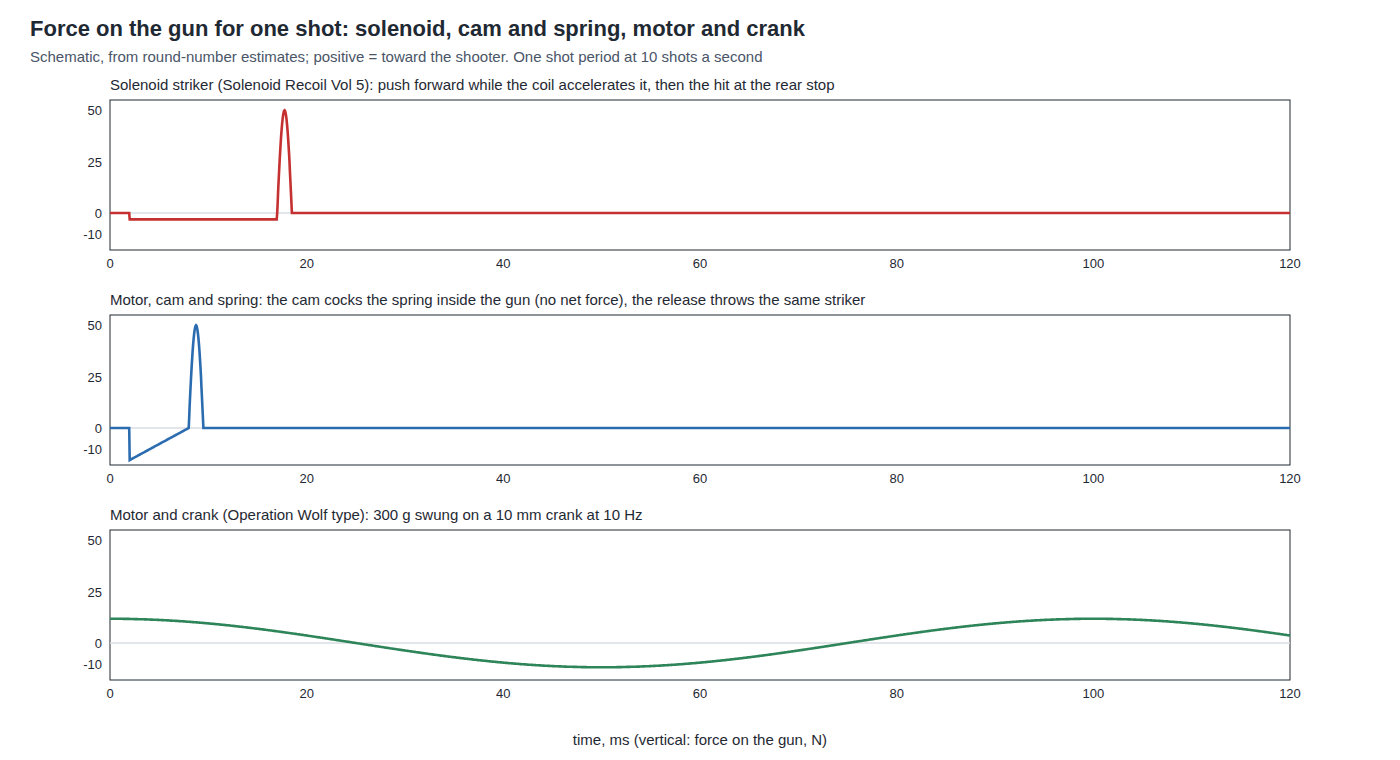
A motor can make the same exchange in two ways. It can swing a mass continuously through a crank, or it can store energy in a spring slowly and let it go all at once. The schematic traces below compare them with the solenoid, using the solenoid dive’s own orientation numbers for the striker: a 20 g striker arriving at about 2.4 m/s carries about 0.047 kg·m/s, and stopped by a rubber pad in about 1.5 ms it gives a peak of the order of 50 N.
5.2 Motor and crank
Taito’s Operation Wolf (1987) made its Uzi kick this way: a geared motor turning a spur gear and crank, a “joint bar” from the crank to a block on a “weight shaft”, so that each turn pushes the weight forward and back (Arcade Light Guns Vol 5, with the manual’s drawings). Collectors describe it as a “rachet effect”, and say the motor “commonly failed after a few years”.
The physics of a pure crank is the physics of an ERM along one axis. A mass m driven sinusoidally through a stroke of 2r at frequency f exerts a force on its mounting of m·r·(2πf)² at the ends of the stroke. For a 300 g weight on a 10 mm crank at 10 Hz, ten shots a second, that is 0.3 × 0.010 × 62.8² ≈ 12 N peak: about 9 m/s² on a 1.3 kg gun, a strong, smooth, rhythmic shove at the firing rate. At 5 Hz it is a quarter of that. The momentum swing is large, 0.3 kg × 0.63 m/s ≈ 0.19 kg·m/s, four times the solenoid striker’s, but it is delivered over tens of milliseconds, so the peak force is a quarter of the solenoid’s and there is no sharp edge to it.
That is why the arcade’s description is a rhythm rather than a hit, and why Operation Wolf’s crank suited an automatic weapon held down for “continuous firing” and would make a poor single shot. A crank can be made to hit by letting the weight strike a stop at one end of its travel, or by driving it through a slotted link with a quick return; the manual read for Arcade Light Guns does not show whether Taito did either.
5.3 Motor, cam and spring
The second way separates storing the energy from releasing it.
- A gear motor turns a cam (or a sector gear with a gap, or a scotch yoke with a drop).
- The cam pushes a striker back against a spring, compressing it, over most of a revolution. The spring’s force and the cam’s push are equal and opposite inside the gun, so the gun feels nothing while it cocks, apart from the motor’s reaction torque and its noise.
- At the cam’s drop the striker is released; the spring throws it forward (or back, for a kick toward the shooter) across its stroke.
- It hits a stop, and the gun feels the hit exactly as it feels a solenoid’s: the same momentum, the same dependence on the stop’s stiffness, the same benefit from a damper and from a heavier striker (Solenoid Recoil Vol 5).
- The cam picks the striker up again on the next revolution.
To match the solenoid striker’s roughly 55 mJ at landing (Solenoid Recoil Vol 5’s 20 g row), a spring must store about that much: ½·k·x² = 0.055 J is, for instance, a 10 mm compression of a spring of 1.1 N/mm, with a peak force of 11 N at the cam. That is a modest spring and a modest cam load.
In the middle trace above the spring-thrown striker crosses its stroke faster than the coil-driven one, because a spring pushes hardest at the start of the stroke, where a solenoid pushes weakest (Solenoid Recoil Vol 2).
5.4 The energy argument
The case for the cam and spring is in the electrical energy per shot.
- Solenoid. Power Supplies Vol 4 works the example of a 24 V, 12 Ω coil fired for OpenFIRE’s default 45 ms: 48 W for 45 ms, 2.16 J per shot. Solenoid Recoil Vol 5’s model lands 48 to 66 mJ in the striker. Of the energy drawn, about 2 to 3 % reaches the stop; the rest is heat in the coil, which is why coil temperature limits autofire (Solenoid Recoil Vol 4).
- Cam and spring. A gear motor storing 55 mJ in a spring at an overall efficiency of, say, 30 to 50 % for a small brushed gear motor and a cam (an assumption, not a measured figure) draws 0.11 to 0.18 J per shot.
That is a factor of twelve to twenty. More useful still is the peak power: the solenoid draws 48 W while it fires, which is the whole reason for the 24 V brick, its trip band and the one-stage-at-a-time rule (decision D16); a gear motor recocking ten times a second averages 1 to 2 W and draws its stall current only at start. For a battery-powered or USB-powered gun, which Power Supplies Vol 3 shows cannot sustain a solenoid’s autofire, this is the only recoil mechanism whose energy fits.
The estimate is rough on the motor side and ignores friction in the cam and the spring’s own mass; it is the order of magnitude that matters, and it is large.
5.5 What it costs: latency, rate, noise, wear
Latency. A solenoid fires within a few milliseconds of the trigger. A cam-and-spring mechanism fires when the cam reaches its drop. If the motor stops after each shot with the cam just before the drop (cocked and held), the latency is the time to turn the last few degrees from standstill, plausibly 10 to 20 ms for a small gear motor, which is a bench number to measure, not a datasheet one. That requires knowing where the cam is: a Hall sensor or microswitch on the cam, and a firmware state machine, which is the “position sensing” the MP7 donor dive’s port-actuator row counted against a cam motor (row P-MP7-4, MP7 Donor Build Vol 2, §2.6). Holding it cocked also means the spring is loaded whenever the gun is idle.
Rate. Single shots: limited by recocking time. Autofire: one shot per cam revolution (or per lobe), so the firing rate is the motor’s speed through the gearbox, which drifts with supply voltage and load. A game-driven rate (serial force feedback) has to be matched by speed control.
Noise. A gearbox whines, the cam and follower click, and the hit is as loud as a solenoid’s. Gear noise is continuous during autofire.
Wear. Brushes (Volume 2), gear teeth, the cam face and follower, and the spring, which fatigues at every cycle. Each is a wear part that a solenoid does not have, though the solenoid has its own (stops, dampers, the coil’s insulation).
Parts and space. A gear motor, a cam, a follower, a spring, guides, a stop and a position sensor, against a solenoid, a striker, guides and a stop.
5.6 The airsoft recoil engine
Airsoft offers a working example of motor-driven recoil at gun scale. An airsoft electric gun (AEG) is already a motor, cam and spring: its gearbox’s sector gear draws a piston back against a spring and releases it to fire the pellet. Tokyo Marui’s “Next Generation” series adds recoil to that cycle. Tokyo Marui’s own series page describes them only as high-end models fitted with a “Shoot & Recoil Engine” that gives real recoil shock.1 Retailers describe a reciprocating weight that simulates the cycling bolt, one of them giving its mass as about 300 g for the MP-A model; those descriptions were read only through search results and are not confirmed from Tokyo Marui.2 How the weight is linked to the gearbox was not found in any primary source and is not described here.
The point for this dive is not the mechanism’s detail but the existence proof: a commercial, mass-produced gun of carbine size makes a felt recoil from a motor, a gearbox and a moving weight, run from a small battery. MP7 Donor Build covers the airsoft MP7s as donors.
5.7 A cam-and-spring module for the printed MP7, sketched
The printed MP7’s kick is planned as a module on an aluminium plate behind the ejection port: a moving mass on two steel rods, a buffer, a stop and a solenoid bay (MP7 Printed Build Vol 5, §5.4). A cam-and-spring version could share everything but the solenoid:
- the same moving mass on the same rods, so the part seen through the ejection port still moves, and the stop and damper design still follows Solenoid Recoil Vol 5;
- a small gear motor where the solenoid bay is, turning a cam that draws the mass forward against a spring, the drop releasing it rearward onto the rear buffer, toward the shooter as Solenoid Recoil Vol 5 recommends;
- a Hall sensor and a magnet on the cam for “cocked” and “home”;
- driven by a DRV8251A stage with current limiting, the part already on the carrier (Volume 4).
It would be a good second-generation experiment for a battery or wireless gun (Fully Wireless), and an interesting alternative if the solenoid’s heat limits autofire in practice. It is not proposed for the first build, for the reasons in the next section.
5.8 Why this, and why not the others
Criteria: a felt hit per shot, toward the shooter; latency of a few milliseconds; autofire rate under firmware or game control; peak and average power within the 24 V brick; parts count and risk for a first build; consistency with decisions D1, D5, D13, D15.
Table 1 — Why this, and why not the others
| Candidate | For | Against | Decision |
|---|---|---|---|
| Solenoid striker (Solenoid Recoil) | Few ms latency; any rate; simple; the bench shortlist is bought (D15) and the regulated stage chosen (D13) | 2–3 % efficient; 48 W peak; heat limits autofire | Stands for the first build |
| Motor, cam and spring | Same hit as the solenoid; 12–20× less energy per shot; 1–2 W average | Latency set by cam position; position sensor and state machine; gear noise; more wear parts; untested | Rejected for the first build; a later experiment (MR-5), especially for battery power |
| Motor and crank | Smooth rhythmic shove for autofire; simple; arcade precedent | No sharp hit; poor single shot; needs a heavy weight for strength | Rejected |
| Large ERM as recoil (Rumble FF) | Already in the gun if MR-1 is adopted; quiet mode | A shake, not a hit; slow start (Volume 2) | Kept as the quiet mode only |
5.9 What could not be verified
- Tokyo Marui’s mechanism: the weight, its drive and its timing; only retailers’ descriptions were found.
- Gear-motor efficiency for a cam-and-spring module: assumed at 30 to 50 %.
- Latency of a cocked-and-held cam: estimated; a bench measurement.
- Whether Operation Wolf’s weight strikes a stop: not shown in the manual read by Arcade Light Guns.
Sources
Footnotes
-
Tokyo Marui, 次世代電動ガン (Next Generation electric guns) series page: 「ホンモノのリコイルショック(反動)が味わえる、シュート&リコイルエンジン搭載のハイエンド・モデル。」 https://www.tokyo-marui.co.jp/products/electric/nextgeneration/, read 2026-10-19. ↩
-
Search results for Tokyo Marui Next Generation Recoil Shock listings (Evike SCAR-H; Land Warrior Airsoft MP-A, item 12248), read 2026-10-19. Not read on the retailers’ pages; unverified. ↩
Comments (0)