LiPo Batteries · Volume 7
The Picks, the Bench Tests, and Shipping Packs in a Kit
Which pack, charger and protection parts to buy and why, with dated prices; nine bench tests on the ADP3450 and the programmable supplies that replace this dive's estimates; and what UN 38.3, the 2026 IATA state-of-charge rule, 49 CFR 173.185 and USPS mean for a kit
7.1 What to Buy
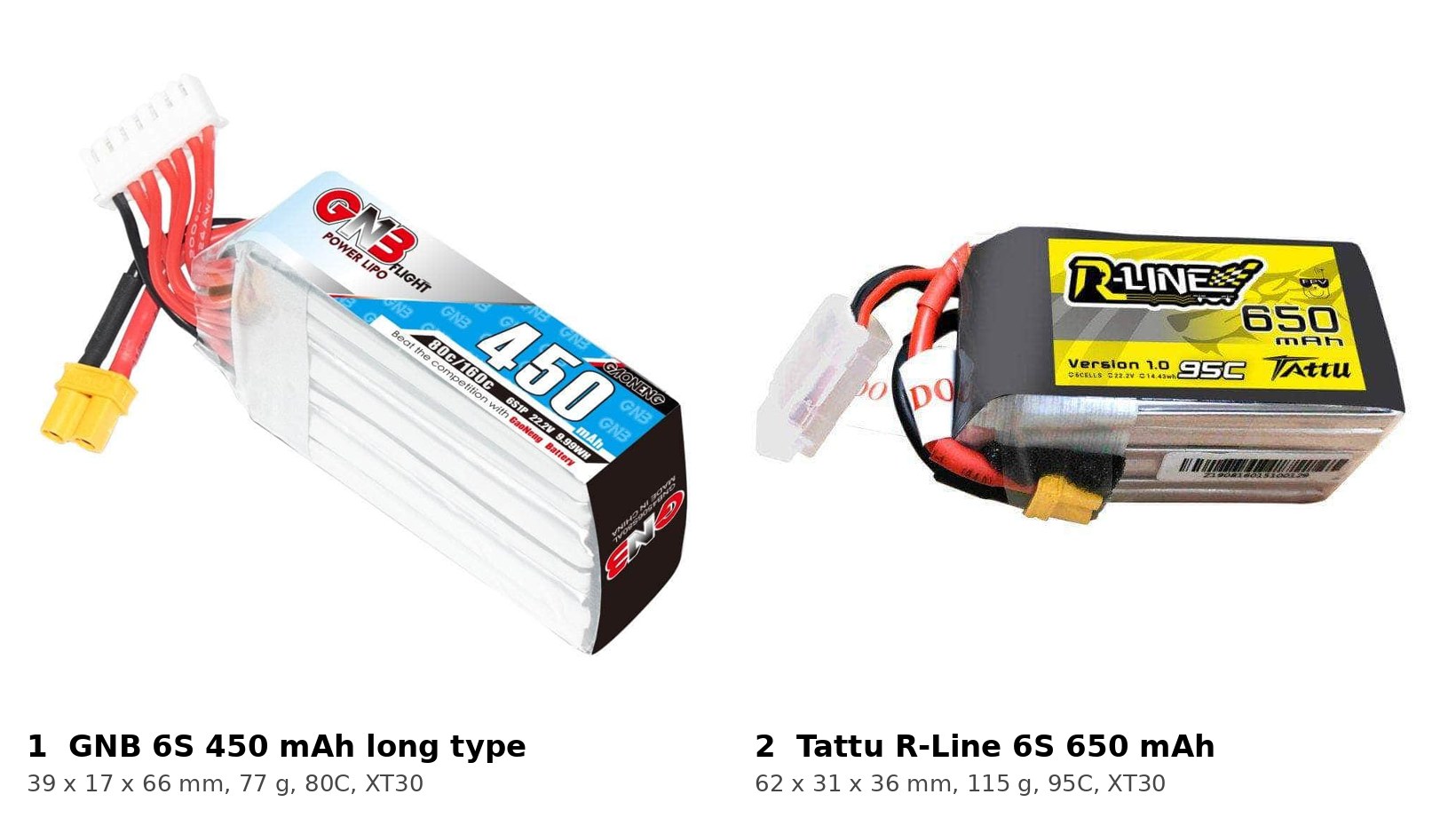
For the first battery build (wireless power only, then fully wireless), with prices from the seller’s own page on 19 October 2026:
Table 1 — For the first battery build (wireless power only, then fully wireless), with prices from the seller's own page on 19 October 2026
| Item | Pick | Price, seller | Why |
|---|---|---|---|
| Pack | GNB (Gaoneng) 6S 450 mAh 80C “long type”, XT30, model GNB4506S80AL | $24.99, in stock, RaceDayQuads | 6S fits the rail with no converter (Volume 2); 17 mm thick, the one stocked shape with a chance of fitting a magazine (Volume 6); 9.99 Wh is many hours of play (Volume 3) |
| Second pack | the same | $24.99 | A spare magazine is a spare pack; buy two small packs rather than one big one |
| Charger | SkyRC B6neo | $39.99, Wrekd (stock not shown) | Runs from the gun’s own 24 V brick or a PD charger; 1–6S, balances, storage mode (Volume 5) |
| Charger, later | ToolkitRC M6AC, for its IR meter | $71.99, RaceDayQuads, sold out | Tracks pack ageing (Volume 6) |
| Logic regulator (fully wireless) | Pololu D36V6F5, 5 V 600 mA | $5.95, Pololu | 5.2–50 V in, under 0.1 mA quiescent, 13 × 10 × 3 mm (Volume 3) |
| Pack protector | 2 × TI BQ77905 | priced at order time (TI) | Host-free, 6 µA (Volume 4) |
| Rail switch | TI LM5060 + a 60 V N-MOSFET | priced at order time (TI) | Soft start, UVLO, OVP, fault latch (Volume 4) |
| Fuse | DC-rated in-line fuse | chosen after test B2 | Volume 4’s three criteria |
| Storage | A fire-resistant container for packs | — | Volume 6 |
No price was read for the TI parts or for Molicel cells, so none is given.
7.2 Why This Pack, and Why Not the Others
Table 2 — 7.2 Why This Pack, and Why Not the Others
| Pack | Verdict | Why | Why not |
|---|---|---|---|
| GNB 6S 450 mAh long type | Picked | 6S; 17 mm thick; 77 g; $24.99 in stock; enough energy for an evening at any realistic rate | No published internal resistance; label C rating unverifiable (irrelevant here); no protection inside (Volume 4 adds it); fit in the magazine is unproven until the scan is measured (Volume 6) |
| Tattu R-Line 6S 650 mAh | Reference only | 95C continuous stated; balance lead type stated (JST-XHR-7P) | 31 mm wide: will not go in a magazine; sold out on 19 October 2026 at $23.69 |
| GNB 6S 550 mAh long type | Not confirmed | A search summary gave 36 × 18 × 73 mm, 85 g | Its RaceDayQuads page returned “not found” when read; not a pick until a live page confirms it |
| Larger 6S packs (850 mAh and up) | Rejected | More capacity | Capacity is not the constraint (Volume 3); bigger section |
| 6S1P Molicel P28A, built | Alternative | Steel cans with vents; complete data sheet; maker’s UN 38.3 route | Six 18.6 × 65.2 mm cells will not go in a magazine; a pack to build, weld and wrap |
| AA-size Li-ion or LiFePO4 cells, built | Fallback for the magazine | 14.5 mm-class cells clear the inferred inside width | A custom pack; 150 to 200 mm of magazine length; 7S LiFePO4 needs a 7S charger (Volume 2) |
| 3S airsoft stick + boost | Donor build only | Fits the VFC donor’s front bay | Needs a 4–6 A boost converter (Volume 2) |
A price lesson from this volume’s own research: a web search gave $18.49 for the GNB 450 mAh pack and $59.99 for the M6AC; the sellers’ pages said $24.99 and $71.99. Every price in this dive is the seller’s page on the date stated.
7.3 The Bench: Emulate First, Then the Real Pack
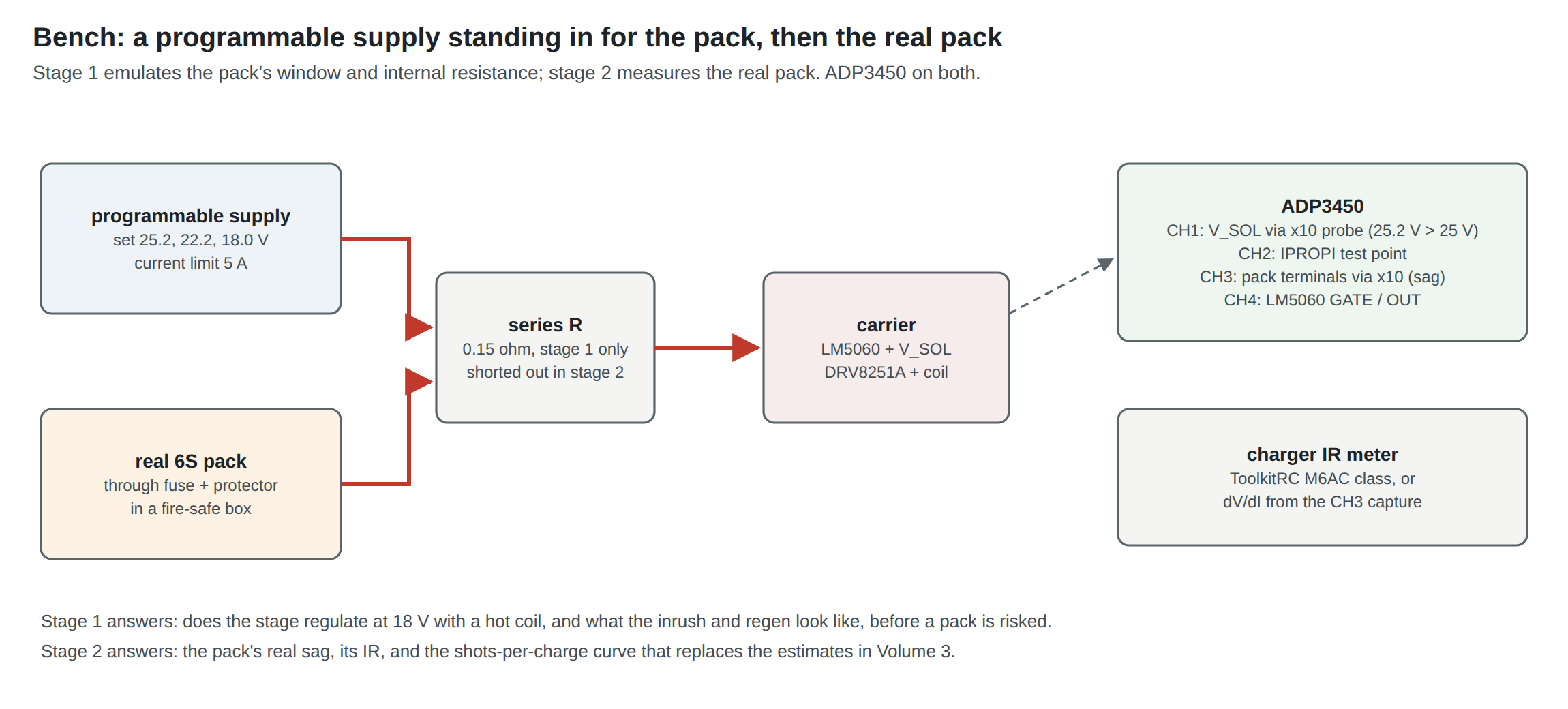
The lab has what this needs: the Analog Discovery Pro ADP3450, programmable bench supplies and the 50 A linear supply, an electronics bench with reflow for the protector and rail-switch boards (_shared/lab_capability.md). The order matters: nothing is asked of a real pack that a supply can answer first. A programmable supply can be a full pack, a nominal pack and a nearly flat pack in three keystrokes, it current-limits, and it cannot catch fire.
One measurement trap. The ADP3450’s direct input range is ±25 V (Solenoid Recoil Vol 8). A full 6S pack is 25.2 V, and the regen rise reaches about 27.5 V. Every channel on the rail or the pack goes through a ×10 probe or a divider, unlike the brick’s 24 V, which sat just inside the direct range.
7.4 Nine Bench Tests
Table 3 — 7.4 Nine Bench Tests
| Test | Stage | What | How | Replaces |
|---|---|---|---|---|
| B1. The floor | 1 | Does the regulated stage reach its set point at 18.0 V with a hot coil? | Supply at 18.0 V through 0.15 Ω; coil heated to its working temperature (Solenoid Recoil’s resistance method); IPROPI on CH2: time to reach ITRIP | The forcing-ratio floor of Volume 2 |
| B2. The pack’s current | 1 | Peak and RMS current from the pack over an autofire burst | Supply current through a shunt at the supply side on CH3, IPROPI on CH2, at 25.2, 22.2 and 18.0 V | The hold-phase table of Volume 3; sets the pack fuse and F1 |
| B3. Sag and IR | 2 | The real pack’s ΔV/ΔI under a shot, fresh and near 3.5 V per cell | Pack terminals on CH3 (×10), current on CH2; and the charger’s IR reading if an M6AC is available | Volume 3’s estimate; the ageing baseline for Volume 6 |
| B4. Inrush | 1 then 2 | Rail rise time and peak current when the rail switch turns on into 1000 µF | CH1 V_SOL, CH4 LM5060 output, shunt current; check the slope is far under 2 V/µs | Volume 4’s 2.5 A at 10 ms estimate |
| B5. Regen with the charge path open | 1 | Bulk capacitor peak after a shot when the source cannot accept current | Supply at 25.2 V through a series diode (it cannot sink), as a stand-in for an open CHG FET; CH1 peak after release | Volume 2’s 27.5 V; confirms the half-volt margin under 28 V |
| B6. Heat in the gun | 2 | Pack face, coil frame and shell temperatures in a 10-minute autofire run | Three NTCs or thermocouples; the firmware’s own coil sensor | Volume 6’s placement rules |
| B7. Shots per charge | 2 | Shots and session time from full to the 3.3 V/cell firmware stop | Count shots from the firmware; log pack voltage between shots | Volume 3’s 80 % usable assumption and 1 J mid-point |
| B8. Shelf drain | 1 | Total pack-side current with the gun off | µA range of a bench meter in the pack lead | Volume 4’s divider table |
| B9. Protector trips | 1 | Over-voltage, under-voltage, over-current and short-circuit trips of the BQ77905 pair | A resistor ladder from a programmable supply to stand in for six cells, each tap adjustable; a current-limited supply for the over-current trip. Never short a real pack to test a protector | The data-sheet thresholds, on the built board |
7.5 Shipping a Pack: the Rules That Apply
If a kit is ever sold with a pack in it, the pack is dangerous goods. The rules below are summarised from the regulator’s or carrier’s own documents, read on 19 October 2026; the legal analysis of selling a kit belongs to the planned Licensing, IP and Kits dive, and nothing here is advice for a particular shipment.
Classification. Lithium-ion batteries on their own are UN 3480; “contained in equipment” or “packed with equipment” they are UN 3481.1 A kit with a pack in the box beside the gun is packed with equipment; a gun shipped with its pack installed is contained in equipment.
UN 38.3 and the test summary. 49 CFR 173.185(a)(1): “Each lithium cell or battery must be of the type proven to meet the criteria in part III, sub-section 38.3” of the UN Manual of Tests and Criteria. Under (a)(3), “Each manufacturer and subsequent distributor of lithium cells or batteries, except for button cells” must make a test summary available.2 IATA’s 2026 guidance extends the same duty to distributors of equipment powered by such batteries, and allows it to be met by putting the summary on a website with a QR code or URL on the battery, its packaging or the shipping documents.1 A seller of a kit that contains a pack is a subsequent distributor. The pack’s maker must have a UN 38.3 test summary for it, and the kit seller must be able to produce it. Whether GNB publishes one for the GNB4506S80AL was not checked for this dive.
Size limits for the simplified rules. Lithium-ion cells of no more than 20 Wh and batteries of no more than 100 Wh qualify for the “smaller cells or batteries” provisions: 49 CFR 173.185(c)(1)(i), “may not exceed 20 Wh for a lithium ion cell or 100 Wh for a lithium ion battery”.2 The GNB pack is 9.99 Wh, about 1.7 Wh a cell; a 6S1P P28A pack is 61.8 Wh, 10.3 Wh a cell. Both are well inside.
Air: the 2026 state-of-charge rule. IATA’s guidance for 2026, based on the 67th edition of the Dangerous Goods Regulations and the 2025–2026 ICAO Technical Instructions:1
Table 4 — 7.5 Shipping a Pack: the Rules That Apply
| How the pack travels | Packing instruction | State of charge |
|---|---|---|
| On its own | PI 965 | Not exceeding 30 % of rated capacity; and not on passenger aircraft without approval |
| Packed with equipment | PI 966 | From 1 January 2026, Section II: cells and batteries over 2.7 Wh must be offered at not more than 30 % |
| Contained in equipment | PI 967 | 30 % (or 25 % indicated) recommended, not mandatory |
Every pack in this dive is over 2.7 Wh, so a kit with a pack in the box, shipped by air, must have the pack at 30 % or less. A LiPo’s state of charge is defined on capacity, not voltage, so “storage charge” on a hobby charger (3.75 to 3.90 V per cell) is not automatically 30 %; IATA points to UN Manual 38.3.2.3 for how rated capacity is determined.1
US mail. USPS Packaging Instruction 9D (domestic):3
Table 5 — 7.5 Shipping a Pack: the Rules That Apply
| Installed in equipment | Packed with equipment | Without equipment | |
|---|---|---|---|
| Service | Air or surface | Air or surface | Surface only |
| Limits | ≤ 20 Wh per cell, ≤ 100 Wh per battery; ≤ 8 cells or 2 batteries per mailpiece | same | ≤ 20 Wh / 100 Wh; mailpiece ≤ 5 lb; originally sealed packaging |
| Marking | DOT lithium battery mark, UN3481 (exempt with ≤ 4 cells or ≤ 2 batteries installed) | DOT lithium battery mark, UN3481 | UN3480 mark plus “Surface Mail Only, Lithium-ion Batteries - Forbidden for Transportation Aboard Passenger Aircraft” |
Ground, by carrier. 49 CFR 173.185(c) sets the marking (the lithium battery mark, with an exception for a consignment of “two packages or fewer where each package contains not more than four lithium cells”), a 30 kg gross limit for packages not containing equipment, and, for air, no more batteries than needed to power the equipment plus two spare sets.2 Each carrier adds its own rules on top.
7.6 What It Means for a Kit
Three ways to handle the pack in a kit, for the owner and the Licensing dive to weigh:
- Ship no pack. The kit specifies the pack (6S, the dimensions the magazine allows, XT30) and the customer buys it from a hobby shop, as every RC kit does. No dangerous goods, no test-summary duty, no state-of-charge rule. The gun’s protector and rail switch (Volume 4) make it safe with any compliant 6S pack. This is the clean answer, and the recommended one.
- Ship a bought pack in the box. UN 3481 packed with equipment: a pack with a UN 38.3 test summary the seller can produce, at 30 % or less for air, marked as above.
- Ship a pack built in the lab. The lab’s own pack is a new battery design: it would need its own UN 38.3 testing before it could be shipped at all. Not a hobby-scale undertaking.
The charger, the protector board and the rail switch carry no such burden; they are electronics.
7.7 What Could Not Be Verified
- The MP7 magazine’s dimensions, inside or outside. Not published; the swi-sro scan (D40) is the measurement (Volume 6).
- Internal resistance of the hobby packs. Not published; test B3.
- What the hobby packs’ C ratings mean. No standard test behind them; not relied on.
- A123’s cut-off voltage in the 2011 sheet revision read (2.0 to 2.5 V appears elsewhere); and the 2012 revision’s reported 50 A continuous rating against the 2011 sheet’s 70 A.
- The SMBJ28A’s 31.1 V minimum breakdown is from distributor listings of several makers’ parts, not a maker’s PDF.
- The GNB 6S 550 mAh long pack’s dimensions (search summary only; page not found).
- Whether GNB publishes a UN 38.3 test summary for the 450 mAh pack.
- The usable fraction (80 %) and the 1 J regulated shot energy are assumptions until tests B7 and B2.
- No price for Molicel cells or the TI parts was read.
Footnotes
-
IATA, Battery Guidance Document: Transport of Lithium Metal, Lithium Ion and Sodium Ion Batteries, Revised for the 2026 Regulations (based on the 2025–2026 ICAO Technical Instructions and the 67th edition DGR). https://www.iata.org/contentassets/05e6d8742b0047259bf3a700bc9d42b9/lithium-battery-guidance-document.pdf (read 2026-10-19). ↩ ↩2 ↩3 ↩4
-
49 CFR 173.185, as published by the Legal Information Institute, https://www.law.cornell.edu/cfr/text/49/173.185 (read 2026-10-19). Quote the eCFR text directly before relying on any paragraph for a shipment. ↩ ↩2 ↩3
-
USPS, Publication 52, Packaging Instruction 9D, “Lithium Metal and Lithium-ion Cells and Batteries, Domestic”. https://pe.usps.com/text/pub52/pub52apxc_032.htm (read 2026-10-19). ↩
Comments (0)