LiPo Batteries · Volume 6
A Pack Inside a Printed Gun — Safety, Heat, Storage, and Where It Fits in the MP7
How lithium packs fail and what a PETG shell does to each failure: swelling, puncture, heat from the solenoid, venting, fusing and storage; then the candidate places for a pack in the printed MP7, the magazine first, and the measurement that decides it
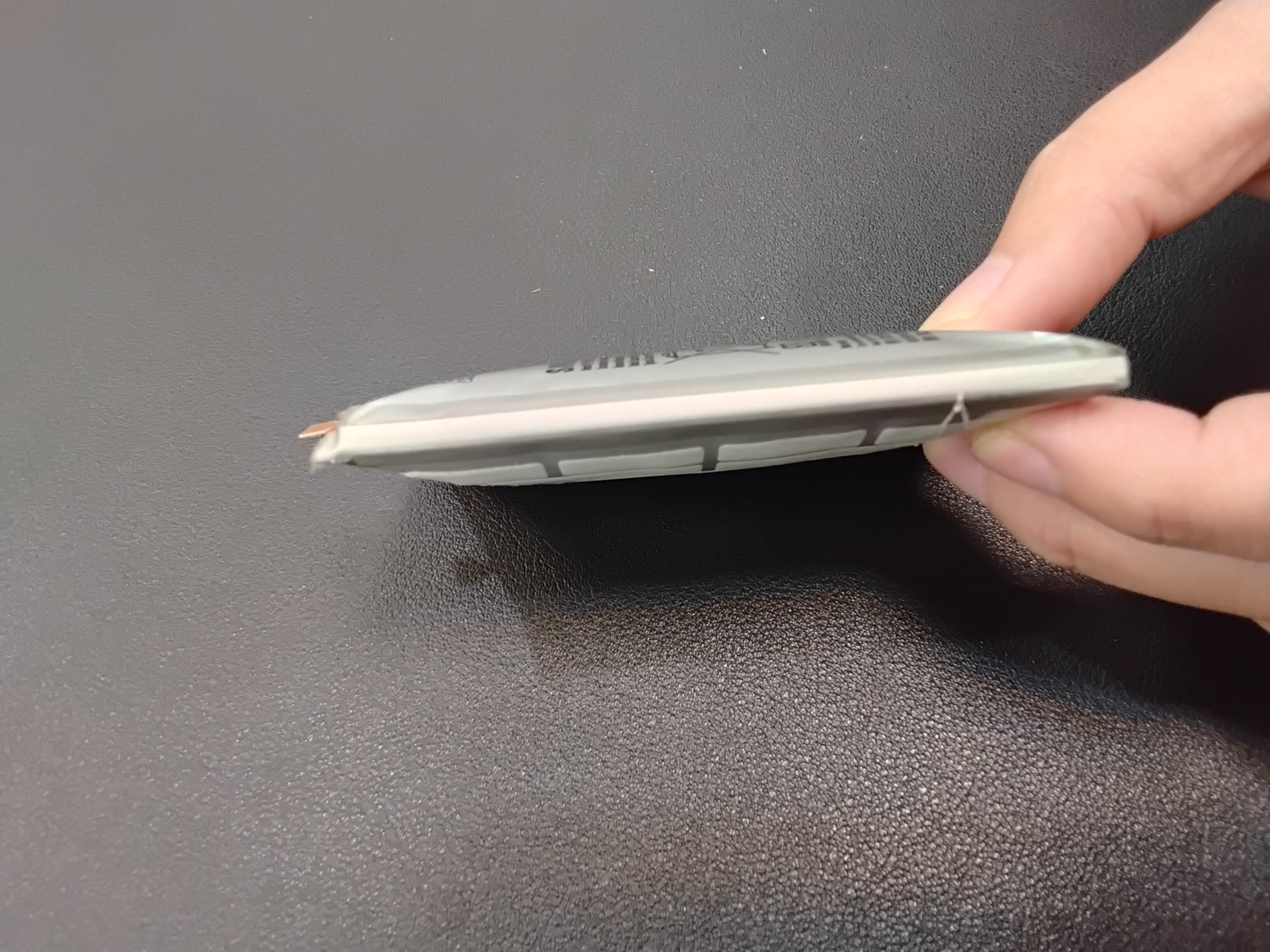
The pack is the one part of a light gun that can start a fire. Everything else on the carrier fails by stopping. This volume takes the failure modes one at a time, says what a 3D-printed PETG shell does to each, and then turns to the practical question the MP7 Printed Build dive left open: where a pack can go. Nothing here has been tested on a pack in a printed gun; the guidance is principle and maker instruction, and the bench steps in Volume 7 are what turn it into a design.
6.1 How Lithium Packs Fail
The causes are well known and are the reason for every warning on a hobby charger:12
Table 1 — 6.1 How Lithium Packs Fail
| Cause | What happens | The defence in this gun |
|---|---|---|
| Over-charge | Lithium plating, gas generation, swelling, heat (Grepow’s list) | Charger’s per-cell limit; protector over-voltage (Volume 4) |
| Over-discharge, then charging | Damage to a cell taken below its minimum, and the risk of then charging it | Protector and rail-switch under-voltage; the charger refuses a cell below its threshold; “Never attempt to charge dead, damaged, or wet battery packs” |
| External short | Very high current (Volume 3: of the order of 150 A), wire and cell heating | Fuse at the pack (Volume 4) |
| Puncture or crush | Internal short inside the cell | Bay design (6.4) |
| Heat from outside | Ageing, gassing; at high temperature, runaway | Placement away from the coil (6.3); protector over-temperature |
| Age and abuse | Rising internal resistance, swelling | Inspect; retire on swelling or rising IR (6.2) |
The common end state is thermal runaway: a cell’s internal heating outruns its ability to lose heat, it vents hot, flammable gas, and it can ignite and pass the event to its neighbours. This dive does not put numbers on the temperatures at which that happens; they vary by cell and state of charge, and the sources read for it did not publish them for these packs. The defences above all aim to keep a pack well away from that state, and 6.5 deals with what happens if one gets there.
6.2 Swelling: the Warning a Pouch Gives
A pouch has no vent and no rigid wall. Gas generated inside it inflates the foil, which is visible and is the pouch’s one advantage: it warns. Grepow lists “gas generation, swelling” among the effects of over-charge.2 The rule for this gun follows: a pack that has swollen at all is retired. It goes to a battery recycler at storage charge or lower, not back into the gun. A pack bay should be designed so that a swollen pack is noticed (it no longer slides in freely) rather than accommodated (a bay with room for a pack to grow hides the warning).
Internal resistance rising over the pack’s life is the earlier warning. The M6AC’s IR meter, or the ADP3450 sag capture (Volume 7), logged at intervals, gives a trend; a pack whose IR has risen markedly from its first reading is retired before it swells.
6.3 Heat: PETG, the Solenoid and the Pack
Three temperatures meet in a battery gun:
- The shell. Prusa’s data sheet for Prusament PETG gives a heat deflection temperature of 68 °C, and Prusa’s guide recommends it for parts below 80 °C, both already cited in Moving Ejection Port Vol 5. A shell near a hot part creeps; a pack bay that creeps loosens its grip on the pack, and a snap that holds the bay closed can let go.
- The coil. The solenoid is the gun’s heater. OpenFIRE warns at 38 °C on the coil frame and stops at 45 °C, and the winding runs hotter than the surface (Solenoid Recoil Vol 4). On a battery the brick’s trip no longer caps the firing rate (Volume 3), so the firmware’s thermal cut-off is the coil’s only limit.
- The pack. Lithium cells’ charge and discharge limits are their own; Molicel gives 0 to 60 °C for charging and −40 to 60 °C for discharging the P28A.3 Hobby LiPo packs rarely publish one.
The design rules that follow:
- Keep the pack out of the coil’s heat path. In the printed MP7 the kick module sits on its aluminium plate behind the ejection port (MP7 Printed Build Vol 5); the plate spreads coil heat into the receiver. The pack belongs in a different compartment, ideally the grip and magazine (6.8), with printed walls and air between.
- Never charge a warm pack, and never charge in the gun (Volume 5, path A).
- The thermistor on the pack (Volume 4) is the backstop, not the plan.
- The DRV8251A and the buck regulator are heat sources too, on the carrier, at a fraction of a watt each on average (Reference Electronics Vol 5). The carrier sits over the magazine well. A pack in the magazine is beneath it; a printed floor between them is worth more than the millimetres it costs.
6.4 Puncture, Crush and Chafe
A pouch has no crush strength. In a printed gun the hazards are specific:
- Screws and heat-set inserts. No fastener may point into the pack bay, and no insert boss may sit where a long screw could reach it. The printed build fixes its parts with M3 and M4 heat-set inserts; the pack bay is drawn with none.
- The closing shell. Two receiver halves closing on a pack, or on its leads, is the most likely way to pinch a wire. Leads run in printed channels, and the bay’s lid closes on a stop, not on the pack.
- Drops. A gun is dropped. The bay holds the pack by its faces on a soft liner (closed-cell foam or a TPU sleeve; TPU 95A is already used in the gun for stops, ME-4), never by its corners or its leads.
- Vibration and kick. Every shot slams a moving mass into a buffer. The pack must not rattle; a pack that moves will chafe its own wrap and leads.
- Sharp print edges. Supports and layer seams inside the bay are sanded or designed out. A pouch’s foil is thin.
6.5 Venting: Where the Gas Goes
If a cell does vent, it releases hot gas, and the shell decides where it goes. A sealed printed bay is the wrong answer twice: it lets pressure build until the weakest seam gives, which may be the seam next to the user’s hand, and PETG itself burns.
The principles, which no source read for this dive has tested in a printed light gun:
- Give the bay a deliberate weak direction that points away from the hands and face: in a pistol grip or magazine, that is downward, out of the base plate.
- Keep the bay small around the pack, so that a venting pack is not surrounded by a large volume of plastic to heat.
- Never put the pack next to the user’s face. In the MP7 that rules out the receiver’s rear above the grip, near the backplate and the OLED (D45).
- Do not rely on the shell to contain a fire. The defences are upstream: protection, placement, charging out of the gun and storage out of the gun.
The practical consequence is that the pack is never left in the gun when the gun is not in use, which also makes the magazine an attractive place for it (6.8).
6.6 Storage and Handling Rules
These rules apply to every pack in this project and are proposed for addition to the house rule (D29) alongside MP7 Donor Build Vol 3 §3.9’s transport and storage rule for the gun itself:
- Out of the gun when not in use. The pack and the gun are stored separately.
- At storage charge if it will not be used for more than a few days: 3.75 to 3.90 V per cell for LiPo, by the charger’s storage mode (Volume 5).1
- In a fire-resistant container, away from flammable material, not in a car and not in direct sun; the charger maker’s own warnings say the same of charging.1
- Charged attended, never overnight, on a non-flammable surface.1
- Inspected before each use: no swelling, no damaged wrap, no damaged leads, no smell. A dropped gun’s pack is inspected before the gun is used again.
- Retired on any swelling, on a markedly risen IR, or after any over-discharge below the protector’s limit. Retired packs go to a battery recycler at storage charge or lower, terminals taped.
6.7 Where a Pack Can Go in the Printed MP7
The printed MP7’s spaces, with what the sibling dives have already claimed:
Table 2 — The printed MP7's spaces, with what the sibling dives have already claimed
| Space | Claimed by | For a pack |
|---|---|---|
| Receiver void over the magazine well | Carrier and IMU (D44, D36) | No: the carrier is there, and the IMU must not share a compartment with a hot pack |
| Behind the ejection port | Kick module and port cassette (Printed Build Vol 5; ME-5) | No: the coil’s heat path |
| Front cover | Proposed for the 34 mm rumble motor (MR-7) and front ballast | Possible but far from the hand, near the muzzle camera’s cable, and a long lead to the carrier |
| Stock | Two rods | No volume |
| Backplate area | OLED (D45), near the face | No (6.5) |
| Grip and dummy magazine | Cable exit and GX plug (D6, D31), reload magnet, ballast pocket (Printed Build Vol 5 §5.6); proposed for the compact 312-107 rumble motor (MR-7) | Yes: the first choice, see 6.8 |
6.8 The Magazine as the Battery
The magazine is the natural place for a pack in an MP7, for reasons beyond space:
- A magazine change becomes a pack change. A spare charged magazine is a spare charged pack, and the pack comes out of the gun as naturally as a magazine does, which is exactly what 6.5 and 6.6 ask.
- It is ballast where ballast is wanted. The printed gun is estimated at 0.9 to 1.3 kg against the real gun’s heavier figure, and the printed build already plans a ballast pocket low in the magazine (MP7 Printed Build Vol 7, Vol 5). H&K gives its empty magazines as about 100, 150 and 200 g for 20, 30 and 40 rounds (HK MP7 Vol 7). The 450 mAh GNB pack weighs 77 g; the 650 mAh Tattu, 115 g. A pack is ballast that does work.
- It is far from the coil and below the carrier, with the grip’s walls between.
- It vents downward, away from the hands, through the base plate.
The question is whether one fits. No published source gives the inside or outside dimensions of an MP7 magazine (searched 19 October 2026). The cartridge gives a lower bound on the inside: the 4.6 × 30 is 38.5 mm long with an 8.0 mm rim (HK MP7 Vol 3), and two staggered columns of 8.0 mm rims need about 8 + 8 × sin 60° ≈ 14.9 mm of inside width, so a real magazine is at least about 14.9 × 38.5 mm inside. That is an inference from geometry, not a measurement.
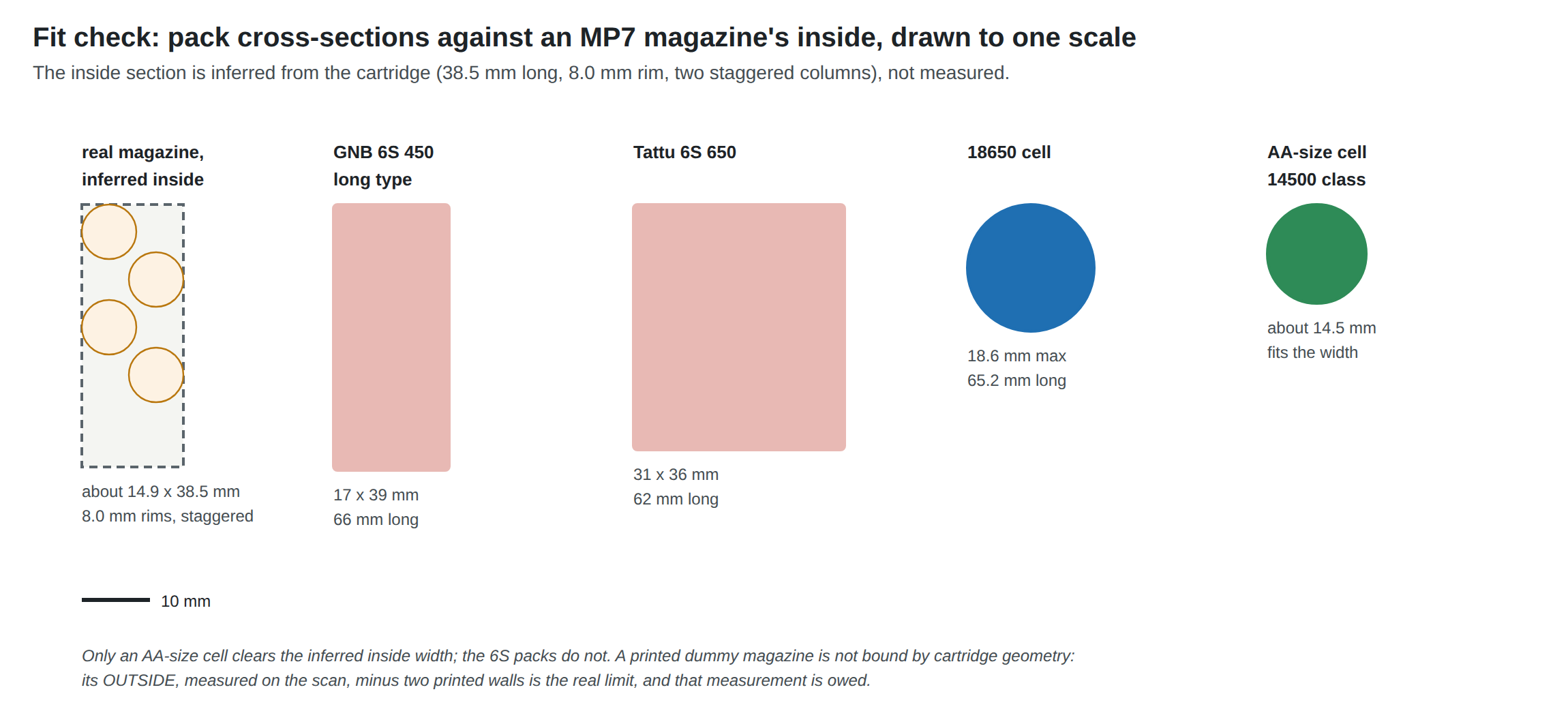
Against that inferred section:
- The GNB 6S 450 mAh “long type”, 39 × 17 × 66 mm, matches the magazine’s front-to-back depth almost exactly and is about 2 mm wider than the inferred inside. It is the closest commercial pack.
- The Tattu 6S 650 mAh, 62 × 31 × 36 mm, is twice the width: it does not go in a magazine.
- An 18650 cell, 18.6 mm, is wider than the inferred inside, and six of them in series are 390 mm of cell in one column.
- AA-size (14500-class) cells, about 14.5 mm, clear the width. Six Li-ion or seven LiFePO4 AA-size cells, two abreast front to back, is three or four cells of 50 mm-class length end to end: 150 to 200 mm of magazine. Whether a 30- or 40-round magazine’s length allows that is not known.
But the printed magazine is not bound by cartridges. It is a dummy whose outside must match the real one (Printed Build Vol 5 §5.6), and whose inside is everything the walls do not take. The real constraint is the outside width of the magazine body, measured on the swi-sro scan, minus two printed walls. If the outside is about 19.5 mm or more, a 17 mm pack fits behind two 1.2 mm walls with a little clearance for the liner. That measurement decides the pack, and it is the first thing to do with the scan when it is bought (D40).
Two conflicts to settle when it is measured:
- The rumble motor. Motors and Rumble proposes the compact PMD 312-107 in the same ballast pocket (MR-7). A pack and a motor will not both fit a magazine. If the pack goes in the magazine, the 312-107 needs another place, or the front-cover 334-401 is the only motor.
- The GX plug and the cable (D31). In a fully wireless gun there is no cable, and the base plate can carry the pack’s release and vent instead. In the wireless-power-only gun the USB cable still leaves through the base plate; the GX plug and its strain relief share the magazine with the pack, which is the tightest case.
6.9 The Donor Guns
The airsoft donors already have a battery place. The VFC electric MP7’s front bay holds an 11.1 V airsoft LiPo (MP7 Donor Build Vol 2), and the gutted gas magazine is the gas donor’s natural compartment. An 11.1 V pack is 3S, which needs a boost converter to reach the rail (Volume 2, 2.8). The same safety rules apply; the donor’s metal and nylon shell changes the heat and puncture picture a little and the venting picture not at all.
6.10 Why This, and Why Not the Others
Table 3 — 6.10 Why This, and Why Not the Others
| Choice | Picked | Rejected | Why, and why not |
|---|---|---|---|
| Pack location, printed MP7 | The dummy magazine, if the scan’s outside width allows a 17 mm pack | Front cover; receiver void; behind the port; backplate | Removable with the magazine, low ballast, far from the coil and the face, vents downward; the front cover is far from the hand and claimed by the rumble motor; the receiver and port areas hold the carrier, the IMU and the coil |
| Fallback if it does not fit | AA-size cells built into a custom magazine pack, or a pack in the front cover | A bigger magazine than the real gun’s | Realism matters (D35); AA-size cells clear the inferred width |
| Bay construction | Snug bay on a soft liner, no fasteners into it, lid on a stop, deliberate vent downward | Roomy bay; sealed bay | A roomy bay hides swelling; a sealed bay builds pressure towards the hand |
| Storage | Out of the gun, at storage charge, in a fire-resistant container | Stored in the gun | 6.5: the shell is not a containment |
| Swollen or high-IR pack | Retired | Pressed flat, re-used | The swelling is gas the cell made |
Footnotes
-
SkyRC, B6neo+ Instruction Manual, v1.20, warnings and “Standard Battery Parameters”. https://cdn.shopify.com/s/files/1/1052/4162/files/B6neo_Instruction_Manual.pdf (read 2026-10-19). ↩ ↩2 ↩3 ↩4
-
Grepow, “What is the charging voltage of 3.7V lithium battery?”, 29 September 2020. https://www.grepow.com/blog/the-charging-voltage-of-3-7v-lithium-battery.html (read 2026-10-19). ↩ ↩2
-
Molicel, Product Data Sheet, INR-18650-P28A, copy at https://www.rosebatteries.com/hubfs/INR18650P28A-V2-80093.pdf (read 2026-10-19). ↩
Comments (0)