LiPo Batteries · Volume 5
Charging — On the Bench, Through the Gun, and Over USB-C
Why neither the 24 V brick nor a 20 V PD charger can top up a 6S pack directly, the bench balance charger that runs from the same brick, charging through a port in the gun, and what a real on-board USB-C PD charger takes
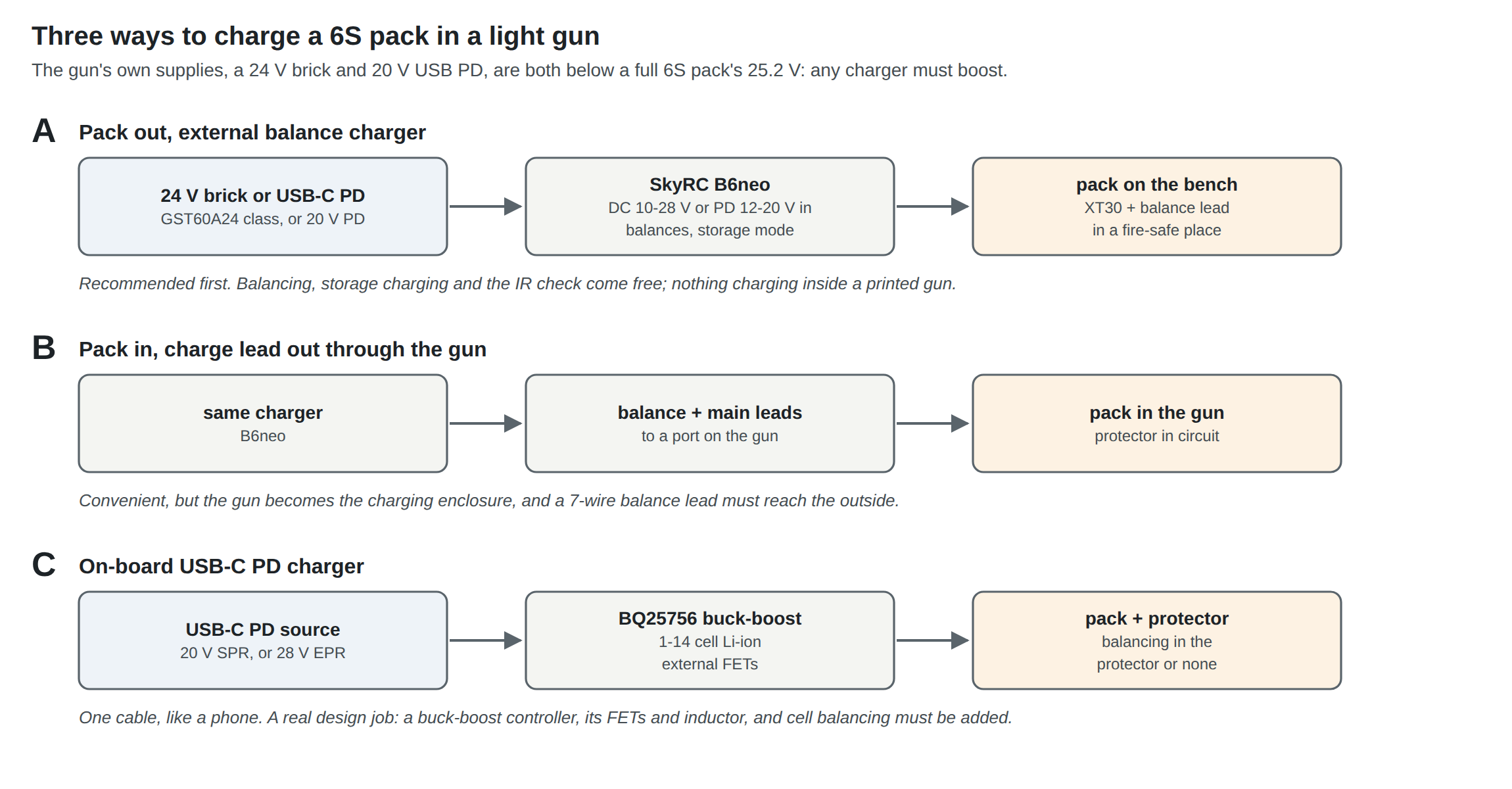
5.1 How a Lithium Pack Is Charged
Every lithium chemistry in this dive is charged the same way: constant current until the cell reaches its charge voltage, then constant voltage while the current tapers, ending at a small cut-off current. Molicel’s P28A sheet states it in one line: “CC-CV Charge to 4.2V, 50mA cut”.1 A series pack adds one requirement: every cell must stop at its limit, so the charger must see each cell, not just the pack’s total, and pull down any cell that runs ahead. That is balancing, and it is why every hobby pack has a balance lead.
The SkyRC manual’s parameter table gives the settings a hobby charger actually applies: LiPo charged to 4.15 to 4.25 V per cell, LiFe to 3.58 to 3.70 V, and an “allowable fast charge current” of at most 1C for every lithium chemistry.2 (The 450 mAh GNB pack’s retailer page lists a 1C to 5C charge rate; this dive follows the more conservative charger-maker figure.) Its warnings are the standard ones, quoted because they are the operating rules for this gun’s packs: “Never leave charging batteries unattended during use.” “Never charge batteries overnight.” “Never attempt to charge dead, damaged, or wet battery packs.”2
5.2 The Gun’s Own Supplies Are Below the Pack
A full 6S pack is 25.2 V. The wired gun’s brick is 24 V (D14), and the highest ordinary USB PD level is 20 V (Solenoid Recoil Vol 8). Neither can charge a 6S pack by any simple means. A diode, a resistor or a linear charger from 24 V cannot push a pack past 24 V less its own drop. Every charger for this pack from these sources is a boost or buck-boost converter.
Only the extended power range of USB PD, with its 28 V level, sits above the pack, and that needs EPR at both ends and an EPR-rated cable (Solenoid Recoil Vol 8; PD details belong to the planned USB-C Power Delivery dive). So the idea of “plug the wired gun’s cable in and it charges its pack while you play” needs a converter in the gun whatever the source. That shapes the three paths below.
5.3 Path A: Pack Out, Bench Charger
The pack comes out of the gun on its XT30 and balance lead and is charged on the bench. Every function the pack needs comes with the charger: balancing on every charge, a storage mode, per-cell voltages on a screen, and on some models an internal-resistance meter.
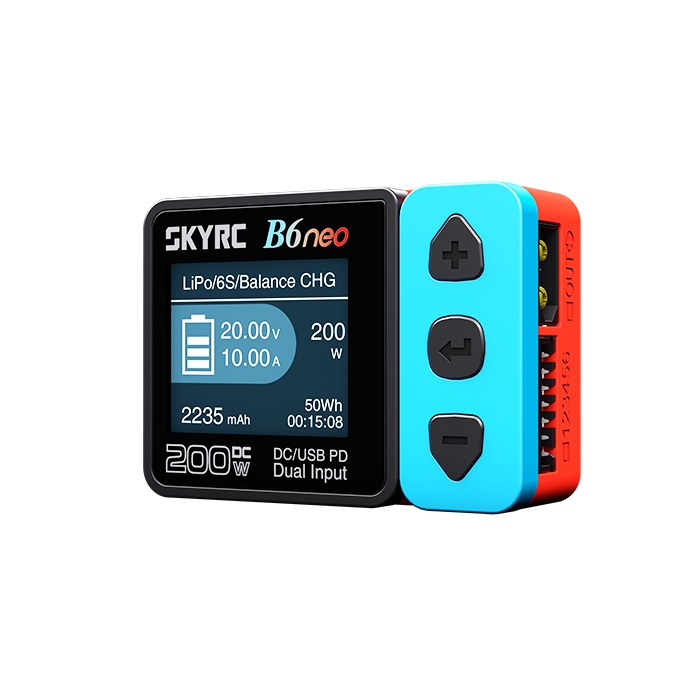
The pick: SkyRC B6neo. From SkyRC’s own page and manual:32
Table 1 — 5.3 Path A: Pack Out, Bench Charger
| B6neo (SK-100198) | B6neo+ (SK-100211) | B6neo 2 (SK-100225) | |
|---|---|---|---|
| DC input | 10–28 V | 5–30 V | 7–28 V |
| USB PD input | 12–20 V | 5–28 V (PD 3.0/3.1) | 12–20 V |
| Charge power, DC / PD | 200 W / 80 W | 240 W / 126 W | 300 W / 80 W |
| Lithium cells | 1–6S | 1–6S | 1–6S |
| Balance current | 500 mA | 600 mA | 550 mA |
| Size, mass | 70 × 50 × 31 mm, 82 g | same | same |
Why it fits this project particularly well: its DC input takes the gun’s own 24 V brick. The GST60A24-class brick decided for the wired gun (PS-3) is a 60 W supply; charging a 450 mAh 6S pack at 1C ends its constant-current phase at about 11 W, a small fraction of either the brick or the charger. One brick runs the wired gun and charges the wireless gun’s packs. The same charger also runs from a USB-C PD laptop charger at 12 to 20 V. SkyRC’s own warnings are to power the charger first and never connect PD and DC inputs at once.2
Price: $39.99 at Wrekd for the B6neo, as of 19 October 2026 (stock not shown on the page).4
Alternatives read for this dive:
- ISDT 608AC: a mains (50 W) and DC (200 W) charger, 0.1 to 8 A, 1–6S lithium, $77.99 and in stock at RaceDayQuads on 19 October 2026.5 Worth it only if a mains-powered charger is wanted with no separate supply.
- ToolkitRC M6AC: mains (120 W maximum) and DC 7–35 V, up to 15 A and 300 W, 1–6S lithium, 1000 mA balance current, and an internal-resistance meter from 0.1 to 99 mΩ. $71.99 at RaceDayQuads and $76.99 at Pyrodrone, both sold out on 19 October 2026.6 The IR meter is the reason to want one: it tracks pack ageing (Volume 6). A web search gave $59.99 for the RaceDayQuads listing; the page itself said $71.99.
What path A costs: the pack must come out of the gun, so the gun needs a pack bay that opens without tools, and the pack’s leads must reach the outside (Volume 6).
5.4 Path B: Pack In, Leads Out
The same charger charges the pack where it sits, through a charge port on the gun that carries the main leads and the seven-way balance lead. Nothing new is designed, and the pack never comes out.
Against it:
- The gun becomes the charging enclosure. Charging is when lithium packs are most likely to fail (the SkyRC warnings above all concern charging), and a printed PETG shell is a poor place for it (Volume 6).
- The balance lead’s negative pin is pack negative, which with a low-side protector is exactly the sneak path Volume 4 warns about. A charge port that is live while the gun’s USB cable is plugged into a PC can bypass the protector.
- A seven-pin balance connector has to be on the outside of the gun, next to the GX plug (D31) or in the magazine base plate, and it is not keyed against the GX.
Path B is acceptable for a bench prototype on the understanding that the gun is unplugged from everything else while charging. It is not recommended for a kit.
5.5 Path C: An On-Board USB-C PD Charger
The phone-like answer: a USB-C receptacle on the gun, a PD sink that negotiates 20 V (or 28 V with EPR), and a buck-boost charge controller that charges the pack in place.
TI’s BQ25756 is the kind of part it takes: “Standalone/I2C Controlled, 1- to 14-Cell Bidirectional Buck-Boost Battery Charge Controller”, 4.2 to 70 V input, Li-ion 1 to 14 cells and LiFePO4 1 to 16, up to 20 A, “USB C/PD compatible”, with a reverse mode that supports PD EPR, in a 6 × 5 mm VQFN-36.7 It is a controller: four external MOSFETs, an inductor, input and output current-sense resistors and their filtering, plus the PD sink negotiation in front of it (the USB-C Power Delivery dive’s trigger chips).
What path C needs that A does not:
- Balancing in the gun. A charger working through the main leads cannot balance. The BQ77905 protector does not either (Volume 4). The pack protector has to move up to a BQ76952 (autonomous balancing) or a BQ76930 with a host.
- A second USB-C receptacle, because D31’s GX plug carries USB data and the 24 V rail on fixed pins and has no CC lines for PD negotiation.
- Heat inside the shell. A buck-boost charging a 6S pack at 1C dissipates a watt or two, in the same shell as the pack.
- Certification exposure. A product that charges a lithium pack from a mains-powered adapter is the kind of product that safety standards and retailers look at hardest; that belongs to Licensing, IP and Kits (planned).
Path C is the right long-term answer for a finished consumer kit, and the wrong first step. It is a board design of its own, after the battery gun works on path A.
5.6 Storage Charge
A lithium pack kept full ages faster and has more energy to release if it fails; a pack kept flat can fall below its safe minimum through self-discharge and its protector’s drain. Hobby chargers have a storage mode that charges or discharges each cell to a middle voltage. SkyRC’s table gives 3.75 to 3.90 V per cell for LiPo, 3.70 to 3.85 for Li-ion and 3.25 to 3.40 for LiFe.2 A 6S LiPo pack at storage reads about 22.5 to 23.4 V. The shelf rules are in Volume 6.
5.7 Why This, and Why Not the Others
Table 2 — 5.7 Why This, and Why Not the Others
| Choice | Picked | Rejected | Why, and why not |
|---|---|---|---|
| Charging path, first battery build | A: pack out, bench charger | B (through the gun); C (on-board PD) | Balancing, storage mode and per-cell readout come free, and nothing charges inside a PETG shell; B makes the gun the charging enclosure and opens a sneak path; C is a board of its own, needs balancing in the gun and a second USB-C port |
| Bench charger | SkyRC B6neo, $39.99 (Wrekd, 2026-10-19) | ISDT 608AC ($77.99); ToolkitRC M6AC ($71.99–76.99, sold out) | B6neo runs from the gun’s own 24 V brick or a PD charger, is the cheapest, and is pocket-sized; 608AC only adds a mains input; M6AC adds an IR meter and is worth buying second when it is back in stock |
| Charge rate | ≤ 1C | the pack page’s 1C–5C | The charger maker’s table caps fast charge at 1C; capacity is not short (Volume 3), so time is not short either |
| On-board charger, later | BQ25756-class buck-boost behind a PD sink | linear charger; boost from the 24 V rail | Neither 24 V nor 20 V PD is above a full 6S pack; a linear charger cannot exceed its input |
Footnotes
-
Molicel, Product Data Sheet, INR-18650-P28A, copy at https://www.rosebatteries.com/hubfs/INR18650P28A-V2-80093.pdf (read 2026-10-19). ↩
-
SkyRC, B6neo+ Instruction Manual, v1.20, specifications, warnings and “Standard Battery Parameters”. https://cdn.shopify.com/s/files/1/1052/4162/files/B6neo_Instruction_Manual.pdf (read 2026-10-19). ↩ ↩2 ↩3 ↩4 ↩5
-
SkyRC, B6neo series product page. https://www.skyrc.com/b6neo (read 2026-10-19). ↩
-
Wrekd, “SkyRC B6 Neo 200w 10A 1-6S DC Smart Charger XT60”. https://wrekd.com/products/skyrc-b6-neo-200w-10a-1-6s-dc-smart-charger-xt60-choose-color (read 2026-10-19). ↩
-
RaceDayQuads, “ISDT 608AC 50/200W 8A 1-6S AC/DC Smart Charger w/ Detachable Power Supply”. https://www.racedayquads.com/products/isdt-ac608-200w-ac-60w-dc-8a-2-6s-smart-lipo-charger-w-detachable-ac-power-supply (read 2026-10-19). ↩
-
RaceDayQuads, “ToolkitRC M6AC 300W 15A 1-6S AC Charger - XT60”, https://racedayquads.com/products/toolkitrc-m6ac-300w-15a-1-6s-ac-charger-xt60; Pyrodrone, SKU C12-13852, https://pyrodrone.com/collections/all/products/toolkitrc-m6ac-1-6s-ac-100w-dc-300w-15a-battery-charger-xt60 (both read 2026-10-19). ↩
-
Texas Instruments, BQ25756 product page and data sheet title (Rev. A). https://www.ti.com/product/BQ25756 (read 2026-10-19). ↩
Comments (0)