LiPo Batteries · Volume 3
Current, C Rating, Sag and Runtime — the Worked Numbers
What the regulated solenoid stage actually takes from a pack, why the C rating on the label does not matter here, how far a healthy pack sags, and how many hours of play a 450 mAh 6S pack holds
Battery sizing for a drone starts with current and ends with capacity. For a light gun both turn out to be easy, and this volume shows why with numbers, so that the pack can be chosen for the two things that are hard: its voltage window (Volume 2) and its size (Volume 6). Every figure is either a sibling dive’s, a datasheet’s, or a stated assumption; the arithmetic is in 04-templates/battery_calcs.py.
3.1 What the Gun Draws
Table 1 — 3.1 What the Gun Draws
| Load | Current | Source |
|---|---|---|
| Logic: Pico, camera, buttons | about 0.1 A at 5 V, about 0.5 W | Power Supplies Vol 1 |
| Recoil coil, regulated (D13) | set point 1 to 2.5 A, coils of 5 to 12 Ω hot | Solenoid Recoil Vol 8 (SR-3) |
| Ejection-port stage | a second DRV8251A on the same rail; JF-0530B 12 V class pull solenoid | Moving Ejection Port Vol 4 (ME-2) |
| Rumble motor, 34 mm ERM | about 0.09 A running at 24 V; about 0.3 A at a start; capped near 0.5 A | Motors and Rumble (MR-3, MR-6) |
| DRV8251A’s own loss | 2.8 W while driving 2.5 A | Reference Electronics Vol 5 |
One stage at a time. D16 forbids the recoil and port stages from firing at the same instant, and the carrier enforces it in hardware (P-RE21). D16 was made to size the brick for one stage. It helps the pack too: the peak the pack sees is one coil’s current plus the logic, never two coils’.
3.2 The Pulse as the Pack Sees It
On a brick, the current the coil draws is the current the brick supplies. Under the DRV8251A’s regulation that is only true during the first part of the shot.
- The rise. At turn-on the full rail sits across the coil and the current climbs at V/L until it reaches the trip current. During the rise the pack supplies the coil current directly.
- The hold. At the trip current, the driver brakes for a fixed 25 µs (low-side slow decay: the coil current circulates through the two low-side switches, not through the supply), then drives again. The pack supplies current only during the drive intervals. The fraction of time spent driving is about (I·R)/V, so the average current taken from the pack is about I × (I·R)/V, less than the coil current. This is the chopper behaving as a buck converter.
- The release. Both inputs go low, the bridge coasts, and the coil returns its stored energy to the rail. A pack takes it back as charge.
The hold-phase average, for two coils and three pack states:
Table 2 — The hold-phase average, for two coils and three pack states
| Pack | Coil, hot | Set point | Duty driving | Average from pack | Coil power |
|---|---|---|---|---|---|
| 25.2 V (full) | 8 Ω | 2.0 A | 0.63 | 1.27 A | 32 W |
| 22.2 V (nominal) | 8 Ω | 2.0 A | 0.72 | 1.44 A | 32 W |
| 18.0 V (floor) | 8 Ω | 2.0 A | 0.89 | 1.78 A | 32 W |
| 25.2 V | 6 Ω | 2.5 A | 0.60 | 1.49 A | 38 W |
| 18.0 V | 6 Ω | 2.5 A | 0.83 | 2.08 A | 38 W |
Two consequences. The pack’s highest steady current is at the end of its discharge, not the start, because a lower voltage must be on for longer to hold the same coil current. And the peak the pack must supply is the set point itself, during the rise: 2.5 A at most, plus the logic, with the DRV8251A’s own over-current trip at 4.1 A as the absolute stage limit. These are idealised (switch drops and the driver’s own loss add a little); the bench capture in Volume 7 replaces them.
3.3 C Ratings, and Why They Do Not Decide Anything Here
A hobby pack’s C rating is its maker’s claimed maximum discharge current expressed as a multiple of capacity. The 450 mAh GNB pack’s retailer page says “Discharge Rate: 80C” with no split between continuous and burst; the pack’s own label prints “80C/160C”. The Tattu 650 mAh page gives “95C continuous; 190C max burst” (Volume 7). Taken at face value that is 36 A and 62 A continuous. There is no standard test behind these numbers; they are marketing figures from makers competing on them, and nothing in this volume relies on one.
The gun’s demand in C:
Table 3 — The gun's demand in C
| Pack | 1.0 A | 2.5 A | 4.1 A (the driver’s trip) |
|---|---|---|---|
| 450 mAh | 2.2C | 5.6C | 9.1C |
| 650 mAh | 1.5C | 3.8C | 6.3C |
| 2800 mAh (one 6S1P string of P28A) | 0.4C | 0.9C | 1.5C |
A 450 mAh pack delivering 2.5 A is at 5.6C, a fraction of even a conservative reading of its label. The Molicel cell’s datasheet allows 35 A.1 Any pack in this dive’s size class carries the pulse with a wide margin, so the C rating should be ignored when choosing one. The one place a low C rating matters is the next section: a pack built for low current has higher internal resistance, and therefore more sag.
3.4 Sag: Internal Resistance Under the Pulse
A pack under load reads its open-circuit voltage minus the current times its internal resistance. The hobby packs considered here do not publish an internal resistance. The Molicel P28A does: 20 mΩ DC, measured at 10 A for 1 s.1 A 6S1P string of them, plus an assumed 30 mΩ for the connector and wiring, is about 0.15 Ω:
Table 4 — A pack under load reads its open-circuit voltage minus the current times its internal resistance. The hobby packs considered here do not publish an internal resistance. The Molicel P28A does: 20 mΩ DC, measured at 10 A for 1 s.[^p28a] A 6S1P string of them, plus an assumed 30 mΩ for the connector and wiring, is about 0.15 Ω
| Current | Sag (6S1P P28A + wiring) |
|---|---|
| 2.5 A, the highest set point | 0.38 V |
| 4.1 A, the driver’s trip | 0.61 V |
Small-pouch FPV packs of 450 mAh will be higher per cell than a 2.8 Ah cylinder, but they are built to deliver tens of amps, so a sag of a volt or so at 2.5 A is a reasonable expectation to check, not a figure to rely on. Sag rises in the cold and as the pack ages. Its effect is twofold:
- The regulated stage hides it. The current, and therefore the kick, is set by the driver. Sag only lowers the forcing ratio a little (Volume 2).
- The voltage reading lies during a shot. A pack at 20 V on the ADC during a pulse may be 21 V at rest. The firmware’s fuel gauge must read between shots or it will call the pack flat too early (Volume 2, 2.9).
Two instruments in the lab measure it directly: a charger with an IR meter (the ToolkitRC M6AC reads 0.1 to 99 mΩ per cell, Volume 5), and the ADP3450 capturing the pack terminals across a shot, which gives ΔV/ΔI under the real load (Volume 7).
3.5 Shots per Charge
Energy per shot comes from the Solenoid Recoil model: a trimmed 24 V pulse of 12.1 ms takes 0.65 J from the supply, and OpenFIRE’s fixed 45 ms default at 24 V takes 2.84 J, of which about four-fifths becomes heat (Solenoid Recoil Vol 4). The regulated stage sits between them; this volume uses 1.0 J as a stated mid-point until the bench measures it. Pack energy is the label’s watt-hours, of which 80 % is assumed usable to a 3.3 V per cell stop. That fraction is an assumption, deliberately round, and Volume 7’s discharge test replaces it.
Table 5 — 3.5 Shots per Charge
| Pack | Label energy | Usable (80 %) | Shots at 0.65 J | at 1.0 J | at 2.84 J |
|---|---|---|---|---|---|
| GNB 6S 450 mAh | 9.99 Wh | 28,800 J | 44,000 | 28,800 | 10,100 |
| Tattu 6S 650 mAh | 14.43 Wh | 41,600 J | 64,000 | 41,600 | 14,600 |
| 6S1P Molicel P28A | 61.8 Wh | 178,000 J | 274,000 | 178,000 | 62,700 |
Coil energy only; the logic and rumble are added in the next section. Even the worst case, a fixed 45 ms pulse at full voltage, gives ten thousand shots from the smallest pack. A light-gun game session fires hundreds to a few thousand.
3.6 Hours of Play
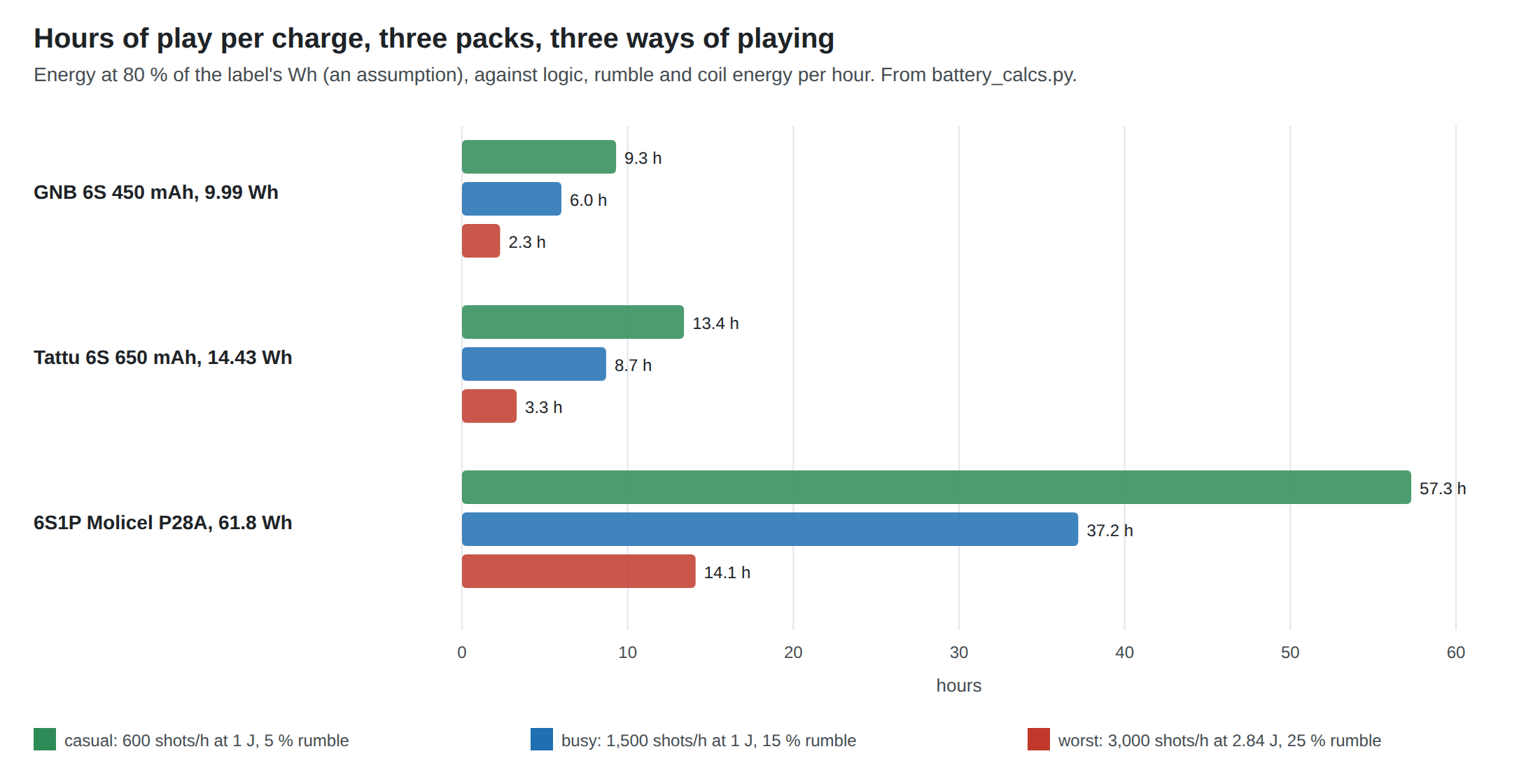
The loads for an hour: logic at 0.5 W through a buck regulator assumed 85 % efficient (about 0.59 W, 2,100 J an hour); the rumble motor at 0.09 A × 24 V, about 2.2 W while running, for the stated fraction of the hour; and the shots.
A correction (2026-10-20): these figures leave out about 0.10 W of standing load that never sleeps, chiefly the rumble stage’s driver and the rail switch (Wireless Power Only, Volume 4). With it counted, the GNB 450 mAh pack’s casual, busy and worst-case figures become about 8.3, 5.6 and 2.2 hours.
Table 6 — 3.6 Hours of Play
| Way of playing | Average power | GNB 450 | Tattu 650 | 6S1P P28A |
|---|---|---|---|---|
| Casual: 600 shots/h at 1 J, rumble 5 % | 0.86 W | 9.3 h | 13.4 h | 57 h |
| Busy: 1,500 shots/h at 1 J, rumble 15 % | 1.33 W | 6.0 h | 8.7 h | 37 h |
| Worst: 3,000 shots/h at 2.84 J, rumble 25 % | 3.49 W | 2.3 h | 3.3 h | 14 h |
The shot rates are illustrative, not measured from games. The worst case is deliberately pessimistic: 3,000 shots an hour at the unregulated 45 ms energy, which the coil itself could not sustain thermally (Solenoid Recoil Vol 4). Even so, the smallest common 6S pack outlasts a long evening.
In the wireless-power-only build the logic runs from USB and the pack carries only the coil and rumble, so these figures are lower bounds.
3.7 Feeding the Logic From the Pack
In the fully wireless build the Pico, camera and radio also run from the pack. Dropping 22 V to 5 V in a linear regulator at 0.1 A would burn about 1.7 W, three times the logic’s own power, inside the shell. A small buck module is the obvious part. Pololu’s D36V6F5 is one: 5 V at up to 600 mA, input 5.2 to 50 V, quiescent current under 0.1 mA (about 2 µA in shutdown), 13 × 10 × 3 mm, $5.95 each as of 19 October 2026.2 Its 50 V input covers the whole pack window and the regen rise with margin, and its low quiescent current matters for a pack left in a gun on a shelf (Volume 6).
The Pico’s own input, VSYS, accepts 1.8 to 5.5 V through its buck-boost (Power Supplies Vol 5), so the 5 V module feeds VSYS through the usual Schottky OR with VBUS, and USB can still be plugged in for configuration. How the logic rail is arranged in the wireless gun belongs to the Fully Wireless dive; this section only sizes it against the pack.
3.8 The Short-Circuit Current
The same resistance that makes sag small makes a fault large. With the 0.15 Ω estimate of 3.4, a dead short at the pack’s terminals draws about 170 A from a full 6S1P P28A pack and about 150 A at nominal. A small pouch pack’s figure is not published and could be lower or comparable; the maker’s 80C label implies the pack is built to deliver 36 A or more on purpose. On a brick the equivalent fault is limited to a few amps by the brick’s trip (Power Supplies Vol 2). This single number is why Volume 4 begins with a fuse.
3.9 What the Numbers Decide
- Capacity is not the constraint. The smallest stocked 6S pack runs a gun for an evening. Choose the smallest 6S pack that fits, and buy a second rather than a bigger one.
- The C rating is not the constraint. 2.5 A is a few C on any candidate. Ignore the label’s number.
- Sag is small and the regulated stage hides it, but it fools a voltage-based fuel gauge read during a shot.
- Without a brick, the coil’s heat is the only limit on autofire. The firmware’s temperature cut-off (Solenoid Recoil Vol 4) is a primary protection on battery, not a backstop.
- The fault current is two orders of magnitude above the working current. That shapes the fuse and the protector (Volume 4).
Footnotes
-
Molicel, Product Data Sheet, INR-18650-P28A, copy at https://www.rosebatteries.com/hubfs/INR18650P28A-V2-80093.pdf (read 2026-10-19). ↩ ↩2
-
Pololu, “5V, 600mA Step-Down Voltage Regulator D36V6F5”, item 3792. https://www.pololu.com/product/3792 (read 2026-10-19; $5.95 for one, $5.47 for five or more). ↩
Comments (0)