Modding Classic Light Guns · Volume 1
Before the Screwdriver — What Is Inside a Classic Light Gun, What Breaks, and What Is Not a Fault at All
Four kinds of classic gun sorted by where the aiming really happens; a Zapper and a GunCon opened part by part from a published teardown and a community component list; the failures each design invites; and the triage that saves opening a gun that was never broken
1.1 What this dive covers, and what it leaves to its siblings
The light guns of the cathode-ray-tube era are now thirty to forty years old, cheap in loose condition and plentiful. They break in predictable ways, and their shells are some of the best-made gun-shaped housings a hobbyist can buy for the price of a meal. This dive is about doing three things with them: repairing them so they work as made, gutting them to carry modern camera-based electronics, and finding out honestly what can and cannot be done to make a CRT gun work on a flat panel. It ends with adding a kick or a rumble to guns that never had one.
It sits between two groups of sibling dives and repeats neither:
Table 1 — It sits between two groups of sibling dives and repeats neither
| Subject | Where it is told |
|---|---|
| What each gun is, its model numbers, prices and the tells of a clone | Console Light Guns (buying and testing a second-hand gun is its Volume 7) |
| Why a CRT gun cannot work on a flat panel, at engineer depth | History of Light Guns, Volume 6 |
| Arcade cabinet guns, their maintenance and the cabinet’s CRT problem | Arcade Light Guns, Volume 6 |
| The home-computer guns and light pens | Home-Computer Light Guns |
| The open firmware, flashing it and the GunCon conversion kits on sale | Open-Source Firmware (Volume 1 surveys the kits and their prices) |
| The board design: microcontroller, camera, inputs, drivers | Reference Electronics |
| Solenoid physics, choice and drive | Solenoid Recoil |
| Supplies, pulse banks and brown-out | Power Supplies |
What is left, and what this dive owns, is the hardware of the old guns themselves: what is inside them, how they fail, how to test and fix them, how much of a shell can be reused and where new parts go in it.
1.2 Four kinds of classic gun
Every repair and every conversion starts from one question: where does this gun’s aiming actually happen? The answer splits the classic guns into four kinds, and each kind fails in its own way.
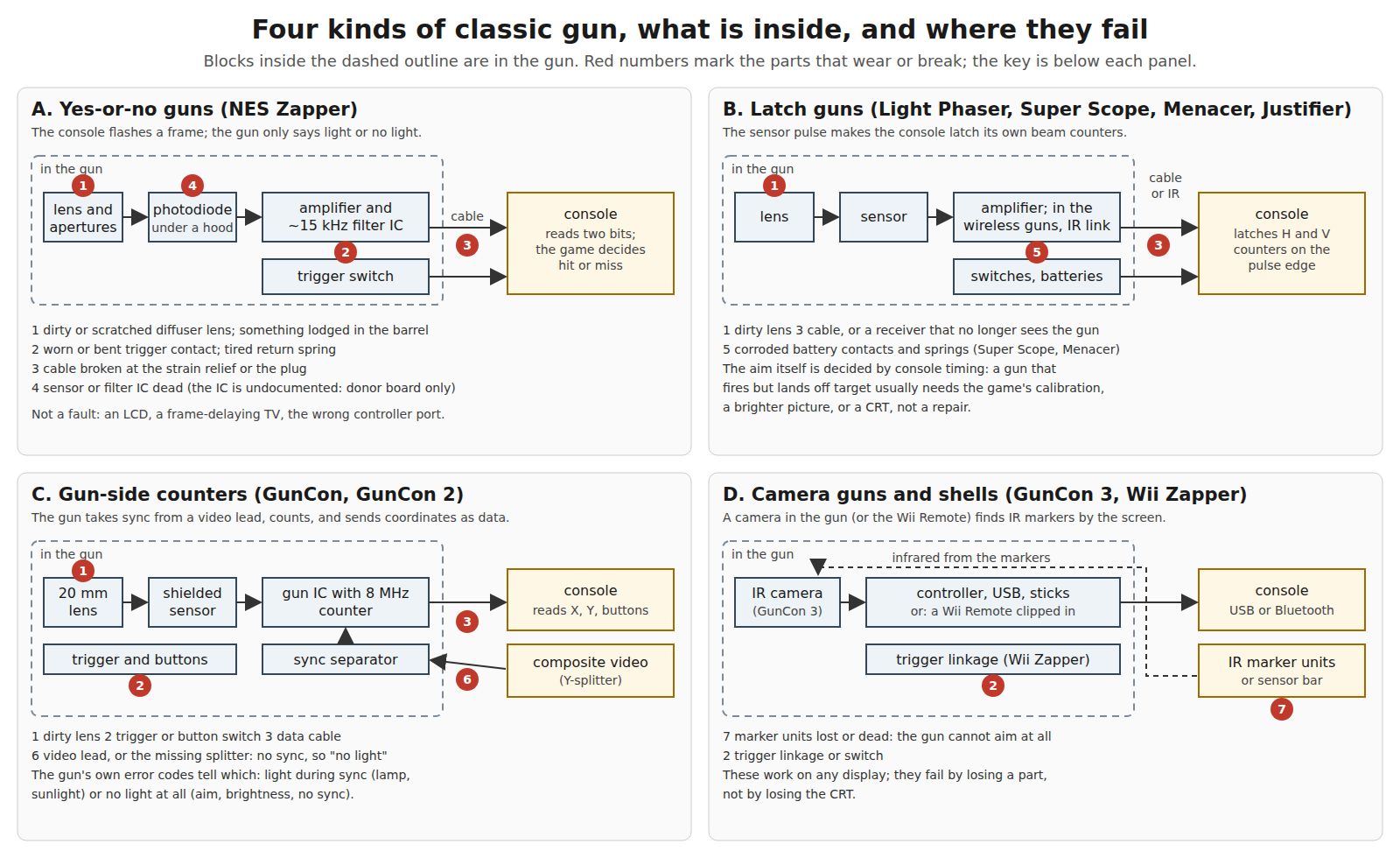
A. Yes-or-no guns. The NES Zapper is a photodiode, an amplifier and a filter in a gun-shaped case. When the trigger is pulled, the game blanks the screen, then draws white boxes where the targets are, and reads one bit that says whether the gun saw light. The gun has no idea where it is pointing; the game infers it from which frame lit the sensor (History, Volume 3).
B. Latch guns. Sega’s Light Phaser and Menacer, Nintendo’s Super Scope and Konami’s Justifier send a pulse at the instant the raster passes the aim point, and the console latches its own horizontal and vertical counters on that edge. The gun again contains no position logic; the console’s video hardware does the measuring. Konami’s PlayStation Justifier and Hyperblaster work the same way through the controller port’s IRQ10 line, with the coordinates read from the console’s timers rather than from the gun.1
C. Gun-side counters. Namco’s GunCon (sold in Europe and Japan as the G-Con 45) and GunCon 2 take composite video through their own lead, separate the sync inside the gun, count 8 MHz clocks from horizontal sync and scanlines from vertical sync, and send the result to the console as data. The console never times anything.1 This one fact decides most of Volume 5: a gun that reports numbers can be imitated by any device that produces the same numbers.
D. Camera guns and shells. The GunCon 3 carries an image sensor that sees two infrared marker units by the screen; the Wii Zapper carries nothing at all and borrows the Wii Remote’s camera (Console Light Guns, Volume 6). These work on any display and fail by losing a part, not by losing the CRT.
The practical consequence for a repairer: in kinds A and B, a gun that “fires but misses” is very often a gun that is fine, connected to a television that is not a CRT, or to the wrong port. In kind C, the gun itself can be asked what it sees (§1.4). In kind D, the first suspect is whatever has gone missing.
1.3 Inside the NES Zapper
The NES Zapper is the gun most often found broken and the one with the least documentation, so its insides are worth setting out from what has actually been published.
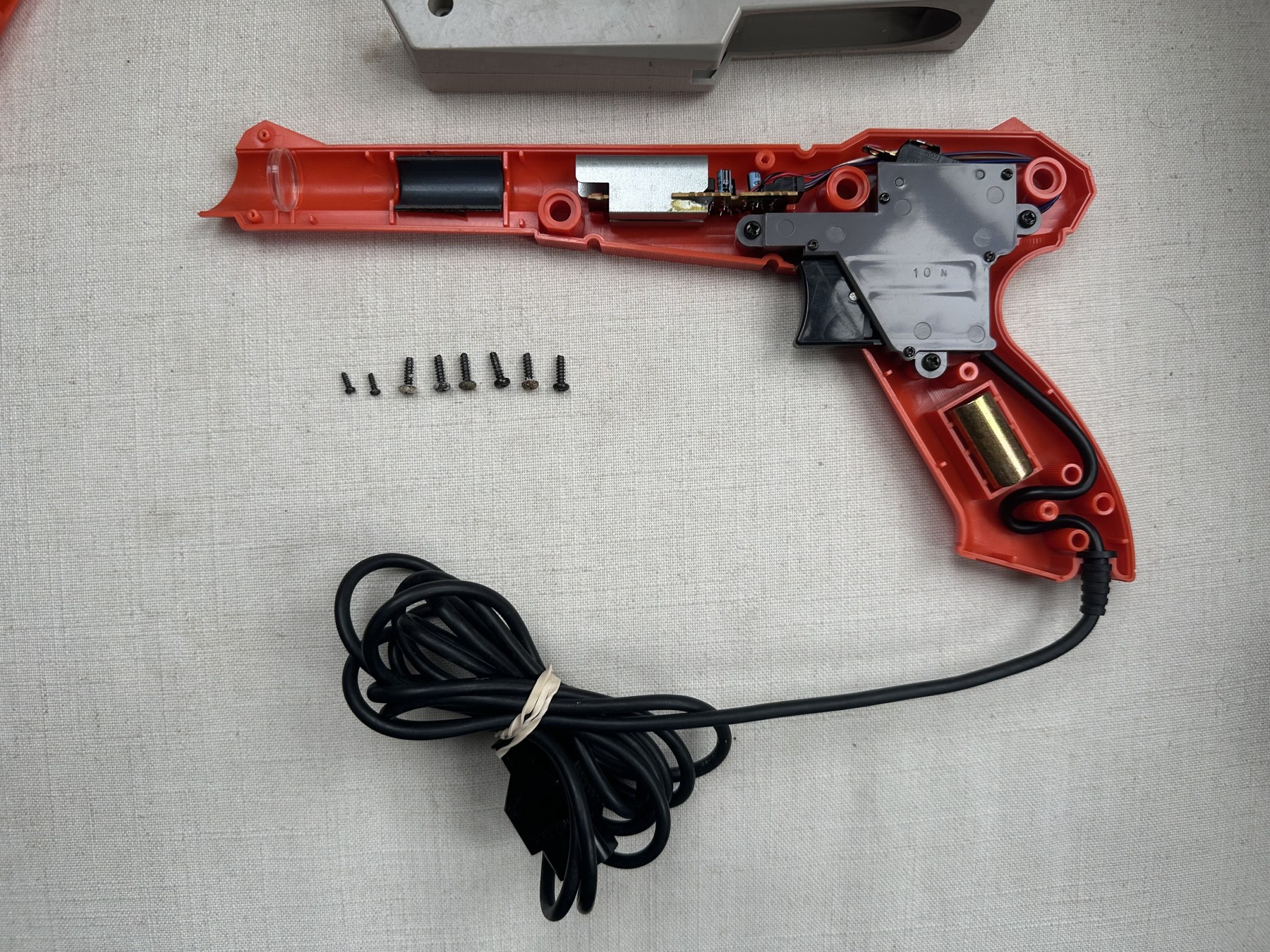
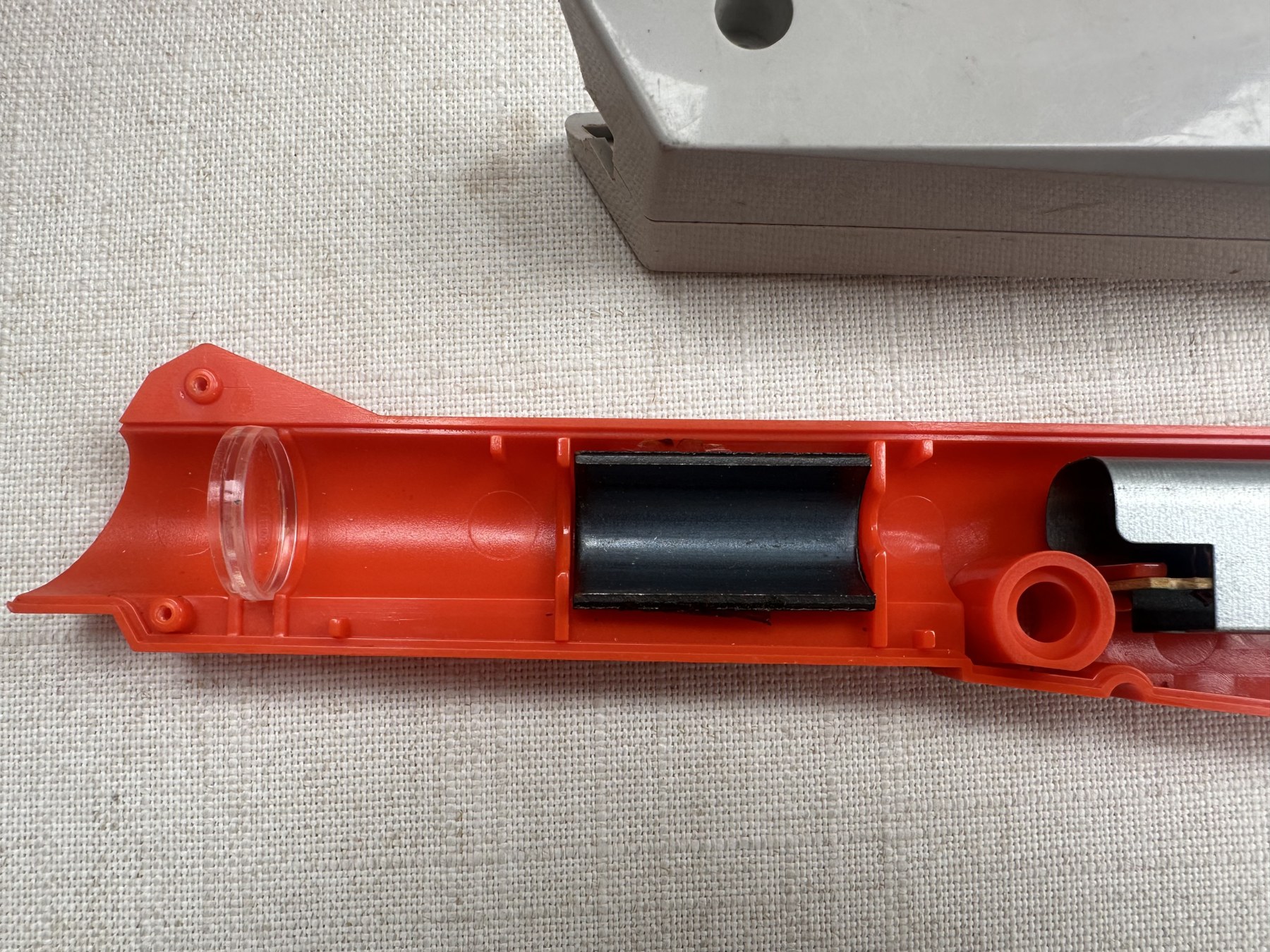
A hobbyist teardown published in April 2024 found the case “very easy” to open, held by “only a few screws of various sizes”, with no clips or tamper tricks. It describes the grey top piece as purely cosmetic, a brass weight in the grip and a black metal piece in the barrel that appears to be counterweight as well, outside the sensor’s field of view.2
The optics are simpler than the shape suggests. The same teardown reports two orange occluding apertures inside the tube, the rear one very small, which together set the sensor’s field of view, and a muzzle “lens” that its author could not get to focus at any distance and took to be a diffuser.2 That is consistent with how the Zapper is used: it needs to know whether a patch of screen roughly the size of a target is bright, not to image anything. It also explains a piece of forum folklore. An owner whose gun flashed and fired but scored nothing found that it worked with the muzzle partly covered, judged it “over sensitive”, and cured it by packing foam round the inside of the muzzle to make the opening smaller. That is an anecdote, not a test, but it is the aperture doing its job.3
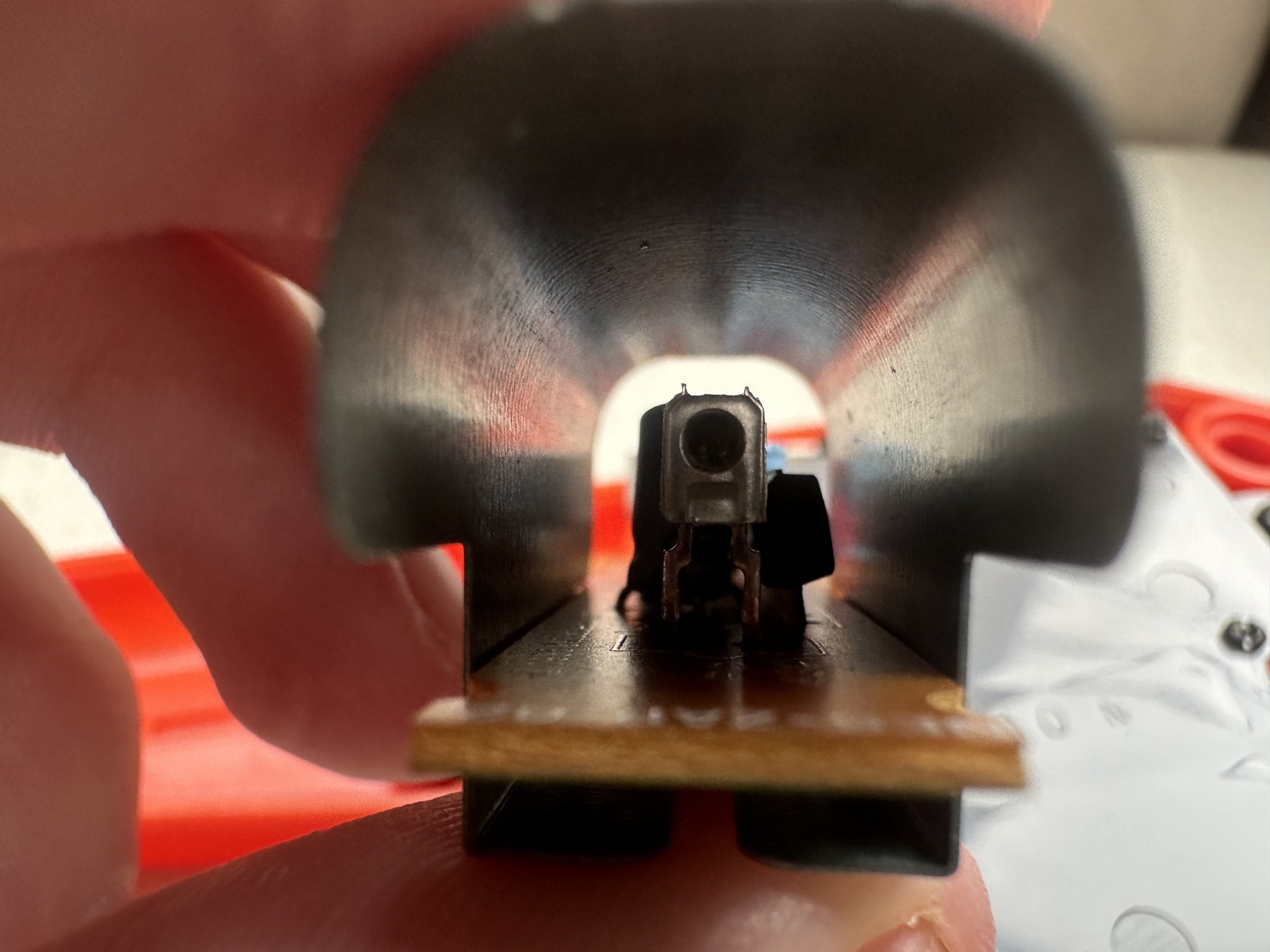
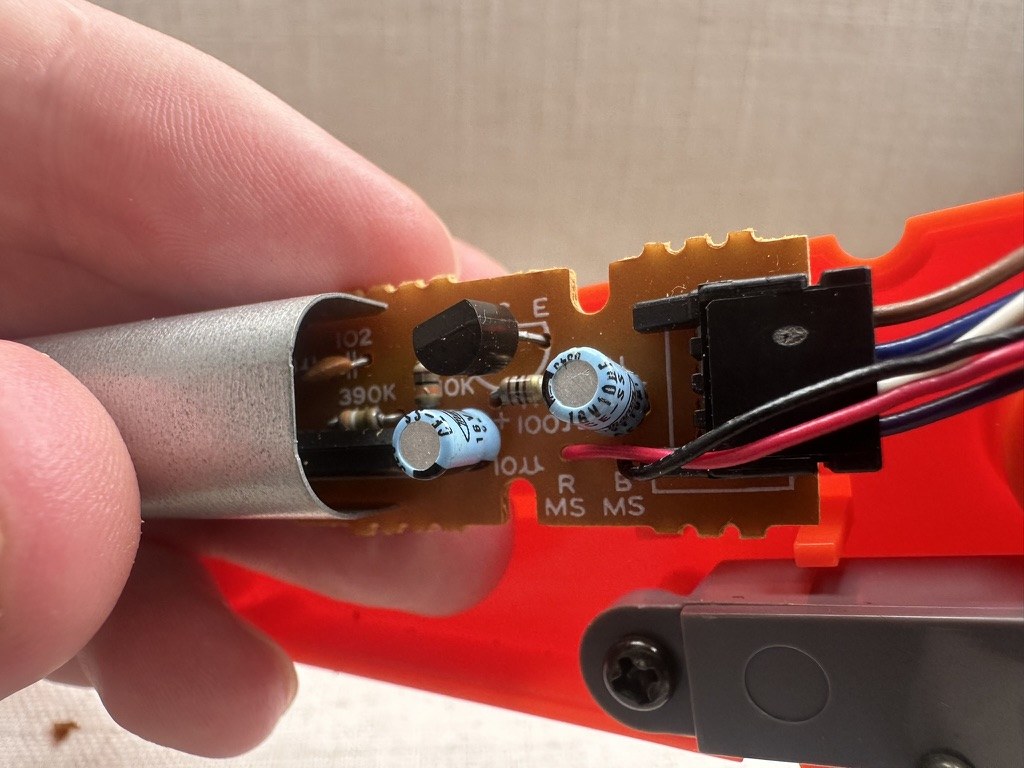
The electronics were reverse-engineered by Nick Bild in 2025. The key part is a Sharp IR3T07A, which he describes as “completely undocumented”: no datasheet could be found. In his measurements the hit line responds to light flashing between about 13.5 and 20 kHz, which brackets the NTSC line rate of about 15.7 kHz; the trigger is a plain switch that “grounds the signal” and is independent of the light sensing, and both the trigger and hit lines rely on pull-ups in the console.4 The NESdev reference adds the console side: light sense on data bit 3 (0 when light is seen) and trigger on bit 4, and a 10 µF capacitor in the gun, together with the console’s 10 kΩ pull-up, stretches the trigger’s release to about 100 ms.5
Two consequences matter for repair. First, the filter IC has no datasheet and no known second source, so a dead one is replaced with a donor board, not a part. Second, because the sensor chain is tuned to line-rate flicker, a Zapper that does nothing on a flat panel is behaving correctly; the NESdev reference says its filter “will strongly attenuate the light signal from many modern televisions”.5 Console Light Guns, Volume 2 tells that story; here it is the first item in the triage of §1.7.
1.4 Inside the GunCon
The original GunCon (Namco model NPC-103) is the best-documented classic gun inside, because the community reference for the PlayStation hardware lists its components and its cable.1
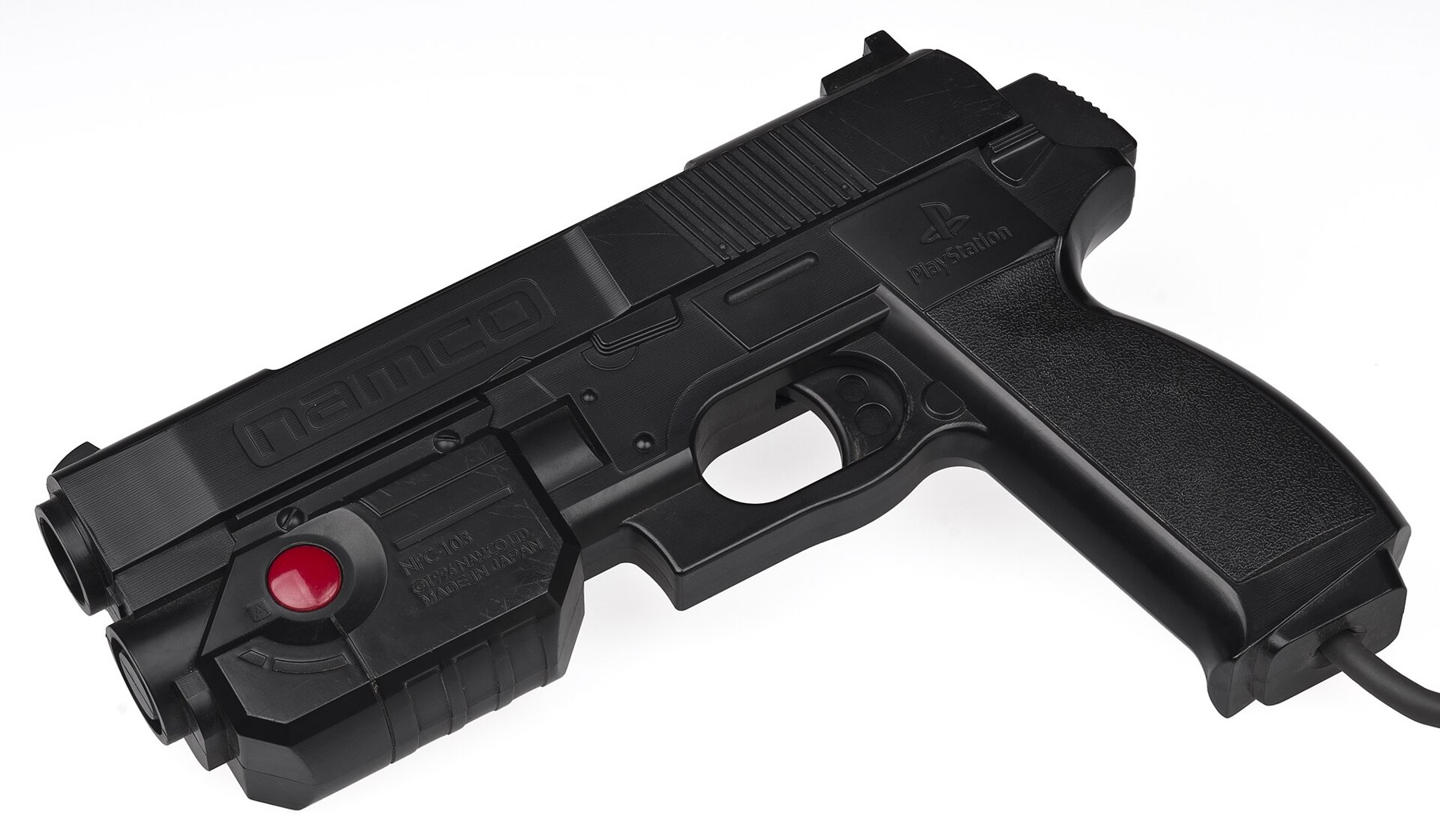
Table 2 — 1.4 Inside the GunCon
| Part | What PSX-SPX records |
|---|---|
| Main board | PCB DNP-0500A, carrying U1, a 44-pin Namco gate array marked NAMCO103P |
| Sync separator | U2, an 8-pin BA7071F “Sync Separator IC with AFC”, fed from the composite video wire |
| Clock | an 8.00 MHz ceramic resonator (CSA 8.00WT) |
| Light sensor | PS1, a 3-pin light sensor with metal shielding |
| Trigger | a DIP switch on its own small board (DN-P-0501), wired with two black wires T1/T2 |
| Side buttons | A (red wires) and B (white wires) on board DN-P-0502 |
| Lens | 20 mm |
| Cable | nine wires to a split plug: controller port plus composite video |
The cable is where these guns most often fail, and the reference gives its colour code from the gun’s connector J1:
Table 3 — The cable is where these guns most often fail, and the reference gives its colour code from the gun's connector J1
| J1 pin | Wire | Goes to |
|---|---|---|
| 1 | green | controller port pin 5, +3.5 V |
| 2 | brown | pin 4, ground |
| 3 | black | pin 9, /ACK |
| 4 | red | pin 6, /JOY (select) |
| 5 | yellow | pin 1, data |
| 6 | orange | pin 2, command |
| 7 | blue | pin 7, clock |
| 8 | grey | shield, ground |
| 9 | white | composite video, from the console’s video output |
The controller port’s +7.5 V and IRQ10 pins are not used.1 That last point is the difference between this gun and Konami’s: the GunCon needs nothing from the console but power, a serial bus and a copy of the video.
The GunCon also reports its own faults. When asked, it returns X as 8 MHz clocks since horizontal sync and Y as scanlines since vertical sync, and two reserved pairs of values: X = 0001h with Y = 0005h means “unexpected light”, light seen during vertical sync, which PSX-SPX attributes to a bulb or sunlight; X = 0001h with Y = 000Ah means “no light”, the gun pointed away, the screen too dark, or the gun read too early.1 A gun that always returns the second code with the trigger pulled at a bright screen has lost its sensor, its sync or its video lead, and §2 of Volume 2 turns that into a test. The same reference gives the dimmest colours the gun still sees: roughly mid-grey (666666h), with red the hardest to see.1
The GunCon 2 is the same idea with a USB connection for data and the composite lead kept for sync. No equivalent component list was found for it; what is known of its inside comes from a published conversion that took it apart board by board, and is in Volume 4. On a PC it enumerates as USB vendor and product 0B9A:016A, which the Linux driver written for it reports as an absolute-position device with the trigger as the left mouse button.6
1.5 Inside the Super Scope and the wireless guns
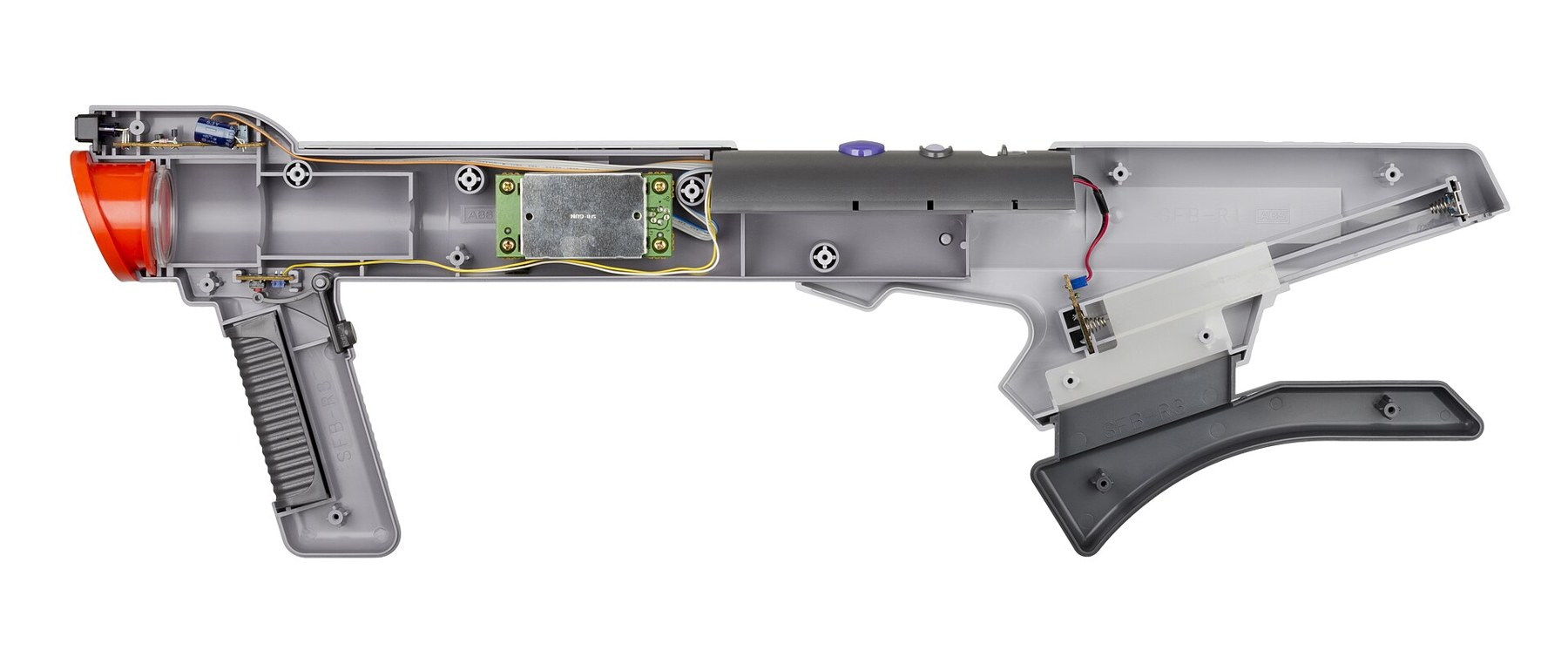
The Super Scope and the Menacer are the wireless latch guns: the sensor and an infrared transmitter are in the gun, a receiver sits on the television, and batteries run the gun. Nintendo’s development manual for the Super Scope, and Sega’s design, are told in History, Volume 4 and Console Light Guns, Volume 3. For a repairer, the wireless guns add three things to the failure list that a wired gun does not have: battery contacts, a receiver that may be lost or dead, and an infrared link that can be blocked or misaligned. Console Light Guns Volume 7 already puts “open the battery doors and look for corrosion before anything else” at the top of its list for these two guns.
Sega’s Menacer is a useful case of folklore. A video circulated in 2019 claiming to show a Menacer tracking on an LCD; the forum that discussed it never established that the video was genuine, and the one owner who tested a Menacer on a flat panel (a plasma) reported a cursor that “jumped wildly” and reliable tracking only on a CRT.7 That is what the design predicts, and it belongs with the claims examined in Volume 5.
1.6 What breaks, gun by gun
No survey of failure rates for these guns exists. Console Light Guns Volume 7 says so plainly and lists the faults “that follow from the designs”: corroded contacts, cables broken at the strain relief, worn trigger switches, dirty lenses and missing accessories.8 The table below adds the part-level detail from the teardowns and the component list above, and marks which entries rest on a source and which on the design alone.
Table 4 — 1.6 What breaks, gun by gun
| Gun | Symptom | Likely cause | Basis |
|---|---|---|---|
| NES Zapper | Never registers the trigger | Trigger contact or its return spring; cable conductor broken | Design (trigger is a bare switch to ground)4 |
| NES Zapper | Trigger works, every shot misses, on a CRT | Sensor board, lens or aperture blocked; or the console’s port 2 | Owners’ reports; NES port 2 fault reported on iFixit3 |
| NES Zapper | Misses on a CRT, but works with the muzzle partly covered | Too much light reaching the sensor; aperture or hood disturbed | Owner’s report (foam in the muzzle cured it)3 |
| Light Phaser, Menacer, Justifier | Fires, lands far off target | Calibration, brightness, a non-CRT display | Design; makers’ manuals (Console Vol 7) |
| Super Scope, Menacer | Dead | Corroded battery contacts; receiver missing or unplugged | Console Vol 7; design |
| GunCon, GunCon 2 | ”No light” every time at a bright screen | Video lead or splitter missing; sensor; sync separator | PSX-SPX error codes1; Console Vol 5 (the splitter) |
| GunCon, GunCon 2 | ”Unexpected light” | A lamp or window in view during vertical sync | PSX-SPX1 |
| GunCon, GunCon 2 | Erratic, intermittent | Cable flexed at the grip exit | Design (nine-wire cable through the grip) |
| GunCon 3 | Cannot aim at all | Marker units missing or dead | Console Vol 6 |
| Wii Zapper | Trigger does nothing | Linkage to the Wii Remote’s B button broken or misaligned | Design (the Zapper is a moulding with a lever) |
The pattern is the useful part. Mechanical faults dominate: switches, springs, cable and contacts. The electronics are simple and rarely the first thing to die, and in the Zapper’s case cannot be fixed at component level anyway.
1.7 Triage: is it the gun at all?
A large share of “broken” classic guns are guns plugged into the wrong place. Before opening anything:
- Is the display a CRT, and the right kind? Kinds A, B and C need a direct-view CRT fed at the console’s own scan rate. Namco’s own list of televisions that defeat the GunCon includes 100 Hz sets and sets with a frame memory (Console Light Guns, Volumes 4 and 7). A scaler or an HDMI mod in the path breaks them too, except in the narrow conditions given in Volume 5.
- Is it in the right port? The Zapper works in socket 2, the Light Phaser in Control 1, the Super Scope, Menacer and Justifier in port 2 (Console Light Guns Volume 7). An AV Famicom does not connect a Zapper’s signals at its NES-style ports at all (Volume 2 gives the fix).9
- Does the game work with this gun? Regional and model mismatches are common: North American Dreamcast games refuse the Sega gun, and Konami and Namco PlayStation guns are incompatible with each other’s games (Console Light Guns, Volumes 4 and 5).
- Is the picture bright enough? Every maker’s manual puts brightness first. For the GunCon, PSX-SPX’s minimum colours give the threshold.1
- Has the game been calibrated? Nearly every gun after the Zapper has a calibration screen.
Only when all five are answered is the gun itself the suspect.
1.8 Opening one
The classic guns are held together with ordinary crosshead screws and moulded locating pins; the Zapper teardown found no clips or tamper-resistant fasteners.2 Three habits save trouble:
- Lay the screws out in the pattern of the holes. The Zapper uses screws “of various sizes”,2 and a long screw in a short boss will push through the far wall of the shell.
- Photograph every layer before lifting it, especially wire routing through the grip and the trigger’s spring, which will jump out once the halves part.
- Lift the board with its sensor shield on. The Zapper’s and the GunCon’s sensors sit under metal hoods that set what they see; disturbing the hood changes the gun.
Consoles, unlike the guns, often use security screws; the AV Famicom modification in Volume 2 needs a “Gamebit” driver to open the console.9 That matters only when the console’s port is the suspect.
1.9 How the rest of this dive is arranged
Table 5 — 1.9 How the rest of this dive is arranged
| Volume | Subject |
|---|---|
| 2 | Repairs at the bench: test methods, switches, cables, sensors, batteries, replacement marker units, and making a gun work on a different console |
| 3 | Shells as hosts: which classic gun to gut, the carrier boards that exist, where the camera goes, and why the GunCon 2 |
| 4 | The GunCon 2 with OpenFIRE at bench depth, Michael’s original fallback build |
| 5 | Classic guns on flat panels: what works, what does not, and the claims |
| 6 | Adding kick and rumble to guns that never had them |
1.10 What could not be verified
- The Zapper’s filter IC. Sharp IR3T07A is Nick Bild’s identification; no datasheet exists, and neither the circuit’s component values nor the photodiode’s part number are published in text.4
- Any failure rate for any classic gun. The failure table rests on teardowns, component lists, owners’ reports and the designs.
- The GunCon 2’s component list. No published equivalent of the PSX-SPX GunCon list was found.
- Screw sizes for any of the guns: none was published in the sources read.
Footnotes
-
Martin Korth (nocash), PSX-SPX: “Controllers - Lightguns - Namco (GunCon)” and “Pinouts - Component List and Chipset Pin-Outs for Namco Lightgun, NPC-103”. https://psx-spx.consoledev.net/controllersandmemorycards/ and https://psx-spx.consoledev.net/pinouts/ (read 2026-10-19). Community reverse-engineering. ↩ ↩2 ↩3 ↩4 ↩5 ↩6 ↩7 ↩8 ↩9
-
“A quick teardown of the NES Zapper Lightgun”, Stay Caffeinated (blog), 26 April 2024. https://www.staycaffeinated.com/2024/04/26/light-gun-teardown (read 2026-10-19). Photographs used with credit. ↩ ↩2 ↩3 ↩4
-
iFixit Answers, “Zapper gun not hitting anything on screen” (question 755126, November 2022, with answers to October 2024). https://www.ifixit.com/Answers/View/755126 (read 2026-10-19). Owners’ reports. ↩ ↩2 ↩3
-
Nick Bild, “How the NES Zapper REALLY Works”, Hackaday.io project 203034, 5 May 2025. https://hackaday.io/project/203034-how-the-nes-zapper-really-works/details (read 2026-10-19). ↩ ↩2 ↩3
-
NESdev Wiki, “Zapper”. https://www.nesdev.org/wiki/Zapper (read 2026-10-19). Community reference. ↩ ↩2
-
beardypig, “guncon2: Linux driver for the Guncon 2 light gun”, README. https://github.com/beardypig/guncon2 (read 2026-10-19). ↩
-
ArcadeControls forum, “WTF - Sega Menacer working on an LCD flatscreen… How???”, thread from 30 December 2019; test report by member 2huwman, 9 February 2020. http://forum.arcadecontrols.com/index.php?topic=161682.0 (read 2026-10-19). ↩
-
Console Light Guns, Volume 7, “When It Does Not Work”. ↩
-
Famicom World, “NES Zapper on AV Famicom”. https://famicomworld.com/workshop/tech/nes-zapper-on-av-famicom/ (read 2026-10-19). ↩ ↩2
Comments (0)