Modding Classic Light Guns · Volume 6
Adding Kick and Rumble to Guns That Never Had Them
What the console guns offered and what the conversion kits add; where a solenoid and a rumble motor go in a GunCon 2, a GunCon and the slimmer shells; why a classic pistol shell gives a tap and not a slide; and the driver, supply and cable for the fallback gun, each with the reasons for and against
6.1 What the classic guns had
Recoil in light guns was an arcade feature: Namco’s blowback guns and the solenoid guns that followed are the story of Solenoid Recoil, Volume 1 and Arcade Light Guns, Volume 5. The console guns did without. None of the first-party CRT-era console guns in Console Light Guns kicks; the GunCon has “no recoil or track/slide”, as one forum builder put it.1 Vibration appeared only at the edges: Sega’s Dreamcast Gun took a Puru Puru Pack in its socket (Console Light Guns, Volume 5), and PSX-SPX notes that the unlicensed Blaze Scorpion for the PlayStation “does additionally have a rumble/vibration function”, without knowing how games reached it.2
So anything that kicks or buzzes inside a classic shell is an addition, with no original mounting to reuse.
6.2 What the conversion kits add
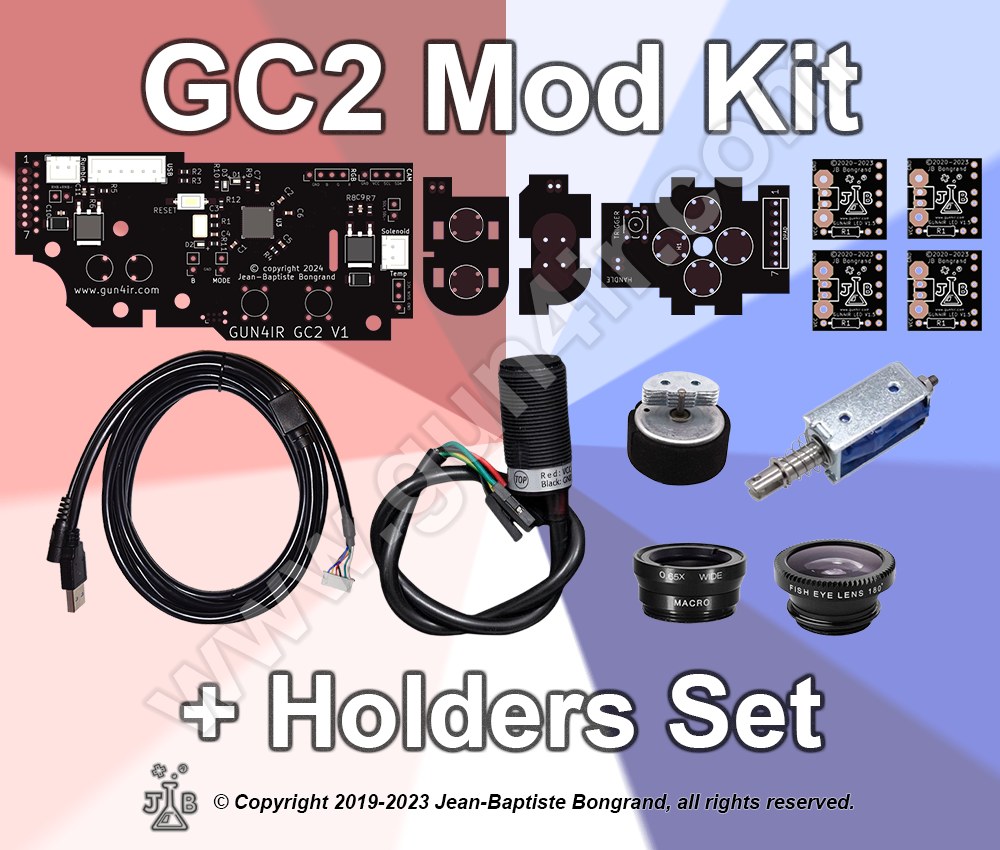
GUN4IR’s kits are the reference for what fits, because they put both a solenoid and a rumble motor in the GunCon shells and sell printed holders for them.
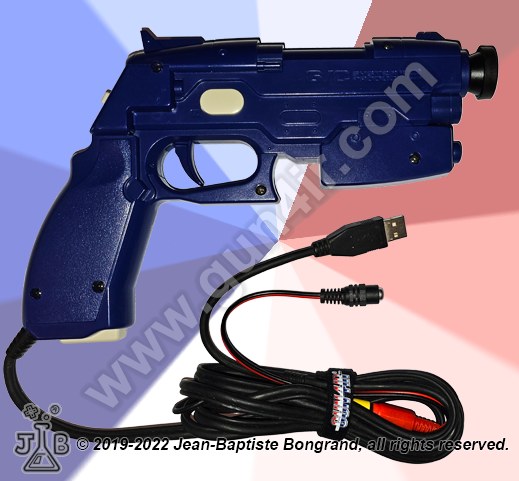
The kit lists “3D printed holders for the solenoid, rumble motor, and cable”.3 Its pre-modified sets list “Solenoid feedback (requires an extra 12v power supply, not included in the set)” and a “Temperature sensor mounted on the solenoid as a safety measure”, and ask for “a standard (non switching if possible) 12v power supply rated for 2A (or more)” (Solenoid Recoil, Volume 1, which quotes them in full). The pre-modified GunCon 2 shows how the supply gets in: a second lead with its own plug beside the USB.
6.3 A tap, not a slide
Michael’s brief recorded the limit before any of this was researched: a GunCon fallback “gives internal solenoid feedback but not slide recoil”.4 That is the right expectation for every classic pistol shell. The slide is a fixed moulding, there is no long axis behind the hand for a heavy striker to travel along, and the shell is thin plastic. What can be added is a small open-frame solenoid throwing its plunger against a stop: a sharp tap through the hand, more felt than seen.
How strongly that tap is felt depends on the moving mass, the stop and where the impulse acts relative to the hand. Solenoid Recoil, Volume 5 owns that mechanics: kick on or near the bore axis, a stiff stop tied to the structure, a damper on the return. In a pistol shell the bore axis sits well above the hand, so a kick along it lifts the muzzle, which is what a real pistol does and is no bad thing.
6.4 Where the solenoid goes in a GunCon 2
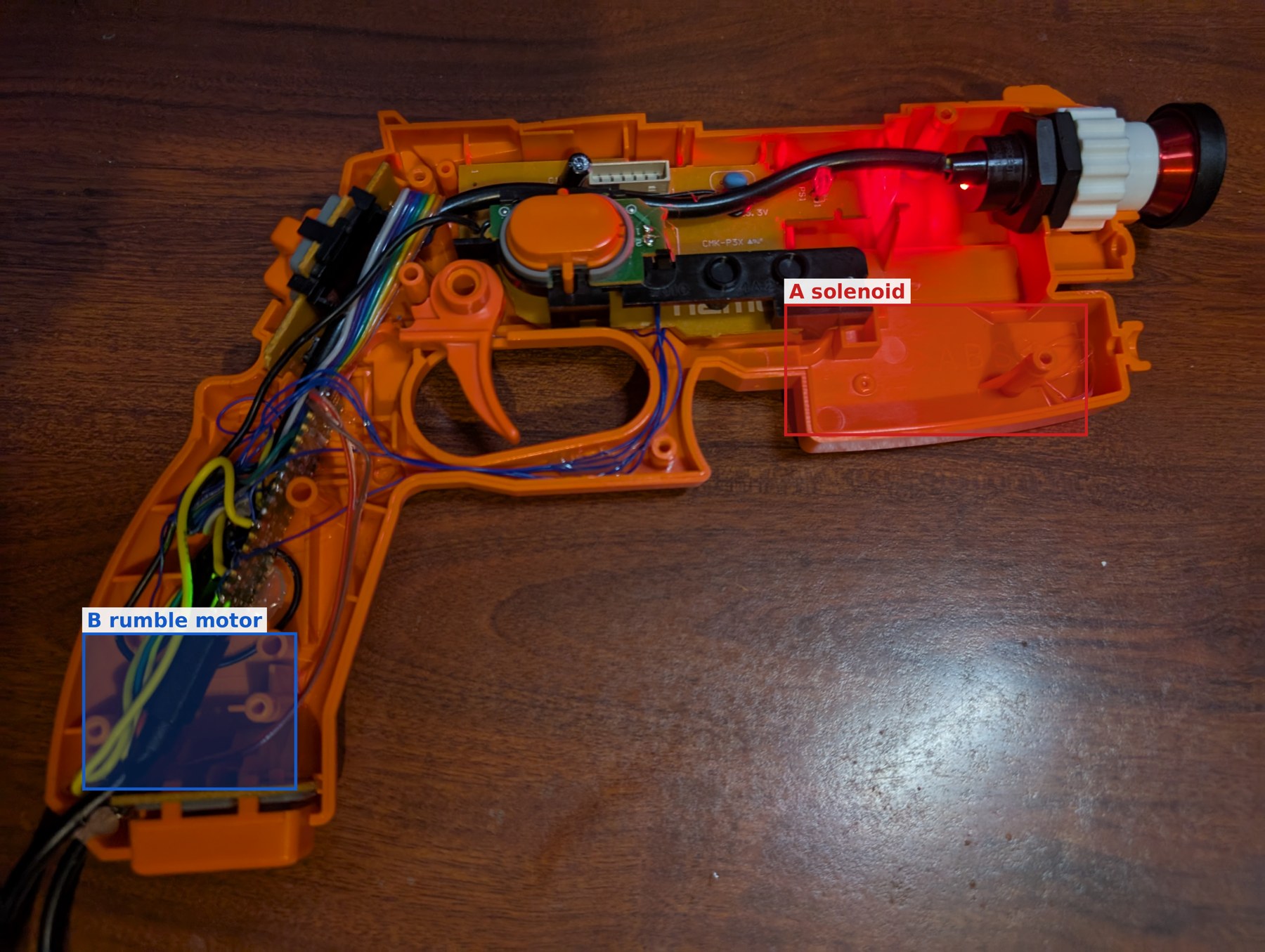
The photographs of the OpenFIRE conversion (Volume 4) show the lower front of the slide almost empty once the original camera tube is out and the boards are kept where they were. That space, zone A, is this dive’s candidate for the solenoid:
- Axis parallel to the bore, plunger striking forward or rearward against a stop moulded into, or screwed to, the shell’s front bulkhead. A forward strike pushes the gun back into the hand.
- Below the main board, so the board’s button contacts are not shaken by the impact path.
- Clear of the camera’s leads, which run along the top of the slide to the muzzle (Volume 4, §4.7).
Whether GUN4IR’s holder uses the same space was not established: its product images show the holder parts but not their position in the shell, and its holders were “tested only on Japanese gun models and some EU models”.5 The zone is an inference from one photographed gun, to be confirmed by fitting.
Fixing it. The shell is thin, injection-moulded plastic with screw bosses where Namco needed them. A solenoid screwed straight into the shell wall will crack it. The robust pattern is a printed cradle that carries the solenoid and its stop as one stiff part and is itself screwed to existing bosses, which is what GUN4IR’s printed holders are. Solenoid Recoil, Volume 5 recommends threaded inserts at every mount in a printed shell; in a Namco shell the inserts go in the cradle, not the moulding.
6.5 The GunCon and the slimmer shells
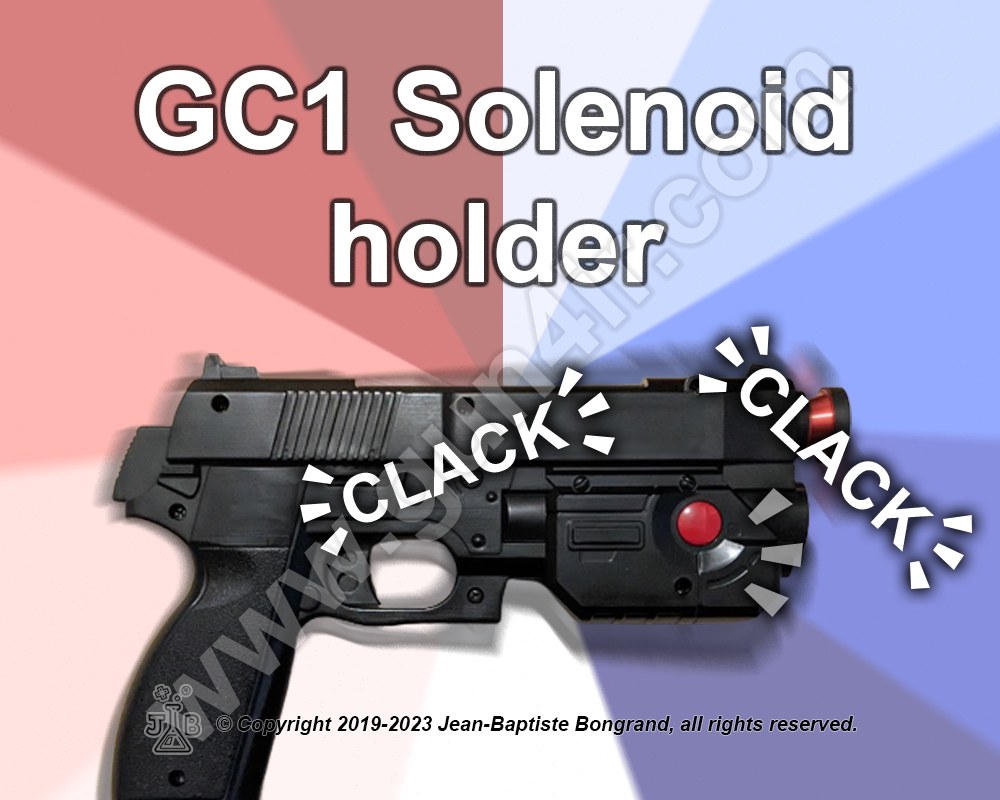
GunCon (G-Con 45). GUN4IR sells a printed solenoid holder for the original GunCon, advertised with its own “CLACK CLACK”, which places the solenoid and its temperature sensor in the shell (Solenoid Recoil, Volume 1). So a small solenoid does fit the GunCon 1.
NES Zapper. Its grip carries a brass weight added for heft and its barrel a second weight that does nothing optical (Volume 1, §1.3). Those two cavities are the obvious places for a rumble motor or a very small solenoid in a converted Zapper; that is this dive’s observation, not a documented build.
Wii Zapper. An open frame with a Remote-sized cradle; any kick has to be built into a printed sled (Volume 3, §3.5).
6.6 Which solenoid fits
Size rules out most candidates before force is considered. A forum builder trying to add recoil to a GunCon found the arcade Terminator Salvation solenoid probably too large for the shell, and warned that small marketplace solenoids “are not suitable for full auto recoil. You’ll burn them out in a few minutes of play”;1 both are forum statements, and the second is exactly the duty-cycle limit that Solenoid Recoil, Volume 4 quantifies.
The candidates already bought for the project (D15) are characterised in Solenoid Recoil, Volume 8, with their published dimensions. Against a pistol shell:
Table 1 — The candidates already bought for the project (D15) are characterised in [Solenoid Recoil, Volume 8](/light-guns/recoil-and-force-feedback/solenoid-recoil/vol-8/), with their published dimensions. Against a pistol shell
| Candidate (D15 shortlist) | For a GunCon 2 | Reason |
|---|---|---|
| JF-0530B class, 30 mm open frame | First to try | The 30 mm class is the size GUN4IR’s kit photograph shows; listings give 13 × 15 × 30 mm (Solenoid Recoil Vol 8); light enough not to unbalance the gun |
| JF-0826B class | Second | Shorter body, listed at 26 × 25 × 22 mm (Vol 8); may fit across zone A where length is short |
| Adafruit 413, 40 mm | Probably too big | 40 mm frame, 144 g listed (Vol 8): heavy for a pistol |
| Guardian TP6x12 tubular | Possible, if length allows | 39 × 19 mm diameter listed (Vol 8); tubular body suits a bore-parallel layout |
| Ledex B14-255 | Not for this shell | Chosen for the MP7’s longer body; check Vol 8’s dimensions before ruling it in |
Whichever is chosen, D1’s bench ranking applies; this table only says which to try first in the GunCon.
6.7 Rumble
An eccentric-rotating-mass motor is the easy addition: GUN4IR’s kit includes one with a printed holder,3 and OpenFIRE drives a rumble output on its own pin (GP17 in the Pico preset, Volume 4, §4.8). The bottom of the grip, zone B, keeps the motor away from the camera and close to the hand. The motor’s driver is a small transistor stage, designed in Reference Electronics, Volume 5; motor types and their feel belong to Motors and Rumble (planned). Rumble needs no supply beyond USB at the currents small ERMs draw, which makes it the sensible first addition to the fallback gun.
6.8 Driver, supply and cable for the fallback gun
The MP7 build has settled its recoil electronics: a regulated-current stage (D13) on a 24 V-class rail (D14), with one stage per actuator, never firing together (D16), from a 24 V brick (D17), through one locking connector at the magazine base plate (D31). The question is how much of that the GunCon fallback should copy.
Driver.
Table 2 — Driver.
| Choice | Verdict | Reason |
|---|---|---|
| One regulated stage as designed for the carrier (TI DRV8251A, D13) on a small board | Chosen | The same kick whatever the coil, supply and temperature; one design to learn instead of two; the bench work in Reference Electronics, Volume 5 carries over directly |
| Logic-level MOSFET and flyback diode (Michael’s brief) | Rejected | Reference Electronics Volume 5 found the usual MOSFET outside its datasheet at 3.3 V gate drive, and a fixed-voltage pulse gives a kick that varies with the coil |
| GUN4IR-style: its own board and solenoid on 12 V | Rejected | Closed system; not the project’s firmware |
Supply.
Table 3 — Supply.
| Choice | Verdict | Reason |
|---|---|---|
| The project’s 24 V brick (D14, D17) | Chosen | One supply standard in the house; the regulated stage sets current, so a small 30 mm coil can run from 24 V without over-driving it |
| A separate 12 V brick, as GUN4IR asks | Rejected | A second supply standard; GUN4IR’s “non switching if possible” request is unexplained (Solenoid Recoil, Volume 1) |
| USB power alone with a boost converter | Rejected | Power Supplies, Volume 3 shows USB cannot sustain full-strength autofire; D17 already chose against it |
Cable. The source conversion notes the GunCon 2’s outlet has room for “an external power connector for a 12/24V solenoid”.6 For the MP7, D31 put USB and 24 V in one GX connector; in a GunCon there is no magazine base plate and the outlet is already full of USB and the pedal lead.
Table 4 — 6.8 Driver, supply and cable for the fallback gun
| Choice | Verdict | Reason |
|---|---|---|
| A second lead through the outlet ending in an in-line 5.5 × 2.1 mm jack that takes the brick’s plug | Chosen for the GunCon | GUN4IR’s pre-modified gun also uses a separate power lead (§6.2); a barrel connector is hot-pluggable, unlike GX; no hole in the shell |
| One GX connector at the grip, as D31 | Rejected here | Needs a hole cut in the grip, which ends the conversion’s reversibility; D31 was made for the MP7 |
| A panel jack in the grip | Rejected | Same objection |
The regulated stage and its bulk capacitor must sit somewhere: in the grip beside the Pico if the cavity allows (owed measurement), otherwise in zone A beside the solenoid. Keep the 24 V lead and the coil’s current path away from the camera’s I2C leads (Power Supplies, Volume 5).
6.9 Noise, and what the shell will take
A solenoid in a hollow plastic shell is loud; Solenoid Recoil, Volume 5 explains why and what helps (a stiff cradle, damped stops, lined panels). A Namco shell was never designed to take repeated impacts: the risks are cracked bosses, screws working loose, and the main board’s dome contacts being jarred. Two precautions follow from the design, though no failure report was found: hang the impact on the printed cradle, not the shell; and recheck the screws after the first hours of play.
6.10 Measurements owed
Table 5 — 6.10 Measurements owed
| Owed | How |
|---|---|
| Zone A length, width, depth on the project’s GunCon 2 | Calipers |
| Grip cavity left beside the Pico | Calipers; decides where the driver board goes |
| Fit of the 30 mm and 22 mm solenoid classes in zone A | Test fit with a printed cradle |
| Felt kick and sound level in the GunCon versus on the bench rig | Solenoid Recoil, Volume 6 method, with the gun held |
| Shell temperature at the cradle after a sustained-fire run | Thermocouple on the ADP3450 bench, or an IR thermometer |
6.11 What could not be verified
- Where GUN4IR’s holders sit in the GunCon 1 and 2 shells: not shown in any image read.
- GunCon 2 interior dimensions: none published; zones A and B are inferred from one photograph.
- The Blaze Scorpion’s rumble: PSX-SPX does not know how games drove it.
- Durability of a Namco shell under a solenoid: no report found either way.
Footnotes
-
shmups.system11.org forum, “One Lightgun to rule them all?” (posts on GunCon recoil). https://shmups.system11.org/viewtopic.php?p=1344873 (seen in search 2026-10-19; forum statements). ↩ ↩2
-
Martin Korth (nocash), PSX-SPX, “Controllers - Lightguns”, third-party lightguns. https://psx-spx.consoledev.net/controllersandmemorycards/ (read 2026-10-19). ↩
-
JB Game Lab, “New GC2 Mod Kit”, gun4ir.com. https://www.gun4ir.com/products/new-gc2-mod-kit (read 2026-10-19). ↩ ↩2
-
Michael’s project memory note, “Fallback”, in
Open-Source-Firmware/02-inputs/brief/(private working file). ↩ -
JB Game Lab, “GC2 DIY Cam and Rumble holders set”, gun4ir.com. https://www.gun4ir.com/products/gc1-gun4ir-diy-cam-and-rumble-holders (read 2026-10-19). ↩
-
The Opponent, “GunCon 2 to OpenFIRE Conversion”, 28 July 2025. https://theo.minuspoint.com/2025/07/guncon2-openfire-conversion.html (read 2026-10-19). CC0. ↩
Comments (0)