Pedersen Device · Volume 8
Owning One, the Law, and Building a Reproduction
What is on the market and at what estimate, the Mark I as a federal curio or relic, the question no ATF ruling answers (whether a loose device is itself a firearm), why Michigan might take the Army's cover name at its word, and what a lawful build of a Mark I-pattern rifle and a reproduction device would involve, from parts and from scratch
The law below is set out from the statutes, regulations and ATF’s own publications. It is not legal advice, and where no ATF statement exists this volume says so rather than filling the gap.
8.1 What can be bought
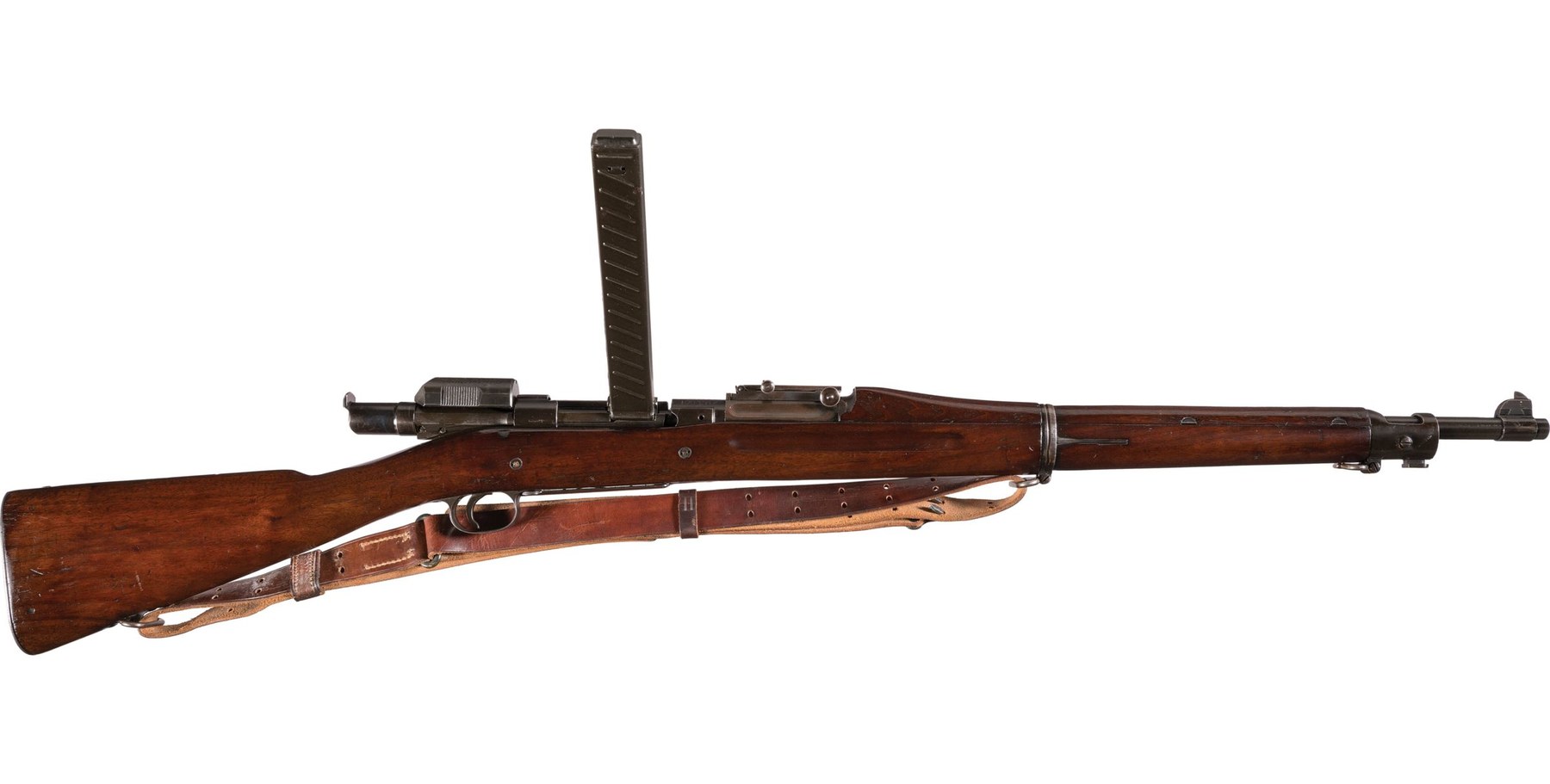
Mark I rifles turn up regularly, nearly all of them converted back to standard (Volume 5). Rock Island Auction has sold several on their own, described as Mark Is “manufactured in 1919”, some “arsenal refurbished” and one still with “the Pedersen device type sear and cut-off lever”.12 They were sold to civilians after the Second World War through the Director of Civilian Marksmanship, and the Civilian Marksmanship Program later let buyers ask for one.3
Devices are rare: estimates of survivors run from 25 to about 100 (Volume 3). They appear in specialist sales, usually with a rifle and accessories. Rock Island Auction estimated two such outfits at $27,500–$42,500 (27 August 2022) and $30,000–$45,000 (26 August 2023); the realised prices are shown only to registered bidders and are not given here.45 Poulin Auctions sold a device with its Mark I in its Fall 2025 sale and offered a device alone in August 2026, without published estimates.67 The same device (by its published serial) appears in Rock Island’s 2022 sale and Poulin’s 2025 sale, so the pool of devices in circulation is smaller than the number of listings suggests.
Accessories (scabbards, magazines, canvas, wrenches, boxed ammunition) appear with the outfits and occasionally alone. Magazines were made in far larger numbers than devices (1.6 million; Volume 2), but they were burned with the devices.
What to check: the receiver port, stock cut and “MARK I” marking agree; the sear, trigger and cut-off are the Pedersen pattern if the rifle is to take a device; the device carries both markings (“U.S.A. 1918-MARK I” and serial on one side, “REMINGTON-BRIDGEPORT / PEDERSEN’S PAT’S. PENDING” on the other); the device actually cocks and fires in the rifle it comes with, since one 2022 device “does not properly cock”; and the end adjustment is right (Volume 6).4
8.2 The Mark I rifle under federal law
A Mark I is a firearm under the Gun Control Act and not an antique: the antique definition, 18 U.S.C. § 921(a)(16), turns on manufacture in or before 1898, and Mark Is were made from December 1918 (Volume 2). The Borchardt C-93 dive’s Volume 9 sets out the antique definition in full.
It is a curio or relic. ATF’s Curios or Relics List, January 1972 through April 2025, includes “U.S. Rifles, Model 1903, manufactured by Springfield Armory or Rock Island Arsenal, all cal.’s, all variations”, and separately “All original military bolt action and semiautomatic rifles mfd. between 1899 and 1946.”8 It also qualifies by age: 27 CFR 478.11 makes a curio or relic of “Firearms which were manufactured at least 50 years prior to the current date, but not including replicas thereof”.9 The M1 Garand dive’s Volume 17 explains what C&R status lets a licensed collector do; nothing about the Mark I changes it.
8.3 Semi-automatic, not a machine gun
The device was a semi-automatic by design. The manual states that the disconnector “prevents more than one shot being fired at each pull of the trigger and also prevents firing the pistol unless the slide is in its forward or home position.”10 The statutory test, 26 U.S.C. § 5845(b), is whether a weapon “shoots, is designed to shoot, or can be readily restored to shoot, automatically more than one shot, without manual reloading, by a single function of the trigger”.11 A correctly functioning device does not.
A worn device that doubles is a different matter. The Borchardt C-93 dive’s Volume 9 discusses United States v. Olofson, in which a malfunction defence to machine-gun status was treated as a jury argument, not a safe harbour. A device that fires more than once on one pull must not be fired again until it is repaired. Its disconnector and sear lever (Volume 4) are the parts to inspect.
With the device fitted, the rifle keeps its full-length barrel (Rock Island Auction gives 24 inches) and overall length, so it is not a short-barrelled rifle.5
8.4 Is a loose device a firearm?
No ATF ruling, classification letter or C&R-list entry for the Pedersen device was found. The Curios or Relics List was searched in full for “Pedersen”; its only hit is an unrelated M1 carbine maker.8 That absence is not proof that no ruling exists, but nothing in ATF’s published material answers the question.
The question matters because the device is not like a bolt. It has its own frame, its own barrel and its own breechblock (the slide), firing pin, sear and disconnector (Volume 4). The rifle supplies only the trigger, the outer barrel and the housing the device sits in.
The regulations, applied by this dive (not by ATF):
- The definition ATF used until April 2022, 27 CFR 478.11: “Firearm frame or receiver. That part of a firearm which provides housing for the hammer, bolt or breechblock, and firing mechanism, and which is usually threaded at its forward portion to receive the barrel.”12 The device’s frame houses its breechblock and its firing mechanism, and the barrel is held at its front by a threaded nut (Volume 6). On those words it answers every element. So does the M1903 receiver for the rifle with its bolt.
- The current definition, 27 CFR 478.12(a)(2): “The term ‘receiver’ means the part of a rifle, shotgun, or projectile weapon other than a handgun, or variants thereof, that provides housing or a structure for the primary component designed to block or seal the breech prior to initiation of the firing sequence (i.e., bolt, breechblock, or equivalent)”. Its example for bolt-action rifles, (a)(4)(v), is “the part of the rifle that provides a structure for the bolt.”13 With the device fitted, the part that houses the component sealing the breech (the slide) is the device’s frame. The M1903 receiver houses the device. The rule has no example for one housing nested inside another.
- 478.12(d), on multi-piece receivers, presumes that a “modular subpart” bearing a manufacturer’s serial number is “part of the frame or receiver of a weapon or device”, absent an official determination.13 Original devices bear their own serial number; the rifles bear theirs.
On this reading, a device is at least arguably a receiver in its own right. The dealers who sell them treat them as firearms: Poulin Auctions lists a device on its own with a serial number and “STATUS: CURIO”.7 The safe course for an original is to transfer a loose device as though it were a firearm (through a licensee, or between C&R licensees if it is treated as a curio) unless ATF’s Firearms and Ammunition Technology Division says otherwise. The rule itself contemplates such classifications (“When issuing a classification, the Director may consider…”).13 An owner wanting certainty can ask for one.
The inventor’s own words point the same way. Pedersen’s third patent says “each of the auxiliary mechanisms, or arms, is available for use as a pistol, and independently of the primary arm”.14 And the Army manual warns, about snapping the firing pin of a loose device, “Do not rest the barrel of the pistol against any object while doing this”, which is the warning one gives about a thing that can fire a chambered cartridge on its own.10
8.5 Michigan
The rifle. A Mark I is a long gun. Michigan’s pistol licensing and sales-record provisions do not apply to it; the Remington Nylon 66 dive’s Volume 7 sets out that position.
The loose device. Michigan defines a firearm broadly and a pistol by length. MCL 28.421 and MCL 750.222: “‘Firearm’ means any weapon which will, is designed to, or may readily be converted to expel a projectile by action of an explosive”, and “‘Pistol’ means a loaded or unloaded firearm that is 26 inches or less in length”.1516 If a loose device is a firearm under that definition, it is far shorter than 26 inches, and it is a Michigan pistol, with the purchase-licence and record provisions that follow. The Army named it an “Automatic Pistol” to fool its own factories; Michigan’s statute may take the name at its word. This is this dive’s reading, not a Michigan State Police position, and none was found. A Michigan collector buying a device without a rifle, or keeping one apart from its rifle, should put the question to the Michigan State Police Firearms Records Unit in writing first. The Borchardt C-93 dive’s Volume 9 quotes MCL 28.422 and 28.422a and describes the concealed pistol licence route, which removes the licence-to-purchase requirement for a holder.
Michigan’s antique exemption, MCL 750.231a, does not help. Its first limb needs a firearm made in or before 1898 and not designed for fixed ammunition; its second needs fixed ammunition that “is no longer manufactured in the United States and is not readily available”, and cartridges of the device’s size are made and sold in the United States today (Volume 7). The Bergmann dive’s Volume 8 quotes the section in full.
8.6 Building: what is lawful and what is not known
The device is semi-automatic and the Mark I is a bolt-action rifle, so the hub’s build treatment applies: there is no select-fire element to avoid. Making a non-NFA firearm for personal use, not for sale, needs no federal licence; ATF’s own answer is quoted in the Borchardt C-93 dive’s Volume 9, with the conditions (no NFA item, no non-sporting semi-automatic rifle from 10 or more imported parts, detectable by metal detector). A build here uses US-made M1903 parts and steel, so neither of the last two applies.
Three points are specific to this build:
- Treat the reproduction device as a firearm for every purpose (record, storage, disposal of scrap and failed attempts), for the reasons above. If it ever passes through a licensee, 27 CFR 478.92 requires the licensee to mark it as a privately made firearm; the Borchardt dive explains how a builder’s own marking can be adopted.
- A reproduction is not a curio or relic. The C&R definition excludes “replicas thereof”.9 Nor is it an antique.
- The disconnector is a legal requirement, not a detail (above). A reproduction must be tested for doubling before it leaves the bench.
In Michigan, the reproduction device raises the pistol question above in its sharpest form, since a builder makes it as a separate object. The written question to the Michigan State Police should come before the first cut.
8.7 From parts: a Mark I-pattern rifle
No new Pedersen parts are made. A search on 19 October 2026 found no supplier of reproduction devices, sears, cut-offs or magazines. “From parts” here therefore means a rifle assembled from M1903 parts and original Pedersen parts, or a converted Mark I returned to original configuration.
The donor. The right donor is a converted Mark I: it already has the port, the stock cut and the marking, and returning it to original configuration reverses the Army’s 1937 work rather than altering a rifle that never was a Mark I. A standard M1903 can be given a port and stock cut (Plate 5’s changes a and b), but it should not be given a “MARK I” marking. A rifle that copies an original’s markings is a fake, whatever its maker intended, and the receiver marking is the one check collectors rely on (Volume 5). Mark the work as a reproduction.
The parts the device needs in the rifle are Plate 5’s items c to g: the cut-off with its cut and the new spindle, the sear with its lengthened slot and the trigger lever, and the cut trigger.10 If original parts can be found, fitting them is ordinary M1903 work. If not, they must be made (below), and the only published guides to their shape are the patents and the manual’s plates, which show the cut-off but say the trigger lever and trigger cut are “not shown”.
Value. Fitting a reproduction sear and cut-off to a converted Mark I changes a C&R rifle in its post-1937 military configuration into something else. That is lawful (it is the owner’s rifle) but it is irreversible in collectors’ eyes unless the original parts are kept with it.
8.8 From scratch: a reproduction device
This is a lab build of a straight-blowback breech mechanism and its barrel insert, at the depth the hub’s lab can execute (CNC mills, lathe, heat treatment, a full gunsmithing bench). It is a project for which no dimensioned drawings exist in any source found, and that is the first fact to plan around.
Where the geometry must come from.
- The Mark I itself. The device’s outside is fixed by the rifle: the bolt way of the M1903 receiver, the .30-06 chamber the insert must fill, the cut-off it locks against, the trigger lever it must meet. A builder with a Mark I can measure every one of those. The Headspace dive covers the chamber gauging the insert’s shoulder depends on.
- An original device, measured. Springfield Armory National Historic Site holds one (SPAR 1324), as do the other museums Culver lists (Volume 3). Access for measurement is a matter of asking.
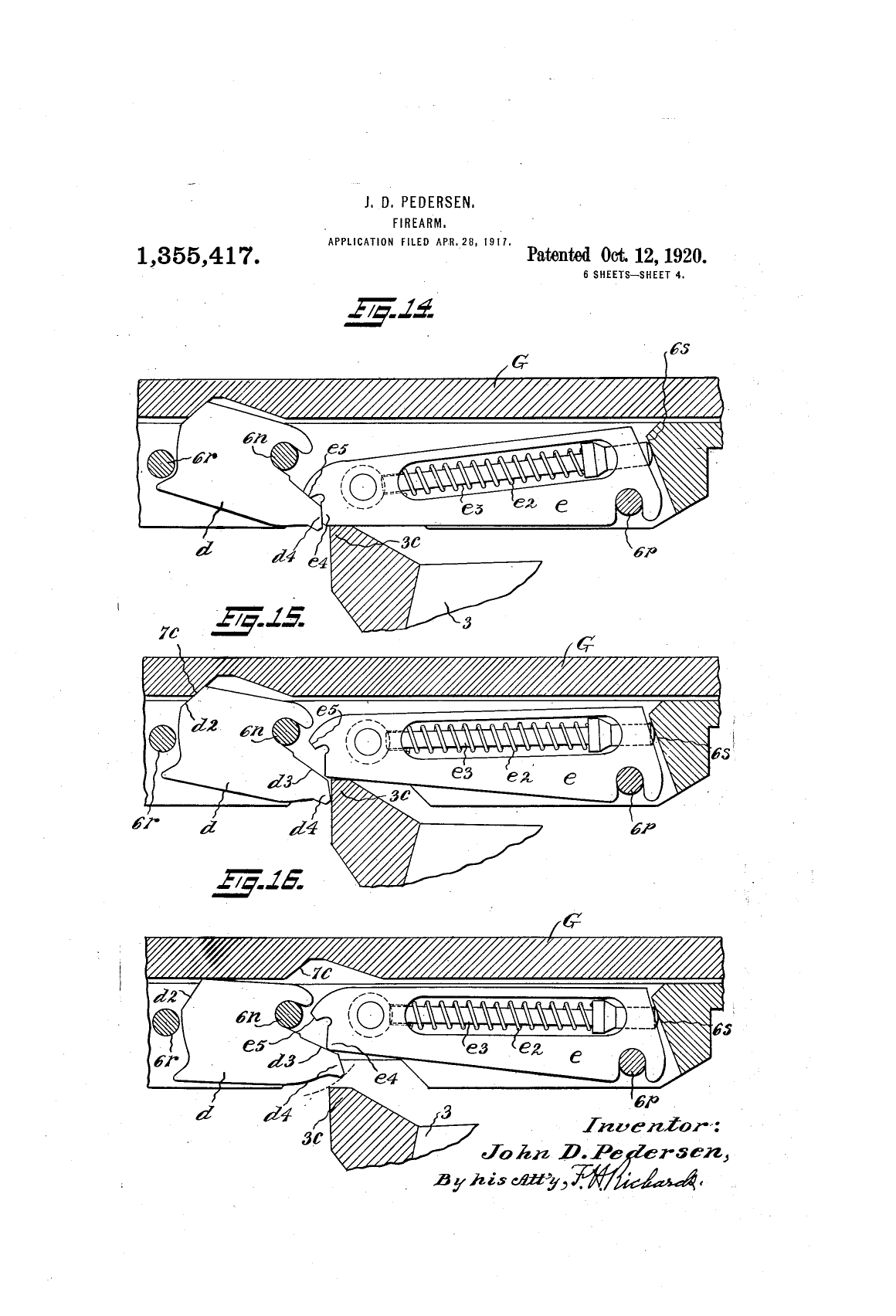
- The patents give the arrangement, not the production design: the first patent’s mechanism fires from an open bolt with an inertia firing pin, the production device from a closed breech with a sear-held firing pin (Volume 4).17
- The manual’s plates show every part to a recognisable shape and proportion, but at no scale.
The design decisions, in order.
- The cartridge. The only cartridges of this size made today are French 7.65 Longue loads, which are not the American load (Volume 7). Steinel’s is a 110-grain bullet at 1,010 ft/s; Starline names 100 grains as the heaviest its case should carry. A reproduction should be designed for a specific, documented load, preferably one handloaded to the original 80-grain weight, and proved for the maximum pressure of the case it uses. No published C.I.P. or SAAMI maximum pressure for the 7.65 Longue was found in this research, and that number is needed before any blowback calculation can be trusted.
- Blowback mass and springs. The original’s slide weight and spring rates are not published. They must be calculated for the chosen load (breechblock mass against the impulse, so that the case does not leave the chamber while pressure is high) and then confirmed by firing with case inspection. The original’s two-stage arrangement, slide then piston and buffer (Volume 4), is worth copying because it was proven over 7,500-round endurance runs.18
- The insert barrel. It must fill the rifle’s .30-06 chamber closely on the outside and carry the pistol chamber and a short rifled bore inside, with “fine rifling” that does not size the bullet below what the rifle’s rifling can take (Volume 4).19 It is a wear part (the Army’s were “badly eroded” after 7,500 rounds) and should be made so that it can be replaced, as the original’s was, on a thread with a lock nut.18
- End adjustment. Copy the original’s adjustable barrel and lock nut. It is how the Army made one device fit many rifles, and it is how a builder will fit a reproduction to his own (Volume 6).
- The firing train. The production arrangement (sear, sear lever, disconnector in the device; trigger lever in the rifle) is described step by step in the manual’s chapter VII (Volume 4). The disconnector must hold the trigger off whenever the slide is not fully home.
- The magazine. Forty rounds in a single column is the original’s; nothing in the law cited above limits magazine capacity. A shorter magazine is easier to make reliable and needs the same feed lips and the same catches.
- Materials and heat treatment. The originals’ steels and treatments are not documented. Use modern steels with known heat treatment, as the hub’s other from-scratch volumes advise.
Proof and testing. The order: function-test with dummy rounds for feed and the disconnector; single-round firing with case inspection for signs of early extraction; then magazines, watching for doubling. A device that doubles is stopped and fixed before it is fired again.
8.9 The decisions in order
- Michigan: put the pistol question to the State Police in writing (above).
- Rifle: a converted Mark I, restored to original configuration with original or made parts; never a fake “MARK I” marking.
- Load: a documented 7.65 Longue load, with its maximum pressure known.
- Measure: the rifle, and if possible an original device in a museum.
- Design: blowback mass and springs for that load; replaceable insert barrel; adjustable barrel nut; the manual’s firing train.
- Mark and record the device as a firearm.
- Test: dummies, singles, then magazines, with a doubling check at every stage.
8.10 What could not be established
- Any ATF classification of the Pedersen device, original or reproduction.
- Any Michigan State Police position on a loose device as a pistol.
- A maximum pressure for the 7.65 Longue from C.I.P. or SAAMI.
- The device’s dimensions, slide mass and spring rates.
- Any maker of reproduction devices or Pedersen rifle parts.
- Realised auction prices, which Rock Island shows only to registered users.
References
Footnotes
-
Rock Island Auction Company, sale 5021, lot 970, https://www.rockislandauction.com/detail/5021/970/us-springfield-armory-model-1903-mark-i-bolt-action-rifle (accessed 2026-10-19). ↩
-
Rock Island Auction Company, sale 5029, lot 663, https://www.rockislandauction.com/detail/5029/663/us-springfield-model-1903-mark-i-bolt-action-rifle (accessed 2026-10-19). ↩
-
Dick Culver, “The Pipsqueak Pistol That Never Was”, Civilian Marksmanship Program, Internet Archive copy of 27 March 2012, https://web.archive.org/web/20120327162014/http://www.odcmp.co/Services/Rifles/pipsqueak_pistol.htm (accessed 2026-10-19). ↩
-
Rock Island Auction Company, 27 August 2022, lot 1458, https://www.rockislandauction.com/detail/86/1458/us-springfield-1903-rifle-with-pedersen-device-and-accessories (accessed 2026-10-19). ↩ ↩2
-
Rock Island Auction Company, 26 August 2023, lot 1336, https://www.rockislandauction.com/detail/89/1336/us-springfield-1903-rifle-with-pedersen-device-and-accessories (accessed 2026-10-19). ↩ ↩2
-
Poulin Auctions, Fall 2025 Premier Firearms & Militaria Auction, lots 25-5085 and 25-5086, https://www.poulinauctions.com/2026/02/03/extremely-desirable-u-s-wwi-pedersen-device-and-correct-springfield-model-1903-mk1-bolt-action-military-rifle-group-is-accompanied-by-a-large-quantity-of-original-accessories-ammunition-and-refere/ (accessed 2026-10-19). ↩
-
Poulin Auctions, Summer 2026 Premier Firearms & Militaria Auction, lot 26-29, https://www.poulinauctions.com/2026/06/14/highly-sought-after-u-s-wwi-era-remington-semi-auto-pedersen-device/ (accessed 2026-10-19). ↩ ↩2
-
ATF, Curios or Relics List — January 1972 through April 2025 (ATF P 5300.11), Section II, https://www.atf.gov/media/19856/download (copy consulted 2026-10-19). ↩ ↩2
-
27 CFR 478.11, “Curios or relics”, as quoted from the 2021 edition, https://www.govinfo.gov/content/pkg/CFR-2021-title27-vol3/xml/CFR-2021-title27-vol3-sec478-11.xml (accessed 2026-10-19); the current text is cited in the Borchardt C-93 dive, Volume 9. ↩ ↩2
-
Notes on Caliber .30 Model of 1918 Pistol, CONFIDENTIAL, Small Arms Division, Ord. Dept., Machine Gun Section; S. G. Green, Captain. Undated. Chapters II and VII; plate V. Internet Archive, https://archive.org/details/pedersen-device-manual (accessed 2026-10-19). ↩ ↩2 ↩3
-
26 U.S.C. § 5845(b), Cornell Legal Information Institute, https://www.law.cornell.edu/uscode/text/26/5845 (accessed 2026-10-19). ↩
-
27 CFR 478.11, “Firearm frame or receiver”, 2021 edition (before the 2022 rule), https://www.govinfo.gov/content/pkg/CFR-2021-title27-vol3/xml/CFR-2021-title27-vol3-sec478-11.xml (accessed 2026-10-19). ↩
-
27 CFR 478.12(a)(2), (a)(4)(v), (c) and (d), Cornell Legal Information Institute, https://www.law.cornell.edu/cfr/text/27/478.12 (accessed 2026-10-19). The rule was upheld against a facial challenge in Bondi v. VanDerStok, No. 23-852 (26 March 2025). ↩ ↩2 ↩3
-
John D. Pedersen, US Patent 1,355,419, “Firearm”, filed 7 June 1917, issued 12 October 1920, https://patents.google.com/patent/US1355419A/en (accessed 2026-10-19). ↩
-
MCL 28.421, Michigan Legislature, https://legislature.mi.gov/Laws/MCL?objectName=mcl-28-421 (accessed 2026-10-19). ↩
-
MCL 750.222, Michigan Legislature, https://legislature.mi.gov/Laws/MCL?objectName=mcl-750-222 (accessed 2026-10-19). ↩
-
John D. Pedersen, US Patent 1,355,417, “Firearm”, filed 28 April 1917, issued 12 October 1920, https://patents.google.com/patent/US1355417A/en (accessed 2026-10-19). ↩
-
Jonathon Krisko, “The Post-War Pedersen Device: Infantry Testing & Ultimate Fate”, American Rifleman, 14 September 2024, https://www.americanrifleman.org/content/the-post-war-pedersen-device-infantry-testing-ultimate-fate/ (accessed 2026-10-19). ↩ ↩2
-
Julian S. Hatcher, Hatcher’s Notebook, chapter XV, “The Pedersen Device”, https://archive.org/details/Hatchers_Notebook (accessed 2026-10-19). ↩
Comments (0)