Pedersen Device · Volume 2
Remington, Springfield and the Numbers
The contracts and what they paid, the Bridgeport works and its subcontractors, a soldier's kit of scabbard, pouches and ten magazines, the Mark II for the Enfield and a Mosin-Nagant prototype, a rifle whose production began after the Armistice, and five sets of numbers that do not agree
2.1 The orders
Pershing’s memorandum of 11 December 1917 asked for 100,000 devices (Volume 1). The two detailed modern accounts date the first order to Remington differently. Jonathon Krisko, writing from Army records for American Rifleman, says that in January 1918 Remington was ordered to make 100,000 devices, with a possible supplemental order of 30,000.1 Bruce Canfield says the initial order was placed on 26 March 1918 and was later increased to 133,450 devices.2 Both may be right if January was an instruction and March the signed contract, but neither source says so, and both dates are given here. The 133,450 figure is also the one Rock Island Auction’s catalogue descriptions use.3
The cartridge contract followed. Canfield: on 24 May 1918 Remington received a contract for 800 million cartridges.2 Pershing’s planning figure, 5,000 rounds for each device to start with, explains the size. Eight hundred million rounds is 5,000 for each of 160,000 devices.
By August 1918 the plan had grown to half a million weapons for the spring of 1919, counting a version for the M1917 Enfield (below). Hatcher: “it was decided that 500,000 Pedersen devices could be ready to go on the front lines in the spring of 1919”.4
2.2 What everyone was paid
Canfield gives the terms. Pedersen received $50,000 for the rights plus a royalty of 50 cents a device. Remington was to net $2.00 profit a device and 3 cents a magazine.2 When the Ordnance Department thought in the autumn of 1919 about buying more, Remington quoted $40 a device.1 In 1931, with the device obsolete, the Army valued its 64,873 devices at $15 each, $973,095 in all, and expected to recover $700 from them as scrap (Volume 3).5
2.3 Who made what
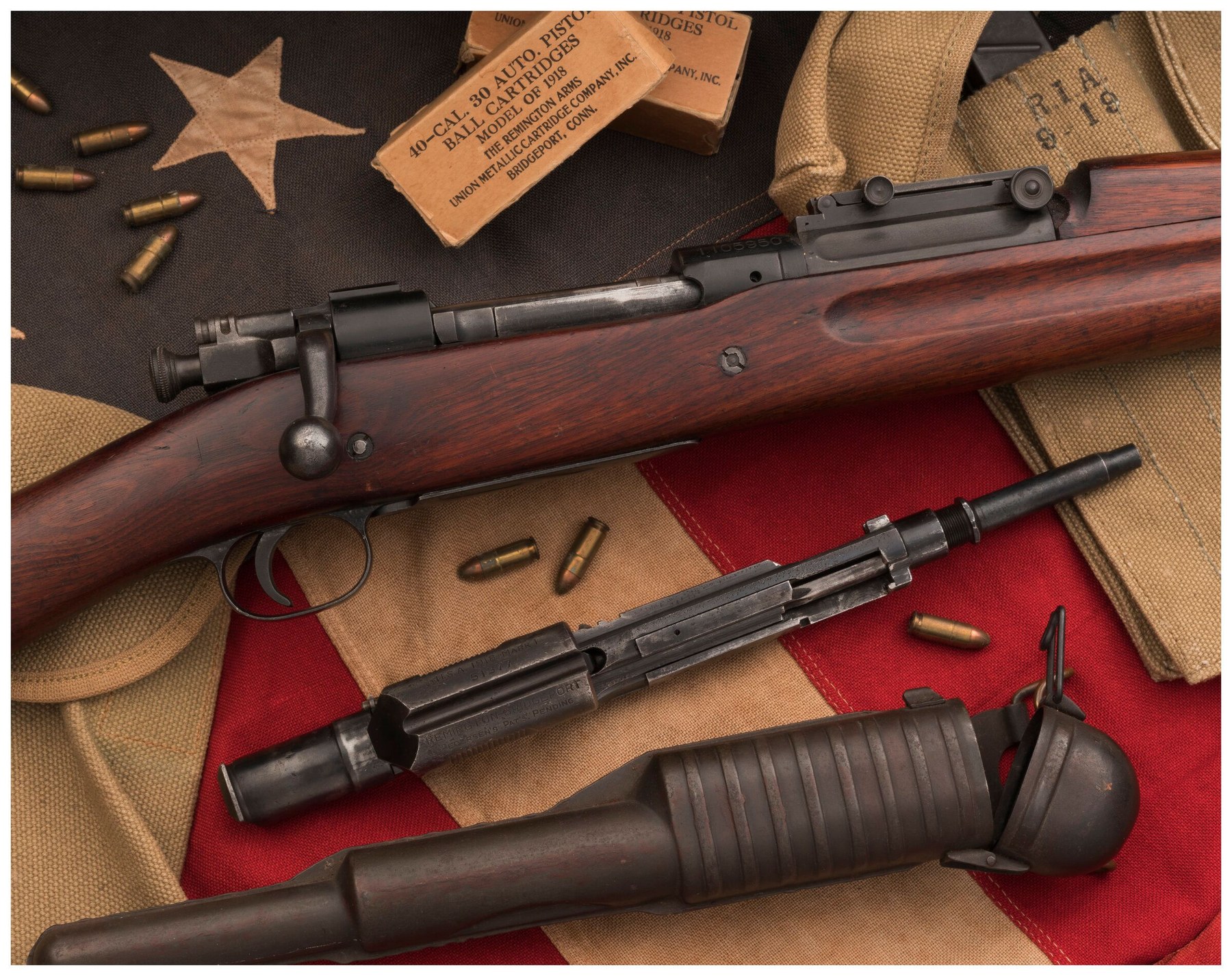
The devices were made by Remington. Culver’s account for the Civilian Marksmanship Program places them at “Remington-UMC at their Bridgeport, Connecticut plant”, and the markings on surviving devices say the same (below).6
The magazines were subcontracted, according to Canfield, to Mt. Vernon Silversmiths, with components from Gorham. The scabbards were “reportedly” made by Gorham.2 Silversmiths making sheet-metal magazines and scabbards is less strange than it sounds: a firm that spun and stamped silverware had exactly the presses a sheet-steel scabbard needed.
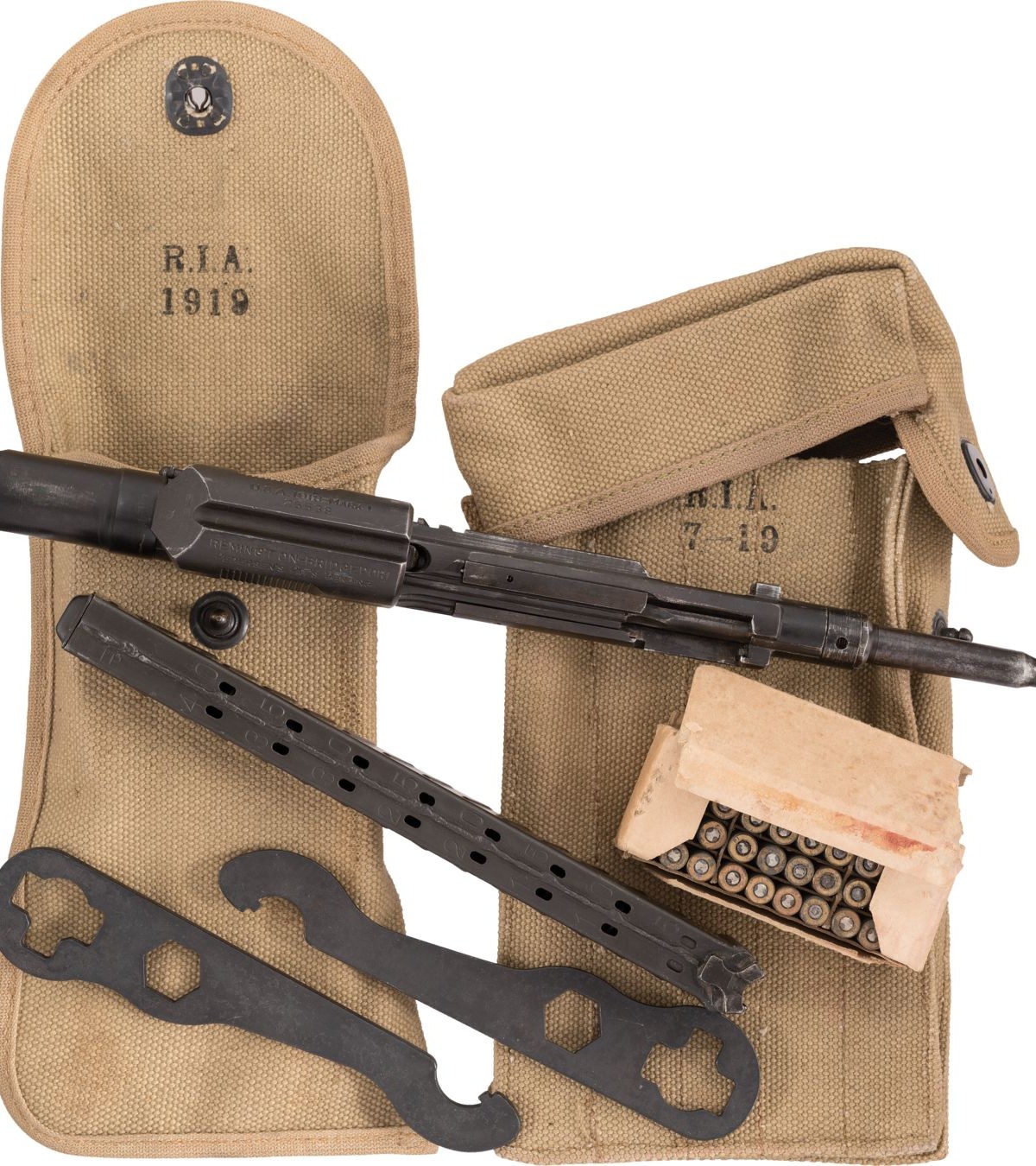
The canvas came from Rock Island Arsenal. Surviving bolt pouches are marked “R.I.A./1919” and magazine pouches “R.I.A./7-19” and “R.I.A./9-19”, as described in two Rock Island Auction lots; the 1962 Springfield Armory photograph below shows a magazine case stencilled “R.I.A. 7-19”.73
The ammunition was Remington’s. Canfield gives the headstamps as “RA” or “RAH”, dated 18, 19 or 20.2 A 2026 Poulin Auctions lot describes headstamps reading “RA”, “H” and “19”, and boxes labelled for “.30 Auto Pistol ball cartridges, Model of 1918, Remington Arms / UMC, Bridgeport, Conn.”8 Frankford Arsenal also made some: the Infantry School’s post-war tests compared “Frankford Arsenal ammunition” with Remington’s, and found the Frankford rounds the more accurate (Volume 3).5 How much Frankford made is not recorded in the sources found.
The rifles were altered or made at Springfield Armory (below).
2.4 The markings that tie a device to Bridgeport
Two auction houses describe the same pattern of markings on the devices they have sold. Rock Island Auction, of two devices in 2022 and 2023: the left side marked “U.S.A. 1918-MARK I” over a serial number in two lines, and the right side “REMINGTON-BRIDGEPORT / PEDERSEN’S PAT’S. PENDING”.73 Poulin Auctions, of a device in 2026: “REMINGTON-BRIDGEPORT / PEDERSEN’S PAT’S. PENDING” on the top right of the slide and “U.S.A. 1918-MARK I. AND SERIAL #” on the top left.8 Rock Island locates the markings on the “cocking piece”, Poulin on the slide; both are describing the slide’s raised handle, which is the only part of a fitted device the user sees from above. The serials published in these listings run from the low thousands into the fifty-thousands, which is consistent with a production of about 65,000 numbered devices.
“Pat’s. Pending” is accurate: the four patents did not issue until October 1920 (Volume 1).
2.5 The soldier’s kit
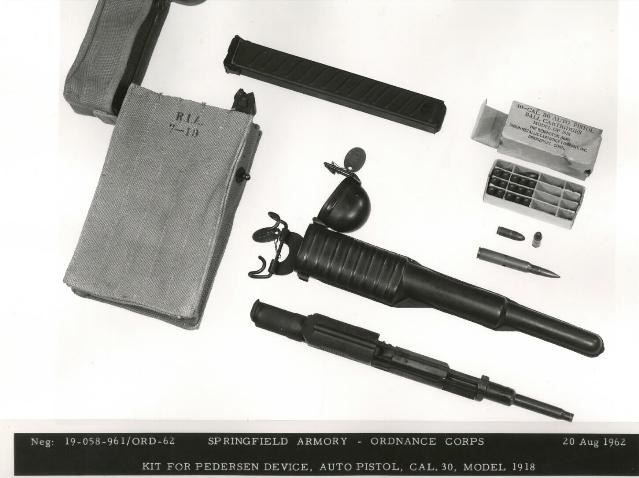
The device was a system, and most of it was carried on the belt. The manual’s drill tells the soldier to put the rifle’s bolt into “hand bolt case, which is hooked to left side of cartridge belt”, and to draw the device from its “scabbard which is hooked to left side of cartridge belt”. Magazines rode in “canvas magazine cases, hooked to the cartridge belt”, charged ones feeding end down and empties feeding end up, so that a soldier could tell them apart by feel.9
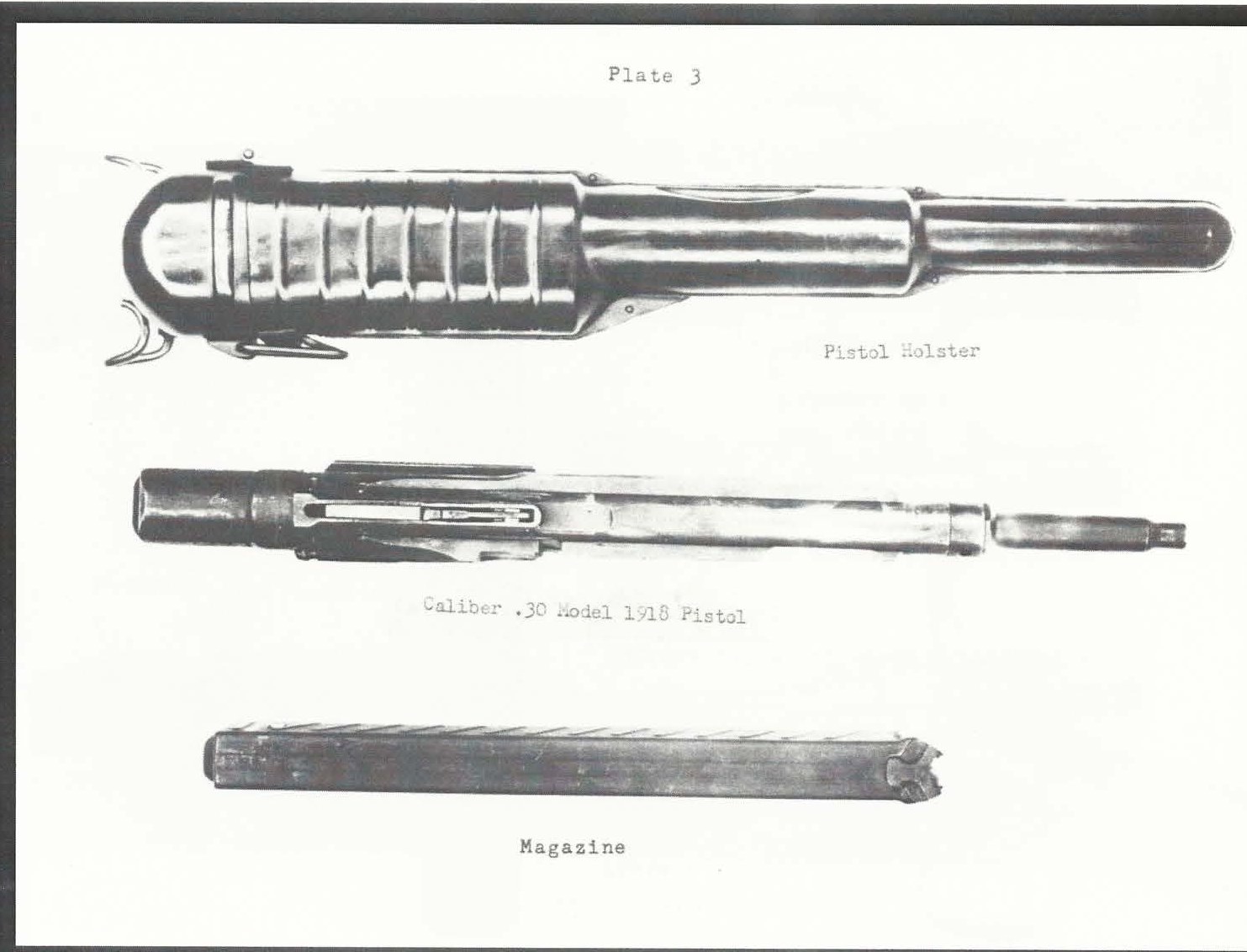
The manual gives the weights: “Weight of Model 1918 Pistol and Scabbard – 2.12 pounds. Weight of Magazine filled (40 rounds) – 1 pound.”9 Hatcher gives the same in other units: “The whole device in its metal scabbard weigh 2 pounds and 2 ounces, and the loaded magazine filled with 40 rounds weighs 1 pound.”4 Hatcher has the soldier carrying “a canvas case holding 10 magazines of 40 rounds each”.4 Culver describes two web pouches of five magazines each, 400 rounds, carried alongside the usual 100 rounds of .30-06, with the whole outfit adding about 14 pounds.6
The ammunition was packed so that it could be loaded into magazines behind the lines and sent forward in the same containers. The manual: “40 cartridges in a box, 5 boxes or 200 cartridges in a paper carton, 3 cartons or 600 cartridges in a canvas bandoleer, 5 bandoleers or 3000 cartridges in a wooden packing case. The bandoleer is designed to carry if desired its 600 cartridges when these are charged into magazines. The wooden packing case is also designed to hold its 5 bandoleers when these are filled with charged magazines. Thus all the cartridges in the packing case can be charged into the magazines at the rear, repacked in the original case and forwarded to the firing line ready for immediate use.”9 A box held exactly one magazine’s load.
One tool came with the system: “A pair of special wrenches for end adjustment of barrel is supplied with every ten pistols.”9 The wrenches set the device’s barrel against the rifle’s chamber, the equivalent of setting headspace, and Volume 6 gives the procedure.
2.6 The Mark II, the Nagant and the Berthier
The Springfield was not the only rifle in the plan. The United States was making far more M1917 Enfields than Springfields in 1917 and 1918: Krisko gives 302,887 M1917s from Eddystone, Winchester and Ilion against 111,808 M1903s from Springfield Armory and Rock Island Arsenal between 1 August and 31 December 1917.1 A device for the Enfield was the obvious next step.
Krisko: in June 1918 the Ordnance Department ordered a version for the M1917, the Mark II; its prototype was demonstrated about two months later; in August 1918 the War Department approved 500,000 Mark II attachments to be ready by March 1919; and the contract was cancelled in December 1918, after the war ended, with the M1903 kept as the standard arm.1 Canfield agrees that only a few hand-made prototypes were built.2 Culver calls the August 1918 demonstration model a “tool room model”.6
Remington also made at least one prototype for the Mosin-Nagant, and Canfield says a version for the French Berthier was considered but does not confirm that any was built.2 Culver says a photograph exists of a Mosin-Nagant tool-room model and that Remington’s museum presumably holds the Enfield and Nagant models; that is his presumption, not a confirmed holding.6
2.7 The Mark I rifle at Springfield
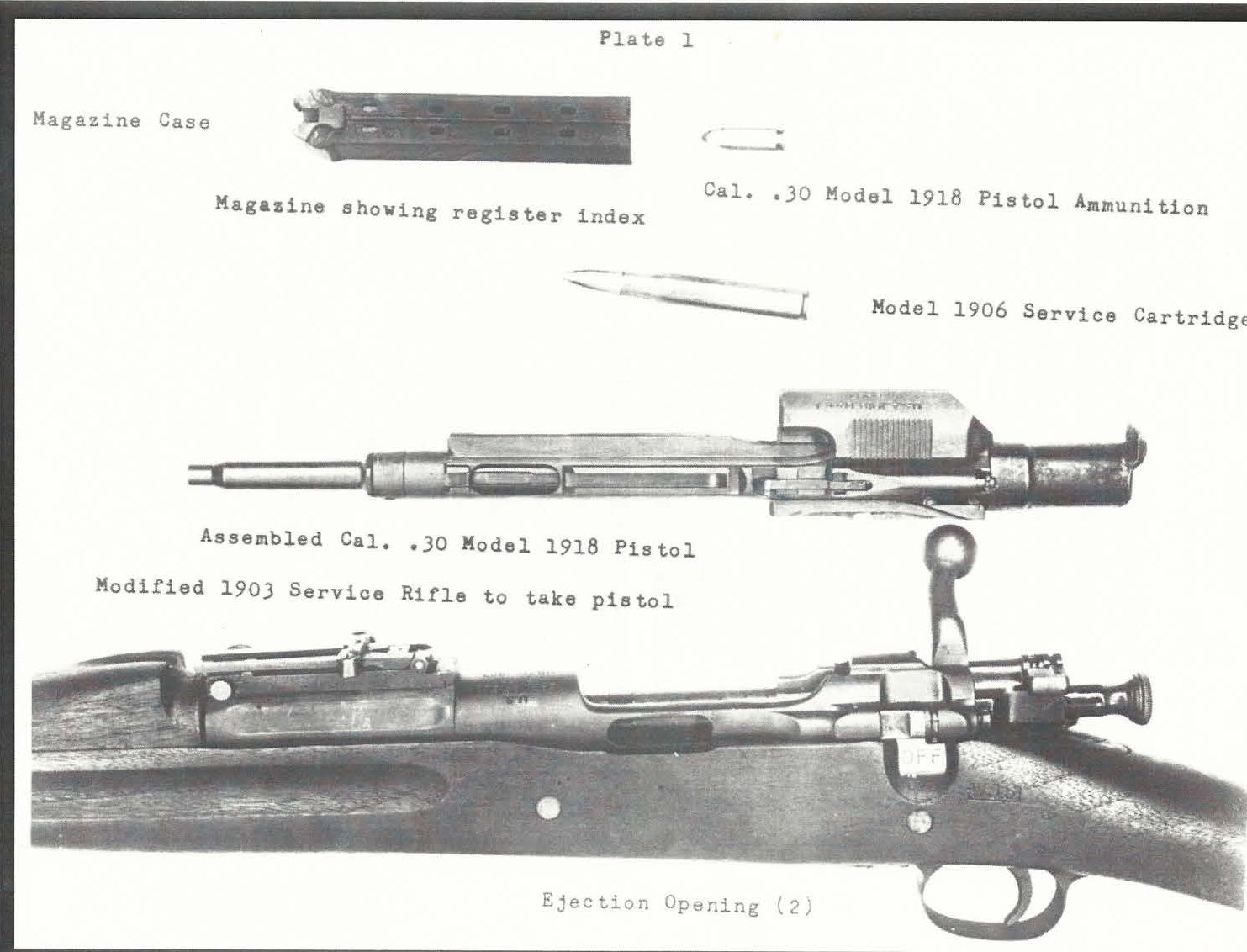
Canfield: “Springfield Armory produced the modified M1903 Mark I rifle”, with a left-side ejection port, a modified sear, trigger and magazine cut-off, and a “Mark I” receiver marking.2 Volume 5 describes the seven changes from the Army’s own list.
Culver adds the most surprising date in the story: “the production of the specially designed M1903 Rifle was not begun until 2 December 1918; almost a month after the Armistice had been signed. Production of the Mark I Rifle continued until the fall of 1920. Total production figures of the Mark I M1903 indicate that a total of 101,775 rifles were produced.”6 So the devices were made first and the rifles to carry them mostly after the war. That fits the production dates seen on surviving Mark Is: the Rock Island Auction rifles described here have barrels dated 7-19 and 8-19 and receivers “manufactured in 1919”.7310
Hatcher wrote that “the Government manufactured one Mark I rifle for each Pedersen device which was produced”.4 The other sources all give more rifles than devices, as the table below shows.
On serial numbers, Culver: “The rifles were manufactured by Springfield Armory starting with serial number 1,034,502, but reportedly, the serial numbers were intermingled with the standard Springfield production, so no definitive serial number range can be discerned.”6 The National Park Service’s year table for Springfield Armory M1903 serials gives 1918 as 761,758 to 1,005,091 and 1919 as 1,055,092 to 1,162,500, “approximate”. Culver’s starting number falls in the gap between those two ranges, which the table does not explain.11 A serial number alone therefore cannot prove a rifle is a Mark I. The receiver marking and the port can (Volume 5).
2.8 The end of production
The war ended on 11 November 1918. Hatcher: “the war ended a month later with 65,000 of the Pedersen devices completed. The remaining orders were canceled.”4 Canfield dates the end to 1 March 1919, with about 65,000 devices, 1,600,000 magazines and 65,000,000 cartridges made.2 Culver: production was “halted at the end of February 1919 with a total of 65,000 Devices having been produced”.6 Krisko agrees on 65,000 and March 1919 and adds that the government also held “more than 100,000” Mark I rifles.1
Note the ratio. Pershing asked for 40 magazines with each device; 1.6 million magazines for 65,000 devices is about 25 each. Sixty-five million cartridges is 1,000 rounds a device, a fifth of the 5,000 Pershing wanted.
2.9 The numbers, side by side
Table 1 — The numbers, side by side
| Item | Figure | Source |
|---|---|---|
| Devices first ordered | 100,000 (+30,000 possible), January 1918 | Krisko |
| Devices first ordered | 26 March 1918, later raised to 133,450 | Canfield |
| Devices planned for spring 1919 | 500,000 (Springfield and Enfield together) | Hatcher; Culver; Krisko (Mark II) |
| Devices made | about 65,000 | Hatcher; Canfield; Culver; Krisko |
| Devices on hand, March 1931 | 64,873 | Krisko (Army records) |
| Magazines made | 1,600,000 | Canfield; Krisko |
| Cartridges ordered | 800,000,000 | Canfield |
| Cartridges made | 65,000,000 | Canfield; Krisko |
| Cartridges on hand, 1931 | about 60,000,000 | Krisko |
| Mark I rifles made | one for each device | Hatcher |
| Mark I rifles made | 101,775 | Culver; Wikipedia, citing Eger |
| Mark I rifles held | ”more than 100,000” | Krisko |
| Mark I rifles made | ”nearly 145,000” | Rock Island Auction catalogue text |
These are not averaged. The 101,775 figure has a named source, Culver writing for the government-chartered body that later sold the rifles; Krisko’s “more than 100,000” agrees with it; Rock Island’s “nearly 145,000” has no stated source and is the outlier.613
2.10 What could not be established
- The device’s manufacturing cost to Remington, as distinct from its $2 margin.
- How many cartridges Frankford Arsenal made, and when.
- The date the Mark I rifle was adopted as a model, as distinct from its production start.
- A Mark I serial range: Culver says none exists; nothing found contradicts him.
- The serial range of the devices: inferred above from auction listings only.
- Whether any Mark II or Nagant device survives, and where.
References
Footnotes
-
Jonathon Krisko, “The Pedersen Device: Its Design, Production & Post-War Issuance”, American Rifleman, 12 September 2024, https://www.americanrifleman.org/content/the-pedersen-device-its-design-production-post-war-issuance/ (accessed 2026-10-19). ↩ ↩2 ↩3 ↩4 ↩5 ↩6
-
Bruce N. Canfield, “The Pedersen Device: A Secret Weapon of WWI”, American Rifleman, 17 July 2020 (print June 2003), https://www.americanrifleman.org/content/the-pedersen-device-a-secret-weapon-of-wwi/ (accessed 2026-10-19). ↩ ↩2 ↩3 ↩4 ↩5 ↩6 ↩7 ↩8 ↩9
-
Rock Island Auction Company, 26 August 2023, lot 1336, https://www.rockislandauction.com/detail/89/1336/us-springfield-1903-rifle-with-pedersen-device-and-accessories (accessed 2026-10-19). ↩ ↩2 ↩3 ↩4 ↩5
-
Julian S. Hatcher, Hatcher’s Notebook, chapter XV, “The Pedersen Device”, https://archive.org/details/Hatchers_Notebook (accessed 2026-10-19). ↩ ↩2 ↩3 ↩4 ↩5
-
Jonathon Krisko, “The Post-War Pedersen Device: Infantry Testing & Ultimate Fate”, American Rifleman, 14 September 2024, https://www.americanrifleman.org/content/the-post-war-pedersen-device-infantry-testing-ultimate-fate/ (accessed 2026-10-19). ↩ ↩2
-
Dick Culver, “The Pipsqueak Pistol That Never Was”, Civilian Marksmanship Program, Internet Archive copy of 27 March 2012, https://web.archive.org/web/20120327162014/http://www.odcmp.co/Services/Rifles/pipsqueak_pistol.htm (accessed 2026-10-19). ↩ ↩2 ↩3 ↩4 ↩5 ↩6 ↩7 ↩8
-
Rock Island Auction Company, 27 August 2022, lot 1458, https://www.rockislandauction.com/detail/86/1458/us-springfield-1903-rifle-with-pedersen-device-and-accessories (accessed 2026-10-19). ↩ ↩2 ↩3
-
Poulin Auctions, Summer 2026 Premier Firearms & Militaria Auction (5–9 August 2026), lot 26-29, “Highly sought after U.S. WWI era Remington semi auto Pedersen device”, https://www.poulinauctions.com/2026/06/14/highly-sought-after-u-s-wwi-era-remington-semi-auto-pedersen-device/ (accessed 2026-10-19). ↩ ↩2
-
Notes on Caliber .30 Model of 1918 Pistol, CONFIDENTIAL, Small Arms Division, Ord. Dept., Machine Gun Section; S. G. Green, Captain. Undated. Chapters I, III and IV. Internet Archive, https://archive.org/details/pedersen-device-manual (accessed 2026-10-19). ↩ ↩2 ↩3 ↩4
-
Rock Island Auction Company, sale 5021, lot 970, “U.S. Springfield Armory Model 1903 Mark I Bolt Action Rifle”, https://www.rockislandauction.com/detail/5021/970/us-springfield-armory-model-1903-mark-i-bolt-action-rifle (accessed 2026-10-19). ↩
-
Springfield Armory National Historic Site, “U.S. Springfield Model 1903 Production”, https://www.nps.gov/spar/learn/historyculture/u-s-springfield-model-1903-production.htm (accessed 2026-10-19). ↩
Comments (0)