Pedersen Device · Volume 3
After the Armistice: The Tests, the Bonfire and the Survivors
A squad of officers at Le Mans, the Infantry School's range and platoon tests, 4,000 sets in the Canal Zone, why the Army turned it down, the obsolescence of 1931 and the order to pile and burn, the Mark I rifles returned to standard, and how few devices escaped
3.1 Le Mans, 1919
The device’s best day came after the war it was built for. Hatcher: “After the Armistice of November 11, 1918, an intensive study was made of the possibilities of this weapon for future use. One of these tests was made at Le Mans, France, and was attended by General Pershing and some high officials of his staff.”1
Two squads of officer marksmen were sworn to secrecy and given practice with the device. Each squad fired at its own group of silhouette targets on the parapet of a target pit, starting at 1,000 yards. When a squad scored a set number of hits, the pit detail pulled down a red flag and the squad advanced to the next station. Both squads used service cartridges and advanced at about the same speed to 600 yards, where the squad with the devices changed bolts. “Immediately they let loose such a whirlwind of fire that the flag went down and they advanced. This was repeated again and again, until they had gained the objective while the regular squad had hardly moved from 600.” Hatcher was there: “Mr. Pedersen and I had taken to France the Pedersen Devices and ammunition with which this test was conducted”.1
Krisko records a further platoon test in April 1919 by the Fiske Board, under Brigadier General Harold Fiske, comparing the device with the Springfield.2 Canfield lists tests in France in 1919, at Fort Benning in 1919, at Fort Riley in 1920 and in the Panama Canal Zone in 1920.3
3.2 The Infantry School’s tests
The fullest record is the Infantry School’s Department of Experiment report at Fort Benning, which Krisko summarises from the archive copy: 27 pages, 99 with appendices. The question it was asked was whether the device had “sufficient merit to warrant its adoption as part of Infantry Equipment”.4 Its findings, as Krisko gives them:
Table 1 — The fullest record is the Infantry School's Department of Experiment report at Fort Benning, which Krisko summarises from the archive copy: 27 pages, 99 with appendices. The question it was asked was whether the device had "sufficient merit to warrant its adoption as part of Infantry Equipment".[^krisko2] Its findings, as Krisko gives them
| Test | Result |
|---|---|
| Accuracy, Frankford Arsenal ammunition | Every shot on target up to 450 yards; groups from 2.44 in to 44.2 in; at 600 yards, 6 hits in 10 |
| Accuracy, Remington ammunition | Less accurate; wild shots from about 300 yards |
| Trajectory | For a 400-yard target the sights had to be set between 1,100 and 1,225 yards; the service round reached 400 yards in 0.69 s and the device’s round took nearly twice as long |
| Penetration | 8 pine boards at 50 yards, 2 at 600 yards; steel helmets at 100 yards and under |
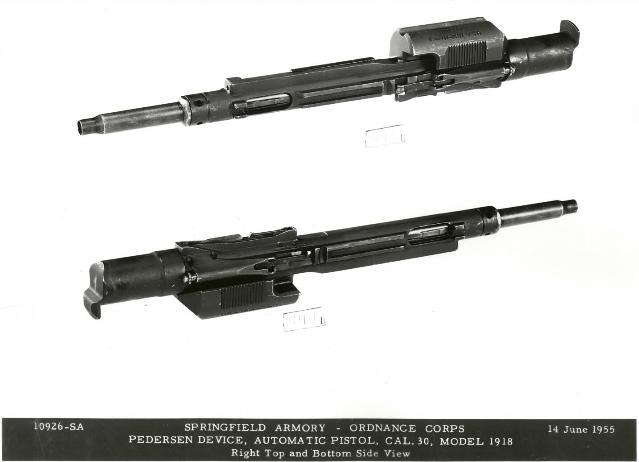
| Handling | A trained soldier took 2 min 30 s to dismount the device and 5 min to assemble it |
| Endurance | Two sets fired 7,500 rounds each, one at 42 rounds a minute, the other in 500-round bursts of five minutes with seven-minute cooling breaks; perfect function to about 5,000 rounds, then powder-fouling malfunctions that oil cured; the chamber-insert barrels “badly eroded” |
| Platoon assault, 600 yards | 2,279 hits with the device in the last 300 yards; 456 hits a minute with the device against 269 with service ammunition; but the rifle-armed men finished three minutes faster |
| Bolts | 19 per cent of men failed to put the rifle bolt in its pouch or to fasten the flap |
| Platoon defence | 1,206 hits with the device against 464; 5,800 device rounds fired against 1,600; accuracy 20.4 per cent against 29 per cent |
Source for every row: Krisko, from the Department of Experiment report.4
The captain in charge recommended that the Model 1918 pistol “be not adopted by the Infantry”. The Infantry Board under Brigadier General Paul B. Malone rejected it for the attack but suggested issuing it to passive-defence troops in the Panama Canal, Hawaiian and Philippine Departments “within the limits of supply and maintenance”.4
3.3 Issue without adoption
Some devices did go to units. Krisko: in late 1919 the device was offered for riot duty and for sub-calibre use; Fort Banks, Massachusetts, received 400 devices in December 1919, and 21 other units received between one and 75 each. In 1920 Panama Arsenal held 4,000 Mark I rifles, 4,000 devices, 4,000 scabbards, 800 wrenches, 60,000 magazines, 12,000 magazine cases and more than five million rounds, enough for one cavalry squadron and one infantry regiment in the Canal Zone.2 The same 1920 testing found that up to 30 per cent of devices needed extra adjustment to their rifles, and the officers recommended that each device be kept paired with one rifle (Volume 6).2
3.4 Why the Army turned it down
Hatcher’s own verdict, written after the Second World War, is the clearest statement of the case against: “At the close of World War I, this device was seen in the light of the situation that had just been passed through; the years of intensive trench warfare on an almost completely stabilized front. Viewed thus, it looked good; but when this perspective had faded somewhat, the picture changed”.1 He gives four reasons.
- Range. “Owing to the light weight and comparatively low power of the bullet from the Pedersen device, it is accurate against individual targets only up to about 350 yards.” And “if it were sighted to hit a man at 500 yards, the bullet would pass over the head of a man at 300 yards.”1 The Benning sight settings above say the same thing in numbers.
- Weight. The soldier already carried everything he could. Adding “a metal scabbard with the Pedersen device, a canvas pouch for the bolt of his rifle, and 10 magazines full of Pedersen ammunition, would be practically impossible in any campaign of movement.”1
- The bolt. Soldiers who switched to the device in an advance “would usually reach their objective without the regular rifle bolt, as this would be lost, dropped or thrown away in their excitement.”1 The Benning platoon test measured it: nearly one man in five failed to stow his bolt properly.4
- Silence. The bullet was subsonic, so it lacked the crack of a passing .30-06 bullet. In one test, soldiers in the target pits kept their heads down under service fire, “but when the shift was made to the Pedersen device, holes began coming into the target faster than ever but without the noise, and the soldiers all got up as high as possible and wanted to look over the edge”. Some observers saw that as an advantage, since the enemy would expose himself; “the prevailing opinion was that the menacing noise of the Springfield rifle bullet is a decided asset”.1
There was also a better idea coming. The Army began trials of full-power self-loading rifles in the 1920s, among them Pedersen’s own .276 T1, which the M1 Garand dive’s Volume 2 describes. A rifle that fired its full cartridge semi-automatically made a bolt that fired a pistol cartridge semi-automatically pointless.
3.5 1931: obsolete
Krisko gives the sequence from the archive. In March 1931 the War Department Sub-Committee on Small Arms recommended declaring the pistol obsolete. The inventory then stood at 64,873 devices, valued at $15 each, $973,095 in all, with an expected scrap value of $700; 59,393 of them were at Rock Island Arsenal; and about 60 million rounds of ammunition remained. The Adjutant General declared the pistols obsolete on 18 April 1931, file AG 474.6/6410. The M1903 Mark I rifle was excluded from the disposal.4 Later reports, Krisko notes, described the ammunition as having “deteriorated to such an extent as to be unreliable”.4
The difference between 65,000 made and 64,873 on hand is 127 devices, which is close to the number of survivors collectors estimate today (below). That is a coincidence of arithmetic, not evidence: Krisko does not say where the other 127 were, and the 1931 inventory may not have counted devices already held by museums and depots.
Hatcher’s chapter puts the decision simply: “a few years after the end of the first World War, the Army decided to waste no further funds keeping these devices in storage, and they were all destroyed”.1
3.6 The destruction order
On 14 May 1931 the Office of the Chief of Ordnance issued the order, signed by Major W. E. Larned “By order of the Chief of Ordnance”, to the commanding officers of Rock Island Ordnance Depot (Illinois), Springfield Armory (Massachusetts), San Antonio Ordnance Depot (Texas) and Benicia Ordnance Depot (California). Boxed equipment was to be piled and burned and the residue sent to scrap. Unpacked equipment was to be exposed to the weather and then sold as scrap. Rock Island proposed burning the contents on scrap lumber so as to save about 8,625 arms chests and packing boxes, worth about $17,250.4 Krisko does not report a final count of devices destroyed.
A correction. Rock Island Auction’s catalogue text says that “Army records show that 64,873 Pedersen Devices and 60 million rounds of ammunition were destroyed in April 1931”.5 On Krisko’s account of those records, 64,873 is the number on hand when the device was declared obsolete in April; the destruction order is dated 14 May, and no destroyed count is reported. The two are not the same figure.
3.7 How the devices were destroyed
The stories are many and the record is thin. Culver: “There are several versions of the destruction of the Devices themselves, but the most prevalent is that they were burned at Benicia Arsenal in California by pouring gasoline over them and their magazines and simply torching them off. This version receives some validity due to an occasional magazine or even a Device itself that will appear with obvious fire scale over all or most of their bodies.”6 Canfield repeats a report that devices destroyed at San Antonio were used as reinforcing bar in concrete sidewalks, and notes that many survivors show burn marks.3 The order itself, as Krisko gives it, supports burning at all four depots, not only Benicia; the sidewalk story is reported, not documented.
3.8 The Mark I rifles go back to standard
The rifles were kept. Hatcher: “the Mark I rifles were converted back to regular Service Rifles by the removal of the special sear and the cut-off with grooves in it to hold the device in place. The ejection port on the rifle remained, together with the wording Mark I”.1 Canfield dates the work: “Beginning in 1937, Mark I rifles were recalled to Springfield Armory and converted to standard M1903 configuration”, and many were then issued to the National Guard.3 Culver says they stayed in storage “until 1937–1938”, that the ejection port “far from weakening the receiver was judged to provide additional gas relief in the event of an overload or pierced primer”, and that “All Mark I receivers were of the double heat treated variety”.6 Krisko, by contrast, says most were converted during routine overhauls, without giving dates.4 After the Second World War many were sold to civilians through the Director of Civilian Marksmanship, whose buyers, Culver writes, were “often at a loss as to what they had acquired”. The Civilian Marksmanship Program later let lottery applicants ask for a Mark I.6
So most surviving Mark I rifles are converted rifles: port and marking intact, standard sear and cut-off fitted. A Mark I with its original Pedersen sear and cut-off is the rarer thing, and the one a device needs (Volume 5).
3.9 The survivors
Estimates of surviving devices vary by a factor of four.
Table 2 — The survivors
| Estimate | Source |
|---|---|
| ”between 25 and 30” pristine devices, “although there may be more” | Culver, for the CMP |
| ”a few dozen to about 100” | Canfield |
| ”less than 100” | Poulin Auctions catalogue text, 2025 and 2026 |
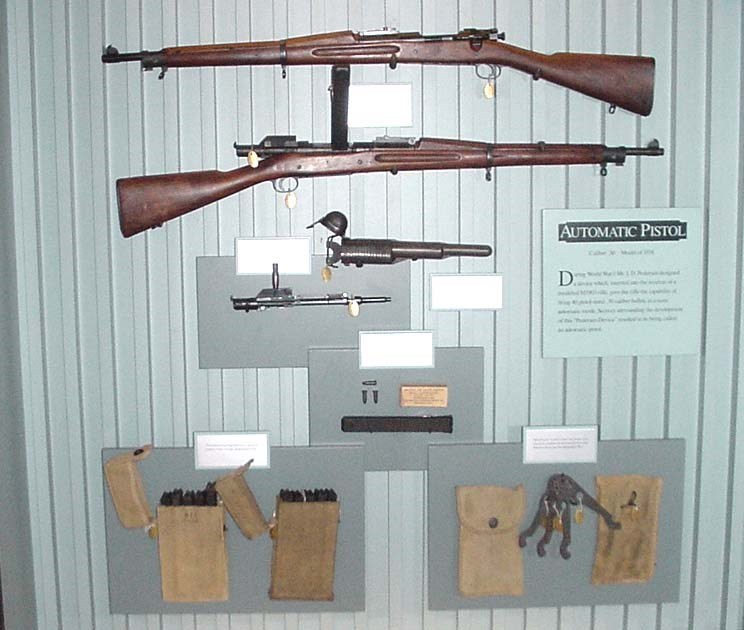
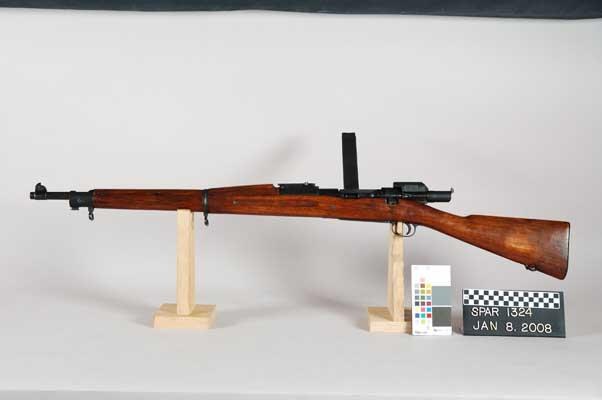
Culver names museums holding a device: the Smithsonian, the Springfield Armory Museum, the Marine Corps Museum, the Armor Museum at Fort Knox, the West Point Museum and “at least one at the Remington Museum”.6 Two of those are confirmed independently here: Springfield Armory National Historic Site shows a Mark I rifle with its device as catalogue number SPAR 1324, and a Mark I without one as SPAR 6292;8 and Canfield places a device in the NRA National Firearms Museum.3 Krisko says the survivors escaped by “a seeming mix of official and unofficial means”.4
In the market a complete set is a five-figure item. Rock Island Auction estimated a Mark I with device, magazine and accessories at $27,500 to $42,500 in August 2022 and another at $30,000 to $45,000 in August 2023; the prices realised are shown only to registered users and are not given here.95 Volume 8 covers buying one.
3.10 What could not be established
- How many devices were actually destroyed, at which depots, and when the burning finished.
- What became of the 127 devices between “about 65,000” made and 64,873 on hand in 1931; “about 65,000” may itself be rounded.
- The date of the Infantry School test, which Krisko’s summary does not give; Canfield places Benning testing in 1919.
- The source of the San Antonio sidewalk story.
- Whether every Mark I was converted, and how many survive unconverted.
References
Footnotes
-
Julian S. Hatcher, Hatcher’s Notebook, chapter XV, “The Pedersen Device”, https://archive.org/details/Hatchers_Notebook (accessed 2026-10-19). ↩ ↩2 ↩3 ↩4 ↩5 ↩6 ↩7 ↩8 ↩9
-
Jonathon Krisko, “The Pedersen Device: Its Design, Production & Post-War Issuance”, American Rifleman, 12 September 2024, https://www.americanrifleman.org/content/the-pedersen-device-its-design-production-post-war-issuance/ (accessed 2026-10-19). ↩ ↩2 ↩3
-
Bruce N. Canfield, “The Pedersen Device: A Secret Weapon of WWI”, American Rifleman, 17 July 2020 (print June 2003), https://www.americanrifleman.org/content/the-pedersen-device-a-secret-weapon-of-wwi/ (accessed 2026-10-19). ↩ ↩2 ↩3 ↩4 ↩5
-
Jonathon Krisko, “The Post-War Pedersen Device: Infantry Testing & Ultimate Fate”, American Rifleman, 14 September 2024, https://www.americanrifleman.org/content/the-post-war-pedersen-device-infantry-testing-ultimate-fate/ (accessed 2026-10-19). Draws on the Infantry School Department of Experiment report, the War Department Sub-Committee on Small Arms (March 1931), AG 474.6/6410 (18 April 1931) and the Office of the Chief of Ordnance letter of 14 May 1931. ↩ ↩2 ↩3 ↩4 ↩5 ↩6 ↩7 ↩8 ↩9
-
Rock Island Auction Company, 26 August 2023, lot 1336, https://www.rockislandauction.com/detail/89/1336/us-springfield-1903-rifle-with-pedersen-device-and-accessories (accessed 2026-10-19). ↩ ↩2
-
Dick Culver, “The Pipsqueak Pistol That Never Was”, Civilian Marksmanship Program, Internet Archive copy of 27 March 2012, https://web.archive.org/web/20120327162014/http://www.odcmp.co/Services/Rifles/pipsqueak_pistol.htm (accessed 2026-10-19). ↩ ↩2 ↩3 ↩4 ↩5
-
Poulin Auctions, Fall 2025 Premier Firearms & Militaria Auction, lots 25-5085 and 25-5086, https://www.poulinauctions.com/2026/02/03/extremely-desirable-u-s-wwi-pedersen-device-and-correct-springfield-model-1903-mk1-bolt-action-military-rifle-group-is-accompanied-by-a-large-quantity-of-original-accessories-ammunition-and-refere/ (accessed 2026-10-19). ↩
-
Springfield Armory National Historic Site, “Automatic Pistol”, last updated 26 February 2015, https://www.nps.gov/spar/learn/historyculture/automatic-pistol.htm (accessed 2026-10-19). ↩
-
Rock Island Auction Company, 27 August 2022, lot 1458, https://www.rockislandauction.com/detail/86/1458/us-springfield-1903-rifle-with-pedersen-device-and-accessories (accessed 2026-10-19). ↩
Comments (0)