Pedersen Device · Volume 1
Pedersen, 1917 and a Secret Weapon
A Remington designer from Jackson, Wyoming, four patent applications filed in the spring and summer of 1917, a demonstration on a Washington rifle range, a board at Langres and General Pershing's order for 100,000, and why the Army called a rifle bolt an automatic pistol
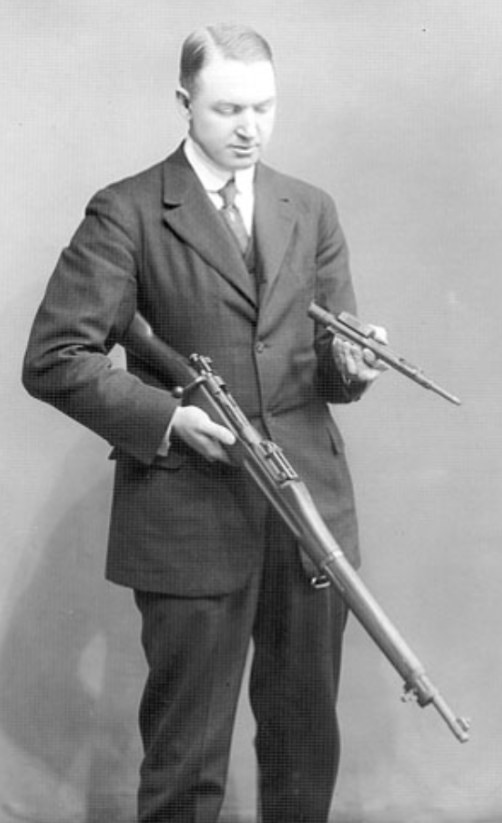
1.1 What this dive covers
This dive is about one of the strangest service weapons the United States ever bought: a self-loading mechanism, the size of a large pistol, that took the place of the bolt in a slightly altered M1903 Springfield and turned the rifle into a semi-automatic firing a small .30 calibre pistol cartridge from a 40-round magazine. The Army’s own name for it was “Automatic Pistol, Caliber .30, Model of 1918”. Everyone since has called it the Pedersen device, after its designer. The altered rifle was the U.S. Rifle, Model of 1903, Mark I.
About 65,000 devices were made. None reached the front. Almost all of them were burned in 1931. The Mark I rifles were put back to standard and served on, still carrying the oval ejection port that is the only common trace of the whole programme. The cartridge outlived the device: a cartridge of the same dimensions became the French 7.65 mm Longue, the round of France’s Modèle 1935 pistols and MAS 38 submachine gun, though how directly it descended from Pedersen’s is disputed.
The volumes run: this one on the design and the decision to buy it; Volume 2 on production at Remington and Springfield, and the numbers; Volume 3 on the post-war tests, the 1931 destruction order and the survivors; Volume 4 on how the device works, part by part, from the Army’s own manual; Volume 5 on the Mark I rifle and how to identify a Mark I, a converted Mark I and a device; Volume 6 on fitting, field stripping, maintenance and the manual’s own table of stoppages; Volume 7 on the cartridge and its French afterlife; and Volume 8 on owning one, the law, and what building a reproduction would involve.
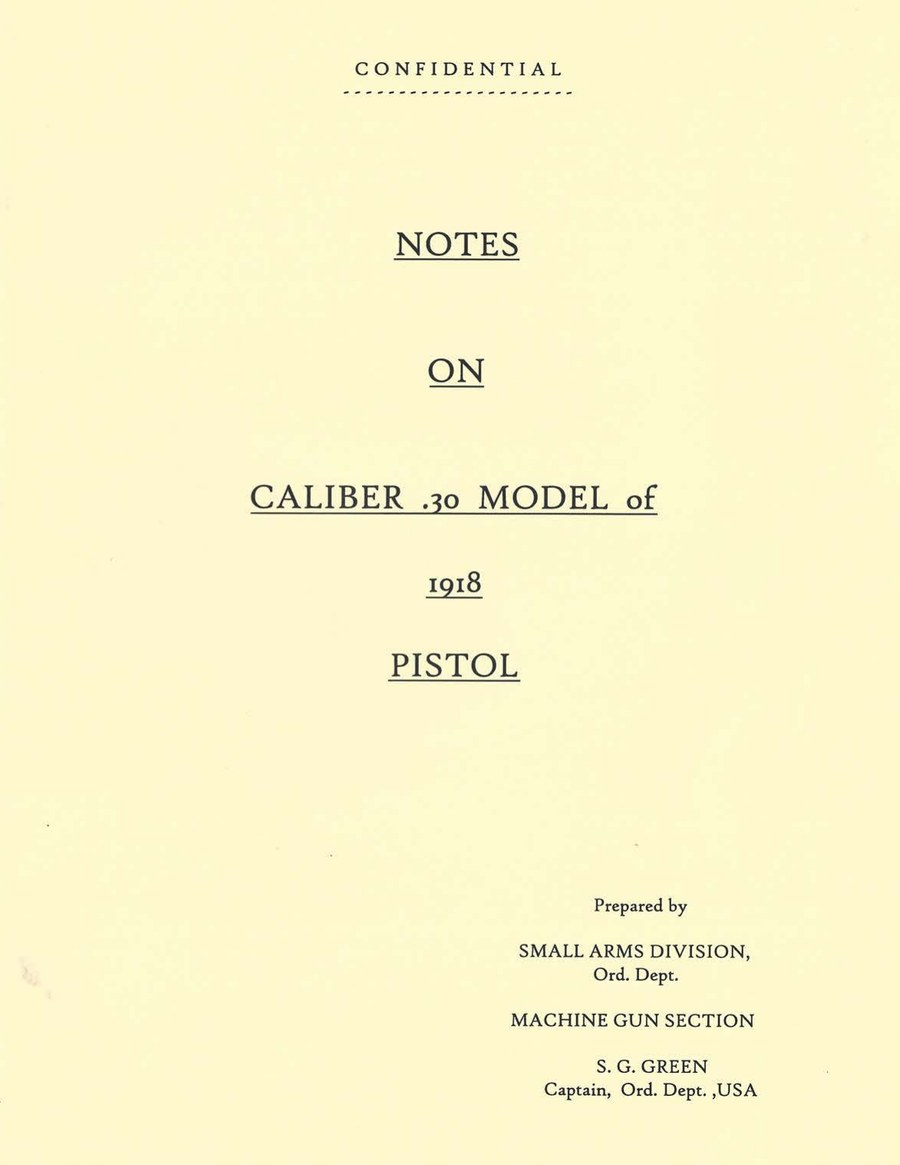
The primary source throughout is the Army’s manual for the device, Notes on Caliber .30 Model of 1918 Pistol, prepared by the Small Arms Division’s Machine Gun Section and signed by Captain S. G. Green of the Ordnance Department. It survives as a scan on the Internet Archive.1 Julian Hatcher, an Ordnance officer who was one of the few who knew of the device in 1918 and who took it to France, wrote the fullest first-hand account in Hatcher’s Notebook.2 Bruce Canfield and Jonathon Krisko, writing in American Rifleman, supply the contract history and the archive record.345 Where these differ, both figures are given.
The device has a direct link to another dive in this hub. The M1 Garand dive’s Volume 2 tells how Pedersen’s later rifle, the toggle-delayed T1 in .276 Pedersen, lost to Garand’s design in 1931 and 1932. That was the same year the Army decided to burn the device.
1.2 The device in one paragraph
The soldier turned his rifle’s magazine cut-off to the middle position, pulled the bolt out and put it in a canvas pouch on his belt. He drew the device from a sheet-steel scabbard on the same belt and pushed it into the empty receiver while holding the trigger back. Its short barrel, shaped like a .30-06 cartridge case, slid into the rifle’s chamber. He then turned the cut-off down, which locked the device in place, clipped a 40-round magazine to it so that it stood up and to the right at about 45 degrees, and drew back the device’s slide to load. Each pull of the rifle’s trigger then fired one 80-grain bullet at about 1,300 to 1,500 feet per second (the sources differ; Volume 7), and the empty case flew out to the left through a port cut in the rifle’s receiver. To go back to full-power ammunition he reversed the drill. The Army’s manual describes every step.1
1.3 John D. Pedersen in 1917
By 1917 John Douglas Pedersen had been designing guns for Remington for more than a decade. Hatcher lists the work that made his name: “the Remington pump-action shotgun, the Remington automatic pistol, and the Remington trombone-action rifles in both .22 caliber and high power”.2 Canfield names the Model 10 shotgun and the Model 51 pistol.3 The hub’s Remington 870 dive traces the line of Remington pump guns that began with his Model 10. His patents of this period give his address as Jackson, in Lincoln County, Wyoming.6
Krisko records a letter Pedersen wrote to Remington in October 1917 about the larger problem of a fully self-loading service rifle: “the cooling problem and ammunition supply remain unsolved”.4 The device was his way around both. It used the soldier’s existing rifle and barrel, and it fired a cartridge so small that heat and ammunition weight stopped being the limit.
1.4 The four patents
Pedersen filed four applications for the system in 1917. All four were held back and issued together on 12 October 1920, after the secret was out.
Table 1 — The four patents
| Patent | Title | Filed | Issued | What it covers |
|---|---|---|---|---|
| 1,355,417 | Firearm | 28 April 1917 | 12 October 1920 | The combined “primary” and “auxiliary” arm: a bolt gun with an insertable self-loading mechanism firing short-range ammunition |
| 1,355,418 | Mechanical movement | 29 May 1917 | 12 October 1920 | The sear-and-lock movement that holds and releases the auxiliary arm’s breech-bolt |
| 1,355,419 | Firearm | 7 June 1917 | 12 October 1920 | Interchangeable auxiliary arms of different sizes on one primary arm |
| 1,355,420 | Firearm | 12 July 1917 | 12 October 1920 | The mechanism adapted to the frame of “the well-known Springfield rifle” |
Dates and titles are from the patents as published.6789
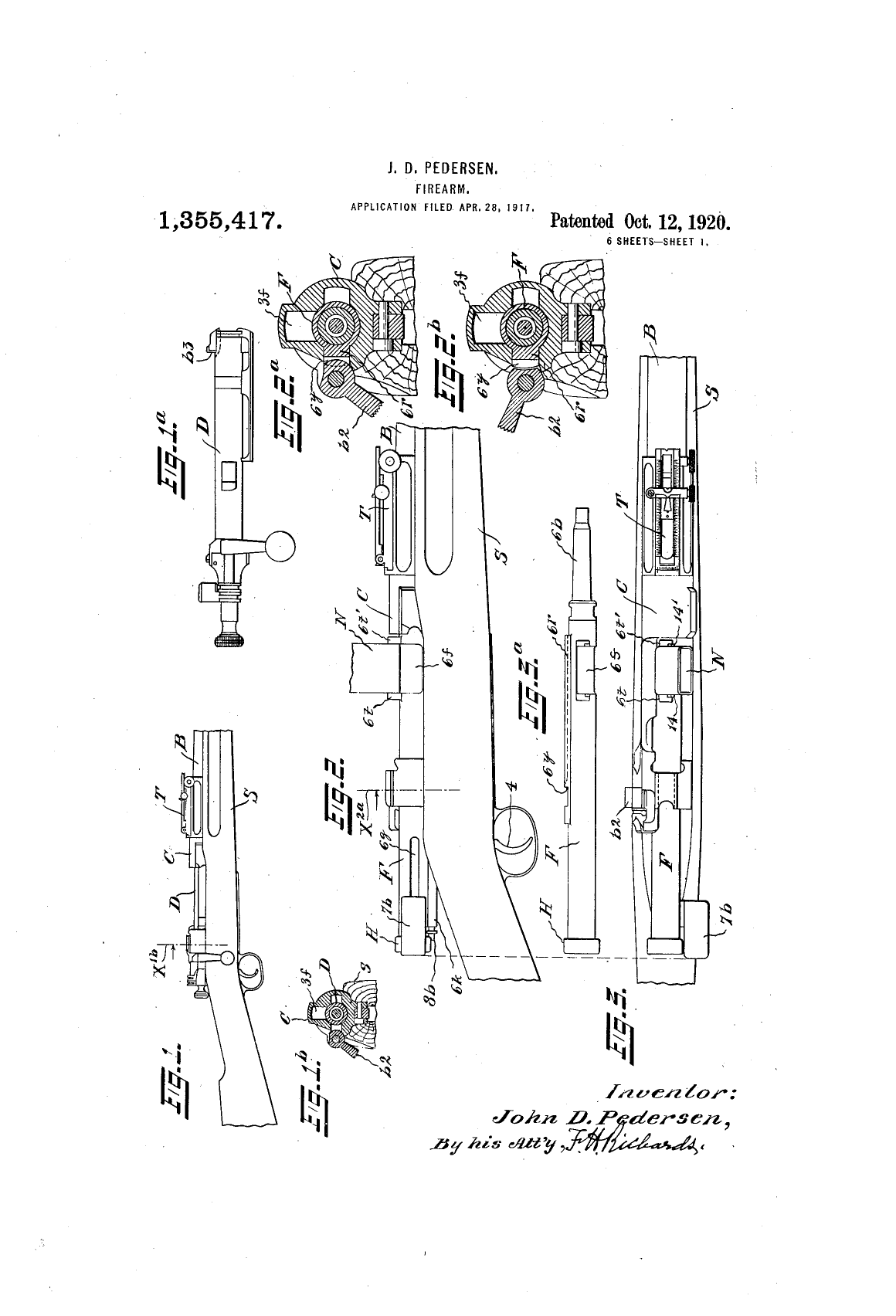
The first application, filed three weeks after the United States declared war, is not specific to the Springfield. It describes “a secondary firearm mechanism which is in the nature of an auxiliary arm, and which shall be applicable by suitable adaptation merely of the form and proportions thereof, to ordinary kinds of breech-loading guns”, and gives the Springfield as one example of a suitable “primary arm”.6 The fourth, filed in July, is the Springfield version: its object is “an auxiliary firearm mechanism having a framework constructed, arranged and furnished for being removably fixable in the frames” of the Springfield rifle, which “has been manufactured in very large numbers and with the parts thereof having a high degree of interchangeability”.9 That interchangeability is the reason the scheme was possible at all: a device made at one factory had to fit any one of a hundred thousand rifles made at another.
The third application goes further than the Army ever did. It proposes a family of auxiliary arms of different lengths, each firing a different cartridge, any of which could be fitted to one rifle, and so that a soldier could carry “two, or even three, of the auxiliary mechanisms”, swapping in a spare if one failed. It also says, in so many words, that “each of the auxiliary mechanisms, or arms, is available for use as a pistol, and independently of the primary arm, especially for short-range work”.8 That sentence, written by the inventor, is worth keeping in mind when reading Volume 8 on how the law treats a loose device.
1.5 The problem Pedersen said he was solving
The first patent states the military case directly. Full-power rifle cartridges “are necessarily of such dimensions and considerable weight, that in actual service a soldier can carry only a small number of them, whereas he can carry a relatively very large number of shorter and lighter cartridges which are especially suitable for short range work, as for instance, in stopping a charge, or rush, from a near-by trench”. And heat: “If the regulation long-range cartridges should be fired rapidly in such a shoulder arm, as for instance, with the rapidity common in autoloading pistols and in machine guns, the firing of some fifty to eighty cartridges would ordinarily so overheat the arm as to render the same incapable of effective use.”6 A short cartridge with a small charge solved both, and because its bullet was of rifle diameter it could use the rifle’s own long barrel. Hatcher’s description of the result is the most quoted line about the device: “It looked as if Mr. Pedersen had converted the Springfield rifle into a one-man machine gun.”2
It was not a machine gun. It fired once for each pull of the trigger, and the manual says so in capitals (Volume 4).
1.6 The demonstration at Congress Heights
Hatcher’s account: “In the summer of 1917, Mr. Pedersen came to the War Department and informed the chief of the Small Arms Division that he had what he considered a very important invention which he wished to have examined secretly.” Only “one or two high officials” saw it, at the Congress Heights Rifle Range in the District of Columbia.2 Canfield dates the demonstration to 8 October 1917 and names the Chief of Ordnance, General William Crozier, among those present.3 The two accounts fit together: an approach in the summer, a demonstration in the autumn.
Hatcher describes what they saw. Pedersen fired a few shots in the ordinary way, “suddenly jerked the bolt out of the rifle and dropped it into a pouch which he had with him, and from a long scabbard which was on his belt he produced a mysterious looking piece of mechanism which he quickly slid into the rifle in place of the bolt, locking the device in the rifle in the same way that the regular bolt is held in place; that is, by turning down the cut-off. Then he snapped into place a long black magazine containing 40 small pistol-size cartridges”. He then fired “as fast as he could work his finger”.2
The officers’ reaction, as Hatcher remembered it thirty years later, was shaped by the trench war: “As the enemy came charging across No Man’s Land, each of our soldiers would begin firing with this miniature machine gun, and the entire zone in front of the trenches would be covered with such a whirlwind of fire that no attack could survive.” And because the device had “no noticeable recoil”, it “could be fired from the hip while marching or running”.2
1.7 France: Beatty, Langres and Pershing
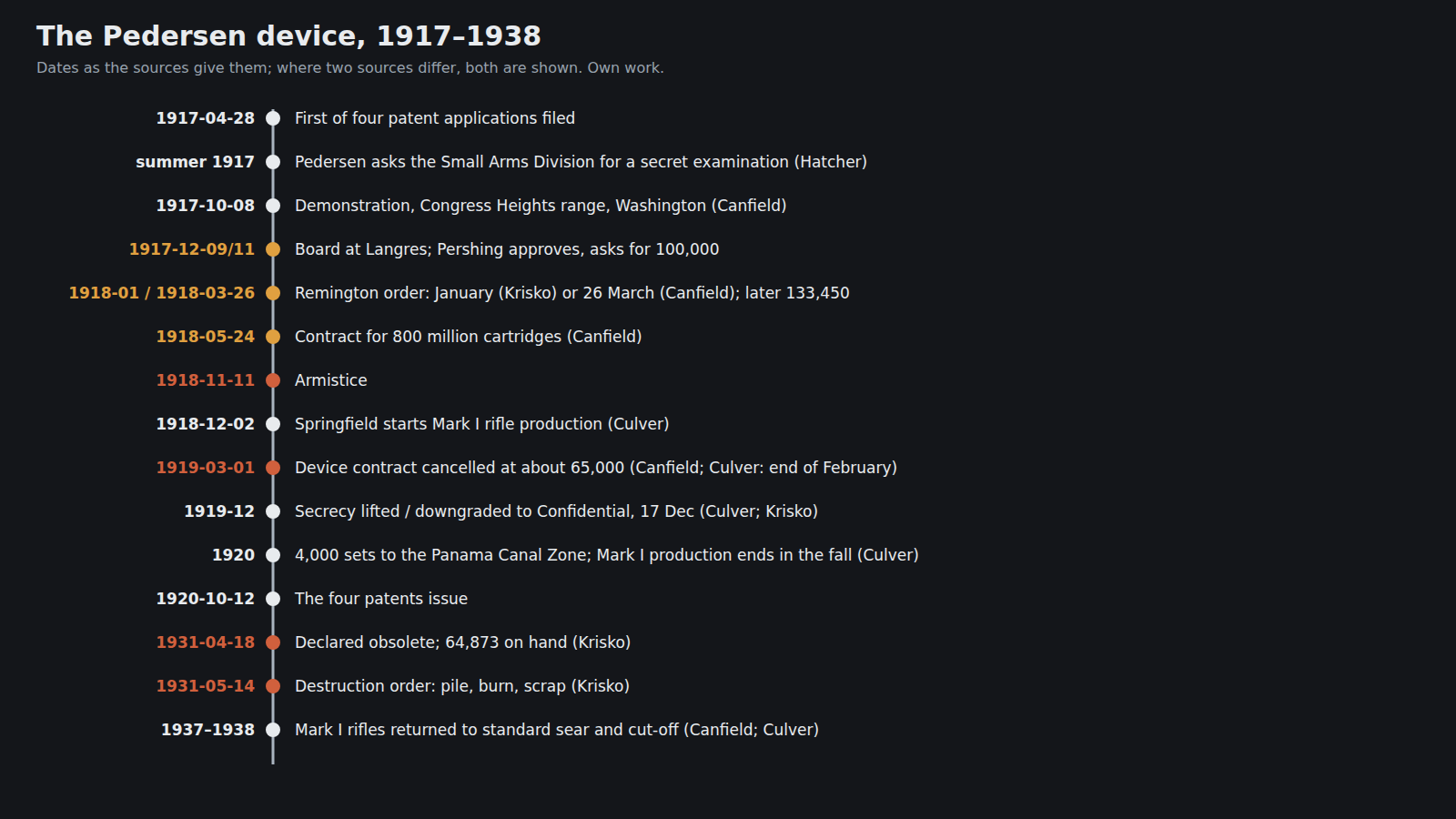
Hatcher: “an officer, who was sworn to secrecy, was placed on a ship to take the device over to France and explain it in person to General Pershing. The result was a code cablegram from General Pershing calling for the earliest possible production of 100,000 of these devices, and asking that the whole project be kept a profound secret.”2 Canfield names the officer as Captain J. C. Beatty, sent in November 1917, and dates a board at Langres, France, on 9 December 1917. Pershing’s memorandum of 11 December 1917 recommended buying 100,000 devices with an initial 5,000 rounds and 100 rounds a day for each, and said: “Strongly approve of device and believe it will materially increase efficiency of our infantry.” A second memorandum asked for 25,000 in reserve, replacement of half the devices and twice the magazines each year, and 40 magazines with every device.3 Krisko adds that the board tested for two days and that its recommendation was to use the device in combat only once 50,000 were ready, so that it could be sprung as a surprise; AEF headquarters adopted it on 11 December.4
The scale grew. Hatcher: after the first production samples, “another officer was sent to France for further conference. As a result it was decided that 500,000 Pedersen devices could be ready to go on the front lines in the spring of 1919, and that they would be utilized as a surprise to be sprung on the enemy at that time”.2 Part of that half million was to be a version for the M1917 Enfield rifle, the Mark II (Volume 2).
1.8 A rifle bolt called a pistol
The name was a cover. Hatcher: “As the name ‘Pedersen device’ seemed to be sufficiently mysterious to excite the curiosity of the people who must of necessity work on it in the various factories, a new name was adopted which was purposely made not at all descriptive of the device. This name was ‘Automatic Pistol, Caliber .30, Model 1918.’”2 The Army’s manual uses the cover name throughout and never the inventor’s name: it is “Caliber .30 Model 1918 Pistol”, and the altered rifle is the “U.S. Rifle Model 1903 – Mk. I.”1
The cover worked well enough to cause a small political row. Hatcher records that “some writers, who in some way heard this name, criticized the War Department severely for adopting a smaller caliber pistol, or even for adopting a new pistol at all, as they contended that our .45 automatic pistol was sufficiently good”. Dick Culver, writing for the Civilian Marksmanship Program, places the rumour in the halls of Congress in the summer of 1918.210
The name did not end with the war. The manual’s plates call the cartridge the “Caliber .30 Model of 1916 Pistol Cartridge” (Plate 4), a designation that appears nowhere else in the sources found, and the ammunition boxes were labelled “CAL.30 AUTO PISTOL / BALL CARTRIDGES / MODEL OF 1918”.111 The modern name “.30-18 Auto” is a collectors’ and reloaders’ label, not the Army’s (Volume 7).
1.9 How well the secret was kept
Imperfectly. Krisko reports that on 29 September 1918 the Paris provost marshal found a copy of a secret memorandum about the device, lost by a Major Wright, at the Casino de Paris.4 After the war a device turned up in Germany: Hatcher reported one in the reference collection of a German explosives firm, and Culver mentions one found in the German ordnance collection at the end of the Second World War, though neither source says when or how it got there.510
Within the Army the secret held through the tests in France after the Armistice. Hatcher tells the story of a Camp Perry demonstration in September 1946, after which a colonel of the executive staff (the name is damaged in the scan and appears to read Griswold) told him he had been one of the lieutenants sworn to secrecy and put in the target pits in France in 1919. The pit officers had formed a committee, searched the firing points afterwards, and found one empty case in the grass that the clean-up had missed. From that and from binoculars, “they gradually pieced together a theory of the device which was just about right”.2 The secret classification was rescinded in December 1919; Culver gives the date of the downgrade to Confidential as 17 December 1919, which fits the CONFIDENTIAL stamp on the surviving manual.410
1.10 What could not be established
- The manual’s date. The scan carries no date. The “Confidential” marking suggests a printing after December 1919 and before the 1931 destruction, but that is an inference.
- Whether the October 1917 demonstration was the only one before the board in France. Hatcher’s “summer of 1917” and Canfield’s 8 October may describe one event or two.
- The first Remington order’s date: January 1918 (Krisko) or 26 March 1918 (Canfield) (Volume 2).
- The photograph above: the Commons file credits no photographer and its date (“circa 1917–1918”) is the uploader’s.
References
Footnotes
-
Notes on Caliber .30 Model of 1918 Pistol, CONFIDENTIAL, prepared by Small Arms Division, Ord. Dept., Machine Gun Section; S. G. Green, Captain, Ord. Dept., U.S.A. Undated. Scan: Internet Archive, item “pedersen-device-manual”, https://archive.org/details/pedersen-device-manual (accessed 2026-10-19). ↩ ↩2 ↩3 ↩4
-
Julian S. Hatcher, Hatcher’s Notebook, chapter XV, “The Pedersen Device”, pp. 361–372 in the Internet Archive scan, https://archive.org/details/Hatchers_Notebook (accessed 2026-10-19). Hatcher was an Ordnance officer who took the devices to France in 1919. ↩ ↩2 ↩3 ↩4 ↩5 ↩6 ↩7 ↩8 ↩9 ↩10 ↩11
-
Bruce N. Canfield, “The Pedersen Device: A Secret Weapon of WWI”, American Rifleman online, 17 July 2020 (print, June 2003, “Never in Anger”), https://www.americanrifleman.org/content/the-pedersen-device-a-secret-weapon-of-wwi/ (accessed 2026-10-19). ↩ ↩2 ↩3 ↩4
-
Jonathon Krisko, “The Pedersen Device: Its Design, Production & Post-War Issuance”, American Rifleman, 12 September 2024, https://www.americanrifleman.org/content/the-pedersen-device-its-design-production-post-war-issuance/ (accessed 2026-10-19). ↩ ↩2 ↩3 ↩4 ↩5
-
Jonathon Krisko, “The Post-War Pedersen Device: Infantry Testing & Ultimate Fate”, American Rifleman, 14 September 2024, https://www.americanrifleman.org/content/the-post-war-pedersen-device-infantry-testing-ultimate-fate/ (accessed 2026-10-19). ↩ ↩2
-
John D. Pedersen, US Patent 1,355,417, “Firearm”, filed 28 April 1917, issued 12 October 1920, https://patents.google.com/patent/US1355417A/en (accessed 2026-10-19). ↩ ↩2 ↩3 ↩4
-
John D. Pedersen, US Patent 1,355,418, “Mechanical Movement”, filed 29 May 1917, issued 12 October 1920, https://patents.google.com/patent/US1355418A/en (accessed 2026-10-19). ↩
-
John D. Pedersen, US Patent 1,355,419, “Firearm”, filed 7 June 1917, issued 12 October 1920, https://patents.google.com/patent/US1355419A/en (accessed 2026-10-19). ↩ ↩2
-
John D. Pedersen, US Patent 1,355,420, “Firearm”, filed 12 July 1917, issued 12 October 1920, https://patents.google.com/patent/US1355420A/en (accessed 2026-10-19). ↩ ↩2
-
Dick Culver, “The Pipsqueak Pistol That Never Was”, Civilian Marksmanship Program website (©1997–2004, updated 10 January 2011), read from the Internet Archive copy of 27 March 2012, https://web.archive.org/web/20120327162014/http://www.odcmp.co/Services/Rifles/pipsqueak_pistol.htm (accessed 2026-10-19). ↩ ↩2 ↩3
-
Rock Island Auction Company, 27 August 2022, lot 1458, “U.S. Springfield 1903 Rifle with Pedersen Device and Accessories”, https://www.rockislandauction.com/detail/86/1458/us-springfield-1903-rifle-with-pedersen-device-and-accessories (accessed 2026-10-19). ↩
Comments (0)